As I explained in my last post, I wanted to convert Susan’s favorite shows on DVDs to digital files so she could watch them with Plex. Because she sews and watches the same TV series, over and over again, I thought we could save money by canceling Netflix, Hulu, and HBO Max.
Well, things didn’t work out as I hoped. I started with Friends and The Gilmore Girls. I bought both as complete series DVD sets for Susan for Christmases long ago. In the first two seasons of The Gilmore Girls, I had two bad discs. And I had one in the second season of Friends. In recent years I’ve discovered other bad DVDs. I tried them on three different players – no luck. The DVD is essentially a 21st-century technology, but now that we’re in year 23 I’m discovering they are not a true archival format.
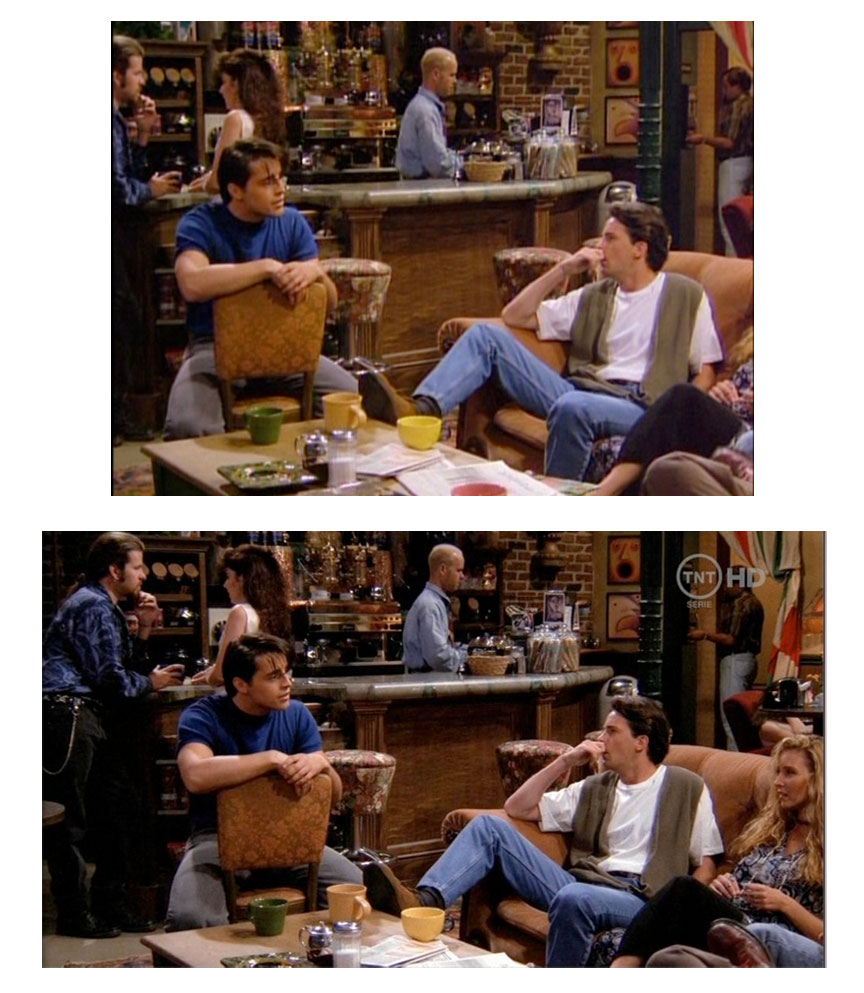
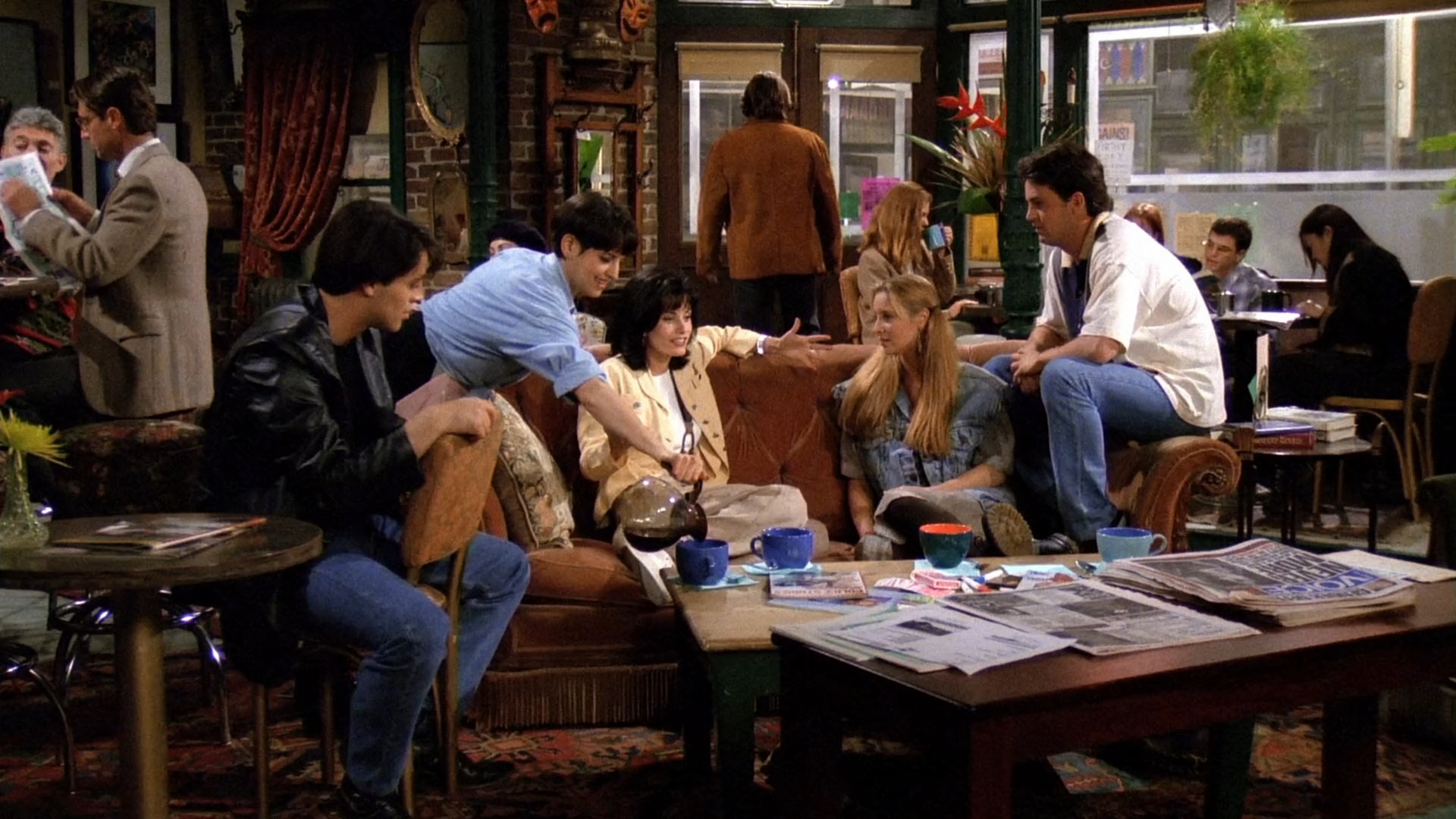
At first, I wasn’t going to let a few bad discs stop me. I got Plex all set up with a couple seasons of both shows and configured her Roku TV to use Plex. Susan isn’t very picky about picture quality, but I realized that Friends episodes playing on HBO Max are in 1080p, while the rip discs are 480p. See the photo at the top of the page to compare the 4:3 aspect ratio to 16:9. Not only that, but the image quality was far superior – essentially Bluray quality to DVD quality. That depressed me. I don’t know if Friends was digitally reframed for HDTV, or if it was originally shot in 16:9 but it looks great on flat-screen TVs. Seeing it on Plex reminded me of old CRTs, which is how we watched Friends when it came out.
The final straw for me was the closed caption was so much better on the HBO Max version. I told Susan I was giving up. We are going to try and just subscribe to Netflix, Hulu, or HBO Max one at a time.
But I also learned that ripping DVDs is a tedious business. It would have taken weeks to rip all our discs. Just messing with DVDs and DVD players is annoying. The whole reason streaming TV is great is not messing with machines and physical media. No wonder old DVDs are cheap at charity shops and library book sales.
The experiment wasn’t a complete failure. I ripped the last three seasons of Perry Mason that I’ve always meant to watch. Watching Perry on Plex is nicer than messing with DVDs every night. I also ripped Survivors (BBC 1975-1978) a favorite series I’ve been meaning to watch again. It’s not streaming anywhere. I even ripped some documentaries on DVDs I recorded off of broadcast years ago that I wanted to save and a couple of DVD compilations of videos we took on vacation and another of my mother made by some of her distant relatives.
Plex is turning out to be something for me, not Susan.
I guess I’ll start going through my DVDs to get rid of most of them. This experiment has taught me I prefer watching movies and TV shows streamed rather than played by a DVD/BD player. I will keep those shows and movies that seldom get streamed or are my absolute favorites, which I will rip to Plex.
I guess the decades of trying to own our favorite movies and TV shows are coming to an end. I’m also glad I didn’t run out and buy that Synology NAS right away. Computers are getting smaller, and we store stuff in the cloud. Thank GNU for Dropbox.
In the 21st century, it now seems air, water, food, shelter, and video are the basic necessities of life. Who lives without screens in their life? Changing times and technologies keep making us adapt to new ways of consuming video.
Broadcast TV originally conditioned us to watch television on a set schedule. The price of this technology was watching commercials.
Cable TV gave us more channels but we still had to follow the schedule and watch commercials. We now had to pay a monthly bill too.
HBO and other premium channels made TV better than movies and freed us from commercials, but we had to pay even more on that monthly bill.
VCR let us time shift shows and zip through commercials, and forced us to deal with a growing collection of VHS tapes. It also allowed us to buy or rent movies and TV shows. VCRs created that wonderful subculture of video stores. This gave us more freedom regarding what to watch, but TV was now becoming a growing monthly expense.
DVD gave us better picture quality but we had to buy new equipment and replace all those videotapes.
DVD R/W+- allowed us to make our own DVDs. It saved us money over buying movies by recording them instead but we had to zip through the commercials again.
DVR made it much easier to record shows and zip through commercials. It was wonderful to give up messing with VHS tapes and R/W DVDs.
TiVo made going back to broadcast TV fun for a while but the $12.95 monthly fee to record free over-the-air TV was annoying.
Netflix discs by mail killed our addiction to Blockbuster and saved us money. I miss Blockbuster.
HDTV made TV watching great and more addicting than ever, but now we had to learn about new technology and spend a whole lot more on TVs.
Netflix streaming killed our addiction to renting discs by mail and saved us money. $7.99 a month was a tremendous bargain! Bye-bye Blockbuster.
Smartphones and tablets have become a new way of watching TV for some people. When the power was out during an ice storm Susan and I streamed TV over 5G on our iPhones.
Streaming services allowed us to cut the cord and give up cable TV. That saved us money – for a while.
Streaming TV services like YouTube TV allowed us to have cable TV without the cable box and for less money while including an unlimited digital DVR. However, they are now racking up their prices. $70 a month is like a Comcast payment from a few years ago.
When will how we watch TV stop changing? Is it evolving or just the churn of change? I thought with streaming services like Netflix, HBO Max, Hulu, AppleTV+, etc. combined with YouTubeTV we had everything we could possibly want. That is until all these services started raising their prices. The fact that we can go months without using some of those streaming services is making me worry. I see that other people are thinking about it too.
TV used to be free. It used to be simple, three channels with a fixed schedule. Now it’s $150 a month, with thousands of shows that can be watched at any time on a variety of devices. TV now has too many choices. That’s mentally wearing. Even exhausting.
Looking back I see now that I subscribed to all those various streaming services to watch another popular TV show that everyone was talking about. Even today, when I talk with my friends they will tell me about the shows they love. Wanting to give them a try often means subscribing to something new. My friend Linda has solved this problem by only subscribing to one service at a time. But she lives with a lot fewer choices. But maybe that’s good.
$150 a month is not bad for how much pleasure we get. However, I cut the cord with cable TV because cable TV forced hundreds of channels on us I didn’t want. It irked me I had to pay $7+ a month for ESPN when I didn’t even watch it. Now, with all the streaming services I’m paying for thousands of movies and TV shows, I don’t want to watch. And I just can’t tune out all those unwanted offerings. Each time I click on Netflix or HBO Max I end up scrolling and clicking and scrolling and clicking to see all my choices. By the time I finally pick something I’m worn out. My sister Becky often yells “I HATE SCROLLING.”
I discovered something very revealing when I started ripping my DVD/BDs for Plex. I have several hundred movies and TV shows I’ve bought over the last several decades. Once I converted DVDs to digital files for a couple of TV series I started watching them. I was no longer interested in streaming services. On Plex right now I have two choices (Perry Mason and Survivors), both of which I want to watch. Imagine Netflix with just two TV shows. (And wasn’t AppleTV+ much better when it had fewer choices?)
When company comes over and we then decide to watch a movie together picking a show depresses us. It makes people happier if I pick out a movie and invite people over saying we’re going to watch X. Susan and several of my TV-watching friends get annoyed if they have to decide on a show. Maybe my current problem with watching TV by myself is having too many choices.
The nightly TV program Susan and I watch together is Upstairs, Downstairs which we get from Britbox. We know what we’ll be watching at 9:30 every night – two episodes of Upstairs, Downstairs. I like that routine. Susan watches other shows by herself while she sews. If I want to watch something on my own I’m currently satisfied with either Perry Mason or Survivors. When I finish those series I’ll rip a couple more.
We did sign up for the current sale for Peacock+ ($29.99 for one year). If all the subscription services charged like that I wouldn’t mind keeping several subscriptions going. However, even though Peacoak+ has lots I think I want to watch, I just don’t feel like watching anything yet. Maybe when I finish with Perry I’ll give one of their shows a try. Maybe the key for me is to only have a couple of shows I follow (besides the one I watch with Susan).
I’ve been very happy the last few days puttering around with ripping DVDs and setting up Plex. I’m not sure Susan will like a very limited TV environment, but I do. I’m not going to try and rip all my DVDs and Bluray discs. I’m just going to rip something when I’m ready to watch it.
I would be perfectly fine just subscribing to BritBox for several months. That’s how we get Upstairs, Downstairs. I’ve already canceled HBO Max and Netflix. I want to cancel Hulu but can’t until I rip some DVDs for Susan. I’d love to cancel YouTube TV, but Susan can’t let go. I only use it for Jeopardy, NBC Nightly News, and Turner Classic Movies. But those two shows are available on YouTube for free, and we’ve got hundreds of old movies on DVD.
It feels like I’m trying to de-evolve my TV watching to back like it was when I was growing up. Just a few channels. Susan is still addicted to the cable TV level of variety. I’m trying to get her to notice that she uses YouTube TV to watch old TV shows all the time. Except for things like tennis matches and cooking shows she seldom watches anything new.
I have friends that watch a lot of television and go through many new shows each year. I used to be that way. I don’t know if it’s getting old or not, but I’m tired of the new show rat race.
Content is spread over more competing streaming services
99% of the content is not something I want to watch
Favorite TV series keep switching services
Some of my favorite TV shows aren’t streaming
It’s hard for two or more people to limit subscriptions
For some reason, I can’t get into watching TV anymore. I flip through Netflix, HBO Max, Hulu, Amazon Prime, and Apple TV+ regularly trying to find something I can watch. But I quit most shows after five minutes. I’m ready to give up on streaming TV. I mainly watch YouTube Premium which is $11.99 I think. I definitely get my money’s worth there since I watch a lot of YouTube channels and I hate commercials.
Susan on the other hand, cross-stitches all day long watching all her old favorite TV shows over and over again in the background. But we’re paying about $60 a month for streaming services for Susan to watch those same old TV shows over and over. That seems wasteful.
Of the five TV shows and movies Susan currently has on repeat mode (Friends, Andy Griffiths, MASH, Harry Potter movies, and Gilmore Girls) we already own all of them except MASH on DVD or Bluray. There are a few other shows Susan will put on sometimes, like Gray’s Anatomy and How I Met Your Mother. She does change things up sometimes but not that often and with not that many shows.
Anyway, I was wondering if it would be cheaper to buy the complete series of TV shows she likes and rip them to Plex than to subscribe to all those streaming services? Plex is a program for creating your own customized streaming service. You convert your DVDs to files that are stored on a computer. You run a Plex server program on that computer to fetch the files, and a Plex app on your smart TV, Fire Stick, Roku, or other streaming device to play them. Plex acts like any other streaming service but it shows you what’s on your computer. It can also play music files, show photographs, or videos you made yourself, or stream content from the web if pay for the premium Plex service.
Right now, Amazon has all 11 seasons of MASH for $54. If we canceled all the streaming services we’d pay for it in one month. How I Met Your Mother is $43. The Big Bang Theory is $73, which is another favorite of Susan’s watches from time to time. I doubt Susan would add more than another six or eight series in the coming years. Since she doesn’t try new series, she’s not gaining any old favorites.
The downside of Plex is the time it takes to rip all the DVDs and the price of the server and hard drive. I have old equipment that works for now that costs me nothing. However, it might be nice to buy a new little mini-PC and a very fast SSD to make it fast to rip and copy files. Playing files from my old 5th-generation NUC is very fast. I’m thinking even with new equipment we’d be saving money in less than a year. Or I could buy a fast DVD/BD drive for my main computer which is a 12th generation NUC and rip the DVDs there.
We stopped watching our DVDs and Blurays because it’s annoying to use them, especially after the convenience of streaming. However, if I took the time to rip them, they would be as convenient to watch as streaming. I stopped watching Perry Mason in the 7th season. I could finish that series if I could get back into the mood of watching that show. I have all the discs. In fact, I have complete series of several old TV shows. Plus we have hundreds of favorite movies we could put on Plex too.
Maybe we don’t need streaming services anymore. It’s gotten rather annoying how streaming services keep raising their prices and offering even more shows we don’t want to watch.
Idea #1
What would be great is a streaming service that offers just all the old TV shows for $9.99 a month. It’s all those new movies and original content that are rising the prices. Spotify gives me access to nearly all music for $9.99 a month, so why couldn’t some streaming service for old TV? The trouble is there are too many streaming companies wanting us to subscribe.
Idea #2
If Amazon sold digital complete series for the same price as DVD sets I’d buy them because streaming from Amazon Prime is easier than maintaining a Plex server. The complete Friends on DVD is $53. But it’s $200 to buy all ten seasons digitally. Amazon should promote building digital libraries which they house. I bought the complete Andy Griffith Show for Susan on Amazon and she plays it every day.
Idea #3
The owners of TV shows should sell the complete series on USB drives. A $15 drive must be far cheaper than producing all those DVDs. That way people could buy the USB drive and easily copy the shows to their media servers like Plex. That would be far more convenient than ripping DVDs. Or they could sell a complete series as a download.
The reason why people are cutting the cord with cable is they’re tired of spending a lot of money for a lot of shows they don’t watch. Streaming services are getting like cable used to be – expensive and full of unwanted content. I’d much rather buy movies and TV shows and put them on my own server.
Conclusion
We could always subscribe to one streaming service at a time to have some new content to supplement the old content we’re buying. We spend very little going out. And we don’t go on vacations. Hell, we used to go to the movies once or twice a week before the pandemic. So four or five streaming services are much less than that. They are a bargain. And they are convenient. But I’m getting so tired of seeing hundreds of shows I don’t want to watch and thinking I’m paying for something we don’t use.
Let’s see how I feel after ripping a couple hundred discs. It might not be practical. But it’s kind of fun creating my own streaming service.
Why do we love some books more than others? Why are some books so enchanting? Why is it so hard to always find the perfect book to read? Especially when we’re old and jaded and have read thousands of books.
I just finished Miss Buncle’s Book by D. E. Stevenson and I want to explain why I loved it so much. I mostly read science fiction, but lately, I’ve gotten tired of the genre. Well, not completely. I recently found a science fiction novel that completely enchanted me too, but it was an old science fiction book that came out in 1939, the setting was England in the thirties, and wasn’t sold as science fiction. See my review of The Hopkins Manuscript by R. C. Sherriff.
I just finished Miss Buncle’s Book by D. E. Stevenson and it pushed all the buttons that make me love books. Am I so burned out on science fiction that any decent story from any other genre would charm me to pieces? I don’t know.
Can I examine these two books and draw any conclusive conclusions that would help me always find a great book to read? And what is great? I might think Miss Buncle’s Book and The Hopkin’s Manuscript are great novels and other people might think they’re both snooze-fests.
Both books are set in England during the 1930s and I have to admit that I’ve been watching a lot of TV shows and reading other books about England before 1960. Maybe I’ve just found a new fictional setting that I like better than those offered by science fiction right now. But why England? And why older books? (I should admit that I still like older science fiction books. Maybe my reading problem is the 21st century.)
Is this a case of reading the right book at the right time? Would they have been so entertaining if I had read either of these books when I was in my teens, twenties, forties, or fifties? Is part of the equation for finding the right book include the age, gender, and philosophical outlook of the reader? I worry about recommending books because even when I love a book, I’m never sure someone reading my review will.
One reason why I’m sick of science fiction is I’ve read too much of it. But I’ve also got tired of the future, especially the far future. But the present isn’t very appealing either. I think I’m looking for comfort books. For cozy novels. And Miss Buncle’s Book fits the bill perfectly.
Normally, I wouldn’t pick a book aimed at women readers, but in the last year, I’ve read quite a number of books by women authors aimed at women readers. I had just finished reading a science fiction book by D. E. Stevenson, The Empty World and while researching her I found this video from The Comfort Book Club:
The enthusiasm of the YouTube host and her mother, as well as the testimonials from the show’s viewers, convinced me to give Miss Buncle’s Book a try. I’m so glad I did.
This 1934 novel is set in the small village of Silverstream. That might be in Yorkshire because we’re told Barbara Buncle has a Yorkshire accent. Barbara has a problem. The depression is on and her investments are no longer paying dividends. She needs money and decides to write a novel. Unfortunately, she has no imagination and writes a story about all the people in her village, just changing the names. She submits the book with the pen name of John Smith and it gets accepted. The publisher loves it, thinking that it’s either a very gentle satire or the work of a very simple mind. However, the publisher renames her novel, Disturber of the Peace.
Slowly the citizens of Silverstream discover the book. Even though it’s set in Copperfield and the characters’ names are different, they recognize themselves. Barbara Buncle has a knack for realistically painting portraits in words. Some of the village folk find it a pleasant read but others are outraged, especially Mrs. Featherstone Hogg, who is livid that the novel reveals she was once a chorus girl. She wants to find out how John Smith is and have him horsewhipped.
Miss Buncle is so mousy that no one suspects her. Several of the Silverstream citizens make it their business to ruin John Smith. But we’re also shown many villagers who are good people. The plot gets quite involved and it eventually becomes a book within a book within a book story when Miss Buncle writes a sequel.
Having this book within a book plot is rather clever. The humor is relatively dry since the story is told realistically even though the action gets rather far-fetched. Its humor is not like P. G. Wodehouse, but I imagine Wodehouse fans will love D. E. Stevenson too. If you like the TV series All Creatures Great and Small and the James Herriot books they were based on, you’ll probably like Miss Buncle’s Book. Miss Buncle’s Book is the first in a series of four. The blog Books and Chocolate thought Miss Buncle’s Book had the same appeal as Miss Pettigrew Lives for a Day by Winifred Watson.
But why did I prefer Miss Buncle’s Book now over my standard fare of science fiction? The writing in science fiction has gotten rather baroque in both prose and ideas. Miss Buncle’s Book is very straightforward and simple, yet very detailed. The characters are far more appealing and realistic compared to what I see in 21st science fiction.
However, I think the most important factor is the novelty of the setting. Science fiction and fantasy settings have gotten old and tiresome. Right now I’d much rather visit a small English village than Mars, or the future, or an interstellar spaceship. However, I wouldn’t mind if a Martian or a human from the future was visiting a 1930s English village.
If you’re a Scribd subscriber, they have the first three Miss Buncle books on audio. They are also available for the Kindle at Amazon and audio at Audible.com. There are nice paperback editions of the first three books from Persephone Books.
[The photo above was probably taken in 1972-1973. It should do to show what I looked like in 1973. Jim Connell is on the left. I’m on the right. Connell was 6’4″ so I look tall and skinny. I’m much lower to the ground and wider today.]
How many memories can our brains hold? Is there a limit, like a hard drive? I know from experience there are limitations on accessing memories, so I assume there are storage limits. However, countless random forgotten experiences burble to the surface of my mind daily. And at night I have an apparently limitless supply of visual settings and characters to film my dreams.
I’ve always been obsessed with wanting perfect recall. Aren’t the things we obsessed over what we want and can’t have? 2023 is the 50th anniversary of 1973. I shall use that year for testing my memory in this essay.
This is not another nostalgic look back in time. In fact, I feel the golden glow of nostalgia is finally starting to wear off. 1973 is one of the least remembered years in my mind. At this moment I can’t recall anything specific I did in 1973. I know I was doing stuff, and some of my vaguer memories might have taken place that year, but for now, I just don’t remember what I was doing. I’m not even sure where I was living at the time.
Think of this essay as a cold case. I’m going to go through old drawers and paperwork looking for clues and use the internet to find out what was happening in the world at large to see if that triggers any memories of 1973.
Unfortunately, around 1975-77 I went into a Buddhist phase and gave away or threw away a lot of my possessions. I intentionally tossed most of my personal mementos because I didn’t want to be attached to them or be hung up on the past. I regret that now because I destroyed all my letters, photos, slides, 8mm films, and copies of my APAzines. When my mother died in 2007 I inherited all her photos and mementos. She kept a lot of my report cards. And over the years people have given me photos and old letters. Plus I have my college transcripts — if I can find them. Physical clues are theoretically slim, but I shall look for them.
I shall use full names in case some of my lost friends are Googling their own names. Who knows, maybe it might cause a reconnection.
Sadly, many of my close friends from the 1970s have died. My old roommate Greg Bridges has moved away and I’ve lost contact with him. 1973 was well before I met my wife in 1977. I’m still in contact with my old high school buddy Connell, and my sister Becky is still alive. Becky married in 1971 and moved to Dallas, so she won’t remember much of my 1973. Most of my relatives have also died, at least the ones I saw the most in 1973.
I did not remember a visit to Dallas in 1973 with Carol Suter and Jim Connell until after writing the first draft of this essay. The act of writing has caused memories to float to the surface. Sometimes it took hours, sometimes days to recall. I shall note these delayed experiences in italics.
I’ve written an essay like this before, in 2019, for the 50th anniversary of when I graduated high school. This time I want to go deeper into reconstructing the past. One of the best books I’ve read about being a historian is Jesus Before the Gospels by Bart D. Ehrman.
Ehrman covers all the sources of evidence a historian uses to reconstruct the past and discusses the effectiveness of each. Ehrman shows how memory is unreliable. He also shows how unreliable eyewitnesses are too. Even if I had lots of memories of 1973 I couldn’t trust them. Not everything I write here will be truly reliable. One of the most damning pieces of evidence Ehrman reviewed in his book was about a professor who had his students write down where they were and what they saw and felt the day after 9/11. Then a decade later he tracked down many of those students and asked them to write down what they remembered about 9/11. Several wrote something entirely different. But here’s the kicker. Some of those students who were shown their original essay written the day afterward claimed they didn’t believe what they had written. They believed their memory!
The first piece of evidence I found is a transcript from Memphis State University (now the University of Memphis).
I was a terrible college student. I dropped out many times. I hardly ever did homework, and it’s amazing I got grades as good as these. During 1971-1972 I attended State Technical Institute Memphis. There I majored in a two-year computer science degree. I loved computers, but the focus was on COBOL and getting a job in a bank. I decided I didn’t want that and transferred to Memphis State in 1973. This only came back to me as I studied the transcript.
Many of these courses are general requirements but the ones that weren’t, remind me of when I was searching for a major. I remember now I was considering history, sociology, English, and anthropology. Although, at some point, maybe even when I quit State Tech, I was considering getting a library degree. I needed a B.S. degree before moving to Knoxville to get an M.L.S. degree (Master of Library Science). I just can’t remember.
I remember liking Byzantine history but not the course. It required too much real work. I don’t know why I made an F in “U.S. Southern History Since 1865” since I made an A in “U. S. History Since 1865.” I have absolutely no memory of taking that course. I took “Southern Literature” in the Spring of 1974 and got an A. I also took two Library Science courses that spring, which backs up my memory theory that I was thinking about becoming a librarian.
One course I distinctly remember is “ENGL 3501 English Grammar” because it was about grammar theory and was really hard. And I have trouble with ordinary grammar. What improved my grade was writing a paper on computer translation of languages. I was really into that subject and I impressed the professor.
I lived at 140 Eastview Drive in Memphis during that year because that’s where I remember writing the paper on computer translation. I was sharing a duplex apartment with Greg Bridges who was my science fiction buddy. We went to conventions and produced a fanzine on Gestetner mimeograph which the two of us co-owned with Dennis McHaney. Another buddy John Williamson lived next door in the duplex across the driveway. We got our friend Claude Saxon to move onto this street too, just a couple doors down. We pictured ourselves creating a hippie-like commune by getting all our friends to move to Eastview. It was a rundown neighborhood in 1973, and it’s worse now in 2022. Here’s what it looks like today from Google Maps.
One of the reasons why my grades were falling off was having so much fun at the time. I was into fandom and a member of two APAs – Spectator Amateur Press (SAPS) and Southern Fandom Press Alliance (SFPA). I was also going to lots of rock concerts and smoking a lot of weed with many friends. Two that I remembered a day later were Tom and Sara. I ended up dating Sara’s sister Alice in 1975.
It was while Greg and I lived in this Eastview duplex that he worked on the Programs committee at Memphis State and he got Fred Pohl, John Brunner, and James Gunn to come and do a two-day seminar. The three writers took Greg and me to lunch and we got to listen to them talk about the old days for a couple hours before Pohl and Gunn had to go to the airport. Then we spent the afternoon taking John Brunner around Memphis. He wanted to see the Lorraine Hotel because he was the president of the Martin Luther King society in London. This was before it was renovated. Then Brunner took Greg and me out to dinner at a Mexican restaurant on Union Avenue before we took him to the airport.
I was able to document this from a fanzine article Greg Bridges wrote for Memphen 279 in 2002. The internet has become my real auxiliary memory. Pohl, Brunner, and Gunn were in Memphis on November 22 and 23 1972. That’s before 1973, and earlier than I thought. I assumed 1973 or 1974. But, can I trust Greg’s memory. I hope he had some kind of physical evidence.
I’ve always told people I never lived anyplace longer than 18 months during the 1970s. His date puts me in Eastview in 1972 and I’m pretty sure I moved out in the summer of 1975. I remember 1975 because that’s the year Born to Run by Bruce Springsteen came out. If Greg’s dates are correct I lived on Eastview for almost three years, maybe longer. That completely contradicts what I believed for years.
To me, the 10th, 11th, and 12th grades seemed like the longest years in my memory. I went to three different high schools in two states while living in four different houses. There’s got to be more to 1973. I was twenty-one for eleven months of 1973, that should have been a special time. I suppose going to college filled up the time in a way that made it seem quick and not memorable.
I found a timeline I made years ago. It gives me a few clues. Jim Connell came to visit me and he, Carol Suter, and I drove in Carol’s yellow Gremlin to Dallis to see my sister Becky and her husband Skip Suter, Carol’s brother. That was when I first met Becky’s future second husband Larry Gamer. I was very impressed with him since he was a computer programmer.
Another thing I remember is making a trip to Cape Kennedy with Carol. Her mother asked Carol and me to drive her nephew and niece back home to Titusville. They had been staying with Carol’s mother. Their father, Carol’s uncle, worked at NASA and he took Carol and me to his job site at a communication facility on base. While we were there they taped conversations with Skylab 3, which operated from July 7, 1973, to September 25, 1973. This was when we were out of school and could have made the trip. After we dropped off the kids, Carol and I drove to Gainesville to see my old friend Jim Connell. I remember sleeping on the floor in a communal house. But I’m not sure of this memory. It might have been another trip with Carol. But Gainesville would have been close to Titusville. I do remember we went by Six Flaggs in Atlanta. That’s when I saw Helen Reddy in concert.
I made that timeline decades ago to help me remember all the places I lived. It confirmed the trip to Gainesville. It said the Helen Reddy concert was on 8/31/73. It also said Carol and I went to see Edgar Winter and Dr. John the next day, 9/1/73.
So far I’ve been able to prove I took 12 college courses and visited Dallas, Atlanta, Gainesville, and Cape Kennedy in 1973. That’s something but not much.
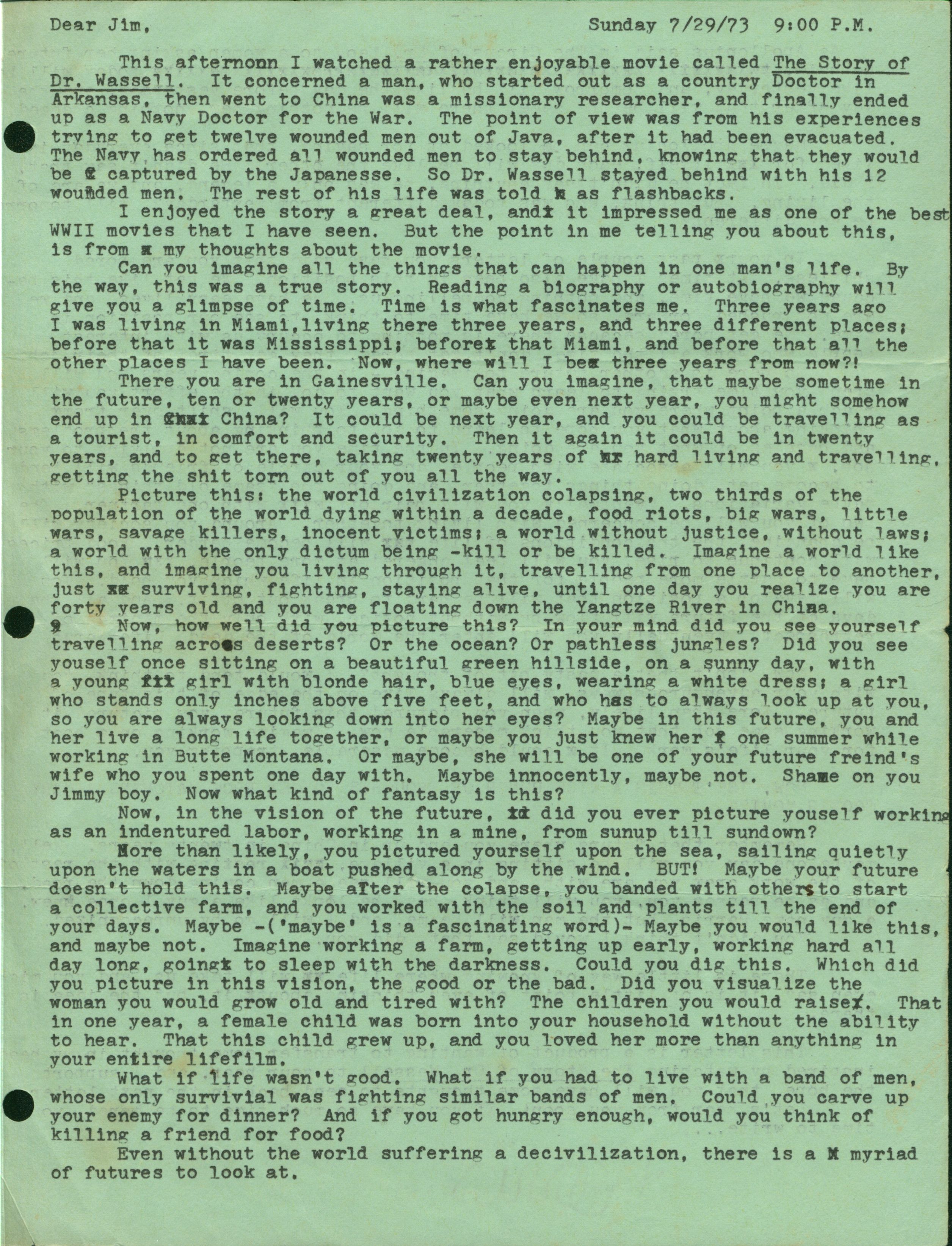
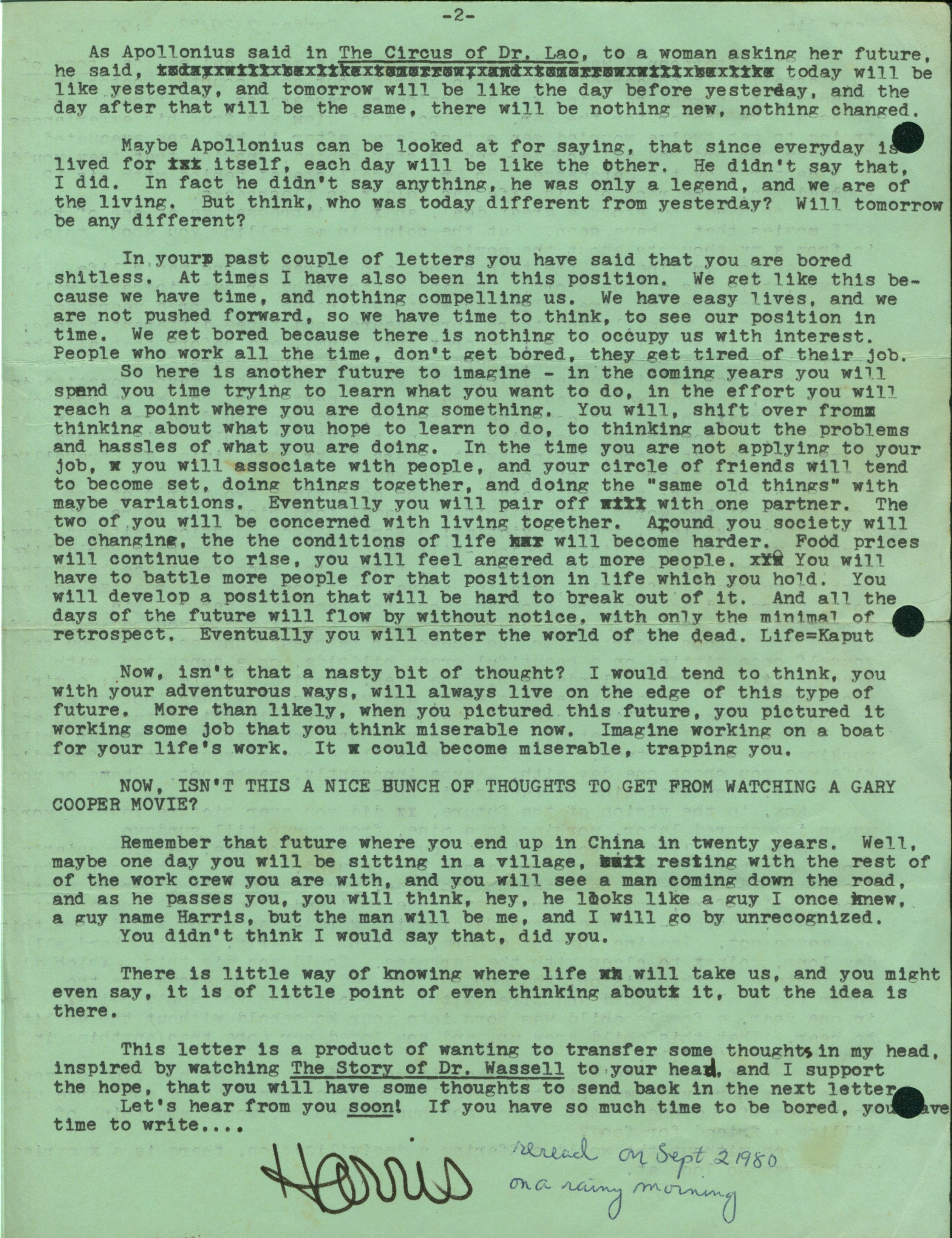
I have found one letter from 7/29/73 that I wrote Connell which he returned in 1980. I wrote Connell hundreds of pages of letters, which he kept in a box, but his mother threw out sometime in the 1970s. I’d give anything to have that box now. Here’s the letter:
There’s something woo-woo in that letter. In the third-to-the-last paragraph on page one, I asked Connell to imagine a future where he has a daughter born deaf. Connell’s stepdaughter went deaf several years ago after having to take some major antibiotics.
This letter is also weird because it sounds like me now. But then I was trying to imagine the future and now I’m trying to reconstruct the past.
I had Connell read the letter to see what he remembered. He didn’t remember the letter but he thought we thought many more thoughts per second back then than we do now because the letter impressed him with my stream of ideas.
I don’t remember taking any photographs from 1973. I don’t think I owned a camera. That really limits my recall.
A day later I remembered that not only did I own a camera, but so did Greg Bridges and John Williamson. That we had built a darkroom, in the living-room closet at the house on Eastview and considered ourselves amateur photographers. I still don’t think we took pictures of ourselves. We were all into nature photography and macro photography. I did take several rolls of film using Carol as my model. Plus we made super8mm movies. Williamson was into various creative hobbies and even made silkscreen images. He made a silkscreen cover for my SAPS apazine After the Goldrush. I through all that out in my later Buddhist phase.
I’m now out of physical evidence to prove my existence in 1973. Wikipedia’s timeline of major events of 1973 triggers little for me. Neither the 1972-73 nor 1973-74 TV schedule triggers any memories. I’m not sure we watched TV at the Eastview house or even owned a TV.
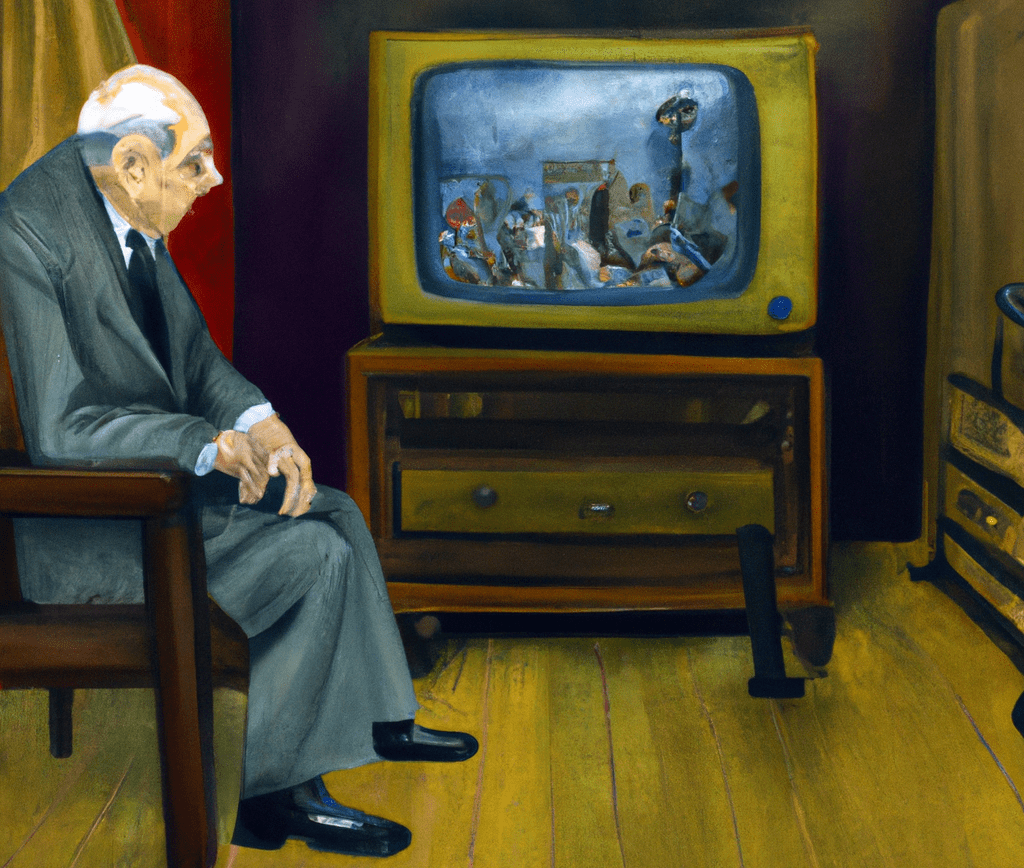
In my letter above I review a movie. I can’t remember where I watched it. I sometimes rode my bike over to my mother’s house to watch TV there. Today I had a vague memory of a black and white TV in an old wooden cabinet sitting in a tiny living room that had one ugly couch. This memory was in black and white. All my memories of that Eastview living room are in black and white. I think it must have been dark and dingy.
In this post about 50 albums from 1973, I remember many of them, but most of them I bought later. The only ones I think I bought in 1973 were Brothers and Sisters by the Allman Brothers Band, ‘Pronounced ‘Leh-‘nerd ‘Skin-‘nerd’ by Lynyrd Skynyrd, Over-Nite Sensation by Frank Zappa and the Mothers of Invention, Goodbye Yellow Brick Road by Elton John, and Piano Man by Billy Joel.
I was able to verify going to a few concerts by recalling them and verifying the dates on the internet. Carol Suter and I went to see Elton John on October 11, 1973, at the Mid-South Coliseum for the Goodbye Yellow Brick Road tour. We also saw him one other time, but I can’t remember if it was in 1972 or 1974. Carol hurt my feelings because she said she would go with me to see Billy Joel during the Piano Man when he was at Lafeyette’s for several days but then went with someone else. I now wished I had seen Billy Joel before he was famous.
I also saw Frank Zappa twice during the 1970s. He was in Memphis in March of 1973, but I can’t verify I was at that concert, but I think it was around the time of Over-Night Sensation. I and my friends went to a lot of concerts during these years. It seemed like every week some big act would perform, often two or three at a time. And the tickets were less than ten dollars back then.
If I would go to the library and look at the microfilm of the Commerical Appeal for 1973 I could verify all those concerts probably. I might even dredge up some other 1973 events I remembered or attended.
Here are the most remembered science fiction books from 1973. I don’t remember reading any of them during that year. Greg and I were both science fiction collectors. I’m pretty sure I subscribed to F&SF that year because I had collected over 200 back issues. But I probably also subscribed to Galaxy, Analog, Amazing, and Fantastic. I also remember building several large bookcases for my collection. They were the same size as a sheet of 1/4″ plywood. I used 1 x 8-inch planks for the shelves and plywood for the backing. They were huge. Greg used giant metal shelves in his room. We even had bookcases in the hall and living room.
Greg and I also published fanzines, traded fanzines, and subscribed to fanzines. Our favorite was Richard Geis’s Science Fiction Review. A few years ago I bought most of them again on eBay and scanned them for the Internet Archive. Probably if I reread the 1973 issues it would trigger many memories.
A memory that came to me on the second day of writing this essay was about my Raleigh 3-speed bicycle. I didn’t have a car that year. When I needed a car I’d ride my bike over to my mom’s house and borrow her car. I rode that bike all over Memphis. Once, and I don’t remember when I visited Connell in Miami and he told me to bring my bike on the airline. I did. And we rode it all over Coconut Grove, where I used to live. I loved that bike. I have no idea what happened to it. That saddens me.
Well, this research is running too long for a blog post, but I think you get the idea. We can remember a lot. Especially if we have triggers. I often have vivid memories of the past pop into my head unbidden. It makes me wonder if everything is recorded and if the bottleneck is the mechanism of recall.
I’m sure if I kept at this experiment I could write a whole book about memory and what I could eventually remember from 1973. I doubt many would want to read it. I’m not even sure anyone will want to read all that I’ve written here. Most people don’t seem very interested in remembering the past. I even know people who say they intentionally try to forget the past and throw away anything that makes them recall it. That horrifies me. I hate that I went through that Buddhist phase.




 Auxiliary Memory