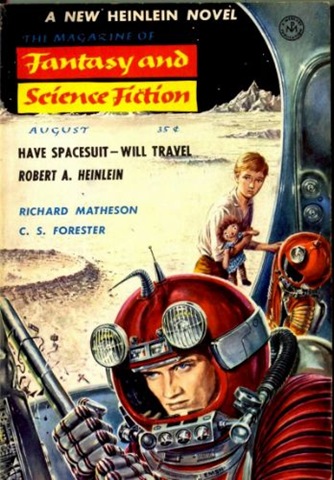
Heinlein on Audio

I love audio books.  One of the first things I wanted to hear when I discovered audio books was stories by Robert A. Heinlein.  And the first books I wanted to hear the most were all the Heinlein juveniles.  I joined Audible.com at the beginning of 2002 and my first two monthly selections were The Menace from Earth by Heinlein and Snow Crash by Neil Stephenson.

At the time they didn’t have any of the juveniles, unless you count Starship Troopers, the intended thirteenth book in the Charles Scribner’s Sons series that was turn down causing Heinlein to leave the publisher, and I assume give up on writing juveniles.  Podkayne of Mars was probably the 14th and last one written.  Variable Star written by Spider Robinson and recently published was inspired by an outline of Heinlein’s.  Finally, I consider Rite of Passage by Alexei Panshin the closest thing you’ll ever get to another Heinlein juvenile, so I’d like to hear an audio edition of it.

Right now, [updated October 4, 2012], if you join Audible.com you can get the following books by Heinlein, including all four of his books to win the Hugo Award, and all twelve of the Heinlein juveniles.  The list below are those audio books available through Audible.com in the USA.  Other editions might exist.

  1. Assignment in Eternity
  2. Between Planets
  3. Beyond This Horizon
  4. Citizen of the Galaxy
  5. The Door into Summer
  6. Double Star
  7. Farmer in the Sky
  8. Farnham’s Freehold
  9. For Us, the Living
  10. Friday
  11. Glory Road
  12. Have Space Suit-Will Travel
  13. I Will Fear No Evil
  14. Job: A Comedy of Justice
  15. Methuselah’s Children
  16. Orphans of the Sky
  17. Podkayne of Mars
  18. Red Planet
  19. Revolt in 2100
  20. Rocket Ship Galileo
  21. Six Column
  22. Space Cadet
  23. Starman Jones
  24. Starship Troopers
  25. Stranger in a Strange Land
  26. The Cat Who Walks through Walls
  27. The Menace from Earth
  28. The Moon is a Harsh Mistress
  29. The Number of the Beast
  30. The Puppet Masters
  31. The Rolling Stones
  32. The Star Beast
  33. Time Enough for Love
  34. The Green Hills of Earth
  35. Time for the Stars
  36. To Sail Beyond Sunset
  37. Tunnel in the Sky

In the future I still hope to hear:

  • The Man Who Sold the Moon
  • Waldo & Magic Inc.
  • The Unpleasant Profession of Jonathan Hoag

We’re getting very close to having all of Heinlein’s books on audio. That’s pretty significant.  It shows that Heinlein is still well loved – and I hope by new readers.  It would be a shame that these audio books are selling only to old fans like me who want to hear his stories once again.

JWH – updated 10/4/12

In Defense of Microsoft

        Those cute, I’m a Mac and I’m a PC, commercials really irritate me.  Now I don’t want to get into the whole PC versus the Mac thing although at times it might seem like I am.  What I want to explore is our love-hate relationships with our computers.  No matter how much you love your computer and OS, they can be throw-out-the-window annoying at times.  For instance, Word 2007 crashed just after I started this blog entry.  Office 2007 sometimes crashes on me on this machine, which happens to run Vista. I use Vista at work and Office never crashes, and I help support hundreds of machines and I’ve never got one support ticket for Office 2007 crashing like this.  Service pack 1 didn’t help either.  If I told this to my Mac loving tech friends at work it would excite them no end because it would be fuel for their anti-Microsoft philosophy.

        John Dvorak, a famous computer pundit, regularly writes columns about the doom of Vista.  He’s not the only one, there seems to be a tidal wave of attacks on Vista and Microsoft.  I think Vista is superior to XP, and I love Office, especially 2007, even though it conks out on me at times on my home computer.  My Mac friends will gleeful attack the faults of Microsoft for hours and I’ll mention I have a user with Leopard that keeps crashing and they’ll just quickly admit Leopard has some problems and go back to attacking Vista or Exchange.  How weird is that?  It’s like having a wife that tries to kill you from time to time, but since you love her you don’t want to divorce her.  I think with Mac fanatics, they say she’s so beautiful, how can I give her up.  PC fanatics say she does everything, takes care of the kids, cooks great meals, keeps a beautiful house, I couldn’t live without her.  Linux fans brag how their computer wives never try to kill them while ignoring the fact that none of their friends find their wives attractive.

        One reason I hate those I’m a Mac commercials is because they are as honest as a political campaign commercial.  And I can’t understand why Microsoft doesn’t slam Apple with counter commercials.  I’ve always been a loner, and should have been a Mac person.  I even used a Mac for years.  But I know who pays for my livelihood, and in the world of work, PC computers are the team player.  And since I have to support hundreds of computers and users, the concept of team playing is quite obvious to me, even though I’m a loner type.  Macs are like opinionated movie stars.  Arty types are just not known to be team players, so I can’t understand why Macs even want to be part of the corporate world of team playing.

        When I listen to my Mac friends they want to overthrow the government and establish a radical new political system.  If makes me feel old and conservative.  When I hear PC pundits scream for the return of XP, it makes me think I’m living with creationists.  I ask my Mac friends what should we do and they say get rid of all the PCs.  And I say wouldn’t Apple become the new Microsoft?  At least Windows runs on any personal computer including Macs.  Why would corporate America want to switch to a system where computers only come from one company?  I tell my Mac friends if I was to dump Microsoft it would be for Linux.  It’s more universal than Microsoft running on anything from the smallest to largest computers.

        I’ve installed Linux once or twice a year since 1993.  Every time I discover I can’t do what I want with Linux and go back to Windows, but each time it gets closer.  Currently, if I was to switch away from Windows I could do the most of what I do now with a Mac, but I refuse to buy into a system with only a single source of hardware, and very expensive hardware at that.  And even though Mac fanatics promise Nirvana, I support Macs at my job and I well know how unhappy some Mac users are at times.

        The truth is we’re all unhappy with our computer systems.  Sure PCs are plain-Jane machines that are as glamorous as shovels but we’re all able to work with them.  Now that the PC pundits hate Microsoft, as well as the Mac and Linux users, I have to wonder should I give up on Microsoft.  Is it time for a new computer world order?  Now that the major music companies are all agreeing to sell music as MP3 files without DRM, it means any computer system can play them.  Now that Amazon bought Audible.com, maybe I could get my audio books in a file format that isn’t dependent on my OS.  If everyone used the same file format for word processing documents, spreadsheets, databases, sound files, etc., then it wouldn’t matter which computer system I used.

        But is that really valid?  Some of the countries getting the OLPC computers are complaining that it doesn’t run Windows like the people use in the rich countries.  When I ask kids from India and China coming over here to go to school about Linux they go huh?  They want to study Microsoft and Oracle.  Where Linux succeeds best is in the corporate world where it does unflashy server work.  Logically, having an OS like Linux, with its free and open source philosophy, should become the world standard and be the replacement OS for PCs and Macs – and that might happen.  But success might not be about logic.  For my day-to-day use Vista is the champ because it offers me more variety of services and works with more online services and is more secure than XP.  Are there things about Vista I don’t like?  Sure.  But to switch to any other system means a lot more aggravation.  Even Microsoft and Windows must evolve.

        Microsoft should make a series of ads where the hippie Mac kid walks into situations where teams of people are working and propose radical solutions.  Imagine today at the Super Bowl the Mac kid walking out on the field and telling the quarterbacks “Hey, football sucks – soccer is the game for America.”  Or have him walk into some corporate skyscraper and go up sixty floors to the CIO office and tell the top guy he should replace his 80,000 computers with Macs, retrain all his workers and rewrite billions of lines of code so his customers use Apple friendly programs.

        I like my Mac and Linux friends, but I get tired of all the Microsoft bashing.  And now that all the PC computer magazines and websites are starting to bash Microsoft too, it’s getting depressing.  Computers are very important to me.  It’s like my last blog entry about living without electricity; I wouldn’t want to live in a world without computers either.  I want my computer to work faithfully and not annoy me, but I don’t want my OS to become my religion or political party or philosophy.

Jim

Living Like Jane Austen

    My power went off Tuesday afternoon just as I was getting home from work and didn’t come back on for twenty-six hours. It was cold and dark outside and I sat bundled up in blankets thinking about what I would blog. My two cats struggled for the warmest place on my lap while I listened to the loud winds. We sat in candle light and I imagine this is what it must be like living in Jane Austen’s time. That old saying about only missing stuff when it’s gone is brilliant because I sorely missed electricity. No cooking, no heating, no television and most of all no computer. The only gadgets that worked were battery powered like my iPod Nano and flashlight or the wired phones. I had just finished listening to Northanger Abbey this weekend, so the early 19th century was still on my mind.

    Because I’ve also been thinking about lunar habitats I imagined what it would be like living underground on the Moon and having the power go out, or on a space station. It would be as black as a photographer’s darkroom. Out my window the low hanging clouds glowed dimly white from the sky glow of all the distant houses that had power, and I could see the black silhouettes of trees against them. On the Moon or Mars if you were underground it would be painfully dark. Of course emergency systems would cut in with light, or at least I hope. I’d assume they would have backup systems. Tuesday night I wished I had a backup system. But what if all systems failed? Imagine being in such a situation and wondering where the candles and matches are? When technology heads south we fall back on old ways.

    Then I started wondering about backup systems for my home. The next day the annoying sound of two generators filled the air. In 2003 during Hurricane Elvis as we Memphians like to call a storm of straight-line winds that knocked out the power to hundreds of thousands homes, I had thought about buying a generator too, but didn’t. My wife and I went without power for thirteen days in hot humid August. Years before that we had an ice storm that knocked out our current house’s electricity for a week or so, but then Susan’s parents lived here. From ten stories up, my Memphis neighborhood looks like a sea of trees with an occasional rock of a tall building jutting up. We’re very susceptible to high winds and ice. So is it worth buying a generator for outages that happen every three years? I’m starting to wonder.

    Between global warming, aging infrastructures, growing power demand, increased energy costs, frequent droughts and more bouts of strong weather, the idea of being energy self-sufficient crosses my mind more often. Certainly an old fashion wood stove would have helped during this blackout in the freezing cold. I have a gas fireplace, but it’s more for looks than heat. I wished I had solar panels for energy and heating, but the aforementioned trees put the kibosh on that solar tech. I’ve written about my desire for a solar energy tree collector before. However, unless I had an electrical storage system, that wouldn’t keep me from sitting in the dark at night.

    We’re very depended on civilization. I don’t know how many times during that twenty-six hours I walked around my house instinctively trying to flip on a light, or grab something to eat that required a stove. Jane Austen sure does overlook those details about how they lived without electricity. Of course her characters were all dependent on servant power. Servants arranged for candles, heated water, cooked with coal or wood. I was amused by Jane’s references to modern living as opposed to the primitive living in the gothic novels her characters read.

    This brings me back to generators. I wished 1950s science fiction was true and we all had a small nuclear power plant in the basement – or if cold fusion had panned out. Gas generators are noisy. So Tuesday night I sat in the dark and cold and imagined how to make gas generators less noisy. I suppose there are more expensive ones than those cheap jobs at Home Depot that might be quieter. I do know rich people can buy fall-over systems that go to work instantly when the power goes out, but alas, I’m not rich. I wondered if I could build a little soundproof concrete bunker with good ventilation for not much money. My goal would be to set aside one room in the house that had a small energy efficient air conditioner and heater and make it into my lifeboat room for when we had power problems.

    I don’t want to live like Jane Austen’s pre-industrial world. I want to have my own little spaceship home that is self-sufficient during bad times. I know I’ll never get to live on the Moon or Mars, or in a space habitat, but in the end we all live like Jane Austen’s world of family and friends looking for relationships and love, even the people who will live in outer space. That’s why we read Jane two hundred years down her timeline, and why future men and women living on other planets will be read her books too.

    The scary ideas of global warming, grid failures, economic downturns, worldwide pandemics, etc. make us fear losing the security of our homes. That’s why I like the idea of renewable energy and living off the grid, or having the grid as a backup. In one sense we all need to build self-sufficient lunar colonies in our own yards. Maybe I won’t be a space pioneer, but I might be able to be an energy self-sufficient pioneer.

    There’s a wonderful book, The Reshaping of Everyday Life 1790-1840 by Jack Larkin, about rural life in America before industrialization. Someday someone will write The Reshaping of Everyday Life 2010-2050, and it will be about how we adapted to the current problems. Let’s hope it isn’t about how we had to de-evolve technologically and all live like Jane Austen again.

JWH


The Moon versus Mars

    Among manned space exploration advocates there is much debate over where to go next. For the last few years it was assumed NASA would follow through on President Bush’s vision to return to the Moon. Now maverick scientists are proposing an alternative plan also reported at Spaceflight Now. Their hope is for manned missions to asteroids with the underlying assumption that this will lead to manned flights to Mars quicker than the Moon first approach. Basically it comes down to a battle between the Reds and the Whites, those people who want to go to Mars and those people who want to colonize the Moon. Mars advocates have always believed we have been wasting decades in low Earth orbit. Lunar explorers appear to believe we’re not ready for manned missions to Mars.

    For most of my life I’ve been waiting for manned missions to Mars. Growing up in the 1960s all the books about space exploration assumed Mars was the ultimate goal. The pioneers of Mercury, Gemini and Apollo missions assumed at that time that Americans would be on Mars by the 1980s because of the momentum of the space race. It was hard to imagine at the time that the public would give up so quickly on the final frontier. After 1972 instead of moving outward the space programs of the U.S. and Russia moved to LEO and parked for decades.

    I still think the ultimate goal is Mars, but I’m no longer a supporter of plans like Robert Zubrin’s Mars Direct. If manned missions to Mars end up like the Apollo missions to the Moon, just a dash over and grab some rocks, I think it will be counter-productive for long term manned space exploration. We know the public doesn’t want to fund expensive missions, and long term missions are always vulnerable to budget cuts and political change. I think the goal needs to be changed. Instead of arguing over where to go next and ending up dividing our forces, we should unify under the goal of colonizing the Moon, with the focus on living off the land colonization. If we can achieve that on the Moon, Mars and asteroid living will be a logical follow-up.

    By colonizing space I mean near self-sufficient living off the land. There are more natural resources on Mars, but its distance make getting started much harder. The Moon is conveniently close and I think the perfect destination for getting started. There’s not much on the Moon, but there might be enough of the essential elements to process what we need. I believe the colonization process is important because anything else will be just visiting, and very expensive vacations at that. Like I mention in “Will Robots Have All the Fun” is the idea of sending robots to prepare the way.

    The first thing to do is send robots to explore the Moon and find that theoretical ice. Not only does ice mean water, it means oxygen and hydrogen. Work on the Moon will be hard because of the extreme temperatures and all that pesky dust. The dust is so bad that it could be a show-stopper. Long term stays on the Moon means engineering dust avoidance. Working with ice at hundreds of degrees below zero isn’t like working with cubes out of the freezer. Once ice is located, and pray that it is, robotic miners could be set up to prove that we can extract and store water, hydrogen and oxygen. Even this initial success will be tempered with the fact that we don’t have any storage containers to use. When you have to build everything from scratch things get very complicated.

    Another fleet of robots can start work on carving rock. If they can build air-tight rooms and tunnels underground they can mix nitrogen or helium with oxygen to make breathable air and create a storage system that people can also live in. This brings up the need for metal for doors and locks, unless we’re bright enough to create everything out of rocks like the people did on Gilligan’s Island did with coconuts. If we have to ship everything we need from Earth colonizing will fail. That means robotic mining of metals and minerals.

    From there we need to find ways to extract carbon and nitrogen. The list goes on and on. Is it even possible to do all of this? That’s still theoretical. I do believe that if all NASA does is collect rocks the public won’t support manned missions. Space exploration needs more purpose and challenge than just going somewhere. It is my belief the public will only spend so much on space exploration. Even if the public got excited about the challenge of designing a self-sustaining system on the Moon, there will still be limits to what we can do. Let’s say Americans do get excited and support one rocket mission a month, a pace never supported by the Shuttle program, how much can be achieved at this pace? How long will the public continue to spend their tax dollars?

    If the public is only going to buy ten missions, then all we can do is little more than recreating Apollo 1969-72. What if we got 120 missions – 12 monthly missions times ten years? What if the first 100 missions sent robots that prepared the way for the final twenty that were manned? How much could 100 robots build on the Moon?

    Would the infrastructure be built faster with men or machines? If you send humans you have to ship air, water and food, as well as all the machinery they need. The colonizing of space maybe just a fantasy, but to test it will be a great engineering challenge. Developing teleoperated and fully autonomous robots to do this work will be a quantum leap in technology. I think having a bigger challenge, especially one so gadget oriented, might be more inspiring to taxpayers.

JWH


Will Robots Have All the Fun?

    Last night I woke up and not being able to get back to sleep read “Balancing Accounts” by James L. Cambias in the February, 2008 issue of Fantasy & Science Fiction. I always love reading a good short story when my brain should be dreaming; it makes the fiction all the more vivid. “Balancing Accounts” is fun first person tale told by a robotic rocketship named Annie. There are humans in this story, but they are strange distant creatures and all the good and bad guys in this story are robots of one sort of another. These robots living out around the moons of Saturn have their own barter economy because making a living means earning new body parts to keep on trucking in the outer system. This is an entertaining story that I recommend, but it got me to thinking about another way to imagine the future of space travel.

    What if all the Vikings, Pioneers and Voyagers had personalities? This isn’t a new idea in the science fiction world, where AIs are old hat, but I’m not sure if the idea has really been explored for all its worth. Let’s breed a mash-up of ideas from Vernor Vinge with Robert Zubrin theories. Zubrin champions the idea of living off the land for future space explorers. Send robots to Mars to set up factories to produce rocket fuel and other supplies so when astronauts go to Mars they have to blast off from Earth with less weight. Zubrin’s robots are like automated factories, but what if they had more intelligence?

    With recent DARPA Grand Challenges to build autonomous vehicles it’s not that hard to imagine a whole series of challenges to build machines that build other machines. It would be great if we had nanotech now, but what if we could build self replicating machines on the scale of Spirit and Opportunity? How smart would they have to be? Smart enough to enjoy themselves and have fun?

    I don’t think we’re ready to send people to Mars, and the public doesn’t want to spend the money on the project anyway. But what if we could send robots to the Moon and Mars and they’d be designed to build tunnels, living quarters, produce stores of usable chemicals, grow farms, and do everything so when people finally did travel to these places a nice home would be waiting for them. The six lunar missions were never about making a home on the Moon. The public doesn’t want to spend billions for a few rocket jockeys to dash over to Luna and gather up a bag of rocks.

    Would the public feel more generous about funding manned exploration if the Moon and Mars were flipped into nice condo properties? Sure it would be more fun to do the work ourselves, but there’s sort of a chicken and an egg problem here. As long as the Moon and Mars are just a pile of rocks no one wants to spend money to go there. If we could program our robot pals as our space contractors and make some major improvements that might change.

    Now read “Balancing Accounts” and think about all the fun these machines could have, and also think of all the fun we could have programming and building them. Robots don’t need air to breath, and they handle radiation a lot better than we do. To make the Moon and Mars good for humans, we need to live underground. We need tunnels and airtight rooms carved out of rocks. We need machines that can take local material and atom by atom assemble the molecules and chemicals we need to build a civilization.

    Most science fiction seldom deals with the details of space travel. Walk up and down the aisles of Home Depot and examine all the building blocks of your home that you can. Pick up an item and try to imagine where it came from and how it was built starting with the mining of the Earth through all the factories it took to make the parts to build the object in your hand. If we want to colonize space we’ll quickly learn it won’t be practical to ship goods and material from the Earth. We need to build everything off planet. The only thing that we should waste rocket fuel on is people and very high tech items. I’m thinking we need to spend years of sending super-smart robots to pave the way for us. We’ll need hundreds if not thousands of varieties and they should be as smart as we can make them. They should also be made to last and be reconfigurable so each machine might mate with others to build even new machines.

    If I was kid growing up in the old K-12 prison I’d study robotics while doing my time. Let’s do a mash-up of Sim City and Lego Mindstorms on the Moon. And while we’re at it, make it an open source project and give the little robots guys some AI so they can have the fun of exploring the final frontier if we can’t.

JWH