The Way We Live Now by Anthony Trollope

I have never read an Anthony Trollope book before reading The Way We Live Now.  In fact, I knew so little about Trollope that I thought he was a French novelist, but of course I was wrong.  He was born and died in London, and was roughly a contemporary of Charles Dickens.  The only reason I listened to The Way We Live Now is because Audible.com had a sale on audio books priced at $4.95 each and I loaded up on them.  Whenever Audible has one of these $4.95 sales I buy just about anything that sounds good, taking chances on books that I normally wouldn’t buy at regular price.  This chance taking often pays off, and with The Way We Live Now was a huge success.

TheWayWeLiveNow 

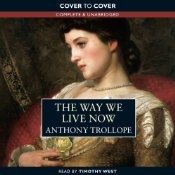
I didn’t even mean to start listening to The Way We Live Now this month, I have several books needing to be read for book clubs, and it was extremely long.  But I was curious and once I started listening I couldn’t stop.  The BBC WW edition I listened to was wonderfully narrated by Timothy West who seems to have made a career out of performing Trollope.  The 32 hour and 25 minute audio book was broken down in four 8 hour plus digital sections, and as I finished each part I watched one episode of the 4-part BBC One production of The Way We Live Now (2001). 
TheWayWeLiveNow2

That means 8 hours of book is turned into one hour of film.  Listening and watching was very educational about how movie makers distill a novel into a teleplay.  Sadly, four hours was way too short.  I think they needed a minimum of 8 hours to do the job well, and would have been a superior production if they had given it 12 hours like many HBO shows.  If a tiny 9.5 hour audio book like Dead Until Dark by Charlaine Harris can be made into a 12 part True Blood, imagine what the BBC could have down with The Way We Live Now at three times the length.

TheWayWeLiveNow2001

The film version uses the phrase “the way we live now” more than once, but I don’t remember it used in the book, but that’s essentially what the book is about, a time when things are changing.  People are having to change, and all the characters illustrate “the way we live now.”  The book is set in London during 1873 when everyone is caught up in an economic bubble.  The story has a very modern feel to it.

Augustus Melmotte is a very rich man who has come to London buying real estate and promoting a stock investing craze.  He has a Donald Trump quality to him.  His background is very mysterious, but he wants to be the wealthiest man in London and even has political aspirations.  He has a daughter Marie that he’s dangling in front of the English aristocracy hoping to wed her to another large fortune and get a title for the family to legitimatize his ambitions.  Unfortunately for Melmotte, many of the swells have titles but no money and see Marie as a solution to their own economic problems.

The story is about class and social climbing, and satirizes much about London life that Trollope didn’t like.  To stir things up even more he gives us two American characters Hamilton K. Fisker and Mrs. Hurtle.  Fisker is a wheeler-dealer promoting a railroad from Salt Lake City to Veracruz, Mexico and convinces Melmotte to lead the charge with  British investors.  Fisker wants Melmotte in on the deal because of all the lay about aristocrats he can get for the board of directors and use their names to sell stock to the gullible English.   And the English want to cash in on American empire building.

The story is long and leisurely, but never slow.  It has a horde of characters, many struggling to find appropriate mates, sometimes for love, sometimes for money.  Like most Victorian novels there’s no actual sex in the story, but Trollope seems to go further than his contemporary novelists at indirect suggestions.  He knows that people are having sex, he just doesn’t give us any sex scenes, or even directly implies his couples are having sex.  What’s interesting is the film version does bring the Victorian novel into the realm of PG-13.  I don’t think this hurt Trollope’s story except when Mrs. Hurtle tells another woman she was sleeping with Paul Montague, and that just doesn’t happen in the novel.  But we the reader knows that Hetta is thinking it.

The film versions leaves a lot out, and actually changes the story in key places, and totally screws up the ending.  If I hadn’t been reading the book I would have given the film a B- for a Masterpiece Theater type show, fun, but not great, like the A+ Downton Abby.  Knowing the book I’ll have to give the film a D+ at best, but well worth watching if you are hard up for Masterpiece Theater kind of shows, which I often am.

The novel is full of great characters that illustrates different layers of London life.

Sir Felix Carbury, a young penniless baronet, lives by his looks and title, mooching off his mother Lady Matilda Carbury while gambling at cards all night, and half-heartedly chasing Marie Melmotte.  Felix is as modern as any slacker son today, and gives his mother endless grief.  Lady Carbury, his doting mother, tries to get by on writing, but she writes terrible books such as, Criminal Queens: Powerful Women as the Playthings of Love that are full of inaccuracies and quickly cribbed from other sensational books of the time.  Trollope uses her literary ambitions to make fun of writers and publishers of the day.  Again, its very modern.

Roger Carbury is the novel’s decent man and suffers for it.  He’s always been in love with Felix’s sister Hetta, but she’s not in love with him.  Lady Carbury pushes her daughter to marry her cousin so the family would be  rich again and Hetta would inherit the Carbury estate.  Hetta is in love with Paul Montague, English partner and civil engineer to Hamilton Fisker’s great railway project.   Paul is Roger’s protégé and best friend.  It’s quite a nasty love triangle.

Paul is tangled up with Mrs. Hurtle, an American adventuress that might have killed more than one husband for being scorned or cheated on, and has taken to the English gentleman thinking he is honorable.  In the novel Trollope portrays Americans as bold, calculating, brash, uncouth, immoral and uncultured.  Mrs. Hurtle dominates Paul and he wants to run, so she chases after him like a big game hunter, refusing to let him escape her clutches.

Marie Melmotte, played by Shirley Henderson (Moaning Myrtle in the Harry Potter films) steals the show in the film version, and for the most part fulfills the character of the novel.  In the novel, Marie is boy crazy for Felix, but her domineering dad, Augustus sees right away that Felix has no money and is worthless for his plans.  At the beginning of the story Marie is weak and mousy, but by the end she’s in command of her fate.  The Way We Live Now is very much a feminist novel, or as much as it could be for the time.  One young social climbing girl is even willing to marry a Jewish man to get what she wants.  Trollope deals a lot with anti-Semitism in the novel, again showing the way we live now involves accepting Jewish people into society and politics, and I think he’s sympathetic to this issue, but I’m not sure.

I doubt few people will run out and read The Way We Live Now because of my recommendation.  Giant Victorian novels just aren’t that popular anymore.  But I do give it an A+ for entertainment value.   It has become one of my favorite 19th century English novels – and the very best include Pride and Prejudice, Great Expectations and Middlemarch.

JWH – 4/24/11

Sorry Bookstores, It was True Love while it Lasted

Time waits for no one, as an old song goes.  When I was a kid I used to marvel at talking to adults who told me about growing up without television.  That just boggled my mind.  And my grandmother, who was born in 1881, would tell me about life before the automobile, airplane, radio, Polio vaccine, refrigerator, and indoor plumbing.  I just could not fathom such living.

It never occurred to me then that I would live long to hear young people extol technology they couldn’t live without, or I’d have to face big transformations in my life.  Personal computers, the internet, ebooks, GPS, cell phones, VHS, CD and DVD players, Facebook, texting, Twitter are inventions that change our society at an unrelenting pace.

Two of my favorite pastimes growing up were shopping for records and books.  I loved record and bookstores.  Whenever I’d visit a new city I’d seek out its best bookstores and music shops.  I really miss flipping through bins of LPs two or three times a week.  CDs were an exciting invention, but their tiny size ruined the love of the album cover.  Now even CDs are disappearing and I quit shopping at music stores years ago.  I got used to it.  Time rolls on.

My greatest identity in life is as a bookworm, and sadly bookstores are failing all around me.  Sales of hardbacks and paperbacks are way down from one year ago.  Yesterday, the local paper said my favorite bookstore is likely to go under unless the landlord makes major concessions to a liquidator that bought it.  And that’s partly my fault.  I’m reading and buying more books than ever, but I get them from Audible.com or Amazon.com, or used from ABEBooks.com (all three owned by Amazon).  For every ten books I read, nine I listen to, and one I read.  And that one I read is mainly in paper form now, but my Kindle will probably supplant that.  Time marches on.

Read “What Is a Book? The Definition Continues to Blue” for one of many ways in how publishing is evolving.  I get the feeling I’m living in times like when books went from scribe produced scrolls to Guttenberg printed volumes.  I’ve been messing around with ebook readers since the 1998 Rocket ebook.  Visionaries back then predicted a quick transition to ebooks, so I’ve sort of been expecting the change.  But when it was announced recently that hardback sales were down 43% from a year ago, and paperbacks down 41.5%, I was shocked it was really happening.  Kindles, Nooks and iPads are the future of books. Oh, I don’t think they will disappear, people still ride horses and buy LPs, but time is relentless, and change comes whether we want it or not.

I wonder if books will become collector items now?  But I’ve changed too, and I’d like to get rid of my book collection.  If I retire and start moving around the weight of my collection will be a heavy burden.  Ditto for my CDs.  Digital is just too damn convenient to ignore.  I loved bookstores, but I actually made more bookworm friends online than I ever did at a store.

And there are unimagined kinds of changes too.  Who could have predicted that a whole generation would grow up stealing their music, books and video?  They think everything should be free.   Did communism win after all?  If someone had told me as a teenager that bookstores and record stores would disappear and everything I wanted could be had for free on little gadgets I would have imagined a science fictional dystopian future.  Nor could I have pictured a future where kids wouldn’t sit around and listen to records together, but instead choose to live in their own little iPod worlds.

Time will continue to march relentlessly forward regardless of my wishes.  On one hand I want to feel wimpy and cry over the bookstores, but on the other hand I want to say “Fuck you time, bring it on, I can take whatever comes.”  If the bookstores close I won’t read any less.  I’m sure magazines and newspapers will be reborn as beautiful swans on future tablet computers.  And I’m sure super multimedia books will dazzle us and we’ll think of hardbacks as quaint as parchment.

I do miss the record store, but I don’t regret they are gone.  I’m listening to far more music than ever with my subscription to Rhapsody.  Instead of owning 1,500 albums, I have access to millions.  The internet is better than any newspaper or magazine that’s ever published.

It’s like when I was a kid talking to old people – I pitied them for having to grow up in a world without TV.   Well, I’m not going to feel self-pity because time bulldozed over my nostalgic habits.  Sorry bookstores, it was nice while it lasted.  I expect someday to talk to children and tell them how I used to read by holding words printed on paper and their little minds will boggle at the thought of such primitive living.

NOTE:  I sat down here to write a cry in my beer post lamenting that I might be losing my favorite bookstore Davis-Kidd.  I truly love bookstores, but as I wrote and rewrote I realized time has already changed me and I was just feeling nostalgia.  Don’t get me wrong, I expect bookstores to be around for years to come, but their days are numbered.  Time changes everything, and time does not stop.  I hate that so much in my life is no more or has changed beyond recognition, and it’s okay to feel a twinge of weepiness for the old days now and again, but I also know it would be unhealthy to cling to the past.

JWH – 4/23/11

The Ethics of Interstellar Colonization

We science fiction fans have always assumed the destiny of mankind is expanding our habitat across the galaxy, exploring new worlds, conquering new frontiers, expanding our territory, because that’s the kind of species we are.  But what are the ethical issues involved.  Think of the Federation policies in Star Trek, and it’s rules about first contact.  It’s pretty obvious that we should leave emerging civilizations alone, to let them find their own way, but what are the right ethical conditions for us to land on a planet and start colonizing it?

If it’s a rocky world like Mars I would think there would be no problems at all, even though some people do advocate leaving Mars untouched.  I think we at least have to establish two ends of the spectrum.  On the left is a dead world, and the right is emerging intelligent life, somewhere in between is where we need to place our mark as the beginning point for not interfering.

Let’s say we landed on a planet that had life like in the Jurassic, tiny brains and big bodies, and no chance of intelligent life appearing for a hundred million years, would it be okay to stay there and setup a colony?  Ignoring the butterfly effect, it should be possible to colonize this world without misdirecting the path of its evolution.  Now we couldn’t utilize this world like we’ve done Earth, using up all the resources and killing off endless species, but it might be possible to coexist with the indigenous life without doing much harm or changing its evolutionary direction.

It would be unethical to use up the heavy metals and other minerals, so we should import them from off planet and make sure we didn’t produce significant waste.

So how close in time to an emerging self aware intelligence should we stay?  Could we live on a planet with a homo erectus type intelligence and just avoid contact with them?

What about bringing other species with us from Earth?

What if we found a planet with simple life in the ocean, and simple plant life on the land, maybe just grasses and fern type species.  Should we introduce fish, trees, vegetables and fruits, along with dogs, cats, chickens, pigs, sheep, cows and horses?  Or should we believe that given enough time complex life would emerge on this planet and the life forms we bring with us would keep them from emerging?

Should the ethnical rule be that only intelligent species should travel to other planets.  So for dogs to go to the stars they would have to evolve and build their own space ships.  But what if we find worlds that have no life on them whatsoever and we terraform them for life, can we bring our animal and plant friends with us?  I would think yes.

How dangerous is the bacteria in our bodies?

But what about all the bacteria and viruses that live inside of us, won’t those contaminate a world and harm its evolution?  we might could live without viruses, but I don’t know, but it’s doubtful we could live without our bacteria friends.  We have a symbiotic relationship with them.

Are we alone?

Are we alone because there’s no other intelligent species near us, or because it would be unethical to contact us?  Are there wise beings all around us waiting for us to grow up?  If we are alone, and humans are the miracle of the galaxy does that give us ethical clout to colonize like crazy?  Would the greatest ethical crime of all reality be the one where we destroy ourselves or let ourselves be destroyed?  Or what if humans go extinct, and other animals and life continue living on the Earth for millions of years without ever becoming self-aware like we are?  Does it matter?  If a self-aware being arises in reality and dies and there’s no other aware beings to notice, do we make a sound?  Do we have an ethical obligation to expand our territory to other worlds so our species can live as long as possible?

What if we don’t go to the stars?

What if we never go to the stars, either because our bodies can’t handle living in space, or we can’t conquer the physics to travel such distances, and just continue to live on Earth, maybe for millions of years.  What does that mean philosophically?  What if we become fish in an aquarium looking at the glass forever?  Is just existing a good enough ethical existence?  What if expanding our abilities, influence and habitats define our meaning in reality?  What if it’s unethical for us not to try to colonize space?

JWH – 4/17/11

The Moral Landscape by Sam Harris

If we accept that God does not exist, who or what has the authority to define morality?  Sam Harris believes science can take on that job and makes a case for it in his new book The Moral Landscape.

The-Moral-Landscape

The concept is quite ambitious – treat morality like gravity, so its force is universal and applies equally to all.  Morality has always been relative, varying from culture to culture, and from religion to religion.  We are all too aware of this because of the conflict between Christianity and Islam, or even between the Old Testament and the New Testament.  What is right and wrong depends on the number of people backing the moral system.

Harris points out that moral relativism is the politically correct stance in our modern world.  If we discover a primitive culture that practices cannibalism, moral relativists do not want to condemn these different people for a practice we find horrifyingly immoral, and allows that cannibalism is morally right within its social concept.  Sam Harris believes that’s a load of crap, and I agree.

I’m reading The Moral Landscape in a non-fiction book club and the consensus is Sam Harris writing is too abstract and vague to make his case clearly and decisively.  How can moral issues be weighed and measured like chemical reactions?  Harris bases his hypothesis on contrasting the lives of intelligent self-aware beings.  If scientific studies can show that one course of behavior leads to a better life for the individual that can be considered scientific proof of morality.

Harris believes it’s obvious that morality should strive to create the best lives possible.  He goes on to muddle the issue, rightly by the way, that it’s very hard to determine what’s the best for any individual.  But throughout the book he tries to tie in many scientific studies that illuminate human nature.  I do recommend the book, it’s not a hard read, and has many fascinating concepts to consider, just don’t expect it to be conclusive proof of the concept.

I’m not sure science can define morality.  For me there’s always been three areas that define right and wrong:  morality, ethics and law.  Morality requires an authority, and for most of history God or gods decided morality.  Ethics is a consensus by philosophers, and laws are decided by governments.  Each system has its own problems.  Science is a system for exploring reality.  It’s impartial and indifferent.  Good and evil, or right and wrong might not exist in reality to be measured.  Ethics and laws might have to substitute for secular morality.

Looking at physics and chemistry, there is no right and wrong.  If we use biology as the basis for morality, survival of the fittest  is a cold form of morality.  If a lion eats an antelope we can’t call it murder.  As Sam Harris points out, morality can only come into play when we’re dealing with self-aware individuals.  Strangely, our species has created morality, and now tries to expand the concept to other species with the idea of animal rights.  Morality has always been an invention of mankind, he’s just used the concept of God to promote it.

Any scientific discussion of morality will be in the social sciences, an area that hard scientists sneer at for being soft.  In other words, imprecise.

Sam Harris uses female genital mutilation (FGM) as a moral issue to consider.  In some parts of the world female circumcision is a very moral practice, but in the west, we find it outrageously immoral.  Anthropology and sociology can defend the practice, so is such moral relativism an example of scientific morality?  Sam Harris says no.  If something is immoral in one part of the world, it should be equally immoral in another part of the world, and science should be able to prove it.

What Sam Harris shows is morality is tied to religion and people do not want to attack religions.  Religious morality always protects the religion rather than the individual.  He wants a morality that protects the individual.  And if you look at a secular society, it tries to protects the individual.  I don’t know if you can make a science out of that, but look at it this way, if the whole world gives up religion and its customs, will not the word morality mutate into what Sam Harris wants anyway, even without the endorsement of science?

Look at the revolution in Egypt.  Its people seem to want democracy.  Of course, the Muslim Brotherhood wants a theocracy, but what if all these revolutions in Islamic countries is a desire for personal freedoms?  Seeking a political solution is asking the legal system to make a moral decision.  In other words, we’ve been moving towards secular morality for thousands of years.  There’s been a shift in power from gods to humans.  Sam Harris wants science now to provide an impartial stamp of approval, but I’m not sure that’s needed.

JWH – 4/13/11

I’m 59, But Feel 19, But Something’s Wrong with My Body

A common sentiment among older people is they still feel young inside, just like when they were teenagers, but it’s their body that’s aging.  I feel that too, but yesterday it occurred to me that I have changed because of a conversation I had with my friend Mike.  We were talking about how bad the old TV show The Monkees was – it’s in reruns on Antenna TV.  Back in 1966, when I was 14, my sister and I loved that show.  Watching it now makes me think I must have been brain damaged!

The Monkees is a horrendous TV show.  It makes Gilligan’s Island feel like Shakespeare, and that’s another old show I loved as a kid but can’t stand now.  So I can’t really say I feel like I did when I was young, something has changed.  But why do I feel unchanged?

If I think about it I can come up with all kinds of ways I’ve changed.  When I was a kid I did stupid things like own a motorcycle, hitch-hike and take drugs, none of which I would do now.  I now think a much wider range of women are attractive, but that’s true of food, music, books, etc.  The more I think about it, the more I realize that I’m not the person I was when I was young.  So why do we feel we are?

I think the tendency is to feel that we’re a little soul driving around inside our head, steering our body until it turns into a rusted old junker.  Now I guess some people feel they are different inside as they age, but I think a lot of people don’t.  What causes that feeling?  It just occurred to me that I’ve reread things I wrote decades ago and felt I was reading someone else’s writing.  Are our inner beings unconnected to our thinking and opinions too, like they are from the body?

Is there a me inside of my body that’s unchanging even though my body changes, my tastes change, my opinions change, my skills change, and so on?  I know when I’m sick I can feel the me-ness shrink inside, like its being physically assaulted, but the uniqueness stays there no matter how much pain or nausea I feel until I pass out.  When I fall asleep the me goes away, but a tiny bit of it exists in dreams.  When I’ve had surgery and have been put under, it feels like the me has been shut off like a light switch and then suddenly turned back on.

It’s interesting to think of the me, the part of me that’s self-aware, is separate from my opinions and tastes. There’s a science fictional concept called downloading, where people imagine having their brains recorded and then burned into a clone’s brain or digital computer.  They think of this as a form of immortality, but what if the me is a mechanism of the brain that doesn’t copy?  What if the me is the equivalent of a tape-head, and not the tape?  So experiences flow past it but it doesn’t change with them?

But that doesn’t explain why I loved The Monkees in 1966 and hate it in 2011.  It implies that it’s not the tape head, or that the tape head does change over time.  Even though I feel like I’m the same person at 59 as I was a 19 that might be a delusion.  If I could put my 59 year old brain back into my 19 year old body would would I keep my wisdom or turn foolish?  Of course, if I could I put my 59 year old brain back into my 14 year old body would I start loving The Monkees again?  I don’t think so.

I’ve read that people with brain damage feel like different people.  I’m guessing the brain is what feels homey and constant, and it’s the physical body that feels different with aging, and the informational content of the brain that makes my tastes change.  What I worry about is having a stroke or getting Alzheimer’s and losing part of my me-ness.  I’m already used to my body breaking down.  And I’m getting used to forgetting information in my brain, which doesn’t hurt by the way.  But I don’t relish losing that feeling of unchanging me-ness.  But sometimes the me dies before the body.

NOTE:  I think a lot of people read my stuff and think I’m depressed because I write about what they think are depressing topics.  But I’m not depressed at all.  I marvel at all the changes in my life.  I regret not being able to hang onto everything, but that’s not how things work and I accept it.  I don’t want to experience decline and death, but I don’t have any choice, so I like to philosophize about what I’m going through.  And I’m trying to learn from those explorers ahead of me, those folks in their 70s, 80s and 90s.

JWH – 4/11/11