At the peak of his career, Robert A. Heinlein was the most famous and influential science fiction writer within the genre, but how famous was he ever outside of the community of written science fiction? There are legions of science fiction fans and writers who tell stories about how Heinlein influenced their reading and writing lives. Yet, how influential is Robert A. Heinlein as a 20th century writer? How famous is Robert A. Heinlein in the at large pop culture world outside of the tiny ghetto of science fiction? As a life-long fan of Robert A. Heinlein, I’d like to know just how important my literary father figure is to everyone else.
Recently the Science Discovery channel ran a series The Prophets of Science Fiction, and episode 7 featured Robert A. Heinlein. Before I saw this episode I thought “Wow, Heinlein is finally going to get the recognition he deserves!” After I watched the show I felt, “WTF!” If that’s the best that can be said about Robert A. Heinlein then the poor guy really is dead and buried, both physically and literarily. The show was so murky in its focus that it neither described Heinlein’s life nor his work. Sure, Heinlein is a hard guy to pin down, but he deserved better than that.
What else does the public know about Heinlein? Last year, volume one of a serious biography came out, Robert A. Heinlein: In Dialogue with His Century by William H. Patterson, Jr., which I reviewed here. It got a mere 32 customer reviews at Amazon, and it’s current sales rank is #360,570. I’d really love to know how many copies were sold in total, but I don’t know if it would be polite to ask the author that question. However, the CATO Institute presented William H. Patterson, Jr. in a hour talk about the book that’s on YouTube. So far it’s gotten 2,353 viewers. There are several videos on YouTube about Heinlein, and there seems to be little interest in them. The Patterson talk is very worthy of watching, at least to us Heinlein fans, but why is no one else interested in Heinlein?
This begs the question: How important is written science fiction to the world? Sure, we know movie goers love science fiction and it makes billions for Hollywood, but let’s focus on written science fiction. As a literary form, how worthy is science fiction? The Science Discovery show, The Prophets of Science Fiction, gives the world the absolutely wrong idea about science fiction. Prophecy is a bogus concept, whether in religion, history, science or science fiction. The future is unknowable, period. Science fiction writers aren’t prophets, and to call them that is insulting. Sometimes they can be accidently prophetic, but that’s all.
I’ve always believed that science fiction was a serious tool to speculate about the future, but it’s been corrupted and hijacked by the entertainment business for creating thrill rides. I think Heinlein took his job speculating about the future very seriously, but I’m afraid the world at large never saw that. David Boaz, who introduces Patterson in the above video tells us a quote from Heinlein in his introduction. He says that Heinlein left a 3×5 card in a safety deposit box to be read after his death. The handwritten note said if people name three of his books as their favorites, Stranger in a Strange Land, Starship Troopers and The Moon is a Harsh Mistress, then they have grokked him. He said all three books are on one subject, freedom and responsibility.
Is that the legacy Heinlein wants? That he had something important to say about freedom and responsibility? And what does he say about those subjects? I’ve read all three of those books at least four times each, and yet I could not summarize them in that way. I’m not sure I’ve ever read an essay about Heinlein that saw those books in that way either. And those aren’t even my favorite Heinlein books.
Starship Troopers (1959), Stranger in a Strange Land (1961) and A Moon is a Harsh Mistress (1965) have become Heinlein’s most famous books. It really helps that Starship Troopers was made into a movie because a film adaptation is one of the few validations that the world at large uses to remember a writer. In The Greatest Science Fiction Novels of the 20th Century, my most popular blog essay (50k hits), I show how very few science fiction genre novels are remembered by the public at large, and that Stranger in a Strange Land is Heinlein’s most famous book with people outside of the science fiction genre.
I also wrote “What Was Heinlein’s Most Loved Story” based on stats from the Internet. Troopers, Stranger and Mistress are the top three. Another form of validation is how many books are on audio, and Heinlein does very well here. I wrote “Heinlein on Audio” and have tried to maintain the list. Heinlein is getting very close to having all his books in print as audio books. Of course, this only proves he’s still a popular writer with his old fans.
Another clue to Heinlein’s popularity is the book, The Top Ten, edited by J. Peder Zane. Zane asked 125 writers to list their top ten favorite books. Heinlein gets one vote, or 4 points, for Stranger in a Strange Land by David Foster Wallace. Dune by Frank Herbert also got one vote, but only earned 2 points by Zane’s system. The Top Ten shows that the literary world doesn’t think much of science fiction.
Even within my own system of ranking science fiction, “The Classics of Science Fiction,” Heinlein doesn’t score high – but I’ve always thought that was because he had too many popular books competing with each other. My list includes the above three famous titles plus Double Star and The Past Through Tomorrow. The Sci-Fi Lists Top 100 Sci-Fi Books also validates Heinlein is still popular with science fiction fans, and Troopers, Stranger and Mistress are the favorites.
But the more modern site, SFFMeta shows Heinlein falling from memory. Their All-Time High Scores shows Heinlein is pretty much forgotten, but that’s how their system works.
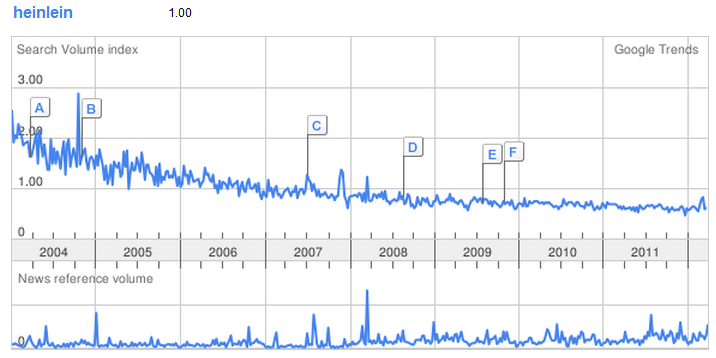
A Google search on “Robert A. Heinlein” only returns 759,000 hits. I’ve only got my memory to go on, but I think Heinlein used to get in the millions. Here’s the Google Trends graph for Heinlein.
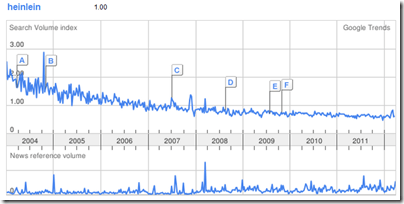
I think I need to accept that my literary hero is declining in popularity, that his most famous books were his favorites and the ones Heinlein wanted to be remembered for, but not the ones I wanted remembered. Here are my favorites and the ones I actually think say way more about science fiction than Heinlein’s own favorites:
- Have Space Suit-Will Travel
- Tunnel in the Sky
- Time for the Stars
- The Rolling Stones
- Farmer in the Sky
- Starman Jones
- The Star Beast
- The Door Into Summer
- Citizen of the Galaxy
Essentially, those are his young adult books.
Now here’s the thing. Is Heinlein being remembered for his ideas, or his stories? The three books Heinlein states he wants to be remembered for and why, suggests he wanted to be remembered for what he had to say. Wrong answer Bob. Ideas are a dime a dozen, and they do poorly with the test of time. Novelists are remembered for their stories and characters. Sadly, Heinlein never wrote an Anna Karenina, the most popular novel in The Top Ten list, or even something as memorable as The Sun Also Rises, nor anything like Nineteen Eighty-Four, Brave New World, Fahrenheit 451, Slaughterhouse Five, Dune, or Earth Abides, books using science fiction techniques that the literary world does remember. Stranger in a Strange Land and Starship Troopers are his best competitors and I’m not sure if they have real lasting power.
The above Heinlein novels I list as my personal favorites are books I love because I bonded with them in adolescence, but I know they can’t compete with the standard classics.
Heinlein deserves more of a literary reputation than was seen in his episode of The Prophets of Science Fiction. I’d like to think he’ll at least attain the status of Edgar Rice Burroughs, H. Rider Haggard or Robert Louis Stevenson have today, but in the world at large one hundred years from now. However, he will be defined by the genre of science fiction, and I think that’s where the show The Prophets of Science Fiction failed miserable – they couldn’t define the scope, value and purpose of literary science fiction. Science fiction has always been a vague term and its getting vaguer.
I had always hoped Heinlein would be remembered as the American Jules Verne and H. G. Wells of the 20th century. In 100-150 years from now, Heinlein might be remembered like the book, Frank Reade: Adventures in the Age of Invention, because I’d like to think Heinlein’s juveniles helped inspire a generation that wanted to make space travel the final frontier.

I associate Heinlein with 1950s science fiction, but I think that generation is fading now. I’m afraid the public now thinks of science fiction not in association with space travel, but movies and toys, like “Twenty Things Every Sci-Fi Nerd Should Own Physically and Emotionally,” – as geeky fantasies of obsessed fans.
William H. Patterson claims Heinlein’s legacy will be:
And even among this select group of writers-cum-culture-figures, Heinlein is unique. He galvanized not one, but four social movements of his century: science fiction, and its stepchild, the policy think tank, the counterculture, the libertarian movement, and the commercial space movement.
I totally disagree that science fiction influenced the development of the think tank. Historians of science fiction will give Heinlein a lot of credit for influencing 20th century science fiction, but claiming anything else science fiction maybe have inspired is very hard. Heinlein hated the counter culture and I don’t think he’d want credit for any accidental influence on hippies. I’m pretty sure inventors in the commercial space movement loved Heinlein’s books and might even say their careers were inspired by him, but I don’t know how much credit Heinlein can take for their success. Heinlein was a writer and his legacy must be literary.
If science fiction has a serious purpose other than escapist entertainment, it has yet to be acknowledged. I believe science fiction can be a cognitive tool like philosophy for examining reality that is separate from both science and literature. Science is the premier tool for exploring reality but it has limitations. Science fiction, using what-if and extrapolation can anticipate what science has yet to discover. Unfortunately, science fiction has been corrupted by the fantasy of desired miracles, just like religion. Too many people want more from reality than exists in reality.
Science fiction really needs to be carefully defined to be considered a cognitive tool or true art form. Right now it’s just a catch all term. How can we say someone is a great science fiction writer when we can’t define science fiction? Heinlein said he wanted to be remembered for writing about freedom and responsibility, and that’s not even science fictional. The makers of The Prophets of Science Fiction want people to believe science fiction is about prophecy, but that’s bullshit. We really need to define science fiction so we can judge if writers hit the target.
The Hunger Games trilogy is immensely popular book right now and I believe it is science fiction. Suzanne Collins is not trying to predict the future, or even warn us against a possible future. “Suzanne Collins” returns 56,400,000 results from a Google search. Orson Scot Card, probably the most popular writer within the genre, returns 3,800,000, and remember, Heinlein only got 759,000 hits. I guess that makes Suzanne Collins the new Dean of Science Fiction. What is she saying about freedom and responsibility? What is she saying about science fiction?
When the baby boomer science fiction fans die off, I’m afraid interest in reading Robert A. Heinlein will disappear. The only thing that could revive his literary reputation for the younger generations is if Hollywood makes several movies based on his novels.
By the way, Lady Gaga gets 602,000,000 results from Google. In comparison “science fiction” only gets 233,000,000 hits. If I could filter out interest in movies and television shows that number would be tiny. Why is the literary world of science fiction so ignored?
JWH – 3/31/12