How Many Pre-1950 Artifacts Do You Own?

Our book club recently read A Canticle for Leibowitz, a 1960 collection of three related stories about a future that barely remembers our 1950s civilization.  A Canticle for Leibowitz is set 600 years in the future after our civilization destroys itself in a nuclear war.  The stories are about the Albertian Order of Leibowitz, where a future Catholic monastery works to preserve the relics of a Jewish electrical engineer named Isaac Edward Leibowitz.  They do not know what the relics mean, and even illuminate one of Leibowitz’s engineering blueprints.

A_Canticle_for_Leibowitz

This got me to thinking about how many things I own might be preserved in the future.  And how many things from the past I own.  Making the cutoff date 1950, I quickly realized I have damn few relics from the past.  All I can come up with are photographs, and a few knickknacks Susan and I have inherited from our parents.  If I move the date up to 1960 I can add an old wooden radio cabinet, more photographs, some LPs, a handful of books, and our house, which was built in 1957.  If I jump to 1970, we add many more photographs, a few more LPs, and a fair amount of household items.

None of my older possessions are particular durable.  None will become antiques worth collecting.  The items I find the most meaningful are photographs and twelve hardback Heinlein juveniles I bought in 1968 with my first paycheck when I was 16.  I assume when I die my wife will give the books away to Goodwill and the photographs to my sister or her sons.

Our throw-away society doesn’t lend itself well to being remembered.   However, the sense of wonder generated in A Canticle for Leibowitz is because civilization collapses so thoroughly that most everything is destroyed, and what’s left is cherished.

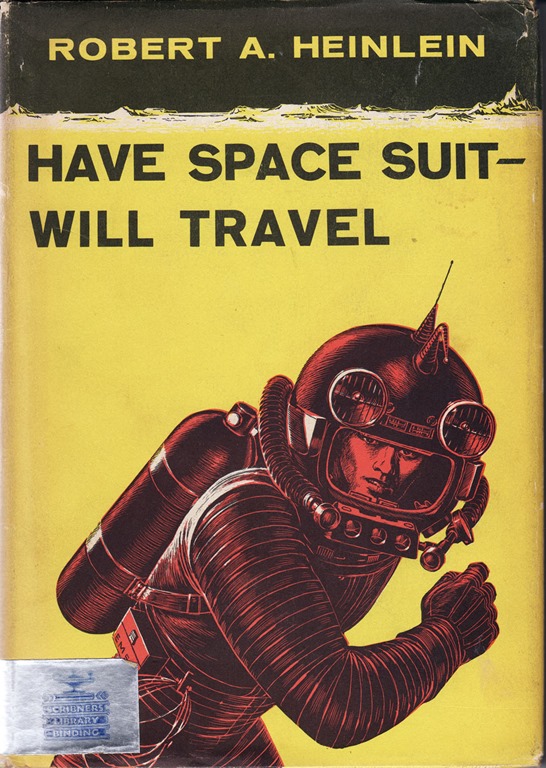
I don’t think I own a single thing that would be worth preserving 600 years, but if I did, what one thing do I own that I would like to represent me and the 20th century to future people?  I would have to pick my hard back copy of Have Space Suit – Will Travel by Robert A. Heinlein.  I used to own a very nice slide rule from the 1950s, and if I still had that, I might have chosen it.  But the Heinlein book really does represent me well.  But what would people a millennia from now think of such a story?  Would their daily language even allow them to read it?

have-space-suit---will-travel

And if I’m honest, I know future people won’t give a  damn about our junk.  They won’t give a damn about what we think or believed.  Some of our crap might make it to museums of the future, and a few eccentrics might collect 20th century doodads, but really, how many people in the year 3013 will even think about us?  Just how much daily life from 1013 do we know about now?  The Al-Hakim Mosque was finished about a 1,000 years ago.

Mosquee_al-akim_le_caire_1

Things that really last are usually buildings, artwork, monuments – works that people create to last.  I’ve often wondered what the world would be like if we all built our houses with the intention they will last a very long time – so every home becomes a museum.  Would that stifle innovation, or stimulate creativity?  Most of the stuff we own ends up in landfill, so psychologically, doesn’t that mean we’re living with garbage and not art?

Imagine a world where the smallest house lot is one acre, and each house owner builds a home intended to last centuries, if not thousands of years.  That everyone lives in the equivalent of an English mini-manor house.  Picture manicured gardens outside, and beautiful art collections on the inside.  How would society change?  Would we still want cars and roads cluttering up the countryside?  Or visible power lines, phone cables, satellite dishes?  Would we design houses to withstand tornadoes and hurricanes?  Could we design roofs that could go 500 years without maintenance?

Homo sapiens have been around for tens of thousands of years.  History, not so long, say five thousand years.  Unless we destroy ourselves, homo sapiens, and their descendants,   AI robots, could be around for millions of years.  How long will we continue to process the resources of the Earth into landfill?  At some point we need to make things that will last, and yet, leave room for new art to evolve and be added.

If I was young I’d buy a plot of land and design a house to last.  I’d furnish it with antique scientific equipment, beautiful electronics from the 20th century, and as much art as I could afford.  I’d want it solar powered.  I’d want enough land to make an interesting landscape. 

It’s a shame I didn’t think of this sooner.

JWH – 10/14/13

What’s the Resolution and Frame Rate of Dreams?

Last night I woke up with a bout of insomnia.  I was in a strange state of going in and out of consciousness and I had some very vivid dreams.  What was fascinating was I was just conscious enough to realize how my dreams were working.  An image would pop into my mind, and then very quickly my mind would provide a story for the image.  I didn’t hear words though.  It was like a telepathic storyteller was narrating my dreams and I just thought the explanations of each image as it appeared.  And those explanations animated the images into a sequence of events – so the dream felt like a movie, a story.

boots

The first image was looking down at my legs and seeing one boot on and one foot just in a white sock – I assumed I was jogging.

I saw an image of my friend Laurie – and assumed we were jogging together.

The next image was me running down a street alone – and then telling myself I’m on a strange street and I need to turn back to find one I know.

The then I saw a series of strange streets – some urban, some suburban – and I assumed I was completely lost.

The next image was being in a movie theater – I thought I came in to ask directions

Then I saw strange people – I was asking them what street was this movie theater on but they didn’t know.

One guy looked like he had Down’s syndrome – so I thought the group was of special needs people.

The next image was of a black woman – she said something about the rules and I thought I had been committed and was on a day trip to see a movie together.

The next image was running in a corridor, and I thought I was escaping.

The next image was me running with boots on both feet – and I thought how much I loved Frye boots

There was more – but I forgot

The point was my dream was a series of images, and a narrative was added to them to make a story, which made the dream flow.  I think because the images came close together, the narrative, or narrator, tied them together, but the images really weren’t related.

Over the years as I’ve been working on writing fiction I’ve often thought my dreams came up with good story ideas.  Now I’m thinking that the dreaming mechanism in my brain is a fiction machine.  The brain generates random images while I sleep and the storytelling portion of my brain ties them together with some kind of meaningful narrative.

Some dreams are more vivid than others.  I wonder just how many pixels a dream image has?  And what is the frame rate of my mind for generating new images.  There are times when I think I am seeing a movie segment, but I think my brain is often lazy and just puts up a few images.  I’ve had some very powerful dreams, ones where I thought I was awake and everything looked and felt absolutely normal, but I was still asleep.  That suggests the brain is capable of producing HD Dreams.  However, it still might have been single images and not a movie, and the narrative was HD powerful.

Today I was listening to music with headphones and almost dozing off, and I realize the song was inspiring a video like sequence on my mind’s theater screen.  It was rather strange and small, but it was an animation of a crowd of people running, and then they all got on horses, and continued to chase something.  It was a fleeting vision.  It looked like a very low resolution YouTube video.

All of this makes me think of how often we fictionalize random images and thoughts.  If you’re laying in bed at night reading and hear the bushes rustle outside your window most people imagine all kinds of scenarios.  It’s a burglar, it’s a raccoon, it’s the neighbor’s cat – we seldom get up and look.  We just make up stuff in our head to explain the input.

Think about how often you make stuff up to explain a random stimulus.  Think how often everything we believe is just made up stuff.

JWH – 10/14/13

Gravity–Riveting Story Set In Space

[Don’t read this review if you haven’t seen Gravity.  But when you have, because you should, come back here and let’s talk.]

Television watchers are experiencing a renaissance in storytelling.  Shows like Breaking Bad, Downton Abbey, Shameless, Friday Night Lights, Dexter, The Newsroom, have taken the art of storytelling to new heights.  By carefully focusing on character, writers have developed new techniques to create highly addictive forms of fiction.  This has revolutionized television.  Character driven storytelling has always been preeminent in novels, and prominent in movies, but television was always seen as a vast wasteland of lowbrow entertainment.  Now I like television better than movies, or even books.

So what is television doing that movies aren’t?  Movies often seem like a vast wasteland of teenage schlock.  CGI unreality, over the top action, Three Stooges type violence, and silly premises that should insult grade school kids.   But most of all, the characters are unbelievable.  Movies aren’t about things I could actually experience.  I don’t relate to their stories.  Maybe kids can love superhero characters because they haven’t yet learned there aren’t any superheroes.

A week ago when watching the final episode of Breaking Bad I wondered what I would have to watch next Sunday.  I remember mentally wishing I could find something that surpassed Breaking Bad in storytelling intensity.  Well, I got my wish, because on Sunday night I saw Gravity, the new film starring Sandra Bullock and George Clooney, and directed by Alfonso Cuarón.   The previews brought me to the theater with great expectations, but I wasn’t prepared by how blown away I would be by the film.  While the credits were rolling I thought how Gravity set a new standard for science fiction movies.

This space story seem real.  The characters felt like they could be real people.  The special effects were wonderful, but not the story.  This movie had the attributes of what make the current great television so much better than the movies.  But what are those attributes? For one thing, there’s not a superhero in sight.  Nobody is saving the world.  Even though the characters are involved with extraordinary situations, they are ordinary people.  Maybe we aren’t rooting for the little guy, but we are resonating with characters that are closer to ourselves.

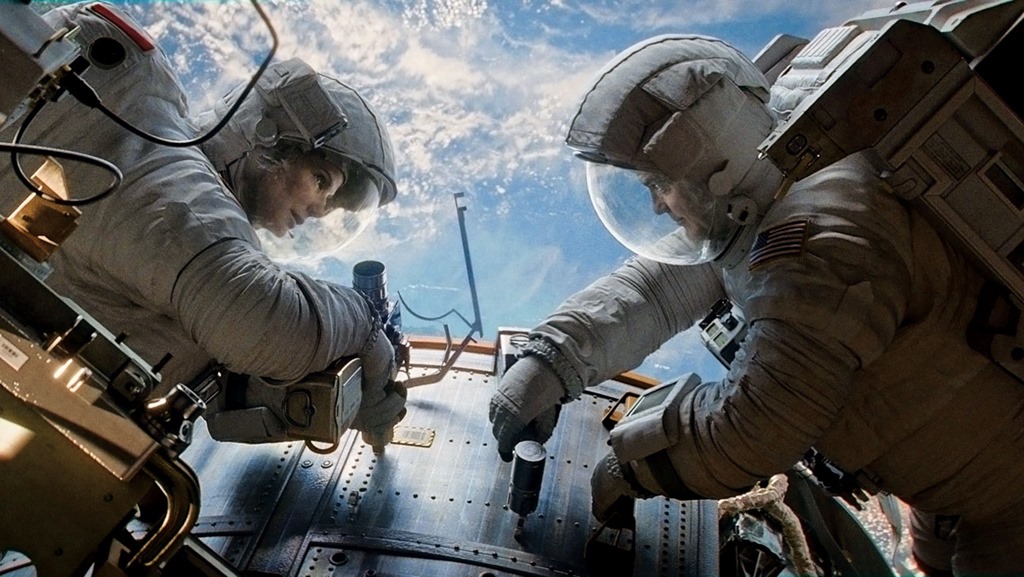
GRAVITY

Don’t get me wrong, Gravity isn’t literary or deep.  And although Bullock and Clooney give amazing performances, their characters were almost clichés.  How Gravity amazes is through simply gripping storytelling.  It is a story of survival, beating tremendous odds in a harsh environment.  And although Gravity wasn’t very scientific, Gravity felt very realistic.  Gravity was brilliantly science fiction in the same way Gattaca had been years ago, it was about a individual overcoming tremendous adversity in a science related setting.

Although in the last couple of decades we have had more and more female action heroes, I felt while watching Sandra Bullock that Gravity represented a paradigm shift, transforming story hero from male to female.  It didn’t feel like a gimmick that Ryan was a woman.

For the first hundred years of of filmmaking Ryan Stone would have been played by a male actor.  Ripley set the precedent, but when Ryan pulls herself out of the muck and stands, with the camera angle from the ground looking up at her towering figure, it felt that women had finally surpassed men at their own game.    It was much like Vincent beating the genetically enhanced humans when he took off into space at the end of Gattaca.

George Clooney plays the ultra-cocky space jock to a tee.  Matt Kowalski is perfectly at home in a vacuum.  Kowalski has the science down cold.  But more than that, he is mature way beyond his boyish antics.  He is an alpha male passing the baton to a female saying with total confidence, you can do this.  I know most viewers won’t see this film as a feminist statement.  Most girls won’t think twice about Sandra Bullock being the lead character.  But in real life and in movie life, things have changed a lot in my lifetime, but not nearly enough.

The message is clear, women can fly the fighters, drive the tanks, pilot the spacecraft, command the ships, shoot the M-16s, control the telescopes, construct the skyscrapers, etc., but it’s sad that so many women have MTV ambitions, like Miley Cyrus, to wear skimpy outfits and twerk.  Movies and television, the most heavy-duty of pop cultural social programming, sends the message that women can now do anything.  But will they?  And will we accept it?

If you think I’m making a pointless issue, then think about this.  What if our two actors were cast against type.  Would you have liked Sandra Bullock as the veteran space jock, and George Clooney as the mission specialist rookie?  We’re still brainwashed to think George Clooney should have played Matt.

Yes, we have made women into action heroes that can shoot and kill, but action heroes aren’t believable characters, they are cartoon characters.  How often are complex male roles given to female actors?  Would you have believed Sandra Bullock as Matt Kowalski?

Let’s put it another way.  I work at a university and the majority of the engineering and computer science students are male, and the majority of the teacher education and nursing students are female.

The role of Ryan Stone calls for a rookie, and most rookie astronauts are still male.  Picking a female to play Ryan is an intentional decision to make the character to appear more helpless because we’re still conditioned to think of women as helpless, or of needing help.  Gravity shows us we’re wrong. But being helpless is good in this movie, because good storytelling is about getting the audience to identify with the main character, and we’d all be essentially helpless in space.

Picking the name Ryan is an intentional choice too – Sandra Bullock is to stand in for a man.  I think that was a perfect choice by the writers of Gravity.  We’re cheering the stand-in for everyman who also happens to be everywoman.  Not only that, we’re all identifying with her, guys and gals.  While watching the movie I totally identified with Ryan Stone and not Matt Kowalski.  I never had the Right Stuff, but I might could have been Ryan Stone.

Maybe next time when they make a film like Gravity, the veteran space jock will be a woman, and it will be as natural as our need for air, but for now Sandra Bullock was perfect in this role.  Whatever is the magic formula for modern storytelling, Breaking Bad and Gravity have it down as well as Walter White cooks meth.

– – –

By the way, many people are nitpicking Gravity for scientific issues.  That’s cool.  But don’t let it keep you from seeing and enjoying an amazing film.  I was really disappointed with Neil DeGrasse Tyson because his complaints were rather lame compared to the problem of orbital mechanics.  Here are some things to read, but don’t get too hung up about them.  Gravity is a triumph of storytelling.  Like preconceived gender roles, we still want fiction with far more excitement than actual reality.  It’s hard to embrace perfect realism.

I expect gender roles to continue to evolve, and I expect incorporating realism into popular fiction to evolve too.  Breaking Bad was far more realistic than such a show would have been ten years ago, but in ten years, writers who will surpass the talents of the Breaking Bad team, will create a series about cooking meth that is far more realistic.  Gravity could have been just as exciting if it had been 100% scientifically accurate.  And I’m not dinging it for its scientific faults.  I’m just pointing out that we’re moving towards a kind of absolute realism in fiction, and that includes gender roles too.

Fact Checking Gravity

JWH  – 10/11/13

You Don’t Know Jack (Kerouac)

Jack Kerouac was born March 12, 1922 and died October 21, 1969.  Nearly all people who knew him in the 1st degree of separation has died – not all, but most.  In recent years, books by the women he knew have been coming out, revising the fiction and the facts.  Kerouac wrote roman à clef novels.  Kerouac and his friends appeared in other roman à clef novels. The same crowd also wrote and talked endlessly about their lives.  Countless biographies have been written.  Then friends and lovers started publishing their stories.  Kerouac has always been ground zero for the Beat movement, and trying to understand why is a fascinating snark hunt that ultimately reveals a lot about universal psychology and philosophy.

Recently Carolyn Cassady died.  She was Camille Moriarty in Jack Kerouac’s On the Road, wife to real-life Neal Cassady, who was Dean Moriarty in the book.  Carolyn wrote her own books, Heart Beat and Off the Road.  Jack Kerouac haunts me, so it saddens me to hear about Carolyn, who now becomes another of the Beat Generation ghosts.

Jack-Carolyn-and-kids

In 2011 Lu Anne Henderson, who was Marylou in On the Road, and Neal Cassady’s first wife, had her side of the story told in One and Only.  Like Carolyn, Lu Anne was the oxygen atom to Kerouac’s and Cassady’s hydrogen atoms.  Camille and Marylou were the pivotal women of On the Road, so to get their stories is very revealing, even creating new mysteries.

lu-anne-henderson-1947

Finally, there’s Joyce Johnson.  In 1999 she came out with Minor Characters:  A Beat Memoir, and then in 2000, Door Wide Open, a collection of letters between her and Kerouac, and finally in 2012 The Voice is All: The Lonely Victory of Jack Kerouac, a major biography.  Joyce knew Kerouac just before and after the publication of On the Road.

joyce_johnson

I often ask people:  Which would you rather do, write a great novel, or be a model for a character in a great novel?  Jack Kerouac wrote many novels and was a character in many more, and he has been the subject of many biographies.  Carolyn and Lu Anne were  featured characters in both the novels and biographies.

Jack Kerouac is a person I like to keep up with, even though he died in 1969, the year I graduated high school.  About every half decade I check out what new discoveries have been unearthed about his legend.  That’s the thing about legendary figures, they always evolve and mutate.  There is much to be learned about oneself by careful studying of other people.  Pick a person and try it out.  I find ambitious writers with lots of personal flaws to be quite revealing about life.  Jack Kerouac makes a particularly painful role model.

Most of Jack Kerouac’s novels are semi-autobiographical.  Many people read On the Road and never read another Kerouac novel – their curiosity for Beat life was quickly quenched.  A few more might go on to read The Dharma Bums, or even Big Sur or Visions of Cody, but for most readers, a little Kerouac goes a long way.  But if you’re like me, you keep reading books by and about Kerouac and the story changes as it becomes deeper.

Part of the problem is most readers think Kerouac equals the Beat Generation, and once they think they understand the Beats and reject their philosophy, because most do, they are through with Kerouac.  That’s too bad.  But to really know Jack, you have to separate him from the Beats and read him as one man trying to make literary sense of his reality.  Kerouac was on the edge of several social and literary movements, but because he was crowned King of the Beats, that’s all most people judge him by.

Some people study genealogy because they want to know about their ancestors, about their genes and blood.  Not me.  I consider myself a creation of pop culture, and I want to know my pop culture ancestors.  Who we are is our cultural history.  We’re all descendants of Judaism, Christianity, Greek philosophy, the Enlightenment, Science and a whole host of 19th and 20th century influences.  Most Baby Boomers focus on the 1960s, but to really know yourself requires getting to know the 1950s, 1940s and 1930s.  And to understand those times means studying the 1920s, 1910s and 1900s.  America is constantly changing and mutating.

I was born in 1951 and remember the 1950s.  My father died when I was 19, and I never really knew him.  He was born in 1920, and Jack Kerouac was born in 1922.  They both died miserable drunks a few months apart, both in Florida no less.  I use Kerouac to understand my father.  And to understand them both I need to understand the 1940s.

By the time the Beats got famous, their movement was already over, and had mutated into many new movements around the country. Go (1951) by John Clellon Holmes and On the Road (1957) by Kerouac, were the real Beat novels, and were about events a decade before the public discovered the Beats.  Kerouac was a character in Go, as was Neal Cassady.  Carolyn Cassady knew Kerouac in both the late 1940s and later in the 1950s, and her books, clarify the story.

The trouble with studying the Beats, is most of the documentation on them is about when they all got famous in the late 1950s.  What defined the Beats were their reaction to America in the late 1940s, but how we remember the Beats is defined by their public personalities of the late 1950s.  To understand Jack Kerouac means understanding American from 1945-1955, and even dividing that time into two parts.

Most people are shaped by their teen years, early twenties and late twenties, from 13-30.  Jack turned 20 in 1942, and 30 in 1952.  It’s those ten years that we want to get to know.  Later on, Jack tried to understand his own personal development by writing about his childhood, the 1930s.  It took a long time to get On the Road published, and by 1957 when it hit the scene, and defined the Beat Generation, Jack was 35, a burnout, living most of the time with his mother in Orlando, Florida, and committing slow suicide with a bottle.  He died at 47.  My father died at 49.  I was 19.

A good contemporary view of Kerouac in 1957 and 1958 is Door Wide Open by Joyce Johnson, a collection of letters between Johnson and Kerouac.  This is not the Kerouac of the 1940s.

There are people who never stop reading about Kerouac and the Beats.  This is hard to explain.  In a way, it’s like studying cosmology – there’s always more to discover.   First you are drawn to the excitement of rushing back and forth across America in the 1940s, but soon realize all this rushing is madness, that there is no normal life to be found.  You accept that poor Jack was a loser, a drunk, and the dazzling Neal Cassady was a low life hustler, con man, thief, and a man who would always let his wife, children and friends down, but they all loved him.

You walk away from the Beats thinking they were Nowheresville.  That’s too bad.  The real mystery is beyond the Hudson rushing across the plains at a 100 mph, the kicks, the drugs, smoking gigantic reefers in Mexican brothels, or following the mad ones Kerouac was so enamored with, but instead, we have to look over Neal’s shoulder’s to the American he was speeding by, to the couples they shared rides with, to people who own the cars they boosted, to the sane folks who saw them in the jazz joints acting like madmen.

hudson

If you’re lucky, you’ll read one of the biographies  and discover Jack is more complicated.  Slowly this Charlie Parker generation starts coming alive, and you begin to realize that the Beats weren’t Beatniks.  America is the sum of all its hidden histories, and not the history they teach you in school.  Reading books by the Beats, and books about the Beats, leads to exploring a different 1940s America than what we remember from It’s a Wonderful Life (1946), The Best Years of Our Lives (1946), The Bishop’s Wife (1947), Miracle on 34th Street (1947) – the films by which most Americans remember America from 1946-1950, which is the time covered in On the Road.  It’s not that those great films are wrong, but they are only one facet of a multifaceted view.

All novels have a gestation period.  On the Road was published in 1957, but was about events from the late 1940s.  The Catcher in the Rye was published in 1951, the year I was born, but was about the earlier 1940s.  Also published in 1951 was From Here to Eternity by James Jones, which was about 1941.  Zeroing in on On the Road’s America, isn’t easy.  It comes before The Man in the Gray Flannel Suit (1955) about 1953, but I think many readers picture Kerouac’s adventures happening around the time of its publication in 1957, just after Sputnik went into orbit, and thus the term Beatnik.  We think of the Beats as the generation before the Hippies, but in reality, they were the 1945-1950 youth, and the famous 60s generation happened between 1965-1975.  1955-1965 included the folk generation, as well as the early rock and roll kids – think Grease and American Graffiti.

By 1957, Kerouac was well on his way to being a full time drunk.  His short moment of fame gave him enough money to reignite his life and go on a few more road adventures, that were mostly lonely and pathetic.  Kerouac in Paris is very sad.

If Kerouac had an artistic vision that chronicled his spiritual quest for transcendence in America, it wasn’t about the end of the 1950s when he was famous, it was about his life between 1940 to 1955, and even earlier when he tried to reconstruct his childhood of the 1930s.  Strangely enough, the late 1950s was Ginsberg’s time, because of the Six Gallery reading in 1955, and the beginning of the San Francisco Renaissance.  Kerouac was there, but his involvement was waning.  Kerouac had been a part of a reactionary movement a decade earlier at Columbia, with his anti-academic friends.  By the mid-1950s Kerouac wasn’t a leader but a follower, inspired by younger writers like Gary Snyder, who inspired his interest in Zen, Buddhism, hiking, mountain climbing, and spiritual practices.  By then, Beats, Beatniks and proto-Hippies were everywhere.  The counter culture was a good sized snowball rolling down the hill that would become an avalanche in the 1960s.

What I want to know about is the counter culture of the 1940s and 1930s.  The radicalization of America in the 1960s didn’t start then – it started much earlier.  I think we’re currently living through times getting ready for another big social change.  Whether the 2010s will be the 1960s, when all hell broke loose, or the 1950s or 1940s when the seeds were planted, is still to be seen.

JWH – 10/6/13
The Weight of My Possessions

I own too much crap!  I’m no hoarder, but I still own too many unused, unwanted, unneeded things.  I hang onto to stuff believing I’ll need it for the future, but after six decades of experience, I’ve hardly ever needed what I saved.

I wish I had an app for my tablet that knew absolutely everything I owned and the last time I used it.  This is a fantasy app, because even if I had such an app, I’d never input all my crap to track.  I wished I had this fantasy app that magically knew everything I owned, when each thing was last used, and counters for all the categories of ownership.  I could contemplate iPossessions every morning when I woke up, and before I went to sleep at night, and it would inspire me to lighten my physical load, and theoretically, every day after that, my spirit would grow lighter.  Aren’t we psychologically burdened by ownership?

How many pair of pants do I own?  I tend to wear my three favorite pairs of jeans over and over.  Many other pairs of pants have hung on their hangers for years unworn.  Why?

I have about 700 hardback books and another 500 digital audio books, plus over a 100 and growing ebooks.  I know I will never read most of them, but I keep saving them.  And like an idiot I keep buying them!  I’m cleaning up my home library/office this morning trying to make more shelf space for books.  Either I need to buy another bookshelf, or get rid of about 20 feet of books stacked in piles around the house.

If you don’t know it exists, why own it?  If you don’t use it, why own it?  If you’re not using something and someone else could, why not give it away?

There are even websites devoted to reduced ownership, like The Minimalists.  Some people like Andrew Hyde, who is a traveler, takes this concept to extremes, he only owns 15 things.  I have no need to go that far, but maybe getting my list below 1,000 items might be a fun challenge.  I’m sure my current list would run more than 5,000.

Some people like to minimalize to save money, like Living on a Dime, which has articles like “How Many Clothes Do I Need?

There’s a website called The Burning House which asks people to submit a photograph and a list of things they would grab to save when their house is on fire.  Think about it!  What would you take?  Those items should be your real prized possessions.

If my house burned down, what would I miss?  What would I cry over not having ever again?  And how many things would I never know that I had lost?

Or think about it this way, what if your house burned down and you got a new one.  What possessions would you replace first?

[After this wonderful pep talk to self, I shall go forth and throw away! ]

{{I hope}}

JWH – 9/29/13