Leave It to Beaver (1957-1963)

by James Wallace Harris, 7/17/24

Susan and I are watching the entire run of Leave It to Beaver. We’re currently in the sixth and final season, about to finish all 234 episodes. We watch two episodes a night, so that means we’ll complete six years of the original broadcast in 117 days. Back then they had thirty-nine episodes per season.

We’ve watched Jerry Mathers (Beaver) and Tony Dow (Wally) grow up. When the series begun in 1957, Beaver was seven and in second grade. Wally was thirteen in the eighth grade. Six years apart, but six years later, Beaver was in the eighth, but Wally was in the twelfth, four years apart. Evidently, the producers didn’t want Wally going off to college. Mathers and Dow were only three years apart in age in real life. Dow was born in 1945, and Mathers in 1948.

Leave It to Beaver premiered on October 4, 1957, the same day that Sputnik I went into orbit. I had just entered first grade and was five. I don’t remember seeing Leave It to Beaver as a kid in the 1950s. It wasn’t until sometime in the 1960s that I saw an episode, and I didn’t see it often. Susan didn’t watch it as a kid either.

In other words, we’re not watching Leave It to Beaver for nostalgic reasons. I’m not sure why we got hooked on it. We were just looking around for something to watch, and I suggested the show as something pleasant we both might like. Susan doesn’t like shows with violence (although I’ve got her to watch the Fargo series recently). I think I picked Beaver because Susan loved watching Andy Griffith so much.

I do have nostalgic memories of family shows like Make Room for Daddy, Father Knows Best, The Donna Reed Show, The Adventures of Ozzie and Harriet, and My Three Sons from the late 1950s and early 1960s, so it’s odd we picked Leave It to Beaver. We even signed up for Peacock with no ads so we could watch it without ads.

I can’t promise that Leave It to Beaver is one of the greatest TV shows ever. It’s pleasant. We like the actors and characters. The stories are quite simple, very pro-family, very didactic. The stories are also repetitive. For example, there are several episodes about Beaver getting a pet he can’t keep, including an alligator, rat, donkey, and a very ugly monkey. There were many shows where Beaver friends convince him they should all go to school wearing something weird, like a sweatshirt with a horrible monster on it, or show up for a special event not wearing a coat and tie, and Beaver shows up as the gang planned but the others don’t, making him look stupid. Another common plot was for Beaver’s friends to talk him into doing something he shouldn’t.

Most of the episodes had a message. Often it was: When your parents tell you something it is for your own good. But fairly frequently, there were shows about how parents should listen to their kids sometimes, because sometimes their kids knew better.

I remember Leave It to Beaver being about only the kids, sort of like Peanuts. But half the show is about Ward and June. I guess as a kid I just didn’t pay attention to adults, either in real life or on TV.

One of my favorite episodes has Beaver getting in an argument with a bigger kid and uses a cuss word. Of course, the school bell rings when Beaver says the word, but his teacher, Miss Landers, heard what he said. Miss Landers is shocked and sternly informs Beaver he’s in big trouble. Miss Landers tells Beaver to bring a guardian to school to meet with her. Ward is off on a business trip, and Beaver can’t bring himself to tell June what he said, so he convinces Wally to come to school as his guardian. Miss Landers accepts Wally because she doesn’t want Beaver to tell June what he said either.

Even though we time travel back to the 1950s and early 1960s when we watch Leave It to Beaver, it doesn’t feel nostalgic. It feels more archeological. The show just reminds me of how things were so different back then.

I thought I’d find episodes I would remember but I haven’t. The closest any episode felt like I had seen it before was the one when Beaver and Wally play the stock market. I do remember as a kid watching a TV show where the kids learn about the stock market, but I can’t swear it was on Leave It to Beaver. Maybe it was, maybe it wasn’t.

Quite often while watching other old TV shows I’ll tell Susan, “Oh, I’ve seen this one.” But that’s never happened with Beaver. But the intros and closing credit scenes to all six seasons seem burned into my memory, but not the stories themselves. I guess I remember the visuals and not the plots.

It’s weird to watch a show from the first to the last episode. I’ve done that several times now. It’s also kind of painful. Older TV shows depended on every episode being entirely self-contained. This approach leant itself to formulaic scripts, which was true with Leave It to Beaver. I’ve read that Beaver was the first show to have a finale, which was a unique episode. But for the most part, there was a commonality to every other episode.

As far as I can remember every episode featured the staircase. Most featured front or back door meetings, breakfast table meetings, dinner table meetings, doing the dishes together, sitting around the bedroom, living room, or den. For most seasons we saw Ward and June kiss in each episode. That seemed to fall off in the last couple of seasons. All four of the main actors had standard facial expressions and used specific body language in every show.

One thing I remembered wrong was the Eddie Haskell (Ken Osmond) character. I remember him as a juvenile delinquent, the bad boy. But the show portrays him as a sympathetic loser, on the pathetic side, one who tries too hard, has too much ego, and probably has bad parents.

Beaver had very few guest stars, which was what I enjoyed when watching the entire nine years of Perry Mason. However, a few of the actors, like Miss Landers (Sue Randall) I’ve seen on other shows. I saw her on Perry Mason. Of course, Fred Rutherford (Richard Deacon) went on to be Mel on The Dick Van Dyke Show.

Watching old TV shows from the 1950s and 1960s reveals an alternate reality that we all observed back then. The Beaver often mentioned the TV shows that were on when Leave It to Beaver was on the air, even making inside jokes about the competition. And to a degree it makes fun of other pop culture of the 1950s and 1960s. But it was very gentle. I even saw a science fiction magazine a couple of times. I’ve often wondered when science fiction was first mentioned in pop culture.

The show covered the phases of childhood and adolescence that kids were going through back in the 1950s and early 1960s. Leave It to Beaver went off the air in 1963, before the famous Sixties began. This photo meme on Facebook conveys that stark change perfectly.

Watching Leave It to Beaver explores the times before that cultural shift.

JWH

What Makes a Great Book Great?

by James Wallace Harris, 7/13/24

The New York Times has made quite a splash with its interactive feature 100 Best Books of the 21st Century. The list was created by polling 503 writers, critics, and other book lovers to vote for their top ten books of the 21st century. The final one hundred were the most popular books among all the 503 voters. The NY Times site allowed their readers to mark which books they’ve read from the one hundred, and which books they wanted to read. Here’s my tally:

But I must ask the question: What makes a great book great? Were these just the most popular books read by writers and critics? Does that make them great? Dozens of nominators allowed the NY Times to publish their ballot, which lets us readers understand what kind of books everyone liked in general. You can read their ballots here. This also reveals books that didn’t make it to the final one hundred list, and I’ve read many of them too.

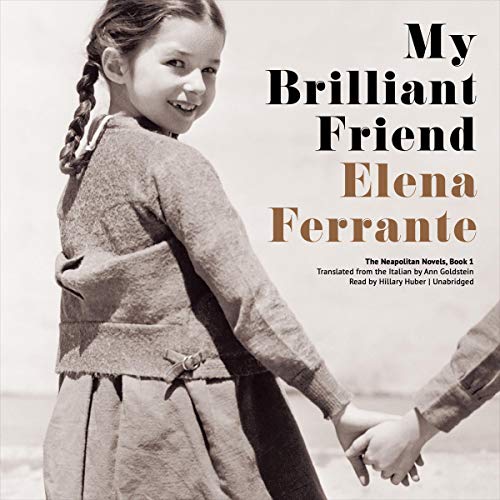
The #1 most voted for book is My Brilliant Friend by Elena Ferrante. I’ve tried reading it, and I’ve tried listening to it, and even tried watching the miniseries based on it, and never finished any attempt. I’m not saying it was bad, but it just didn’t hook me.

The #2 most voted for book is The Warmth of Other Suns by Isabel Wilkerson, which I have read and consider one of the best books I’ve ever read. It’s a monumental nonfiction book that took Wilkerson a decade to write. It’s a history of the migration of African Americans from the South to the North between 1915 and 1970.

The Warmth of Other Suns would be the archetype of a great book in my mind. From it, can I define what qualities go into a great book? Well, first, a great book must cover a great subject. I would say, a great work of nonfiction needs to leave me feeling like I’ve learned something profound about reality. By that measure, I can quickly fill up my top ten great books of the 20th century with these titles leaving no room for fiction:

  1. The Warmth of Other Suns by Isabel Wilkerson
  2. The Information by James Geick
  3. Jesus Before the Gospels by Bart D. Ehrman
  4. An Immense World by Ed Yong
  5. The Invention of Nature by Andrea Wulf
  6. Behind the Beautiful Forevers by Katherine Boo
  7. The Order of Time by Carlo Rovelli
  8. Fantasyland by Kurt Andersen
  9. Dark Money by Jane Mayer
  10. The Code Breaker by Walter Isaacson

And this is just from a quick look at my bookshelves. If I studied my reading log of books read published after 1/1/2000 I’d probably find plenty more to compete for the top ten spots.

All ten books above have the qualities I’d consider needed to make a great book, but the reality is that’s because they’re nonfiction. Fiction often deals with historical, scientific, and philosophical topics, but do they deal with them honestly? Does reading a novel about racism or inequality have the same impact and value as reading a nonfiction book about the subject?

Greatness is much harder to evaluate in fiction. I read a lot of science fiction, but I’d never but consider it great literature. None of the novels I’ve read in the NY Times 100 list are great in my mind. I might call them great reads because they were entertaining and page turners, but I’m not sure I’d reread any of them.

I love the novels by Elizabeth Strout but are they great? Olive Kitteridge made the list, and it’s probably favorite of the novels that did, but is it better than Strout’s other novels? I think I like Olive, Again, and Lucy by the Sea even more. Franzen’s The Corrections got on the list, it’s my least favorite of his books. I’m partial to Crossroads. And as much as I liked Richard Powers’ The Overstory, I much prefer Bewilderment.

I’m not sure if greatness in fiction can be recognized so soon. It might take a century, or at least a half-century. I reread older novels. I’ve read On the Road by Jack Kerouac and The Sun Also Rises by Ernest Hemingway three times each. They go in and out of fashion. I’m not even sure if I think they’re great, but I keep reading them and reading about them. Is that the mark of greatness in fiction?

I wish the Times had three different Top 100 lists for the 21st century. Novels, Nonfiction, and Memoirs/Biographies. Memoirs like In the Darkroom by Susan Faludi, The Year of Magical Thinking by Joan Didion, Between the World and Me by Ta-Nehisi Coates, and Educated by Tara Westover are far more powerful to me than any of the novels.

For me, major nonfiction works trump memoirs in the greatness impact. But then memoirs are far more impactful to me than novels. I don’t know why novels get all the fame. However, nonfiction works seldom stay in print. As great as The Warmth of Other Suns might be, will it be read often fifty years from now? And that’s also true for memoirs. Biographies tend to last a bit longer, until someone writes a new definitive biography on the subject.

Most books are forgotten. Of all the novels listed in the final list and from the nomination lists, how many will be read after 2050? I was blown away by Middlesex when it came out, but I just don’t feel like rereading it. I’m looking forward to rereading Olive Kitteridge (and the other Strout books). And I’m looking forward to rereading a few other novels from 2000-2024 someday, probably Lessons in Chemistry, A Gentleman in Moscow, and Bewilderment. Is that a factor that designates them as great? I don’t know.

I also think age is a factor when considering novels great. When we’re young, any novel that’s exciting to read is great. I don’t know if that’s true now that I’m in my social security years. In the last third of life, greatness in books seems to equate with resonating with what I’ve learned throughout my lifetime. Whether with fiction or nonfiction, it must reveal something that makes me think, “Oh wow, that’s so damn insightful.” Entertaining is a big plus, but it doesn’t count for much in judging a book great.

Nonfiction must be great in terms of understanding reality, while fiction must be great in terms of understanding being human. Now that I’m getting old, I think the tide is turning against fiction, which might be why I’m so hard on it now.

JWH

When Tsundoku Meets Döstädning

by James Wallace Harris, 7/9/24

Tsundoku is a Japanese term for buying books and magazines far faster than you can read them. Döstädning is a concept from Sweden that translates into death cleaning, advice for how to get rid of your stuff before making other people do it after you die.

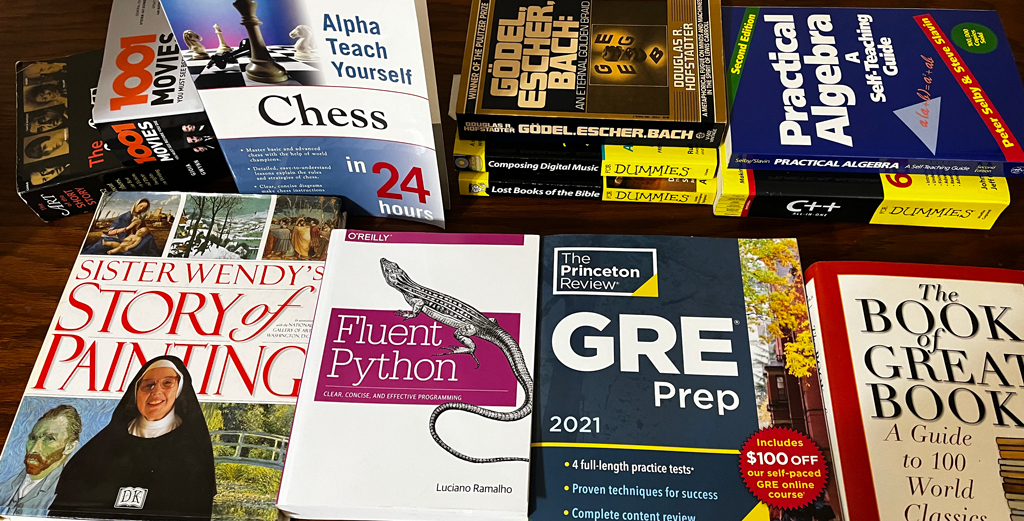
At 72, I figure it’s my time to turn the tide of tsundoku into a wave of döstädning. Last year I took many shopping bags of books to give to the Friends of the Library so I could shelve every book in my house. I had finally reached the equilibrium of perfectly filled bookshelves with no books lying on desks, tables, nightstands, or floors. It felt so good.

Today I gathered all the books lying on desks, tables, nightstands, and floors and had to stack them on top of my bookshelves again. I’m losing the battle with tsundoku again.

I don’t get out much anymore. I take my turn going to the grocery store every other week, and I go to the Friends of the Library Bookstore once a week. I buy books I think I want to read before I die, but I’ve already own enough books to last me until the middle of the twenty-second century.

Instead of coming home with two or three books every week from the Friends of the Library Bookstore I need to take two or three books to donate. That would still give me an outing every week. I guess I could continue to buy books so long as I always donated more books than I purchase.

If I knew some Japanese and Swedish people, I’d ask them to produce a phrase that means “döstädning my tsundoku.”

I need to develop a system for death cleansing my bookshelves. One idea came to me while reading A Gentleman in Moscow by Amor Towles. The story is about a Russian aristocrat, Count Alexander Rostov, who is sentenced to life imprisonment in the Metropol hotel after the Russian revolution. But instead of remaining in his luxury suite, Count Rostov is forced to live in a tiny garret once used by the servants of the aristocracy. He keeps one book with him to read, Michel de Montaigne’s Essays. What a wonderful book to read in that situation.

That reminded me I needed to finish my copy of Montaigne’s complete essays.

And it gave me another idea too. I need to read books that are most suited for an aging guy waiting for the guy with the scythe to show up. Books that make me feel philosophical positive about my life and help me understand the decline of civilization. I feel A Gentleman in Moscow is most suited. I would call it a fairytale for old folks, something Charles Dicken, Robert Louis Stevenson, and Tolstoy might have collaborated on if they were living in our century. It is a delightful yarn about a man growing old imprisoned in a hotel while the twentieth century changed outside his window.

I need to start thinning my book collection of books aimed at young people, unless they are books I read when I was young and want to remember them from an aged vantage point.

I need to read books that make me feel good about getting older. I need to jettison books that don’t deserve to be among the last books I read. Even if I live another couple of decades, I doubt I can squeeze in more than a thousand books, and that leaves me a couple thousand to abandon. If I live only another five years, I might finish 250 reading at my peak pace when I was younger, but more than likely, less than two hundred, since I’m now reading less every year.

Some days I don’t feel like I’ll make it to eighty, and on other days feel, gee, I might make it to ninety. I need to save those books suitable for someone in their 70s or 80s, and thin out the others.

It would be fun to see my library shrink over time, each year further distilled into a smaller collection of greater books, so in my last year I read only classics that fully reveal their depths to readers about to depart this planet.

Now, I think I have a system I can work with. It sounds logical and doable. I’ll have to report back in the future if it works. When I get in there pulling out books one by one, and asking myself if they are worthy of reading in my elder years, I might think every volume I already own is perfectly suited.

JWH

What I See Outside My Window vs. What I See on My TV Screen

by James Wallace Harris, 7/5/24

The picture above was taken from my dining room window. Not much is happening. It’s quiet and peaceful. In my den, looking through the sixty-five inch window of my television screen, I see so much turmoil and suffering. The fall of civilization is what’s happening.

One of my favorite novels is called The Door into Summer because the cat in the story hates New England winters and asks to see what’s out every door hoping to find one that leads to summer. I can open my front door and walk out into summer. It’s 77 degrees outside right now – not bad at all for July in a year that might become the hottest year on record. So, why do I spend my days watching television when all it does is to depress me?

The need to know what’s happening is a burden. The belief that I can control anything through knowing more is an illusion and deception. However, there are wars going on all around me and I don’t know if I can sit them out. My friend Anne lives in a nice neighborhood too, but last week there was a shooting at the house one over from hers. Yesterday was the 4th of July, and we heard plenty of fireworks. But we also heard plenty of guys shooting off their guns.

Crime and climate change are getting nearer all the time. What if I looked out my window and saw this:

Thousands of people are seeing this everyday around the world because of hurricanes, tornadoes, floods, and fires. In a decade it could be millions seeing such sites every day. Can we learn anything to avoid that future?

There is a cultural war happening all over the world and the battles are being fought in polling booths. Popularism wants to rewind the clock on progressive progress. To understand this, watch this talk by David Brooks. It’s one of the most uplifting things I’ve seen on my television screen in a very long time.

If you listen to Brooks, you’ll understand what the conservatives want to do with their Project 2025 plan and why. They believe it is their door into summer. If they succeed, I believe 1/20/2025 will be remembered like 4/12/1861 or 6/28/1914. It would be so much easier for my mental health to quit watching TV, but is that really an option? I can understand why Christians are fighting so hard for their way of life. I would have no problem surviving in their utopia if they got everything they wanted. But millions of people wouldn’t, and it will lead to civil war and self-destruction.

The world is going nuts while the environment is going down the drain. On one hand, I can’t stop watching this slow-motion apocalypse. One the other hand, I just want to look out my window or read a science fiction novel.

JWH

I Want to Argue with Carlo Rovelli

by James Wallace Harris, 7/1/24

Can I understand science if I’m not a scientist? I read popular science books, but that doesn’t mean I understand the work that went into making the scientific discoveries they report on. However, is it possible for me to intuit what popular science writers are describing?

I’ve been thinking a lot about the concept of Universal Now. What is this thing we call now? How is it different from the past and future? But the most important question that’s driving me crazy is: Is it now everywhere in the universe at the same time? But then, what is time? I went looking for a book that might answer these questions and found The Order of Time by Carlo Rovelli. I discovered that book from finding the article “Now Means Nothing: How Time Works in Our Universe” online. It was taken from The Order of Time.

This passage tangles up my brain:

Now Means Nothing 

What is happening now in a distant place? Imagine, for example, your sister has gone to Proxima b, the recently discovered planet that orbits a star approximately 4 light-years away from us. What is your sister doing now on Proxima b?

The only correct answer is that the question makes no sense. It’s like asking, “What is here, in Peking?” when we are in Venice. It makes no sense, because if I use the word “here” in Venice, I am referring to a place in Venice, not in Peking.

If you ask what your sister, who is in the room with you, is doing now, the answer is usually an easy one: You look at her, and you can tell. If she’s far away, you phone her and ask what she’s doing. But take care: If you look at your sister, you’re receiving light that travels from her to your eyes. That light takes time to reach you — let’s say a few nanoseconds, a tiny fraction of a second. Therefore, you’re not quite seeing what she’s doing now but what she was doing a few nanoseconds ago. If she’s in New York and you phone her from Liverpool, her voice takes a few milliseconds to reach you, so the most you can claim to know is what your sister was up to a few milliseconds ago. Not a significant difference, perhaps.

What does it mean, this “modification of the structure of time”? Precisely the slowing of time described above. A mass slows down time around itself. The Earth is a large mass and slows down time in its vicinity. It does so more in the plains and less in the mountains, because the plains are closer to it. This is why the friend who stays at sea level ages more slowly.

Therefore, if things fall, it is due to this slowing of time. Where time passes uniformly, in interplanetary space, things don’t fall — they float. Here on the surface of our planet, on the other hand, things fall downward because, down there, time is slowed by the Earth.

Hence, even though we cannot easily observe it, the slowing of time nevertheless has crucial effects: Things fall because of it, and it allows us to keep our feet firmly on the ground. If our feet adhere to the pavement, it is because our whole body inclines naturally to where time runs more slowly — and time passes more slowly for your feet than it does for your head.

Does this seem strange? It’s like when watching the sun set, disappearing slowly behind distant clouds, we suddenly remember that it’s not the sun that’s moving but the Earth that’s spinning. And we envision our entire planet — and ourselves with it — rotating backward, away from the sun.

I really dislike that answer. It goes against my sense of intuitive logic. I can understand that time is relative. I can even understand that it’s impossible for us to know what’s happening on Proxima b because of the speed limit of light at any given moment. But I refuse to believe that if Proxima b still exists, that the same now I’m experiencing isn’t occurring there too. Any sentient being will experience the moment of now at a different rate, but don’t we all exist in the same Universal Now?

To me, it feels natural to think of the universe as one giant entity that is evolving/growing. I can accept that time is variable in separate places within this entity, but I feel there is a Universal Now everywhere. Only it’s perceived at different speeds. And that’s okay. I don’t expect us to be in sync in our sentient awareness of the Universal Now.

For example, a hummingbird perceives time differently from people. We seem to be slow moving to it. A computer with a clock with operates at trillions of cycles per second will see time differently too. Just because we each perceive time differently, doesn’t mean we don’t all experience it in the same Universal Now.

I have read that the Big Bang didn’t occur in an infinite void, that space and time were created with the Big Bang. I picture the universe as one cosmic system that evolves/grows. Time evidently is the awareness of change/growth at any given point. That if stars were sentient, they’d feel time differently than we do, or if bacteria could sense change, or if humans were traveling at different speeds, every perspective would sense time differently. But that doesn’t mean it isn’t happening in one Universal Now. I just can’t grasp what Ravelli is saying.

Everything that can perceive time doesn’t perceive it in the same way, but I believe they all exist together and there is one now they are all reacting to.

If my sister Becky went to Proxima b, and we had an ansible (a science fictional communication device that can transmit and receive instantaneously from anywhere), Becky and I could have a conversation in this Universal Now that I’m talking about.

Now if Becky were on a spaceship going near the speed of light, our voices would change. I would speak so fast she couldn’t comprehend me, and she would speak so slowly I couldn’t understand her either. But if the ansible had a record feature, my message could be slowed down, and hers could be speeded up.

I’d have the same problem if I was talking with a star or a bacteria (ignoring the language barrier).

If I was on Earth, and Becky was on her way to Proxima b, and I thought, “I wonder what Becky is doing now?” Becky would being doing something.

If time is relative, and it is unfolding at different speeds, I can’t help but think, “What is it unfolding into?” To me, that’s a Universal Now, the same kind of place that spacetime unfolds into, some kind of existential nothingness. If the universe is expanding, isn’t that the same as growing? And if time is unfolding, isn’t that a kind of growing too? Maybe it’s even the same. Maybe the Now I’m talking about, and the Nothingness that spacetime is expanding into, are the same thing.

To humans, time is sensing change. It is perceived at different rates. Without an ansible, I can’t know what Becky is doing on Proxima b because it would take over four years to learn whatever it was. Where I disagree with Carlo Ravelli is Becky isn’t experiencing the same Universal Now I’m experiencing.

I can comprehend why time is relative and why different sentient beings would perceive it differently. I just can’t understand why there isn’t one Universal Now that spacetime isn’t unfolding into.

As I write this, I assume Carlo Ravelli is experiencing the same Universal Now. I can’t know what he’s doing, or what time it might be, but if he’s alive, he’s doing something, and he’s feeling time unfold at the same time I’m feeling it unfold.

And if there are multiverses. I think they all exist in the same Universal Now. I can’t understand why there isn’t nothing rather than something. But no matter how many universes or dimensions there are, I’d like to think they are all in one Universal Now. It would hurt my mind too much to imagine multiple creations.

JWH