Remembering Pulp Science Fiction

By James Wallace Harris, Saturday, February 20, 2016

I grew up reading science fiction written by writers who grew up with pulp magazines. That generation assembled anthologies in the late 40s and early 50s of their favorite stories from Amazing, Astounding, Thrilling Wonder, Planet Stories, Unknown and other legendary pulps. Reading those anthologies was like listening to the old Blues records in the 1960s that inspired The Rolling Stones. Those anthologies put me one generation from the pulp era when I started reading science fiction in the early 1960s. As a kid, I’d haunt the gloomy backroom stacks of the downtown Miami Public Library searching out musty old collections by Groff Conklin.

I think we all remember how popular culture impacted us between ages twelve and twenty. Did you remember how your pop culture heroes were slightly older? Maybe you even paid attention to their influences, who was one generation older still. In other words, our favorite books and songs were usually created by the folks from the two previous generations. And depending on your age, you might have noticed that you aren’t keeping up with current pop culture. Some folks can stay hip with the generation after themselves, and a smaller number can keep up with one more generation, but eventually we become clueless about what’s new and cool. Most people have a pop culture window of four or five generations depending on their age. Of course I know some people stuck in a two-generation window.

For example, my generation, the Baby Boomers, loved The Beatles, but John, Paul, George and Ringo were not Baby Boomers. They were from the previous generation, and they were inspired by music produced from even an earlier generation. There’s a trailing off affect in both directions of time.
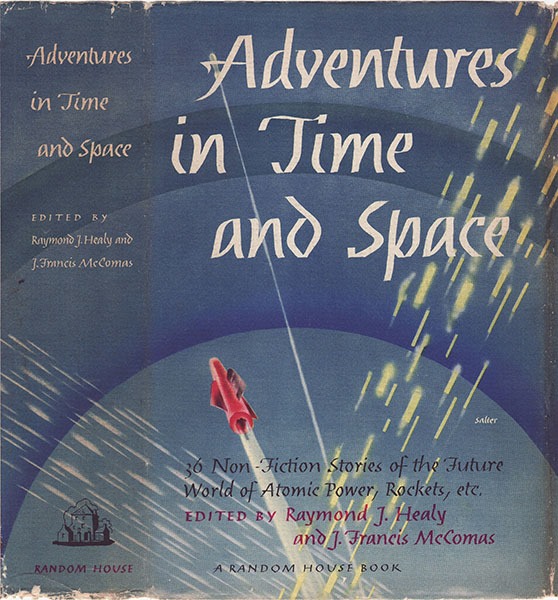
Adventures in Time and SpaceA Treasury of Science Fiction

This chart represents the distribution of SF short stories in several famous anthologies from 1946-1995 that I remember reading.

Year 1920s 1930s 1940s 1950s 1960s 1970s 1980s 1990s
1946 2 13 22          
1948 1 6 23          
1950 3 4 16 7        
1952 2 6 12 22        
1959   1 7 16        
1965   3 12 4 2      
1970   3 10 12 1      
1973     3 29 4      
1974   2 1 7 8 3    
1979 3 8 10 11 14 3    
1980     5 15 11 8    
1981   1 7 16 7 9    
1995     2 5 4 12 15 4

Women of Wonder 1Women of Wonder 2

If you click on the above titles the link will take you to ISFDB.org where you can see the actual story titles in the anthology. As you can see, over time, anthologists started forgetting about the 1920s, then the 1930s. I consider the pulp era over by 1949, and that the digest magazines of the 1950s were a horse of a different color. The digest era is slowly dying out today, being replaced by online magazines. If you’re old enough, this is kind of sad.

When I was growing up in the 1960s it wasn’t hard to run across old pulp magazines. You’d see stacks of them in old bookstores, or I’d meet men who are my age now, who collected runs of their favorite science fiction magazines from the 1920s, 1930s and 1940s. They nostalgically collected Amazing Stories, Astounding Science Fiction and Planet Stories that meant so much to them when they were young. Sometimes I’d meet older guys, and they were always guys, who collected All-Story and Argosy from the beginning of the 20th century. And even older still, and these guys were extremely rare, were collectors of dime novels from the 19th century. It’s been decades since I met a dime novel aficionado, or even an old guy who collects Argosy. I still run across guys who collect Astounding or Unknown, but they are fading away like old WWII vets. Out on the net, if you search for them, you can still find fanatical pulp collectors, but I’m afraid their species is becoming extinct. Folks my age, and that does include some rare women, prefer to collect the digests like F&SF, If, Galaxy and Astounding.
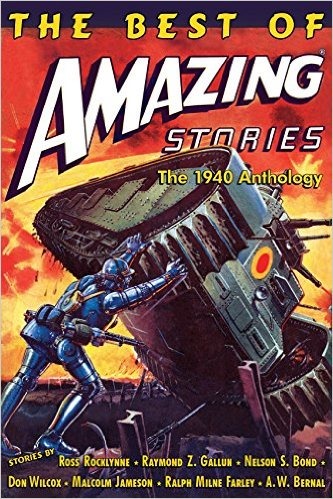
Amazing Stories 1940STARTLING-STORIES-42.09

I don’t know how many fans of pulps still exist, but I see reprints of pulps at Project Gutenberg and Internet Archive, and run into guys who collect scans of old pulps as digital files. I used to buy old pulps occasionally, but eventually gave them all away. Every once in a blue moon I like to buy an anthology that resurrects the old stories. Last night I bought The Best of Amazing Stories: The 1940 Anthology. Amazing Stories still exist, in case you didn’t know. And I noticed that facsimile editions of old pulps have started showing up on Amazon for $12.95 or $14.95. (However, you can sometimes find the original issues for less on Ebay.)

If I collected old digest magazines, I’d be tempted by the Cele Goldsmith and Ted White runs of Amazing and Fantastic from the 1960s or early 1970s, or F&SF and Galaxy from the 1950s. However, it’s a pain to deal with old magazines because they are all decaying. Pulps existed before acid free paper, so they’re quickly disintegrating. I also assumed they’d disappear as the generation of collectors before me died off. So I’m surprised that people still love pulp SF. There’s now four generations between the current new generation and the pulp generations. You’d think they’d be forgotten by now.

But is all this interest in old SF pulps from people my age, or are newer generations searching them out? I recently came across The Time Traveler’s Almanac, edited by Jeff and Ann VanderMeer. The VanderMeers appear to be early Generation X, and their anthology had a few pre-1950 stories in it. One of my favorites is “Vintage Season” by Henry Kuttner and C. L. Moore, but it’s one of the most anthologized stories of all SF stories from the pulp era. I guess a few pulp fiction stories will become classics.

Interest is short stories seems to be declining but it’s hard to tell. Every year Gardner Dozois reports on the decline of subscriptions to the printed digest magazines. I don’t know how many people are reading web magazines. Studying ISFDB shows there were over 400 anthologies in 2014, when The Time Traveler’s Almanac came out.

When I first discovered science fiction, the short story was the heart of the genre. That seemed to be a legacy of the pulps and the digests. For 50 plus years I get all the major best-of-the-year anthologies and it seems that people still love short stories, even though I know damn few people who read them. Most of the genre fans I know love to read novels, especially novels that come in long series. And some of my friends are obsessed by giant books that go on forever, like The Wheel of Time series.

Tonight I read “The Voyage That Lasted 600 Years” by Don Wilcox, which Wikipedia claims is the first story about a generation space ship, coming out a year before Heinlein’s “Universe.” It’s a quaint tale, that’s not very well told, but was probably very exciting back in 1940, and obviously, it presented ideas that inspired later authors of generation ship stories. I should be reading new stories, which are more sophisticated in their storytelling, and have better science, but sometimes it’s fun to read the old tales from the early days of science fiction.

What’s been fun lately is to find even older stories. I recently reread “The Machine Stops” by E. M. Forster, from 1909. It anticipates the Internet Age rather creepily, and might have inspired Asimov’s The Naked Sun. When I was a kid, I thought the science fiction I read represented new ideas. Now that I’m old, jumping back in time, I’m finding those ideas were old when I thought they were new. I’m currently haunted by the notion that ideas we think of as science fiction has always been around, maybe even before recorded history, and a small percentage of the population always had a sense of wonder.

JWH
Can Science Fiction Save Us?

By James Wallace Harris, Friday, February 12, 2016

Science fiction has always used world-wide worries to inspire story ideas, and since we have more problems than ever, no science fiction writer should have writer’s block. Science fiction about climate change is a growing sub-genre, and our lists of future-shaking events keeps growing. Any current concern in the news can be extrapolated into the future, becoming a muse for science fiction. But how effective is fiction at solving real world problems? Can science fiction save us?

When I was growing up the future was so bright we had to wear mirror shades. Now, our tomorrows are clouded over by menacing speculative storms. Most of the 7.3 billion passengers on spaceship Earth are so preoccupied with their day-to-day survival that any thoughts about the future are reserved for escapes into imaginary wonderlands. And I can dig that too — who desires realism when its dreary? Anyone who has seen Sullivan’s Travels, a Preston Sturges film about The Great Depression misery, knows that people don’t want stories with messages, but stories that let you forget your problems. I assume Lois McMaster Bujold has more fans than Paolo Bacigalupi.

dark clouds 3

Science fiction has always taken two paths. The first, and most common, is to entertain. The second, and harder to travel, is to philosophize about the discoveries of science and imagine what they mean to the future. Science fiction has always produced wild speculations, but for most of its history, was never taken seriously. SF was often ridiculed, even though it can be considered a cognitive tool for a highly specific task. Serious science fiction can warn us about emerging dangers through extrapolation, but it also has the potential to create desired goals with creative speculation.

Yet, I’ve got to wonder if science fiction can save us. When I was growing up you’d hide your Heinlein inside a copy of Lady Chatterley’s Lover to avoid the embarrassment of being caught reading science fiction. Science fiction was childish fantasies for weirdo kids. Trufans rationalized science fiction was serious stuff, claiming it prepared readers for the future, but that was mostly laughed at. Things changed May 25, 1977 when Star Wars came out, and science fiction became the favorite form of fairy tale for the information age. Now, billions say they love Sci-Fi, but few take it seriously. Should they?

The future is shaping up to be everything we never wanted. Maybe it’s time to reconsider’s science fiction’s role. Christians believe that studying the teachings of Jesus can save people, at least after they die. I’d like to believe studying science fiction could save our species before we reach self-extinction. I’m not asking that science fiction become boring and pedantic. I’m just wondering if it’s possible for science fiction to imagine desirable futures that are sustainable. Project Hieroglyph was one attempt.

Novels like Among Others by Jo Walton and All the Birds in the Sky by Charlie Jane Anders convey how painful it used to be growing up nerdy. SF fans were outcasts. In my day they’d call us zeroes. But now that the geeks have inherited the Earth, science fiction fans seemed to have taken over the world. Is its appeal large enough to be influential? Science fiction must compete with two older literary traditions, The Bible and The Quran, for explaining reality. Science offers the only consistent explanation of reality, but evidently the majority of folks on this planet can’t comprehend it. Science fiction is only slightly more rigorous than religion, but it might be a step in the right direction since religion desperately seeks to focus on the past.

Just because pop culture has embraced comics and science fiction, doesn’t mean they have social impact. Can any novel change society? Maybe. Consider George Orwell’s Nineteen Eighty-Four. That tale of Big Brother and newspeak did more to undermine communism than all the John Birchers put together. Uncle Tom’s Cabin by Harriet Beecher Stowe shamed a nation against slavery, so we know novels can help reshape morality. How many Victorian minds were blown by H. G. Wells? And didn’t Catch-22, M*A*S*H and Slaughterhouse-Five convince many Americans to turn against the Vietnam War?

Every day the mass media brings us more stories about how the future is going to bring humanity retribution for its evil ways. Political conservatives and faithful fundamentalists from around the globe have dedicated themselves to denying science. If billions refuse to listen to scientists, why should they pay attention to science fiction? Christianity uses Hell as an effective tool to sell salvation, so why doesn’t frightening futures work for science fiction? Of course Christianity has made the purchase price of salvation so ridiculously cheap that most people figure why not buy. Saying “I believe” is a micro-payment compared to the painful expense of self-disciplining our souls.

Where the rubber hits the road to tomorrowland is the fact that we all need to change the way we live. Most people can’t lose weight even when the incentive is not to die a miserable death. As a species we’re very adaptable at surviving in diverse environments, but we can’t adapt ourselves to stabilize the environment. In 1968, I read Stand On Zanzibar by John Brunner. I was horrified by his vision of 2010. Brunner claimed two common themes would exist, worldwide terrorism, as well as daily TV news stories about crazed individuals committing mass killings. I really didn’t want to grow up to live in that future. But we all have. Could we have studied Brunner in the sixties to avoid the now in which we live? Brunner didn’t offer any prophecy. By the way, prophecy isn’t about predicting the future, but about convincing people how to live, so as to create a desired future. Can any science fiction novel be truly prophetic? Science fiction can create elaborate extrapolations leading to scary tomorrows, but can it find paths to greener pastures?

How often has the fate of the Earth been the plot driver of science fiction? 99% of the purpose of science fiction is entertainment, and even that 1% of serious speculation needs to be entertaining secondarily. Some science fiction writers have been prophets. Unfortunately, as people who read The Bible know, few people listen to prophets, which probably answers my title question.

I bring up this question now after reading All the Birds in the Sky by Charlie Jane Anders, the first SF/F book I’ve read for 2016. Anders’ book is getting great reviews and buzz around the net. It’s a wonderful YA/SF/F/Literary mashup about many things, including the forces of magic and the forces of science separately fighting climate change. Not to give anything away, but I found their desperate solutions rather horrifying, which I think was Anders intention, but other recent science fiction stories have also come up with similar solutions that are even scarier.

The most extreme example is Interstellar, which preaches sacrificing all to build spaceships to seed other worlds before Earth collapses. Their logic is we’ve used up Earth, so let’s abandon it and go find a new home. There was never any suggestion that we try to save our planet. It’s the ultimate example of disposable consumerism. Our home world is a used Kleenex, so toss it out and get a new one.

In Seveneves, the latest novel by Neal Stephenson, the Earth is destroyed by an astronomical event, but humans were given enough time to build a fleet of Noah’s arks in space. This avoids the ethical issue of self-destruction. The story is extremely optimistic about our technological potential. But one of the common reasons now given to justify the colonization of other worlds is that we need to get all our genetic eggs out of one basket. Even scientists like Stephen Hawking are promoting this idea. And it’s logical. We could claim that science fiction inspired this philosophy. If we ever spend the money to colonize the Moon or Mars, we can give science fiction the credit. However, humans haven’t left Low-Earth orbit for over forty years, even after an explosion of science fiction popularity since the last man walked on the Moon. Taking care of Earth should be our prime priority — but it seldom is in science fiction. When will everyone realize that Earth might be our only home for millions of years?

We’re starting to see more science fiction deal with climate change. One very vivid novel last year, The Water Knife by Paolo Bacigalupi, focused on water wars. Bacigalupi doesn’t offer any instructions on how to avoid that future, but does paint such a scary picture of climate change’s side-effects that he’s trying to scare us straight. The novel got some good reviews, but I’ve yet to meet anyone else who’s read it and haven’t heard any buzz about it on the net.

Is preaching fire and brimstone futures the only tool science fiction has to convince us to avoid our life of sin? And let’s fess up here, climate change, mass extinction, polluted land, sea and sky, economic inequality, sexism, racism, xenophobia, and all the rest, are our sins. Yes, the world sometimes ends in a comet collision, gamma-ray burst or super-volcano eruption, but most of the time, Earth gets trashed by us.

There’s a growing library of climate change science fiction (Cli-Fi). But will reading such stories make us consume fewer resources? How many people read science fiction? Well, not that many. But multitudes go to the movies to see science fiction. What if HBO offered a mini-series based on The Windup Girl by Paolo Bacigalupi? Would it influence politics and lifestyle? The Windup Girl illustrates the results of climate change, monoculture farming, and using up all the oil. Even though it’s a very colorful future, it’s not one that most people would visit if they had a time machine.

All the governments around the world are working on reducing C02 in the atmosphere. Ninety-eight percent of the scientists and a large percentage of the general population know about the dangers of increase C02. The problem is many people refuse to believe there is a problem, including the Republican Party. Would more science fiction illustrating what life might be like after “visiting the iniquity of the fathers on the children and the children’s children, to the third and the fourth generation” make a difference? If all of us believed the science of climate change absolutely, would we change the way we live? Or are too many Homo sapiens fatalists?

1998 brought two films, Deep Impact and Armageddon about big rocks crashing into our planet. Since then, governments around the world have been spending money to develop early warning systems. And can’t we claim all the SF stories about malevolent emerging AI made the current client of skepticism of artificial intelligence what it is today? Hasn’t the phrase “living off the grid” come from SF-awareness? Haven’t all the Preppers gotten their philosophy from science fiction? Didn’t we go to the Moon because of science fiction? Cold war politics paid for the Apollo program, but wasn’t science fiction the original inspiration?

Science fiction can give us thousands of scenarios about ecological catastrophes, mass extinction events, and AIs transforming society, but are they useful? Do we all just read the stories to be thrilled, and then continue on with our excessive lifestyles, ignoring daily species extinctions, and even wanting our computers to get smarter and take over more jobs?

I have to be cynical here. Could science fiction be like religion, in that we’re willing to talk the talk, but not walk the walk? How many of the faithful swear absolute belief, yet make no attempt to live divinely? How many eco-evangelists live green lives? For the prophets of science fiction to succeed they must first imagine livable lifestyles, and then convince readers to live them. And isn’t the record for famous Biblical prophets something like Prophets 0, People 7? I don’t think we escape our fate by self-flagellation and choosing to live like ascetics. We need visionaries that can imagine new kinds of urban lifestyles that protect the environment yet offer self-sustaining forms of abundances to seek, rather than our rampant destructive consumerism we chase now.

Science fiction has always excelled at imagining Hells, but it’s awful at inventing Heavens. In fact, dystopias are what kids love today. Why? Isn’t it kind of sick that the chosen setting for escapist literature is a dystopia? Why have utopias gone out of fashion? Sure utopias are impossible almost by definition, but getting close might be possible. Utopias were popular hundreds of years ago, but I guess most of humanity gave up on Heaven on Earth back in the 19th century.

Donald Trump campaigns with the slogan “Make America Great Again” so we know a better future is a popular want because of his success. Yet, Republicans are so adamant about no new taxes that they are causing the country to slide into ruin and disrepair. You can’t make a great nation by penny pinching. All the anti-tax revolutionaries have done is ruined K-12 and higher education, neglected the infrastructure, deflated the middle class, fired first responders, teachers and other valuable governmental employees, gutted libraries, let parks run down, defund science and research, and the list goes on and on. America was great when we had the Apollo Moon program, or when we were fighting WWII—and we all paid a lot more in taxes. We weren’t cheap, and knew building a great nation costs money and requires sacrifice.

We have the scientific knowledge and technology to solve all our problems, but we don’t. Why? Because we’re not unified. All across the globe populations are divided between conservatives and liberals. Most of the Muslim world, and half the Christian, want to return to the past, to embrace an Old Testament view of reality. We all live in the same reality, but we each perceive it differently. Until we reach some kind of consensus about the nature of reality, we’re not going to solve our problems. This is where pop culture comes into play, it’s a kind of peer pressure of ideas.

At some point we have to do what the prophets ask, or face extinction. Did all the prophets of the past fail because they imagined unappealing lifestyles? Evidently convincing people to do what’s hard never succeeds over people choosing to do what they feel like. Can science fiction ever make us disciplined?

I didn’t write the above to make a political point, but to show that we lack vision for making life better. Most conservatives are arming themselves for the Armageddon, while liberals focus on their own brand of gloom and doom. Science fiction needs to stop thinking about the end of the world and focus on the goal of surviving a million years on this planet. If we don’t think about the future, then the future becomes whatever we’re doing without thinking.

JWH

When Do You Get Your Creative Energy?

By James Wallace Harris, Tuesday, February 9, 2016

More and more I’m realizing what it means to be a morning person. I’ve been retired for over two years and have all my time free. Yet, I’ve discovered if I’m not creative before noon, I should switch from output mode to input mode. After lunch I can socialize, read, listening to music, watch TV, cook, exercise, clean house, but I can’t write or program. I can study in the afternoons and evenings, but I don’t know how effective it is.

Yesterday I was flowing with creative ideas, and poured out words before 9am, but I had to go to the grocery story before it got busy. Even getting back by 11am, I realized nothing was coming out of the idea faucet. It felt so freaking strange to be so full of ideas that morning and sixty minutes later feel so completely empty. My brain felt dark. Sometimes I can take a nap after lunch, and I’ll start thinking of things to write, but I can’t make my body sit at the keyboard and type.

faucet

My mind turns on around 5am, but coziness keeps me in my sleeping chair until 6:30 or 7:00. Often I’ll write for an hour or so before showering and exercising, and then eat breakfast at 10 or 10:30. What’s so damn cliché, is showering turns on my idea faucet full blast. I can usually keep working for another hour or two after breakfast, but that’s it. My thoughts slow down to a drip drip drip. No recourse but to eat lunch.

I’ve wondered if eating calms the mind? I’ve read our body goes through daily chemical cycles, and evidently there’s a stage in my chemical processes that stimulate ideas. At other times during the day I can get ideas, and the faucet might speed up to a dribble, but my body is filled with inertia. I wish it was healthy and legal to do artificial stimulants. It’s also cliché how many writers used drugs to stimulate their muses.

I’ve recently read a couple biographies of Philip K. Dick, and he’d write like a maniac all night long. He was also crazy, and he did a lot of speed. Being a night person has its drawbacks, because if you have mental problems, staying up all hours only inflames them. I’m a calm and happy person. Are other morning people that way too? I’ve always wondered if I wasn’t a productive creative person because I’m too even keeled. Elizabeth Gilbert in her new book claims it is possible to be well adjusted and creative, but I’m not sure how many people are.

By the way, I never hear about afternoon people. Are there swing shift creative people?

JWH

Why Doesn’t Google Fix Its Obvious Flaw?

By James Wallace Harris, Friday, February 5, 2016

Yesterday I searched Google for a book review of All the Birds in the Sky  by Charlie Jane Anders. I carefully created a search request that would give me exactly what I wanted.

           “all the birds in the sky” review anders

Yesterday it returned 37,500 links. Today it returns 38,900. If I take out the quotes around the book’s title it returns 461,000. If I add “book” to the search request and keep the quotes it returns 41,100. This is absolutely ridiculous.

Google_-G-_Logo.svg

If Google was as smart as it should be, the returns should be something like 78 or 123, or if there’s really a lot of book reviewers in this world, maybe 478. I can’t imagine that a book released two weeks ago should have garnered that many significant reviews, even counting bloggers, and I was wanting good blog reviews.

I’m reading All the Birds in the Sky and wanted to know what other people thought of it. I wanted significant reviews where readers pondered the implications of the story. Some of the returns on the first pages gave me what I wanted, but even those pages were cluttered with links to sites that weren’t book reviews. And I discovered that some review sites only give a minimum description of the book, as if the book hadn’t been read, but merely summarized by an overworked journalist, or composed by one of those new AI content creators that can crank out narrative that looks like it was written by a human.

Many of the returns were like this one “Babe of the Day – Penelope Cruz…” that had no information about the book. But there is a mention of the book in this guy’s blog links column.

Google’s AI should have been smart enough to know this site wasn’t a book review. Google’s AI should be smart enough to know that most of those 38,900 links aren’t book reviews either. Hell, I gave it a helpful hint by putting in the world “review” in the search query. Any half-ass AI should know that the words in the quotes is a book title, and the last word is the author’s last name.

I have to assume that offering me 38,850 links I don’t need helps Google make money. Google, the reason I gave up cable TV is because it made me pay for hundreds of channels I never watched. I don’t think I can cut the cord with Google. Bing gave me 5,600,000 results on the same query. Duck Duck Go doesn’t tell me how many returns it finds, but it does check mark some of its returns, as if “hint hint” these are the ones you really want. Their results come in a continuous scroll, so there’s no telling how many results there are.

Here is the search query I’d like to use with Google:

       “all the birds in the sky” review anders words>600 –notbuying

Google would know I wanted book reviews containing more than 600 words. Also, it would know I didn’t want to see any sites selling the book, so don’t bother sending me sites trying to sell the book. Of course if their AI was really sharp, I should be able to ask for:

       Give me significant reviews of All the Birds in the Sky by Charlie Jane Anders.

And it would.

JWH

Autistic Characters in Fiction

By James Wallace Harris, Wednesday, February 3, 2016

I started reading The Rosie Project by Graeme Simsion yesterday, and realized I was enjoying yet another book with an autistic first person character. This got me to thinking, just how many books have I read with an autistic character, and then wondered, just how often autistic characters show up in fiction. So far my list includes:

GoodReads lists 65 books on their Autism in Fiction list, some of which I find quite surprising, like To Kill a Mockingbird. And it turns out I have another book on my to-be-read pile, The Speed of Dark by Elizabeth Moon that features an autistic character. It appears listing autistics in fiction is quite popular, and Wikipedia even has a list of fictional characters in books, movies, television and comics that are on the autistic spectrum. If you search Google for “autism in fiction” you’ll find a lot to read.

the-rosie-project-graeme-simsion

Most of the books have been from the last twenty-five years. Didn’t autistic people exist in the time of The Bible, Shakespeare or Charles Dickens? I do know that Confessions of a Crap Artist, written by Philip K. Dick in 1959 has a very autistic-ish narrator. And strangely, isn’t Mr. Spock from Star Trek very autistic like? There is a danger to retroactively diagnosing characters from the past with autism, just read “Sherlock does not have Asperger’s or Autism, Thanks – From 4 Psychiatrists” or “We Shouldn’t View Sherlock as an Autistic Savant.”

Many people do not consider Oskar Schell in Extremely Loud and Incredibly Close to be autistic, but I do, because he has some autistic like traits. And I think that’s what’s interesting about these books, they don’t all define their characters as autistic or having Asperger’s syndrome, a diagnosis that’s been replaced with the term autism spectrum disorder. That’s because it’s very difficult to pigeonhole people into precise mental categories. I’ve written about this before, “Don’t We All Have Personality Traits in the Autism Spectrum?” and “Reading Novels To View Reality From a Diversity of Mental Spectrums.”

I think is extremely fascinating we all want to clearly define people into categories, but our own unique traits are usually invisible to ourselves. Just like Don Tillman in The Rosie Project, who is unaware of his Asperger’s symptoms, we can’t see our own quirkiness. Think how often you have heard your voice on a recorder and found it shocking. Or how disturbing it can be to see photographs or videos of ourselves. Our inner self-image seldom matches outer evidence. So it’s easy to understand that other people see you far different from how you see yourself.

In the The Rosie Project, Don decides it’s time to get married and goes about finding a wife in a very systematic way. The whole time I was reading this story I couldn’t stop picturing Sheldon from The Big Bang Theory. But doesn’t everyone fumble around trying to find their soul mate? And if we’re honest, aren’t we all clueless about finding compatibility?

People wonder why there’s been an explosion of autism in the general population. Some wonder if we always had autistic people and are just getting around the labeling them. Can you remember an old relative with autism spectrum traits? Others think the increase is from an environmental cause, and a few people have suggested the increase in autism comes from more super-intelligent people mating with each other. I have no idea, but I do find that characters in fiction with moderate amounts of traits from the autism spectrum appealing. (Although severe amounts are horrifying and tragic.) And I think that’s so because we can identify with their problems and admire their eccentric skills. Don’t we all have some kind of communication problem, or compulsive behavior? My friends consider me very good at communication, yet I’ve always felt a slight sense of agoraphobia when it comes to socializing. And I certainly wish I had the organizational skills of Sheldon and Don. I do know I pass all the tests for introversion with flying colors.

And how often do you feel that your friends are clueless to seeing the real you? Aren’t we all on a social awareness spectrum? If we fall into a certain range, does that put us on the autism spectrum? I have long ago given up on the idea of “normal” people. I assume we all exist on a hundred different spectrums – picture a mixing board in a sound recording studio. I doubt anyone has sliders position in the center all across the board. And I expect what we now call autism spectrum disorder will be broken up into several spectrums in the future.

Finally, I wonder if we were all characters in a book like Don Tillman, and readers got to see just how we think, wouldn’t our logic for doing things and making decisions seem peculiar to others? Aren’t we all strange little birds?

JWH