The Psychology of 1, 10, 100 and 1,000

By James Wallace Harris, Sunday, May 15, 2016

1 is a special number. We can only be in love with 1 person at a time, like ducklings imprinting on their mother. This week 2 of my friends told me The Game of Thrones was their all-time favorite TV show. We can only have 1 favorite of anything—books, friends, movies, beverages, television shows, foods, songs, photos. There must be a psychology that’s special to that number. 1 is never enough, is it? How many people can we love, how many good friends can we have? I believe there’s a practical limit to that too. It might be 10 at any one time, and maybe 100 in a lifetime. Some people claim 1,000s of friends. Really?
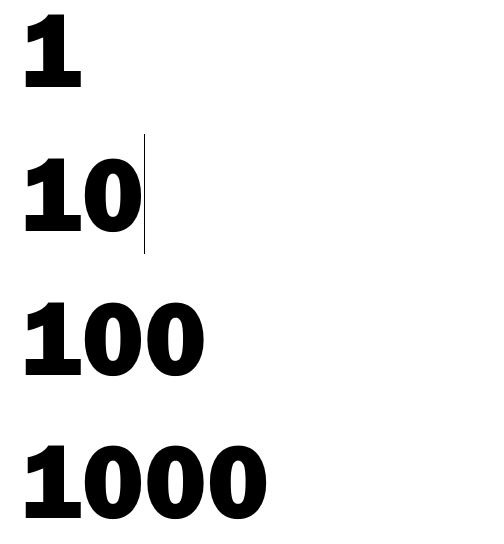
1 10 100 1000

Psychological researchers used to say 7 of anything is the most images people can retain in their mind at once. Newer studies claim fewer. Multitasking is a myth. We’re like old Macs, good at quick task-switching. I can picture 6 marbles in a triangle pattern of 3, 2, 1. When I add number 7 next to the group of 6, the group of six disappears. Back to 1.

This is why we make lists. You might remember to bring home 4 items from the grocery store, but probably not 10. And certainly not 100. On Spotify I’ve been building TOP 1000 playlist of my favorite songs. When the list approached 500 songs, I realized there were songs I loved way more than others. So I created a TOP 100 list. It quickly filled to 123. As I listened to that list, I realize that some of those songs didn’t belong. The list is shrinking towards 100.

If asked, what my TOP 100 favorite songs were, could I recite that playlist from memory? No, that’s doubtful. That’s why we have TOP 10 lists. Few people think in lists like I do. But if they did, there’s a psychological dynamic that works with the number 10. Maybe because we have 10 fingers, or we use a base-10 numbering. 10 is memorable, but we want more than 10. That’s why we see people listing their 12, 15 and 25 favorites. I’m guessing we have the capability to love 100, or even 1,000 things. Yet, I think 10 is the around the limit we can recall quickly. A TOP 10 list can be recited to a friend, but a TOP 100 requires writing down.

I can love a 1,000 songs, but not a 1,000 movies or books—definitely not 1,000 people. A 1,000 song playlist is manageable, but not memorable. The songs are unforgettable, but I could never recite 1,000 song titles. If I had more bookshelves, I could fit 1,000 books in this room where I write. I had over 800 before the last culling, but I’ve since pared them down to less than 400. Even that many is too many for me to handle at age 64. I’m forgetting what I own.

Sometimes 1,000 is practical. Other times 100 or 10 is workable.

When Olivia and Annie told me their all-time favorite TV show was The Game of Thrones, they asked me about mine. My immediate answer was Breaking Bad. I think it hurt their feelings I didn’t agree with them. I assured them The Game of Thrones was in my TOP 10. But I was mentally rattling off many shows I liked more. In no order, Downton Abbey, Humans, Mr. Robot, Big Love, The Man in the High Castle, Battlestar Galactica, The Sopranos, Fargo, Deadwood, came quickly to mind. Ooops, did that make The Game of Thrones number 11? Were there older shows I love more, but I just couldn’t remember them at the moment? In 1961, my list would have included The Many Loves of Dobie Gillis, The Twilight Zone and Have Gun-Will Travel. Would any old favorite make it to my current TOP 10?

Time constrains the numbers we can embrace, the magnitudes we can grok. On my TOP 100 playlist is “East St. Louis Toodle-Oo” by Duke Ellington from 1926. A TOP 10 list tends to focus on the current, but a TOP 100 can span time. My TOP 100 songs span 106 years. The oldest song I love is a 1910 orchestral arrangement of “Pavane pour une infante défunte” (Pavane for a Dead Princess) by Ravel. My TOP 1000 contain choral, classical and operatic works created 100s of years ago.

My guess is TOP 10 lists focus on recent experiences, whereas TOP 100 lists will span decades, and TOP 1000 can cover centuries. The beauty of subscribing to Spotify is I have a fantastic library for building my playlists. Back in the 1970s, when I haunted record superstores, I used to wish that I owned all the albums in the store. Spotify grants that wish times 100. For the past couple years I’ve been searching out my favorite songs from a lifetime of listening. That list is at 444. I’m guessing it will get close to 1,000 by the time I finish. I know collectors can own 1,000s and even 10,000s of LPs, but physically ownership is not the same psychological awareness.

I wonder, and this is just from personal experience, if 1,000 is the upper limit of our comprehension? I used to own 1,001 Books To Read Before You Die. I never read it all the way through. I eventually gave it away because it overwhelmed me to think I still had another 800 books I had to read. I figure I’ve read at least 2,500 books in my life, and probably seen more than 5,000 films, but I doubt I could ever remember more than 1,000 of each, even if I starting writing titles down with the aid of Wikipedia and IMDB. I can handle a playlist of 1,000 songs, but not a bookshelf 1,000 books, or a rack of 1,000 DVDs. When I was younger, I did, but getting old is shrinking my universe.

For a while, maybe into my 70s, I’ll search out the TOP 100 books and movies I want to cherish. I expect, as the years go by, that number will dwindle. Eventually, I’ll be down to remembering my TOP 10 of everything, and finally, if I have the right kind of death, my TOP 1 of favorite people and things will pass through my thoughts as I fade away. If I can distill that number down before I die, I’ll tell my last friend to mention them at my funeral.

JWH

Diet or Die!

By James Wallace Harris, Monday, May 9, 2016

It’s one thing to choose to diet, it’s another thing to have to diet. I’ve become trapped into eating healthy because of my heart. If I go off my diet, I can feel the symptoms of my arteries clogging, and that isn’t nice. It seems like everyone I know can just chow down on anything they want, and ignore any possible consequences. I resent that. Some of my friends are visibly fat, but others aren’t. Most of my friends take statins or blood pressure medicines, or both. My wife has great cholesterol numbers because of her statin, and she eats what she wants. I have to take a statin and eat vegan just to keep my numbers in line.

They say the first sign of heart disease for many people is the heart attack that kills them. My first signs a few years ago were decreasing vitality, lack of stamina, trouble breathing and tightness in my chest. I was “fixed” by doctors putting a little spring in my widow maker artery called a stent. The trouble with atherosclerosis is it builds up everywhere in your arteries. Unless I change my habits, I’m only waiting for the next clog.

How Not To Die - Michael Greger

I’ve been experimenting with a plant based diet, something former President Clinton did after his stent was put in. He claims his research revealed that 82% of people who follow a plant based diet after a heart problem heal themselves. I’ve been trying to follow that diet for the last couple of years. When I stick to it, my cholesterol numbers go down. When I don’t, they go up. I keep trying to find ways to cheat with some of my favorite foods (peanut butter, sweets or cheese), but when I do, my LDL goes up again. If I cheat long enough, I can feel some of my old symptoms returning.

The book I try to follow, Prevent and Reverse Heart Disease by Caldwell B. Esselstyn, Jr. M.D., is very strict. When I follow Esselstyn’s diet I feel good, and I lose weight. I can eat as much as I want off the approved foods, but no fun foods. After a year of trying to find ways to tweak his diet in my favor, and four quarterly blood tests, I know I can’t. I’m trapped in this diet. I’ve found a new book, How Not To Die by Michael Greger, M.D. that confirms the claims of a plant based diet with numerous scientific reports. Greger runs a website, nutritionfacts.org, that regularly explains the research in medical journals with short easy-to-understand videos.

My dad died at 49, on his third heart attack. He survived two attacks and a stroke, but was miserable for seven years. He never ate healthy, never stopped smoking, and always ate what he wanted. Evidently, by not smoking and being a vegetarian since the 1960s, has let me beat his record and live to 64. I was always a sweet-tooth vegetarian. Now I’m discovering that I have to jettison the junk food to live longer.

Advocates claim following a plant based diet will reverse heart disease. I hope that’s true. If I’m going to die anyway, I’d rather go out eating Ben & Jerry’s. Right now I don’t have a choice. If I don’t eat healthy I feel my heart clogging up, and that feels pretty much like having a scary guy point a gun at my head and say, “Eat that and die.”

Bummer.

JWH

TOP 100 Songs—A Spotify Experiment in Personality

By James Wallace Harris, Tuesday, May 3, 2016

If you selected your Top 100 all-time favorite songs, the ones that define your soul, how many of those songs would you think you shared with your friends? I’ve always loved seeing what albums my friends owned, and if they’d let me, what songs are on their playlists. People are surprisingly unique. I’ve yet to find anyone that shares even five favorite songs with me. Don’t get me wrong, me and my friends often enjoy the same kinds of music, but when it comes to absolute favorites, the songs we choose to form a life-long love affair, those tunes are quite distinctive. Maybe as identifying as fingerprints.

fingerprintmusic

This is where Spotify comes in. It would be fantastic if Spotify created a permanent playlist in everyone’s account called TOP 100, and encouraged their subscribers to fill it in with the songs that define the music they loved best in their lifetime. Then after a time, start showing us big data statistics. What is the percentage of overlap based on various demographic standards. Am I more likely to overlap with other people born in 1951? Does gender matter? Could Spotify predict where I grew up or my ethnic background? Would it be possible for Spotify to discern my Myers-Briggs type? And if there are incidences of high overlap, would listening to the playlists of those subscribers help me find songs I would love that I’ve never heard?

Conversely, could Spotify fill in our TOP 100 lists automatically from studying our current patterns of play? Or predict our second 100 favorite songs?

Even with millions of users, would they ever find two people with the same songs in their TOP 100 playlist? What would be the statistical odds? (I don’t know, I can’t do that kind of math.) How often would 50% agreement show up? What if the list was based on order? If they applied statistical analysis to the data, would it reveal anything about personality? Would it tell us anything about generational shifts? Are people predictable by their tastes? If they could connect to other databases, would our musical tastes also reveal what we love in books, movies, television shows and other art forms?

My bet, which is only a hunch, would be for age cohorts, the average overlap would be less than 5%.

JWH

I Wasn’t Crazy After All—I Can Gain Weight on Fewer Calories

By James Wallace Harris, Tuesday, May 3, 2016

Yesterday, The New York Times ran “After ‘The Biggest Loser,’ Their Bodies Fought to Regain Weight” that was an extensive article that explained the science behind regaining weight after dieting. Scientists used contestants from the reality show, The Biggest User in their study. They measured their metabolism before and after their massive weight loss successes. Contestants, as they lost weight, became more efficient at maintaining their weight. The startling news, which many dieters have learned from experience, is after you regain your weight, you also maintain that efficiency. So it gets harder and harder to lose weight. In other words, dieting makes our metabolism slow down, but it doesn’t speed back up when we regain the weight.

“The key point is that you can be on TV, you can lose enormous amounts of weight, you can go on for six years, but you can’t get away from a basic biological reality,” said Dr. Schwartz, who was not involved in the study. “As long as you are below your initial weight, your body is going to try to get you back.”

I lost 30 pounds last year, but keeping it off is a struggle. I kept telling myself that I’m eating less and not losing. How could that be? Well, I wasn’t crazy. Scientists also discovered as we lose weight, we reduce our levels for the hormone leptin, which makes us feel hungry. The study on the Biggest Losers contestants discovered their leptin levels went down almost to zero, leaving them ravenously hungry. Leptin levels went back up when they regained weight, but only to about half the level before, leaving them hungrier than they were before they dieted.

This sucks.

Pug20 

JWH

Television for the 55-Plus Folks

By James Wallace Harris, Monday, May 2, 2016

Talking with my old buddy Connell last night, I commented that everyone today has very different tastes in music. Out of 432 songs on my favorite Spotify playlist, I might share a unique handful with each of my friends. Back in the 1960s, when we were young boomers, we all watched the same three TV networks, listened to the same AM top-40 radio stations, often bought the same albums, went to the same rock concerts and movies, and pretty much shared the same pop culture. Living in the shiny future of the 21st century, pop culture has exploded. Everyone has gone off to do their own thing—usually tuning out with earphones and a personal screen—and won’t VR be even more isolating? I feel little pop culture kinship anymore.

Antenna_TV_logo.svgme-tv-logo

I wonder if cord cutters, the retired ones, aren’t all sitting in our darkened rooms, by ourselves at night, watching the same TV shows? We’ve reduced our TV universe to a few local broadcast networks again. Going from 200+ channels to a handful might be a socially unifying trend. How many of us are watching Antenna TV, Grit TV, Movies!, Decades, GetTV or MeTV?

I cut the cable cord years ago. I planned to watch Netflix, Hulu and other streaming services instead. What’s weird is I spend more time now watching broadcast TV. What goes around, comes around. I own a Tivo Roamio, which allows me to record over-the-air TV—and zip past the commercials. When I do see the commercials, most are targeted to my demographic, the 55-plus crowd. At any random moment of the day, a quick flip by all the channels will mainly reveal commercials. To get folks to watch those commercials they use old shows and movies as bait. I guess they know what we’re biting.

decadeslogo2Grit

If I didn’t have the Tivo, I couldn’t handle that. I hate commercials. Yet, I’ve got to admit they’ve got my number, because these networks broadcast content that appeals to me, and I assume, to my fellow baby boomer cord cutters. I hardly ever watch the major networks anymore. Their primetime shows aren’t geared to my tastes. Mostly I watch PBS. However, when I’m not watching public television, I love the local channels that show old movies, and to a lesser degree, the old television shows. Especially content created in the 1950s and 1960s, when I grew up. Is broadcast TV curated for us baby boomers? Or do young people like retro-TV? After we get on social security, and our fixed incomes become cable-unfriendly, lots of us go back to over-the-air television reception. Evidently, marketing gurus have discovered old episodes of Peter Gunn, Perry Mason and The Twilight Zone sell adult diapers, self-catheters, Consumer Cellular phone, prostate pills, unbreakable reading glasses, and other doodads for the 55-plus-set better than reruns of Cheers or The Mary Tyler Moore Show . I have 4-5 channels where I can watch the same shows I watched when I lived with my parents. Decades later, in the 1980s we chanted, “I want my M-TV.” Now I sing, “I want my GetTV.” (My city doesn’t have it yet.) There’s a tremendous number of broadcast networks, but no city gets them all. But as each city gets more of them, won’t there be less demand for cable?

     movies tv logogettvlogo

How many over-55 cord cutters are watching these networks? By reducing the the number of networks we watch, do we bring ourselves closer? Will there ever be a time again when people share the same pop culture? Sometimes I think I could cut out all TV but one network – PBS. Are public television lovers my chosen peeps?

I cancelled my subscription of Netflix discs because I just let the discs sit around for weeks. I have Netflix streaming, but I don’t watch it much, mostly for documentaries. I also have Amazon Prime which I use to watch new television shows and movies when I have company. When I’m by myself, which is most of the time, I mainly watch documentaries on PBS or old westerns. I spice things up now and then by trying an ancient TV show, or an old film, in particular, a 1960s comedy, or a 1940s film noir. When I have friends over, we watch new TV shows like Mr. Robot, Humans, Fargo, The Knick, Man in the High Castle, Mad Dogs, etc. I do like modern scripted TV, especially if the show is one story told in 10-13 episodes. But I save those shows for when I have company and we can share. It’s great to have new shows to talk about. Solitary watching is different. I guess my comfort TV is old stuff.

I realize I have multiple personalities. I have my main personality that watches TV by myself, and a different personality for each of my friends. I almost never listen to music with friends anymore. I guess group listening to albums stopped when we quit smoking pot back in the 1970s. I wonder if medical marijuana for old folks is bringing back album parties? I do read books with friends, sometimes, because of book clubs. And I usually go to plays and art shows with friends. When I think about it, I spend a lot of time enjoying various art forms alone. Back in my K-12 years, that wasn’t so. You’d watch TV with your family, and then go to school the next day and discuss the shows with your friends. Our world was smaller, but it was closer. I guess in a couple decades when I move into a retirement home, I’ll be back watching TV together with a new family.

With over sixty years experience watching TV, I’ve gone though many phases of TV culture. I wonder as I get older if I’ll want to rewatch 1970s TV, and then 1980s TV, and if I live long enough 1990s TV. Do people get nostalgic for their twenties, thirties, forties, fifties? In the future, will baby boomers crave Must See TV and want to watch old episodes of Seinfeld, Mad About You, and ER? Right now I can’t even make myself watch old Star Trek series which I once loved. Will, I change in the future and crave them again? Or will nostalgia always keep me trapped in 1956-1965 TV-land?

JWH