Why Would Anyone Want to Be President or Queen?

by James Wallace Harris, Monday, December 12, 2016

I’ve been watching The Crown, an excellent 10-part biopic on Queen Elizabeth II. It’s a Netflix original. I’ve never cared about royals before, but this show is riveting. John Lithgow as Winston Churchill makes the series compelling, just for his part of the history. However, the show gives a somewhat realistic portrayal of the duties of a British monarch, and it looks so painful, I wouldn’t wish it on Donald Trump. Why would any little girl want to be a princess after seeing The Crown? Poor Elizabeth goes on one tour of the Commonwealth that lasts for months. At one point she has to have her cheek shot up with a muscle relaxant because of smiling at the crowds for hours at a time has frozen her face. Another time she has to ride in an open car in hundred degree heat for two hours so the possession can go at a pace safe for horses.
Obama-2008-and-2016

I also wonder about Donald Trump. Why would a billionaire used to absolute freedom want to be President? It’s like being a rock star wanting an office management job, one requiring 80 hours of drudgery a week. I always thought the point of getting rich was to escape a day job. Trump is already fighting his bridle by refusing to take all his daily briefings. What’s going to happen to him when he’s on the job and his life is scheduled 24×7? If it’s anything like QEII’s schedule, I’ll actually feel pity for that lying deluded megalomaniac. Solitary confinement in a maximum security prison would be a more human punishment.

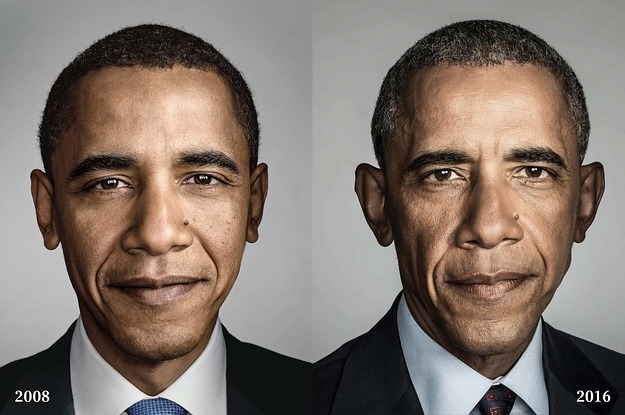
Just look at what eight years did to poor Obama, and he was a young man. Donald Trump is starting the job at 70. Will he age normally in the next four years? Of course not. Why waste precious golden years choosing to be chewed up by history?

Trump is already annoyed at Saturday Night Live, but didn’t he know becoming president means being the most hated person on Earth? Sure millions will love him, but there’s always a larger segment of the population that reviles the CEO of the USA. Doesn’t every person dreaming of living at the White House know they’ll be mocked in a thousand ways a thousand times a day? Even with a “good” approval rating, a president gets endless barrages of flack, much of it mean-spirited. I feel sorry for presidents. Everyone on the planet wants a piece of them, and the burden of office is a great deal more than tremendous. Talk about a plot for a horror flick. You spend 4-8 years in stressful conflict with countless nightmare inspiring issues. I’m pretty sure a week of that job would kill me. We know Trump and Clinton are very strong old people because they survived over a year of campaigning. But won’t that be a fun 10k compared to Iron Man triathlon of serving one term?

I’m very curious how many hours a day Trump will occupy the Oval Office. I bet he’ll spend most of those moments daydreaming about being an ordinary billionaire, jetting around, making deals, playing golf, and grabbing you know what.

I really can’t understand why anyone would want the job of President, or Queen. In The Crown, Winston Churchill seems obsessed with creating a political order that matches his passionate ideals. QEII feels the weight of centuries. What drives Donald Trump?

JWH
Science Fiction Books That Start Snowballing Themes

by James Wallace Harris, Saturday, December 3, 2016

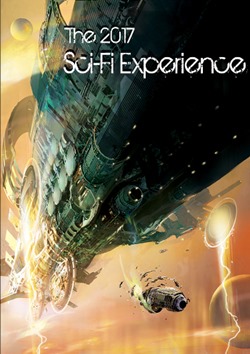
2017 Sci-Fi ExperienceOver at Stainless Steel Droppings, Carl Anderson has started his 2017 Sci-Fi Experience early. It’s based on Andrea’s Vintage Science Fiction Month. Usually, Carl reads old science fiction in January and February, but decided this year to switch to December and January. Since I’m already reading old science fiction I decided to join in. But I want to put a focus on my efforts. I recently read “17 Science Fiction Books That Forever Changed The Genre” and although I agree with some of their selections, I disagreed with others. However I really liked their idea of identifying the books that either changed the rules/direction of science fiction, or inspired other writers to explore their ideas. I like to think of certain science fiction books as snowballs rolling down a slope getting bigger and bigger – or even causing an avalanche.

James Gleick’s new book, Time Travel: A History does just that for The Time Machine by H. G. Wells. Wells’ little book has started a huge snowball rolling down the decades. It might be the best example of what I’m talking about. And Gleick describes many classic time travel novels that came afterwards, but he doesn’t come close to covering all the major time travel stories, just look at this list of books, television shows and films at Wikipedia. Hasn’t every possible speculative variation on time travel been imagined by now?

I want to make my reading of vintage science fiction about studying science fiction themes. I keep wondering if there’s a limited number of science fictional concepts. But then I read something like Spin by Robert Charles Wilson or Quarantine by Greg Egan, and think speculative fiction is unlimited. I do believe we can identify snowballing books, and that will help us count up the themes.

Another good example would be Starship Troopers, a book that inspired such novels as The Forever War by Joe Haldeman, Ender’s Game by Orson Scott Card, and Old Man’s War by John Scalzi, plus seems to have launched the Military SF sub-genre. When I watch movies like Aliens, I think Starship Troopers. When I watch Star Wars I think of Asimov’s Foundation books.

Under-the-Ocean-to-the-South-Pole-2What other books, or series of books inspired a sub-genre in science fiction? Did Heinlein start the YA science fiction market with Rocket Ship Galileo in 1947? But then, does anyone remember The Great Marvel Series by Roy Rockwood (1906-1935)? Carl’s reading challenge generally focuses on books from 1950-1979, but what about books from 1850-1950? Have we already forgotten the books that inspired the Golden Age writers to write those 1950-1979 classics? Older fans today can remember juvenile series by Heinlein, Norton, Asimov and Wollheim, but science fiction for young people goes way back.

Did The Last Man by Mary Shelley, The Scarlet Plague by Jack London and Earth Abides by George R. Stewart start the sub-genre of post-apocalyptic science fiction last man on Earth stories? Remember Wells hinted at that in The Time Machine. And didn’t The Time Machine set things up for Olaf Stapledon? All that stuff about future species of humans.

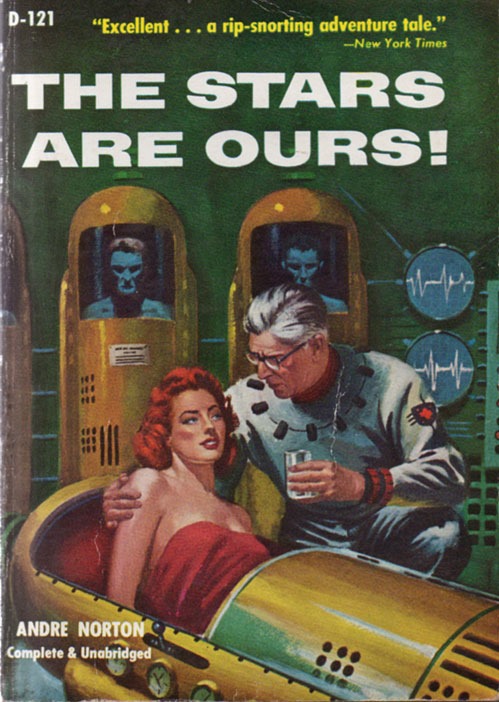
The Stars Are Ours - NortonI’ve been been wondering two things. One, is there a limited number of science fictional ideas, themes, subgenres? And two, how far back do they go? For my science fiction book club, we’re reading The Stars Are Ours! by Andre Norton from 1954. It presents two interesting themes. One, conservative/religious groups repress/destroy science and scientists, and two, people need to escape Earth to start over again on another planet. Both themes are relevant today.  Can we find books from the 19th century or even 18th century that first got those snowballs rolling? Do those themes ever stop being relevant? Will science fiction written in the  22nd century add to the existing snowballs? Will science fiction fans in the 2050s read many SF books from the 1950s? Or even known about them? Or will they think the science fiction they discover in adolescence as having original ideas?

At what point does vintage science fiction become forgotten science fiction, and newer, but older science fiction, become vintage? SF of the 2010s will be vintage by the 2050s. The appeal of vintage science fiction might be due to fans getting older and realizing what they once thought of as original ideas might be as old as the hills. As I’ve said before, Noah’s Ark might have been the first generation ship story. I find parts of The Book of Genesis to be very science fictional. If you squint at it in the right way, doesn’t the whole tree of knowledge of good and evil story seem like speculation about the evolution of human awareness? I can easily imagine a writer, male or female, living under Babylonian occupation, trying to imagine how everything got started, and wrote about a powerful alien being creating us. What’s really science fictional, is people think that story is the literal truth 2700 years later.

Generally, we read for story. We want to be entertained. But I think as we read and reread these vintage science fiction tales, we should examine the ideas they present. Then speculate about what inspired those ideas, and finally, evaluate how well they were implemented. As a liberal, I was rather shocked by the 2016 election results. The lesson I learned is don’t trust my assumptions. I’m applying that lesson to reading vintage science fiction. For example, should we assume that humans can leave Earth and start over on another planet if we totally screw things up here? I hated that Interstellar depended on that idea.

Some snowballs rolling down a hill just fall apart. Can we also count them as we read?

I believe science fiction represents a collection of speculative ideas that have been around a very long time. Eventually, they become real – like heavier than air flight, traveling to the Moon, cloning, constructing robots to do our work – or, we can eventually give up on the idea. I think time travel stories are now considered fantasy by most people. I hear they are remaking filmed versions of Starship Troopers and A Handmaid’s Tale. That’s a recognition that those themes are still valid to a mass audience. But are they considered fantasies or science fiction? Do we believe space marines and horrible theocracies are possible? I think we do.

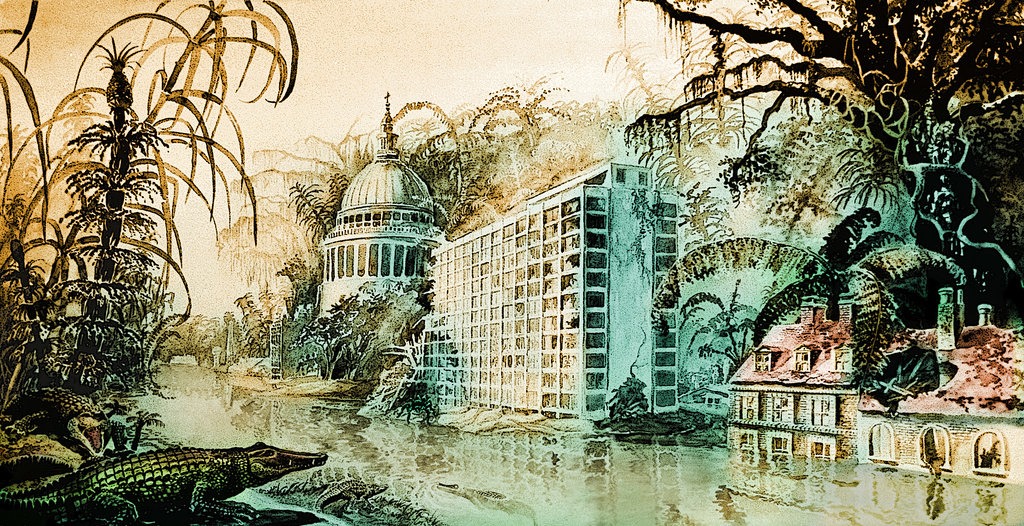
I’m currently listening to The Drowned World by J. G. Ballard, a short novel that was first published in 1962. Ballard wrote several eco-apocalyptic novels back in the 1960s. They are part of a speculative snowball that now includes The Windup Girl by Paolo Bacigalupi and Green Earth by Kim Stanley Robinson. In biblical times God caused such catastrophes. After Darwin, it was nature that could destroy us. Now we imagine species suicide. But the theme is the same. Either all, or nearly everyone, gets wiped out. That theme isn’t new – it might have existed in pre-history.

I want to contemplate vintage themes while reading my vintage science fiction.

drowned-world

JWH

Old Movies on Big Screens Again

by James Wallace Harris, Thursday, December 1, 2016

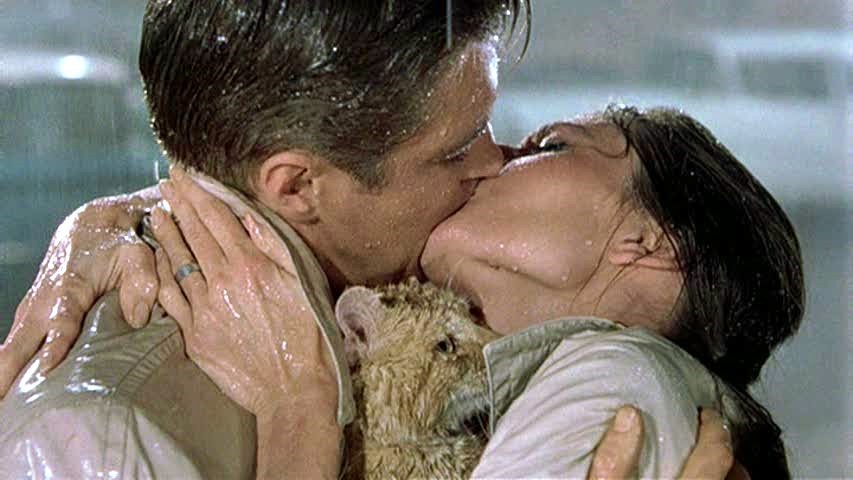
Last night I went out to see Breakfast at Tiffany’s at the movie theater. It was absolutely wonderful to see on the big screen. Generally, we see movies on the big screen first, and then watch them again on the little screen at home. We’ve gotten used to seeing old movies small, but when you see one again big, it’s almost mind altering. And even though my little screen is 56”, and I have a Blu-ray copy of Breakfast at Tiffany’s, it’s just not the same – not even close. While watching the movie last night I wondered why I even bothered with watching movies on television. I even wondered about getting a video projector to create my own home theater. I doubted if I could make the image large enough. If I could convince my wife to allow me to cover the windows in the living room with movie screen I might buy a video projector and try.

Breakfast-Tiffanys ending with cat

I was at a multiplex that has 16 screens, and Breakfast at Tiffany’s was on one of the small-to-medium size screens, and it was damn impressive. Month ago I saw The Maltese Falcon on one of the larger screens, and it was amazing. We’re so used to seeing classic films on a small screen that we forget what they’re really suppose to look like. Back in the 1970s there were old theaters here that played old movies – at least for a couple years. I’d go two or three times a week, and got to see many famous flicks, including silent films, on a big screen. It’s worth both the money and effort, although I don’t know why an old movie should cost more to see than a new movie. Last night it was $27 for 2 tickets. I’d go once or twice a week if it was $5-7 and old shows were available to see.

The Maltese Falcon

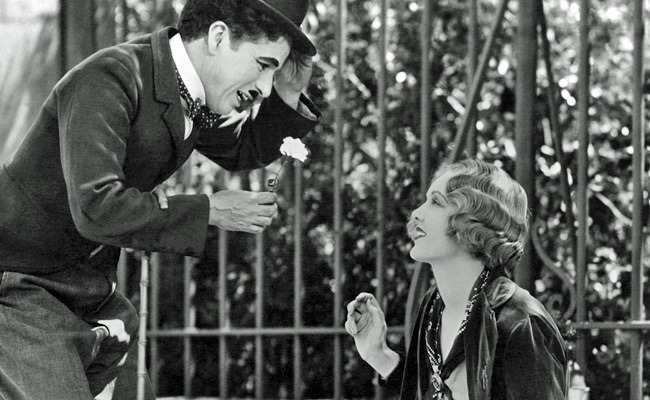
Be sure and check out Fathom Events to see if old movies, plays, concerts, operas and other special films are shown in your area. Test out an old movie on a big screen. This month they will be showing From Here to Eternity. I’m still kicking myself for missing when they showed Dr. Strangelove. What I’d love to see are my favorite westerns from the 1950s at a theater. And I’d really love seeing old movies from the 1930s. I consider myself lucky to have seen films like Grand Hotel, The Postman Always Rings Twice, Double Indemnity and Dodsworth on big screens. I’ve also seen Charlie Chaplin, Harold Lloyd, and Buster Keaton like they appeared in the 1920s. Silent movies don’t look so quaint and archaic when shown in a theater at the right film rate.

City Lights

I guess this might be the only thing I envy the rich. I don’t care about privates jets, exotic sports cars, or mansions. But I’d love to have a large home theater and a 4K projector.

JWH

Isn’t Receptivity for Fake News in Our Genes?

by James Wallace Harris, Tuesday, November 29, 2016

When we are very young our parents convince us to believe in Santa Claus, The Tooth Fairy and The Easter Bunny. We grow up believing in Super Heroes, Harry Potter like magic, and far out science fictional ideas. We are taken to churches and taught to believe in Jesus, God, angels, heaven, hell and eternal life. All of these beliefs are easily disproved with a good education. And when we want to keep these fantasies rather than accept reality, we learn denialism. Even our favorite adult art forms – television, movies and novels depend on us suspending rational thinking to enjoy.

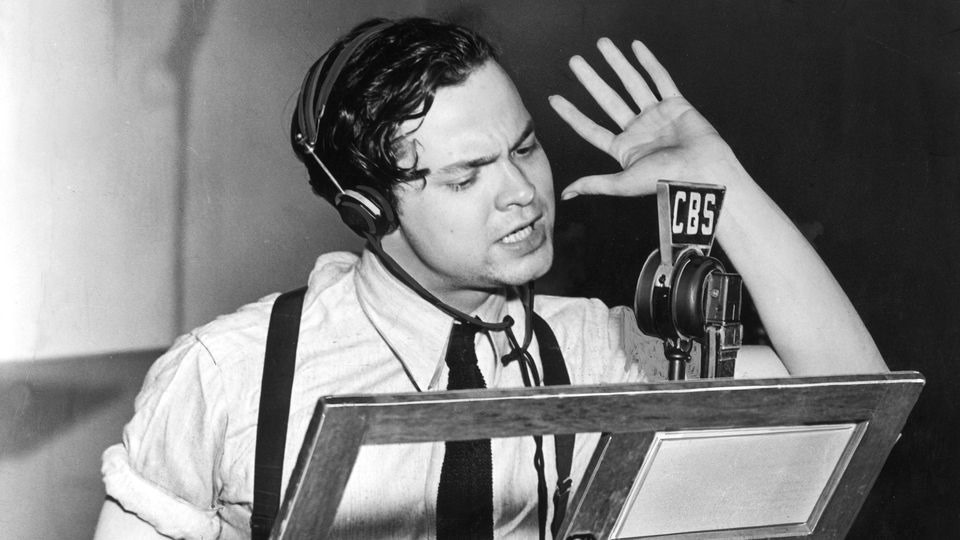
Orson WellesWe are conditioned to believe in fantasies. Most people aren’t atheists because they can’t throw off their childhood brainwashing even when there’s amble evidence. And all the fantastic ideas we embrace are so much more appealing than the cold facts of reality. Is it any wonder we find it easier to rationalize what we want than to be rational thinkers able to discern fake news from validated facts? Homo sapiens aren’t rational creatures, but rationalizing ones.

Strangely, fake news is in the news like its something new. The Onion and Saturday Night Live have been doing fake news for decades (1988, 1975). Tabloids go back much further, but even the earliest of newspapers played fast and loose in their reporting. It’s also well established that first person testimony is unreliable. We all live in a sea of lies, so is it such a surprise we can’t tell shit from Shinola?

The Bible is promoted as the literal word of God by many, yet it only takes reading the book itself to reveal it was written by all too human people, expressing widely divergent opinions and philosophies, using different writing styles and points-of-views, and often showing contradictions and inconsistencies. And scholars of history, who study The Bible in-depth, have found parts of it to be fake history. Many books of The Old Testament appear to have been written to pre-date land claims in building of an ancient nation. And books in the New Testament were forged to shape Christian theology based on personal bias. To compound the many false aspects of The Bible, many thousands of books have been written to rationalize those falsities. Anyone who reads The Bible should at least get a scholarly study Bible, like The New Oxford Annotated Bible, and read what experts have to say along with the currently best translation of the oldest biblical texts we have. It would also help to read books about the history of The Bible before starting any serious Bible study, such as The Bible Unearthed or Who Wrote the Bible? to give a historical context why the The Bible was originally written, and by who. But we don’t do that, do we? We just embrace the good bits, using them to justify our current beliefs and wants, claiming “God” an an authority.

And remember that saying, “History is written by the victors,” that’s just the start of the distortion. Anyone who wants to shape current thought can write a history book. And the news media can say anything about history, as well as artists. Just look at JFK by Oliver Stone. Everyone thinks they know the truth. But reality is Rashomon 24×7. Truth is extremely elusive, unless you understand science, math and statistics, and only then it’s the best truth we can find at the moment.

How to deal with fake news is the talking-head topic of the month. Most discussions are about how to ban fake news, yet I can’t imagine a world where we can trust what we read, hear and see. Will we ban satire? Obviously we won’t ban lying politicians. Should churches have to prove the existence of eternal life before collecting tithes? Shouldn’t fantasy fiction come with the warning “Magic Does Not Exist” printed on the spine?

Fake news isn’t just those weird stories you see on Facebook. Fake news is any information you use to understand reality. I include religion because gospel means the good news. We assume its true, but isn’t it fake news too? Gossip can also be considered fake news, since it’s usually distorted. When it comes to spotting fake news, we’re piss-poor judges, and it’s everywhere.

To abolish fake news would require programming our kids to become hyperaware of lying, to think skeptically, distrust the media, history books, social institutions and other people, and carefully evaluate everything they read, see, or hear. We need to educate them about science, logic, philosophy, ethics, authority, evidence, scholarship and statistics. We’d have a wiser society if folks studied statistics and data mining every Sunday instead of going to church.

But will any of this ever happen? Didn’t Donald Trump win because of anti-intellectualism, denialism, fake news, unethicality, and mob rule social media? Doesn’t his success endorse its efficacy? Isn’t fake news an effective tool in the fight against science and enlightenment politics? Didn’t orthodox Christianity suppress liberal Christianity in the first three centuries of the common era with the same tactics? George Orwell’s classic novel, Nineteen Eighty-Four illustrated perfectly the value controlling the news. Aren’t the institutions of news always the first things revolutionaries take over in revolutions? Haven’t conservatives succeeded amazingly well with Fox News? Fake news is too effective to give up, especially if your objective is to get votes, change laws, or demolish reputations.

I’d like to believe we could change things for the better, but when I read history I’m not sure I see any signs of progress. I’d like to believe the pendulum swings back and forth between conservative and liberal eras, and overall we’re becoming more liberal over time. But that might be like climate change deniers taking tiny segments of temperature histories to claim a cooling trend, while ignoring the larger trend on the graph. Reading books like Collapsed by Jared Diamond suggests we don’t change. Our species has been extremely stable for a couple hundred thousand years. Evolution produces species that adapt to their environment, and we have adapted very well. But we have adapted because of the selfishness of individuals. We have not adapted because of liberal ideals. Fake news benefits the survival of the fittest individuals, not groups.

JWH

65 Classic Science Fiction Books I Want to Hear

by James Wallace Harris, Friday, November 25, 2016

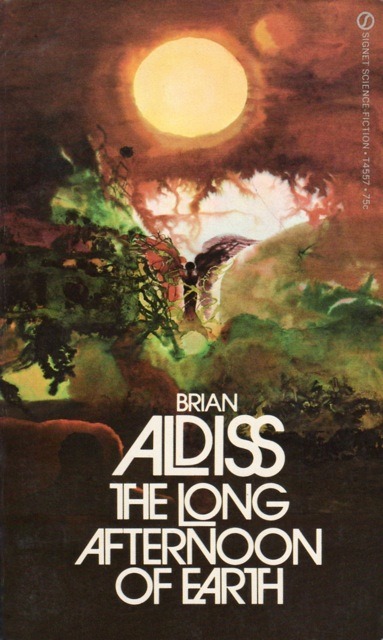
Hothouse - Brian W. AldissHappy Birthday to me! Last year I wrote “64 Classic Science Fiction Books I Want to Hear” for my 64th birthday. It was published at SF Signal. I had hoped audiobook publishers would have granted my wish by now. Unfortunately, only one title has shown up at Audible.com – Nova by Samuel R. Delany. I bought it and it sounds wonderful. Maybe more will show up by the time I’m 66. But guys, I can only live for so long.

Here’s the list updated to 65 titles for my 65th birthday. I’ve substituted some collected works for older original short story collections. I figure it’s probably easier to get the audio publishing rights to the most recent collections.

If I had three wishes from a genie, one wish would be for Adventures in Time and Space (1946) edited by Raymond J. Healy and J. Francis McComas in a perfect audiobook edition. Great anthologies on audio are rare. I expect publishing rights are hard to arrange. I’m still wishing for six completely out-of-print volumes to come out in audio. Most of these books below are available in print or ebook editions. Does it take a certain demand for print/ebook editions before publishers will risk an audio edition?

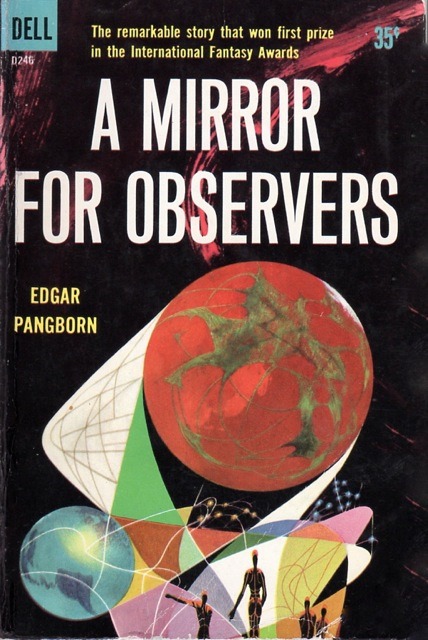
A Mirror for Observers - Edgar PangbornMost of the great science fiction classics have shown up on audio. Starting in 2002 when I join Audible.com, I’ve been “rereading” my favorite science fiction books from youth by listening to them. I love hearing old science fiction when read by a great narrator. If you can think of an old science fiction book that’s not on my list below, chances are its available on audio at Audible.com. If you haven’t gotten into audiobooks yet, I recommend starting with an old favorite. You might be surprised to hear something you missed.

Many of the books below are forgotten classics, especially the older ones. People from my generation might remember them, but younger readers may never have heard of many titles. The real question is whether or not these books still hold up. Just because I want to hear them doesn’t mean they are great stories. They are just books I often read about when reading about science fiction.

What amazes me are the authors that have no Audible.com editions of their work. Or next to none. I can’t figure out if this is for legal reasons, or there’s no interest in their work. These include:

  • Eleanor Arnason
  • Alfred Bester
  • Michael Bishop
  • Pat Cadigan
  • R. A. Lafferty
  • Maureen F. McHugh
  • Eric Frank Russell
  • James H. Schmitz
  • William Tenn
  • James Tiptree, Jr.
  • Wilson Tucker

65 Books I Want to Hear

H=Hardback  T=Trade paper  M=Mass market  E=ebook  *=OOP

  1. A Voyage to Arcturus (1920) by David Lindsay – HT
  2. The World of Null-A (1948) by A. E. Van Vogt – TE
  3. The Voyage of the Space Beagle (1950) by A. E. Van Vogt – T
  4. Bring the Jubilee (1953) by Ward Moore – TE
  5. The Demolished Man (1953) by Alfred Bester – TE
  6. A Mirror for Observers (1954) by Edgar Pangborn – H
  7. Mission of Gravity (1954) by Hal Clement – TE (as Heavy Planet: The Classic Mesklin Stories)
  8. Cities in Flight (1955) by James Blish – E
  9. The Stars My Destination (1956) by Alfred Bester – TE
  10. Wasp (1957) by Eric Frank Russell – E
  11. The Lincoln Hunters (1958) by Wilson Tucker *
  12. Rogue Moon (1960) by Algis Budrys – E
  13. The High Crusade (1960) by Poul Anderson ME
  14. Hothouse (1962) by Brian W. Aldiss – E
  15. Davy (1964) by Edgar Pangborn – H
  16. Empire Star (1966) – T (combined with Babel-17)
  17. The Witches of Karres (1966) by James H. Schmitz – ME
  18. Dangerous Visions (1967) ed. Harlan Ellison – TE
  19. The Einstein Intersection (1967) by Samuel R. Delany – TE
  20. Camp Concentration (1968) by Thomas Disch – TE
  21. Past Master (1968) by R. A. Lafferty – T
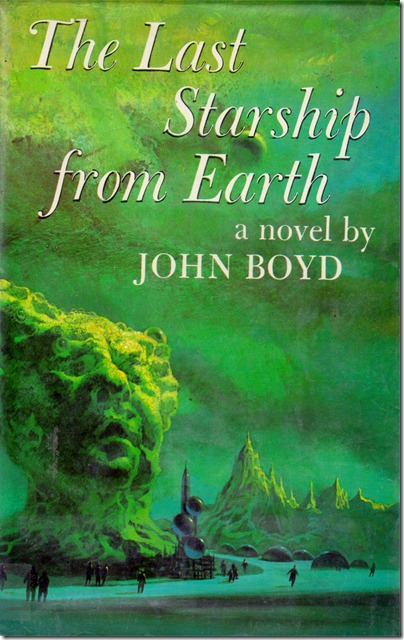
  22. The Last Starship from Earth (1968) by John Boyd – *
  23. Behold the Man (1969) by Michael Moorcock – T
  24. Bug Jack Barron (1969) by Norman Spinrad – TE
  25. Macroscope (1969) by Piers Anthony – HTE
  26. The Left Hand of Darkness (1969) by Ursula K. Le Guin – HTME (OOP on audio)
  27. And Chaos Died (1970) by Joanna Russ – *
  28. Science Fiction Hall of Fame (1970) edit by Robert Silverberg – T
  29. The Year of the Quiet Sun (1970) by Wilson Tucker *
  30. The Doors of His Face, The Lamps of His Mouth (1971) by Roger Zelanzy – TE
  31. The Fifth Head of Cerberus (1972) by Gene Wolfe – TE
  32. The Listeners (1972) by James Gunn – T
  33. The Science Fiction Hall of Fame Volume 2A and 2B (1972) edited by Ben Bova – T
  34. The Sheep Look Up (1972) by John Brunner – TE
  35. Before the Golden Age (1974) edited by Isaac Asimov – *
  36. A Martian Odyssey and Other Science Fiction Tales (1974) by Stanley G. Weinbaum – *
  37. The Centauri Device (1974) by M. John Harrison *
  38. The Female Man (1975) by Joanna Russ – T
  39. The Shockwave Rider (1975) by John Brunner – TE
  40. Trouble on Triton (1976) by Samuel R. Delany – TE
  41. On Wings of a Song (1979) by Thomas M. Disch – E
  42. Ridley Walker (1980) by Russell Hoban – HTE
  43. No Enemy But Time (1982) by Michael Bishop – E
  44. Native Tongue (1984) by Suzette Haden Elgin – TE
  45. Stars in My Pocket Like Grains of Sand (1984) by Samuel R. Delany – TE
  46. Ancient of Days (1985) by Michael Bishop – TE
  47. The Falling Woman (1986) by Pat Murphy – E
  48. Mindplayers (1988) by Pat Cadigan – TE
  49. Grass (1989) by Sheri S. Tepper – TE
  50. Her Smoke Rose Up Forever (1990) by James Tiptree, Jr. – T
  51. A Woman of the Iron People (1991) by Eleanor Arnason – E
  52. Sarah Canary (1991) – Karen Joy Fowler – TE
  53. Synners (1991) by Pat Cadigan – TE
  54. China Mountain Zhang (1992) by Maureen F. McHugh – TE
  55. Ammonite (1993) by Nicola Griffith – TE
  56. The Rediscovery of Man (1993) by Cordwainer Smith – H
  57. Galatea 2.2 (1995) by Richard Powers – TE
  58. Ingathering: The Complete People Stories of Zenna Henderson (1995) – H
  59. Holy Fire (1996) by Bruce Sterling – TE
  60. The Book of the Long Sun (1993-96) v.1 and v.2 by Gene Wolfe – T
  61. Immodest Proposals: The Complete Science Fiction of William Tenn Volume 1 (2001) – H
  62. Here Comes Civilization: The Complete Science Fiction of William Tenn Volume 2 (2001) – H
  63. Aye, and Gomorrah (2003) by Samuel R. Delany – T
  64. Strange Relations (2008) by Philip Jose Farmer – M (The Lovers, Flesh, Strange Relations omnibus)
  65. The Big Book of Science Fiction (2016) edited by Jeff and Ann Vandermeer – TE

the-last-starship-from-earth-by-john-boyd_thumb

JWH