
by James Wallace Harris, Thursday, May 31, 2018
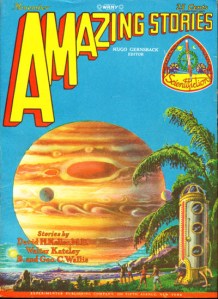
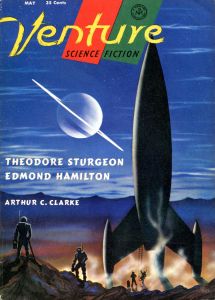 It’s impossible to know everything about everything. It’s even impossible to know even a little bit about everything. There’s no way to become a generalist, even a half-ass one. That’s why people specialize. But even then, it’s hard to decide just how small an intellectual territory to conquer. Lately, I’ve been absorbing everything I can about science fiction magazines from Amazing Stories (1926) to Worlds of Tomorrow (1963). I’m making my cutoff date 1976, to have a 50-year range, but even that might be too much. I’m considering even sub-specializing on 1951-1969 (birth through high school).
What a weird little patch of knowledge to hoe. I can’t claim it’s meaningful, but out of the whole universe of things to study, it’s what appeals to me at age 66. It’s my way of coping with sensory overload. Yet, even such a microscopic portion of history is too large to master. Now that I am in my social security years, interest in current affairs is dwindling. The present really belongs to the young. I have a handful of small territories I struggle to claim, like movie westerns, 1950s jazz, nineteenth-century art, etc. There’s a special kind of fun in becoming a micro-expert know-it-all.
 What drives me to conquer various tiny territories of history is the challenge of putting a massive amount of data into a small consumable package. I’ll use my interest in SF magazines for an example. The Wikipedia entry, “History of US science fiction and fantasy magazines to 1950” is an excellent hypertext overview of half my territory I want to explore. And it’s “List of magazines” table is another comprehensive way of looking at it, especially if you follow the links to individual magazine histories. If only this entry was to 1976 or had a part 2, this one article would define the specific science fictional expertise I wish to master. I’d love to write a book that covered this tiny history or package it in a webpage or app.
One reason I’d love to focus on little topics is that my mind is letting my general knowledge drain away. I’m theorizing my brain can only hold less, so I jettison the stuff I don’t care about to make room for what I do. But choosing such tiny topics to study isolates me from most people. However, it clearly defines a subculture I wish to identify. I believe everyone needs a few specialties to dwell on. Something we can bore folks with at parties if they’re careless enough to ask, “What are you doing in retirement?”
I connect with most of my friends through everyday living and shared experiences, like television shows, movies, eating out, but it’s nice to have something to intellectually gnaw on that’s uniquely mine. Of course, the history of the science fiction magazine in the mid-20th century is not relevant to real problems we face today, but neither am I. I just love having a small patch of history to putter around. Some people garden in their backyard, I tend a tiny patch of history in my thoughts and blog.
 I’ve thought about choosing something contemporary and relevant, like artificial intelligence with Python and R, but I’m not sure my old brain is up chasing a current subject that’s growing too fast even for young geniuses. Focusing limits my scope of study in a comfortable way. Yet, when I outline what I want to know, it’s still a giant pile of data to digest. The pleasant challenge is to organize that data in a way that I might teach it to someone else.
Technology allows me to study science fiction magazines in a way that I couldn’t before the internet. Back in the 1960s when I first became interested in old SF magazines I would have had to spend a fortune to buy and house them. Now I can download digital scans for free and shelve them on an internal solid-state drive the size of a pack of gum. The internet conveniently allows me to locate the histories of the genre, the anthologies that collected the magazines stories into books, the biographies of the writers and editors, digital copies of the primary documents that go with these histories, communicate with other folks studying the same history, and use all the online resources that classify and organize the data that people are building. It’s a great time to become a micro-expert.
The Scope of My Ambition
For a few decades, the center of the universe for written science fiction was the science fiction magazines. Before Star Trek (1966) and Star Wars (1977), science fiction fandom was practically unknown to most people. Science fiction fandom began in their letter columns of the science fiction magazines. Almost all the major SF writers first published in the magazines. The earliest histories and biographies ran as features in the magazines. Most of the classic novels of science fiction were first serialized in the magazines. The earliest gossip and controversies first appeared in the letter columns, which spawned the creation of fanzines. Fanzines were amateur magazines devoted to the genre that devoted most of their content to what was happening in the professional magazines (which fans called prozines).
The history I study covers the magazines and stories, the editors, writers, and artists that worked for the magazines, and the major fans and historians who remember those magazines.
The Magazines
In some ways I’d love to own the actual old magazines – but not really. Pulp paper is now brittle, brown, and fragile. And I’d have to fill all the rooms of my house with bookshelves. And there were too many science fiction magazines for me to care about them all. Here are the science fiction magazines before 1976 that intrigue me enough to collect and study. If you follow the links to Wikipedia you can read very nice concise histories.
- Amazing Stories (1926)
- Astounding Stories (1930)
- Thrilling Wonder Stories (1936)
- Startling Stories (1939)
- Science Fiction Stories (1939)
- Future Science Fiction (1939)
- Planet Stories (1939)
- Astonishing Stories (1940)
- Super Science Stories (1940)
- The Magazine of Fantasy & Science Fiction (1949)
- Imagination (1950)
- Galaxy Science Fiction (1950)
- Fantastic (1952)
- If (1952)
- Infinity Science Fiction (1955)
- Venture Science Fiction Magazine (1957)
- Analog Science Fiction and Fact (1960)
- Worlds of Tomorrow (1963)
Histories
Mike Ashley has published two series of histories just on the science fiction magazine. The older series is mostly an anthology of stories with supplemental essays about the magazines. They include:
- The History of the Science Fiction Magazine, Part One: 1926–1935 (1974)
- The History of the Science Fiction Magazine, Part Two: 1936–1945 (1975)
- The History of the Science Fiction Magazine, Part Three: 1946–1955 (1976)
- The History of the Science Fiction Magazine, Part Four: 1956–1965 (1978)
The second series are all history, without the stories. These books are expensive, and now that the first three are out of print, they are even more costly to track down. I can’t understand why they aren’t in print as ebooks. I find it annoying that most histories of science fiction are out of print, especially in the age of ebooks and print-on-demand.
- The Time Machines. The Story of the Science-Fiction Pulp Magazines from the Beginning to 1950 (2000)
- The Story of the Science Fiction Magazines from 1950 to 1970 (2005)
- Gateways to Forever. The Story of the Science-Fiction Magazines from 1970 to 1980 (2007)
- Science Fiction Rebels: The Story of the Science-Fiction Magazines from 1981 to 1990 (2016)
Over the years there have been a few histories and memoirs about specific magazines.
- A Requiem for Astounding (1964) by Alva Rogers
- Galaxy Magazine: The Dark and the Light Years (1986) by David Roshelm
- Astounding Days (1989) by Arthur C. Clarke
- The Gernsback Days (2004) by Mike Ashley and Robert A. W. Lowndes
- Astounding (forthcoming 2018) by Alec Nevala-Lee
There are several good essays on the internet about the histories of science fiction magazines.
- Science Fiction Magazine – Wikipedia
- History of US Science Fiction and Fantasy Magazines to 1950 – Wikipedia
- The Golden Age of Science Fiction – Jess Nevins
Then there countless popular and academic histories of science fiction that include histories of the magazines. These are too many to list. What I find fascinating are books that analyze the evolution of science fiction, such as The World Beyond the Hill by Alexei and Cory Panshin. Science fiction has always been a reflection of contemporary popular culture, revealing both the hopes and fears about the future, with unique perspectives from each country in which it was written. China is now generating a new wave of science fiction today, in the same way, the United States did in the 1960s.
Most of the best stories from the old science fiction magazines have been reprinted in books, as novels, as author short-story collections, or as anthologies. What I enjoy about reading the actual old magazines are the editorials, columns, book reviews, essays, letters to the editor, and reports on fandom and fanzines. This gives a history of a subculture. For example, here’s a wonderful illustration of a science fiction club membership by caricature. 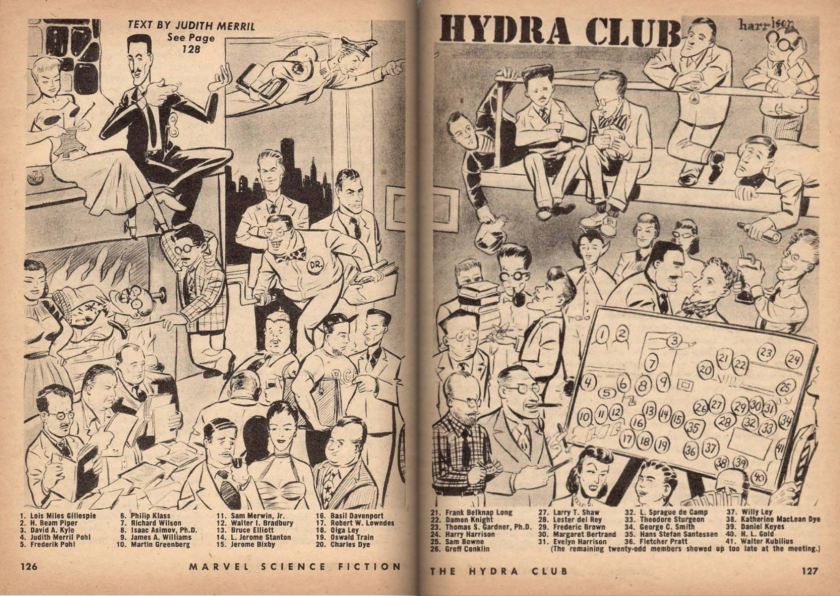
I belong to groups on Facebook, Twitter, Yahoo, Groups.io, with members all over the world that love to remember these magazines, its subcultures, and the stories. I think it’s because we all grew up in the 1950s and 1960s and imprinted on science fiction back then. It’s the closest thing I have to a tribe.
JWH




 And here’s the jungle of half my backyard. The other half is paved for parking. Raccoons, squirrels, rats, cats, chipmunks, and other creatures live back there. Years ago we had a fox, but it got ran over. By the way, I live in the city. There are even more neighbors behind all that green.





 Auxiliary Memory