
by James Wallace Harris, Wednesday, July 5, 2017
I have a new essay up at Book Riot, “What Do We Talk About When We Talk About Science Fiction?” It’s always fun to see other sites publish something I’ve written. And it’s an essay I’m proud of and want people to read. However, I’m not sure it’s the essay I intended to write. I don’t know if you have ever written an essay but if you have, do the thoughts you want to write ever come out the in the words you type?

Inspiration is often a vague idea, or maybe just a feeling. When you start writing about that momentary impulse other ideas start flowing out too. Ideas you haven’t thought of before, or planned. Quite often an essay will take off in a new direction, even a better direction. When I first started writing “What Do We Talk About When We Talk About Science Fiction?” I planned to list and categorize all the main topics of science fiction. I felt there were a finite set of topics we label as science fiction. The essay covered that somewhat, but not in the way I planned. It veered off into another thought, that science fictional ideas are descended from myths, religion and fantasy stories. I ended up saying when we talk about science fiction we’re talking about ideas that we’ve been talking about ever since we shared Europe with the Neanderthals. Science fiction has redefined some of those ancient desires. The few that have any kind of scientific possibility we call science fiction, the rest we call fantasy, religion, or myths.
Since I hang out in book clubs and forums devoted to science fiction I talk and write about science fiction a lot. More often than not we end up talking about stories, storytelling, plots, characters, authors, publishing, reviewing, cover art, and all the things that go into the making of the genre of science fiction, but not the actual philosophy of science fiction. It usually comes down to whether or not the story entertained us, rather than did the story have an original speculative idea.
I actually believe science fiction is a very limited area of discourse. I believe science fiction is the act of speculating about specific unknown aspects of reality. I believe reading a story that makes us think about life on alien worlds is science fictional, but I believe that’s different from enjoying an adventure story that’s set on another world with aliens.
I often wonder if the stories we’ve inherited from myths and religions are the entertainment versions of once serious speculations about reality. That one-day science fiction from the 20th century will be like us reading about Greek mythology. Will they ask, “Did they believe these stories were true?”
When Robert A. Heinlein wrote stories about people living on the Moon in the 1950s he thought his stories were speculating about the possibility of colonizing the Moon. He wanted his stories to inspire a generation that would actually go into space and build the high frontier. Now we read those stories for entertainment or nostalgia.
I’ve always believed the science fiction magazine was where the cutting edge of science fictional ideas first appeared. But few people read those magazines anymore. I’m out of touch with most of the popular SF novels. Few of them seem to be serious science fiction speculation. People want a thrill ride, not philosophy.
I’m not sure all the serious speculative ideas of science fiction haven’t become part of our everyday culture. Forbes, a magazine devoted to business regularly covers astronomy, cosmology, theoretical physics, and space travel at its website. Artificial intelligence and robots are now part of the corporate bottom line. Miracles of biotechnology and engineering are on the news every day.
So what are we talking about when we talk about science fiction? I worry science fiction is a dying area of philosophy that’s being transformed into entertainment category. For Example, why is a sequel to Blade Runner coming out soon, and not an honest version of Do Androids Dream of Electric Sheep? PKD was a weird-ass philosopher, not a writer of action hero adventure stories. In many ways, movie and television science fiction is stuck in the era of Planet Stories and never reached what was going on in Galaxy, F&SF and IF in the 1950s, much less what came out in the 1960s and 1970s.
p.s.
I used the essay as a post of the Facebook group Space Opera Pulp and some of the people also said that movie science fiction wasn’t like what we used to read. So maybe I’m not alone in thinking science fiction is changing.
JWH

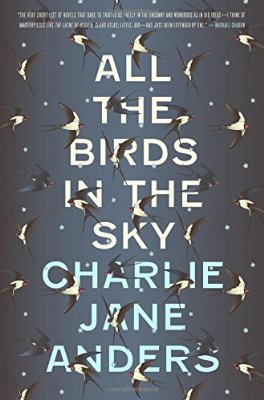 All the Birds in the Sky by Charlie Jane Anders walks the razor’s edge of a very near future science fiction, confronting the obvious dooms while still offering hopes. Anders impressed me with her faith in our future. She accomplishes her task with a light touch, producing a novel that is a joy to read, yet is as deep as you’re willing to dig. I expect many to speed along in this story because of its shiny science fiction bits, but those who read slower, analyzing its fantasy and literary symbolism will find deeper concerns to contemplate.

 Auxiliary Memory