Survivors (BBC 1975-1977)

Ever since I gave up cable TV years ago I’ve discovered I really love finding a TV series and watching it from the first to last episode.  Preferably from Netflix streaming, but DVDs are an okay second choice.  Watching a complete TV series is like enjoying a very long novel.  I listen to novels all the time, so I’m used to their length in hours.  Average novels are 10-20 hours.  Recently I listened to Anna Karenina and it was 42 hours.  I’ve just finished 38 episodes of Survivors which ran on the BBC for three seasons (series as they say) from 1975 till 1977.  Each episode was slightly less than an hour, so the entire run was equal to one long novel.  It’s a shame actual novels aren’t filmed this way.

Survivors is a post-apocalyptic story set in England about a handful of people who survive a world-wide plague.  In the course of the story we hear that only 1 person in 5,000 survived, another time they guessed 1 in 10,000.  This plague is far more virulent than the famous Black Plague of the middle ages.  Viewers assume the plague was engineered as a bio-weapon from the opening credits.

survivors 

In the first season Greg, Jenny and Abby each find themselves alone among the dead.  They strike out on their own with very different plans but they eventually meet up and work to survive together.  Most of the episodes deal with finding food, encountering other bands of survivors with different agendas for surviving, wild dogs and rats, and much talk about how to start civilization all over again.  The driving plot of the first season is Abby’s desperate need to find her son who was away at boarding school when the death came.  Greg and Jenny agree to help her enthusiastically at first, but as the season progresses and chances dim, become reluctant to keep traveling.

In the second season, Jenny and Greg have settled with others on a farm and the season is about rebuilding civilization at the rural level.  Charles, a new main character replaces Abby.  Each episode deals with various post-apocalyptic issues, like having babies, finding medicine, fighting roving bands of thugs, producing methane for tractor fuel, handling dysfunctional people, how to decide who does what jobs, making alliances with other settlements, developing trade, and so on.  Many fans didn’t like this season because the action slows.  Stories are about raising sheep and cabbages.  I actually like the second season quite a lot.  Each episode dealt with true post-apocalyptic problems.

For the last season, Jenny, Greg and Charles travel most of the season seeing other settlements, promoting trade, and hoping to get electricity going again.  Our characters do a lot of horseback riding around rural England and Scotland.  Fans felt the action picked up in the third season. 

It’s too bad this show is 1970s television technology because the bucolic scenery, old manor houses, and rustic farms would have been beautiful in modern high definition.  There was a 2008 remake of Survivors that only ran for two short seasons that gives us a taste of what could have been.  The original series never had big production values but that never bothered me because after-the-collapse stories are among my favorite fictional themes, and living is inherently low tech in such a scenario.

Overall, I really enjoyed Survivors, which is only available on DVD through Netflix, so I had to wait patiently for each new disc.  Sadly, the discs are old and scratched so I don’t know how much longer they will be available.  There is a 6-disc set of the entire three seasons at Amazon that came out in 2010, but I wonder how long they will stay in print.  Plus the set is on 5 double-sided “flippy” DVDs and 1 single sided DVD.  In England and Australia the set was on 11 single sided discs.  I consider it bad form, lack of respect and cheapness to put shows on double-sided DVDs, which keeps me from buying it.  I enjoyed the series enough that I know I’ll want to watch them again in the future, but I don’t want to buy it with flippy discs. 

Evidently this show still has lots of fans in England, but it’s little known in America.  That’s too bad because it’s a intriguing show.  It’s not fantastic, but it is thought provoking and I liked the characters.  I was sad they fired Carolyn Seymour who played Abby at the end of the first season.  And many appealing secondary characters get killed – but hey, that’s what life would be like after the collapse.  Survivors introduced many secondary characters over the course of the three seasons, several of which I really got to like before they disappeared or were killed off.

The show had lots of room to grow because of all these additional characters, and I’m sorry the producers and writers didn’t explore their lives more.  Instead of 13 episode seasons the concept could easily have supported 26 episode per year, and the entire show could have run five or six years without running out of interesting topics to pursue.  But then I like technical stuff.  I’d gladly would have watched several episodes about getting the steam trains running again, or getting tractors to run off of methane.  The 1970s was a big back to nature era and this show would have been perfect for the Mother Earth News crowd.

To me, the Gold Standard of post-apocalyptic novels is Earth Abides by George R. Stewart.  In England I assume it’s The Day of the Triffids.  Only Earth Abides takes its story into the third generation after the collapse.  When they remade Survivors in 2008, they should have started with the second or third generation after the original 1975-1977 series.  The actors who play Abby, Jenny and Greg are still alive, so it would be interesting to see them reprise their roles as grandparents.  Instead they modernize the original series and brought in a ridiculous secret government program.

Since Mary Shelley’s The Last Man, every generation has imagined what life would be like if civilization collapsed.  The list of novels is long, and there have been many movies dealing with the theme, but there have been few television shows covering the topic. Survivors, both 1975 and 2008, are the standouts, along with Jericho from 2006-2008.

JWH – 7/8/12

Living in Real Time

If you’ve ever gotten used to having a DVR (digital video recorder) for your TV, you’ll know what I mean about living in real time.  The HTPC (home theater PC) I built to record TV shows stopped working the other night.  I went out to the living room to watch the news and my computer was dead.  No news.  No electronic TV guide.  I had to watch TV in real time by clicking around the channels to see what was on.  I ordered a new power supply, but that apparently wasn’t the problem.  I took everything apart and put it back together and it started working again.  Then it stopped again.  Maybe the memory is flaky – I don’t know.

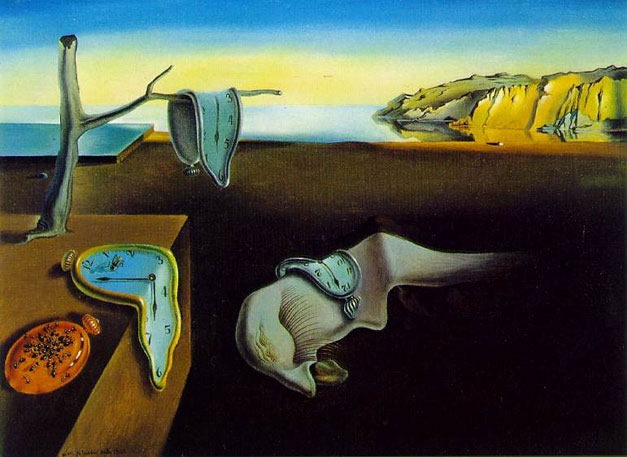
Every now and then, the electricity goes out and I’ll have to live without power for a few hours, and on some occasions a few days.  Sometimes I’ve had to live without internet.  Time seems to flow at a different rate when you live without electricity, the internet, cable TV, or TV without a DVR.  Some people go crazy when they don’t have their smartphones. 

All our gadgets alter our sense of time.

dali-persistence-of-time (1)

I recently read Anna Karenina by Leo Tolstoy and I was struck by how little technology they had in their lives, and how slow information flowed.  The Russians were having a war with the Turks and the news came by telegram to newspapers.  Each day people waited for new news of the war, and discussed the latest telegram.  People in the 1870s Russian traveled by train, horse, cart and carriage.  If they wanted to know what a friend was doing they had to wait days for a letter.  It took weeks and even months to travel from one place on Earth to another.

Time works different when I have to be in my den chair at a specific time to watch a TV show.  Normally I like to watch TV starting after 10pm, until about 11:30pm.  I watch recorded shows, Netflix or a DVD/BD disc.  I rarely watch TV live.  Watching TV in real time is a total pain.

Now there is Netflix/DVD/BD time, DVR time and real time.  Netflix and discs are old stuff just waiting to be watch whenever I feel like it.  DVR is recent stuff, waiting to be watched when I feel like it.  And real time is always now.  DVR time lets me time shift and actual watch more TV.  I seldom feel like watching TV in real time, but PBS has several amazing documentaries every week I want to watch.  I’m over 100 documentaries behind in my DVR watching because they produce them faster than I can watch.  Those shows just wait for me on my 1.5 terabyte hard drive.  My HTPC watches TV for me.  Watching TV on my time schedule seems to make time go faster.  I never have enough.

I’m wondering what my life would be like if I don’t fix my HTPC.  Will I confirm to TV time, or will I just abandon the TV and only watch Netflix and discs?  When I was young this would have been an impossible situation.  Young people have to see movies opening night.  They have to watch new TV shows when they air.  There’s an impatience to see things first.  Years ago I had to be home Sunday nights to watch shows like The Sopranos and Deadwood live on HBO.  Then I gave up HBO and waited about a year for them to come to DVDs.  I think I could do that because I had gotten older and had the patience to wait.  I no longer had to live in TV time, in real time.

Are DVDs real time, or slower than real time?  The illusion is all this technology is speeding up time and real time is slow.  That’s how it feels, but is it really?  Is watching 2 hours of TV really any different if you’re watching it live, DVR, DVD or Netflix?  It’s still two hours of TV?  Somehow watching TV with commercials in real time seems very slow.

I remember when I got my first punch-the-clock job when I was 16, and had to work after school and didn’t get home until around 10pm.  This was back in the second year of the original Star Trek and I hated missing that show.  But work broke me of the TV habit for many years.  The DVR allows us to maintain the TV habit without having to show up on time.  Maybe I just need to kick the habit completely and live in real time.

JWH – 4/26/12 

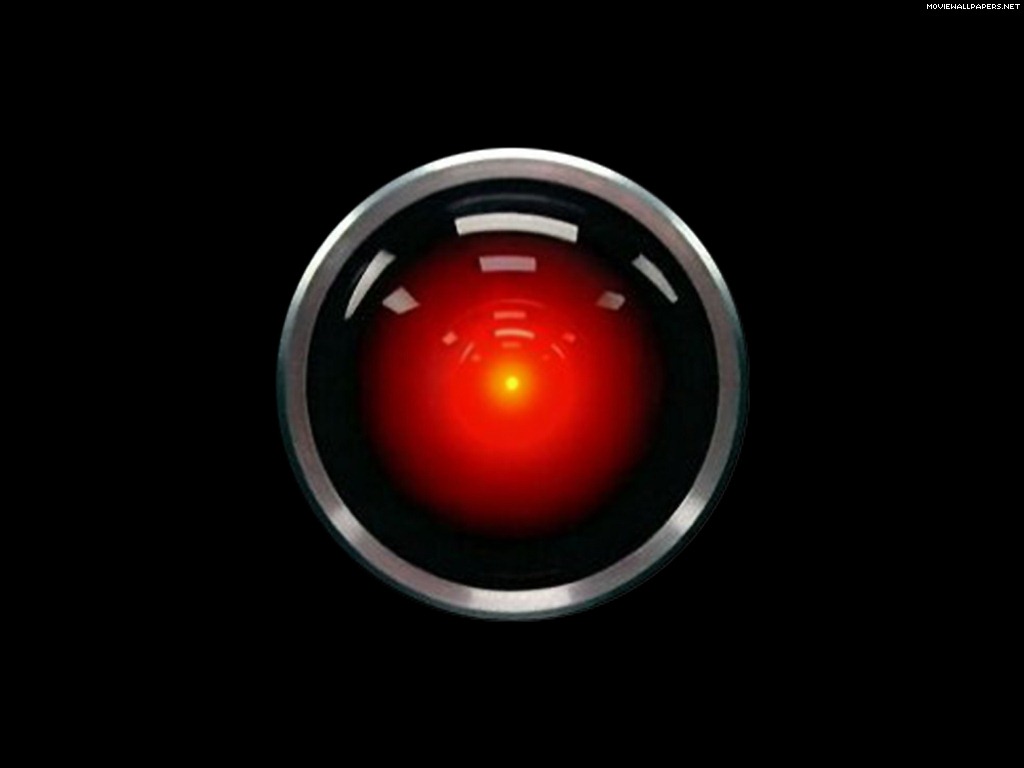
How To Turn Smart TVs in Genius TVs, But Will They Become HAL 9000s?

In recent years TV makers have been adding features from the Internet (Netflix, Pandora, etc.) to their sets and calling them Smart TVs.  Let’s imagine the trend continuing so that we have Genius TVs – what features would they have?  Do we really want them?

Right now we have many devices, services, apps, sites that all work in different ways.  Smart devices are ones where two technologies blend together, like Bluetooth consoles in cars recognizing Bluetooth smartphones so you can have hands free phone calls while driving.  To make them smarter, they can also be GPS screens, rear view videos, engine monitoring, radios, CD players, etc.  Genius devices are one that blend in many technologies and make them work together.  Bluetooth, Wi-Fi, Broadband, USB, TCP/IP are all enabling technologies that bring electronic devices together.

In a way, all of this is very scary because we’re making machines smarter and smarter.  If you’ve ever read John Varley’s classic story, “Press Enter ■” you’ll know what I mean, but for right now we’re all rushing headlong into convergence of intelligent machines.  Most people love their gadgets but often get overwhelmed in how to manage them.  That’s why inventors work so hard to let machines talk to one another so they can figure out how to work together without human intervention.

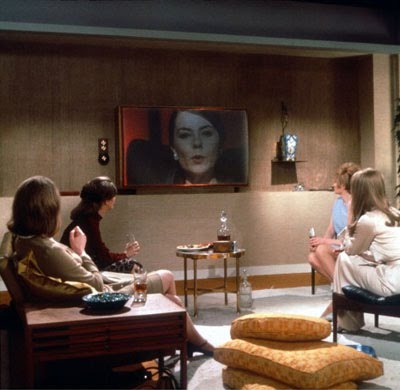
This also reminds me of scenes from the dystopian film Fahrenheit 451, based on the classic Ray Bradbury novel, and of course, Big Brother screens in Nineteen Eighty-Four.   I’m in love with gadgets, but such gadgets haven’t always been portrayed well in science fiction.  And there was HAL 9000 of course.

fahrenheit-451_2

Our machines are getting smarter to make it easier for us to be dumber.

Here’s an example.  When I sat up my new Roku I had to add each channel I wanted, and for each channel the Roku would give me a code that I had to enter in at a web browser.  For Netflix I went to http://www.netflix.com/roku and entered the code, and then went back to the Roku to see that I had been validated.  In the future I could validate my identity with the Roku, and then it could go down its lists of channels and automatically check with each service to see if I had an account and configure the Roku device for me.  The smarter Roku would know more about me, and have access to my accounts.

With a Genius TV, I should be able to identify myself and it should configure itself automatically for everything I like to do with its designed features.  It will be a video phone, and so it will get my contacts from the cloud, so I can say, “Call Connell” and it will know who I want.  Or I could say, “Take me to the next episode of Breaking Bad I want to watch” or “I want to look at all the photographs of my father” and it would know what I want to do.  Of course, I’ll be developing a symbiotic relationship with my Genius TV.

If you’ve ever used the program Zite on the iPad you’ll know how a program can consolidate your interests with articles appearing on the Internet each day.  I should be able to tell my Genius TV that I’m interested in learning about how people lived in Boston from 1850-1875 and it would go get me diaries, photos, newspaper articles, books, etc., and format them in an interesting way to process all the data.  This goes way beyond Google.  I’m talking about a digital Jeeves like in the P. G. Wodehouse books who is smarter than me, and who can take care of all my needs.  Siri is the first step to a Genius TV.  But what if we all had our own personal Siri that really knew us?

A Genius TV must be completely Internet aware, not just design to work with a few services like a Roku box.  It needs to be voice activated.  It needs to integrate with my Internet provider, phone provider, my TV provider, broadband provider, my cloud services, my home security provider, utility provider, security cams, home network, cameras, and even local over-the-air TV and radio.  I mean, this sucker’s got to be aware of everything.  Before we all run headlong into this future, I really do recommend reading “Press Enter ■” if you can find a copy.  [There are no legal copies I can link to, but just remember my warning.  There are dangers to the future we’re all heading into.]

We won’t have an Einstein level Genius TV for years, but TVs on sale today are getting smarter all the time.  So this essay should help you think about the possibilities the next time you buy a new TV.  The simple way to look at it is to think about what devices that you own now that you can eliminate.  Think how smartphones have eliminated so many older gadgets, well the same thing will happen to smart and genius TVs.

Here’s all the devices that’s connected to my current entertainment center in my den.

  • 56” TV
  • Blu-ray player
  • CD/SACD player
  • Receiver
  • Roku
  • Home Theater PC
  • Old game unit
  • Ethernet switch
  • 5 speakers

I picture a Genius TV being a larger wall mounted screen with maybe or maybe not a visible speaker bar, and that’s it.  Elegant and simple.  It can see me and I can talk to it.

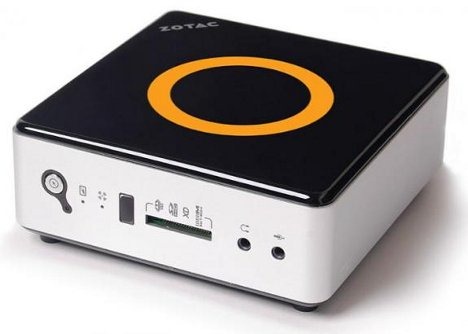
I can buy the physical setup now if I’m willing to give up CD/DVD/BD discs and go without the computer and better sound I get from the receiver/amp.  Right now Smart TVs don’t have PCs built into them.  My current HTPC is bigger than the receiver, but I could buy one that’s smaller than a Mac Mini.  Music, movies and radio are all available via a computer now, so I could do a lot of consolidation now by buying a smart TV from Sony or Samsung, and a Zotac mini-PC.

I could fake the start of a Genius TV by buying a Smart TV and adding a small computer like this one,

Zotac-ZBox-mini-PC

However, a real Genius TV will have a fully functional computer built-in.  An iPad screen has more pixels than a HD TV, and smartphones and tablets now have 2 and 4 core CPUs.  They are small and getting smaller and cheaper.  Adding one to a TV set is a no brainer.  Just think of of a smart TV as a 60” iPad.  Once you have a computer inside your TV you are connected to the world.  You don’t need a stereo receiver to get local AM/FM radio because you can get internet radio from all around the Earth.  TVs are built with 5.1 surround sound now, so we can jettison the receiver.  See how it eliminates older devices?

Most people have already given up CDs and DVDs, and BDs never really caught on.  But we’ll also give up game discs, paper photographs, and even paper personal records, books, newspapers and magazines.  The closer we get to Genius TVs, the less clutter we should have in our lives.  We’ll have different size screens.  Now’s the time to ask if this is good or not, because we’re already moving in this direction as fast as inventors can invent.  Machines have eaten our music, and they are about to eat our books.

Contemplate everything you use a TV or video screen for now.  How could you converge all of these activities into one elegant device?  One that would integrate or replace your other devices.  You’d still need a smartphone, and maybe a tablet, but all the TVs and computers in your house could be replaced by a Genius TV in each room, like the wall screens in the houses in the classic film Fahrenheit 451 shown above.

What all do you do with your TV, computer, phones and other gadgets in the house now?

  • Watch over-the-air TV
  • Watch cable/satellite/broadband TV
  • Watch DVD/Blu-ray discs
  • Watch Roku, AppleTV or similar Internet TV devices
  • Play video games with Xbox, Wii, Playstation
  • Use a computer connected to your TV or display
  • Skype
  • Video picture frames
  • Play family videos
  • Look at family photos
  • Listen to AM/FM/satellite music with a receiver hooked to TV
  • Listen to subscription music via the internet
  • Listen to ripped music on a hard drive
  • Watch pay-per-view TV
  • Run computer programs
  • Use tablet/smartphone apps
  • Use smartphone
  • Read books
  • Take an online course
  • Play DVD courses from The Teaching Company, or other educational training
  • Record shows with DVR
  • Medical monitoring
  • Web cameras
  • Security cameras

Okay, you get the picture.  Now think of the electronic components involved:

  • Screen with 1920×1080 resolution
  • TV tuner
  • Ethernet networking, wired or wireless
  • Cable/satellite tuner
  • Roku/AppleTV/etc. tuner
  • Computer
  • Sound/speakers
  • Hard drive
  • DVD/Blu-ray drives
  • Lots of clickers to control each device
  • Computers, tablets, ebooks, smartphones, GPSes, etc.

But let’s simplify this system.

  • 1920×1080 screen (or 2048×1536 or 4096×2160)
  • Electronic brain – or TV/CPU
  • Soundbar

Like the old component stereo systems of old, it’s easier to build and maintain a system from parts, that way you can upgrade or replace any part without replacing the whole.  The TV/CPU would have components itself.  Power supply, motherboard, memory, SSD drive.  It’s time to get away from optical drives, so let’s just assume our Genius TV won’t use DVD or Blu-ray, but the TV/CPU could have a slot for a drive for be backward compatible for those people who collected thousands discs and can’t part with them.

hal-9000

Den and living screens would be wall mounted, and they would include a video camera.  I picture soundbars now, but even they could be shrunk or hidden so all we see is the big screen.  That leaves us to imagine the TV/CPU.  They could be designed to easily hide in various kinds of furniture or also wall mounted.  They would need two wires, one for the power and the other for TV/Internet, which is now coax, but that wire could be redesigned into a wireless network.  Computers are becoming powerful enough, and wireless networking fast enough, that we might only need one TV/CPU brain to control all the screens in the house.  Our Genius TV could be completely hidden away, near where the fiber optic cable comes in from the street.

Of course, the controllers (clickers, keyboards, mice, game controls, motion sensors) for each screen in the house would be wireless, and we’d need them until which time we perfect human-machine verbal communication, and the video cameras that watch us can read our every movement and intent.  One day it will be just intelligent screens and people.

I think TVs should have full computer power, but not need Apple or Microsoft operating systems.  They will use those OSes for the foreseeable future, but eventually that will change.  I picture Genius TVs more like giant tablets with personalities.  The current iPad has more screen resolution than a HD TV.  Imagine if your TV had a library of apps like you find at the Apple or Android app store and could talk to your as easy as you talk to your friends?

Isn’t it time we have a world standard operating system?  So any screen size can run the same apps?  Once the screens become Geniuses, it won’t matter what OS they run, they will be smarter than us anyway.

If all our data is in the cloud, would we even need a SSD drives?  Wouldn’t 16-32gb of local memory for each screen  handle it all?  After the optical drive disappears won’t hard drives disappear next?

Can you imagine the opening menu on this Genius TV?

  • TV
  • Movies
  • News
  • Magazines
  • Music
  • Audiobooks
  • Internet
  • Apps
  • Videophone
  • Games
  • Photographs
  • Videos
  • Documents
  • Security
  • Medical

Or would we even need a menu if it was completely voice activated?   Most people can’t imagine the possibilities.  I’m sure I’m just barely scratching the surface of what’s possible.  Could you have have imagined the iPhone back in the 1990s?  Look at the video on this page about Pebble watches.  It’s a Bluetooth watch the integrates with your smartphone.  This synergy between two devices, watch and smartphone, creates surprising spinoffs.  Combing TVs, computers, internet, cable TV, phones, AI, etc. will produce some surprising spinoffs we can’t foresee now.

One thing that’s sweeping the country right now is online education.  At first in colleges but also for K-12 schooling too.   If you seen TED talks and Khan academy videos, imagine what a Genius TV could do for education.  Combine it with Skype and Google Hangout and home schooling becomes more social.  But instead of studying with children from the same school, or district, it would be possible to find other students anywhere in the world to form a study group.

If you have a 14-year-old kid who is fascinated by chemistry, you can hook them up with other 14 year-olds also fascinated by chemistry, and have them watch lectures from the very best chemistry professors in the world, and then have them remote view chemistry laboratories that are doing real chemistry.  Suddenly a TV becomes a lot more than a TV.  And computers become more than computers.

What happens if politics becomes truly participatory?  Why let just 100 senators vote on a bill, when anyone who is interested could participate?  TV has always been passive.  The Internet and computers are active.  Combining live events with the internet and TV screens should produce endless forms of real-time two-way/multi-way social networking.

What happens when your computers, TV, utility meter, security system and medical monitors mind meld into one system?  Is it a computer?  Is it a TV.  Do we need a new name?  Let’s not pick HAL 9000.  We’ll interact with large wall sized screens, so we’ll think we’re talking to a TV, but one that’s very smart.  Not some box that just passes on hundreds of video feeds.  As we add more intelligence to these devices won’t they seem more intelligent and individual?

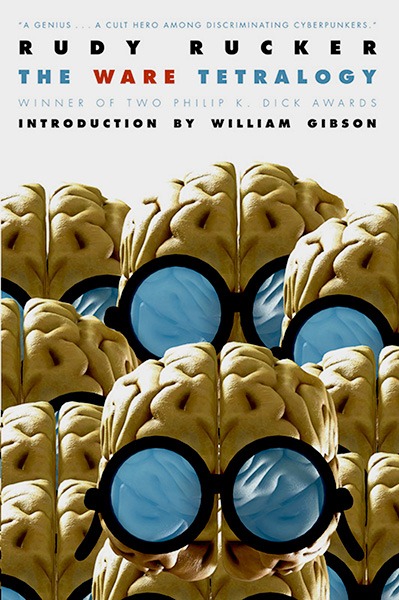
Read Wake by Robert Sawyer.  No, I mean it.  You need to be prepared for the future.  There are science fiction stories that can help you imagine this future better than I can.  Read Rudy Rucker’s The Ware Tetralogy.   People are all nuts over vampires, zombies and werewolves right now.  Those undead creatures aren’t real and won’t happen.  Intelligent machines are happening.  Pay attention.  We’re all gadget crazy, but what happens when our TVs do become geniuses?

warescover

JWH – 4/16/12

Cable TV–Why Isn’t the Customer Always Right?

Millions of people have dropped cable and satellite TV in the last few years.  Some have done it to save money during a recession, and others because they are tired of ever increasing cable bills, or being forced to buy TV channels the don’t watch.  Recent news reports say the average American is paying $100 a month for TV, that it will be $123 by 2015, and $200 a month by 2020.

Even the people who continue to subscribe to cable and satellite services complain about too many channels, bad service and growing bills.  When will the pay TV industry wake up and think, “Hey, the customer is always right!”  A friend of mine got mad when his cable company charged him $50 to fix his cable service he was paying over $100 a month to use – shouldn’t something you buy be in working order?  He wasn’t ready to quit cable completely, so he took his service down to the $29.95 basic rate.  He’s still mad and thinks of giving up cable completely.

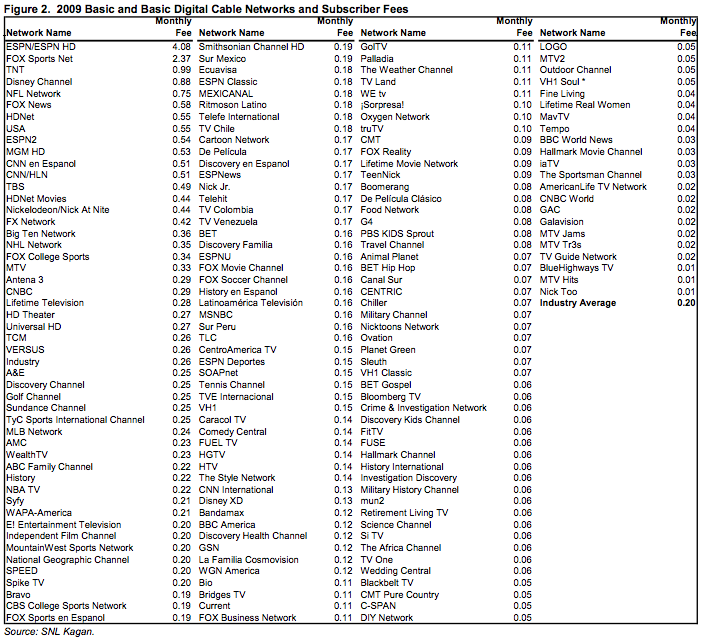
I gave up cable because I got tired of paying for a zillion channels I didn’t watch.  I wanted a la carte pricing but cable companies want to bundle their services.  If you want to know why, look at this chart I got from “Hate Paying for Cable? Here’s Why.”  You’ll probably need to click on the image to see the larger version to read it.  This is an example of what cable/satellite companies pay for each network to get all those channels they offer.

cable-sub-fees

I don’t watch sports, so I would be paying over seven dollars a month for sports channels I don’t watch.  WTF!!!  I recently tried to get U-verse to sell me just Turner Classic Movies (TCM) which this chart says this cabled company pays 26 cents a month per subscriber, but I’d have to pay AT&T $80 a month to watch the one channel I wanted.  Sure I’d get 200 other channels, but I only wanted TCM.

By the way, that chart is old.  A newer article says ESPN is $4.69 and TNT $1.16 (“How ESPN Is Making Your Monthly Cable Bill More and More Expensive”).  This is like going to Target to buy toilet paper and being forced to buy a pair of pants, a quart of motor oil, a bottle of shampoo, a comb, a gallon of Clorox, and 200 other items just to be able to leave the store with butt wipes.

But you can see why cable networks want cable companies to bundle their stations.  Take ESPN.  For each million homes forced to buy ESPN, they contribute $4.69 million per month to ESPN.  However, if we went to a la carte pricing and only 500,000 per million wanted ESPN, and ESPN wanted to make the same amount of money, then they would have to charge $8.38 a month to the people who wanted it.  Which would probably make many of those 500,000 subscribers think even more about if they really wanted ESPN.

If we have a la carte pricing, I doubt Comcast or U-verse would sell me TCM for 26 cents.  But I’d be willing to pay $10 a month for TCM, but I’m not sure how many other TCM fans would be willing to pay that much.  But for a la carte to work, instead of shaking everyone down for 26 cents a month, TCM fans would have to pony up more, maybe a lot more, or TCM would go out of business.

If we had a la carte pricing, many cable stations would go out of business.  Bundled pricing is keeping  these channels afloat.  If the goal is to have hundreds of television networks, bundling is the way to go.  But most cable customers bitterly complain about buying channels they do not want, and it’s the reason why cable bills keep growing and growing.

Cable and satellite companies need to get right by their customers.  What they need to do is provide a base service, say $19.95 that provides a  HD DVR/modem box and the local stations.  HD is standard with free over the air stations, so quit being a dick and charging extra – and it will simplify things for both the customers and you.

DVRs should be standard too.  Quit finding ways to charge extra for what should be standard, that only annoys the customer.   And don’t charge for fixing the system when it’s broke.  We’re renting a service from you, it should be reliable and high quality.  Even at $19.95 a month for the base system with just local channels, pay TV services should be able to make a profit at this level.

Then offer an onscreen menu that customer’s can control from home that shows all the channels, pay-per-view, on-demand channels and other services with the monthly costs for each.  Let them sign up with their clickers – no annoying phone calls.  I bet you can make the same profits or more by pricing the channels individually.  The only downside will be that the total channels will go from 200-300 to maybe 50-100.

Since I gave up cable TV I learned just how good 1 channel can be.  I have a home built DVR (HTPC) and what I mainly record is PBS.  It offers more top quality TV than I can watch.  If you distilled hundreds of channels, with mostly crappy content, into dozens of channels with mostly quality content, the perception of your product will vastly improve.

I think most homes will be happy with 10-20 “a la carte pay” channels.  Having fewer channels makes watching TV less stressful.  To much choice can be painful.  Their cable bill could be as high or higher than it is now, but it would reflect exactly what they wanted.

If such a system was available I’d go back to being a cable subscriber.

In the future there are other changes cable companies could make to make their customers happier.  Get rid of the cable box.  That would reduce clutter and a clicker.  Work with TV manufacturers to make smart TVs work with cable/satellite feeds and develop standards.  DVRs should be built into TVs.  A SSD drive would not take up much space.  It could be user replaceable.  Or make TVs with 128-256gb SSDs built-in, with a slot for customer’s to add an additional drive.

A TV could be built to do TV, Internet, video games and music that uses one clicker plus game controllers.  One cable, from a cable/satellite/broadband company could provide all content.  And build your systems with self-diagnostic awareness so we won’t have the aggravation of feuding with your company over intermittent problems.  There should be no reason to send a cable guy to see what’s wrong.  Your system should know what’s wrong, and if it’s involves something in the house, notify us to pick a time for your guy to come by – otherwise fix the outside stuff without bothering us.

And why fight Netflix – make it part of your lineup.  Right now I have over-the-air stations I use the TV clicker to manage, and then HTPC content, which I use a wireless keyboard, and then Amazon and Netflix through a Roku box with another clicker, and watch Blu-Ray/DVDs with another box and clicker.  Plus I manage sound with a receiver and another clicker.  That’s a HUGE PAIN IN THE ASS!  The next TV I buy should have all that crap built-in, requiring only one clicker.

If Netflix, Hulu, Amazon, and other Internet TV services can work with TV manufacturers to get their content  built right into the TV, why can’t cable/satellite/broadband companies?  Sorry Roku, but it’s obvious that your 2 ounces of electronics could easily be added to a TV set.  And why not a computer and stereo receiver?  If such integration happens, and TVs are moving that way now, having an external cable box is just stupid.  I’m not an inventor but I can see which way the electronic wind is blowing.

Lastly, Hey TCM, go the Netflix/Hulu Plus route and set up your own Internet TV service.  I’d gladly pay you $9.99 a month, but you might get more subscribers at $4.99 or $7.99.

JWH – 4/15/12

Redesigning the Television–Will Apple Revolutionize the TV Next?

Before Steve Jobs died he told his biographer that he wanted to create a television set that was completely easy to use.  Can you imagine a TV that’s as revolutionary as the iPhone or iPad?  Well, I think it would be fun to guess its features.

World TV

Right now there are different technical broadcast systems all over the world so I would think the first area of simplification would come from jettison outdated technical standards.  Why not design one TV that will work with all 7,000,000,000 citizens of the Earth.  I can’t imagine Jobs would want to design a TV that had to work with set-top boxes from other companies selling content.  Nor could I imagine he’d want to design something that used over-the-air channel reception.  Because the Internet is universal across the world, why not just design the future TV to be an Internet TV?

Picture a TV with one power plug and built-in wireless networking.  Now that would be a simple and elegant design.  It would essentially be a computer with a 24”-62” screen using 1080p, that could work anywhere in the world with a different power cord.

The TV antenna will go the way of the buggy whip, and so will set-top boxes and DVD-Blu-ray players.

Physical Design

Now we need to imagine the design of the device itself.  Currently I have 5 remotes and a keyboard with trackpad to use with my 52” TV entertainment system I built myself.  If our new future TV used something like Siri, we could get rid of all remotes and keyboards.  The only external control that Siri couldn’t handle is a game controller, and with a Kineck type sensor even that might be eliminated.

Having to connect a receiver and surround sound speakers to HD TVs is a pain.  Our perfect TV should have a sound bar built-in with great surround sound.  And it should play music fantastically too.  No more Hi-Fi component, speakers and wires cluttering up the living room.

My new LG computer monitor has no physical buttons on it, but light sensors, even for the on/off switch.  I think our perfect TV wouldn’t have mechanical buttons either.  It should be voice activated only, but if it did require a manual power switch it should be light activated.

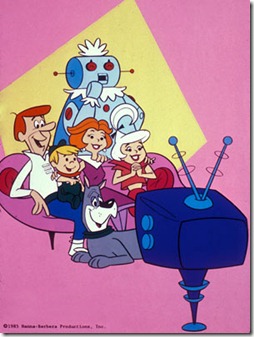
This TV will be more futuristic than anything on the Jetsons.
jetsons_l

Content

Now I can’t imagine Jobs thinking he could design this TV and just throw iOS 5 on it.  The TV opening screen and menu system is the hardest feature to imagine.  This is why Apple is the success it is, and why other companies copy its design.  Our prefect TV needs to show:

  • Internet broadcasts – live TV
  • Recorded shows from the past
  • Movies
  • Personal videos
  • Photographs
  • Internet
  • Games
  • Music
  • Telephone
  • Teleconferencing
  • Online courses
  • Presentations
  • Business and education software

For Internet TV to work we need TV networks to switch to streaming their content, but there’s needs to be a paradigm change first.  How many shows need to be live?  Think about that.  The news, sports, reality shows, special live concerts and performances.  We actually don’t need live TV all that much.  Most of what’s on TV is recorded.  Because of DVRs and services like Hulu, how many people even watch new TV shows that premiere each week live?  Cable/satellite services provide hundreds of channels because of their technical limitations, not because we need hundreds of live TV channels.

Content from networks like TCM, National Geography, Discover, History, etc. can be served just as well from a web page, they don’t need to be live.

Recorded TV shows and movies can come from services like Netflix, iTunes and Amazon Prime.

When I was growing up in the 1950s and 1960s we had 3 television channels.  There were no DVDs or DVRs to catch a show later.  You either watched the show when it aired, or maybe had another chance the following summer during rerun season, and that was it.  Each fall we were presented with a new line-up of shows and they would generally run a whole season – shows were seldom canceled mid-season.  Once you learned the lineup on shows in September you pretty much knew what was going to be on television until next summer.  Special shows were indeed special and rare.  That was simplicity then.

Back then watching TV was as easy as basic arithmetic.  Today with cable, satellite, iPads, smartphones and internet television channels, along with DVDs, Netflix, Amazon Prime, Blockbuster, Redbox and DVRs deciding what to watch on television is more like advanced calculus.  We now live in a TV age of painful complexity.

Watching TV fifty years ago meant three channels of choice.   Today we’re getting closer and closer to being able to watch anything that’s ever been on television at any moment.  The choices aren’t infinite, but when someone asks “What’s on TV?” it might be safe to say, “There’s a million things on TV tonight.”  And that’s painful to deal with.

Our perfect TV needs to have an operating system that allows the viewer to find what they want to watch as quickly as possible.  It needs to be as simple to use as an iPad for a two-year-old.   When the set is turned on it needs an opening screen – the top menu, and the basic functions can be simplified to these:

  • TV
  • Library
  • Telephone
  • Games
  • Music
  • Computer

This makes six tiles – is Microsoft on to something?  TV would be live TV, Library would be recorded shows, either TV, movies, personal videos, photographs, or other content.  Telephone could be two way video or conferencing.  Games and music are obvious.  Computer would be anything from online courses, business presentations, science simulations, word processing, blogging, etc.  I think we’ll be surprised what we’ll want to do from the family TV in the den.

Think what a game changer such a television would be.  It would be the Holy Grail of integration between TVs and Computers, but also phones, stereos and game units.  Is it any wonder that Steve Jobs wanted to tackle such an exciting project?  Sadly, think how many companies it will put out of business.  We won’t need Blu-ray players or discs, or Google TV or Roku, or music CDs, or movies and TV shows on DVD.

How To Get From the Complexity We Have Now To A New Simplicity?

If you have cable with hundreds of channels how do you even know what to watch?  And what great shows are you missing?

Live

The first thing we need to do is separate live content from recorded content.  We need to bring back the demand and understanding of live TV and we need to reduce the number of channels offered.  Because our system works with the world, live TV could be from anywhere on the planet.  We want our TV user to select any channel they want, but we need to simplify the TV menu system.  I like how Roku does things.  It offers hundreds of channels but you only add in the ones you regularly use to you main menu.  I’ve done the same thing with my over-the-air TV, reducing about two dozen local channels down to five.  It makes life easier.

When the user says “Live TV” to our new set they should see a small listing of favorite live channels.  They could be numbered on the screen so the user could say “Number 4” or just “PBS.”  Or they could say “Add channel” and then go into a menu of all possible live channels to add.  They might say, “Japan” and see live TV channels from Japan.  Or they could say “American football” or “British reality shows.”

This system would allow for simplicity from an unlimited offering.

Also, the Live function could connect to web cams around the world.  TV doesn’t have to be produced.

Library

The selection of recorded shows could run to the millions.  Any movie, any TV show, any documentary, any home video, etc.  We’d need a system to help people find good content.  The basic search engine could find things if user already knew the name of the show, or certain related details, but for discovering new shows they would need help.

What we need is the wisdom of crowds – hit lists of all kinds to let people find what other people are watching and rating.

The default Library screen could have pull down menus on the left and a list of shows on the right. The pull down menus will let you pick for Year, Genre (and Subgenre), Audience, Now/Then, Rating, and maybe others. The default might be Current to see the most popular shows people are watching right now. But under Time you can change it to a listing by year or decade. Under genre you’ll see a detail list of genres and from Audience you can pick age group.

This way you could put in 1950s, Science Fiction, 60-65, Now – and you’d see a list of 1950s science fiction shows and movies that people 60-65 are currently watching the most. You can also switch to Then and see what the people back in the 1950s watched the most.

So if you want your daughter to learn about astronomy you could request the most popular documentaries on astronomy that are viewed by 10-20 year old girls that are rated 8-10 stars.

We’d need supplemental features that used the techniques of Amazon customer reviews, Netflix, Wikipedia, Rotten Tomatoes, MetaCritic etc. to help people find shows.

The system could have an encyclopedia of TV shows and you could find any TV series that’s ever been made and start watching them from the first episode to the last.  Such a TV system will kill off DVDs.

Finally, our Library feature could also integrate with your local libraries, to their special collections, or to libraries around the world.  There’s more to our culture than old movies and TV shows.

Telephone

Wouldn’t it be cool for one family on Christmas to see and talk with other family members who can’t make it home that year?  The possibilities are endless. Science fiction has been predicting for the wall screen telecommunication device for decades.  It’s time to get around to making one.

Games

It’s pretty obvious games need to be integrated into this system.  Essentially our TV will be a computer, whether it runs Mac OS X or Windows 8 or Linux, it will be competing with console gaming.  It could signal the end to console games.  But won’t Angry Birds be cool on a 62” screen at 1080p?  Or future versions of World of Warcraft?

Music

Apple wants you to buy music from iTunes – that’s such ancient 20th century thinking.  I’m surprised that Steve Jobs didn’t recognize the simple beauty of streaming music libraries like Rhapsody, Rdio, MOG, Spotify, Zune and others.  Why mess with owning music and having to worry about backing it up and protecting it for the rest of your life.  Streaming music rental libraries is just too damn easy to use.

Like the “Live” TV function, the “Music” screen should allow users to add subscription services to the default screen.  Probably only one, but they should get to pick which one.  I’m sure the future TV from Apple will show iTunes, but unless iTunes starts its own streaming music service, this will keep the Apple model of future TV tied to the past.  Right now I subscribe to Rhapsody and Rdio, and use the free version of Spotify.

Computer

Lot’s of people want to predict the death of the desktop computer but you just don’t want to do everything you can do on a computer from a 4” screen, or even a 10” screen.  Online education is going to be big.  Doing business presentations is already huge and getting bigger.  Everyone will learn to create content, whether you’re an artist, teacher, musician or mathematician.  Imagine letting kids paint on a 62” canvas?  Or studying math from a library of the best teaching programs from around the world.  For many families the desktop might go away, or it might become the family TV.  Or the bedroom TV.  Pretty soon a TV will be a computer and a computer a TV.

Summary

It’s like Dylan said, you don’t need a weatherman to know which way the wind blows.  Many young people have already abandoned the family TV to get all their content from smartphones and tablets.  The shift to Internet TV has been going on for years, so it doesn’t take much imagination to predict a perfect TV.  I wished Jobs would have lived into his 90s to see everything he could have revolutionized.  Actually it would be fun to see if he ran out of things to reinvent. 

At some point things have got to settle down.  If you contemplate this TV I’ve imagined here, it integrated a lot of technologies into one simple device.  I’d expect one screen in every room.  And then everyone would have a 4” smartphone and a 10” tablet and maybe a 12-16” laptop if they needed one.  After the war of gadgets we’ve been seen in the last decade will we see a gadget peace for a time?  Reading Engadget makes that hard to believe.  But the Flip video camera was killed off because of video cameras in smartphones.  What will the iPhone 4s do to the digital still and video camera market?  What’s happening to portable DVD players and handheld game units?  Does anyone buy handheld GPSs anymore?

Just when Microsoft was getting into touch, Apple comes out with a voice interface.  Schools are giving up teaching cursive handwriting.  When will typing disappear?  Always remember, the evolution of machines is away from moving parts.  Now that consumers have access to 3 terabyte hard drives do they really need them when everything is moving to the cloud?  How much does the iMac look like the future of computers and TV?  Evolution appears to be moving toward intelligent flat screens.  The smartphone suggests that everyone will have a personal 4” screen they take everywhere.  Some people will also need 10” screens (tablets).  At what point does voice controlled touch screens invalidate the need for 12-16” laptop computers?  And when does the 24” computer monitor in the bedroom merge with the TV?  And can one OS handle all screen sizes?  Will it still be Microsoft v. Apple v. Linux?

My recommendation if you are buying a new TV now is to pick one with the most Internet features built in.  But expect Apple to come out with something in 2012.  Will it be as revolutionary as the iPhone?  I don’t know.  Too much depends on TV networks, cable channel systems and content providers.  But I can’t help believe that cable TV will go the way of the floppy disc.  Expect CDs, DVDs and Blu-ray discs to disappear quickly too.  Cable TV and Satellite companies will put up a big fight for years, but the Internet will allow content produces to do an end run around them.

How quickly will all this happen?  Well, how quickly are ebooks taking over printed books?

JWH – 10/30/11