Roku 3–”Loading, Please Wait” Message is Driving Me Crazy-But Is It Roku’s Fault?

I have a Roku 3 and have been using Rokus for three generations now.  However, in the last year I’ve been getting more and more “Loading, Please Wait” messages.  I’m even using Ethernet instead of Wi-Fi, to have the best connection.  At first I thought it was my internet provider, or network traffic, or even an example of net neutrality breaking down.   I stream Netfix, HBOGo, Warner Archive, Amazon and HuluPlus.  I was mostly getting the loading message from HBOGo and Warner Archive, but then it started with Amazon too.  Amazon even automatically refunded my rental fee when a western I was watching timed out too often.

Then I made an interesting discovery!
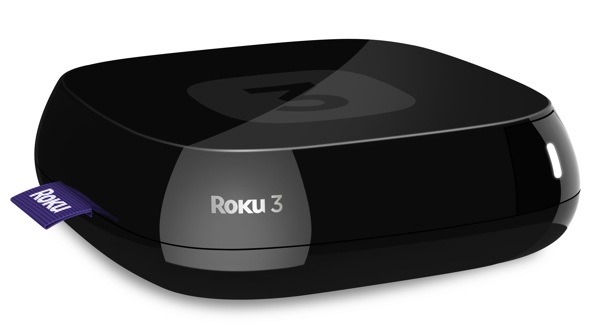
roku

I got the idea of streaming from my computer that’s also attached to my TV—I use it as a DVR for over-the-air TV.  Bingo.  Everything streamed perfectly, at the highest resolution, plus the picture looked richer in colors.  Evidently, a computer with a Athlon X2 processor and 4 GB of memory, with a PCIe video card does a better job decoding streaming television than the Roku.  So maybe it’s not the internet or my provider?  Speedtest.net does tell me I get 19.43 Mbps download and 1.92 Mbps upload on my U-Verse connection, which is pretty good.  But that’s to a test site and not to a streaming server.

On the other hand, my Roku 3 seems to have no trouble streaming with Netflix.  Is it the hardware or the servers the Roku is streaming from?

The Roku does have a dual processor, but only 512 MB of memory.  This might explain why the Amazon Fire TV has 2 GB of memory and a quad processor.  I would buy the Amazon Fire TV to give it a try but it doesn’t support several Roku channels I depend on.  Using the computer is great for viewing films and shows without the dreaded “Loading, Please Wait” message, but instead of channels I have to go to individual web pages, each with their own different kinds of controls.  I have to use a wireless keyboard that doesn’t work as conveniently as the Roku remote, and that’s a pain-in-the-ass.

The Roku is an excellent system for viewing internet TV—I’d hate to see it crap out.  My biggest headache using the Roku is watching Warner Instant and HBOGo.  And some people do have trouble with streaming Netflix, even with fiber optic connections, like this story.  The solution this user found was to use a private VPN that circumvented congested internet routing.  This makes me wonder if my Roku 3 is somehow using different routes than Chrome on the PC, or if internet providers can detect Roku traffic and treat it different.

Like I said, I’ve been a faithful Roku user for years, and love it.  Maybe there’s something wrong with my Roku 3, but checking Google I see other people have this problem too.  And it does seem to be somewhat internet traffic related.  I usually don’t see the “Loading, Please Wait” during the day time, mostly during primetime, especially on Friday, Saturday and Sunday nights.  So it appears the Roku 3 works well if things are just right.  My guess, as more and more people use these streaming services because of the popularity of Roku, Apple TV and Amazon Fire, traffic and server demand will get tight.  Adding a bit more horsepower, memory, and maybe a better video GPU, might process the bulging traffic in a more efficient manner.  I expect the Roku 4 will have specs similar to the Amazon Fire TV, or top them, to fix this problem.  That is, unless internet providers aren’t throttling traffic from devices like the Roku.

This is a technical mystery beyond my ability to decipher.  I recommend people having “Loading, Please Wait” issues with their Roku, or other small streaming device, try plugging their laptops with HDMI connectors to their television and see if they get better streaming via a computer.

My guess is demand for internet services is always growing and we’re always going to see breakdowns at the weakest link in our technological chain.  Right now, for me, it’s my Roku when it’s connecting to the most used servers on the internet.  We might be pushing the limits of what a $99 device can do.  I wonder if the Amazon Fire TV costs more to make than what it sells for?  Or is the solution for Warner Instant and HBO to add more server capacity and pay for better peering?

JWH – 7/22/14 – Table of Contents

Update 6/1/15. HBOGo and Warner Instant both stream far better than a year ago. I think they must have improved their servers. I was able to watch the latest episode of Game of Thrones Sunday night, which is the first night it appears. My conclusion is the Roku is fine, but hiccups in reception are probably due to servers.

Amazon Fire TV v. Roku 3 v. Apple TV v. Chromecast

Amazon just announced their Amazon Fire TV with a quad processor and 2GB of memory.  Since my Roku 3 only has a dual processor and 512MB of memory, I’m wondering if I should put a Amazon Fire TV in my Amazon cart.  The Amazon Fire TV also ups the Roku 3 with gaming, offering far more games than the Roku, or the Apple TV, plus it can use an option game controller.  See list of games and apps here.  I’m not really a gamer, but it’s a consideration.  My wife plays games on her laptop, so she might like it.  I need to see more gamer reviews before I spend $99 dollars to try it out.  But it’s a big advantage point for Amazon.

AmazonFireTV

[Click image to enlarge]

What really tempts me is the tech specs.  My Roku 3 has trouble streaming certain channels in primetime.  Now, this is most of all a problem with the Internet, and maybe even Net Neutrality, and not the Roku.  All of these devices are heavily depended on the speed of your Internet connection.  Recently upgrading to the Roku 3 did show that more CPU power does help, and more memory will too.  The Amazon Fire TV has a quad processor and 4X the memory.

Netflix streams fine anytime on my Roku 3.  But HBOGO and Warner Archive Instant both will crap out in primetime, frequently going to the reloading screen.  In the daytime, I get a HD signal with fast start ups and no stopping, but in Primetime, especially on the weekend, things don’t work as well.  I just wondered if the Amazon Fire TV with 2GB of memory could buffer that problem.  I’m not quite ready to order an Amazon Fire TV to find out, but I’m awful curious.  I don’t want to jump in right away, and because Warner Archive Instant and HBOGO are not listed for the Amazon Fire TV at the moment.

By the way, my streaming problem didn’t happen until a couple of months ago.  I’ve wondered if its because more people than ever are using streaming TV services, or has Net Neutrality issues popped up?  The quality of the TV picture on these devices is directly related to your Internet throughput.  But content can be interrupted by overwhelmed servers at the provider site, just like the Obamacare servers.  So I wouldn’t buy one of these devices unless you had at least 6 Mbps or better Internet.   Try Speedtest.net to check your speed.  Make sure you click the Begin Test and not any of the other buttons that trick you into buying stuff.  I got a 19.60 Mbps for download, and I still have problems on weekend nights.  I don’t think it’s the Roku or my Internet, but the content provider servers and peering deals.  Netflix pays its peering partners, so they get good throughput.

The big hold back – will Amazon Fire TV have all my favorite Roku channels?  One of many reasons why the Roku is superior to the Apple TV is the vast away of channels.  And the poor pathetic Google Chromecast is really a no show.  I didn’t send my Chromecast back, because my wife thinks she might have a use for it, but I haven’t found one yet.  To me, it was a one horse race until Amazon showed up.

My fear is Amazon Fire TV will be like the Apple TV, mainly gearing its content to what Amazon sells.  The Roku has over a thousand channels, and their numbers are growing fast.  They have Rdio and Spotify, which apparently Amazon and Apple do not.  Sure, most of those channels are crappy, but it does offer a tremendous variety, and crap is in the eye of the beholder. 

I don’t have cable TV and I don’t miss it because of my Roku 3.  Right now, it would be a step back in terms of streaming content, to switch to the Amazon Fire TV.  Over the years I’ve convinced many friends to try the Roku and they’ve all been very happy.  Some have even given up cable TV too.  I know a few people with Apple TV, and I’ve set up one for a friend, and it just hasn’t impressed me.  Because my Mac friends haven’t gushed about their Apple TV I assume it was ho-hum.  Even the guys at Mac Power Users podcast seem to prefer the Roku. 

I’m on my third Roku.  My first generation went to a friend who is still using it, and my second generation went to my wife’s apartment.  It’s going to be hard for me to switch, but not impossible.  I like new gadgets.  It’s still too early to run and buy an Amazon Fire TV.  I think I’ll at least wait until the Roku 4 comes out.

Which makes me ask:  How far can these internet TV boxes evolve?  The competition is obviously heating up.  What’s weird, is over the air broadcasting is heating up too, with new channels popping up from time to time.  Now, with internet TV, the competition to cut the cable TV cord is getting intense.

The one thing that cable TV has that most won’t give up is the DVR.  Internet TV could completely invalidate both broadcast and cable TV because it’s not time bound.  A Roku 3, Amazon Fire TV or Apple TV  do not have a DVR, but their channels work just like everything was already DVRed.  Instead of watching shows live over the air, I can watch them later on Hulu Plus or the PBS Channel on Roku.  So Internet TV boxes could be the wave of the future except for one thing – live sports.  Since I have no interest in sports, I’m good to go.  But I always warn people who ask me about the Roku, is if they love sports.  If they do, cable TV is still their meal ticket.

I’m mighty impressed with the Apple Fire TV specs and rollout.  I’m very tempted to buy one.  Susan has a Kindle Fire.  We are Amazon Prime users.  I keep my MP3 music at Amazon Cloud Music.  The world is dividing into Android v. iOS users, and in particularly, Amazon v. Apple as content providers.  The Amazon Fire TV runs on a customized Android OS.  Is there room for the Roku?

Here’s where the Roku has to go up to the plate and hit a few more homers to prove itself.  There’s still plenty of room to innovate.  Take the Rdio channel.  It’s bare bones.  Now the channels are created by the content providers, but Roku should help them improve with programming tool kits and standards.  I’ve even considered switching to Spotify because the Spotify Channel is better on the Roku.  However, I prefer Rdio’s software on the iOS and web.  Warner Instant Archive recently did an overhaul of their interface, but in many ways it was a step down.  The new look is slicker, but hides the content.  The apps on these devices are all still rather primitive.  Apple which is legendary for its Mac UI, falls down on the UI for it’s TV box.

Amazon gives their users voice search at the remote, which is a huge jump forward because typing in movie titles or actor names is tedious on the other streaming TV players.  Of course, Roku gives their users a headphone jack at the remote which is a very useful option.  I expect these devices to find plenty of ways to innovate and compete in the future.  I know most iPhone and iPad users assume they need to get Apple TV, but they really should consider the Roku or Amazon Fire TV.  It’s still too early to be locked in, especially at $99.

If you don’t already own a streaming Internet TV box, the choice now will be very hard to make.  I think Amazon wins on tech spec and slickness, Roku on content, and Apple for dedicated iOS users.  Because Amazon is an 8 million pound gorilla, and because Roku is not a household name, I’d bet that Fire TV will succeed like the Kindle Fire.

JWH – 4/3/14

Professions and Fame

Our society loves the famous, and the glamour of being famous, yet I think we have a rather narrow range of professions in which people become famous.  Quite naturally, the most famous in our society are the people who work in front of cameras:  movie stars, television stars, sports stars.  Musicians are less famous because they aren’t on television as much, and the more famous of rock stars seem to be due to media exposure rather than just musical ability.  If you want your song to become a hit, you have to make yourself famous. 

With the Internet, people are gaining fame through online exposure, but more often than not, it’s because of video hijinks.  YouTube now allows anyone to produce themselves as their own star.  See “The Impact of the Like Button.”

Fame drives ambition, so kids want to grow up and become the kind of people we see on screens – television screens, movie theater screens, computer screens, tablet screens and smart phone screens.  This limits what professions kids will think about when asked, “What do you want to be when you grow up?” 

I’m thinking we need to make more types of professionals famous.

Take for instance architects.  PBS has a new series Super Skyscrapers that is about building monstrous structures that would make the Tower of Babel dinky.   Their episode on the Shanghai Tower, about a 121 floor “vertical city” was mind boggling.  The feat of designing such a building is so tremendous that I have to wonder why such a person isn’t more famous than any movie or pop star on the planet.  Of course, Shanghai Tower wasn’t designed by one man, but a firm, Gensler, but even still, they should be as famous as any rock band.  But I can’t name them.

Shanghai_Tower_2013-8-3

How many professions out there are so cool, so important, so dazzling, that their best practitioners should be famous?  Shouldn’t doctors who develop new techniques to cure cancer be more famous Justin Bieber?  Shouldn’t the creators of the Mars rovers or space telescopes be more famous than Miley Cyrus?  Shouldn’t the top philanthropists get as much attention as Olympic athletes?   Would two weeks of fame every four years inspire more people to change the world for the better?  Hell, I think there should be a weekly show devoted to such people.

Since people love CSI shows so much, why don’t we have weekly shows about real criminal investigators?  Our cities are plagued by crime, so why not focus on real crimes being solve by real people?

Why do we need so many reality shows about faked reality when we have so much far out real reality to film?

Steve Jobs and Bill Gates became famous, but why aren’t the programmers of all the apps and games we use today not famous?  Things do change, because chefs have gotten famous lately.  And I assume because of that, more kids want to take up the culinary profession.

I love The Big Bang Theory, but why not have a weekly show about real scientists and engineers and what they really do?  Would a weekly show about particle physicists around the world encourage more kids to study math and science harder in school?

I can’t help but believe if we made more smart people famous then kids might choose to become smarter.

JWH – 2/21/14

Aren’t Television Shows Just Short Stories for People Who Don’t Want to Read?

Many of my bookworm friends tell me they dislike reading short stories.  They claim short stories are too slight, not enough plot and character, to waste their reading time on.  Okay, I can buy that.  But isn’t a 22 minute episode of The Big Bang Theory just a short story?  Isn’t a 47 minute episode of Nashville, merely a novelette?  I’m currently listening to The Portrait of a Lady by Henry James that runs 24 hours.  Most current TV shows have a season of 24 episodes.  So if they were collected as an audiobook, the entire season of 30 and 60 minute shows would still be shorter than one literary novel.  Doesn’t that sound like an anthology of stories?

In other words, don’t people still really love the short story?  Some people like to read, others to listen, but most love to watch!  Don’t most of us crave two or three stories a day?

playhouse-90-2

At one time the short story was very popular in America.  There were hundreds of short story only magazines for sale at newsstands, and some writers like F. Scott Fitzgerald were paid big bucks for a single story.  Even when I was growing up in the 1950s and 1960s, most women’s and men’s magazines would contain at least couple short stories. 

Why did people stop reading short stories?  Why did they fall out of favor?  The obvious answer is they haven’t.  Pulp magazines just mutated into television shows.

How long have humans needed a daily diet of fiction?  Aren’t short stories just oral story telling in mass production?

It seems pretty logical to think folks just switched from reading a thirty minute story to watching one.  It’s also easy to assume that the half hour show is the short story, the hour show the novelette, and the movie is the novella.  But if we look deeper, I think there are some other concepts to consider, most notably the continuing character, the series, and the genre subject focus.

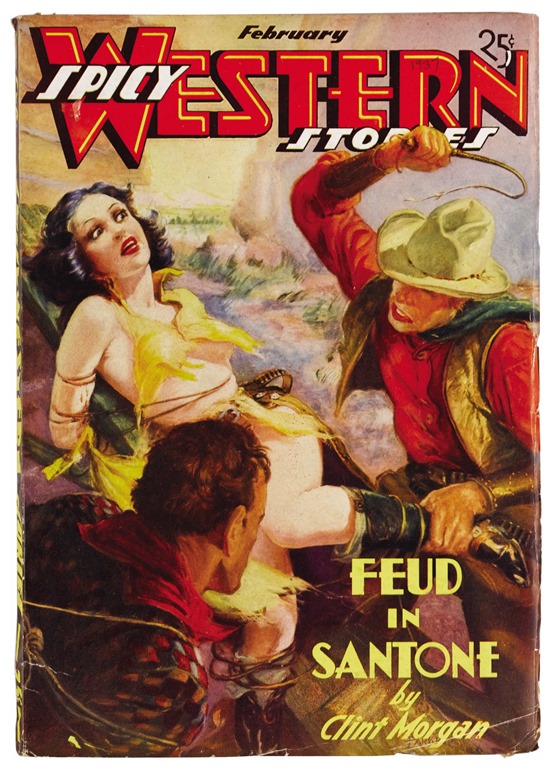
spicy-western-stories

At the beginning of the 20th century most magazines, even pulp magazines, were general purpose magazines for readers of all ages of both sexes.  But as the century progressed publishers created specialty subject magazines, some devoted to single characters, that catered to particularly reading tastes, and demographics.

If you read the latest volume of Best American Short Stories 2013, the annual anthology that collects the best of literary short fiction, you don’t see stories involving a continuing character, a series, or can easily be pigeon-holed into a micro-genre.  Now there are plenty of genre magazines devoted to the short story that do regularly publish this type of story, but their content seldom gets picked for the annual Best American Short Story collection.  For the last 50-75 years, publishers seem to be zeroing in on the continuing character novel, so that most mystery novels, and many science fiction and fantasy books, are now about popular characters involved in a series of adventures.  Doesn’t that sound like television?

doc savage

Television supplanted the pulp magazine, and is now inspiring how many writers write their books.  What happened to the slice of life short story, and the great American novel?  Writers prefer to develop a character and setting they stick to, like those in television shows.  It’s easier to sell, and sells better.

The best literary short stories are tiny slices of life, unique views of humanity.  Most novels from the early history of book publishing were always stand-alone tales, just longer slices of life, with highly detailed unique views.  In the early days of television there were many drama shows that featured a different story and cast of characters each week, the most famous at the time was Playhouse 90, but probably the most famous still somewhat seen via streaming, is The Twilight Zone.

The unique slice of life story was quickly supplanted by the continuing character show.  But that had already started in pulp magazines before the age of television.  I’m curious who the first continuing character was?  Sir John Falstaff appeared in three plays by Shakespeare.  And how many stories did Sherlock Holmes appear in?  Huck Finn and Tom Sawyer appeared in several books, and readers wouldn’t let Louisa May Alcott stop writing about Jo March.  If Louisa was alive and writing today, the March sisters would be a television series.

It seems most people love short stories, about favorite characters, in a setting and subject of particular interest to them.  Other people like stories stretched into novels.  While I love continuing character stories on TV, I avoid them in novels.  But I still love short, unique, slice-of-life stories, either written or dramatized.  I wonder why most people don’t.  I’ve been re-watching old episodes of The Twilight Zone, and some of them are very powerful.

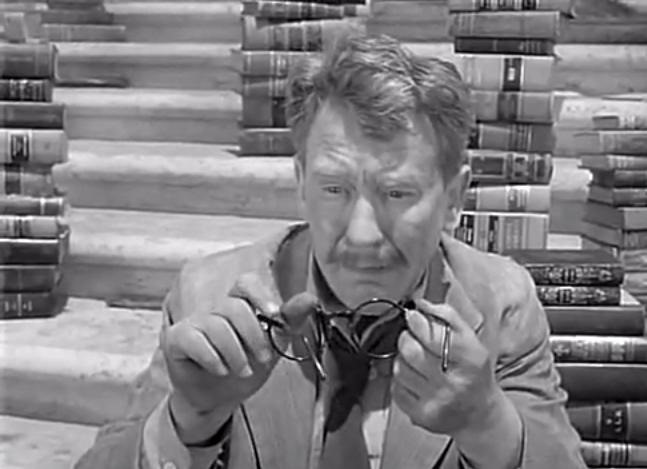
Burgess-Meredith-Time-Enough-at-Last 

However, my brain quickly forgets them, or most of them.  In over fifty years I’ve never forgotten Henry Bemis, or the pig nose people.  If I had only seen one episode of The Big Bang Theory in my life, would I still remember it?  Maybe it’s memorable because I’ve stuck with it for seven years.  Apparently we crave long term relationships with our fictional friends.

Memorable novels are like short intense love affairs we never forget.  By that standard, it seems most people would rather have long term friendships.

JWH – 1/17/14

Gravity–Riveting Story Set In Space

[Don’t read this review if you haven’t seen Gravity.  But when you have, because you should, come back here and let’s talk.]

Television watchers are experiencing a renaissance in storytelling.  Shows like Breaking Bad, Downton Abbey, Shameless, Friday Night Lights, Dexter, The Newsroom, have taken the art of storytelling to new heights.  By carefully focusing on character, writers have developed new techniques to create highly addictive forms of fiction.  This has revolutionized television.  Character driven storytelling has always been preeminent in novels, and prominent in movies, but television was always seen as a vast wasteland of lowbrow entertainment.  Now I like television better than movies, or even books.

So what is television doing that movies aren’t?  Movies often seem like a vast wasteland of teenage schlock.  CGI unreality, over the top action, Three Stooges type violence, and silly premises that should insult grade school kids.   But most of all, the characters are unbelievable.  Movies aren’t about things I could actually experience.  I don’t relate to their stories.  Maybe kids can love superhero characters because they haven’t yet learned there aren’t any superheroes.

A week ago when watching the final episode of Breaking Bad I wondered what I would have to watch next Sunday.  I remember mentally wishing I could find something that surpassed Breaking Bad in storytelling intensity.  Well, I got my wish, because on Sunday night I saw Gravity, the new film starring Sandra Bullock and George Clooney, and directed by Alfonso Cuarón.   The previews brought me to the theater with great expectations, but I wasn’t prepared by how blown away I would be by the film.  While the credits were rolling I thought how Gravity set a new standard for science fiction movies.

This space story seem real.  The characters felt like they could be real people.  The special effects were wonderful, but not the story.  This movie had the attributes of what make the current great television so much better than the movies.  But what are those attributes? For one thing, there’s not a superhero in sight.  Nobody is saving the world.  Even though the characters are involved with extraordinary situations, they are ordinary people.  Maybe we aren’t rooting for the little guy, but we are resonating with characters that are closer to ourselves.

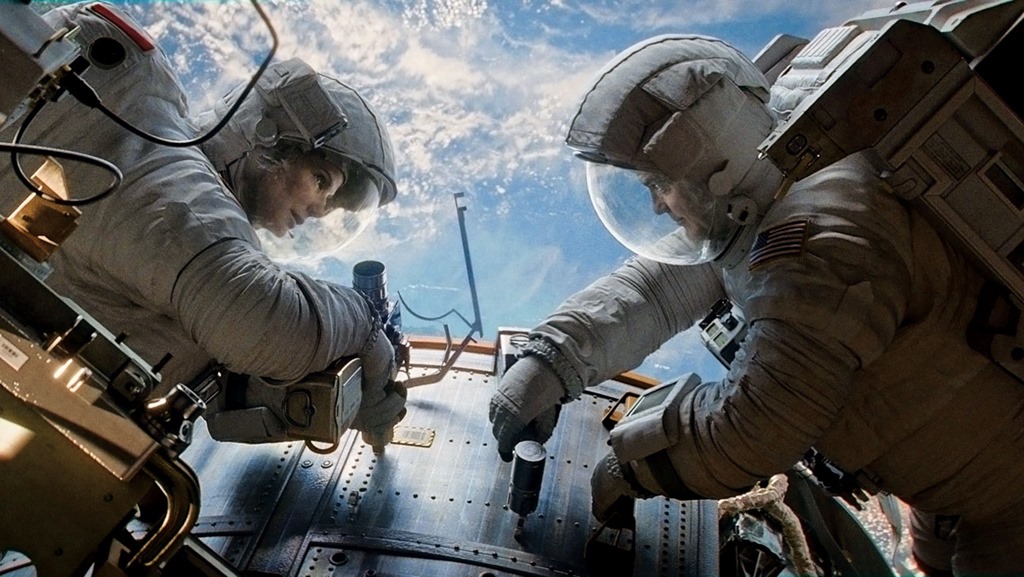
GRAVITY

Don’t get me wrong, Gravity isn’t literary or deep.  And although Bullock and Clooney give amazing performances, their characters were almost clichés.  How Gravity amazes is through simply gripping storytelling.  It is a story of survival, beating tremendous odds in a harsh environment.  And although Gravity wasn’t very scientific, Gravity felt very realistic.  Gravity was brilliantly science fiction in the same way Gattaca had been years ago, it was about a individual overcoming tremendous adversity in a science related setting.

Although in the last couple of decades we have had more and more female action heroes, I felt while watching Sandra Bullock that Gravity represented a paradigm shift, transforming story hero from male to female.  It didn’t feel like a gimmick that Ryan was a woman.

For the first hundred years of of filmmaking Ryan Stone would have been played by a male actor.  Ripley set the precedent, but when Ryan pulls herself out of the muck and stands, with the camera angle from the ground looking up at her towering figure, it felt that women had finally surpassed men at their own game.    It was much like Vincent beating the genetically enhanced humans when he took off into space at the end of Gattaca.

George Clooney plays the ultra-cocky space jock to a tee.  Matt Kowalski is perfectly at home in a vacuum.  Kowalski has the science down cold.  But more than that, he is mature way beyond his boyish antics.  He is an alpha male passing the baton to a female saying with total confidence, you can do this.  I know most viewers won’t see this film as a feminist statement.  Most girls won’t think twice about Sandra Bullock being the lead character.  But in real life and in movie life, things have changed a lot in my lifetime, but not nearly enough.

The message is clear, women can fly the fighters, drive the tanks, pilot the spacecraft, command the ships, shoot the M-16s, control the telescopes, construct the skyscrapers, etc., but it’s sad that so many women have MTV ambitions, like Miley Cyrus, to wear skimpy outfits and twerk.  Movies and television, the most heavy-duty of pop cultural social programming, sends the message that women can now do anything.  But will they?  And will we accept it?

If you think I’m making a pointless issue, then think about this.  What if our two actors were cast against type.  Would you have liked Sandra Bullock as the veteran space jock, and George Clooney as the mission specialist rookie?  We’re still brainwashed to think George Clooney should have played Matt.

Yes, we have made women into action heroes that can shoot and kill, but action heroes aren’t believable characters, they are cartoon characters.  How often are complex male roles given to female actors?  Would you have believed Sandra Bullock as Matt Kowalski?

Let’s put it another way.  I work at a university and the majority of the engineering and computer science students are male, and the majority of the teacher education and nursing students are female.

The role of Ryan Stone calls for a rookie, and most rookie astronauts are still male.  Picking a female to play Ryan is an intentional decision to make the character to appear more helpless because we’re still conditioned to think of women as helpless, or of needing help.  Gravity shows us we’re wrong. But being helpless is good in this movie, because good storytelling is about getting the audience to identify with the main character, and we’d all be essentially helpless in space.

Picking the name Ryan is an intentional choice too – Sandra Bullock is to stand in for a man.  I think that was a perfect choice by the writers of Gravity.  We’re cheering the stand-in for everyman who also happens to be everywoman.  Not only that, we’re all identifying with her, guys and gals.  While watching the movie I totally identified with Ryan Stone and not Matt Kowalski.  I never had the Right Stuff, but I might could have been Ryan Stone.

Maybe next time when they make a film like Gravity, the veteran space jock will be a woman, and it will be as natural as our need for air, but for now Sandra Bullock was perfect in this role.  Whatever is the magic formula for modern storytelling, Breaking Bad and Gravity have it down as well as Walter White cooks meth.

– – –

By the way, many people are nitpicking Gravity for scientific issues.  That’s cool.  But don’t let it keep you from seeing and enjoying an amazing film.  I was really disappointed with Neil DeGrasse Tyson because his complaints were rather lame compared to the problem of orbital mechanics.  Here are some things to read, but don’t get too hung up about them.  Gravity is a triumph of storytelling.  Like preconceived gender roles, we still want fiction with far more excitement than actual reality.  It’s hard to embrace perfect realism.

I expect gender roles to continue to evolve, and I expect incorporating realism into popular fiction to evolve too.  Breaking Bad was far more realistic than such a show would have been ten years ago, but in ten years, writers who will surpass the talents of the Breaking Bad team, will create a series about cooking meth that is far more realistic.  Gravity could have been just as exciting if it had been 100% scientifically accurate.  And I’m not dinging it for its scientific faults.  I’m just pointing out that we’re moving towards a kind of absolute realism in fiction, and that includes gender roles too.

Fact Checking Gravity

JWH  – 10/11/13