Is Religion Holding Back Space Travel?

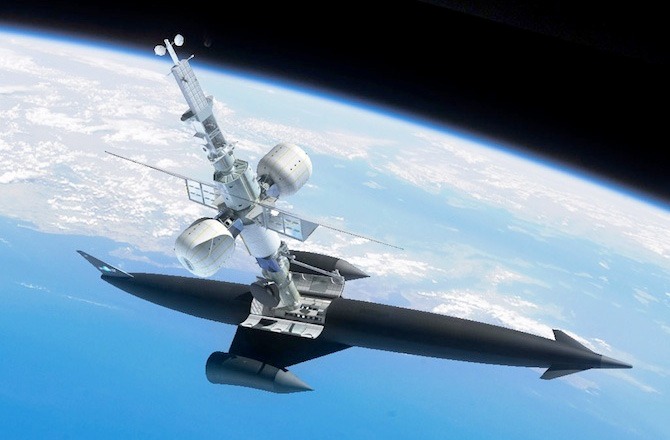
If every person on Earth woke up tomorrow an atheist would there be a surge of interest in space travel?  Does the promise of an afterlife keep us from noticing that we’re living on a very small rock in a very big universe?

Most people living today expect to leave this world for another when they die.  Without heaven, would we travel to the stars instead?

If we were all atheists and expert cosmologists, would we think, “Why are we just sitting on this on speck of dust when there’s endless worlds to explore?”

Because most people are self-centered, addicted to creature comforts, and afraid of death, would freedom from religion make them brave explorers?  And if not willing to go themselves, would a godless existential reality inspire them to pay tithes/taxes so other humans could leave Earth in rocketships?

space-travel

If there was no God to define who we are, how would we define ourselves?  In other words, if we weren’t burdened by religious beliefs and truly free to shape our own destinies, would many of us seek to leave Earth in spaceships and colonize the galaxy?

If we were all absolutely sure of our mortality would we huddle close to home, hoping for life extension from science?  Or would we bravely fling ourselves beyond the sky and its protective shielding to see if we could adapt to the bizarre habitats of space?

If we knew we lived in a godless universe, and we were the crown of creation, would we work harder to preserve the Earth and colonize other worlds so all our genetic eggs wouldn’t be in one basket?  Or without God, would humanity just become depressed and wallow in self pity?

If we find ourselves in a meaningless universe can we make our own meaning?

Is it true, when the going gets tough, that the tough get going?

JWH – 3/13/13

Is Heinlein’s Have Space Suit-Will Travel Satire?

Over at Locus Online, Gary Westfahl has proposed a new theory about Robert A. Heinlein in his essay “The Joke Is on Us:  The Two Careers of Robert A. Heinlein.”  Westfahl proposes:

Thus, I wish to argue instead that there were, in fact, only two periods in Heinlein’s career: from 1939 to 1957, Heinlein wrote science fiction, and from 1958 until his death in 1988, Heinlein wrote satires of science fiction. Or, if that language seems too strong, say that from 1939 to 1957, Heinlein took his science fiction very seriously, and after that, he no longer took his science fiction seriously.

Now Westfahl didn’t say Heinlien wrote satires, but satires on science fiction, and even makes a case that Heinlein is parodying his own earlier work.  Westfal starts his essay by claiming Heinlein is a golden age science fiction writer that still has impact:

Still, there is at least one classic writer that every science fiction reader must come to terms with; for when you visit a bookstore today, the science fiction section may have only a few books by Jules Verne and H. G. Wells, or even Isaac Asimov and Arthur C. Clarke, and there may be few signs of their influence on other writers. But the works of Robert A. Heinlein are still occupying a considerable amount of shelf space, and the evidence of his broad impact on the genre is undeniable.

I don’t agree.  Heinlein has always been my favorite SF writer, but I’ve watched his reputation’s slow decline in recent decades.  I am totally open to reevaluating Heinlein’s work like Gary Westfahl has done, but not to explain Heinlein’s continued success, but to rescue Heinlein’s work for contemporary readers.  I think we need to find and recognize Heinlein’s best work that will appeal to new readers.  In our Classics of Science Fiction Book Club we have many Heinlein fans but far from most, and his popularity is on the wane, especially with younger readers.

I don’t think repackaging Heinlein as a satirist will sell or fly.
Heinleinface

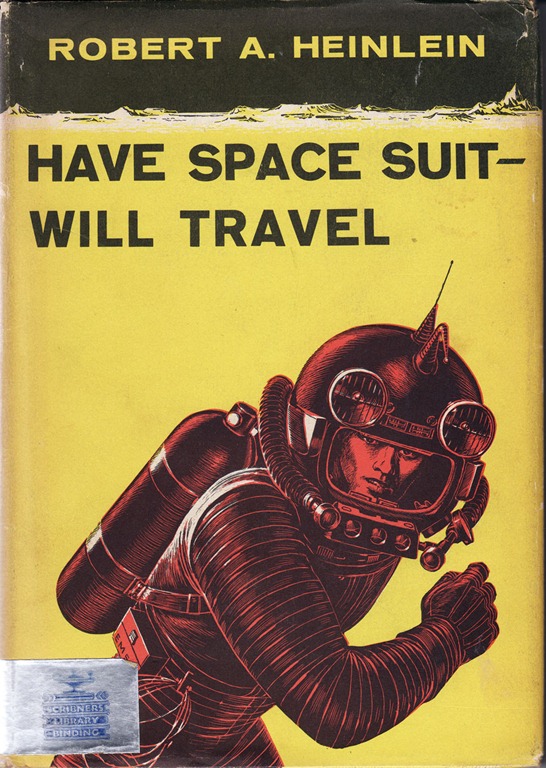
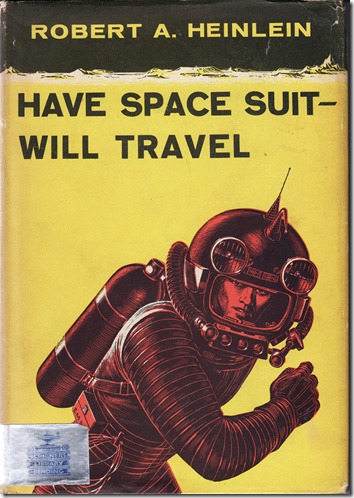
Claiming Heinlein’s later work is satire is not new, William H. Patterson Jr. was the first one I remember proposing this idea in his book The Martian Named Smith back in 2001.  But I’m sorry, I just don’t buy the satire theory of Heinlein.  To me Heinlein was always as serious as a rattlesnake, and even when he was being light hearted, as he was in Have Space Suit-Will Travel, a book for children, he was dealing with kidnapping, murder, torture, genocide and destroying planets.  Heinlein worked awful hard to make that book realistic, even though it had a silly title.

Westfahl believes Citizen of the Galaxy, the 11th juvenile was the culmination of Heinlein’s expansion of stories moving away from Earth starting with Rocket Ship Galileo.  However,  Have Space Suit-Will Travel went further than Citizen of the Galaxy, by leaving the Milky Way.  Have Space Suit-Will Travel is the logical conclusion of the series.  Starship Troopers is the first retreat.   Starship Troopers is the first of the preachy Heinlein novels.  Starship Troopers it the first of Heinlein’s books where Heinlein is flat out on his soap box arguing his philosophy and politics to the reader.  Starship Troopers is Heinlein’s first Putnam novel.

And that preaching has always been in Heinlein’s work, but I believe editors always reined Heinlein in until he went to Putnam.  Once Heinlein moved to G. P. Putnam, we finally get to see the naked Heinlein.  I don’t think he wanted to wear court jester attire, he was a nudist.  When Heinlein’s characters propose killing people for being rude I don’t think Heinlein was trying to be funny or satirical.  I think he really meant we should shoot rude people.  And this horrifies me.

Even at the end of Have Space Suit-Will Travel, when Kip is before the galactic tribunal and Earth is being judged, Kip gets mad and tells them, “All right, take away our star–  You will if you can and I guess you can.  Go ahead!  We’ll make a star!  Then, someday, we’ll come back and hunt you down—all of you!”

That wasn’t satire.  Heinlein meant it.  Heinlein has always believed that homo sapiens are the most dangerous creature in the galaxy.

The Daily Show is satire.  Saturday Night Live is satire.  Satire is something liberals do.  I don’t think deadly serious conservatives do satire.  When Heinlein was younger he had some liberal in him, but I’m pretty sure most of it was gone by 1958.

If you read Heinlein from beginning to end, over and over again, you’ll see he had certain pet ideas that were always present in his stories.  I believe Heinlein changed his writing style to fit his publisher.  In the early days those were pulp magazine editors.  Then he started writing for the slicks after the war, and finally snagged a lucrative deal at Charles Scribner’s Sons in 1947 and wrote twelve amazing juvenile novels.  Heinlein’s writing was confined by Alice Dalgliesh, his editor while at Charles Scribner’s Sons.  In the 1950s he also wrote a handful of adult books for Doubleday, and they were different from the Scribner titles.  Finally he went to Putnam, and his writing changed again.  I think Putnam let Heinlein be Heinlein.

Heinlein always claimed his number one reason for writing was money.  But after he got money, I think he wanted to express his own ideas.  As he got older, I believe Heinlein started expressing his personal fantasies.  I think all his later books are his own personal power and sex daydreams.  I don’t think Jubal Harshaw was Heinlein, but I believe Heinlein wanted to be Jubal Harshaw.

I believe Heinlein changed after Sputnik too, like Gary Westfahl suggests, but for different reasons.  Heinlein was savvy enough to realize that NASA was going to invalidate much of science fiction before the 1960s.  Heinlein knew space science was going to change science fiction and he wanted to be ahead of the curve, so he started writing social science fiction, political science fiction, sexual science fiction, fantasy science fiction, and got away from writing space travel science fiction.

Personally, I believe Heinlein’s writing got sloppy as he got old, and lost his ability to write structured novels.  He never was great at the structure of fiction, but the editors at Putnam let him run wild.  I don’t think Heinlein ever wanted to be Jonathan Swift but Patrick Henry.  Later in life Heinlein claimed his essential books were Starship Troopers, Stranger in a Strange Land and A Moon is a Harsh Mistress.  Oh, I agree some of Stranger does seem satirical, like the scenes with the angels, but I believe that was Heinlein being sentimental, more like A Wonderful Life for grownups.  Most of Heinlein’s political drama is simplistic, like out of a 1930s Frank Capra flick.

I believe all the scenes with Harshaw are Heinlein talking straight.  I believe the scenes with Mike are Heinlein’s power and sex fantasies.  The Fosterite Church scenes could be labeled satire on 1950s television preachers, but what is he satirizing?  One of Heinlein’s pet ideas was proving that the soul existed after death.  Do people attack beliefs they want to be true?  Mike, Foster and Digby become archangels in the end.  Is this satire or sentimentality?

Is Heinlein attacking “Thou art God” philosophy or proposing it?

Satirical writers have a target in mind for their writing.  They want to destroy people and ideas with humor.  Heinlein was cynical and angry, and didn’t think much of the average man, but I don’t think he was trying to kill people with humor, if Heinlein wanted to kill people he’d use a gun.  Heinlein was as funny as William F. Buckley, Jr.  Heinlein never struck me as a George Carlin, Jon Stewart, Stephen Colbert, or even a Mark Twain.

Although Heinlein is my favorite writer, I’ve always felt he went downhill after he went to Putnam.  None of the Putnam books strike me as funny or satirical.  Heinlein is attacking people, ideas, customs and society, but I don’t believe its with humor.  Humor is a funny thing in that what I might not laugh at someone else will.  Maybe I’m just missing the satire.  Heinlein always seemed to be about getting what he wanted.  He was bad about developing conflict, and generally created faceless straw men to knock over.  Satire is all about the details of the enemy, and Heinlein was always about the details of people who got ahead and took what they wanted.
have-space-suit---will-travel

Have Space Suit-Will Travel has always been my favorite book because its about the overwhelming desire to go into space.  It’s about a boy wanting to go to the Moon, and I grew up wanting to go into space myself.  I took this novel seriously, even though it had a funny title.  Have Gun-Will Travel was a favorite show as a kid, and it wasn’t funny either.  Much of Have Space Suit-Will Travel is about space suits.  I loved those details.  Have Space Suit-Will Travel was a power fantasy for me at 13.  It was a story I wanted to live.

It never occurred to me to think Have Space Suit-Will Travel is satire.  What I worry about now is modern minds looking back on those old books and thinking them silly, and concluding the author must have written them for laughs.   And I can even see why Gary Westfahl claims Have Space Suit-Will Travel is poking fun at science fiction because in modern eyes the story might seem quaint, goofy and naïve, but back in 1964 it was my Bible, my dream, my fantasy for the future.  I would have exchanged places with Kip in a heartbeat.

I don’t consider Have Space Suit-Will Travel poking fun at science fiction, I consider it the ideal expression of science fiction.

JWH – 11/30/12

The Chinese Should Be Writing Some Great Science Fiction About Now!

The Chinese have big plans to explore space, and they are sending manned missions into orbit like the United States and Russia did  in the mid-1960s.  The Chinese even say they are going to the Moon.  I think that’s great, and I imagine it’s a very exciting time to be Chinese.  Not only are they going to become a leading space exploration nation, but in the last few decades their economy has gone from poverty to an economic miracle.  All of this should have inspired their science fiction writers to write some amazing science fiction.

chinese-astronuat

The 1950s and 1960s were very exciting times for America as we went into space, and those decades were my favorite for science fiction.  At the time, the sky was no longer the limit until we succeeded.  1969, we went to the Moon and everyone thought we’d keep going, by 1972, we stopped going anywhere but low Earth orbit.  Will it be different this time for the Chinese?  Will it be to infinity and beyond?  Will they go to the Moon, and then keep going like we dreamed back in the 1960s?

I would imagine China is living through its version of our 1960s.  Culturally and artistically they should be blasting off in all areas of life.

How are Chinese science fiction writers picturing their future in science fiction novels, television shows and movies?  Who are their big three like Heinlein-Clarke-Asimov were in the 1950s and 1960s?  Do the Chinese have a Gene Roddenberry?  Do they have an old guard and young upstarts like our 1960s Samuel R. Delany, Roger Zelazny and Harlan Ellison?

We get very little news from China.  It’s on the other side of the world, and they speak a very different language.  Taking the pulse of Chinese science fiction is rather difficult.  There is The World SF Blog that covers the entire world, and from there I found World Chinese-language Science Fiction Research Workshop.  From there I found a link to “But Some of Us are Looking at the Stars” by Kun Kun, which profiled  Liu Cixin, who has a handful of novellas and short stories at Amazon for the Kindle.  I found more about Liu Cixin and a history of Chinese science fiction at “Utopia, Dystopia, Heterotopias: From Lu Xun to Liu Cixin.”

China Daily did a profile on Liu Cixin and an overview of his books.  I’d like to read the books they describe, but other than the character names, their plots don’t seem uniquely Chinese.  Are science fiction and fantasy themes just universal?  Like English writers, Liu Cixin writes about threats to the Earth, either from natural forces or alien forces.  I was hoping for stories about China exploring the solar system and building colonies.  Maybe the Chinese people have already learned from us that few people want to colonize the Moon and Mars.

I bought Liu Cixin’s “The Wandering Earth” but it reminds me more of England’s contemporary New Space Opera movement.  It’s about the Sun going red giant much earlier than expected and how Earthmen cope.  But it also reminded me of something that shatters my illusions about the SF of the 1950s and 1960s.  Most SF is about catastrophes, or war, or warnings about self-destruction.  SF needs conflict, and all too often it’s bleak.

For some reason my nostalgia for 1950s and 1960s is confused in my memories of the excitement for the 1960s manned space programs like Mercury, Gemini and Apollo, as well as the Mariner missions to Mars.  Back then, as a teen, I equated science fiction as the cheerleading squad for the space program, and it never really was that.

I do wonder if a boom in science fiction correlates with an expanding space program?  Does going into space inspire the average citizen into thinking about their descendants living in space?  I think the American experience has shown that there is a disconnect between now and a Star Trek future.  People want space travel to be luxury class, not pioneering in covered wagons.  There’s damn little science fiction about actually doing the hard work of colonizing the solar system.  We loved Star Trek because all the dirty work had been done.

Very few 1950s and 1960s science fiction books were about the joys of pioneering space travel.  And the ones I remember best, were all Heinlein juveniles like The Rolling Stones, Time for the Stars, Starman Jones, and Farmer in the SkyHave Space Suit-Will Travel had a lot of sense of wonder space travel in it, but it was mostly about interstellar conflict and judging species on their aggression.  Many other classic science fiction stories at the time had space travel in them, but space travel wasn’t the main theme of the story.

The Foundation stories by Asimov had lots of space travel, but it was about the rise and fall of a galactic empire, and space travel was about as important as airplanes are to stories in The New Yorker today.  I’ve always had this false assumption that science fiction was about promoting the colonization of the final frontier.  But if I look at the popular books of the time that isn’t reflected.  Here are the 1960s books from The Classics of Science Fiction List.  [The number states the number of citations that recommended the book.]

1960 Canticle for Leibowitz, A Miller, Walter M. 24
1960 Deathworld Harrison, Harry 7
1960 Rogue Moon Budrys, Algis 11
1961 Big Time, The Leiber, Fritz 10
1961 Dark Universe Galouye, Daniel F. 7
1961 Lovers, The Farmer, Philip Jose 9
1961 Stranger in a Strange Land Heinlein, Robert A. 19
1962 Clockwork Orange, A Burgess, Anthony 16
1962 Drowned World, The Ballard, J. G. 8
1962 Long Afternoon of Earth, The (Hothouse) Aldiss, Brian 17
1962 Man in the High Castle, The Dick, Philip K. 20
1963 Way Station Simak, Clifford 16
1964 Davy Pangborn, Edgar 11
1964 Greybeard Aldiss, Brian 8
1964 Wanderer, The Leiber, Fritz 9
1965 Dune Herbert, Frank 25
1966 Babel-17 Delany, Samuel R. 10
1966 Crystal World, The Ballard, J. G. 10
1966 Dream Master, The Zelazny, Roger 7
1966 Flowers for Algernon Keyes, Daniel 17
1966 Make Room! Make Room! Harrison, Harry 7
1966 Moon is a Harsh Mistress, The Heinlein, Robert A. 17
1966 The Witches of Karres Schmitz, James H. 7
1966 This Immortal Zelazny, Roger 8
1967 Dangerous Visions Ellison, Harlan 12
1967 Einstein Intersection, The Delany, Samuel R. 10
1967 Lord of Light Zelazny, Roger 15
1967 Past Through Tomorrow, The Heinlein, Robert A. 9
1968 Camp Concentration Disch, Thomas 16
1968 Do Androids Dream of Electric Sheep? Dick, Philip K. 14
1968 Nova Delany, Samuel R. 7
1968 Pavane Roberts, Keith 10
1968 Rite of Passage Panshin, Alexei 12
1968 Stand on Zanzibar Brunner, John 24
1969 Behold The Man Moorcock, Michael 7
1969 Bug Jack Barron Spinrad, Norman 10
1969 Left Hand of Darkness, The Le Guin, Ursula K. 24
1969 Slaughterhouse Five Vonnegut, Kurt 13
1969 Ubik Dick, Philip K. 13

It seems social unrest in very inspiring for science fiction too, maybe more so than success in space travel.  If you look at the breadth and variety of subjects covered in the books above, can you imagine what the Chinese writers must be writing about now?  In some ways I feel China is as far away as alien life in another stellar system.  I could physically fly there to visit, but without knowing the language I’d never actually get there. 

I felt the same way about Russia back in the 1960s.  The Soviets were our competition and enemies back then, but I figured it had to be exciting times living there, at least for the men and women who built their space program.  We eventually got a trickle of Soviet SF but never enough to really feel what their science fiction world was like.

We never saw a Dune, Canticle for Leibowitz, The Left Hand of Darkness or Stand on Zanzibar come out of Russia.  Will we ever read such great stories translated from the Chinese?  Hell, for all I know, Russia could have produced a library of great SF that blows our classics away, but because of the language barrier we’ll never know.  If any Russian or Chinese readers read this, please post a comment below to lets all know about the state of science fiction in your country.

JWH – 7/29/12

Losing My Faith in Space Travel

Science fiction promised children growing up in the 1950s something different than what it does to our children today.  The innocent expectations of tomorrow culminated in the 1964 World’s Fair which seemed all about the future and the promise of space travel?  Was there ever another time in history where kids truly believed they would walk on the Moon or Mars when they grew up?  Between 1961 and 1972 NASA always went further and faster with Mercury, Gemini and Apollo space programs.  For the forty years since 1972 we’ve been retracing old orbital paths below those reached in Project Gemini in 1965.  Now, the U.S. can’t even launch men and women into orbit.  When did the final frontier fizzle out?  I’m sure the budget bean counters know.

It’s not like we don’t have the technology to travel to the planets, we just don’t have the desire, or at least the desire to spend the money.

Like religion, science fiction promised true believers life in the heavens.  As long as NASA kept rocketing to new heights it was easy to believe the faith of space travel.  Like religion, space travel has failed to answer the prayers of its devoted – nobody leaves Earth.  Could it be that humans are meant to stay on Earth?  Forever?

What if it becomes obvious we’re not going to the planets and stars, and humans must live for thousands, if not millions of year here on planet Earth?  How does that change science fiction and the faith in the final frontier?  What if we come to realize that travel in space isn’t practical or even desirable?  What if we come to realize that alien spaceships will never visit us either?  That gulf between the stars is too vast for travel by biological creatures.  Robots might go, but not us.  How will that change our faith in science fiction?

We won’t know our limits in space until we hit them.  So far, we’ve only hit the money barrier!

I always believed science fiction was the sacred writing of the space travel faithful, but again like other belief systems, tenets of the faithful change.  If humans aren’t meant to travel to the stars, what is our destiny?  Science fiction, instead of selling space travel, promotes turning inward with artificial intelligence, cybernetic worlds, brain downloading, biological immortality, and other fabulous speculation about living on Earth.   I can accept the confinement if there are real limitations to humans traveling in space, but I’d sure hate it if we’ve just reached the limits of our vision.

Oh sure, there are still true believers who can’t give up the idea there’s a world just 35 million miles away that’s ripe for terraforming.  They keep preaching their gospel hoping to convert enough believers to make their visions come true, but their creed dwindles.

Yes, there is another time when kids grow up thinking they will walk on the Moon and Mars.  It’s now, and those kids live in China.  Do they dream my old 1950s dreams?  Will their dreams come true this time for all us humans?

This is what we get for cutting taxes.

A small government leads to smaller dreams.

China will get bigger with bigger dreams, while we grow small, clutching our tax dollars.

Thank you, Republicans.

New_York_Worlds_Fair_1964

JWH – 4/9/12

A Practical Plan for a Lunar Colony

Newt Gingrich last week got politically slammed for proposing a Moon colony while campaigning in the Florida primary.  In an obvious bid for votes from space coast residents Newt Gingrich claimed he would build a permanent colony on the Moon by the end of his second term.  Sounds great if you’re a science fiction fan and space enthusiast, but everyone else just hears more national debt.  The other Republican candidates quickly thrashed Gingrich for being impractical.

Even if the United States was flushed with dough and out of debt would Americans really want to return to the Moon?  China is making plans to land on the Moon but will they develop a colony there when we didn’t?  Back in 1969-1972 the U.S. landed six missions on the Moon, but the public grew bored after two.  The Chinese will discover the same thing – only a geologist can love the Moon up close.

Sending humans to the Moon, or Mars or anywhere else in space just doesn’t make sense right now, and hasn’t since 1972.  Sadly, robots have turned out to be far better astronauts, but we shouldn’t feel too choked up over being replaced by machines.  The human body isn’t suited for life in outer space, at least not yet, whereas robots can thrive in the harsh climates beyond our atmosphere.

What we need to do is colonize the Moon with robots.  Have machines roam over the lunar surface high and low and make a complete survey of natural resources.  Then send robots that mine those resources and build other robots.  Eventually we’d have enough robots on the Moon that could build underground cities suitable for humans to visit or colonize.  Whether humans can live on the Moon for extended stays, reproduce, and safely raise children is still unknown.  We may yet discover that humans can’t adapt to low gravity.

My point though is robots can build a colony on the Moon far cheaper than using manpower.  And it would be a far greater scientific achievement to develop a robotic colony because most of the money and resources used for a lunar colony for humans would go just to keep people alive. 

There are few reasons to go to the Moon:

  • Scientific study of the Moon
  • Base for very large telescopes
  • Mine helium-3 when fusion reactors come online
  • Prove that humans can live permanently in space

Three of the four reasons can be handled by robots, and robots could prepare the Moon for humans for the fourth.

Building a robot civilization on the Moon would be a new accomplishment and would outclass anything the Chinese could do by just repeating the Apollo missions.

Building a robotic colony would be far cheaper and it would lay the foundation for a cheaper human colony in the future.

Finally, developing the technology for a robotic civilization on the Moon would be more valuable than the accomplishment of putting men and women on the Moon again.

JWH – 1/31/12