We Need A Number

Go do a Google search on this phrase – “Target Atmospheric CO2” – and include the quotation marks, and you will find 2,400 links.  The links point to essays discussing a scientific paper by James Hansen and other scientists called “Target Atmospheric CO2: Where Should Humanity Aim?”  The gist of the story:  The likely safe high range for CO2 in the atmosphere is 350ppm, and we’re beyond that at 385ppm.  Hansen is the NASA scientist that first alerted Congress to the global warming problem back in 1988.  Randomly read some of those essays reacting to the paper and you’ll save me the time paraphrasing it.  The paper itself is perfectly readable, if you’re patient, but it’s bumpy with scientific speak, so it might be easier to read the commentaries.

Many of the writers act like 350 is the magic number we need, and in some ways that’s true.  It gives humanity a very specific goal.  It tells everyone that if we want weather like the nice weather we grew up with, then everybody needs to go on a carbon diet and get the atmospheric CO2 below 350 again.  However, that does not convey the sacrifice needed to achieve the goal.

I think we need another number.  Scientists need to decide what is the fair share target number we all need to stay under personally to get the job done.  Recycling paper and buying compact florescent lights are not going to do the trick.  I think until we have a personal number to target, along with proper labeling on everything we buy, people won’t understand how much CO2 they need to cut out of their lives.

How much sacrifice do we need to make?  If the nations of the world had a crash program to switch to 100% solar, wind, geothermal, nuclear and other sources of clean energy, would that solve the problem?  Would that be one way to solve the problem without asking individuals to think about the details?  Or should governments just kill off some of the most polluting industries?  Do we need to give up the beef industry?  Or the paper industry?  Or the airline industry?  Or all of them plus more?  Or would it be better to ask the citizens themselves to take on their own share of global warming responsibility and let them make their own decisions on how to clean up their share of personal waste?

If we had a number to measure our personal use against, we could all decide the sacrifices we’d like to make.  Some people might be willing to dry their clothes on the line outside for a year to budget flying to New York City for a vacation.  Other people might buy high tech cars that put little CO2 in the atmosphere so they can enjoy living in a larger house.  Others might choose to walk to work so eating steaks wouldn’t break their personal greenhouse gas consumption budget.

Many people have suggested having a carbon tax to help fund a Manhattan style project to convert to clean energy power plants.  This would discourage waste and finance change.  Having a tax would be one way to quantify for the public their duty to humanity.  It could also simplify the decisions people make.  If gasoline with a carbon tax was $12 a gallon, then you’d think long and hard about wasting it.  If the price of electricity from coal went to 4x with a carbon tax, it would give utility companies income to build new plants and customers incentives to make their houses energy efficient.

This would be the easy route.  What if in the next ten years we screwed around and didn’t do anything and it became frighteningly obvious we need to do something drastic?   Would we make bigger sacrifices then?  What if we had to outlaw the gasoline powered car?  Or outlaw airplanes?  Or ration electricity?

There are thousands and thousands of things we can do now by freely making the choices ourselves before the governments of the world have to get heavy.  If we knew what our carbon allotment was, it would be easier to make those choices.

Take for instance paper.  I have no idea how much paper contributes to the problem of global warming, but I have seen one number that says that junk mail adds 114 billion pounds of CO2 annually.  My reaction is to give up paper completely.  I’m phasing out my magazine and newspaper subscriptions, I’m doing my best to never print computer documents, I’m working to reduce junk mail, and I’m finding ways to shop for products with less packaging.

If everyone thought this way, paper magazines would disappear from society and everyone would read electronic periodicals.  Is this good or bad?  That’s a lot of jobs lost.  Potentially, it could mean a lot of businesses would go under.  I’d hate to see that, but on the other hand, paper really isn’t needed in our computer networked society.  My local newspaper just started offering a weekly electronic edition that looks just like the print edition, but costs less than the Sunday only paper subscription.  I’m moving to a paperless lifestyle, but even though it’s logical to me, is it what everyone else should be doing too?

I draw the line at magazines and newspapers, but feel that books are worth their environmental costs because we preserve them and consider newspapers and mags disposable.  What if that’s wrong.  What if there’s a way to have environmental safe magazines?  Unless scientists tell us the values associated with all our consumption we won’t know how to make enlightened decisions.  If a National Geographic subscription form came with a number – 24 – for 24 pounds of CO2 added to the atmosphere per 1 year subscription then that would be a big step in understanding the problem.

However, unless I know my allotment number, say 1,000 pounds per year, I wouldn’t be able to practically use the 24 figure I got from National Geographic.  So Mr. Hansen, it you and your science buddies would be so kind, give us another number.  350 is cool for the world to know, but we all need another number, a number that would tell us how to live by so all 7 billion people riding on spaceship Earth pulls that 385ppm figure down to 350ppm.  That number is the maximum amount in pounds of greenhouse gases we can each safely add to the atmosphere in a year.

President Elect Obama, you could help with this too.  Instead of offering another general economic incentive package, offer us tax breaks on buying specific clean energy products and services.  That would be another way to quantify a solution.  Tax what’s bad for the environment, and subsidized what’s good.  Get the U.S. to do more than it’s fair share to get the world below that 350ppm number.  We owe the rest of the world.

JWH 11-9-8

Hubble Telescope at 10x or 100x or 1000x

The other night I caught a new documentary, “Hubble’s Amazing Universe” on the National Geographic Channel that in high definition wonder showed how the Hubble Space Telescope revolutionized astronomy since 1993.  Sadly, I can’t find a link to an online version.  I hope they repeat this HD documentary often because seeing the spectacular Hubble images on a 52″ inch screen was beyond beautiful.  Using technology that I can’t name, they made the images look three dimensional, and the stories that went with them explained why Hubble was well worth it’s price tag of billions.

Now, I’ve got to wonder, what will a telescope that is 10 times more powerful than the Hubble will see and discover?  What about one 100 times more powerful, or even a 1,000 times more powerful?  We really won’t know what such futuristic telescopes will discover, because like the Hubble’s discoveries, they will be unexpected.  In my mind, the most exciting thing these future space telescopes could discover are Earth-like planets orbiting around nearby stars that show indications of life or technology.

image

Pillars of Creation

Ever since our cave dwelling days, humans have been asking how we got here in this unbelievable reality.  Well, the Hubble telescope has shown us how big here really is, both in dimension and composition.  Hubble has revealed stellar nurseries and black hole graves.  It has helped scientists make discoveries about dark matter and energy, and revealed the largest structures in the universe discovered to date.

Most people never ponder the size of reality.  They never grasp that we live in space-time.  Hell, few people even look at up at the lights in the sky at night.  If Genesis had to encompass the scope of Hubble’s vision, imagine how different God and the Bible would have been.  Is there any analogy that I can give that can convey the scope of how far Hubble can see?  If you were the smallest sub-atomic particle in an carbon atom that’s part of a molecule in a one cell of your heart, would any scientific instrument you build show you how big your body would be?  Imagine being one grain of sand and trying to count all the others on a beach?  In the photo above, our solar system is so small it wouldn’t be seen in those dust pillars that are light years high.  But look at the picture below.  The above scene is smaller than you in relation to the solar system compared to the objects in the photo below.

image

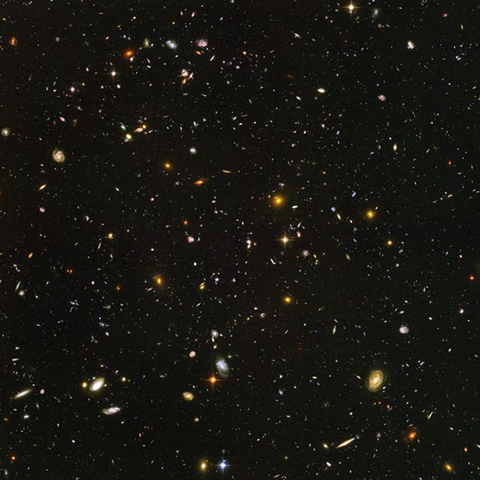
This is the famous Hubble ultra deep field photo, where scientists tried to photograph an empty patch of sky.  Each speck of light is a galaxy containing billions of stars.  Now imagine a more powerful space telescope picking a black patch in this photo and zooming in on it.  What would it see?

We know the universe is big.  Back to that analogy of being a sub-atomic particle in your heart, now imagine trying to figure out that you are part of a body of organs, each with its purpose, could you ever imagine what the brain does from just looking at its parts from your tiny vantage point?  It’s no wonder that so many want to embrace the Biblical view of creation, because the scientific view is too much work to grasp by us little fellas.  Individually we are tiny, but scientists stand on each other’s shoulders to get the bigger view.  Now imagine future space telescopes spying on nearby stellar systems and seeing other Earth-like worlds, worlds where we analyze the chemicals in their atmospheres.  What if we discovered what we call man-made chemicals?

Now imagine, if we could get our giant artificial brains to communicate with the distant giant AIs of their world.  How far can two species see standing on each other’s shoulders?

Think of it another way.  If we consider every human as a cell in the body of a single being called humanity, a space telescope could be its eyes, and all our computers and knowledge, its brain.  The mirror lens of the Hubble telescope was slightly wider than a very tall man.  Now imagine building a pair of eyes in space where the pupils were the size of a football stadium?  How far could our new body see?  Then hook them up to immense armies of computers and swarms of natural philosophers and you might begin to imagine what I’m asking.  And, I’m only wondering, “what might we see?”  We won’t know until we build these new eyes.

The primary question we’ve always asked is, “Where do we come from?”  The next important question is, “Are we alone?”  We hoped that SETI would answer that question, but it might be astronomy and space telescopes that will actually answer it.  The manned Apollo missions to the Moon answered a lot of scientific questions, but the Hubble Space Telescope has answered an immense amount more in comparison.  Some people are now asking, what if we went back to the Moon and built truly giant telescopes on its far side, how far could we see?

The James Webb Space Telescope is schedule to fly to L2 orbit in several years, and it’s eye is 6.5 meters in diameter, compared to Hubble’s 2.4.  The JWST is designed to see in the infrared, and not the visible spectrum like Hubble, but then the visible spectrum is such a tiny fragment of the total spectrum to be explored.

What if Congress had said no to the financial bailout, and given the $700 billion to astronomers, how much more would we have gotten for our money?  Just try and speculate what life on Earth would be like if we found out we weren’t alone in the Universe, and had nearby neighbors.  The Hubble Space Telescope gave us a quantum leap in knowledge about the universe, so think about a Hubble telescope at 10x, or 100x or 1000x.

JWH 11-18-08

Science As Fantastic As Science Fiction

Science fiction magazine editors often complain they don’t get enough science fiction stories submitted to them.  What they need to do is convince the popular science writers showcased in the latest edition of Best American Science and Nature Writing 2008 to also write fictionalized versions of their latest essays.  Or maybe, all those would-be science fiction writers stuffing their slush piles should study this volume, integrate the ideas into their work, and then they’d impress those editors.  I kid you not, there are some far-out, fantastic, sense-of-wonder concepts in these essays.  Just do a bit of sampling here, and you’ll see what I mean.

Start with the Freeman Dyson prediction about green technology.  He’s not talking about windmill generators, but plants with silicon leaves, engineering biology and taking over the role of evolution to remake the Earth.  If you want to know about alien minds, trying reading the essays by Colapinto and Cook.  They don’t look to the stars and little green men who think different, but to South America.  Then Jon Mooallem looks at the history of people seeking anti-gravity and gravity radio.  Each essay, no matter how down to earth, could be used to inspire SF stories.

Here’s the table of contents with links to the articles on the web:

Just the fact that I can link to full-text versions of all but three of these articles on the web is science fictional.  It represents a major paradigm shift in copyright, economics and the dissemination of knowledge.  And I’m not linking to these articles to give you free reads, you should buy the volume and study it.  I’m linking to web pages as a way to review this book, because just sampling these links will give you a taste of what I’m talking about far better than I could with descriptive words.  Most people do not like to read off computer screens, but having these essays online is an excellent way to recommend them to your friends.

This collection is a snapshot of our times but far different from what you see on the news at night.  These articles are overwhelmingly about the future, either predicting fantastic new developments, or warning us of dire happenings if things continue as they are now.  All the concepts that science fiction writers use to write visionary science fiction.  I’ve been getting this volume each year for awhile now, but I’ve yet to meet anyone else that recommends it.  That’s a real shame.  Science was never so accessible, so why isn’t it more popular?

Could this be why the SF mag editors aren’t seeing that many science fiction stories cross their desks?  Because we now live in a world that seems science fictional compared to what we grew up in just a few decades ago.  I was watching a new cop show called Life on Mars, about a detective thrown into the distant past of 1973, and I was struck by the scene where he’s wishing for a cell phone.  Or another time when he mutters about wanting a computer.  I’d love to time travel back to see The Monterey Pop Festival in 1967, or the Beatles in Germany, but I don’t know if I could live without my sixth sense, the Internet.

The world and election I remember seeing through a 19″ black and white TV in 1960 is so very different from how I see reality in 2008 while watching a 52″ high definition set.  I think we take science for granted now, and back then science was that gee-whiz Mr. Science stuff that nobody paid any attention to other than the proto-geeks.  Many of the science stories in this year’s collection come from The New Yorker, The Atlantic and other mundane periodicals.  Today I can switch on my TV and see an hour documentary on the history of the black hole, and the controversy over the information paradox that Stephen Hawking had proposed that angered scientists for years.  When I was growing up, my choices were Gilligan’s Island, Bewitched and I Dream of Jeannie.

In the early days of three channel television, there wasn’t room for physics and astronomy shows.  Today I can find several science documentaries on every night, and not boring ones like we used to see on 16mm film in science class, but fantastic shows with killer computer graphic clips beautifully illustrating cutting edge science, like string theory and the effects of dark matter of galaxy formation.

Sheila Williams, the editor at Asimov’s SF Magazine, complains she receives too many stories beginning with exploding space ships.  That was a popular way to begin a story back in the 1930s.  Explosions are dramatic and quickly lead to action, but what people want today are new far-out ideas to create sense-of-wonder SF, and evidently too many potential science fiction writers are living on ancient clichés.  They need to be reading the science essays and watching the science documentaries on TV, because the mundane world has passed old science fiction by, leaving it quaint and suitable for nostalgia retrospectives.

The Donlan and Dyson articles inspired me to envision fantastic changes in our everyday landscapes.  Donlan writes about scientists wanting to repopulate the American plains with substitute “megafauna” like that found 13,000 years ago during the Pleistocene overkill, which would make traveling out west like a safari crossing a well populated African wildlife preserve.  Imagine tooling west on Interstate 70 and seeing elephants, tigers, lions, camels dwelling in the high grass beyond the highway fences?  If you add in Dyson’s biological experiments, and think about T. Boone Pickens’ giant windmill farms, our country is going to look very different.  When I was growing up, the future was exciting because of rocket travel.  Traveling to Mars may end up boring compared to just staying home.

I think about the recent hurricanes, Katrina and Ike, and wonder what our coastlines would be like if we could build houses that were indifferent to big waves and wind.  In my neighborhood I’m seeing hawks, raccoons and red foxes set up habitats.  I know there’s a chance that possums, coyotes and armadillos exist unseen.  It wouldn’t take much to let our lawns become urban prairies and adapt our lifestyle to allow for more wildlife, renewable energy, shifting ecologies so where we live would no longer be manicured sameness.

If we listen to Freeman Dyson, we could have all kinds of scientifically created plants and animals joining us, like shrubs that produce electricity.  How do you make such a neighborhood biosphere into a science fiction story?

On the TV at night, the news is all bad, dwelling on lost jobs, crashing stock markets, terrorism, melting glaciers, oil panics that make me worry that the future will be dim and full of drudgery.  Reading The Best American Science and Nature Writing 2008, makes me think the future will be more like living in Oz.  I wonder what the mood of the country would be like if ABC, CBS and NBC nightly news programs shifted their focus from Wall Street to science laboratories around the world, would we all feel better about the future?

The public fear you see in the news is all about economics, and that’s because economists are uncertain about the future.  Reporters should spend more time interviewing scientists, who are more confident about what’s ahead.  Reading Hot, Flat and Crowded by Thomas L. Friedman made me feel a whole lot better about the next forty years because he interviewed hundreds of people with solutions, not problems.  The articles in Best American Science and Nature Writing 2008 aren’t gosh-wow futurism like the 1939 World’s Fair, but working class science, as real and ordinary as cloning and gene splicing.

JWH 10-11-8

Future History and Science Fiction

We generally live in the now, washing dishes, typing emails, talking to friends, staring at the television.  Looking backwards at history does fill our minds on occasions.  Education seems all about looking backwards, and much of fiction is about the past, and even during football games or golf playoffs on TV, commentators will spend time talking about past games and legendary players.  Many hobbies dwell on the past including collecting coins, guns and stamps, genealogy, airplane modeling, refinishing antique furniture, learning to play music, art collecting, woodworking, rebuilding old cars, and so on.

Of the past, present and future, we mainly live in the present, and look backwards, but some people like to think about the future.  When you buy a lotto ticket you are hoping to change the future.  A political election is all about the years to come.  But there are little ways to think about the future too.  Like waiting for an anticipated job change, or looking forward to your favorite TV show coming back next week, or just thinking about cake after dinner.  Overall though, we don’t spend a lot of time on the future.  People are notoriously bad about preparing for what’s to come, such as saving money for retirement, eating right for getting old, teeth care to avoid large dental bills, and so on.  The future is there and we know it, but we only deal with it in a cursory fashion, like planning your day during a shower, or studying Consumer Reports to pick the best TV to buy.

The past has a sweep of 13.7 billion years to the big bang.  K-12 and college years are when we cram in thousands upon thousands of facts about the past.  We don’t however dwell on the next 13.7 billion years, that is unless we read science fiction.  I’ve always felt that reading science fiction was studying future history.  Robert A. Heinlein even called some of his SF stories his future history series.  Now science fiction isn’t meant to predict the future, but its alternate name is sometimes speculative fiction.  We could also call science fiction, tales of future histories.  Science fiction may come true, but that’s accidental, what science fiction tries to do is show what happens if this goes on, regarding a single point of speculation.

I’m not particularly old at 56, but I can remember the Mercury space program and how TV commentators talked of the future Gemini and Apollo programs.  I waited a few years and those missions came to pass.  Then NASA talked about orbiting labs, space shuttles, robotic missions to the planets, and a giant space telescope called Hubble.  I waited and they too came to be.  Stuff NASA has been doing since 1958 was vaguely suggested by science fiction going back hundreds of years.

It is possible to change the future through imagination.  Take for instance T. Boone Pickens and his Pickens Plan?  Pickens, an oil billionaire gets an idea, and now he’s trying to create a future in which his vision unfolds.  It helps to be a billionaire if you want a big idea implemented fast, but it also takes a practical idea that millions will support.   Whether Pickens’ plan plays out according to his intent still remains to be seen, but I think it’s pretty obvious that energy windmills will start sprouting all across the U.S. midsection like giant dandelions.  You don’t have to be a science fiction visionary to spot a money making idea.

There’s a new nonfiction book out called 10 Books That Screwed Up the World by Benjamin Wiker.  Wiker is a Christian moralist worried that ideas can be unleashed that adversely affects our culture.   I don’t agree with his conclusions, but I do think ideas can be like seeds that blossom into cultural change.  Over the years I think science fiction, and it’s earlier incarnations, have planted many of these seeds.  Some have taken a very long time to come to fruit, and others won’t blossom until far into the future, and many still, will never germinate at all.

Space Travel

Science fiction’s biggest claim to fame is space travel.  Stories of fantastic voyages to the moon, planets and stars go back centuries, but many people give Jules Verne and H. G. Wells credit for popularizing the ideas for the 20th century, which led to modern science fiction, rocket experimenters, and eventually the Russian and American space programs.  I won’t dwell too much on this idea because it’s so obvious, but I will say it’s been over speculated.  Although the word “science” is part of the label “science fiction” the field has always been weak on the science aspect and heavier on the fiction component.  Many readers can’t tell fantasy from speculative fiction.  The potential for mankind traveling across the galaxy is there, but it probably won’t look like Star Wars or Star Trek.

The human race is about three years away from its 50th anniversary of manned space flight.  Long dormant, manned space exploration has gotten renewed interest with the take-off of the Chinese space program.  I think the odds are good for humans returning to the Moon, and slight for making it to Mars during the next 50 years of exploration.  For imagining further we need to study both space science and science fiction, and reconcile the two visions.

Robots

Almost as old as space travel are dreams of creating mechanical men.  If you watch the science shows on television you will know that the science of robotics is taking off like a Atlas V.  Most people are familiar with toy and movie robots, and some even know about industrial robots, but will intelligent, free moving humanoid robots ever appear in the next 50 years?  Guessing that involves following a number of scientific breakthroughs.

Electronic and mechanical bodies that are roughly shaped like people, and are as mobile as our species, should be ready within 50 years, and probably much earlier.   We have humanoid robots now, but they are slow and limited. Like futuristic cars, battery technology will limit the range of android life.  Robots will always be hungry for energy and an AI companion that can go where you go, and for as long as you go, will require some very good batteries.

Next in limitation is intelligence.  There will be two levels of intelligence involved.  What scientists are working on now is what we might call mammalian intelligence.  They need to create a machine with the hardwired wits to survive in the real world like an animal.  Currently the progress seems to hover around the development of insects, but I’ve seen one robot that reminded me of a dog in its behavior.  Of course the real goal of our robotic dreams is artificial intelligence.  We want our mechanical pals to be as smart as Data on Star Trek.

What we’re waiting for is an AI breakthrough, the singularity, like that promoted by Vernor Vinge.  Personally I don’t see any laws of science stopping us there, not like Einstein’s laws putting the kibosh on FTL interstellar travel.  Like the kid in 1961 waiting for the moon landing in 1969, I feel like seeing intelligent robots is merely a matter of waiting.  This is going to have a big impact on society.  For a period robots will be like serfs and slaves, but at some point the civil rights of AIs will come up.  At what point does your faithful Rosie the Robot maid become too close to a manmade Hazel?

I’m hoping personal robots will be ready by the time I get old and need a caretaker.  I’ve watched a lot of people age and lose their independence, so I think the most obvious purpose for a personal robot is as a companion and helper for when we get frail.  Interestingly, this overlaps perfectly with another science fiction prediction, life extension.

Life Extension

Science predicts that I should die around age 79.  Those are my odds.  I might beat them by a bit, or I might cash in early.  In other words, on average I can plan to live another 22 years.  With the direction my body and mind has taken during the past decade I worry that even those 22 years will not all be good ones.  However, I’d like to think that medical technology could fix me up and keep me going.  If I had decent health, especially if my mind holds out, I could picture wanting to live to 100 or 110.  There’s plenty of science fiction predicting people will live hundreds, if not thousands of years, but for the next fifty years I think those stories are in the realm of the fantastic.  My personal fantasy is to double those 22 expected years and live a bit past 2051, and enjoy a 100th birthday.

The odds are against me, but medical science is moving fast.  I really don’t want to live to be 100 so much as I want to see what life will be like a 100 years after my birth.  Will we make it to Mars.  Will intelligent robots be common.  Will we make SETI contact.  Will space telescopes detect Earth like planets with artificial chemicals in their atmospheres?

With a little bit of life extension, baby boomers might get to see another decade called The Sixties.  What will life be like then?  Well, we all know what science is predicting for those years, the weather.

Global Warming

Science is usually not in the business of predicting the future, except for the limited time frames of controlled experiments, but climate scientists are now oracles prognosticating quite far into our futures and it isn’t good.  Despite the beliefs of climate change deniers, thousands, if not millions of scientists, engineers and technicians are working on the assumption that human activity is changing the climate of planet Earth and they are working hard to engineer ways to stop it.  In relation to science fiction, global warming is not an idea that came out of left field, because science fiction has often explored the end of the world through environmental catastrophes.

Global warming, overpopulation and the limits of resources will really determine the true nature of the next fifty years, and those forces could drastically effect what happens with space travel, robots and life extension.  If you want to get an idea how bad things could get, and why we should avoid any possible chance that we’re damaging the environment, then take up reading after-the-collapse stories written by some of the more gloomier science fiction writers.

For science fiction to be truly speculative fiction it must consider the laws of science carefully.  Will it be practical for 10 billion people to own a robot and live longer?  We know we can apply alternative technologies to solve the problems and answer the question in the affirmative, but science isn’t very good at predicting human nature, and that’s the real factor in how our future unfolds.

The reason why I’ve taken side tracks into exploring polarized attitudes and speculating on twin human species is because I’m not sure we can change our habits even with the aid of better technology.  If you read Thomas Friedman’s Hot, Flat and Crowded, you’ll see with some changes in the laws we could dramatically transform society.  That transformation will be like the major societal shifts we’ve seen in the last few hundred years.  Examples include converting to an industrial economy, the migrations to urban environments, the move from horse power to horsepower, learning to fly, and supplementing our neural brains with silicon thinking.  Climate change deniers may have no more impact on slowing change than Luddites or lovers of the horse and buggy did in the past.

If this is true, science fiction has a lot of room left in writing future histories.  Despite what conservatives want, and fundamentalists dream, we won’t stay the same or move backwards in social development.  Fossil fuels will run out, but new technologies will replace them.  The future can be as bright as we want, the question is will we dial darkness or light.  If we can unintentionally change the world, can we intentionally change it back?

Adaptability

Humans show a talent for adapting, just look how fast DVDs, cell phones and iPods were adopted.  I think integrating robots into society will happen just as fast.  Reading science fiction will give us a range of future histories to study on how to handle that problem, from Asimov’s Three Laws of Robotics stories, to City by Clifford Simak, and Blade Runner‘s demand for empathy for androids.   Space travel is harder to accept because most of us will be paying for a few people to have all the fun.  And how many will reject life extension if offered?

Humans are very quick to accept change if it’s cheap and easy.  Dealing with Global Warming is more like not smoking, eating healthy, exercising and flossing your teeth.  Being disciplined on a world-wide level will require laws because on average we’re not a particularly disciplined species.

I read science fiction to think about all those centuries that I won’t get to see, all those billions of years of evolution I won’t get to study.  If you’ve explored the past you know great upheavals are common.  It would not be all that hard to write science fiction novels about futures where the number of carbon molecules in the atmosphere doubled and tripled, and the population halved and then halved again, and then again and again.  Humans have the adaptability and survivability of cockroaches and eventually we’ll make a comeback.

People do not like change.  Overall, we’re all like gamblers who go to casinos every single night hoping to break even.  What are the odds on that?  We don’t like change, but we certainly have the training for it.

JWH 9/28/8
What If Carbon Pollution Was Visible?

If automobiles had never been invented and transportation still depended on horse power, we’d be knee deep in horse you know what.  We’d probably have some very strict equine pollution laws.  Now imagine if cars pooped out solid carbon pellets – lets imagine them to be orange and about the size of golf balls so they could shoot out existing tailpipes – then according to CarbonCounter.org my mid-size pickup truck would leave more than 10,000 of these car turds on the highway and streets every year.   My house would excrete more than 26,000 of these scat balls piling up around the yard.

Carbon is invisible and goes way up into the atmosphere.  It’s easy to think we’re not doing anything to the climate.  But if pollution was solid and visible, we probably couldn’t see anything else.  What if every kind of pollution was a color coded feces.  Methane could be green balls, sulfur could be brown, etc.  Try and imagine what our streets would look like.  I doubt they would be drivable.

If we could see the invisible pollution we’re putting into the air, or into the sea, we’d realize that we have a huge problem.  I don’t want to take the time to do the mathematics, but I bet we’d all be standing pretty deep in piles of colored balls.  And the funny thing is, if we had cars that made solid pellets out of carbon we would not need to worry about the greenhouse effect.  People are trying to invent technology to sequester carbon underground.  To understand the magnitude of that problem, once again picture how many colored balls would be laying around to be picked up and put somewhere.

Think about it another way.  What if you had to pay $1 for every pound of carbon you polluted and the only way to get a deduction from this tax was to produce less carbon?  If my wife and I worked to be more efficient, we might could reduce $50,000 a year down to $20,000, but that’s still leaving a lot of pollution.  And when you think how the standard of living is rising all around the world, we’re quickly back to being waist deep in carbon doo-doo.

When environmentalist talk about rolling things back to how it was before 1990 or 1980, and that means asking Americans to consume 50% less, it would also mean asking a billion people that climbed from underdeveloped to developed to step back into poverty.  If Americans could find a mode of transportation that had 1/20th of the impact on the environment, then the rest of the world could come up to our standard – but then we’d all need to cut consumption by half.

The magnitude of the problem is just horrendous.  And we really don’t see it because carbon is invisible.  How sneaky.  I’m a positive guy.  I like to believe we can solve this problem.  I like to think humans can overcome anything, but if you read Jarrod Diamond you know our track record 0 in N tries.  Why didn’t all the brilliant MBAs running Wall Street not see the sub-prime fiasco coming?  As a race, civilizations seem to prefer to collapse, and then pull a Phoenix, rather than do a caterpillar and butterfly act.

Lots of people love spectator sports.  I like watching all the nations on the Earth play the game of survival.  The United States has no trouble facing any odds if it can play the game with guns, but for some reason we don’t want to compete when science is the weapon of choice.  Science fiction writers really should help us see what lies ahead, so more people can see the invisible coming.

Jim