Learning to Write Science Fiction By Studying Temporal POV

My goal is to write a science fiction novel, but I don’t have the skill or discipline to finish one now.  I write scenes and chapters, and then rewrite them.  I spend much of my time thinking about fiction and how it’s created.  I also spend a lot of time thinking and reading about the past and how we learn about it in fiction and nonfiction, films and documentaries, television shows, and even poems and songs.

When we read science fiction we read it imagining the scenes are happening in the future.

All art is communication from the past.  Even when artists are creating their artwork in the present, they are inspired by the past in creating their communiqué to the future.  Yet, when we experience art, we experience it in the present.  Writing science fiction is hard because I’m writing a message to the future, about the future, but it’s really about their past, and my past, but perceived in some future present.

Once you start thinking about artistic temporal POV it gets as twisted as a time travel paradox.

Most readers will be thinking I’m overthinking this and say, “Quit procrastinating and go write a story about spaceships and robots.”  I can crank out bad fiction all day long.  Fiction is like a stage magic – full of illusions and sleight of hand.  It’s easy enough to fool readers with crude make believe, but it’s damn hard to create a slick piece of storytelling magic.

My retired life is divided into three modes.  The first, I spend living in the present, cooking, cleaning, having friends over for dinner, getting the hot water heater replaced, shopping for books, paying bills, etc.  The second, and what I spend most of my time doing, is decoding messages from the past.  The second mode happens in the present, so reading a book – the act of sitting in a chair and looking at pages – I’m still living in the first mode.  In my head though, I’m decoding messages from the past.  Most people never think about this, and reading a book or watching a movie is the present.  It’s only when you examine how art is created that you start decoding the message from the past.  My third mode of existence, which I’m working to expand, is spent coding messages to the future.

This morning I woke up at 4:09 am. I sat in the dark (I sleep in a chair) thinking about all this.
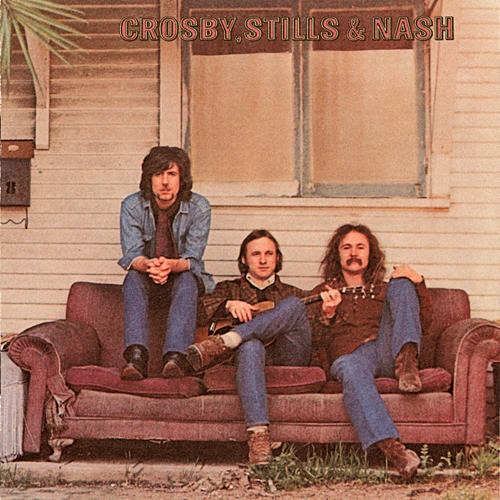
Crosby, Stills & Nash 

I put on Crosby, Stills & Nash, CSN’s first album.  Listening to an album on headphones in the dark before dawn is a great time to focus on music and stimulate thinking.  I remember buying this album the week it was released in 1969 and how excited I was to discover it.  The Byrds were my favorite group in the 1960s, and Buffalo Springfield was another favorite band, so the names David Crosby and Stephen Stills jumped out.  The album blew me away back then.  And as I listened to it now, I admire it greatly for its artistic construction, and find it beautiful to hear.  However, the songs are fascinating.  They are histories themselves, many about famous girlfriends.  Or the songs have a history themselves, like “Wooden Ships” which months later appeared on the Jefferson Airplane’s Volunteers album.

Why am I talking about music when I promised to talk about science fiction?  I’m working on a story that I want to be about legendary people.  When you read it, these people will be from the future, but the narrative will make you feel they are from the past, but the scene will be set in their present.  What details from fifty years ago about ordinary people living their present survive to make legends?

Like I said, all artwork is a communication from the past.  But even my urge to hear this album this morning comes from an earlier communication.
legends_of_the_canyon

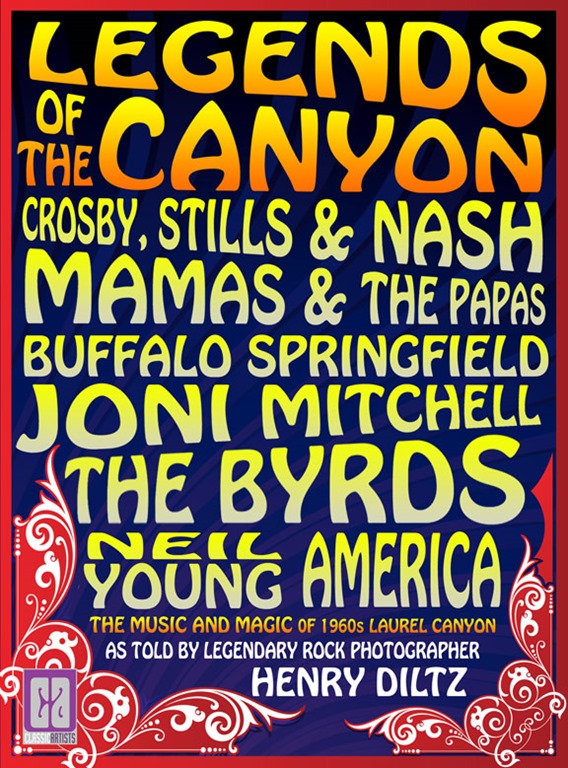
The other night I watched Legends of the Canyon about many famous musicians, songwriters and groups that lived in Laurel Canyon in the 1960s, including The Mamas and the Papas, The Byrds, Buffalo Springfield, Joni Mitchell, and Crosby, Stills & Nash.  Because David Crosby, Stephen Stills, Graham Nash and Dallas Taylor were prominently interviewed, the film almost seemed to be about the birth of CSN.  Now I want to find time to listen to Joni Mitchell and The Mamas and Papas albums.  I don’t think I’m an old guy that dwells on the past, at least not my personal past, but much of my retired time is spent listening to music, reading books, watching television and going to the movies.  These people who lived in Laurel Canyon lived lives that are still being written about again and again.  Imagine writing about such people who live in the future.  How do you capture their essence in the fewest words?

One thing that struck me was the memories of Crosby, Stills and Nash had of the first time they played together.  Crosby and Nash insist it was at Joni Mitchell’s house, Stills adamantly insists it wasn’t.  Reading science fiction often feels like science fiction writers are predicting the future, but they are not.  They never try to predict the future.  We remember the past imperfectly, but we constantly mine it for value.  Don’t we also mine speculation about the future for value even though we know those stories are completely untrue?  Doesn’t fiction create truth out of lies?  

I’m consuming the past.  Part of that is being in the present moment just enjoying the art, but more and more, I’m thinking about where and how the art was produced.  I have read many books and articles about these bands, albums and songs.  As interpreters of art we do not have to know the history connected to them.  You can listen to “Suite: Judy Blue Eyes” without ever knowing that Stephen Stills was writing about Judy Collins.  However, if you do study it’s history, the nature of how you appreciate the song changes.  The more you know how the song was recorded, and how the band was formed to record it, the more you realize the song is history, part of the past, and not part of the present.  Won’t the same be true about science fiction?  The more you know about science and the present will enhance the art of painting imaginary futures?
hemingway 

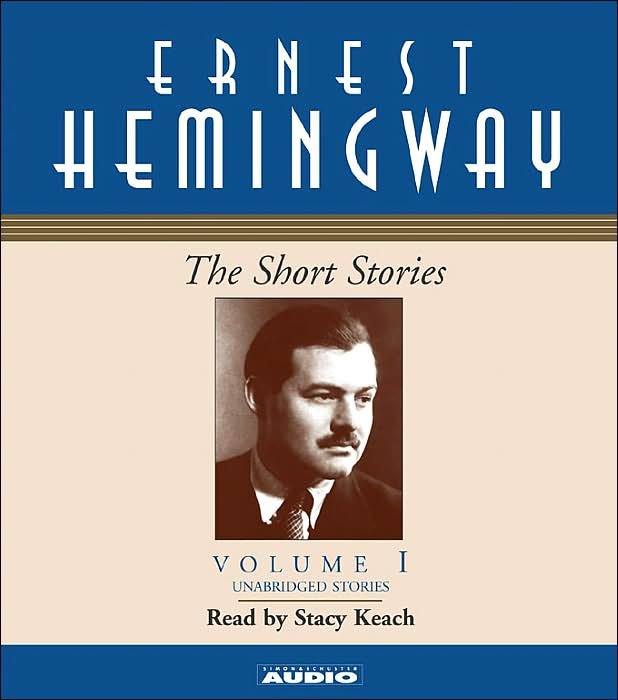
Am I studying art, or studying history?  Yesterday I cooked lentil soup while listening to The Short Stories of Ernest Hemingway Volume One.  The stories are exquisite.  They are wonderful read by Stacy Keach (who Judy Collins left Stephen Stills for) on the Audible edition, making them dramatic, and the intent of Hemingway’s writing clear and obvious.

For my retirement years my goal is to write a novel, and I’m working on it sporadically.  I’m not a very good writer, so I’m spending part of my days studying fiction and writing styles.  When I listen to Hemingway I realize two very important things.  One, Hemingway wrote as if he witness these events first hand.  Some of his stories, like the Nick Adams tales, are autobiographical, but others like “The Short Happy Life of Francis Macomber” are obviously fiction, but the details are so vivid, that I believe many of them are autobiographical too.  Second, Hemingway wrote in a style that describes much with few words.  His scenes are vivid and dramatic, with dialog so pitch perfect that they feel ultra realistic, like everything he writes is a documentary film.  It has tremendous impact.

For example, just a few lines of dialog paints a vivid picture of the mother in “Soldier’s Home.”  How did Hemingway create her?  Was she like his mother, or did one of his friends tell him a story about their mother, or did Hemingway make it up whole?  Like a poet, Hemingway uses very few words to capture this woman.  The scene reminded me of conflicts with my mother when I was young.  No matter where Hemingway got his idea, it feels like it had actually happened.

Most fiction is made up in the head of the writer.  It’s not based or inspired by anything that really happened.  Great fiction either captures real events, or fakes them so well they feel real.  Good writing is about pulling off this trick.

I spend my days experimenting with writing science fiction, but I want to use the Hemingway style.  How do I write about a future that will never exist as if I’m chronicling something I experienced for real?  It’s only possible if I can visualize it completely, as if each scene really happened.  I’m working on a scene where a man and women meet for the first time – how can I convey it to readers who can’t see what I’m seeing in my mind, and for me to make them feel they are experiencing something that really happened?
Philomena

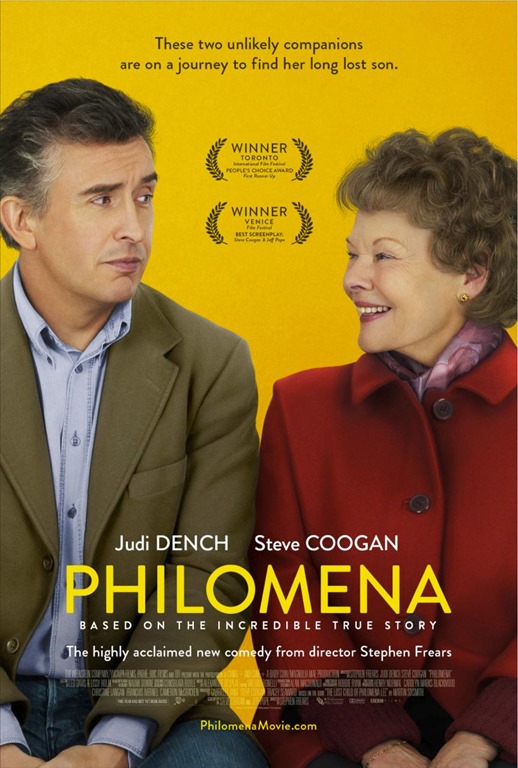
After I cooked the soup, I went to see Philomena with my friends Janis and Anne.  It’s a movie based on real life events, which was also published as a book, The Lost Child of Philomena Lee by Martin Sixsmith.  We all loved this quiet little movie because it was so real.  I spend a lot of time thinking about how real life is turned into fiction, or how completely fictional characters are made to seem real.  It often seems to me that the fiction with the most impact is either based on real events, or at least written by people who have been to the times and places where the stories took place. 

That means science fiction and fantasy have a very real handicap.  If everything comes out of the author’s mind then the story is limited by the author’s imagination.  That’s why the Harry Potter books are so impressive.  J. K. Rowling spent years imagining her characters and scenes.  She even drew detailed pictures of them.  And that might be why movie science fiction and fantasy is so much more popular than book SF&F.  Movies have to create all the visuals and that makes the stories more real.

Science fiction and fantasy stories must spend a lot of time painting the scenery and explaining the cultural background, but don’t you think the Harry Potter books feel like the events actually happened?  Isn’t that why they succeeded and other books about schools for wizards don’t?
from-lark-rise-to-candleford

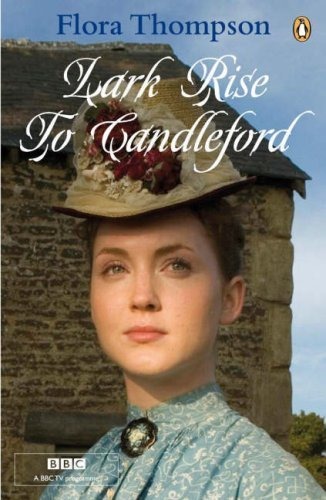
Sometimes history is so distant that we must recreate it from imagined details.  After the movie last night, Janis and I watched Alpha House, and then I watched an episode of Lark Rise To Candleford.  Flora Thompson wrote a trilogy of books that were autobiographical sketches of growing up in rural England in the late Victorian times.  As much as I love the TV series, it’s full of anachronistic thinking.  I’ve read a little bit of the original book and it’s absolutely wonderful in providing period details.

Writing science fiction is like producing a television show over a century after the events – only a strange stylized view comes through.  I wished I had the skill to write about the future with the details of Flora Thompson’s written observations.  Since that’s impossible, I’d have to make up the details with that level of realism.  I don’t know if that’s possible.
distrust

I’m currently listening to Distrust That Particular Flavor, a nonfiction book by William Gibson, where he talks about learning to write science fiction, but also deals with understanding the past, present and future.  Gibson also admits to not knowing how to write when he started writing but taught himself.  Listening to his essays I get the feeling he’s also obsessed with time and science fiction too, but maybe in a different way.  He talks about writing about the net before the net caught on, and writing about future technology that we have no words to describe, especially verbs that explain its impact.

1984_pulp3

I’ve also reading Nineteen Eighty-Four by George Orwell.  It is a book written in the late 1940s about 1984 but about a future that has never happened but is all too real, that is now part of our past.  Nineteen Eighty-Four is a brilliant piece of science fiction, absolutely stunning, among the best examples of the literary technique ever produced.

So, what makes Orwell’s great novel great?  To me it’s the temporal POV.  It reads like the events have already taken place, like the details given were facts of memory, like the characters actually lived through these events.  It feels like Orwell lived through this time like Hemingway lived through the events in his stories.  That’s a neat trick for a science fiction book.  It’s a trick of literature.  It’s a writing trick that distinguishes literature from genre.  And it’s one very hard act to pull off.

In struggling to write my scenes, which I do over and over again, at best I can produce pulp fiction.  I’m not being critical.  There’s nothing wrong with pulp fiction.  Hell, my writing isn’t even good pulp fiction.

But what all of this exploration of time and science fiction has taught me is I want to write as if I’ve already experienced what I’m writing.  In other words, I want to write about the future as if I’ve already lived it, instead of imagining a future I might could live in.

JWH – 12/18/13

Science Fiction: Nostalgic Past v. Dystopian Future

I am sixty-two years old and I want to write and publish my first science fiction story.  I started reading science fiction in 1962.  What science fiction was to me then, and what science fiction means to me today, are vastly different literary forms.  On Tuesday, SF Signal ran “How to Escape the Legacy of Science Fiction’s Pulp Roots” by Gareth L. Powell, which triggered a lively discussion in the comments section.  Many readers took it as an attack on classic science fiction, but I don’t think that was the point, but the real point is rather complicated because of various viewpoint perspectives.

  • For many people science fiction equals the Heinlein/Clarke/Asimov era
  • Some of these people are older fans that grew up with those stories and have tremendous nostalgia for them
  • Some of these people are younger fans that have discovered this classic era and love it
  • Some of these people are non-SF readers who rejected SF because of this era’s lack of literary quality
  • Some of these people are current SF fans who have no interest in past SF and feel it’s irreverent to contemporary SF
  • Then there are general readers that have read a few of the classic SF stories and now they narrowly define SF by these old classics
  • Then there are many readers, young and old, that are completely ignorant of SF, classic or modern, and the phrase science fiction equals movies and television shows, and book SF and its history are invisible to them

saturn

Powell, a science fiction writer, was talking to a book club that obviously wasn’t a SF book club and said of them:

I noticed this recently, when I spent an enjoyable evening being quizzed by members of a local book group about one of my novels, which they had been reading. They were a nice group of people but, when they spoke of the science fiction books they had tried previously, not one of them mentioned anything less than fifty years old! In their youths, they’d tried reading Asimov, Clarke and Heinlein, but had been put off by, as they saw it, a concentration on ideas at the expense of characterization or literary merit.

I’ve known lots of people like this in my lifetime.  Over there years in the general literary press, writers like John Updike and others, have expressed this view about science fiction.  Basically they say it’s poorly written kid’s stuff, and they are referring to the classic Heinlein/Clarke/Asimov era of SF.  SF fans have always reacted badly to this – especially the old fans who grew up reading and loving classic SF, and the younger fans who have rediscovered it.

Gareth L. Powell is a writer of new science fiction and feels, “As science fiction writers and fans, we are rightly proud of our genre’s origins and heritage. Yet sometimes, those same origins can be a millstone around our necks, dragging us down.” 

Powell goes on to admit an influence and admiration for classic science fiction but suggests that the literary past can be a burden to contemporary writers. 

That is my conflict too, but for other reasons that don’t pertain to literary style.  Powell, as a writer is trying to discover new territory to write his science fiction and says,

But, can we really blame them? Those early classics (and the million derivative works they inspired) helped establish and reinforce the popular perception of science fiction as a pulpy and poorly written backwater of literature. For modern non-SF audiences, they have little appeal. Readers are more sophisticated now. The only way we’ll escape the legacy of our pulp roots is to promote the innovation, literary merit, and relevance of the best modern genre writing.

Some fans will always cling to the ‘golden age’ works of the 1950s, 1960s and 1970s, and I can understand why. They provide a magic door back to the simple pleasures of a simpler world – a world before global warming, oil shortages, terrorism, and economic uncertainty; relics of a world where the future was easily understood, and (largely) American, middle class and white in outlook, origin and ethnicity.

My reading world of 1962 is so much different than my reading world at age 62.  I still read and love 1950s and 1960s science fiction, but I’m willing to admit that it was poorly written, but that’s not an essential complaint, at least by me, no, my problem with classic science fiction is it’s dated.  It’s wrong.  It’s about futures that will never be.  Classic science fiction futures have become my nostalgic past.  I read old SF to relish how I felt when I was young and the future was full of fantastic possibilities.

When science fiction writers like Robert Silverberg  admit that interstellar travel is probably impossible, and I’m starting to doubt that even interplanetary travel and colonization will happen, then it’s time we need to completely reevaluate science fiction.  But isn’t that what new SF writers do?  If I have any criticism of Gareth Powell, it’s not over his criticisms of classic science fiction, but rather, over how he’s reimagining science fiction.

If science fiction fans want the respect of the literary world at large they need to take their genre more seriously.  Doctor Who and Star Trek reboots are just recycling a nostalgic past.  So is the new space opera.  Science fiction has become horribly incestuous.

I’m 62 and want to write science fiction.  I’m inspired by the science fiction I discovered in 1962 – but I don’t want to live and write in a nostalgic past.  I don’t think Powell went far enough in suggesting that classic science fiction is a millstone around the neck of new science fiction writers.  Most science fiction, and I’m talking 98-99%, is recursive science fiction fantasies. 

Real science fiction is about writing about possible futures.  You can’t do that by writing about impossible pasts.  You can’t be the next H. G. Wells, Robert A. Heinlein, Arthur C. Clarke or Isaac Asimov by recycling their ideas about the future.  The thing about science fiction is it always gets the future wrong, but it’s fabulously right when it’s inventing new possible futures.

Right now dystopian science fiction is very popular, very exciting to young people.  Their instincts tell them the futures of science fiction pasts are nostalgic pap.  Sure, there’s a large segment of the young and the old that want to cling to the futures of classic science fiction, but they need to either accept their fantasies are fantasy and not true science fiction, or go read some science books.  On the other hand, we need new writers that can imagine some possible non-dystopian futures.  And do you know the definition of non-dystopian?  It’s utopian. 

That’s why so many readers love classic science fiction.  For all the scary aspects of alien invasions, collapsing civilizations, nuclear wars, there was a sense of utopian dreams in that fiction, of interplanetary and interstellar travel, life extension, new civilizations, immortality, intelligent machines, brain uploading, etc.  The reason why teens love dystopian fiction is not because they want to dwell on the horrible, but because the characters are free to fight for a new way of living, invent new societies, to rebel against authority, to live without parents and rules. 

Readers are attracted to the positive, even if the setting is a nightmare.

Classic science fiction is both inherently positive and now nostalgic.  But the futures it predicted aren’t going to happen.  Powell is right, the challenge of new science fiction writers is not to be burden by past science fiction.  Not just because it has the reputation for being poorly written, but because its now dated and wrong.  I know why so many people love classic science fiction and defend it so passionately.  I’m sure Powell knows too.  But lovers of classic science fiction shouldn’t be offended when we criticize classic science fiction.  The goal of this criticism is to write better science fiction.  It’s called evolution.

JWH 12/7/13

Please Recommend SF Books for a Course on Technology and Culture

A friend of mine has a friend that wants to create a course on the impact of technology on culture as seen through science fiction.  Since she knows I’m a Sci-Fi nut, she asked me for author and book recommendations.  This sounded like a fun challenge until I started thinking about concrete examples.  I wondered if most classic science fiction books and authors from the past still count?  When does science fiction go stale?

windup-girl

Does Neuromancer still work to show off the effect of a wired world?  Or would Little Brother by Cory Doctorow be more relevant now?  What’s a good book about robots?  Everyone immediately thinks of Asimov, but his stories are so quaint now that we have real robots.  Would Robert Sawyer’s Wake, Watch, Wonder Trilogy be a better story about intelligent machines and what they would mean to society?

What would be a good book for genetics and longevity?  I could recommend the movie Gattaca, but what book?  What about Holy Fire by Bruce Sterling?

For the impact of technology to deal with global warming and running out of oil, I’d highly recommend The Windup Girl by Paolo Bacigalupi.

There’s zillions of space travel books but do any of them explore the impact of space travel on world culture?  Quite often science fiction is about a technology without being about its impact on society.  Think of all the stories about SETI.  Contact by Carl Sagan is the most famous, but does it really say much about what it would mean to the people of Earth if we started getting messages from the stars? 

How would our lives on Earth be different if humans colonized Mars?

If you think about it, our current society is far more tech driven than any science fiction book I’ve ever read.  What novel captures us now?  I thought about Ready Player One by Ernest Cline.

And should we list books where technology destroys civilization like The Road by Cormac McCarthy?  Or what about books that want to rebuild technology after our culture collapses like Earth Abides by George R. Stewart, The Long Tomorrow by Leigh Brackett and A Canticle for Leibowitz by Walter M. Miller, Jr.?

Are there any technological utopias portrayed in recent science fiction books?  2312 by Kim Stanley Robinson is very hopeful I’d say.

I’m sure I’m missing the obvious, but I also believe there are many great books written in the last twenty years that are excellent but I haven’t read them.  Tell me about them.

JWH – 12/3/13

The Flavors of Science Fiction

Science fiction is not a good term for pointing to the things I like about science fiction books.  I know too many people who claim to love science fiction, but we don’t share the same favorite movies and books.  Why is that?  Well, because the term science fiction is not a very good term for pointing at a specific type of stories.  It’s a collective term for a whole spectrum of fantastic tales.  I’m now thinking we need a new way of describing the stories we love that go beyond genre labels.

I’m not even sure the standard genres labels, mystery, romance, science fiction, fantasy, westerns, historical, thriller, etc. are all that useful for readers.  They’re a rough categorization for book publishers and bookstores, but not very precise for reading moods.  I think readers like particular flavors featured in fiction, rather than their genre classification.

Take witty romantic comedies.  Does it really matter where the witty romance takes place, in the old west, in Regency England, in outer space, as part of a murder mystery in 1939 New York City, if that’s the kind of story you’re in the mood to read?  If you’re in the mood to shoot a lot of bad guys, does it matter if it’s Al Qaeda terrorists you blow away, or aliens from Betelgeuse or Nazis in WWII?

I believe readers who love Military SF would probably enjoy just as much, high-tech, squad level combat stories set in other times and places.  Combat stories with band of brothers camaraderie is the flavor readers crave.  Or a grunt working up the ranks is another flavor people love.  Honor Harrington stories are appealing in the same way many people love stories about Horatio Hornblower or Aubrey-Maturin stories.  I think they reflect a flavor of fiction rather than a genre.  Although some readers might find they love stories about very tall women, and thus the connection to other sea stories wouldn’t matter.

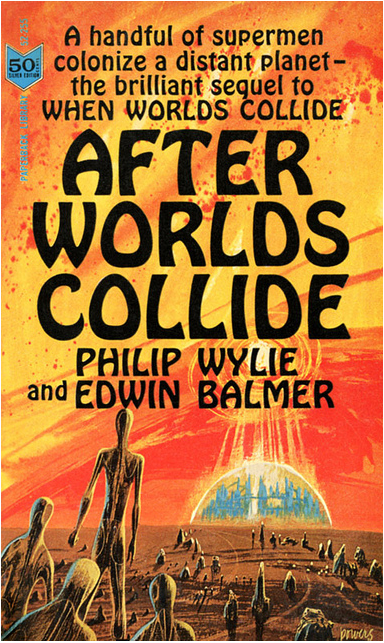
Growing up I loved “sense of wonder” stories.  I thought the label meant specific kinds of science fiction, but I don’t now.  Now I know there are several buttons to push to turn on my sense of wonder.   When I was a kid and read books like After Worlds Collide by Philip Wylie and Edwin Balmer, it pushed my sense of wonder button in a big way.  When the humans were exploring the ancient city of Bronson Beta, that pegged my sense of wonder meter.  Any science fiction book that has explorers walking around in long dead civilizations pushes my sense of wonder button.  But when I read regular fiction and nonfiction books about explorers poking around in long dead human civilizations of Earth, it pushes the same button.

after-worlds-collide

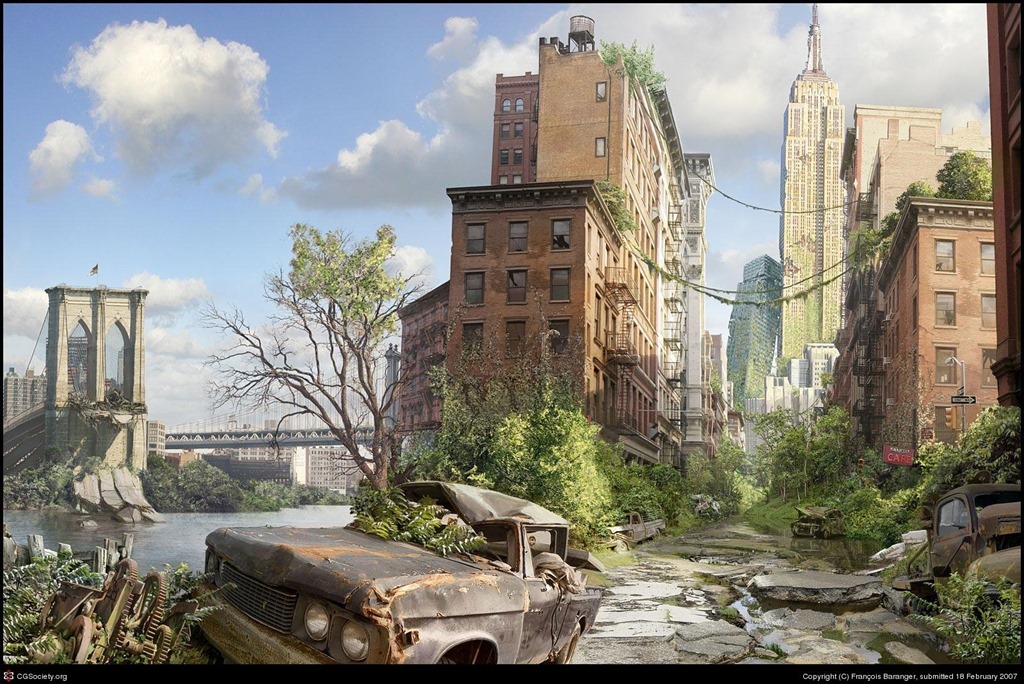
Another type of story that sets off my sense of wonder button are those that remember humans after they became extinct, like the connecting pieces to City by Clifford Simak, or the later chapters of The Time Machine by H. G. Wells.  But watching documentaries about life after people sets off the same flavor.  Theoretically I should be able to seek out all the stories, whether science fiction, or nonfiction, and find the flavor I desire to experience.  The same powerful sense of wonder flavor came in the 1920 poem “There Will Come Soft Rains.”  The World Without Us is evoked by a very specific idea.  It shows up every now and then in science fiction, but elsewhere too.

the-world-without-us-new-york

Another flavor I realized I loved as a kid that I completely associated with Robert Heinlein’s juvenile novels, is the young adult science fiction novel.  I found the same flavor in many Winston Science Fiction novels and books by Andre Norton.  But over the years I realized that any story about a teen without parents struggling to make it in a new environment does the trick.  Part of the enticing flavor is the kid must be on their own, or their parents must be mostly tuned out.  National Velvet by Enid Bagnold works because Velvet Brown is learning to do something behind her parent’s back, and something girls, especially young girls in the 1920s, didn’t do, which was jockey a horse in a national race.

What I point to when I use the term science fiction, are those books which extrapolate on current trends to speculate about possible futures.  Brave New World, Nineteen Eighty-Four, Stand on Zanzibar, and The Windup Girl are examples of what I mean.  But there are many kinds of science fiction that I read that don’t fit that flavor.  Space opera is one.  PKD type stories are another.  In fact, Philip K. Dick wrote a flavor of story I really crave that’s not science fiction at all, and those where his stories about the 1950s.  I really love Confessions of a Crap Artist, and would read more like it if I could find them.

confessions-of-a-crap-artist-5

I often meet people who love Lois McMaster Bujold’s Vorkosigan Saga series.  That’s the flavor they think of when they crave science fiction, but most science fiction stories are not like her books about Miles and Cordelia.  Her books are a mixture of romance, military, thriller and mystery set in an aristocratic galactic empire.  Her books have so many other flavors that I don’t think of them as science fiction at all, at least by my definition.  But that’s my point.  Fans of Bujold seek a certain flavor or flavors in their fiction that can’t be described by the generic term science fiction.  I find her books very pleasant, but none of their flavors actually make me think of science fiction.

To me, when a group of people all claim to love science fiction, I no longer think they love the same thing, even though they are all using the same phrase, science fiction.  In reality, they could all hate each other’s favorite books and movies.  We have to accept the term science fiction because it’s so widely used, but I think impossible to universally define.  Now when I talk to friends about books, or read reviews, I’m going to see if I can find out the flavors of the stories, because I know I love certain flavors of fiction and crave them.

JWH – 11/15/13

Has Humanity Given Up on the Three Major Promises of Science Fiction?

Science fiction has been around a very long time, but it wasn’t always called that.  The essential core of science fiction has always been three promises:  space travel, intelligent alien beings and intelligent robots.  We know as far back as the classical Greece, that there has been speculation about travel to other worlds and finding intelligent beings on them.  The idea of building an artificial human is as old as memory too.

There’s always been a few outliers in society that think up far out ideas and a larger group of fans who favor them.  Currently we call these two groups science fiction writers and science fiction fans.  During the second half of the 20th century I believe certain science fiction ideas peaked in popularity, and that we’re now detecting a possible diminishment of their popularity.

I strongly felt the public turning against the major promises of science fiction when I read the new issue of The Atlantic, and the essay “The Man Who Would Teach Machines to Think” by James Somers that profiles Douglas Hofstadter, author of the 1980 Pulitzer Prize winning Gödel, Escher, Bach.  Hofstadter hit a home run with his first book, but has been mostly missing in action all these years since, even though he continues to write brilliant books about artificial intelligence (AI).  The trouble, as The Atlantic article points out, is Hofstadter’s idea of artificial intelligence is different from what the academic world has come to accept for the term.  Douglas Hofstadter wants to teach machines to think, just like us, while the industry is happy enough to program computers to accomplish fantastic data processing feats that give the illusion of thinking.

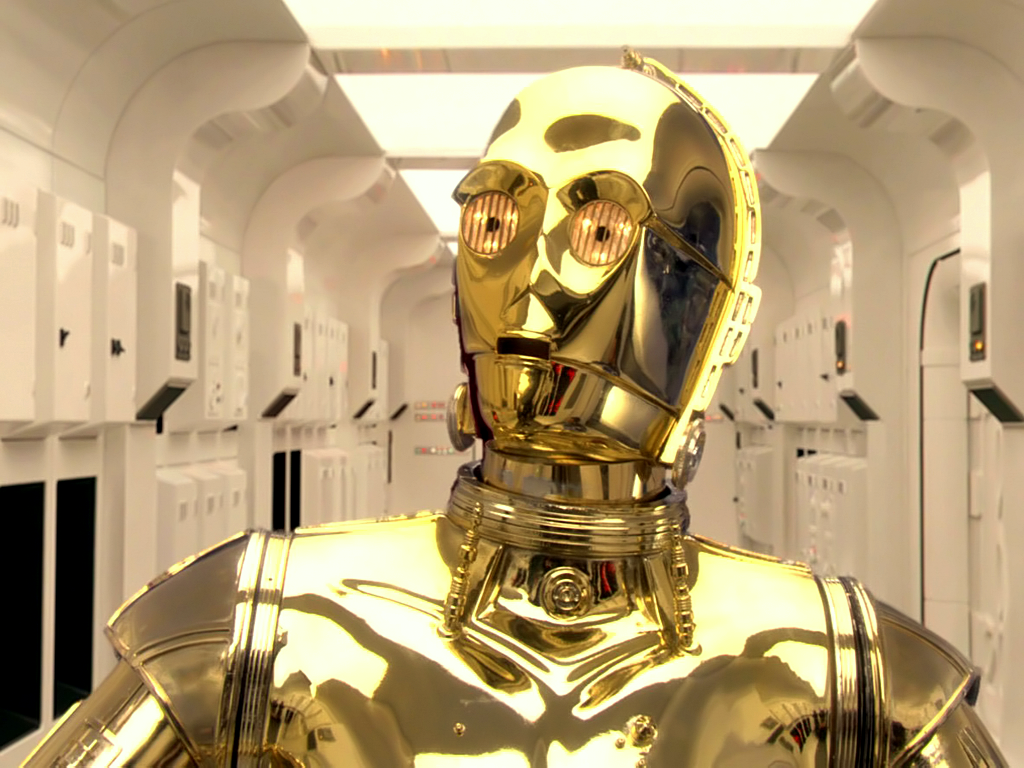
c-3po

If we want robots like C-3PO, then we need Douglas Hofstadter.  If you’re happy with IBM’s Watson, then we don’t.  And I’m worried that most people on Earth don’t have the sense of wonder that it takes to want a C-3PO.  And that’s a fucking crying shame.  I want Star Trek, but the public is only grudgingly willing to pay for NASA.  I want humanity to become friends with all the aliens in the galaxy, but all the vast run of people on Earth want is to thrill to the xenophobia of alien invasion movies and to shoot ETs in video games.

I have pretty much given up on seeing the public support space travel, and figure our only hope of meeting aliens would be through SETI projects, but I figured we had a real chance of seeing intelligent machines in my lifetime.  I might have to give up on that dream too.

For most people artificial intelligence is not an issue they will ever concern themselves with, but if you’re a philosopher, computer scientist, or science fiction fan, then it is.  The crux of the matter is whether or not machines will ever be able to think like us.  Here’s my logic.  Humans are self-aware thinkers and we’re the accidental creation of evolution.  If nature can randomly rub molecules together until it produces a self-aware biological being why shouldn’t we create thinking machines intentionally?  Sure, it took 13.78 billion years for reality to create us, but that doesn’t mean it will take as long for us to engineer intelligent machines if we put our minds to the task – we have 13.73 billion years of experience to consciously study.

Up to now, we’ve mostly tried to program machines to do specific jobs, some of these jobs used to be tasks we thought required thinking, like playing chess, being a contestant on Jeopardy or translating foreign languages.  We can program machines to do these tasks, but they don’t think, not in the way we think.  That’s not a failure of AI, it’s a lesson in what makes us conscious beings.

To do what Hofstadter wants will require building machines that can learn and evolve.  This is completely different from the direction that AI is taking now.  We can’t program machines to be self-aware, but we should be able to program machines to learn and evolve, and eventually that will lead to self-aware AI.

Think about the evolution of life on Earth.  It reflects the growth of simplicity into complexity.  It shows how simple creatures learn to interact with its environment and evolve better senses.  Over time those senses could interpret more and more complex patterns in the environment.  Look around you.  Everything you see is recognize as a distinct object.  In a cluttered room you might be seeing hundreds of different things.  Think how, and how long it took you to learn what all those things are.  Computer scientists for the longest time have tried to just tell machines what to see.  That won’t work for a thinking machine.  Like a human child, a thinking machine will have to grow up and learn everything on its own.

It does no good to create code that tells a computer what a banana is.  Can you remember learning what a banana was, and how to tell it from all the other kinds of fruits, or even distinguish it from vegetables?  I bet you can remember learning what an iPhone is, and maybe you can even tell the difference between an iPhone 3S and a 5S.  You’d think it would be easy to tell a computer to do the same thing, but it’s not.  Modern AI can be programmed to spot an iPhone, but not out of context of knowing what everything else is around it.  Not seeing and understanding the complete context of the visual field shows why the machine isn’t thinking.  It’s how we learn about new things that’s thinking, not knowing what they are.

The same problem we face building thinking machines are the ones we face for creating true space travel and finding alien life forms in the galaxy.  Most people just don’t see the point.  They don’t want to waste the money.  And they’re xenophobic.  But what it comes down to is most people really don’t care.  It’s not on their radar.  Space travel, aliens and robots have no value to them at all.  Zip. Nada.  Nothing.

So why the immense popularity of science fiction at the movies, on television and in video games?  Well, that’s another essay.

When I was a kid back in the 1950s and 1960s I embraced science fiction because I wanted to see space travel in my lifetime.  I wanted first contact in my lifetime, even if it was just SETI contact.  And I expected intelligent machines to be created in my lifetime.  Hell, I thought all of these things would have happened by the beginning of the 21st century.  Boy, was I wrong.

st

I thought we took a bad turn when the Apollo program was cancelled, but felt things were back on schedule with the emerging popularity of Star Wars and the return of Stat Trek.  I felt millions and millions of Earthlings were embracing the three great promises of science fiction as science fiction at the movies became huge box office successes.  But I was wrong.  All those people weren’t dreaming the same dreams as I had.  They are getting something else out of science fiction.

Orphans of the Sky is a powerful story by Robert A. Heinlein about a generation ship traveling the vast distances between the stars for so long that the passengers have forgotten that they live in a spaceship.  Their self-contained world becomes their entire universe and they forget the larger universe exists at all.  When I read Orphans of the Sky back in the 1960s I felt that humanity was waking up and realizing that they were living on spaceship Earth.  Hell, again I was so goddamn wrong. 

In most people’s minds, people on Earth live in a small place where God rules over them and cruelly holds out promise of everlasting life if they only confess belief.  Earth is a ball of dust God created as a classroom for us to live on while we decide.  Earth has no purpose other than a staging area for heaven and hell.  All the rest of the vast universe is a big distracting illusion.

The future used to be a vision of mankind spreading out to the stars making endless discoveries, but now I have a different vision.  Humans will continue to live on the Earth forgetting it’s a spaceship traveling through a vast universe, and the inhabitants will continue to follow their illusions century after century until they destroy their ship.  I could be wrong – I’ve shown that to often be true.  Let’s hope.  Maybe The Enlightenment is just taking longer than we thought.

Now it might sound like I’m depressed over this reevaluation of my beliefs, but I’m not.  I consider it far more healthy to be realistic than try to keep my own cherished fantasies.   The truth is always discovering the true mission of the spaceship where you become self-aware.  Which brings me back to robots.  If we ever create truly self-aware robots, what will they make of old spaceship Earth?

JWH – 11/6/13