More Science, Less Fiction

As a lifelong science fiction reader I’ve always had an on again, off again relationship with science, but now that I’m retired I’m thinking about a deeper commitment.  Science fiction inspires a kind of love for science that’s not very realistic.  Science fiction is a marijuana high of smoking science, and is about as scientific as two dopers discussing theories of reality.  Science fiction is a good gateway drug to science, but sooner or later you have to move on to the harder stuff – physics, chemistry, biology and mathematics.

Most folks today have little knowledge of science, and most of those who do, have a Newtonian model of reality in their heads.  The hard to intuit relativity of space-time, and the bizarre quantum world is beyond all but a few to incorporate into their seeing of how things work.  We truly live in a science fictional world, where a little bit of science creates a lot of fiction. 

Back in the 1950s and 1960s when I was growing up, science fiction was about the future, but our lives in the 21st century present are very science fictional.  We live in times described by Arthur C. Clarke’s third law, “Any sufficiently advanced technology is indistinguishable from magic.”  Growing up reading science fiction gave me a view of the future that’s turned out to be wrong.  Before I die, I’d like to assemble another view of the future, to imagine what things will be like after I die.  But this time, hopefully, I want to install a more realistic science.  We can’t predict the future, but we can shoot down a lot of crap ideas.  I’d like to die with a reasonable idea of what my brief visit to reality was all about.

I read about 52 books a year, or on average, one a week.  I’d like to be more systematic about reading science books, but I don’t want to give up reading other kinds of books.  Actually, I don’t want to create any rigid rules to live by at all – anything I feel obligated to do, I won’t.  But lately, I’ve been reading a lot of great popular science books and I realize to better understand what I’m reading will require some applied effort.

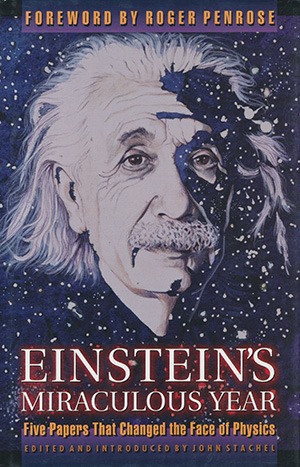
For example, I’m currently listening to Time Reborn by Lee Smolin, and he mentions reading Einstein’s original papers from 1905 as a young student.  Smolin says they are quite easy to understand, far better than most science papers, and they set the standard for science papers in their clarity of thought.  I’ve always assumed they could only be read by genius level scientists.  It just so happens I have a copy of Einstein’s Miraculous Year:  Five Papers That Changed the Face of Physics.  Now, I’m torn.  Should I stop reading Time Reborn and read Einstein?

Einstein 

Smolin makes it sound like reading Einstein’s original work is the foundation of all his scientific thinking.  This makes me think instead of reading the latest popular science books I should instead be reading older ones.  I’ve always dismissed science books older than a few years as being past their expiration date.  Maybe this is a false assumption. 

When I bought Our Mathematical Universe, I read an interesting reader review at Amazon where Michael Birman said:

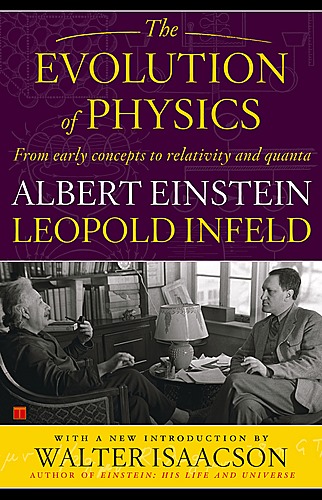
Years of reading science books have produced a personal pantheon of the finest I’ve ever come across. There are several aspects of Tegmark’s book that have placed it amongst the three finest popular science books I’ve ever read. The other two books are Albert Einstein and Leopold Infield’s The Evolution of Physics and Kip Thorne’s Black Holes and Time Warps: Einstein’s Outrageous Legacy (Commonwealth Fund Book Program). The first book, The Evolution of Physics, is still the clearest exposition of classical and (relatively) modern physics ever written, despite its age. It remains the most authoritative, concise and profound discussion of the source of Einstein’s world-shattering ideas, and has never been surpassed as a book written by a great scientist for a popular audience. Kip Thorne’s book combines personal reminiscence and scientific exposition with an elegance and depth that makes it my choice as the finest modern popularized science book. Thorne proved that you can write about science in an engaging manner without sacrificing either intelligence or necessary relevant technical detail.

You guessed it, I ordered those two books too.  So just starting two new books has gotten me to buy three old books.  The trouble with reading current physics books is they are often so ethereal that I don’t know if I’m learning science or reading science fiction.  For the last many years, I’ve been constantly drawn back to the 19th century in literature and history, so I’m thinking I might need to return to that century to study science.  I need to learn the physics that led up to Einstein.

books_evolution 

Then there’s the whole gnarly issue of math.  My math abilities are slight.  How far can I really understand science without math?  I’ve bought a bunch of math history books, and a Great Course on the history of mathematics.  Part of my retirement benefits is getting to take two free courses a semester, and there are many online math courses.  If I wanted to, I could study math again.  And I might.  Although I wonder at making such an effort in my retirement years when I seem to be forgetting faster than I’m remembering.

Reading Einstein (I’ve already started) does make you think about the physical world differently.  To understand time in the way Smolin is talking about it in Time Reborn will take a lot of contemplation.  More and more I realize the value of Einstein’s thought experiments.

In the modern world we’re easily fooled by pre-digested knowledge we get from television.  The new Cosmos might look dazzling, but to understand it requires ignoring the frenetic CGI dazzle and returning to a slow Amish like simplicity of thought.  Just doing the math to model 13.8 billion years on a generic 365 day calendar is enlightening. 

I’ve read lately, but I’ve forgotten where, that if the most complex science can’t be explained to the average person without mathematics then that science isn’t really understood by the scientists either.  I’d like to believe that.  I’d like to believe I can understand science even if I can’t prove it mathematically.  But I shouldn’t give up on studying math either.  What I need to do is go back to the beginning and learn math historically, and progress forward through time.  Start with the Babylonians, and then the Greeks, and see if learning math in the order it was discovered will help me see a mathematical reality.

Growing up in a gee-whiz era of science and technology makes it hard to tell science from fiction.  Even the science books I read, and the science documentaries I watch, are full of fiction, even though they are factual in intent.  If I don’t comprehend what they say correctly, then I create mental fictions to explain what I think I see.  Science fiction novels that I’ve always loved to read, took science concepts and intentionally made wild fiction out of science.  Such hopeful expectations from science fiction has corrupted my mind about science.  I now need to rethink both science and science fiction.

I’ve been a life-long atheist, and been skeptical of religion, mysticism, the metaphysical and paranormal, thinking instead that science is the only valid course to understanding reality.  But the more I study science, the more I feel the need to be skeptical of my own knowledge of science.  It’s very easy to fool oneself.  Eye witnesses are notorious unreliable, and we tend to feel that other people can be tricked and not us – that what we see is real.  But isn’t that another fiction?

How much do you know could you prove?  Can you really prove the Earth orbits the Sun?  Humanity has discovered a lot of scientific knowledge in the last four hundred years, but how much could you prove yourself?  Being told something is true doesn’t mean you understand why its true.

Even if science fiction didn’t exist, we still live in a science fictional world, not because of rocketships and robots, but because we fictionalize science, we fictionalize what we’re told is true, we fictionalize everything we don’t know, and even the things we do.

JWH 3/14/14  

Human 2.0 versus Robot 4.0

If we think of all the versions of genus Homo leading up to modern man as alpha and beta tests, we can call the average person today Human 1.0.  Science fiction has often explored the idea of the next stage of humanity, which I shall call Human 2.0.  Most guestimates of Einstein’s IQ puts it around 160-180 – let’s assume he was Human 1.6.  IQ is not a reliable measure of man, but it’s useful enough for this essay.  Basically I’m suggesting that humanity is evolving toward a time when the average person’s 100 IQ is equal to today’s 200 IQ, and we can say we reached the Human 2.0 stage of evolution.

Cyborgs-vs-Humans

IQ is terribly hard to quantify, but there is speculation that some people have surpassed the 200 level already.  Might not the huge economic divide between the “haves” and “have nots” we see today already reflect the emergence of Human 2.0?  Science fiction always predicted Human 2.0 beings looking different, with bulging foreheads, and maybe six fingers.  And for some strange reason, more often than not, they predict Human 2.0 with ESP abilities.  What if people were just twice as smart, but looked no different.   Isn’t that difference enough to bring about a massive social transformation?  Isn’t that different enough to designate a new species?  Plus, if you implant a smartphone into these people, making them cyborgs, how could normal people compete?

While humans are evolving, so are robots.  Many scientists expect a point in our future where robots reach a state of intelligence equal to Human 1.0.  Let’s call that Robot 1.0.  But like Moore’s Law for computers, I expect robots to quickly evolve, so Robot 2.0 and then Robot 4.0 will quickly be upon us.  How will humans feel when their smartphones are twice as smart as they are?  I hope you’ve seen the movie Her.

There is speculation that many historical people had theoretically IQs as high as 180, or Human 1.8.  I assume our brains, although fixed in size by the shape of our heads, and limited by the birth canal, can still evolve to become smarter, but I doubt we’ll ever see Human 4.0.  We could go the Brave New World route and grow babies in artificial wombs, and use genetics to quicken our evolution, to produce big headed humans often imagined by older science fiction stories.  But for now, let’s assume that won’t happen soon.

lthesixthfinger

Let’s forecast instead, that humanity as a whole is working towards becoming Human 2.0.  If the average future person is twice as smart as today’s people, will we become smart enough to be ethical stewards of the Earth?  It’s pretty obvious that collectively Humanity 1.0 is not smart enough, because we’re ruining this planet quickly and killing off species at an alarming rate.  By that standard we really don’t want robots staying at 1.0 levels long.  We want robots to reach 2.0 and 4.0 levels as fast as possible, because we know the destructive power of Human 1.0.

Maybe that’s why so many science fiction movies predict intelligent machines attacking humans, because they can’t imagine anything smarter than people, and that’s what people would do, attack any competitors.

If science fiction is any indication of how humanity will deal with smart machines, the future doesn’t look good – but I think science fiction is wrong.  What if robots are more ethical than humans?  Most of what makes humans evil are their animal impulses, and robots won’t have those.   I’ve read people say that without our animal drives machines won’t care to live and will want to shut themselves off.  But being alive, whether via biology or cybernetics, tends to inspire a desire to keep living.

I read a lot about the 19th century, both fiction and nonfiction, and the rise of the first machine age and industrialization caused a lot of human suffering and angst.  Jobs are important to the physical, mental and spiritual wellbeing of humans.  One problem with life on Earth in 2014 is we have way too many people compared to the number of fulfilling jobs.  People in the 19th century asked why build machines to do our work when so many people want those jobs.  Many are still asking the same question in the 21st century, but few people think progress will hit the brakes.

I’ve always been a science fictional dude, so I have a science fictional solution.  Let intelligent machines have all the solar system except the Earth and Mars, and we share the Moon.  Space really is a hostile place for people, either much too cold, or much too hot, and always way too radioactive and thin on something to breathe.  Instead of designing machines with Asimov’s Three Laws of Robotics, design them to live in space, and leave Earth to us.  Let robots have the spaceship building business and sell us rides to Mars.

I wouldn’t think even Humans 2.0 would want to compete with Robots 4.0, or Robots 32.0.  Let’s invent smart machines and then tell them to keep anything they learn a secret from us, so we can figure things out for ourselves.  Instead of programming them not to kill us, lets program them not to crush our spirits.  Let’s keep our jobs and ambitions, and let AI robots create their own societies away from us.

We need to preserve space on Earth for all the animals, as well as all the old fashioned humans, and the newly evolved humans, and maybe for some of the robots.  But do we want to coexist with machines that are smarter than us than we are to pug dogs?

pug-dog-wallpaper-free-download-i

Science fiction is constantly changing and evolving.  It represents our most ambitious fantasies, but in recent years I think we’re all becoming more realistic.  I don’t think humans will be colonizing the solar system and the galaxy.  Earth, and maybe Mars, might be our only homes.  We need to protect our environments because we need to live here for millions of years.  Maybe Human 3.0 or 4.0 will adapt to living in space.  I just don’t see Humans 2.0 going the Childhood’s End thing, and destroying Earth and leaving it for space.   I think the conservation of our planet is very important because we’re going to need it for a very long time.

There is no heaven or final frontier, just Earth.

Let the robots have the stars.

JWH – 3/4/14

1964–Fifty Years of Reading Robert A. Heinlein

While everyone is remembering it was fifty years ago that America discovered The Beatles, I’m remembering it was fifty years ago that I discovered Robert A. Heinlein – a discovery that had far more importance to me.  1964 was the year after Project Mercury, and the year before Project Gemini.  Back then each space mission got uninterrupted coverage on CBS, NBC and ABC, and I always got to stay home from school and watch.  1964 was also the year a very futuristic World’s Fair in NYC and everyone seemed to be thinking about the decades to come. 

1964 was the year I turned 13 and I started thinking about my future. 

Now it’s 2014 and I’ll turn 63 later is year, and I think about my past.

As much as I love The Beatles and remembering 1964, 2014 is my 50th anniversary of reading Robert A. Heinlein.  I thought it might be interesting to analyze why reading the twelve Heinlein juveniles I first discovered in 1964 was so much more important than “Twist and Shout.”  Wouldn’t it be fun to read a series of blogs by baby boomers remembering all the artists that meant more to them from 1964 than The Beatles?

hein04

I read science fiction before 1964, but it wasn’t until I discovered Heinlein that I became a hardcore science fiction fan.  I turned 13 on November 25, 1964.  For some reason I started puberty by rejecting religion and God, becoming an atheist, and embracing science fiction.  I’ve always joked that science fiction was my religion, which made Heinlein my messiah.

I have my 8th grade English teacher to thank for introducing me to Heinlein, although I’m pretty sure I would have discovered him one way or another.  I wished I remembered this lady’s name, and had a photograph of her.  She had a remarkable teaching method.  For each six weeks grading period she required the class to read and report on three books.  However, if you read five, she would raise your grade one letter.  That allowed me to be a B student that year – at least for my English class.  My teacher provided us with a list of approved authors and Robert A. Heinlein was one.  In the 1940s and 1950s Heinlein had published twelve young adult novels with Charles Scribner’s Sons that had gotten a lot of recognition with librarians and teachers.

The first of the twelve juveniles I discovered was Red Planet, after that I quickly consumed the other eleven, and then went on to read the Heinlein adult novels.  Sadly I don’t remember the order in which I read them.  I do remember the night I read Have Space Suit-Will Travel, my favorite Heinlein book, and my all-time favorite science fiction novel.

HSSWT

I was babysitting for an airman my dad knew from work at Homestead Air Force Base.  I was dropped off at their house around eight, after the kids were already put to bed, and the couple didn’t return home until after three.  So I was paid fifty cents an hour to read Have Space Suit-Will Travel.  I was blown away.  When the couple came home the young dad offered to drive me home, I told him I’d walk.  It was 3:30am, and I wasn’t even sure where I was.  I had a vague idea my house was north of their house, so I started walking.  It was eerie out – completely dead, with a bit of a mist from the dew. 

I wasn’t afraid, but the long walk was surreal.  All I could think about was Kip’s adventures, going from Earth, to the Moon, to Pluto, to a planet orbiting Vega, to the Lesser Magellanic Cloud.  My brain speeded on thinking about the future and I felt very alive.

A sliver of the Moon glowed in the sky that dark night fifty years ago, and the stars looked down on me, and I up at them.  I was living the mundane life of an 8th grader, the 1960s was heating up, and all I could think about was living in the 21st century.  Now, it’s 2014, and my future is almost over, and more and more, I think about the past.

The promise and potential of space travel was why I loved Heinlein.  Elementary school had been about Project Mercury, Project Gemini was going to be my junior high years, and Project Apollo my high school years.  I started the 1st grade a couple months before Sputnik went into orbit, and graduated high school a couple months before Neal Armstrong walked on the Moon.  That, reading science fiction, and being a baby boomer growing up with the rock music revolution of the 1960s, did a number on me. 

So did the drugs.  Strangely, by 1968, science fiction had taken me far further than the chemical trips I had started taking.  Reading Stranger in a Stranger Land in 1965, I’m sure I saw it way different than Heinlein intended.

I read everything I could about NASA.  In 1964 all I could think about was the rock music on the radio, the science fiction I read, and the future of manned space flight.  I was positive I’d grow up and in my lifetime we’d build a colony on the Moon and Mars, and just maybe, I might get to go. 

Boy, was I wrong.

Heinlein made it all sound so simple, so obvious, so right.  Humans were meant to go to the stars.  His twelve young adult novels were a roadmap for all my tomorrows.

1947 Rocket Ship Galileo Moon
1948 Space Cadet Asteroids, Venus
1949 Red Planet Mars
1950 Farmer in the Sky Ganymede
1951 Between Planets Venus
1952 The Rolling Stones Moon, Mars, Asteroids
1953 Starman Jones interstellar
1954 The Star Beast Earth with interstellar visitors
1955 Tunnel in the Sky interstellar
1956 Time for the Stars interstellar
1957 Citizen of the Galaxy interstellar
1958 Have Space Suit—Will Travel Moon, Pluto, Vega 5, Lesser Magellanic Cloud

Ross, Morrie and Art, three teens in Heinlein’s first juvenile only go as far as the Moon, but in the last book, Kip and Peewee leave the galaxy.  The first half-dozen are about interplanetary travel, the second half-dozen have youngsters like me going to the stars.  These books made me a true believer in space travel in the same way Christians believe in heaven.

I’m now an atheist to my own religion, and Heinlein and his books are in my past.  They are just fun stories now, myths I lived by growing up a half-century ago.  The future was everything I never expected.  As I spend my retirement years trying to write science fiction, I imagine a much different future than I did at age thirteen.  What will the next 50 years be like? Can I conceive of a more realistic future, one that might happen, or will I only invented imaginary futures that will become fantasies like the Heinlein stories?  Do I stir up the passion of kids to believe in scientific fairy tales, or do I try to give them hope about real scientific possibilities?

Like the 1964 me, I still contemplate the future.  I have no space suit, I will not travel to the stars, but the future still holds exciting possibilities.  If I’m alive in 2051, what will I write about looking back on the next fifty years?

pug-2059d8dee5b705b4 

JWH – 2/3/14

A Concise History of Science Fiction Short Stories

Let’s face it, the short story is a fading art form that most modern readers ignore.  The short story will never fade away completely because of would-be novelists, MFA Creative Writing students, and legions of fan fiction writers.  The short story existed before mid-19th century in proto-forms, had it’s heyday of mass popularity from the 1850s to the 1950s, and continues to exist now in various subcultures centered around mystery and science fiction writers, academic literary writers, and fanfic writers.  Before television in the 1950s, there were hundreds of magazines devoted to the short story, filling the newsstands each week, that were read by the masses as a popular entertainment.  Television killed that publishing industry.  Today if you search hard at good bookstores, you can find a handful of story magazines to buy.  Most literary magazines have print runs in the hundreds, or low thousands, and a handful of genre magazines have paid circulations in 20,000-30,000 range.
worlds

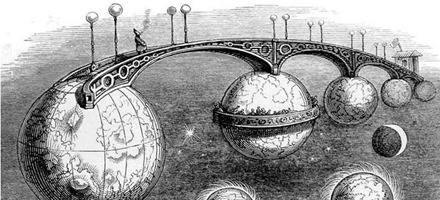
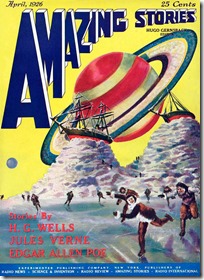
My motive for writing this essay is to give modern science fiction fans a sense of history of how science fictional ideas emerged out of magazines in the 19th century, grew in popularity with the general fiction pulp magazines of the early part of the 20th century, coalesced into a specific genre pulps starting in 1926 with Amazing Stories, grew even more in popularity in the 1930s and 1940s in many more pulp titles in the U.S. and Great Britain, and peaked in the 1950s and 1960s, when the SF novel became the dominant form of expressing science fictional ideas, and afterwards when television and movies became the main purveyor of science fiction.

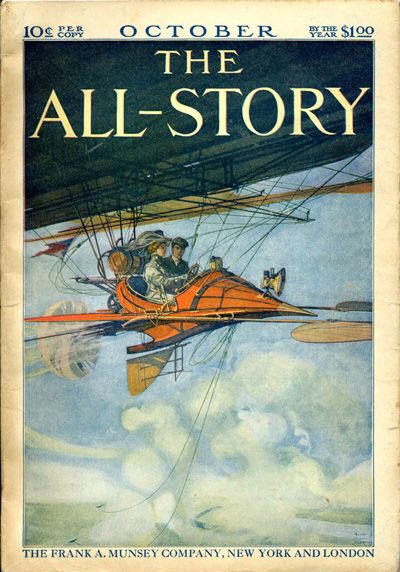
all_story_190810Amazing_Stories_April_1926

In the 19th century the genres we know today were all available in general circulation magazines.  The rise of the literate middle class, combined with the advent of cheap publishing, created a reading boom.  Think of 19th century magazines as the television of its day – the technology of how people studied the world then, because they didn’t have the radio, television, or the Internet.

All subjects and genres have probably existed for millennia as oral tales, myths, bible stories, anecdotes and even jokes, but as they gelled in the 19th century, certain favorite fictional topics and genres emerged, and maybe the last and least of them, was science fiction.

  • Sex – stories of romance, courtship, sex, marriage, children, families have always been the most popular story subject.
  • Mystery – murder, crime, detectives right from the beginning, especially with Edgar Allan Poe, have been the next big favorite.
  • History – recreating the past has always had its reading fans.
  • Westerns – came out of the urge to write historical fiction to become it’s own genre.
  • Fantasy – the supernatural and magic is probably the first genre.  Horror is a major sub-genre.  Think ghost stories.
  • Intrigue – Tightly plotted stories of conflict over politics, espionage, money, industry, diplomacy has a distinctive readership.
  • Travel – people in the 19th century couldn’t get enough reporting from other lands, and even in the 21st century with television and the internet, fiction about travel is still popular.
  • Humor – ranges from crude to highbrow, and is very hard to write.
  • War – many people consider history the chronicles of wars, but war fiction is about humans at their worst and best.
  • Sports – games, hunting, fishing, living in the great outdoors
  • Forbidden – Pornography, sadism, masochism, perversion – all the stuff kept under the counter.
  • Future – it’s very hard to define science fiction, but generally it’s stories about the future.  In the 19th century it was often about planned utopias, speculation about disturbing trends, how inventions would change society, the marvels of possible new discoveries, and that emerging academic discipline, science.

No categorization is perfect, and most stories involve cross fertilization.  Starting with a microscopic audience in the distant past, to a massive audience today, stories about science fictional ideas have appealed to a segment of readers.  For most of literary history there has been little demarcation between fantasy and science fiction.  Mostly, this was due to the concept of science and scientists having not been invented.  It wasn’t until the 1830s that science as a discipline and label was created, so it’s not surprising that it was until the 1930s that the term “science fiction” finally caught on, and even until the 1950s that it was widely use.  Nowadays, in the 21st century, most people associate the term with movies and television shows, and not books, and definitely not short stories.  But I firmly believe it’s the short story where the best SF ideas emerge first.

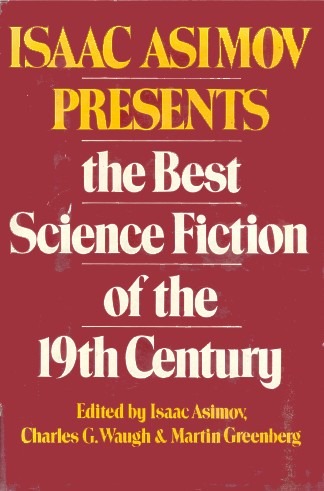
We know speculation about intelligent life on other worlds has existed as far back as classical Greek times, and that stories about space travel, artificial life, mechanical beings, and such have appeared occasionally throughout the centuries, but there were no real science fiction fans until the 20th century, when the term science fiction was invented.  Science fictional ideas slowly became popular in the 19th century periodical, gained momentum in the first half of the 20th century, and became very popular in the second half.  Most of the 19th century stories were wild, fantastic and even silly.  They are rarely read today, and seldom anthologized. For example, here is one to try, “Rappaccini’s Daughter” by Nathaniel Hawthorne, first published in 1844.

best-science-fiction-of-the-19th-centuryToC

I’m encouraging modern SF fans to read modern SF short stories, then then to explore the history of SF stories, because they have a rich heritage and are a wonderful art form, if you can get into them.  Most readers no longer like reading short stories.  When I was growing up back in the 1960s, reading the science fiction digest magazines was my introduction to science fiction fandom, but also to a mother lode of science fictional ideas.  SF novels are usually plot driven, whereas SF short stories are idea driven.  Science fiction short stories are memorable for wild, far out ideas, thinking out of the box, pushing the limits of new concepts, experimenting with writing techniques, exploring borders between the known and the unknown, and just having a lot of fun by endless speculation about possible futures.

Like I said, few science fiction fans read the current print and online magazines that publish science fiction, and far fewer still go back and read the older stories where science fiction began.  Older stories reflect an evolution of thinking in general, and specific writing styles over time.  To be honest, most past science fiction stories aren’t worth reading, even many that were collected into anthologies.  Editors constantly resurvey the genre publishing retrospective anthologies looking at our genre history with new eyes, and often old favorites disappear over time.  Few science fiction short stories are worth reading when they are published, and far fewer older stories are worth remembering by modern minds.  But some are, and over the years and decades, anthologists have collected them.

From the first issue of Amazing Stories till the present, magazines and original anthologies have generated millions of science fictional ideas.  Sure the science fiction novel and movie are the far more famous, but it’s the short story that’s the evolutionary engine of the genre.  With less at stake, writers can easily experiment in the shorter forms of fiction, and the short story seems to bring out more variety of science fictional ideas.  Sadly, the art of short fiction is disappearing from the genre just as fast as it has disappeared from the fictional mainstream.  Few science fiction fans read SF short fiction, either in the dying print format, or the emerging online electronic formats.

At the Classic Science Fiction book club we try to remedy this by discussing one short story a week.  Few members join in, but there’s enough to keep the feature going.  For the first couple of years we only picked stories that were free on the net to make it easy for members to find and read.  As it’s gotten harder to find free reprints of classic stories, we’ve decided to pick a big anthology of stories that can be our textbook.  The book we want has to have a great selection, be readily available used, and cheap.  Two were nominated, The Science Fiction Hall of Fame:  The Greatest Science Fiction Stories Ever and The Ascent of Wonder edited by David Hartwell, with the Hall of Fame volume winning out.  It’s pretty easy to find both of these books for less than $5 at ABE Books and Amazon.

This got me to thinking:  “What were the greatest SF retrospective anthologies ever?”  It seems like every decade of my reading life some editor has come out with a huge anthology that surveys all of science fiction for its absolute best stories.  New SF readers need an introduction to the history of the short works of science fiction, but that introduction always needs to be updated.

When I was growing up reading science fiction short stories in the digest magazines F&SF, Galaxy, If, Analog, Amazing and Fantastic, short SF was considered the heart of science fiction because of the high concentration of  exciting science fictional ideas.  Old timers would talk about the great stories from the pulp era, usually describing the idea and not the plot, and there were many anthologies that collected these stories for new SF fans to catch up on the past.  Hell, most of the great SF novels we baby boomers read first appeared as a series of short stories, and they were called fix-up novels, like City, The Foundation Trilogy, A Canticle for Leibowitz, More than Human, A Case of Conscience, etc., or they were famous collections like I, Robot, The Martian Chronicles, The Illustrated Man, The Menace from Earth, etc.

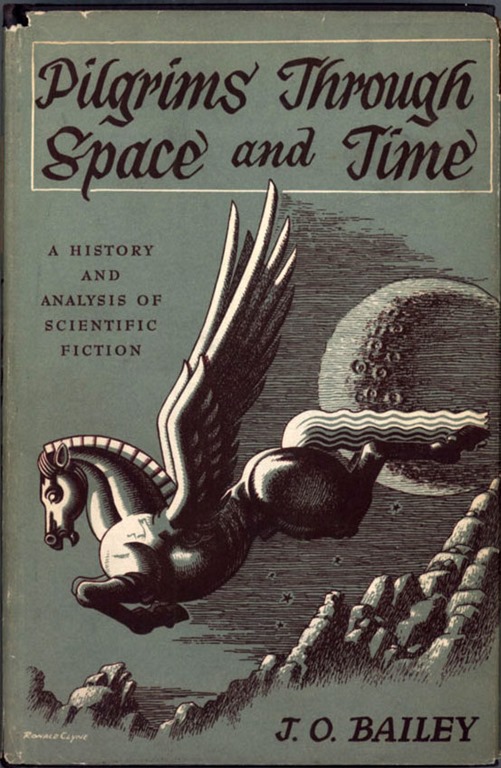
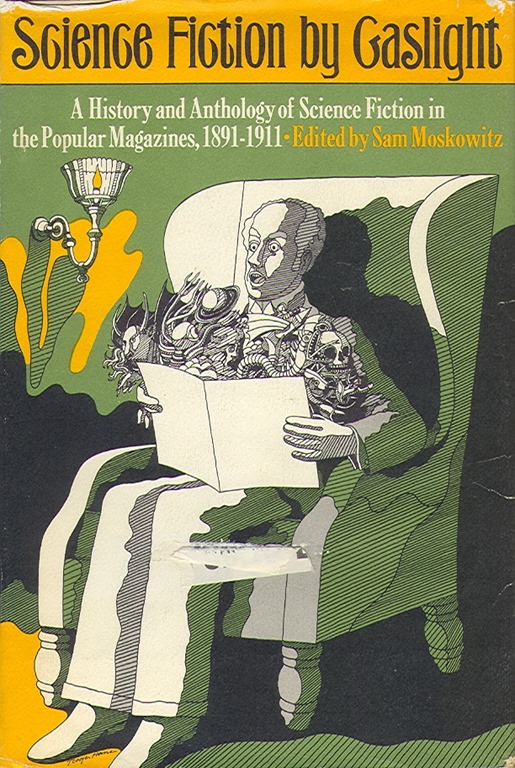
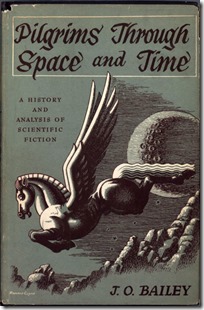
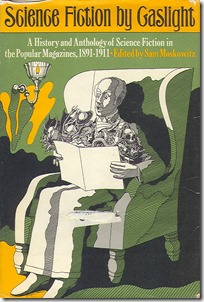
Fans of the genre usually attribute the beginning of science fiction to the publication of Hugo Gernsback’s  Amazing Stories (April, 1926) but short fiction featuring science fictional ideas have been around a very long time.  At first Gernsback called his stories scientifiction, trying to classify a certain kind of story.  Before that, sometimes this unknown type of story was called the scientific romance.  Sam Moskowitz create a number of anthologies featuring earlier science fiction such as Masterpieces of Science Fiction (1650-1935), Science Fiction in Old San Francisco (1854-1890), Science Fiction by Gaslight (1891-1911) and Under the Moons of Mars (1912-1920).  More can be read about these pre-Amazing era of science fiction in Pilgrims Through Space and Time by J. O. Bailey, a classic study first published in 1947.
Pilgrams-Through-Space-and-Timescience fiction by gaslight

Amazing_Stories_April_1926

During the late 1920s and for most of the 1930s, Amazing Stories, Thrilling Wonder and Astounding Science Fiction was the primary source of science fiction as it wasn’t common yet to publish such genre stories in book form.  This era is decidedly different than what came afterwards,  what the first fandom read and loved.  There are two great anthologies to track down if you want to get a taste of 1930s science fiction, Before the Golden Age edited by Isaac Asimov, and Science Fiction of the 30’s edited by Damon Knight.

Before-the-Golden-Agescience-fiction-of-the-30s

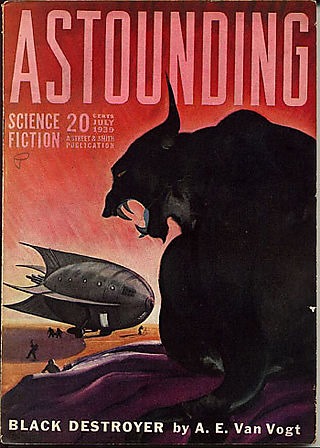
Then in July, 1939 John W. Campbell published his famous issue of Astounding Science Fiction, and what later old timers called The Golden Age of Science Fiction began.  Much of what came out in hardcover from the legendary small press publishers, Gnome Press, Fantasy Press, Shasta, in the early 1950s, first appeared in the pulps in the 1940s.  Few modern science fiction fans know about John W. Campbell and how he changed the direction of science fiction.  He’s famous for discovering Robert A. Heinlein and Isaac Asimov, among many others.
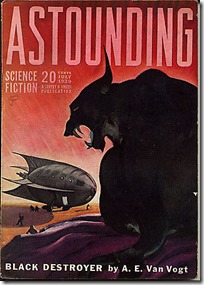
astounding science fiction july 1939 astounding science fiction march 1941

Then right after the war, in 1946, maybe because WWII involved atomic bombs and V-2 rockets, or maybe it was just time, two retrospective science fiction anthologies of science fiction short stories were published, Adventures in Time and Space edited by Raymond J. Healy and J. Francis McComas, and The Best of Science Fiction edited by Geoff Conklin.  I discovered both anthologies as tattered library books in the early 1960s as a neophyte SF fan.  The first, and the one that made the biggest impression on me was  Adventures in Time and Space (Toc).  It was a huge book that collected stories that defined that first The Golden Age of Science Fiction.  Growing up talking to older fans I always thought the Golden Age of Science Fiction was 1939-1949, but later learn the golden age of science fiction was 12.  Every year we have twelve-year-olds discovering science fiction books, but how many today ever discover the new short stories, much less the classic short stories?

In my early teens, the stories I read in the digest magazines Galaxy, If, Amazing, F&SF and Analog, would define my Golden Age nostalgia at 62.   1950s science fiction discovered in the early 1960s, along with newer writers like Samuel R. Delany, Roger Zelazny, J. G. Ballard, John Brunner, created my definition of science fiction, that is essentially unchanged today, and I assume is different from how younger generations define science fiction.

I also assume subsequent generations of SF fans will look back and define SF differently, and they probably don’t include SF short stories in their formative years.  Their Golden Age of Science Fiction might be Star Trek, or Star Wars, or video games I don’t even know the name of.  However, science fiction continued to produce short stories, and a few people read them and will remember them.

What anthologies are there for every Golden Age period of science fiction that have come out in the last 60+ years?  The four pictured below cover the 1940s and 1950s, but sadly they are out of print.  They can be found used if readers take the trouble, but probably 99.9% of science fiction readers don’t take the trouble.  As newer retrospective anthologies come out, fewer stories from these years become representative, because more recent anthologies have to cover longer stretches of classic science fiction short stories.  In the early 1960s I had to discover these 1940s books.
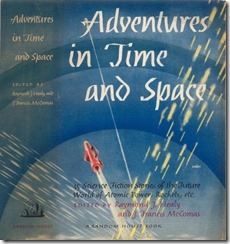
adventures-in-time-and-spaceadventures-in-time-and-space-ML

the-best-of-science-fictiona-treasury-of-great-science-fiction

I eventually bought Adventures in Time and Space, but not the original 1946 edition, the 1957 Modern Library reprint.  I lost that copy over the years, and now have 1990 SFBC edition.  I reread this famous anthology every ten or fifteen years to take me back to the headspace of my childhood.  Every time I reread “Requiem,” “Forgetfulness,” “Black Destroyer,” “Nightfall,” “Farewell to the Master,” “By His Bootstraps,” and many others, I’m reacquainted with 1940s science fiction, and the 1964 me.  These stories were already over two decades old when I first read them, and they had a feel of quaintness fifty years ago, so I wonder what teens today will think of them?

Even though I’m encouraging younger readers to try these old stories, I have to warn you, they are old.  Not as ancient as those from the 19th century, but they represent a different mindset than what I assume a kid today has.  Part of reading anything old, whether it’s The Bible, Dante, Shakespeare, or Mark Twain, is you’re exploring ancient thoughts and thinking.  Some old writers can actually speak across time and still have vitality.  Most writers can’t.  You read those writers with an academic mind, playing both an English professor, anthropologist, and historian.

Science fiction is often described as evoking a sense of wonder.  Reading these old stories is like being the Indiana Jones of science fiction, looking for rare treasures of wonder, working as an archeologist uncovering ancient far out ideas and trying to piece together the evolution of science fictional memes.

Adventures in Time and Space is a rare example of a retrospective anthology getting reprinted, and although it’s been reprinted many times, it’s long out of print.  For some reason many anthologies seldom get reprinted or stay in print.  I guess it’s a copyright issue.  So most of these books I mention here are not in print.  Which is a shame, because they represent a special kind of history – our genre history.  And wouldn’t it be great if someone could reprint all these wonderful books as ebooks and audiobooks?

The Best of Science Fiction (ToC) edited by Geoff Conklin, that also came out in that breakthrough year of 1946, never had the lasting fame as Adventures in Time and Space.  This historical collection was reprinted once in 1980 as The Golden Age of Science Fiction.  Geoff Conklin went on to edit many more science fiction anthologies, but none of them became classic like Adventures in Time and Space.  If you can get ahold of a copy of the Healy and McComas volume it contains some of the most remembered stories from the late 1930s and early 1940s era.  Wikipedia shows its table of contents and many of the stories and authors have links to entries.  Of course, the titles in red are the stories now forgotten.  By modern standards, these tales are still part of the ancient history of science fiction.
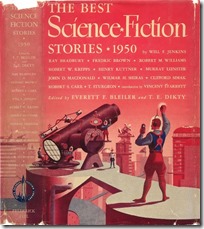
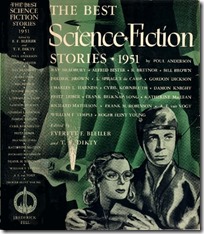
the-best-science-fiction-stories-1950the-best-science-fiction-stories-1951

Starting in 1949, and running through 1958, T. E. Dikty and Everett F. Bleiler started an annual anthology series that collected the best stories of the previous year.  Then from 1956-1968 Judith Merrill created her The Year’s Best S-F series.
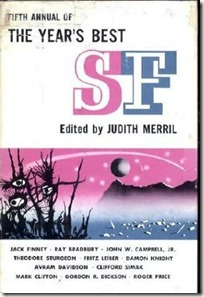
SF-60

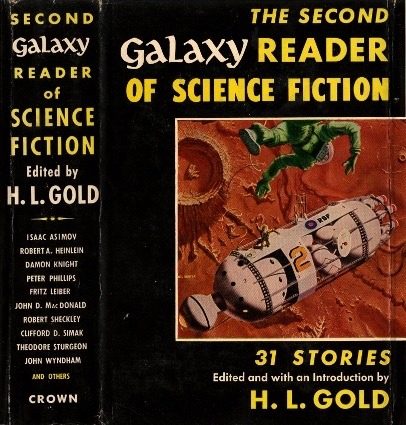
All through the 1950s there were periodic collections for F&SF and Galaxy magazines that collected the best stories.

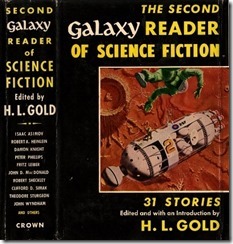
the best from fantasy and science fiction 7th seriesGalaxy Reader 2nd

a-treasury-of-great-science-fiction

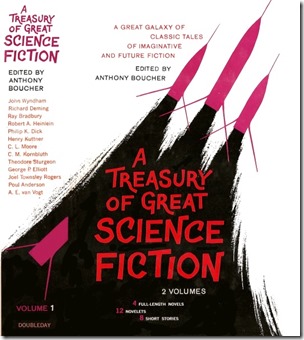
In 1959, Anthony Boucher edited A Treasury of Great Science Fiction, a two volume anthology that collected 4 short novels, 12 novelettes and 8 short stories to give a really big overview of the science fiction genre.  For years this two volume set was a prime inducement to join the Science Fiction Book Club (SFBC), and gave new fans a sense of SF history.  It’s not really a great collection for a retrospective short stories because it was dominated by four novels, although great ones.  See TocV1, TocV2, because it might be worth collecting.  Volume 2 has Brain Wave by Poul Anderson and The Stars My Destination by Alfred Bester, a couple of my favorites.

Worlds-Best 1967Worlds-Best 1968

Worlds-Best 1969Worlds-Best 1970

Starting in 1965 and running till 1990, Donald Wollheim edited World’s Best SF.  Wollheim was the Gardner Dozois of his day, or maybe I should say Dozois is the Wollheim of today.  These were my favorites annual reads when growing up, and couldn’t resist showing four covers that are burned into my memory.  Wollheim’s taste was closer to mine than Judith Merril.

the-science-fiction-hall-of-fame-one

At the beginning of 1970s, one of the greatest retrospective SF anthologies ever came out, The Science Fiction Hall of Fame (ToC), edited by Robert Silverberg.  The selection is so great that every story has an entry at Wikipedia.  That says a lot if a story is remember well enough for people to write a history about it for an encyclopedia.  This book is still in print, and has often been reprinted.  It is one of the most famous science fiction anthologies ever, but it only collects stories published through 1963, and time rolls forward.  Ben Bova, Terry Carr and Arthur C. Clarke edited four more volumes in the series: Two A, Two B, Three and Four.   Annoyingly, only v. 1 and 2a and 2b are in print, but they do collect some of the most famous and loved short stories of science fiction.

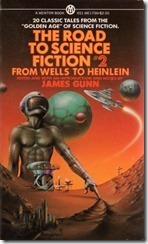
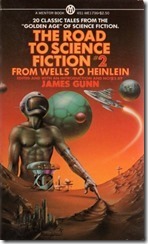
the-road-to-science-fiction-v1_thumb the-road-to-science-fiction-v2_thumb

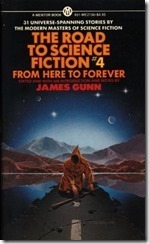
the-road-to-science-fiction-v3_thumbthe-road-to-science-fiction-v4_thumb

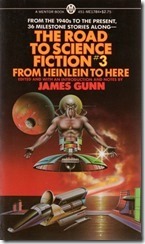
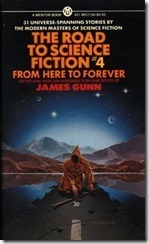
In the later 1970s I started seeing some odd mass market paperbacks called The Road to Science Fiction, edited by James Gunn.  Eventually they included six volumes:

  • The Road to Science Fiction: From Gilgamesh to Wells (1977) (ToC)
  • The Road to Science Fiction 2: From Wells to Heinlein (1979) (ToC)
  • The Road to Science Fiction 3: From Heinlein to Here (1979) (ToC)
  • The Road to Science Fiction 4: From Here to Forever (1982) (ToC)
  • The Road to Science Fiction 5: The British Way (1998) (ToC)
  • The Road to Science Fiction 6: Around the World (1998) (ToC)

The original four came out as mass market paperbacks, but eventually reprinted as trade editions when the last two volumes completed the series.  They can be expensive to track down now, which is rather depressing, since they make a very nice overview of science fiction.  Even the Kindle edition of volume one is $31.49, and the trade paper of volume 3 is $57.75, which means few people will ever buy them.

Since 1953, The Hugo Award, selected by fans, has been given to short stories and novelettes, and in 1968 they created the novella category.  If you follow the links from the story length you’ll see listings of famous stories published since then.  Since 1966, The Nebula Award, selected by writers, have been given for short stories, novelettes, and novellas.   Again, follow the links to the listings.  Over the years these award winning stories have been collected into anthologies for The Hugo Winners (5 volumes) and The Nebula Awards (1-33, 2000-).

the-oxford-book-of-science-fiction-short-stories

In 1992, Tom Shippey edited The Oxford Book of Science Fiction Stories (ToC) which aimed to give a concise collection of 20th century science fiction.  Luckily this volume is still in print.
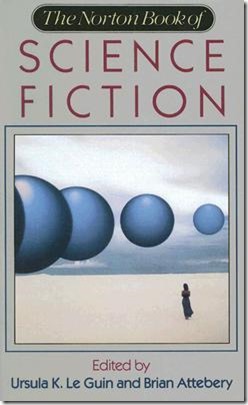
the-norton-book-of-science-fiction

Then in 1993, Ursula K. Le Guin and Brian Attebery took another look at 1960-1990 American science fiction short stories with their book, The Norton Book of Science Fiction (ToC).  Not quite a SF feminist manifesto, this anthology included far more women writers than prior retrospective collections.

the-ascent-of-wonder

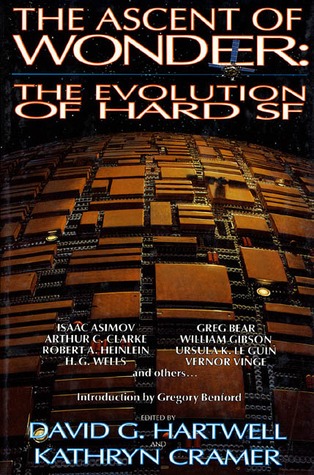
In 1994, David Hartwell and Kathryn Cramer came out with one of the biggest retrospective anthologies ever, The Ascent of Wonder: The Evolution of Hard SF (ToC), with stories going back to 1844 (“Rappaccini’s Daughter” by Nathaniel Hawthorne).  This massive book, almost a 1,000 pages, took a new look at the complete history of the science fiction short story, with the focus on real science fiction.  Sadly, this one is out of print.
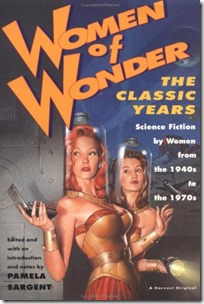
women of wonder classic yearswomen of wonder contemporary years

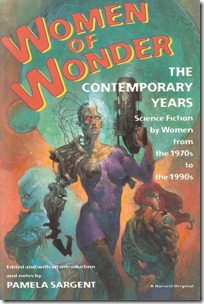
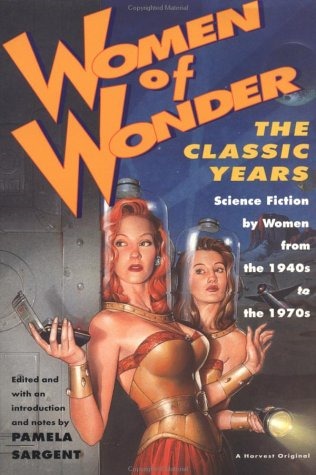
The 1990s was a great decade for retrospective anthologies, especial this two volume set edited by Pamela Sargent that showed a different look at science fiction, emphasizing how women wrote SF.  Women of Wonder: The Classic Years (1940s-1970s) (Toc) and Women of Wonder: The Contemporary Years (1970s-1990s) (ToC).

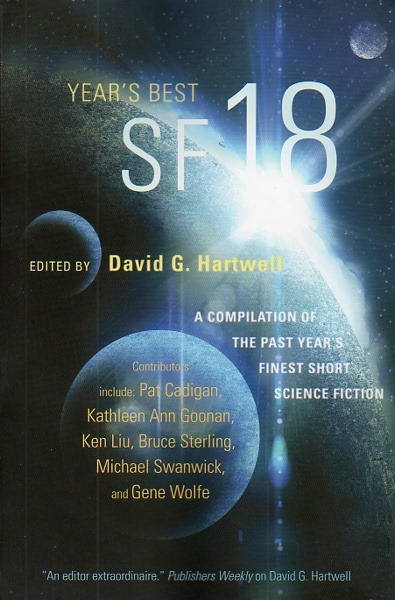
The Years Best Science Fiction 30thYears Best SF 18

Since 1984 Gardner Dozois has been editing the annual The Year’s Best Science Fiction.  If you don’t currently read the printed or online SF magazines, this is one of two great annual resources to keep up with short science fiction.  The other is David Hartwell’s Year’s Best SF which started in 1996.

Internet Science Fiction Database offers lists of top stories and anthologies at their site on their ISFDB Top 100 Lists.  Sci-Fi Lists, a fan polling site offers Top 100 Sci-Fi Sort Fiction, and Next 100 SF Short Fiction.  Ian Sales offers “The list: 100 Great Science Fiction Stories by Women.”  Free Speculative Fiction Online links to legal free copies of science fiction short stories.

Any story that catches you attention from the table of contents listed here can be researched at ISFDB to see if it’s in an anthology you already own.

Current Print and Online Science Fiction Magazines

History of the Short Story

JWH – 1/23/14 – Table of Contents

Why Were The Two Most Famous Science Fiction Novels of the 20th Century Not Written By Science Fiction Authors?

The two most famous science fiction novels of last century were Brave New World by Aldous Huxley and Nineteen Eighty-Four by George Orwell.  Now I didn’t write that to generate a flame war among science fiction fans, or as a slight to genre writers, but because I believe it’s true, especially if you ask people who don’t normally read science fiction.  I’m actually wondering why the two biggest successes using science fiction as a writing technique weren’t penned by writers who specialized in writing science fiction?  Huxley and Orwell were straight ahead literary guys – total amateurs at speculative fiction.  They probably never heard of Hugo Gernsback or John W. Campbell.

And, the two most famous science fiction novels of the 19th century, The Time Machine and The War of the Worlds, were not written by a genre writer either.  H. G. Wells existed before the science fiction genre was established.  Nor were his books written for the genre reader of his day, which did have a lot of science fiction, even though it lacked the label.  In the 21st century, when science fiction is a well established, and a well loved genre, it bizarrely seems that the people who aren’t science fiction writers have the biggest successes with the technique.  Cormac McCarthy and Margaret Atwood are two good recent examples.

What are these non-SF writers doing that SF genre writers aren’t?  I just got through rereading Nineteen Eighty-Four and I thought about this the whole time I was thoroughly enjoying the book.  Nineteen Eighty-Four is so different from the genre science fiction books I normally read that I’m tempted to say it’s not science fiction.  Many literary writers and English profs claim just that, but they would be wrong.  Insanely wrong.  George Orwell might not have written for Campbell’s Astounding, and probably never even read the famous pulp, but Nineteen Eighty-Four would have fit comfortably in that magazine as a serial.  No Astounding reader would have made one objection as to it not being science fiction.  And I’m quite sure readers would have voted it the best story of the issue, even if Heinlein had had a story in that issue too. 

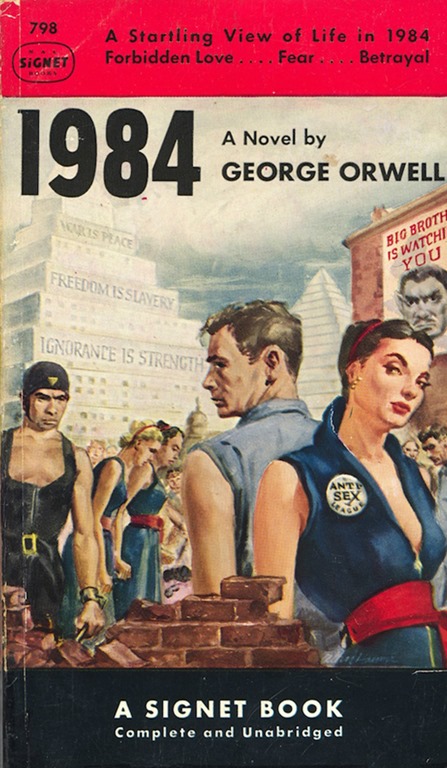
Not long ago I reread Beyond This Horizon by Heinlein and I felt pretty sure that Heinlein wrote it hoping it would be another Brave New World.  Heinlein was savvy enough to know that Huxley’s book sold far more than pulp fiction, and at the time, very little science fiction was even being published in hardback, or that new format, the paperback.  Here’s an early paperback cover for Nineteen Eighty-Four – looks just like a science fiction novel, doesn’t it?

1984_pulp3

While reading Nineteen Eighty-Four this time I was blown-away by Orwell’s world building genius.  World building is an essential feature of SF/F, which books like Dune and The Lord of the Ring illustrate.  J. K. Rowling is a billionaire for her world building, and deservedly so.  Does that mean Cormac McCarthy’s post-apocalyptic world is just better painted than all the other genre stories working with the same idea?  Does The Handmaid’s Tale just out dystopian run of the mill SF writers?  Maybe so, but why?

It’s pretty obvious that more people on Earth can understand what the implications of Big Brother are over philosophical implications of Arrakis.  Too many hundreds of millions of people in the 20th century encountered a totalitarian state first hand, or fought against them in wars, or spent years hearing about them in the news, not to understand the brilliant portrayal of Big Brother and the savage criticism of them with the creation of Newspeak.

The reason why Nineteen Eighty-Four and Brave New World are so well known in the 20th century is they describe so clearly the quintessential fears of the 20th century.  All stories set in the future are about the present, and I guess the better they are about exploring the present, the more copies they will sell, and the better chance they will be part of the curricula in high schools and colleges.

The entire time I spent reading Nineteen Eighty-Four off my Kindle I was amazed by how relevant this book written in 1948 was to 2013.  To write that Orwell was brilliant is an undeserving understatement.  We live in a society that worships freedom, yet we live with constant NSA surveillance, continuous war, Homeland Security, and the sun never sets on our drone airspace.  Our paranoia knows knows no bounds.  In terms of political psychology and insight into the human heart, Orwell runs away with the prize for applying science fiction techniques for writing about the future to say so much about now.  Nor has any science fiction writer ever attempted to explore the linguistic territory of Newspeak, which is the real science that makes Nineteen Eighty-Four great science fiction.

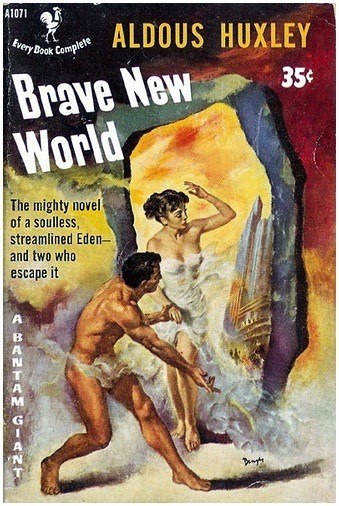
brave-new-world1

I haven’t reread Brave New World recently, but I plan to.  Brave New World was written in 1931 and I just finished a book,  One Summer: American 1927 by Bill Bryson that is the perfect companion to the Huxley book, because it explained the world Huxley was living in when he wrote his classic.  It’s a time when many U.S. governors and mayors belonged to the Ku Klux Klan, where many prominent Americans publically espoused beliefs in eugenics and extreme racism, where many states had passed eugenic laws, and racism was the law of the land.  The twenties was the decade that mass production and mass communication really got massive.  It was a decade where America began the Americanization of the world.  That scared Huxley.  Huxley was afraid of America in 1930, and Orwell was afraid of Russia in 1948.

Brave New World and Nineteen Eighty-Four are true dystopian novels – they are anti utopian, written in response to intellectuals promoting utopian solutions to world problems.  Huxley and Orwell understood the world in which they lived, and wrote books that showed off that knowledge in deeply insightful ways.  They both used science fiction as a literary device to philosophize about ideas if written as nonfiction would have been entertaining to few, and boring to many, but because of those techniques, wowed millions.  Readers still study and reference their work.  And those novels would not have had the impact they did without the science fiction. 

Huxley and Orwell, and other literary writers, use science fiction to bring political, ethical and scientific ideas to the masses.  Why don’t more genre writers attempt this?  Heinlein tried, especially with Stranger in a Strange Land, his most ambitious novel.  So, why did he fail?  I think for two reasons.  First, it included ESP, or PSI powers, that aren’t scientific or believable, and second, it promoted his personal ideas about freedom, especially sexual freedom, nudity, and group sex, which few people beside the hippies of the 1960s shared.

Ray Bradbury hit one out of the park with Fahrenheit 451, but it’s never achieved the popular acclaim that Brave New World or Nineteen Eighty-Four has.  Maybe because it wasn’t nearly as ambitious as those two.  And dare I say it, maybe the target, those people who would give up reading for mindless television, were insulted rather than inspired to canonize literacy?

John Brunner also tried several novels of this type, using science fiction to make political statements, especially Stand on Zanzibar.  Zanzibar was an experimental tour de force that was hard to comprehend or read by the general reader, but dazzled the exceptional reader.  It should have been a contender.  It should be better remembered.  Both Fahrenheit 451  and Stand on Zanzibar are shining examples of what pulp writers can do when they aim high.

I think the genre writer that comes closest in writing ambitious science fiction for the non science fiction reading masses was Orson Scott Card and his book Ender’s Game.  It was obvious targeted at genre readers, but it was widely read outside of the genre.  It was never as sophisticated as Huxley and Orwell’s books, and didn’t deal with broad contemporary issues, but it dealt with xenocide in a way that made it relevant to the average reader who could translate it into commentary on genocide, or commentary on science fiction.  Unfortunately, the recent movie version of the story targets Ender’s Game at the lowest common denominator video game player, whose kill anything that moves instinct means they have deaf ears for the ethical insights.

The 2014 Earth is just as fucked up as the 1948 Earth, even more so, so why aren’t we reading novels that targets our political, social and ethical failures like modern science fictional smart bombs that are literary descendants of Huxley and Orwell?  Is it because serious thinkers no longer believe that science fiction is the proper tool?  Has decades of fun science fiction dulled the edge of sharp science fiction?  Or maybe we don’t have political and social thinkers like Orwell or Huxley anymore, because those writers work for the New York Times or Fox News.  Let’s hope it’s not that times aren’t bad enough yet to be muses for such writers.
JWH – 12/31/13