Looking Forwards v. Looking Backwards

by James Wallace Harris, Wednesday, September 20, 2017

Do you read books about the past, or about now, or the future?

Our Nig by Harriet WilsonThis morning I started work on an essay about African-American fiction in the 19th century. It began with a question that had popped into my head: “Who was the first black novelist in our country?” This kind of fun sleuthing on the internet inspires me to write essays. I quickly came across articles about how Henry Louis Gates, Jr. had discovered a long forgotten book in the early 1980s called Our Nig; or, Sketches From the Life of a Free Black (1859) by Harriet Wilson. That made me want to research a number of other things. Have earlier novels been uncovered since? What were the second, third, fourth, fifth novels? What about short stories? Were any bestsellers in their day. Before long I realized I could spend weeks on this project.

Men-Into-SpaceI usually think of several ideas a day for researching and writing. I start work on just a fraction of these ideas, and complete work on damn few. Another idea I got yesterday was to write about Men Into Space, a one-season TV show of 38-episodes (1959-60) that worked to be very realistic about space flight. A lady in my online book club mentioned it and I was surprised I hadn’t known about it before now. It’s not available on DVD except as DVD-R sales through places like eBay (because it’s in the public domain). It is available to watch online at YouTube. However, I did find a book, Men Into Space by John C. Fredriksen that extensively writes about the series. I’d love to write a book like this – if I could focus my mind for a year or two.
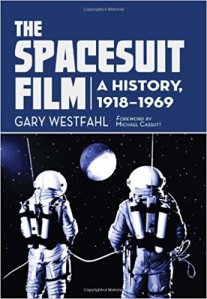
The Spacesuit Film - A History 1918-1969 by Gary WestfahlWhile researching Men Into Space I came across another book The Spacesuit Film: A History 1918-1969 by Gary Westfahl that covered Men Into Space as well as other movies and television shows that prefigured the space age. Hell, this exactly the kind of book I’d love to write too. But can you imagine the time it would take? But wouldn’t it be fun to watch all those old movies and television shows analyzing them for how they imagined the future? However, how many people read such books? I want to, but the $39.95 price for the paperback stops me. Even the $19.99 price for the Kindle edition is making me think long and hard.

This suggests another idea for researching. How many people buy and read these esoteric kinds of history books? How many people love to study tiny segments of forgotten history? I have this nagging desire to write something longer than blog essays. This month was supposed to be the month I began a book-length project. And I did start on an idea, but once again got side-tracked by too many distractions. But I’m back to focusing my mind on the project.

I have to ask myself, who is going to read what I write and why? Why spend a year, or several, writing something few people will want to read? It occurred to me this morning I could divide books into three categories: about the past, about the present, about the future. This is true for both fiction and nonfiction.

To Be A Machine by Mark O'ConnellI’ve always loved science fiction, which is future-oriented. But when I think about writing about science fiction, that’s past-oriented. Because I write for Book Riot, I can also write about contemporary publishing. I even think about writing books like To Be A Machine: Adventures Among Cyborgs, Utopians, Hackers, and the Futurists Solving the Modest Problem of Death by Mark O’Connell, which is essentially about how science fiction is affecting our world today.

I also came across this pledge drive for Farah Mendlesohn yesterday. She is writing a book about Robert A. Heinlein and is looking for backers. She’s gotten 143 supportors so far. This is also exactly the kind of book I’d love to write – but is that the rough number of people who would be interested in reading it?

I’m now worrying that I’m spending too much time thinking about the past. Is that because I’m getting older and it’s natural for aging folks to analyze yesterday? I assume that many people who like my blog do so because they are somewhat like me – they are older and thinking about when they grew up, and we all loved some of the same things.

I believe my less popular essays at Book Riot are due to writing about topics that bore their demographic readership, which tilts young and female. This makes me wonder if I should accept that I like to write about things that appeal to a subset of aging baby boomers, or if I should work to write about topics that have a wider appeal across different age groups.

My guess is writing about contemporary subjects or about the future has more universal appeal. I wonder if writing about today or tomorrow isn’t more psychologically positive for both me and readers. But I’m so fascinated by the past, especially esoteric subjects.

I’m currently reading The Man Who Loved Only Numbers by Paul Hoffman about Paul Erdős, a brilliant mathematician, and The Five Gospels, about the Jesus Seminar, a group of scholars who work to figure out what the historical Jesus actually said. Both of these books are intensely fascinating. Both of these books are about the past and have little relevance to today or tomorrow.

I have to wonder if I’ve given up on tomorrow because I don’t have much hope for the future, either for myself, or the planet, and I’m finding pleasure and meaning by exploring the past.

I’ve always loved science fiction but when I read science fiction today I’m usually very critical of works that are based on unrealistic ideas. I don’t believe in all those far out futures like I used to. As a writing challenge maybe I should work to write about positive futures that could be realistic, ones we can hope to find. Yet, my most popular essay ever is, “50 Reasons Why Humans Are Too Stupid To Survive.” Gloom and doom does sell. Hell, the TV shows my friends and I binge-watch focus on awful people and horrible events.

Writing is about focus. Writing a book is about intense focus over a great time span. I’m wondering if choosing to write about the past isn’t a way of escaping the present or future? I also wonder if writing about the future isn’t a way to give myself hope for tomorrow?

Maybe you can’t relate to this topic because it’s about writing. Think of it this way. Do you love watching old movies and television shows, or new ones? Do you listen to old music or new music? If you’re mentally young, no matter what your age is, you’ll be enjoying whatever is new.

I’m being more and more drawn into the past. 1950s movie westerns, mid-20th-century written science fiction, 1960s romantic movie comedies, 19th-century novels, 1950s jazz, 1940s film noir, 1920s modernistic literature, Victorian scientific romances, etc. Growing up, I always thought about the future…

JWH


Distractions! Distractions! Distractions!

by James Wallace Harris, Friday, August 11, 2017

I’ve always wanted to be a person who could focus intensely on a project until it’s finished. Instead, I’m easily derailed by endless distractions. Don’t get me wrong, I love my distractions – that’s my problem – I love them too much. I have too many interests, too many things to do, too many people to visit, too many art forms to consume, too many ideas to write about, too many ambitions, too many book clubs, too many hobbies, too many distractions of all kinds.

Distractions

As can be guessed from the previous sentence the solution is to have less of everything. I regularly meditate on the wisdom of minimalism but the best I can do is maintain a holding action against the thought-kipple hordes that eats up my time.

Psychologically I feel I have all the time in the world since I’m retired, but the reality is I don’t. Every morning when I wake, I spend a delicious half-hour planning my day or thinking about essays to write. I know not to be too ambitious. I’m quite aware of my limitations. Usually, I settle on three small goals, because that’s all I can remember. One task always involves writing. The other two deal with fighting the chaos that comes with everyday living.

If I ever found a genie in a bottle my first wish would be for the kind of mental focusing powers that allow complete control of going in and out of flow. Of course, as all the three-wishes stories tell us, there are dangerous side-effects to getting what we think we want. But this how I imagine focusing:

distractions2

I know what it takes to get there. I’ve always known. I’ve written about it many times before. A great analogy is a rocket with a payload and a destination. The mathematics of space travel involves cruelly cold equations. Every bit of extra mass a rocket carries costs fuel. In the 1950 science fiction film Destination Moon, the astronauts used too much fuel landing their rocket ship on Luna. The only way to return to Earth was by jettisoning everything possible to lower the take-off mass.

Destination-Moon

Knowing this wisdom doesn’t change who I am, that takes more of something I evidently don’t have. It requires I throw out all my beloved interests but one. I usually spend my days alone in solitary pursuits. I love being with people in the evenings. This gives me six to eight hours to pursue whatever I want during the day. That should be more than enough to achieve take-off to any destination.

I dream of spending all those hours on one big ambition, writing a book. However, right now I can’t muster that kind of focus. The older I get the harder it gets to spend even two hours on writing small essays like this one. The reason why I write essays for this blog and other sites is that short essays allow me to pursue many subjects, and that appeals to my scattered-brained thinking. I’m like a dog trying to chase six squirrels at once. I enjoy the hell out of the pursuit but I don’t catch any squirrels. I need to pick just one.

And if that one squirrel I pick to chase is writing a book, it means giving up essay writing, something that’s become a habit during this last decade. Up to now, I couldn’t make that commitment. But today I’m wondering if I could try it for a month?

So, the plan is to spend the rest of August finishing up some projects and commitments and spend all of September thinking and writing on one subject as an experiment. I’ve imagined writing a nonfiction book by writing fifty blog-sized related essays on one subject. 50 x 1,200 words = 60,000 words. I’ve probably written 1,500 essays since 2007, or about 30 books worth of words. The challenge will be to plan one coherent topic that’s divided into fifty chapters that locked together perfectly like a jigsaw puzzle.  I’d need to learn to constantly redirect my thoughts to that one topic. I have a topic in mind too, but I don’t want to talk about it ahead of time.

Now that I’ve thought this out I need to spend the rest of this month jettison all the extra mass I can.

JWH

Taking Life Slower

by James Wallace Harris, Wednesday, July 12, 2017

Back in May, I watched a segment on CBS Sunday Morning about Norway’s slow TV movement. You can watch the video here. Slow TV is watching ordinary events for hours at a time, like watching the view out the window of a train. It’s a step up from watching paint dry or grass grow – but not by much. I turned to my wife and told her she was already a slow TV fan. She’s been watching a live webcam of two eagles raising a baby for weeks – hours every day.

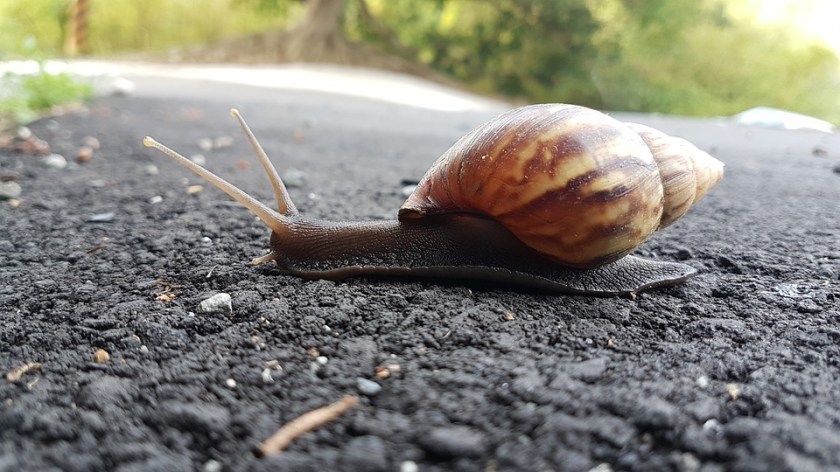
Slow Snail Life Animal Slime Small

Yesterday, I found “The Case for Taking Forever to Finish Reading Books.” I’ve always known I read too fast, even when I’m intentionally trying to read slowly. That’s why I love audiobooks – they go very slow. My friend Mike has given up audio books because he wants to read even slower.

For years I’ve kept a pace of reading one book a week – or 52 in a year. This year I’ve slowed down. In the first half of 2017, I’ve only read 16 books instead of 26. Still, that’s speed reading compared to the author of the article above, who has spent five years reading In Search of Lost Time by Marcel Proust, and is only two-thirds finished.

My TV buddy Janis and I have rushed through ten episodes of Glow in about a week. We took about as long to finish Season 3 of Fargo. I’m not a slow TV watcher, but I’m wondering if I should be. Tonight my friends and I will be watching Emma, the fifth of six Jane Austen films we’ve watched in five nights. Tomorrow night is Persuasion. Already, I struggle to remember the plot and characters of Northanger Abbey, the first we watched on Saturday night.

If I had watched these six films in six weeks instead of six days would it have improved the experience? This is my Jane Austen week. I’ve been gorging on her biographies. I wish I had time to read her books again. Like most of my study manias, I’ll feast on Austen for a week or two and then forget her for years. Instead of trying to consume all of her quickly, I wonder if I had taken one novel, read it slowly, and studied its history, would I know Jane Austen better?

Reading the biographies concurrent with the movies reveals why she developed her plots. Studying one novel intently for one month would be intensely revealing, both of Austen and of early nineteenth-century English history.

The trouble with reading slower is reading less. I read fast so I can read more. I’m starting to wonder if I need abandon my quest to read everything great. It was never a particularly practical ambition. Over and over again I anguish over the fact that I can’t remember what I read, and I always come to the same conclusion – reading is for the moment. It’s not about remembering. I cannot store facts in my brain like entering data into a computer.

Reading is about experiencing a moment. My guess is reading very slow makes that moment a fuller. (Can you imagine a fatter moment?)

This week is all about Jane Austen. Next Tuesday is the 200th anniversary of her death. I need to read her at the pace Norwegians watch the scenery from a riverboat traveling down a river. Maybe I can stretch my week into a month. I know no matter how hard I try I won’t remember 99.9% what I read.

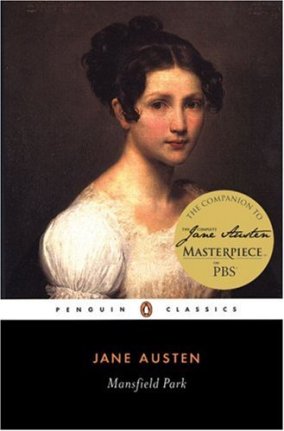
Mansfield ParkBut if I can slow down, both in my contemplation of what I’m reading and in my need to finish the project, I can go deeper into Jane’s world. I have so many other books I want to read, so many authors I want to consume – but does that matter? Can I go slow enough to forget future ambitions that follow this ambition? If I could go slow enough I’d never leave Jane Austen. If I could go even slower I’d never leave Mansfield Park.
 

JWH

My Book Addiction is Getting Out of Control

by James Wallace Harris, Saturday, January 28, 2017

toomanybooksI wrote, “Hi, I’m a Book Addict” for Book Riot hoping the act of writing would exorcise my demon. It hasn’t. Below is a list of books I’ve bought this month. It’s about a year’s worth of reading since I read a book a week. I’m buying 10-12 books for every one I read, which I know sounds insane, but doesn’t stop me.

I’ve annotated the list with my rationalization for buying the book. I know I’m being impractical. I know I’m wasting money. It gives me pleasure to shop for books, especially to find bargains, but those are not reasonable justifications. This compulsive behavior does reveal a pathological need to “own” knowledge. Because my memory is failing, owning a book, especially an old favorite, is a way of keeping it in memory. My new memory is my iPhone, which has become my real auxiliary memory. I guess it’s an external brain, making me a tiny bit of a cyborg.

This list of books reflects what I want to know. Pathetically, not by study, but by acquisition.

Access to cheap books is the main cause of my addiction. Most of the books below cost me just a $1.99. Used books, either from my library’s used bookstore or ABEbooks.com average around $4. Here are the daily newsletters I get that announce bargain books:

I’ve hyperlinked some titles to show why the book is worth reading. If you want to maintain your place in the list, just right-click and select open in new window to read the annotation.

  1. Dimension of Miracles by Robert Sheckley – read twice, want to keep for memory
  2. Draw Lab for Mixed Media Artists by Carla Sonheim – to inspire me to draw
  3. Time is the Simplest Thing by Clifford D. Simak – collecting Simak on the cheap
  4. 10-Minute Digital Declutter by S. J. Scott – love books about minimalizing
  5. 10-Minute Declutter by S. J. Scott – love books about minimalizing
  6. Silent Spring by Rachel Carson – classic I’ve always wanted to read
  7. On the Road by Jack Kerouac – read many times wanted a copy for my iPhone
  8. A People’s History of the United States by Howard Zinn – always wanted to read
  9. The Social Organism by Oliver Luckett – about social media
  10. The Grid by Gretchen Bakke – about our aging power grid
  11. Revolution from Within by Gloria Steinem – interesting feminist take
  12. In the Darkroom Susan Faludi – one of the best books of 2016
  13. Chaos Monkeys by Antonio Garcia Martinez – start ups at Silicon Valley
  14. Never a Dull Moment by David Hepworth – rock music of 1971
  15. Kill ‘Em and Leave by James McBride – James Brown
  16. Hidden Figures by Margot Lee Shetterly – best books of 2016
  17. Schaum’s Outline of Mathematica by Eugene Don – to use with Mathematic on my Raspberry Pi
  18. Schaum’s Outline of PreCalculus by Fred Safier – I’m dreaming big
  19. Complete Book of Home Inspection by Norman Becker – should keep an eye on my  house
  20. How Will You Measure Your Life by Clayton M. Christensen – how to measure success in life
  21. College Algebra DeMYSTIFieD by Rhonda Huettenmueller – my dream of relearning math
  22. Pre-Calculus DeMYSTIFieD by Rhonda Huettenmueller – my dream of relearning math
  23. How to Diagnose and Fix Everything Electronic by Michael Geier – I want to learn about electronics
  24. Practical Electronics for Inventors by Paul Scherz – I want to learn about electronics
  25. Schaum’s Outline of Linear Algebra by Seymour Lipschutz – my dream of relearning math
  26. Schaum’s Outline of Precalculus by Fred Safier – my dream of relearning math
  27. Why We Read Fiction by Lisa Zunshine (ebook and audio) – why do we read fiction?
  28. Altamont by Joel Selvin – the evil twin of Woodstock
  29. Summary of Analysis of Hidden Figures by Worth Books – wanted to see how a book is summarized
  30. The Wizard of Menlo Park by Randall E. Stross – bio of Edison
  31. Visual Intelligence by Amy E. Herman – to improve my powers of observation
  32. Extreme Focus by Dominic Mann – want to improve my concentration
  33. Time for the Stars by Robert A. Heinlein – old favorite to keep on iPhone
  34. The Age of Wonder by Richard Holmes – great science history
  35. Wonderful Town by David Remnick – New York as viewed by the New Yorker
  36. Time and Again by Clifford D. Simak – collection Simak on the cheap
  37. Console Wars by Blake J. Harris – love tech history
  38. Island by Aldous Huxley (ebook and audio) – admire Huxley and always wanted to read it
  39. The Best American Short Stories 2016 – love this series, get them cheap once a year
  40. The Best American Essays 2016 – love this series, get them cheap once a year
  41. The Best American Science and Nature Writing 2016 – love this series, get them cheap once a year
  42. The Best American Travel Writing 2016 – love this series, get them cheap once a year
  43. The Best American Nonrequired Reading 2016 – love this series, get them cheap once a year
  44. The Origins of Totalitarianism by Hannah Arendt – books to read because of Trump
  45. A Case of Conscience by James Blish – classic of science fiction I want to keep on iPhone
  46. The Second Golden Age of Science Fiction Megapack by Mark Clifton – first Hugo winning novel for 99 cents
  47. The More of Less – by Joshua Becker – love books on minimalism, might help with this book problem
  48. The Hollywood History of the World by George MacDonald Fraser – I’m writing essay on Hollywood’s treatment of history
  49. The  New Painting by Charles Moffert – I’m fascinated by the Impressionists
  50. On Rereading by Patricia Meyer Spacks – writing article about rereading
  51. Composing Digital Music for Dummies – I’d love to learn to use digital music programs
  52. The Outliers by Malcolm Gladwell – read library copy wanted one for me
  53. Mind Tools by Rudy Rucker – my kind of book
  54. I Contain Multitudes by Ed Yong – another top 2016 book
  55. The Sound of a Wild Snail Eating by Elisabeth Tova Bailey
  56. The Big Picture by Sean Carroll

JWH

Science Fiction: Books v. Television v. Movies

By James Wallace Harris, Thursday, September 29, 2016

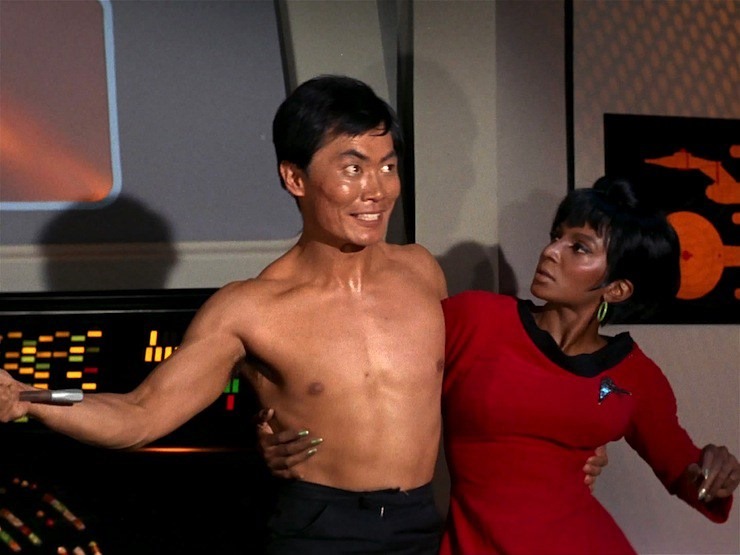
50 years ago tonight, “The Naked Time,” the fourth episode of Star Trek was shown. “The Naked Time” allowed the actors to chew the scenery, but wasn’t that science fictional. The context of Star Trek was very science fictional, with a spaceship exploring the galaxy, but often the episodes plot’s were centered around mundane conflicts or fantasies. Mostly the show liked allegories over speculation. My assumption then and now, was television and movie science fiction had to appeal to millions, and thus any real science fiction was watered down.

The Naked Now

This will reveal my media snobbery, but I’ve always felt science fiction I read was more advanced than science fiction I watched. That might be less true in 2016, because television has evolved a great deal in fifty years, but I think it’s still true. Because we’re celebrating the 50th anniversary of Star Trek premiering in 1966, I thought it might be fun to look at the other science fiction from that year. Were the 1966 SF novels and short stories more sophisticated than first fifteen episodes of Star Trek? I’m not comparing the quality of storytelling, but examining which science fictional ideas from 1966 was most innovative.

It’s rather ironic that the beautiful film version of Fahrenheit 451 premiered in England just days after Star Trek.  Directed by François Truffaut, Fahrenheit 451 was science fiction attacking a future where people gave up reading for television and comics. Few episodes of any version of Star Trek can compare to that film, but why haven’t we seen celebrations of its 50th anniversary? Why have we seen no public praise for the novels and stories below turning 50? Star Trek was loved by millions, and I’m afraid the science fiction books and magazines of 1966 were read by just thousands at the time.

Fahrenheit 451

We think of Star Trek as classic science fiction, but what most fans love are the characters, and the show’s allegorical content. If you compare it to the science fiction that was being written in 1966, I don’t think Star Trek was innovative, at least in terms of science fictional ideas. It was innovative television. And don’t get me wrong, I’m not knocking Star Trek. It was fun, and I’m very nostalgic about it. I’m just trying to put it into context of written science fiction of 1966.

The two Hainish Cycle novels by Ursula K. Le Guin that appeared in 1966, were far more mature science fiction than what Gene Roddenberry was pursing.  Even the two short novels published by the youthful Samuel R. Delany were far more philosophical, and intellectual. And if you compare the two tales of young men named Charlie, “Charlie X” and Flowers for Algernon, you’ll see that Star Trek went for the easy and obvious. And let’s face it, Star Trek just couldn’t take us to the strange alien headspaces that Philip K. Dick, R. A. Lafferty, and Cordwainer Smith could. Nor did it have the style of Roger Zelazny or J. G. Ballard. And it certainly didn’t have the elegant beauty of what Keith Roberts was writing. And it’s a real shame that Larry Niven, Anne McCaffrey, Keith Laumer, Gordon R. Dickson, Jack Vance and Fred Saberhagen weren’t writing for Star Trek because they had wonderfully cool ideas for galactic civilizations – although Desilu didn’t have the budget to produce what they imagined.

A great deal of science fiction from the 1960s assumed humans will be part of a galactic civilization in the future. The difference between the famous TV show and what we read was the depth of those assumptions. Star Trek existed between the two most remembered science fiction novels of the 1960s: Dune by Frank Herbert (1965) and The Left Hand of Darkness by Ursula K. Le Guin (1969). Can you imagine Captain Kirk visiting Arrakis or Gethen? What kind of exploration of those societies could a 50 minute TV show give us? Especially, when the plots usually involved Kirk being held hostage, and centering around escape.

Television

Episode Idea
The Man Trap Alien that can shape shift, or telepathically make people think it looks different. Reminds me of “Who Goes There?” (1938) and The Body Snatchers (1954).
Charlie X Human raised by advanced aliens and taught psychic powers, must learn to live with normal humans. Reminds me of Stranger in a Strange Land (1961).
Where No Man Has Gone Before Two humans acquire god-like powers. Reminds me of Slan (1940).
The Naked Time Disease causes crew to lose their inhibitions.
The Enemy Within Transporter creates two Captain Kirks – one aggressive the other passive.
Mudd’s Women Space age mail-order brides with siren like abilities.
What Are Little Girls Made Of? Robots replace people. Reminds me of Philip K. Dick.
Miri On a mirror-Earth, the crew meet children that have very long childhoods and die when they reach puberty.
Dagger of the Mind About a penal colony and mind control.
The Corbomite Maneuver Advanced alien plays cat and mouse with Enterprise.
The Menagerie, Part I Mr. Spock commits mutiny.
The Menagerie, Part II Mr. Spock takes Enterprise to planet where aliens can control human thoughts.
The Conscience of the King Unmasking a mass murderer. Made me think of Nazi war criminals in hiding.
Balance of Terror The Enemy Below played out with Romulans.
Shore Leave Crew visits a planet where thoughts come true. This was written by Theodore Sturgeon but it felt like something Thorne Smith would have written.

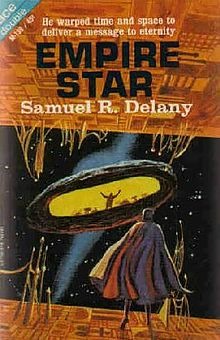
Delany_Empire-Star

Novels

Title Idea
Babel-17
Samuel R. Delany
Linguistics, poetry. Language influences thought and perception. Code breaking an enemy alien language.
Empire Star
Samuel R. Delany
The novel referenced in Babel-17. About simplex, complex and multiplex thinking.
Colossus
D. F. Jones
A U.S. military supercomputer takes control and allies with a U.S.S.R. supercomputer.
Destination: Void
Frank Herbert
Developing an artificial consciousness, and cloned humans.
Earthblood
Laumer & Brown
Trying to find lost mythic Earth after humans moved to the stars.
Retief’s War
Keith Laumer
Intergalactic diplomatic hijinks and humor.
Flowers for Algernon
Daniel Keyes
Mentally challenge young man artificially evolved into a genius.
Make Room! Make Room
Harry Harrison
A 1966 extrapolation of year 1999, speculated about the horrors of an overpopulated world of 7 billion.
Mindswap
Robert Sheckley
A comedy about a man who vacations across the galaxy by swapping his mind into various alien bodies.
Now Wait for Last Year
Philip K. Dick
Drug causes time travel and addiction during a time of war with aliens.
Planet of Exile
Ursula K. Le Guin
Anthropological study, and racial conflict on a colony planet.
Rocannon’s World
Ursula K. Le Guin
An ethnological mission to another planet. The word ansible, for faster-the-light communication was coined here.
The Crystal World
J. G. Ballard
Apocalyptic novel about life on Earth turning into crystal.
The Eyes of Heisenberg
Frank Herbert
Genetically modified humans, and longevity.
The Moon is a Harsh Mistress
Robert A. Heinlein
An artificial intelligent sentient machine evolved out of a network of computers on the Moon. The AI joins an anti-colonial rebellion against Earth.
The Solarians
Norman Spinrad
Space opera, about a star-drive that can destroy stars.
The Dream Master
Roger Zelazny
Citizens of an overpopulated Earth suffer psychologically and use dream therapy where their therapist enters their dreams.
This Immortal
Roger Zelazny
A devastated Earth is now a tourist destination for alien races to view our ruins.
The Watch Below
James White
Humans are stranded underwater. Think if The Poseidon Adventure had been science fiction.
World of Ptavvs
Larry Niven
Earth and “Belters” in a cold war, with story of ancient alien discoveries, and telepathic amplifiers.

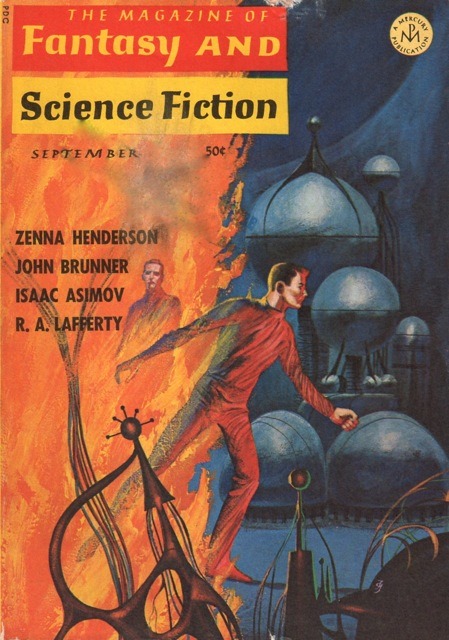
FSFSEP66

Short Stories

Title Idea
Neutron Star
Larry Niven
Humans and aliens study a neutron star.
Light of Other Days
Bob Shaw
Invents slow glass, where light can take years to pass through, thus capturing scenes from the past.
The Last Castle
Jack Vance
Far future humans battle enslaved aliens
For a Breath I Tarry
Roger Zelazny
After the extinction of mankind, a sentient computer remembers our species
Call Him Lord
Gordon R. Dickson
Aristocrat from galactic empire visits old Earth.
Bookworm, Run!
Vernor Vinge
About an uplifted chimpanzee.
Pavane stories
Keith Roberts
About an alternate history of England where Queen Elizabeth was assassinated and Protestantism failed, and the technology we know never developed.
Day Million
Frederik Pohl
Love affair between two altered humans on what would be the millionth day AD.
In the Temple of Mars
Fred Saberhagen
Humans versus intelligent machines.
Nine Hundred Grandmothers
R. A. Lafferty
Humans visit planet and learn about a strange ontology.
Riverworld
Philip José Farmer
Humans reincarnated in another existence, one that stretches along one immensely long river.
The Ship Who Killed
Anne McCaffrey
Spaceship with a cyborg soul.
We Can Remember It for You Wholesale
Philip K. Dick
Recording false memories.
Under Old Earth
Cordwainer Smith
A visitor to an underground world without laws.
The Age of the Pussyfoot
Frederik Pohl
A man from our time visits the future via suspended animation. He is given a computerized personal assistant.
When I Was Miss Dow
Sonya Dorman
Sexless alien impersonates a woman to understand gender.
You: Coma: Marilyn Monroe
J. G. Ballard
Contemplating geometry and time
The Primary Education of the Camiroi
R. A. Lafferty
About a society where everyone is expected to be an expert.
Behold the Man
Michael Moorcock
Time traveler looks for Jesus.
The Keys to December
Roger Zelazny
Genetic modification.
The Secret Place
Richard McKenna
Science versus myth.

One-Million-Years-BC

Films

Title Idea
Fantastic Voyage Raquel Welch is made small enough to travel in tiny submarine inside a human body.
Fahrenheit 451 About a near future where books are banned, and society wants people to watch large flat-screen TVs or read comic books instead.
Seconds A rich middle-age man buys rejuvenation and attempts to be young again living with bohemians.
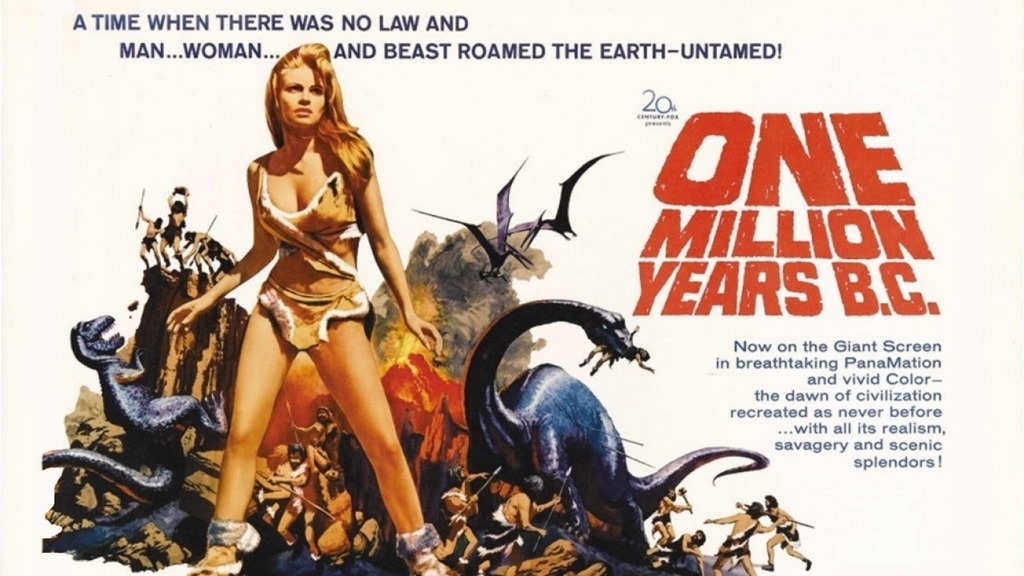
One Million Years B.C. Raquel Welch is cavewoman back when humans lived among the dinosaurs. (Not joking)

Is it surprising how many stories involved intelligent computers? In 1966, mainframe computers were common, but few people interacted with them. AI was a concept them emerged in the 1950s, and science fiction had grabbed it. Most of science fiction before the 1950s dealt with exploring the solar system. The idea of interstellar travel and galactic civilizations boomed in the 1950s, so by the 1960s writers were refining those ideas. Writers blended AI with spaceships. And sociology, anthropology, and psychology was embraced. Stories about human colonized worlds and aliens became richer. Much of the science fiction we read in the 21st century is based on science fictional ideas first developed in the 1950s and 1960s. What’s really evolved since then is the art of storytelling. We exist in a Baroque period of science fiction, where novels are gigantic, and often multi-part, but still exploring the same ideas science fiction fans first encountered in 1966.

JWH