
Surviving 18 Months of Political Campaigning

by James Wallace Harris, Friday, May 3, 2019

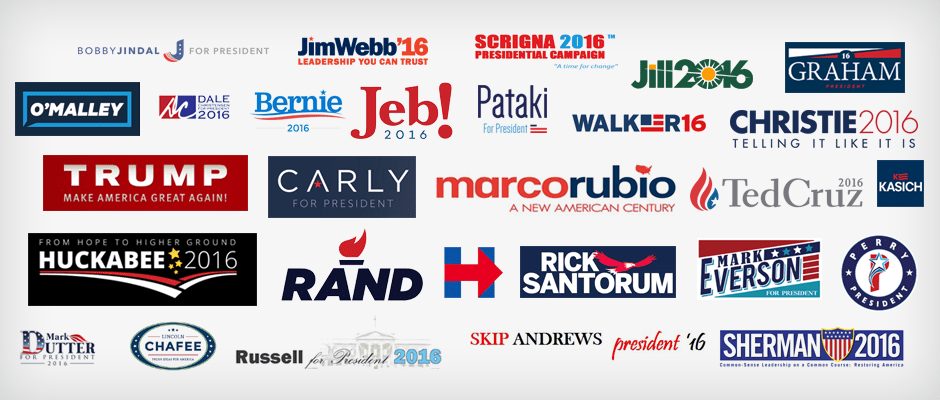
The 2016 presidential election wore my psyche to a frazzle. It started early and dominated the news for a year. The 2020 election process has started even six months earlier. Damn! We know who the Republicans will run. For the next 18 months, we’re going to be bombarded by news of Democrats campaigning. That’s torture to contemplate.

Over the years polls have shown that the split between Democrats, Republicans, and Independents are roughly even, or about 1/3 for each. If Democrats are serious about dethroning Donald Trump they need to run a candidate that independent voters will love. The political reality is Republicans will always vote for Republicans and Democrats will always vote their ticket, so the election is decided by the independent voter.

I’m thinking about how I’m going to survive the next 18 months. One solution would be to not watch any news programs until next summer after the Democratic convention. Another idea is to figure out which candidate has the best chance to win against Trump and support them. But how is that done? I think it’s by figuring out what the independents will want in 2020, and not by what liberals want. Now is not the time to seek liberal pie in the sky.

Republicans have a very definite platform, even if it’s unwritten. They know what they want. We know what they want. They have a coalition of special interest groups that back them. The Democrats are much less defined by specific goals. Some Democratic candidates are using Medicare-for-All, wealth equality, and tuition forgiveness to attract voters, but are those issues that will appeal to independent voters? The reason why Trump won in 2016 is that the Democrats didn’t have the pulse of the nation.

My guess is voters who hate Trump will want a rational candidate, one who is psychologically normal, even dull. That might be why Biden gained an instant lead. I would like a qualified candidate, one that has the skills to do the job of president. Unfortunately, America picks its presidents like high school kids elect theirs. It’s all about personality and chemistry. Trump supporters love him like football fans love their favorite teams – a kind of fanatical passion that defies reason.

I personally feel burnt out by politics. I’ve read that many young people didn’t vote in 2016 because they feel politics doesn’t matter or that politics is a complete turn-off. Almost as many people didn’t vote as did in 2016. Can the Democrats find a candidate that will appeal to all those non-voters?

I don’t feel the job is attracting qualified candidates but egotists. I would prefer down-to-earth candidates that have real experience, either a mayor from a large city, governors, or senators. I’d like to see candidates who have governed at least a million people and made most of them happy. Because governing 330 million constituents is a huge step up.

Our country faces many big problems. We need someone that can lead the rest of us into solving them. Trump has done an excellent job of making the rich richer but has he even tried to solve the problems that are true threats to our nation?

Conservatives by their very nature want to preserve the past. The trouble is, the future is about his hit us like a freight train, so it’s suicidal to look the other way.

JWH
How to Read The Federalist Papers

by James Wallace Harris, Tuesday, January 15, 2019

As previously mentioned, my two-person book club has decided to study The Federalist Papers. Linda and I are two liberals who want to understand conservative philosophy and these 85 essays that began appearing in 1787 are considered essential to understanding how our union was formed while detailing the reach and limits of the federal government.

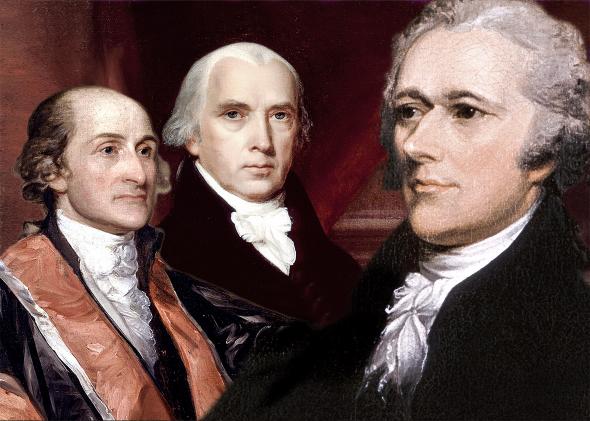
There are a number of problems in reading and understanding these essays. First, the language is 18th-century English can be difficult for modern readers. Second, it helps to understand the times in which they were written. This is before our Constitution was ratified. Back then, most nations on Earth were ruled by some kind of aristocracy, so we must envision a group of men theorizing how ordinary people could rule themselves. This is very radical. The Federalist Papers were written by Alexander Hamilton, James Madison, and John Jay under the pseudonym “Publius.” Basically, Hamilton in his introduction was telling the citizens of thirteen states there are great reasons for forming a union but if you can’t understand them then every state should go its own way.

What’s rather ironic is Publius wrote The Federalist Papers to justify a federal government, but modern conservatives often use these essays to justify limiting or reducing our federal government and increasing the rights of states. We could have been fifty different little countries instead of the United States. Uniting a group of separate countries is not easy, just look at what happened to the Soviet Union or is happening to the current European Union. Neither force, ideology, or economic interests is enough to bind peoples of smaller governments into larger nations. The Constitution is one successful example that is always under attack. Thus the reason to read and understand The Federalist Papers.

The Federalist Papers are the foundations of our social contract. Conservatives want a smaller federal government, but the reasons to be governed are just as great at the local and state level. Hamilton, Madison, and Jay describe in great detail why we should agree to be governed and how to protect our freedoms from too much government and the dangers of those who want to govern.

I’ve just started to read The Federalist Papers and already see their vital importance. If you’ve ever complained about how society is run or offered your own utopian ideas on how to fix it, then you owe it to yourself to read The Federalist Papers. Publius gets down to the nitty-gritty details of the problems to be faced. This is the third reason why it’s so hard to read The Federalist Papers. A solution is almost impossible. No single human can think of all the angles and issues, and together we never agree perfectly.

Linda and I decided to spend this week trying to figure out the best way to read and study The Federalist Papers. Before we started this project we thought it was as simple as reading a book. It’s not. We then looked for books that explained The Federalist Papers or translated them into modern English with annotations. But even those books are tough going. There are many versions of The Federalist Papers. Some are straight reprints. Others organize the 85 essays into individual themes. We also considered picking a history book that covers everything related to the essays.

I’ve decided the best place to start is Wikipedia. Its entry for The Federalist Papers is detailed, concise, and easy to understand. Its Complete List entry offers links to explanatory essays for each of the 85 essays in The Federalist Papers. Starting with #1, which is Hamilton’s introduction, Wikipedia annotates essential quotes. It also links to each paper at Congress.gov, where the full-text can be read.

the federalist papers audio bookI’ve also decided to supplement this approach with The Federalist Papers (Amazon Classics Edition) audiobook from Audible.com and Brilliance Audio. Hearing James Anderson Foster narrate the papers helps me to understand the 18th-century sentence structure of Hamilton, Madison, and Jay. You can hear a sample here. The sample also illustrates what it’s like to try to read The Federalist Papers. It seems obvious to me they were meant for oration. The meaning of some of these complex sentences is often revealed in the cadences of how they are spoken.

Linda and I usually read books in 50-100 pages a week and then spend an hour or so on the phone discussing what we’ve read. This is a very rewarding book club structure. However, it’s extremely doubtful we can go through The Federalist Papers at that pace. Hamilton’s first essay, the introduction deserves a whole week of study and discussion.

I feel we’ve been overly ambitious in wanting to read The Federalist Papers like some other book. I worry that we will give up. I feel it’s a project that will take a good deal of time, but if we do 1 of the 85 essays a week as an extra project, it might be possible to achieve our goal eventually.

JWH

Conscience of a Conservative by Jeff Flake

by James Wallace Harris, Monday, January 7, 2019

Former Senator Jeff Flake is a rational Republican. I’m a liberal, but I read his book because my friend Linda (another liberal) and I thought we should be reading some books by conservatives to balance our views. Jeff Flake is the kind of Republican I wish all Republicans were like. He doesn’t believe what I believe, but he’s at least sane and reasonable, with some integrity. And his book Conscience of a Conservative is a worthy read by anyone interested in current politics.

Flake tells us he’s a Goldwater/Reagan conservative and explains what that means. He then goes on to explain why the conservative movement has been corrupted by Donald Trump and his populist supporters. Flake’s book is really aimed at his fellow Republicans, and Flake even offers examples where he followed the party line and now considers himself wrong. He also regrets some of his votes he made solely to keep a perfect conservative voting record. One fascinating revelation was how Republicans vote no and pray yes. Flake even spends a chapter on the importance of bipartisan lawmaking. Much of what he writes is from a wise perspective, good political thinking for either party.

For years Flake took pride in always voting with his party. This made me think of a solution to solve our polarized politics. I’d like to see an amendment forcing Congress to compromise. I think every bill should pass by 50% of the whole voting body, with at least 25% from the minority party. That would mean if 100% of Republicans wanted to pass a law they’d at least need 25% of the Democrats. I’m tired of living in a society where half the voters are angry at the other half. If that’s too complicated we should require being governed by a 66% vote for all bills.

Flake’s book presents two essential problems for its readers. Flake wants Republicans to get back to their original conservative values. For liberals, we have a different problem to solve. We must identify the economic and societal problems that conservative philosophy fails to solve.

Flake subtitled his book, “A Rejection of Destructive Politics and a Return to Principle.” Flake’s hope is the Republican party will become a party that embraces all citizens. He’s a big tent Republican. He believes the conservative philosophy should appeal to all groups, not just to old WASPs. I believe that’s the primary failure of the Republican party, it’s goals don’t address all citizens.

As a liberal, my problem with Flake’s conservative idealism is he’s a true believer and his faith in conservatism is too simple-minded to solve our complex problems. Flake’s religious-like belief in free-market capitalism fails to see how it can’t work. If we had 100% free market capitalism with no regulation we would not have 100% employment, low taxes, and no need for social programs. We’d have a minority of rich people, a vast majority of poorer people, and a polluted planet going down the drain hole. Only worse than what we have now.

I believe capitalism is the only practical driver for economic growth, but I also believe it should be heavily regulated. We want steady-state capitalism, where growth is sustainable for both the economy and the environment. And we need enough socialism to support those people that capitalism can’t. The percentage of people who can’t thrive under capitalism will grow if we allow automation to run unchecked, eliminate collective bargaining, and keep accepting an ever-expanding wealth-inequality gap.

Flake’s book also inspires me to read two more works that conservatives admire. The Federalist Papers and The Road to Serfdom by Friedrich Hayek. Flake spent a fair amount of his book explaining the foundation of his conservative beliefs. His book was inspired by Barry Goldwater’s Conscience of a Conservative. I’ve started reading it, but I’m not sure if the other two aren’t more important and relevant. However, I liked when Flake asked: “What would Goldwater Do?” His questions offer me hope if many conservatives are asking these questions too. Of course, this is also Flake’s direct attack on Donald Trump, but it also sums up his own beliefs too. Here are Flakes’s questions he’d ask Goldwater:

Would he have thought that it is conservative to abruptly abandon the core conservative belief of free trade with the world and break with multilateral trade agreements? Or abandoned established or pending trade deals, creating a void in the markets that are currently being filled by China, Russia, and even Mexico, just to name a few?

Is it conservative to believe in the magical thinking that suggests that we can ignore the growth in “entitlement” spending simply by declaring that our growth rate will reach at least 4 percent annually—growth that will make the Social Security Trust Fund flush again?

Is it conservative to play chicken with some of the most productive and important international alliances we have ever had?

Is it conservative to heap praise on dictators and to speak fondly of countries that crush dissent and murder political opponents, and muse that the Chinese massacre of students at Tiananmen Square “shows you the power of strength”?

Is it conservative to attack and undermine the intelligence agencies that are essential to our national security and to attack their findings as “hoaxes”?

Is it conservative to vilify religious and ethnic minorities? To exaggerate threats and stoke security and economic fears? To promise that another sovereign country will be forced to pay for a border wall just because such a promise gets a good response at rallies?

Is it conservative to embrace as fact things that are demonstrably untrue, to traffic in “alternative facts,” and to attack the constitutionally protected free press as the“enemy of the people”?

Is it conservative to propagate a conspiracy theory about the birthplace of the president of the United States, long after the facts have put the theory to rest? And is it conservative for members of Congress to remain silent as such conspiracy theories are propagated?

Is it conservative to undermine confidence in our democratic elections, to describe them as “rigged,” and assert with no evidence that three to five million illegal aliens voted in the last general election?

JWH

Even If You Only Speak English You Still Know Many Languages

by James Wallace Harris, Wednesday, December 19, 2018

My obsession with memory is teaching me fascinating lessons. I realized something new today. I was trying to remember what my mental outlook was like in 1959 when I was seven. I barely remember the presidential election of 1960 and seeing Kennedy and Nixon on TV. But I have no memory of ever even noticing President Eisenhower before 1960. And I got to thinking about my essay “Counting the Components of My Consciousness” and realized how important languages are in understanding the world around us.

I see now we know many languages even when we think we only speak one.

In 1959 I had no language for politics, so politics was invisible to me. I didn’t understand words like mayor, governor, president, senator, congressman, etc. I didn’t know about local, state, and federal governments. I didn’t know about the three branches of the federal government. I didn’t know about constitutions or legal systems. The world of politics was invisible to me because I didn’t know the language of politics. At seven, I also didn’t know the language of religion, science, mathematics, or even grocery shopping.

My awareness of politics began on November 22, 1963, when President Kennedy was shot in Dallas. That’s because my family watched the news for several days straight, and that hooked me on watching the nightly news with Walter Cronkite. However, I still didn’t know the language well. In the 9th grade (1965-1966) I took a required civics class that taught me the basics, but I’ve been learning the nuances of the language of politics ever since, and still don’t speak it fluently. It has its own vocabulary and grammar.

This morning I was researching where I went to school in Aiken, South Carolina in 1964. I found a copy of an Aiken newspaper online. I was 12 at the time. All the stories about local politics and businesses were unfamiliar to me. Even the ads were unfamiliar to me. I didn’t shop for groceries or clothes at age 12, so I didn’t have the language to remember that part of Aiken, South Carolina. I realize now I could have read that paper at age 12, but didn’t. I doubt I could have understood most of it. I didn’t have the languages. And that’s why I don’t remember 99.99% of what life was like in Aiken, South Carolina in 1964.

I’ve often returned to the year 1959 over my lifetime. 1959 was an important year in jazz, but I didn’t know that until I began learning the language of jazz. And my ability to speak jazz is at a very rudimentary level. I’m much more conversant in the language of science fiction so I can comprehend 1959 in science fictional terms much more deeply.

This revelation about knowing multiple languages within English is giving me many insights this morning. It explains why so many people refuse to accept that climate change is happening to us right now. They don’t understand the language of science, so it’s invisible to them. This realization also explains our polarized politics. Conservatives only know the language of conservative politics, so they are blind to liberal politics. And liberals are blind to conservative politics because they don’t know that language.

Linda, the other member of my two-person book club, suggested we read a conservative book for our next discussion. We’re both extreme liberals and she thought it might be enlightening if we did. And it is. We picked Conscience of a Conservative by Jeff Flake. I’ve only just begun but immediately realized Flake speaks a different political language than I do. His words have different meanings. His grammar is even different. His language references points to concepts and things in reality that I normally don’t see.

Liberals and conservatives are polarized because they aren’t speaking the same language even though they use the same words. In the essay, I mentioned above, I told about two experiences where I lost my ability to use words, and how reality looked when that happened. Without words, I didn’t know what things were. I could still see and hold them, but I could tell you what they were. Abstract concepts ceased to exist. Language is everything in understanding reality.

In 1959 I didn’t have the languages to understand most of what I saw and experienced. I’ve since learned a lot of new languages and can look back and see so many things that were invisible to me then. I’m obsessed with memory at this stage in my life, and I’m learning how important languages are to memories. I’m losing my memories, words, and languages. I struggle to keep them. One way of doing that is to look back over the years and study the languages that reveal what I saw.

We can’t trust our memories. One way to understand them is to struggle to remember what we saw. But another way is to study what we couldn’t see, and learn the language to reveal it.

I realize now I must study the languages I know more deeply to understand what I see now, and what my memories might have seen in the past. Here are the languages I partial know now but want to study deeper:

  • Science Fiction
  • Literature
  • Science and Nature
  • Politics
  • Ethics and Philosophy
  • Computers and Programming
  • Music
  • Television
  • Movies
  • Myths and Religions

JWH


The Future Belongs to the Young and Diverse

by James Wallace Harris, Thursday, November 15, 2018

We can easily see a difference between conservatives and liberals in these pictures. This photo spread has become a popular meme on Facebook. The new conservatives in Congress are all white males except for one white woman. The liberals are still mostly white, but there are more women, and if you look closer, there’s more diversity. If you study the photos a bit more, it appears the liberals are younger on average.

Personally, I think this is good. I feel there are too many old white guys running this country, and I’m an old white guy. I don’t want to get into politics here, but talk about the future. It’s time to rethink everything. We have more problems than any single ideology can solve. If ever there was a time to think out of the box, it’s now.

We’re at a crossroads where one dominant group is fighting with everything they’ve got to retain their dominance. But we live in a country of 325.7 million very diverse people. You can’t judge by appearance. You can’t go by age or gender. But the odds are if all our leaders look the same then everyone is not getting proper representation.

I don’t want leaders who are driven by special interests or limited philosophies. I want leaders who feel compelled to make the 100% happy with the government, not just their own 50%. I want leaders who can see the giant multi-dimensional picture of global everything. Think global act local is still a valid mantra. Our current government is run by a fraction for their own self-interests — that can’t succeed. We are doomed if our votes are only guided by self-interest.

I love the photos above because the diversity of faces looks like the diversity of faces I see everywhere in America. I love the faces above because they are young and the future belongs to them. I don’t want to be governed by a desperate minority hanging onto yesterday, I want to be governed by the majority who will build tomorrow.

JWH