Which Came First: Political Personality or News?

by James Wallace Harris, Monday, December 19, 2016

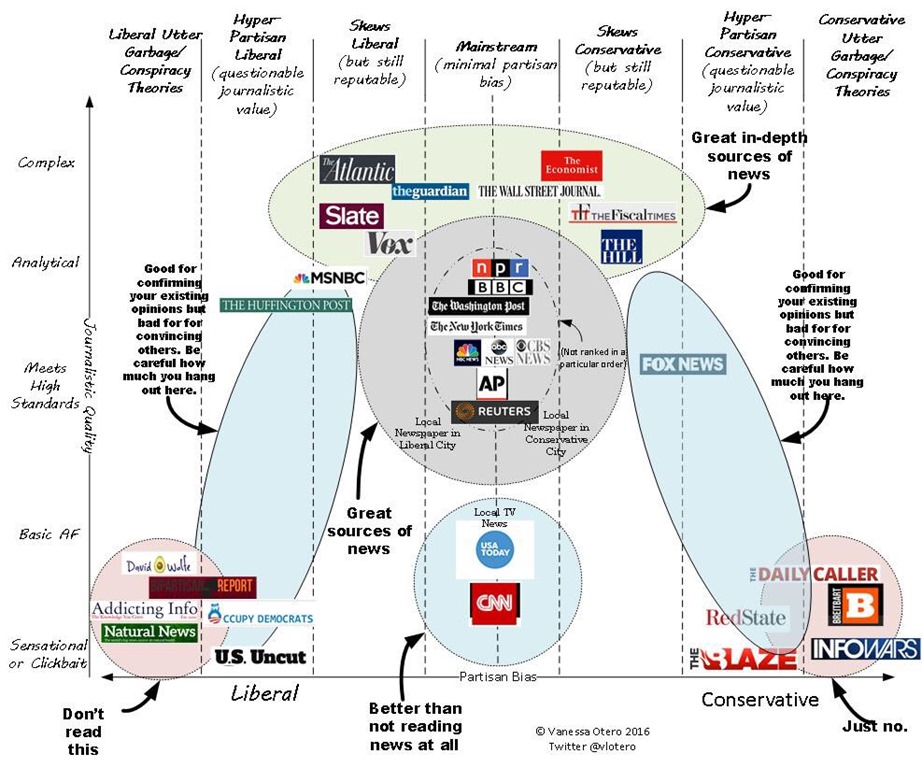
My wife Susan found this infographic on Facebook. It was created by Vanessa Otero and distributed on her Twitter feed. You can click on the image to see a larger version.

Vanessa Otero News Graph 2016

My news sources are NBC, CBS, PBS, The New York Times, NPR, The Washington Post, The Guardian, The Atlantic, Slate, Vox, and sometimes The Economist and The Wall Street Journal when I get free links. In other words, I stay close to the center of things, and by Otero’s reckoning, use sources of high standards, that can be analytical and complex.

Do I have the kind of personality that is drawn to those news sources, or did those news sources create my political personality? If you grow up reading news from sources on the lower left or right of the graphic, do you program your personality by them? In recent years I’ve met a number of people who watch Fox News all day long. These people have different personal personalities, but they often feel like they have the same political personality. They are usually paranoid about the government, believe in various kinds of conspiracies, are passionately anti-taxes, and hate when people get money from the government without working.

Do people in childhood develop particular beliefs and then migrate to news outlets that promote those beliefs, or do they get hooked on various news sources and adopt the beliefs of the news programs they watch?

Would people who watch Fox News morph into new political personalities if they switched to watching PBS news programs? If I started watch Fox News all the time, would I become conservative? I remember favoring JFK back in 1960, when I was in the third grade, and that was well before I watched the news. I’ve never liked any Republican candidate – is that because of my innate programming, or because of how I acquired my news?

When I did start watching the news, it was the CBS Evening News with Walter Cronkite, probably around 1962-63. In 1960 when we moved from New Jersey to Mississippi, I learned I didn’t like racists. As a shy kid, I was always afraid of people with strong emotions, and the racists scared the crap out of me with their raging anger. I had no idea what they were talking about. They were for Nixon. Maybe that influenced my political development. I remember getting into a playground fight with a kid who was pro-Nixon. Did that experience lean me towards the left?

When I went to tech school for computers in 1971, they taught us a phrase, GIGO (Garbage In, Garbage Out). That implies the news we consume does change us. But then, I’ve read books like The Blank Slate by Steven Pinker that counter that philosophy. I’ve also read books like Thinking Fast and Slow by Daniel Kahneman that explain how our consciousness minds aren’t too swift when it comes to making decisions. I’m almost finished with The Undoing Project: A Friendship That Changed Our Minds by Michael Lewis that profiles Daniel Kahneman, and his colleague Amos Tversky. They were two Israeli psychologists that made careers studying how we make poor choices and misunderstand reality because our gut reactions are usually wrong.

JWH

TOP 100 Songs—A Spotify Experiment in Personality

By James Wallace Harris, Tuesday, May 3, 2016

If you selected your Top 100 all-time favorite songs, the ones that define your soul, how many of those songs would you think you shared with your friends? I’ve always loved seeing what albums my friends owned, and if they’d let me, what songs are on their playlists. People are surprisingly unique. I’ve yet to find anyone that shares even five favorite songs with me. Don’t get me wrong, me and my friends often enjoy the same kinds of music, but when it comes to absolute favorites, the songs we choose to form a life-long love affair, those tunes are quite distinctive. Maybe as identifying as fingerprints.

fingerprintmusic

This is where Spotify comes in. It would be fantastic if Spotify created a permanent playlist in everyone’s account called TOP 100, and encouraged their subscribers to fill it in with the songs that define the music they loved best in their lifetime. Then after a time, start showing us big data statistics. What is the percentage of overlap based on various demographic standards. Am I more likely to overlap with other people born in 1951? Does gender matter? Could Spotify predict where I grew up or my ethnic background? Would it be possible for Spotify to discern my Myers-Briggs type? And if there are incidences of high overlap, would listening to the playlists of those subscribers help me find songs I would love that I’ve never heard?

Conversely, could Spotify fill in our TOP 100 lists automatically from studying our current patterns of play? Or predict our second 100 favorite songs?

Even with millions of users, would they ever find two people with the same songs in their TOP 100 playlist? What would be the statistical odds? (I don’t know, I can’t do that kind of math.) How often would 50% agreement show up? What if the list was based on order? If they applied statistical analysis to the data, would it reveal anything about personality? Would it tell us anything about generational shifts? Are people predictable by their tastes? If they could connect to other databases, would our musical tastes also reveal what we love in books, movies, television shows and other art forms?

My bet, which is only a hunch, would be for age cohorts, the average overlap would be less than 5%.

JWH

The Williamson Effect–Losing Interest in Life

By James Wallace Harris, Monday, March 28, 2016

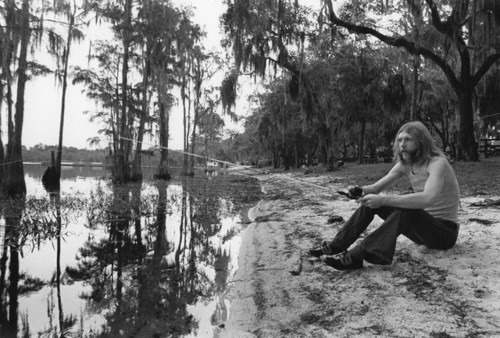
A friend of mine, before he died, called me to talk about life. His name was Williamson, and he was depressed. This was back on the first night of the Gulf War. Williamson said something then, a quarter century ago, that has always stuck with me. He said he was down to loving only two things in life. Benny Goodman and Duane Allman. I had gone to see The Allman Brothers with Williamson when Duane Allman was till alive. That was a long time ago. Williamson and I were buddies for a while in the 1970s, and we went different ways when I got a steady job.

Duane Allman Fishing 

Williamson hated working, always telling friends, “A job a good way to waste a life.” He spent his life avoiding the old nine to five, choosing to pursue endless hobbies and schemes hoping they’d pay off. They never did. I was surprised to hear from Williamson in August of 1990. The decades had changed him, and he was quite bitter. He called me a few times after that, and then disappeared. I heard later he died under mysterious circumstances.

I now worry when a friend tells me they are getting tired of things they used to love. I call it The Williamson Effect. I’m known to be a naturally happy person, even though I love to write about depressing subjects. I don’t know if I’m happy because of genes, or because I’m constantly searching out new things to love. Whenever I hear a friend suffering from The Williamson Effect I encourage them to try new things, especially music. I’m always amazed how a new artist and their music can revitalize my thinking.

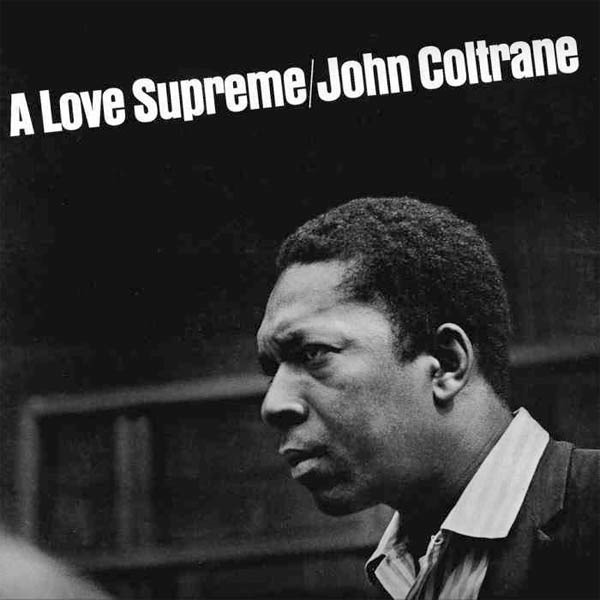
I tried to convince Williamson that there was more to music than Benny Goodman and Duane Allman. He only sneered and belittled my then current favorites. Benny Goodman and Duane Allman are still on my main Spotify playlist, but so are Katy Perry and Sarah Jaffe, and I’m still living.

JWH

Autistic Characters in Fiction

By James Wallace Harris, Wednesday, February 3, 2016

I started reading The Rosie Project by Graeme Simsion yesterday, and realized I was enjoying yet another book with an autistic first person character. This got me to thinking, just how many books have I read with an autistic character, and then wondered, just how often autistic characters show up in fiction. So far my list includes:

GoodReads lists 65 books on their Autism in Fiction list, some of which I find quite surprising, like To Kill a Mockingbird. And it turns out I have another book on my to-be-read pile, The Speed of Dark by Elizabeth Moon that features an autistic character. It appears listing autistics in fiction is quite popular, and Wikipedia even has a list of fictional characters in books, movies, television and comics that are on the autistic spectrum. If you search Google for “autism in fiction” you’ll find a lot to read.

the-rosie-project-graeme-simsion

Most of the books have been from the last twenty-five years. Didn’t autistic people exist in the time of The Bible, Shakespeare or Charles Dickens? I do know that Confessions of a Crap Artist, written by Philip K. Dick in 1959 has a very autistic-ish narrator. And strangely, isn’t Mr. Spock from Star Trek very autistic like? There is a danger to retroactively diagnosing characters from the past with autism, just read “Sherlock does not have Asperger’s or Autism, Thanks – From 4 Psychiatrists” or “We Shouldn’t View Sherlock as an Autistic Savant.”

Many people do not consider Oskar Schell in Extremely Loud and Incredibly Close to be autistic, but I do, because he has some autistic like traits. And I think that’s what’s interesting about these books, they don’t all define their characters as autistic or having Asperger’s syndrome, a diagnosis that’s been replaced with the term autism spectrum disorder. That’s because it’s very difficult to pigeonhole people into precise mental categories. I’ve written about this before, “Don’t We All Have Personality Traits in the Autism Spectrum?” and “Reading Novels To View Reality From a Diversity of Mental Spectrums.”

I think is extremely fascinating we all want to clearly define people into categories, but our own unique traits are usually invisible to ourselves. Just like Don Tillman in The Rosie Project, who is unaware of his Asperger’s symptoms, we can’t see our own quirkiness. Think how often you have heard your voice on a recorder and found it shocking. Or how disturbing it can be to see photographs or videos of ourselves. Our inner self-image seldom matches outer evidence. So it’s easy to understand that other people see you far different from how you see yourself.

In the The Rosie Project, Don decides it’s time to get married and goes about finding a wife in a very systematic way. The whole time I was reading this story I couldn’t stop picturing Sheldon from The Big Bang Theory. But doesn’t everyone fumble around trying to find their soul mate? And if we’re honest, aren’t we all clueless about finding compatibility?

People wonder why there’s been an explosion of autism in the general population. Some wonder if we always had autistic people and are just getting around the labeling them. Can you remember an old relative with autism spectrum traits? Others think the increase is from an environmental cause, and a few people have suggested the increase in autism comes from more super-intelligent people mating with each other. I have no idea, but I do find that characters in fiction with moderate amounts of traits from the autism spectrum appealing. (Although severe amounts are horrifying and tragic.) And I think that’s so because we can identify with their problems and admire their eccentric skills. Don’t we all have some kind of communication problem, or compulsive behavior? My friends consider me very good at communication, yet I’ve always felt a slight sense of agoraphobia when it comes to socializing. And I certainly wish I had the organizational skills of Sheldon and Don. I do know I pass all the tests for introversion with flying colors.

And how often do you feel that your friends are clueless to seeing the real you? Aren’t we all on a social awareness spectrum? If we fall into a certain range, does that put us on the autism spectrum? I have long ago given up on the idea of “normal” people. I assume we all exist on a hundred different spectrums – picture a mixing board in a sound recording studio. I doubt anyone has sliders position in the center all across the board. And I expect what we now call autism spectrum disorder will be broken up into several spectrums in the future.

Finally, I wonder if we were all characters in a book like Don Tillman, and readers got to see just how we think, wouldn’t our logic for doing things and making decisions seem peculiar to others? Aren’t we all strange little birds?

JWH

77 Things I Learned From Writing 1,000 Blog Essays

By James Wallace Harris, Wednesday, January 20, 2016

This is my 1,000th blog post and I’ve learned a lot from blogging.

My first post was “Access time in a fifty-five year old brain” published 12/26/2006. Here’s the first paragraph:

The main reason I’ve created this blog is to help me remember.   After that I want to study how information is organized with the ultimate plan of taming the horde of competing topics that have tangled up my synapses.  I’m hoping if I can find a way to organize my thoughts I will be able to remember facts and details more efficiently and faster.  If I can’t, then the search box will do the job my neurons can’t.  My access time for my gray matter runs from instant, to many hours, to total failure.  This started as a noticeable problem in my late forties and has been getting worse ever since.

Well, I’m still struggling to organize my thoughts, but I’m quite confident Auxiliary Memory has been an huge help as an external memory device. Blogging is also a form of mental exercise that keeps my declining mind in shape. After nine years, or 3,314 days, and over a million words, I have forgotten most of what I’ve written, but it’s still there for me to retrieve. I’m often surprised to reread what I write. Blogging has turned out to be an incredibly useful tool, and I wonder why more people don’t blog.

To celebrate these nine hundred and ninety-nine essays, I thought I’d note some of what I’ve learned.

  1. Blogging is like piano practice for writing.
  2. Essay writing is a concrete way to organize thoughts.
  3. Original thoughts are thin and vague, and it takes a lot of work to make them coherent.
  4. Often coherency doesn’t show up until days of writing and rewriting. 
  5. We don’t realize how unclear our thoughts are until we try to put thoughts into sentences.
  6. Thinking improves with editing.
  7. The quality of my writing is directly related to the number of times I reread and edited an essay before I hit the publish button.
  8. There is no relation between getting hits and what I’m interested in writing about.
  9. I can’t predict what people will want to read. The old essay that gets the most current hits is “Do You Dream About Dinosaur Attacks?” If you search Google for “Dreaming about dinosaurs” my piece is 2nd in their listing. Evidently 30-50 people a day research this topic. I never would have predicted that.
  10. If my goal is to get hits, then I should review products. Product reviews are my consistent hit getters, but I quit writing them. 
  11. Science fiction is the subject that has garnered my most readers, and my favorite topic to write about.
  12. Don’t expect your friends and family to read your blogs.
  13. Only a few of my friends have subscribed to my blog and will occasionally mention reading an essay, or post a reply.
  14. I’ve learn to write what I feel like writing and not to worry if it will be read. I’m currently getting 250-350 hits a day, mostly due to Google searches, but also because of a handful of regular readers. I have 1,500 subscribers. But I can’t assume that a hit means a read. Just because a person clicks on a Google search return doesn’t mean I’m providing them with information they want to know. And many of my subscribers are other bloggers hoping I’ll read their blog. (Which I do try to do.)
  15. It’s extremely hard to write a 1,000 words that someone else will want to read.
  16. Few people want to think about a specific topic the same time that I do.
  17. There are very few people that have the same mixture of interests as I do.
  18. Blogging is a way to embed your personality into words.
  19. Blogging is a way to find out how many of your friends, family, and strangers think your interests are interesting.
  20. Blogging is a way to express yourself without boring your friends.
  21. If you want to find out how interesting you are to your friends, blog your thoughts. You might be surprised.
  22. There is a direct relationship between how much time my friends are willing to listen to me talk and whether or not they will read what I’ve written. My most chatty friends, the ones that never let me get a word in, never read my blog. I don’t say this as a hurt ego, but to show that blogging will reveal which of your friends are actually interested in what’s going inside of your head. Don’t blog if you don’t want to know.
  23. Blogging will reveal what your true interests are to yourself, and how fanatical you are about them.
  24. Blogging is a good way to meet people like yourself online.
  25. Blogging is a good way to learn if you have common interests or obscure fascinations.
  26. Blogging is a way to learn when your thinking is faulty.
  27. Blogging is a way to learn when your thinking is political incorrect.
  28. Blogging is a way to learn things about yourself that you don’t see – because readers do.
  29. Blogging is a way to test the limits of your memory.
  30. If you blog about a past event and try to document it with photos, outside reference material, interviews with people at the event, you’ll learn that memories are piss-poor at best.
  31. A well written blog about an event written within 24 hours will provide a better memory than your brain.
  32. If you get an idea for a blog post start writing it as soon as possible because the idea will disappear quickly.
  33. Blogging is mostly memory, opinions and reporting.
  34. Reporting is when you document events outside of yourself.
  35. Being a good reporter is hard.
  36. Opinions are a dime a million, essentially worthless unless you can back them up with evidence.
  37. The more evidence the better. 
  38. My personal memories are only interesting to people if I can frame them in a universal theme. And even then, few people will read them. One of my favorite memory-lane pieces, “Super Men and Mighty Mice” has gotten the least amount of hits. It was about being kids and pretending to fly, and begins like this:

    During the Ozzie and Harriet years, when I was seven and people called me Jimmy, my sister Becky and our best friends Mikey and Patty, would beg old tattered terry cloth towels from our moms and pretend to be George Reeves. We’d tie those old faded pastel rags around our necks, stretch out our arms, hands flat, fingers pointing forward, tilt our heads down and run like Hanna-Barbera cartoon characters, occasionally jumping with all our might, with the hopes of getting airborne like Superman, or at least Mighty Mouse. And when we were burnt out and our little bodies too tired to try any more, we’d go to sleep at night and have flying dreams.

  39. It’s hard to write Jean Shepherd type nostalgia and get hits. Shepherd is famous for A Christmas Story. Nostalgia just doesn’t index well on Google.
  40. Nostalgia does appeal to readers who have similar past experiences. It’s lucky when you find those people, or they find you. 
  41. Blogging teaches elements of journalism. If you want hits, you have to write what other people want to read. That means focusing on current popular topics, and writing short pieces that don’t exceed the common attention span. I decided long ago to write what I’m interested in and at lengths longer than most people want to read. So it goes. 
  42. I’ve learned that I naturally think in 500-1500 word essays.
  43. 500-1500 words is far longer than what most people want to read.
  44. Titles are very important.
  45. Delete all the words that people will skim over.
  46. I’m a verbose writer and don’t delete enough.
  47. Over the years I’ve often written about topics I’ve already written about but have forgotten that did.
  48. I have common themes I repeat but I hope are refined with each new approach. 
  49. Regular blogging helps with my writing and thinking skills.
  50. Regular blogging helps with my verbal skills. This was a real revelation.
  51. Regular blogging keeps my vocabulary active. If I don’t blog for a week or two I start forgetting words, and forget how to pronounce them. That old saying, “Use it or lose it” is true.
  52. Blogging has been a great social outlet since I retired.
  53. I can express myself better in a blog than I can talking.
  54. Blogging helps me listen to other people.
  55. Blogging makes me wish my friends blogged so I could read their thoughts.
  56. Blogging makes me wish my friends blogged so they would make their thoughts more coherent.
  57. Blogging is somewhat like being in a hive mind.
  58. I wished I had started blogging when I learned to read and write.
  59. I wished I had learned to read and write at age 4, when I started being self-aware.
  60. I wished my parents, grandparents, and ancestors had blogged so I could read about their inner lives.
  61. I wish the Library of Congress would archive blogs.
  62. I wish politicians, famous people and people doing interesting jobs would blog. Sound bites on television makes people seem shallow, tweets make them seem snarky, and Facebook makes them seem silly.
  63. Everyone approaches blogging differently. Some people use it like a diary, making short notes about their day. Others post photographs of all the places they visit. Some people repost other people’s blogs that they like. Some people write excessively about tiny topics, or say essentially nothing about big topics. There’s no one way to blog.
  64. Folks want to read about your dreams about as much as they want to see your vacation photos.
  65. Sometimes you have to guess what you remember. In recent years many writers have gotten into trouble for writing nonfiction that turned out to be fiction. Memory is closer to fiction than nonfiction. That’s just how it is.
  66. Wikipedia is my absolute best memory bank.
  67. Google makes a great spelling tool and dictionary.
  68. Sometimes I have to play Six Degrees of Separation to remember a person. IMDb is great tool for that.
  69. I’ve learn to fact-check my memory.
  70. I always try to send friends my blog when I mention them, but most people don’t care.
  71. I generally get photos from Google and use them without credit. I shouldn’t do that. I do try to get generic photos, or things in public domain.
  72. Sometimes people use my posts and photos without credit. Sometimes I think it’s flattery, other times I think fraud.
  73. Blogging is good for my mental health.
  74. Blogging gives me a sense of purpose after I retired.
  75. Blogging is a way to examine my life – remember an unexamined life is not worth living.
  76. Blogging is a way to be philosophical.
  77. Blogging is a way to push myself to do more.

Pug10

JWH