The Big Trail (1930)

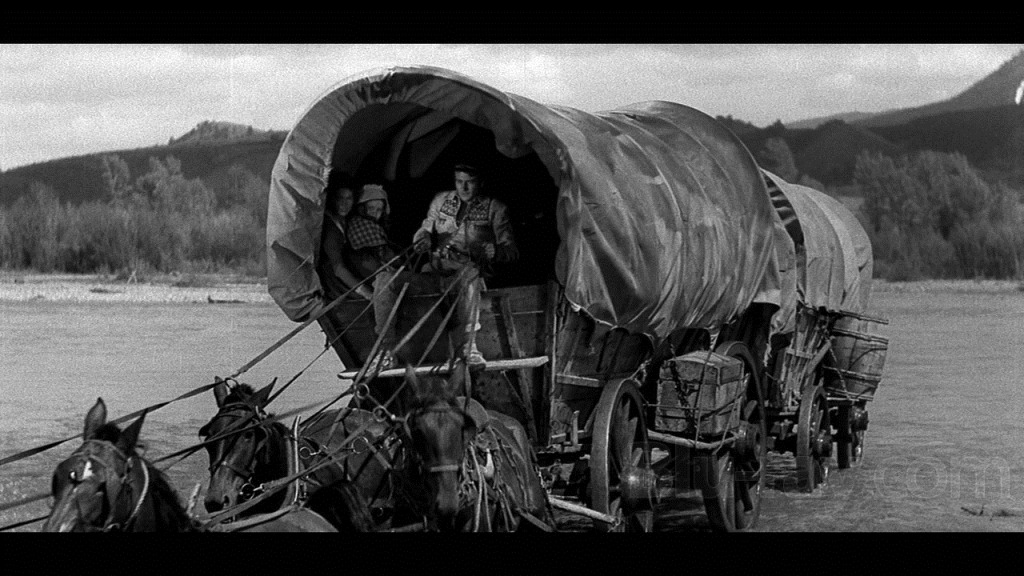
Yesterday I got in a Blu-ray copy of The Big Trail, an early widescreen movie from 1930.  The Big Trail has quite a fascinating history behind it.  Starting in the late 1920s Hollywood began experimenting with widescreen and Technicolor, but the depression killed off interest in these technologies, especially widescreen because it required special theaters, screens and projectors.   The Big Trail was filmed from April to August in 1930 in black and white using both 70mm and 35mm cameras, creating two unique versions from different camera angles.  The whole production was also shot in five languages using different lineup of actors for each language.

Epic production doesn’t begin to describe the making of The Big Trail.  Seven different states were used for film locations, covering 4,300 miles, traveling in 123 baggage cars, with 93 principle actors, 2,000 extras at all the locations, 725 Indians from five tribes, 12 Indian guides, 22 cameramen, 1,800 cattle, 1,400 horses, 500 buffalo, 185 wagons and a production staff of 200.  And they had the wagon train do everything wagon trains did back in those pioneering days, cross rivers, get lowered down cliffs, blaze trails through timbered lands, cross deserts, climb mountains, survive snow storms.  All other wagon train movies since have been puny in scale.  The Big Trail was a very gigantic production, but it’s not as famous as Gone With the Wind from 1939.  That’s too bad, it should be better remembered.

I had to watch The Big Trail alone last night because none of my movie friends like old black and white films and I couldn’t convince them to give The Big Trail a try.  What a loss for them.  It’s a shame because as soon as I started up The Big Trail I was stunned by it’s beauty.  Old movies are in a square format and seeing this movie in widescreen format on my 56” HDTV made my heart ache.  If only this 70mm widescreen format had caught on in 1930.  All my favorite old films from the 1930s and 1940s would have been so much more grandeur looking.  And that’s what Fox called their experimental format, the “Fox Grandeur” process.  What if Grand Hotel had been widescreen, or The Maltese Falcon, or The Wizard of Oz, just imagine how more magnificent they would have been.
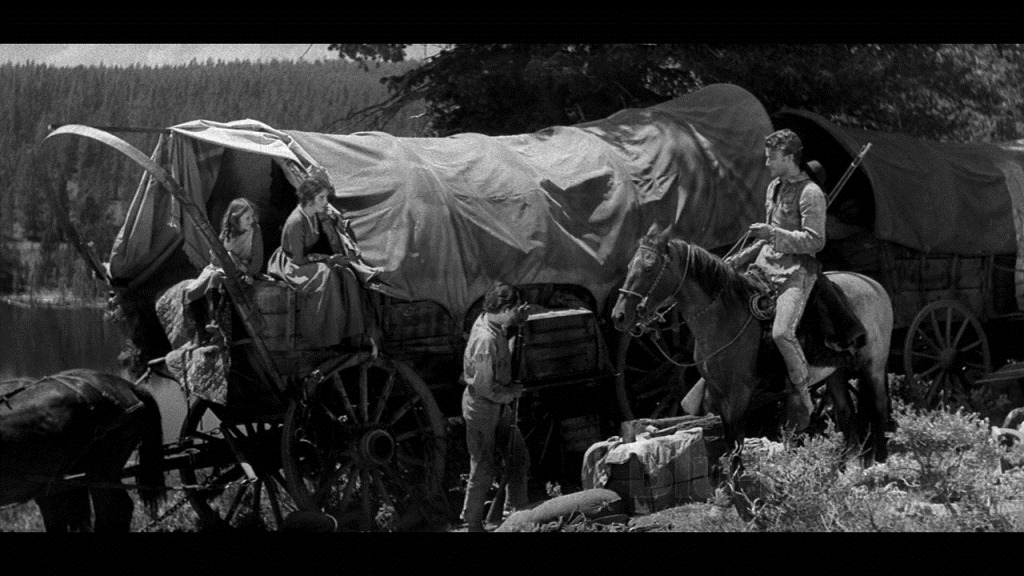
The-Big-Trail-screenshot

[This screenshot is from Blu-ray.com – click for full size version]

Modern movie goers are used to high tech visual productions and when they see old movies, especially silent films and films from the 1930s, they think of them as primitive and crude, and often assume people of those days saw what we see today.  Their technology was older and less sophisticated, but the prints we have are old and in bad shape compared to the original pristine prints audiences viewed in their day.  Silent movie film goers didn’t see jerky prints with faded splotches and lines running through them.  They were sharp and vivid with wonderful contrast and the motion was as natural as modern films.  Sure the acting style is strange to us, but the acting style was normal to them.  It was great acting by the way they judged acting.

Old movies are being restored all the time now, especially for the Turner Classic Movie crowd and Blu-ray movie fans.  The restoration of The Big Trail is far from perfect, but I found it impressive to watch visually.  I expect someday that digital processing will clean up even more of these film defects, and created a print closer to the 1930 original.  For the most part the defects weren’t distracting.  A couple of times I thought it was raining because of the tiny scratches.

The Big Trail was an experiment in many ways, not only for the widescreen filming.  It was an early epic western about settlers crossing the country in a huge wagon train.  The Big Trail was the first starring role for John Wayne, but many of the actors were from Broadway, because it was an early talky and they needed actors that could project their voices to outdoor microphones.  Much of the dialog is stagey, and the cinematography is reminiscent of great silent films.  Yet, the sets and costumes look very realistic.  It would take another 60 years before citizens of the pioneering west looked so realistically dirty and grungy.  Plus the Indians were real.  Often the wagons were drawn by oxen and cattle rather than horses.
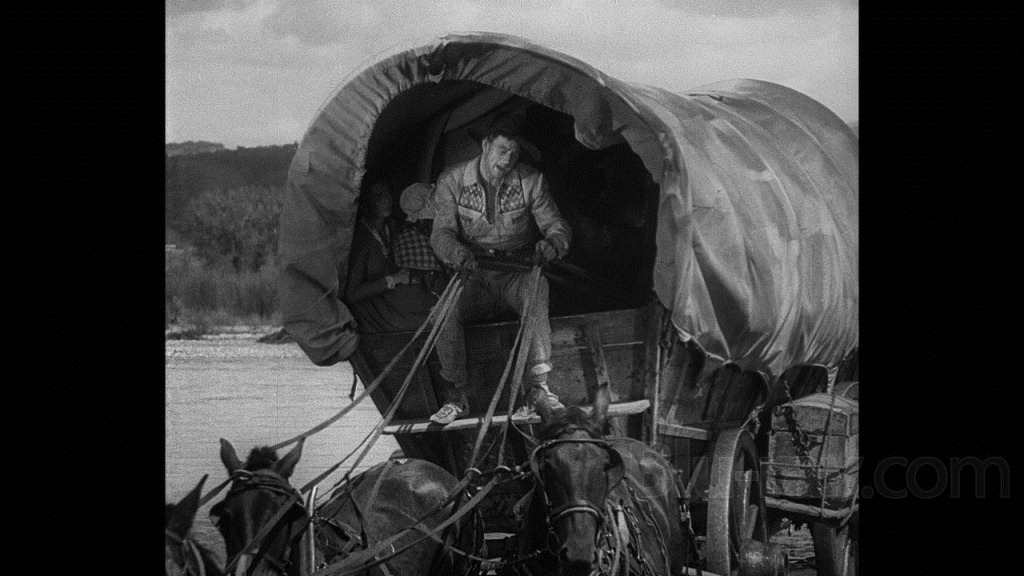
The-Big-Trail-normal

The-Big-Trail-wide

[Click for full size versions.  From Blu-Ray.com]

Westerns weren’t this good for a long time, not until Stagecoach, ten years later.  Most westerns of that era were B movies, shot full of action, produced from very small budgets.  As I watched The Big Trail, I wondered how many people living in 1930 had once traveled across the country in a wagon train.  The heyday of the wagon train was from the 1840 to the 1860s, when the continental railroad was built.  It was possible that some of these pioneers were still alive to verify the realism of the film.  I wonder if any of them wrote about it?

Westerns today, 80 years later, often work hard to appear realistic and historical.  It seems like every decade has a different view on how the old west looked.  Just compare the two versions of True Grit.  There’s also a difference in how violence was portrayed.  In The Big Trail, John Wayne only kills one of the bad guys, and with a knife.  And the bad guys were on the hesitant and cowardly side, only willing to kill when no one was looking.  Nobody was a great shot either.  Today’s westerns have heroes that kill as many people as a mass murderer.

The Big Trail was an innocent portrayal of pioneers.  At one point the John Wayne character was telling a bunch of boys what all he learned from living with the Indians and one of the kids asked, “Did they teach you were papooses come from?”  That’s about as risqué as this movie got.  But it was realistic enough to show a woman nursing a baby.  And I thought the love conflict was reasonably sophisticated for a movie of its time.  The plot of The Big Trail was gentile and slow.  I’m not sure people only used to modern films would like it.  Modern audiences are addicted to fast action, fast dialog, and lots of plot twists.  I’ve seen The Big Trail three times now and I’m looking forward to seeing it again.  It’s a classic western, and a classic 1930s film, my two favorite genres.

JWH – 12/29/12
Django Unchained–Reviewing a Film I Wanted to See But Won’t

I grew up in the 1950s on a steady diet of western movies and TV shows.  The western is my favorite movie genre, and sadly few are made anymore, so I was really looking forward to Django Unchained.  That was before Sandy Hook.  And even before the mass child killings in Newtown, Connecticut, I worried that Django Unchained was going to be too violent and over the top.  I love realistic westerns, or at least westerns that feel historical.  Watching the trailer to Django Unchained didn’t remind me of any history I knew about.  It’s a strange revisionist fantasy of 19th century America.

True Grit and Open Range were good westerns in my book, but I have to admit there’s little real history in westerns.  Westerns are a genre that teaches us that guns are the answer to social conflict.  Westerns are Darwinian tales about the survival of the fittest, but in the 1950s, westerns were stories about the fittest bringing civilization to the west.  In modern westerns, civilization isn’t the focus, but gun play.  It’s still good versus evil, but the good guys are pretty much as vicious as the bad guys.

The trouble with modern westerns is they often are just gun porn, and from the previews and what I’ve read, it appears that Django Unchained is a killing fantasy like a sex fantasy.  Pornography is hard to define, but for me, porn films are those which merely press our brain buttons and set off our neural programming for sex, violence and fear, providing little else artistically and intellectually.  In the old days if films showed actual sex or violence they were deemed pornographic and illegal.  Over the years we’ve accepted more sex and violence in movies because the sex and deaths were artificial.  We called it art.  But art can push them same buttons as real sex and snuff films.

Movie makers want to make millions so they need big audiences, and action movies with massive body counts are among the top selling films.  Such films need a bad guy that filmmakers can manipulate the audience into hating.  And since our love for violence seems to have no bounds, movie makers need really evil bad guys to justify the extreme violence they wish to recreate on the screen.  Django Unchained selects slavers in the Old South.  These guys were plenty evil, so no one will feel bad if we watched them get killed in horrible ways.  And evidently Quentin Tarantino didn’t feel actual historical slavers were evil enough, so he made them even more repulsive in his film, so the audience could enjoy watching them be punished with an orgy of good clean gun killing fun.  What an emotional release it must be to see those slavers get their retribution.  But is enjoying that retribution divine or evil?

Now I’m not saying I wouldn’t have enjoyed Django Unchained, because I probably would, I’ve been conditioned by decades of violent movies.  I’m not going to see Django Unchained because part of me is telling myself that it’s sick and disturbing to be enjoying such gluttony of violence, in the same way part of me tells myself I can’t gorge on Ben & Jerry’s Ice Cream.  Too much of anything is bad.

I don’t plan on giving up all violent movies, or westerns.  However, I need violence to be presented realistically.  We should be shocked and horrified by violence, not getting off on it.  Gun porn is just giving the little angry guy inside of us a hand job.

I read three books this year that covered the subject of slavery and violence in America around the time of the Civil War.  Midnight Rising by Tony Horowitz, about John Brown the abolitionist terrorist, Reconstruction by Eric Foner about the horrors of the South after the Civil War, and Freeman by Leonard Pitts, Jr., a novel about a freed black slave returning to the South to find his wife after the Civil War ends.

Reading the lengthy plot summary of Django Unchained on Wikipedia and looking that the previews on YouTube convinces me that Tarantino’s history of this time period is some kind of strange fantasy created to justify the gun violence.  Movie goers will not learn any history about slavery or the Civil War South, just like they didn’t learn anything about WWII from Inglourious Bastards.  Where is the justifying art?

In fact, if you wanted to make an artistic anti-slavery film Mr. Tarantino, there’s actual slavery going on in the world today that needs our focus of attention.

The real issue is how we use fiction.  Fiction has always been about entertainment, and it’s always manipulated us by pushing our emotional buttons.  If fiction is high art we should learn something about reality, people and ourselves.  Fiction should not masturbate our base instincts, but isn’t that what much of fiction has become?  Low art.  Our most powerful instinct is to reproduce, so most films deal with sex and romance.  However, instead of dealing with them as a topic for enlightenment, all too often films just stimulate our urge for intense romance and hot sex.

We are all animals with a strong fight or flight instincts.  Most violent and horror movies stimulate that deep biological programming.  Fiction is based on conflict, and the plot must go through several stages before bringing its audience to a release of tension, which for gun porn usually involves the hero killing more and more people – a mass killer.  On screen body counts have gotten ridiculous.  Action violence is choreographed like live action cartoons, so unreal they are on the level of Roadrunner cartoons and Three Stooges films.   Can anyone really watch The Expendables 2 without feeling insulted?

Our world is full of real violence, so why do we need pseudo violence to thrill us?  Even if television news wasn’t presenting us weekly stories on mass murders, isn’t it time to wonder about why gun porn is so entertaining?  Have we seen so many fictional killings that only visions of extreme slaughters can thrill us?  Haven’t we become so jaded to violence if it takes the Sandy Hook killings to make us question violence in our society?

Maybe I’m just getting old and my testosterone is petering out, but gun porn has gotten too absurd.  I just can’t ethically rationalize enjoying the big screen killings to myself anymore.  I’m not immune to the thrill of violence.  I can still rationalize Breaking Bad because the show is not about violence, but about a good man becoming evil, and there are many episodes where people don’t get killed, and when they do it’s horrifying.  To me, films like Django Unchained are only about the thrill of violence, and other aspects to the story are just straight men setting us up for the high caliber penetrating punch line.

I’m tired of pretending it’s all in good fun.  I’m not even suggesting that these films escalate violence in our society.  I’m asking:  Isn’t it weird we get so much fun out of watching people being killed?

JWH – 12/27/12

I Can’t Watch Movie Violence Without Thinking About Sandy Hook

Last night I was going through my DVDs looking for something to watch and popped in The Matrix.  The opening scene is of the police trying to arrest Trinity.  It had some pistol shots, and I immediately thought of Sandy Hook.  I felt guilty watching the movie.  I watched a little longer because the shooting was over, but as I watched I remembered the scene where Neo rescues Morpheus in an orgy of semi-automatic and automatic weapons violence.  I had to turn off the movie.  I knew as soon as the assault rifles showed up I’d imagine their bullets impacting little bodies of six and seven year old girls and boys.

Sandy Hook is my turning point for rejecting violence in our society, like Hurricane Sandy is the turning point for many about climate change.

We’re all asking ourselves how can anyone become a mass murderer of children?    That’s too monstrous to comprehend much less accept.  But this is after decades of accepting other kinds of violence as part of our ordinary life.  Haven’t we long taken serial killers, terrorists, gangs, drug cartels for granted?  There have always been terrorists, serial killers and even mass murderers, but the horror of their crimes keeps growing bigger and bigger.  When will this escalation of violence end?  How much can we accept before it drives us all into a terminal depression?  If we don’t do something, then we will accept mass murder of children as part of life too.

And I’m afraid watching violent movies, television shows and video games is a form of acceptance.  If we could plot the rise of violence in our society with the rise of violence in the movies I bet the lines would parallel each other on the chart.  And if we also plotted the number of weapons and kinds of fire power civilians now own, that graph would match the others.

When I was growing up policemen carried revolvers and  automatic weapons were carefully controlled.  The average citizen couldn’t own machine guns.  If people owned a gun for protection it was usually a simple .38 Smith & Wesson or a small .410 shotgun.  Now families have whole military arsenals including assault rifles with extended clips.  In the 1950s movie action heroes were cowboys that carried a single pistol on his hip.  Now action heroes blaze away with assault rifles cradled in each arm, and when their ammunition runs out, whip out two large semi-automatic handguns from concealed holsters.  Both in real life and screen life, we can’t seem to get enough firepower.  What are we afraid of?

I was looking forward to the new western by Quentin Tarantino that comes out Christmas, but after Sandy Hook I can’t handle any more violence, real or fun.  And isn’t it weird we accept so much violence as fun?  Something is wrong with us.

Are all those assault rifles and semi-automatic pistols in movies just product placement for arms dealers?  Have the arms industry just shifted it sales from warring countries to American consumers?  When average Americans feels the need for night vision goggles and laser scopes, I have to wonder who is promoting those sales and what emotions are they playing upon.

I used to believe that there was no correlation between violent video games and movies and real life violence, but I’ve changed my mind.  Hurricane Sandy and Sandy Hook are warnings about the future.  Our environment is overheating in both weather and violence.

Sometimes we vote in a polling station, but most of the times we vote with our dollars.  Sorry Mr. Tarantino, but you and other action film makers have taken violence for escapist fun too far.  I think some of our gun fantasies have become porn and we need to classify them XXX and keep them away from people under 21.

But  what level of gun violence is obscene?  Back in ancient Greece, they believed violence should occur off stage.  Sometime between 400 BC and now we’ve crossed a line.  I think it’s time to think about where that line should be and return to an earlier standard of violence in art.  We’ve gone too far.

JWH – 12/18/12

Life of Pi–Is God the Better Story?

Director Ang Lee and screenwriter David Magee have done an excellent job of adapting Yann Martel’s 2001 novel Life of Pi to film.  When I read the book back in 2004 I thought at the time it would never be made into a film because the novel was too cerebral, too narrative heavy, plus, how could anyone get a tiger to do all that acting?

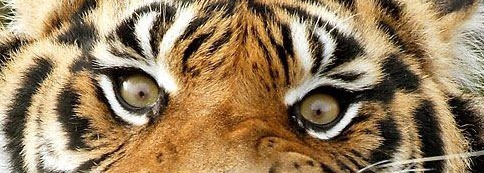
bengal-tiger

Life of Pi the film covered a surprising amount of the content of Life of Pi the book.  So far I can think of just three scenes I missed.  First, story of Pi’s family running into Pi’s three religious leaders.  Second, showing how Pi used turtles to survive, and finally, the scene where Pi is blind and hears people in another life raft.

Still, Lee and Magee beautifully succeeded with capturing the philosophical heart of the novel.  If you loved the book, go see the film, you’ll be surprised by how well it was filmed.

Is God the Better Story?

If you haven’t read the book or seen the movie, don’t read beyond this point if you plan do either, because I’m going to analyze the philosophical statement of the book and it will spoil the story.

In the main story, a boy from India, Piscine Molitor Patel,  who wants to be called Pi, is shipwreck in a lifeboat with a zebra, orangutan, hyena and a tiger named Richard Parker.  Martel tells us this story very realistically and we are expected to believe it happened. But along the way, Martel takes us through scenes that are very hard to believe, like the carnivorous island with the meerkats.

Yann Martel has crafted a Zen kōan into a novel.  Most kōans are short, “What is the sound of one hand clapping.”   Yann Martel essentially asks, “Is God the better story?”

At the beginning of the novel and movie, in a pseudo introduction, the author is told by an older Pi, that he can tell the author a story that will make him believe in God.  Yann Martel creates two stories, one very long, elaborate, fantastic, awe inspiring – and brutal, and a second that is short and brutal.  We are asked which one we prefer.  Martel is right, everyone, including realists like me, will pick the story with Richard Parker, the Bengal tiger.

So where does God come in?  How can this story make us believe in God?  Analyzing fiction for symbolism is tricky, but for me, Richard Parker represents God though analogy.  At the end of the film and novel, when Pi has told his long fabulist story to two Japanese insurance investigators they refuse to believe him.  So Pi tells a shorter, ugly version that we know is true, but hate to believe.  Then Pi asks the investigators which story they prefer.

We all want to believe in the story where Richard Parker existed because it’s a better story than the one of madness, murder and cannibalism.

So what about the prediction at the beginning, that the story will make us believe in God?  I believe Yann Martel uses the desire to believe in Richard Parker as a stand in for God, creating an analogy, that the readers and audience must make on their own.  Pi desperately wants to believe in God.  Pi asks us to believe in Richard Parker because the story of surviving in a lifeboat with a tiger is a better story than going mad and surviving alone.

The whole point of the novel is to trick the reader into the question:  Which story do you prefer.  Of course everyone prefers Richard Parker to be real.  By transference, we’re ask to accept that belief in God is the better story, just like how we want to believe that Richard Parker existed.  We’re never explicitly told that wanting to believe in Richard Parker is the same as wanting to believe in God, but I feel it’s obvious.

Yann Martel tells us people prefer religion over reality because the story of God is a better story than reality.  And I ask:  “Is this why people refuse to accept the fact of evolution because they prefer the story with Richard Parker – oh, I mean God?”

The novel is an elaborate metaphor to explain why people believe in God.  It doesn’t say that God exists.  Nor do we know what Yann Martel believes.  It just says people prefers belief in God because it’s a better story than how we see reality directly.

What the novel is tricking us into confessing is that the belief in God, no matter how unbelievable that story might be, that it’s a better story than reality.  That when we’re pushed to the ends of our physical and mental limits, we want God even if he’s cruel, vicious and indifferent.  That the belief in God is what gets us through this life.

Has Yann Martel stacked the deck?  Is God the better story?  Yes, reality does sometime involve madness, murder and cannibalism.  And even in the God story, people die, animals are cruelly killed and eaten, people suffer.  If the audience was given the Richard Parker story, and a documentary about the evolution of the universe with cosmology and the evolution of life on Earth with evolutionary biology, is God still the better story.  I don’t think so.  Richard Parker is like a magician’s diversion.  If you could watch this movie and blot out the tiger, the reality of Earth is magnificent!  Richard Parker and God divert our attention to our fantastic reality.

God is only the better story when you don’t understand reality.  Richard Parker is ferocious, terrifying, cruel, indifferent and doesn’t answer prayers.  No matter how much Pi loves Richard Parker and wants his recognition, Richard Parker ultimately refuses to acknowledge Pi’s existence.

So why is God the better story if Richard Parker just walks away from us?  I know many people who have long given up religion but haven’t given up on God.  They say that God must have created us but walked away from the universe and is no longer involved.  Personally, I’m confident there is no God and the size, age and origin of reality is beyond our understanding.  I find it far more comforting to know the rules of our local universe and not feel the need to blame a superior being for bad things or beg for good things.  If a bacteria, shark, drunk driver hurts me badly, I just accept it was the luck of the draw and not a judgmental deity deciding I had done something wrong.

Where the metaphor of Richard Parker breaks down is Pi can see Richard Parker, and we never see God.  It’s actually easier to believe in Richard Parker than it is to believe on God.  Life of Pi is a wonderful novel.  I’ve read I twice now.  And each time I want to believe the Richard Parker story, even though I know the truth is the story about cannibalism.  How many times will I have to read this book before the realistic story is the better story?

What if the novel and movie had been about a boy that survived 227 days on the ocean and had endured the incident with cannibalism and madness and survived.  No tiger, no zebra, no hyena, no orangutan, just Pi, his mom, the Frenchman and the Buddhist sailor?  It would have been brutal, but the success of Pi surviving the ordeal would have been just as magnificent.

Why do we want a better story?  Santa Claus is a better story than parents buying kids Christmas gifts from Target.  The tooth fairy is a better story than throwing milk teeth in the garbage.  Heaven is a better story than dying.  But why is God a better story than reality?  Is God a better story than evolution?  If you understood evolution and cosmology, God isn’t the better story.  God is a simpler story, and God’s story is endlessly confusing and contradictory.  It’s just God is fantastically powerful like Richard Parker.

Even though I disagree with Yann Martel’s assertion, I love his fiction.  See, that’s the real revelation in this.  Fiction is the better story, and Life of Pi is very good fiction.  Humans embraces fiction with an intense passion.  Richard Parker is a better character than a cannibalistic Frenchman.  And for many people, all the stories about God, are a better story than the brutal aspects of reality.  However, there is nothing in fiction that comes within light years of evolution.  All stories about God are just crude children stories compared to the complexity and beauty of evolution.  Evolution is just as brutal as the Old Testament God – it’s just not personal.

Here’s the final kōan:  Did Yann Martel write this story to make us atheists or make us believers in fiction?

JWH – 11/28/12

From Words to Films: Cloud Atlas, The Life of Pi, The Hobbit, Anna Karenina

Yesterday I saw Cloud Atlas at the theater, and it had previews for The Life of Pi and The Hobbit.  I’ve also seen recent previews for Anna Karenina.  All books I’ve read.  While watching the preview for The Life of Pi I wondered what Yann Martel and David Mitchell are feeling now that their words have become movies.  Do they feel like gods creating new worlds?

Lucky writers type words on their computer and a few years later those words become images on the big screen.  How marvelous must that feel for a writer?  Of course, a writer creates all their characters and scenes in their head by themselves, and a movie requires hundreds, if not thousands of people to create images on the screen for us to see.  And often, they aren’t the same visions the writer first imagined.  I can’t imagine David Mitchell picturing so many of his characters looking like Tom Hanks, but Tom Hanks with the help of make-up artists have fleshed out Mitchell’s characters in a world of pixels that is so much more vivid than printed words on a page.

I have to admit while watching the previews that I wished I could write something worthy of filming.  Few books are given birth on the big screen, so it’s a very rare honor that few writers get to enjoy. 

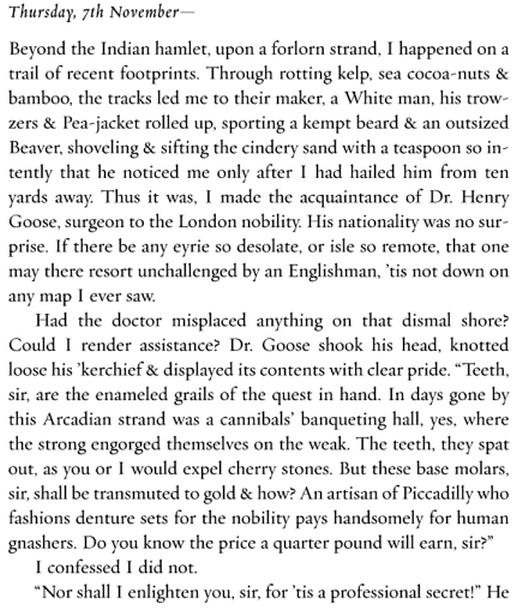
Look at the opening page of Cloud Atlas by David Mitchell – I saw it acted out yesterday.  It’s not the same at all, these words inspired a movie scene on the beach.

cloud-atlas


Next, watch this clip:


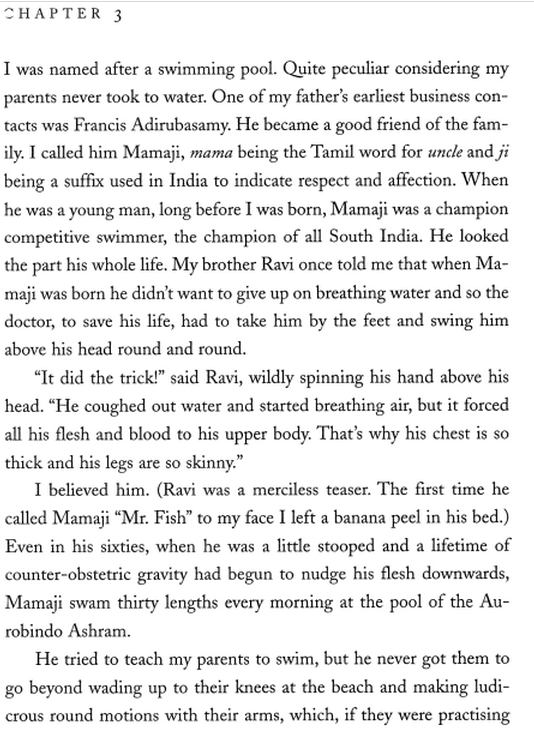
Now read from the The Life of Pi by Yann Martel.


Life-of-Pi


And then look at the trailer for The Life of Pi:


These are just two examples.  I wish I had the time and technology to show several examples, with the exact book pages and filmed scenes.  Both Cloud Atlas and The Life of Pi are books of astounding feats of imagination.  I’m sure bookworms hope all their favorite books will become films, but few do.  I’d love to see The Windup Girl by Paolo Bacigalupi made into a movie.   That book also exhibited tremendous feats of imagination, although it’s a bleak view of the future.  I’m thinking movie makers prefer upbeat stories based on fantastic events.

I wonder how many writers sit down to write a story they hope will be filmed?  If you’ve read Cloud Atlas or The Life of Pi, you probably thought like me at the time that it would be impossible to film these stories.  Watching the preview of The Life of Pi made me realize that anything a writer can think up movie makers can film.  Watching the preview of Anna Karenina made me realize that movie makers are going far beyond what writers can do with words.  I don’t think any one mind can imagine so much beauty, color and vivid detail.

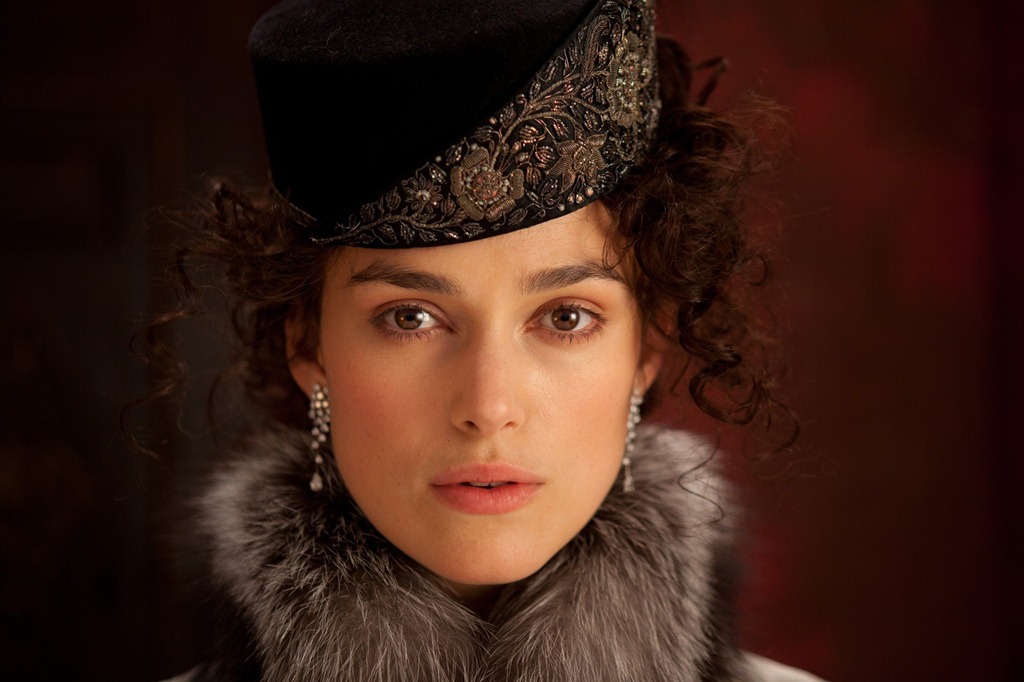
anna-karenina-kk

Look at this photo and then read Tolstoy’s words:

Anna was not in lilac, the colour Kitty was so sure she ought to have worn, but in a low-necked black velvet dress which exposed her full shoulder and bosom that seemed carved out of old ivory, and her rounded arms with the very small hands. Her dress was richly trimmed with Venetian lace. In her black hair, all her own, she wore a little garland of pansies, and in her girdle, among the lace, a bunch of the same flowers. Her coiffure was very unobtrusive. The only noticeable things about it were the wilful ringlets that always escaped at her temples and on the nape of her neck and added to her beauty. Round her finely chiselled neck she wore a string of pearls.

Well, they got the ringlets.  Can any words ever describe what we actually see?  What is the power of Tolstoy’s words that have made Anna Karenina one of the greatest novels of all time?   It is a novel that has inspired the production of many movies.  Will there be additional productions of The Life of Pi and Cloud Atlas?  Will Martel and Mitchell be as inspiring as Tolstoy?

Like I said, I wish I could write a story other people felt compelled to film.  The old saying is, a picture is worth a thousand words, well that means most novels have about 100 pictures in them.  But novels are really about characters fighting adversity, and that’s where movies and books really overlap.  I believe if I wanted to write a novel worth filming, I’d need to create unique characters facing unique conflicts.  Words are great for that.

I think it’s fascinating to read the words that become movies.  I think it’s even more fascinating see characters on pages become characters on screen.  I think it’s also fascinating  for stories to come alive before our eyes in the dark that we once read as black marks on white pages.

[By the way, is film even a valid word to use regarding movies anymore?  Are movies still filmed?  Or do they use high resolution video cameras?  In our modern times both novels and movies appear on screens.  I guess I could have talked about stories that appear in black and white on small screens and in color on large screens.  Is that the transformation good stories should expect – more pixels with great color depth?]

JWH – 11/5/12