A New Kind of Reading: iEssays

What’s the best economic model for finding the absolute best essays to read?

I decided to go paperless with my periodical reading back in February, 2008, and my last magazine subscription (Popular Photography) has finally run out.  At one time I subscribed to over 20 magazines. I love magazines, and I spent six years working in a periodicals department at a university library back in the 1980s. 

At first this effort was to do my part in fighting global warming, but over the last few years I’ve realized that magazines aren’t the most efficient way to read about the world.  Out of a year’s worth of The New Yorker, I might only read 1/20th of the printed pages, and it was probably less.  I now subscribe to The New Yorker on my Kindle, but I don’t even look at every issue, so I’m wasting my money.  I do wish I read each issue cover to cover because it’s a great magazine, but in reality I spend far more time reading on the Internet.  There’s something compelling about jumping from one web site to the next grazing on information.

Long before the Internet was a gleam in its designers’ eyes, magazines and newspapers were the world wide web of information.  Most print magazines and newspapers have a web presence today, and they all compete for eyes and dollars, while still trying not to compete against their own print editions, but I can’t imagine that lasting for many more years.  With ebooks, smartphones and tablets all offering periodicals and news reading apps, how can paper periodicals compete?

I wish I could take a news pill every morning and just know what’s happening around the world, but that’s not possible – yet.  But here’s the modern reality of reading – petabytes of data are being created daily, but we all still live in a 24 hour world, and at most I might spend 7 of my 168 weekly hours keeping up the world by reading short non-fiction essays, and when I’m busy or lazy it’s a lot less.

The Challenge of Keeping Current

We live in exciting times, and this is a happening world, but it is surprising how ill informed we are about what’s going on.  For most of my life I’ve watched the half-hour evening news and then supplemented it with some magazine reading, and figured I was doing pretty good keeping up with current events.  But I realize now that I’m not.  Too much of the evening news on television is worthless.  Are daily stories about natural disasters, politics, and economics really that valuable to keeping up with external reality beyond our tiny lives?

In any 24 hour period, what really are the most worthwhile stories to know about?  Let’s say we spend 60 minutes a day, whether surfing the net, scanning RSS feeds, watching television, reading a newspaper or magazine – what’s the most productive way to spend those 60 minutes in terms of learning about what’s going on in reality?

Generally, we all have a passive attitude towards acquiring news.  We take in whatever’s in front of us, whether it’s the NBC Nightly News or Slashdot.org.  But what if we read with conscious intent?  What if we systematically reviewed data sources ourselves, instead of letting editors at newspapers, magazines and TV shows decide what we need to know?

The Old Way

Before radio and television, people read newspapers.  Your daily paper might present 25 stories and you picked the ones you wanted to read.  With mass broadcasting on radio and TV, news was bundled into shows of 30 or 60 minutes and you just sat through all the stories, even if you really weren’t interested in all of them.  If you wanted to know more you subscribed to magazines and hoped they presented in-depth coverage for stuff you missed from your newspaper, radio and TV.  Before the plague of attention deficit syndrome hit the world, magazines often presented long essays, thousands of words on a topic, offering far more data than you’d get in a one hour documentary.

The Current Way

The Internet publishes thousands, if not millions, of stories every day.  There are many ways of finding stories to read.  You can go to a editor driven sites like Google News, MSN, Slashdot, Engadget, or any of countless other outlets and scan for interesting items to read.  Or you can go to social sites like StumbleUpon or Digg and hope serendipity will bring you a great news surprise.  Or, you can add all your favorite sites to a RSS feed reader and try to manage the internet fire hose of data that way.

With the advent of the tablet computer we now hold a magic magazine that can overcome the limitations of the printing press. 

The Better Way?

Money makes a great editor, in more ways than one.  I guarantee if you go buy copies of The New Yorker, The Atlantic, The New York Times, Scientific American, or any of the many top printed periodicals and read the longest articles you’ll get the best bang for you reading time.  These publications pay writers top dollars and there is a kind of survival of the fittest in information quality going on.  However, we still have the problem of subscribing to paper copies, or tediously searching the net for the web editions.  And whether we pay for paper copies or subscribe to digital editions, we’ll buy a lot of content we won’t read.

What we need is the iTunes of essays, iEssays or a Readers Digital Digest.  Articles under 1,000 words should be 49 cents, 1,000-4,999 should be $1, and stories greater than 5,000 words that aren’t considered books, should be $1-3.  If you buy one $5.99-6.99 magazine a week, you’re spending a $1 a day for essays, and I doubt many people would read more than one long essay a day, so these prices are about equal to average magazine reading.  Leave the under 500 word content to free web sites supported by ads.

Picture The New York Times Most Popular section but getting content from hundreds or thousands of magazines, newspapers and web sites.  This is how I read the NY Times, start at this page and only reading the best/most popular articles.

At our iEssays site, we could follow best seller lists set up by topics to quickly find the Hit Essay of the Day from a variety of subject categories.  They can also keep lists for Hits of the Week, Month or Year.  Imagine sitting down with your iPad once a day with the intent of spending 30-60 minutes reading a very high quality article and you’re willing to spend a buck.  This would definitely weed out the crap and silly stories you mind at most social news sites. 

And it’s important that the site not charge a subscription for the whole site.  What we want to do is generate hit essays like iTunes creates hit singles.  It would be important to still read newspaper sites or watch TV news to get a general impression of the news, but if you wanted to really learn something new every day about the world, I think the iEssays would be the best way to go.

Also, to help the survival of the fittest process, I think as part of your purchase you get to send an article to up to five friends, or link it on your blog.  So articles could be promoted up the Hit List by purchase votes, recommendation votes, or link hit votes.  The New York Times allows free reading to its articles if they come in via links.  I think that’s an innovative way to promote stories and still collect payments.

And finally, I think the iEssays should be an app that stores your purchased articles forever in the cloud, so they become part of your digital memory.

Conclusion

I’m not expecting this system to supplant subscription systems.  Most people prefer passive news gathering.  Most people are happy to subscribe to a newspaper or magazine and just skim and read, tossing the issue out when they are done.  But I think there’s enough people like me who are annoyed at buying far more content than we read, and wanting to get the most for our money.  It’s like cable TV plans, spend $60 a month and get 200 channels.  Some people don’t mind channel surfing, but I don’t.  Not only would I like a la cart cable, I think I’d like to buy television by the show.

Unless magazines and newspapers go the way of subscription music, I’d prefer paying by the article rather than the issue.  I pay $4.99 a month to Rdio and get to listen to essentially everything.  I use its social tools and charts to narrow my listening.  But I think by the essay pricing would help me find the best article reading the fastest.

Right now The New York Times charges $20 a month for unlimited tablet access.  That seems way too expensive when compared to what I get from the music business.  If The New York Times also presented content from many major newspapers and magazines, then I might consider a $20 monthly bill, like how I spend for TV and movies through Netflix.  But the NY Times is trying to price their digital newspaper like the old paper copies, and this is different world.  Netflix and Rhapsody are changing content pricing models in people’s minds and I don’t think they will go away.

I think the Rhapsody pricing model is superior to the iTunes pricing model, which is superior to the old CD pricing model.  iTunes sells hits, and I want to buy hit essays.  I don’t want to buy whole papers and read just a handful of its stories.  I want either the Netflix/Rhapsody model which is gigantic piles of content for one low monthly price, and I’d use built in tools to find what I want, or I want the iTunes model, where I buy just the hits. 

When it comes to reading quality essays (or short stories and poems for that matter), I predict the price per song model is superior for quickly finding the best reads.  And ultimately I think more writers and publishers would benefit from this model too.  If I spent $20 a month for The New York Times I doubt I buy any only periodical.  Which is why I can’t make myself spend $20 for one online newspaper.  If they added 20 top magazines to their deal, I would gladly pay $20 a month, but I’d rather pay $1 an article for an even larger pool of hit providers.

The monthly library model like Netflix and Rhapsody is great for music, movies and TV shows if you like to try out lots of different songs or programs.  But reading is different, at least for me.  I have a limited amount of time I spend reading, and I only want the very best stories to read.  It’s like people who prefer iTunes to Rhapsody.  They just want to get a few hits to play and aren’t concerned with trying out one or two dozen new albums a week.  That’s why I think some enterprising Readers Digest wannabes should apply the iTunes model to creating iEssays.  Or if the Best American Series editors came out with a monthly digital issue rather than a series of books once a year.

JWH – 7/17/11
Blogging by Candlelight and Paper

I started this blog last night while the power was out, writing with pen on paper by candlelight.  My power was out just 45 hours, but some people on my block still don’t have power.  I think after the storm Monday as many as 60,000 homes were affected.  We’ve had our power out as long as 13 days here in Memphis.  Memphis is a sea of trees if seen from the air, and when we get high speed windstorms lots of them blow over.  Down the street I saw where one tree fell and knocked another over.  My power was out because on the next block over a tree fell on the power line and pulled the pole over and the wires down.  Two houses over they had their power line pulled off their house.

The first night without power my nephew was visiting and we sat up playing rummy by candlelight, but he left first thing in the morning, to continue on his trip from Portland, Oregon to Lake Worth, Florida.  I thought my power was going to be out until Friday, so I was bucking up for two more nights of darkness and cold but MLGW fixed me.  Having these incidents are very educationally, and even though I hate when things like this happens I try to make the best of them.

I spent a lot of time last night thinking about being addicted to the grid.  I found plenty to do in the dark.  I have an iPod touch with 22 unabridged audio books on it.  I also found an old Walkman and a box of old time radio shows on cassette, so I listened to a 1950 episode of Philip Marlowe Detective.  But I spent most of the evening thinking about how we live on the power-water-gas-information grid and how ill-prepared we are for when things go wrong.

When I came home yesterday I had plan to take my frozen food to my friends house, but by then it had gone mushy.  I had to toss out most of what was in the refrigerator and all the stuff from the freezer compartment.  So I started thinking about how I would eat for three days.  I figured I could eat out, or buy food that doesn’t require refrigeration.  I didn’t want to mess with an ice chest because we had just thrown away two that had gone mildewy.   A neighbor a few doors down was running a very loud gas powered generator, and I thought about buying one of those for the future but I decided against it too.  I hate the noise.  It does protect the food but they take a lot of gas, so I figure it would be a breakeven deal.

What I wanted was more light.  I had three flashlights, two candles in glass lanterns and a giant block candle with seven wicks, but even with nine flames I didn’t have enough light to read comfortably.  I once read a wonderful book about America in the 1800s and it chronicled how people’s lives were changed by the technology evolving past candle light.  Whale oil made a huge difference.  I did some research on Amazon and found there are LED lanterns now, so I’m going to order one of them to be prepared for future blackouts.

I also wanted a radio or TV to listen to the news.  I have two Walkman cassette players with AM/FM/TV tuners, but the TV part doesn’t work anymore since they phased out analog signals.  And I couldn’t find any news on the AM/FM bands.  I didn’t have much patience though.  I plan to buy one of those emergency radios that have a crank to recharge the batteries and l want learn which radio stations are worth tuning before the next power outage.

Some of these emergency radios have hand cranks that will charge a phone or USB gadgets.  My cell phone ran out of power just after the storm.  This event taught me to keep my phone and gadgets well charged, keep the dishes washed up, and don’t let the dirty clothes pile up either. 

Luckily the house only got down to 60 degrees – just a touch cold.  I put on a hoody jacket and slept in my clothes under one patchwork quilt and was fine.  I have been in the house without power in the dead of winter and in August, so it could have been much worse.  But being addicted to a favorite temperature is a bad habit to have.

Most of all I was annoyed by having my routine disrupted.  That’s really being a pussy I know, but I’m a man who loves his rut.  If I owned an iPhone 4 instead of an iPod touch I think I would have felt connected to the net and felt less of a sense of net withdrawal.  The funny thing is I saw this PBS show last Friday about a family in England being forced to live with 1970s technology.  I never would have thought the 70s as the old days, but when I saw how different they had to live I realized how much life has changed just in my lifetime.

I tried to imagine what life was like for Jane Austen at the beginning of the 19th century, two hundred years ago.  No toilets, electricity, running water, central heat and air, safe foods, etc.  Dark was dark back then.  If I only had candles last night and none of my gadgets I would have been closer to Jane Austen times.  What the hell did they do in the evenings?

Just listening to the old time radio tapes reminded me of stories my mother and father told me about how they grew up.  Radio shows aren’t very sophisticated entertainment – and neither is television once you get used to the internet.  I think our modern minds have become addicted to complex stimulation.  Listening to the Philip Marlowe mystery was quaint but I’d hate to return to those simple story days.

Since I gave up cable last year my wife constantly searches the local channels for something to watch when she’s in town.  She likes to watch Antenna TV, a channel with old TV shows from the 1950s, 1960s and 1970s.  I loved The Monkees as a kid, but seeing it now makes me wonder if I was mentally handicapped as a teen.  I grew up back then but I wouldn’t want to return to such primitive entertainment.  I can’t imagine what young people today think of us when they see such shows.  But then I was talking to a young woman (in her thirties) and she told me how much she loved The Adams Family because it was something fun to watch with her 4 year old daughter.

Of course I did a lot of thinking about the poor people in Japan who are having their routine lives diverted for probably months if not years.  I was having no trouble adapting to life without power – it’s not life threatening, but I wouldn’t want to go all Thoreau and choose such a lifestyle.  I’m reading Edward Abbey’s Desert Solitaire and he makes living out in nature sound exciting and romantic, but reading between the lines I don’t think the desert heat comes through well in just words.

I also thought about what it would take to live with less, and wondered how much less is acceptable.  Could I live without the Internet?  Sure, but I really wouldn’t like it, but that’s weird to think about.  Why is the Internet so important?  I spend  Sunday afternoon to Friday evening living alone, so I use the Internet to socialize at night.  The computer, phone and TV make me feel in touch with the world and people.  If we fell back to Jane Austen times, work would be my only social contact and I’d probably read in the evenings.  I’m too tired after work to be socially active.  But if we didn’t have this modern world I don’t suppose my wife would be working out of town.

I wonder what our married lives should be like without our electronic addictions?  And yes, my wife has her addictions too, like Farmville and Angry Birds.  When Nicky was visiting we talked, and then we played cards.  I can see how simple games like chess, checkers and cards could be so valuable to people in the old days.

My first night back with electricity I’m typing my blog, listening to Miles Davis’ “So What” from Kind of Blue and enjoying unnatural light and heating.  I just got in the 5th season of Friday Night Lights, one of my all time favorite TV shows to watch later, and I’m back in my routine.  However, I’m not as inspired to write like I was last night.  See, being forced to do something different has it’s educational value.  Thinking about being out of my rut was stimulating in itself.  I should try to do it more often.  Yeah, right.

JWH – 4/6/11

Apple’s Dangerous Storefront Paradigm

What if you bought a Sony TV and then discovered you could only watch shows that Sony okayed ahead of time?  Furthermore, what if Sony decided that anyone wanting to create a show to broadcast to your TV had to pay Sony a fee?  What if some TVs worked with some networks but not others?  How would you feel if you wanted to watch a certain show but discovered that Sony censored that TV production?

Radios, televisions, record/tape/CD/DVD players have always been sold as machines that were universal devices.  They would work with the same content everyone was providing.  You bought a RCA television and it played the same shows as a Sears set.  A GE clock radio would pick up the same stations as any other AM/FM set.

When computers came out there were many types, with different chips and operating systems, and there was no universal system.  Then came the IBM PC in 1981, followed by PC clones, and things settled down, but not quite, because in 1984 the Apple Macintosh came out with all intentions of being different.   The Mac’s market share has always hovered around 1/20th of the PCs.  It wasn’t quite disruptive, but offered an alternative.  But if you bought a Macintosh computer you could buy any Mac compatible software you wanted.

Now, with the iPhone and iPad, and the Apple App Store, Apple is creating a paradigm shift that will shake up things and change the way we do things completely on computers.  And don’t be fooled, smartphones and tablet are computers.

Apple is changing the computer from being a general purpose device that the buyer has control over into one that’s essentially a tiny Apple storefront.  Apple wants to get a cut of the action on any program, service or content that runs on their machines.  Not only that, they want to control what services, programs and content that can be used on their machines.

This is like Samsung saying “If you want to watch The Social Network on our TVs, we get a percentage of its selling price.”  Because computers never completely became universal devices like radios, TVs and DVD players, computer makers can get away with trying something different.

What Apple is saying, we don’t want to be a computer maker anymore, we want to be a retailer that sells products for computers.  They couldn’t do this before because they didn’t have the App Store.  The App Store is a choke point that Apple can control.

Under the old paradigm if you wanted a tax program for your computer you picked out a program you liked and bought it direct from its maker, or from a mail order store like Amazon or New Egg, or a retailer like Office Depot.  Now Apple can say the only way you will get a program for your iPhone, iPad, and soon maybe your iMac is through an App Store they control, and which they charge a 30% cut.  Now some people like this paradigm shift, it does have merits, but I for one find it scary too.

For instance I was going to buy the iPad 2 as soon as it came out.  I changed my mind weeks ago when Apple announced their 30% fee.  I was wanting an iPad to read magazines on, and my first magazine subscription was going to be The New Yorker.  Right now The New Yorker is $4.99 an issue on the iPad.  It’s $2.99 a month (4 issues) on the Kindle, and $39.95 for the PC version, that includes access to the complete back run of the magazine.  I don’t know what the subscription fee will be on the iPad because Apple is just now working out the deals and technology to sell subscriptions.

Now Amazon has a choke point for Kindle users too, and I’m sure Amazon is making something for selling magazines, but I doubt it’s 30%.  But see the difference?  Under the old PC model of buying content we can deal directly with the seller.  $39.95 a year is a great deal.  It’s $3 more a year than the Kindle price, but I would get all the back issues to read while I’m a subscriber, plus I’d see the full magazine page with all it’s ads and illustrations, and not just the content and cartoons as I do on the Kindle.

I was hoping The New Yorker would provide the same deal on the iPad for $39.95, but will it when Apple wants $12 for its share?  Does Apple deserve a share?  Are they really a retail store?  Google has since claimed that sellers on the Android platform will only have to kick back 10% to them.  But is being cheaper any fairer?

See the paradigm shift coming?  Computers are becoming storefronts.  Apple tells its users that programs bought from their App Store are safer than those purchased elsewhere, but isn’t that some kind of protection racket?  And isn’t this also a kind of Monopoly too?  To be legal shouldn’t iPad users have the right to visit any application store they choose?  Imagine if Ford sold you a car but enforced where you bought your gas and oil because they claimed it was safer?

Before Apple announced their shakedown plans I had imagined having an iPad with Rhapsody Music on it.  I pictured in my head what a beautiful app Rhapsody could design for listening to music while looking at appealing visuals, like large size photos of album covers.  But will Rhapsody still develop such an app?  Many content producers are saying they might have to pull their wares from the App Store, but I don’t picture that happening.  I just see them jacking up their prices.

The New York Times plans to sell the online version of their paper for PC users for $15 a month, and charge $20 a month for iPad users.  But to be fair it’s $19.99 for Kindle users now.  If they didn’t have to go through Apple or Amazon, and Kindles and iPads were just generic devices, would The New York Times just charge $15 a month to their users?

Is having the device maker controlling a choke point on sales of content for their devices really needed?  If you buy stuff from Target at their stores or online you really need Target to manage all the stuff they sale, so they deserve making money.  But do Google and Apple really do that much to run their stores?  It’s nice to have one payment system, and it’s nice to have one installation system, but is it really worth 30%.  Their fees should be more in line with what credit card companies charge retailers.  I’d say 3% tops.  And how many retail stores can get away with a 30% mark-up – most live and profit by razor thin margins.

Whether we like it or not, tablet computers are our future, and this is a good thing.  But giving Apple, Google, and Microsoft the right to control all sales on their devices is not.  Microsoft is a dark horse in the tablet race.  What if they came out with a hands off approach, and just sold their OS to tablet makers, would that change the game?  There’s a reason why PCs dominate the market share.  They may be open to attack from hackers, but they are open.

JWH – 3/20/11

The Implications of Watson

Watson, the supercomputer contestant on Jeopardy this week represents a stunning achievement in computer programming.  People not familiar with computers, programming and natural language processing will have no clue to how impressive Watson’s performance is, but it has far reaching implications.  Jeopardy is the perfect challenge for demonstrating the machine’s ability to process English.  The game requires the understanding allusions, puns, puzzles. alliterations – almost every kind of word play.  This might look like a smart gimmick to get IBM publicity, but it’s so much more.

Computers can process information if its formatted and carefully structured – but most of the world’s knowledge is outside the range of a SQL query.  Watson is a machine designed to take in information like we do, through natural language.  When it succeeds it will be a more magnificent achievement than landing men on the moon.

While I was watching the intro to the second day show and listening to the designers of Watson I felt rather humbled by my puny knowledge of computers.  I felt like a dog looking up at my master.   Most people like to think they are smart and intelligent, but when they meet people with brains that far exceed their own minds it’s troublesome.  A great novel about this is Empire Star by Samuel R. Delany.  It’s about a young poet who thinks he’s having original experiences until he meets an older poet who has already done everything the younger man has.

How will we feel when the world is full of Watsons and they are the intellectual giants and we’re the lab rats?  IBM built Watson to data mine natural language repositories – think libraries, the Internet, or NSA spying.  The descendants of Watson will be able to write papers that leave human PhD candidates in the dust.  One of the Watson designers said they built Watson to handle information overload.  Of course he assumed Watson would be a tool like a hammer and humans would be in control – but will it always be that way?

Watson cannot see or hear, but there are other AI researchers working on those problems.  We’re very close to having machines like those in The Moon is a Harsh Mistress or When H.A.R.L.I.E. Was One or Galatea 2.2.  Right now Watson is way too big to put into a robot body so he will live immobile like HAL and WOPR, but that will change too.

Real life has seldom caught up with the wild imaginations of science fiction.  I had hoped manned exploration of the solar system would have happened in my lifetime but that is not meant to be.  I’m starting to wonder if robots and intelligent machines will.  What will that mean?  I don’t think there is any going back, we just have to surf the changes.

NOVA has an excellent overview of Watson that you can watch online.

JWH – 2/15/11

Are Smartphones Nanocomputers?

Young people will probably not know this, but back in the 1970s personal computers were called microcomputers.  The dinosaur of computers, mainframes, were huge, some as big as houses, and cost millions.  Then in the 1960s newer, smaller computers started coming out that were dubbed minicomputers.  These were still too expensive to be personal, but they were cheap enough that they spread like gossip.  So when even smaller computers came out in the 1970s they were dubbed microcomputers.  These eventually became cheap enough for almost everyone to own one.

Now most people think of their smartphone as a phone, but it’s really a computer, just a very small one, so why not consider the smartphone the next paradigm of computing and call them nanocomputers?  I doubt if smartphones have any actual nanotechnology in them, but they might, but nano is obviously the next label in the series, so why not call them that?  Of course, what will picocomputers be like?  Nanocomputers are a planned concept, and smartphones might eventually use real nanotechnology, so it might be a self-fulfilling prophecy.

In the current vernacular, a “PC” is a Windows based computer.  PC used to stand for personal computer, and in the old days all microcomputers were PCs, even ones from Apple.  Somewhere along the way it became the PC versus Mac.  The smartphone is even more personal than the original PC because people actually carry them on their person.  We could call the smartphone a pocket computer, but that would be another PC acronym.

We could also call the smartphone the hand computer, following the labels of desktop and laptop computers.  The term handheld was in use for awhile, but it doesn’t quite work.

So why do I object to the phrase “smartphone” when it’s already so popular?  Because it’s rather limiting to think of the device as a phone.  Steve Jobs and Apple have done a wonderful job with the iPhone by creating a new category of pocket computer with hundreds of thousands of applications.  The phone part is just one of those applications, so why should it get top billing?

Already iOS phones and tablets have garnered over 1% of net user market share, competing with both Windows and Mac operating systems.

iPhones and Androids are quickly evolving into what I dreamed of having, an auxiliary brain.  Cellphones are about as close as we’ll ever get to telepathy.  Their GPS features give us homing pigeon like directional sense.  Adding the still and video camera broaden their versatility to create new concrete forms of memory.  The device is obviously more than a phone.

In the 1980s it was all the rage for schools to offer computer literacy courses to help the public understand the impact of the microcomputer on society.   Nanocomputers are bought and used without any training and no one talks about computer literacy anymore.  But do we understand the true impact of the nanocomputer?

Take this one example.  Public opinion pollsters are worried that telephone polls are now skewed because only certain types of people still have a landline phone, which is the only kind they can poll.  Now I don’t ever want pollsters to be able to call cell phone numbers, but what if nanocomputer users could elect to have a polling app, so whenever they felt like it, they could respond to variously kinds of polls.

What if nanocomputers became uniquely customized to its owner that they could be used to verify the identity of the user?  Nanocomputers could then be used as voting booths, and that would lead to their use for referendums.   By this thinking we should see these devices as extensions of our body.  We can already network the ear with a Bluetooth headset.  What if we connected nanocomputers to sensors inside our body?  As we integrate nanocomputers to our body, when do they become part of us?

And more importantly, how do we become part of them?  I now spend more time in front of a computer than I do sleeping.  Computers dominate my life, and so too for most people.  When do we start thinking of them as a prosthesis?  Aren’t they becoming enhancements for our brains, aren’t they becoming prosthetic minds?  We should think of nanocomputers as body enhancements that are leading us towards group minds.

The idea of wearable computers has been around for decades.   Most people thought such a concept was dorky, but now most people carry around one or more computers with them all the time.  Even a normal dumb cell phone is a computer, and so are MP3 players, game units, tablets, calculators, GPSes, digital cameras, ebooks, etc.  How long before it becomes obvious that the most convenient way to carry a nanocomputer is by wearing it?  Many people wear their Bluetooth headsets all the time now.  When will glasses and hearing aids be networked with the nanocomputer?

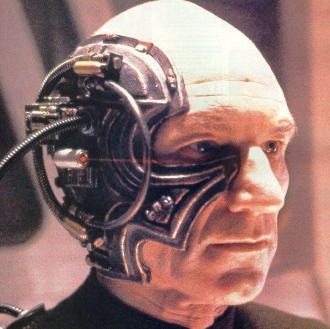
We need to get away from thinking of nanocomputers as phones but cybernetic enhancements to our bodies and minds.  So when did the Borg assimilate us?  When you think about it, Bluetooth headsets look like the first sprouting of Borgware.

the-borg

JWH – 10/28/10