Are You An Auto-Brainwasher?

by James Wallace Harris, Saturday, April 22, 2017

There is an extreme condition known as the Anton-Babinski syndrome where blind people believe they can see. It’s a visual variation of Anosognosia, where a person with a disability is unaware of their disability. Anosognosia covers a range of delusions dealing with the body, senses, memory, and language. There is a cognitive related syndrome called the Dunning-Kruger Effect, where low-ability individuals suffer from superiority illusions. (I can’t help think of Donald Trump when reading that article.) Quoting Wikipedia, here are the essential qualities of the D-K effect:

  • fail to recognize their own lack of skill
  • fail to recognize the extent of their inadequacy
  • fail to accurately gauge skill in others
  • recognize and acknowledge their own lack of skill only after they are exposed to training for that skill

I believe we all fool ourselves. But how far do we go? Are some people auto-brainwashers? Anyone who has read books by Oliver Sacks knows how powerful a brain is at fooling its own mind. I highly recommend you read the articles linked to above, and then ask yourself: Am I fooling myself?
brainwashing

This has very powerful implications. What if you think another person is in love with you and they are not? What if you think you are great at your job and you are not? What if you believe you’re writing the world’s greatest novel and you’re not? What if you think you are brilliant, sexy, funny, and compassionate and you are not? Many people are crushed by self-doubts, but maybe just as many people are brainwashed by over-confidence and delusions.

Take climate change deniers. They believe they know the truth, even though they oppose armies of scientists with PhDs, using trillions of dollars worth of supercomputers, space satellites, rockets, airplanes, drones, ships, submarines, monitoring stations, balloons, and other scientific resources. Are they any less deluded than blind people claiming they can see?

Any individual who thinks they can solve any of the world’s major problems is absolutely deluded. Our reality is intensely complicated. To assume we understand anything clearly is delusional. A reasonable amount of self-doubt is healthy. Too much can be crippling, yet we need enough for humility.

The trouble with being human is we make up stories to explain a limited set of facts. This is called the narrative fallacy. I can’t find a single article that explains it, but the book, The Black Swan by Nassim Nicholas Taleb is where I first heard the concept. If a noise wakes you in the middle of a night you can’t stop yourself from imagining scenarios for what caused that noise. From burglars, falling tree limbs, to raccoons, you have to think of something to explain the noise, even if the explanation is wrong. And generally, it is.

This is how we brainwash ourselves. Narrative fallacies lead to the Dunning-Kruger effect if you don’t do a lot of fact-checking. The reason why fake news is so successful is it often fits into people’s narrative fallacy storylines.

Science is our cognitive tool where we statistically study reality to look for consistency. We can only trust evidence when it’s overwhelming. We can only trust evidence when a majority of other people collaborate that evidence with further scientific research. But we are easily fooled by masses who have fooled themselves with auto-brainwashing. Their claims appear to be consistent evidence – but consistent opinions do not equal consistent evidence.

One of the purposes of Zen Buddhism is to deprogram our auto-brainwashing. If you can get your inner observer to back away from its attachments to thoughts it is possible to see how we auto-brainwash ourselves.

My old friend Connell and I have been talking about auto-brainwashing lately. Terms like Dunning-Kruger aren’t very effective, or memorable, so I’ve started using the phrase auto-brainwashing. Once we accept that a concept exists and have a good label for it, it’s possible to see it in action. With the idea of auto-brainwashing in mind, study yourself and your friends.

What do we see that’s not there. What’s there that we don’t see?

JWH

Serving Only One Master

by James Wallace Harris, Tuesday, April 4, 2017

I’d like to repurpose a famous saying by Jesus, “No one can serve two masters. Either you will hate the one and love the other, or you will be devoted to the one and despise the other. You cannot serve both God and money” and apply it to modern self-help advice about goal seeking. If we replace God with goal and money with everything in our life that keeps us from our goal, I think it works quite well.

Every day my newsfeed Flipboard includes a handful of articles about successful people and their habits, especially lists of things to do if we want to achieve our goals in life. Over the years I’ve seen hundreds of such how-to guides. I’d say the most common bit of advice is to narrow your goals down to as few as possible. And if you’re really ambitious, make it one. Jesus didn’t know about psychology because it hadn’t been invented yet, but he must have been a keen observer of people.

focus

For my whole life, I’ve been plagued by wanting to do too many things. Too many choices paralyze us with indecision. Humans are terrible at multitasking, and we’re not much better as task switching. Success requires focus. To focus requires getting into a flow state, and that’s not possible with distractions.

Recently I wrote, “Time Management for Work, Hobbies, Skills, Chores, Pastimes, and Interests” that calculated the time requirements for different levels of applied focus. Since I’ve retired I’ve been trying to organize my time to pursue as many of my favorite hobbies as possible. I wrote “Sisyphean Hobbies For My Retirement Years” about how I hoped to juggle them.

It’s been a complete failure. The more I divide my time, the less I get done. A byproduct of aging is a slow decline in the total time I can focus. Maybe I could have kept more balls in the air when I was younger, but I can’t now. I thought having all my time free would give me more time to focus. It just hasn’t worked out that way.

When I quit work in 2013 my plan was to write a science fiction novel. I quickly learned I couldn’t focus on such a big project. I switched to essay writing. Novels normally run 50,000-100,000 words. My essays run 500-1500 words. Even that shorter length requires a great deal of focus. And it’s not just a matter of cranking out the words. The challenge is to write better essays over time.

I think what happened in recent months is I got distracted by other hobbies – coloring, drawing, photography, computers, math, crossword puzzles, socializing, television, and I started writing less. If my retirement was only about having fun that wouldn’t matter. Nor am I trying to become a successful writer. What I’m really talking about is maintaining a skill while aging.

We need one master to serve to measure our ability for commitment and focus. We need one goal that defines us. Reality does not assign meaning. Existentialism requires us to define our own meaning. I believe happiness comes from having something we want to do. Whether that’s a goal, discipline, job, art, hobby, religion, philosophy, etc. is up to us. But it becomes our yardstick by which we measure ourselves. It’s the anchor of reality which everything else is related.

We can pursue as many activities as we can cram into our schedule but we need one to be the yardstick.

JWH

Overcoming Inertia in Retirement

By James Wallace Harris, Tuesday, July 19, 2016

In retirement you can do whatever want – if you’ve have the drive. Otherwise you do what you feel. That distinction might be meaningless to many. (I imagine old hippies replying, “If you’re following your feelings, you’re doing what you want.”) The difference defines ambition.

All too often I feel like kicking back in my recliner to daydream about writing while listening to favorite songs on Spotify, rather than actually writing at the keyboard. Just now I was lazing in my La-Z-Boy when this essay occurred to me. I told myself this morning my number one priority was to finish the essay I’ve been working on weeks for Book Riot, and then finish an idea I have for Worlds Without End. (I do have growing guilt over not working on them, but writing this is what I’m feeling.) The trouble is both Book Riot and Worlds Without End each have an essay in the can waiting to be opened, so the pressure to write another isn’t that driving. (BTW, I’m not blaming my laziness of them.)

countdown to ecstasy

In the middle-third of my life, I hated being trapped in the nine-to-five world of work. Before that, in the first third, I hated being imprisoned in the K-12 school system. But I’ve got to admit without that outside pressure I never would have learned much, or put in my 35-years of work. (At least I’m honest about my laziness.)

If this sounds like I’m wishing for someone to crack the whip over me, I’m not. Na, I’m just whining about my own lack of drive. I didn’t have it then, and I don’t have it now. I’ve always admired people who live like guided missiles, always on target. And that’s the confusing thing about retirement. It feels like I’ve reached the target. The social security years can feel like being in the queue for nonexistence. How we fight that is important. It defines the game in the last third of life.

Don’t assume I’m depressed. I’m never bored. I go to bed every night near midnight, regretting the day is over, and wishing I had more time. Every day I do get a few things done I want, but mostly I overindulge my whims. And that’s quite satisfying too, in a heroin kind of analogy. My problem is I have too many things I both want to do, and feel like doing. My lament is I spend too much time with Ben & Jerry’s, and not enough with broccoli. (Not literally, just another analogy.)

Being the puritanical atheist I am, I’m hung-up on doing productive work in my existential random existence.

Most people think retirement is all about not working – not me. I might have a minor guilt trip about being unproductive, but I’m not about to get a job, paid or unpaid. I won free-time millions in the retirement lottery, and just need to figure out how to wisely spend them. This means creating my own definition work. Right now, I gauge productivity in essays. Any day I finish an essay, feels like a productive day. Even if I write a navel-gazing one like this.

If I actually write a hard-to-conceive, hard-to-implement essay, that takes great effort and research, I feel like I’ve climbed a mountain. That’s when I believe I’ve won out over inertia. It’s how I redefine rolling my rock.

JWH

The Williamson Effect–Losing Interest in Life

By James Wallace Harris, Monday, March 28, 2016

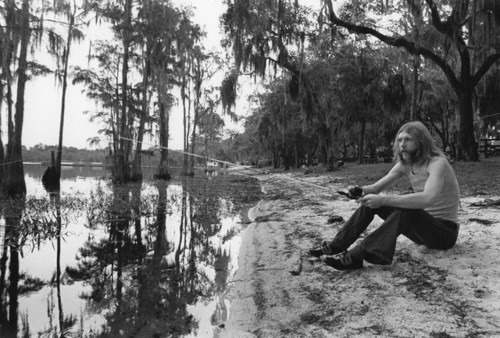
A friend of mine, before he died, called me to talk about life. His name was Williamson, and he was depressed. This was back on the first night of the Gulf War. Williamson said something then, a quarter century ago, that has always stuck with me. He said he was down to loving only two things in life. Benny Goodman and Duane Allman. I had gone to see The Allman Brothers with Williamson when Duane Allman was till alive. That was a long time ago. Williamson and I were buddies for a while in the 1970s, and we went different ways when I got a steady job.

Duane Allman Fishing 

Williamson hated working, always telling friends, “A job a good way to waste a life.” He spent his life avoiding the old nine to five, choosing to pursue endless hobbies and schemes hoping they’d pay off. They never did. I was surprised to hear from Williamson in August of 1990. The decades had changed him, and he was quite bitter. He called me a few times after that, and then disappeared. I heard later he died under mysterious circumstances.

I now worry when a friend tells me they are getting tired of things they used to love. I call it The Williamson Effect. I’m known to be a naturally happy person, even though I love to write about depressing subjects. I don’t know if I’m happy because of genes, or because I’m constantly searching out new things to love. Whenever I hear a friend suffering from The Williamson Effect I encourage them to try new things, especially music. I’m always amazed how a new artist and their music can revitalize my thinking.

I tried to convince Williamson that there was more to music than Benny Goodman and Duane Allman. He only sneered and belittled my then current favorites. Benny Goodman and Duane Allman are still on my main Spotify playlist, but so are Katy Perry and Sarah Jaffe, and I’m still living.

JWH

The Vital Role Emotions Play in Decision Making

By James Wallace Harris, Thursday, November 5, 2015

In the summer of 1966, when Star Trek first appeared on television, I became fascinated by the character of Mr. Spock. Spock was half human and half Vulcan, and was constantly at war with his emotions. Vulcans believe rational beings are not emotional, so poor Mr. Spock had to use massive will-power to suppress his feelings. That appealed to me immensely. Then in the 1970s I took up various New Age pursuits that taught me to calm my mind and tame my emotions. Thus, I’ve always thought emotions were burdensome. That emotions got in the way of clear thinking. Last night I learned I was completely wrong. Brain research shows that we can’t make decisions without emotions.

Decision-making-relies-on-emotion

Now I wonder if I’ve always been a indecisive person, with little drive, because I’ve kept my emotions on a very even keel. I learned as a child to crave stress-free living, and have arranged for a very calm life. I am contemplative and philosophical, rather than active and driven. I always wanted to be a science fiction writer, but assumed I was never unhappy enough to succeed. People I know who are writers are emotional, often disturbed and even tortured by their passions. I always thought I didn’t commit to writing because I lacked the pain to inspire me. Now I wonder if didn’t pursue my goal because my lack of emotions made me indecisive. Or maybe pain inspires not as power to animate, but as a series of decisions that direct.

I am reminded of an old fantasy story, where a magical coin if found by the main character who doesn’t know it’s power. Every time he wants to decide something, he flips the coin. Because the coin is magical, each decision moves him towards a magical reality. Evidently our feelings weigh our decisions and lead us to the reality they want.

I learned about emotions and decision making last night watching episode 4 of The Brain with David Eagleman on PBS. This mind-blowing six-part series is shaking up my beliefs about how the brain works. Eagleman showed us a woman who was in a motorcycle accident and her brain was damaged in an area where her emotions and logic meet. She can no longer make even the simplest of decisions. Checking out articles on Google Scholar I learn this knowledge has been around for a while, often inspired by studies on people who had similar brain damage.

This information also makes me wonder about artificial intelligence. Machines won’t have emotions, so how will they decide? My old friend Bob Beach always argued that self-aware machines would turn themselves off. Without emotions they couldn’t even make that decision. AI machines will be able to process massive amounts of data, but how will they weigh their decisions? Up until now we’ve believed we made decisions based on logic – weighing the pros and cons, but evidently that’s wrong.

Actually, we should have deduced that without brain studies. How often do we decide on the side of illogic?

Table of Contents