The State of Freedom 100 Years Ago

By James Wallace Harris, Wednesday, January 14, 2015

If you think terrorism and war is bad now, just study how things were one hundred years ago. We think of America as the land of the free, but during the 1910s people were being jailed for printing words and jokes about things we commonly see in sitcoms. Language we’d consider G-rated would get you jailed back then if you used it in a literary work that was sent through the U.S. mails.  Writing about contraception, condoms or abortion could also get you thrown in the slammer. Using phrases like “snot-green” or “old fart” would get you labeled as a horrible lower-class person. And it sickened and horrified cultured people when James Joyce wrote about Leopold Bloom eating organ meats, even though everyone ate organ meats. One hundred years ago people just didn’t like facing up to the gritty details of life, details we embrace today.

Because of laws regulating decency, sedition, sexual practices and other moral issues, most of 21st century writers, movie makers, publishers would be jailed if their work appeared a hundred years ago. This doesn’t mean the common people didn’t say anything they wanted, but state and federal governments tried very hard to control what people printed and shipped through the mails. If liberals think conservatives are controlling now, just read about the history of censorship in America. We’ve come a long way baby.
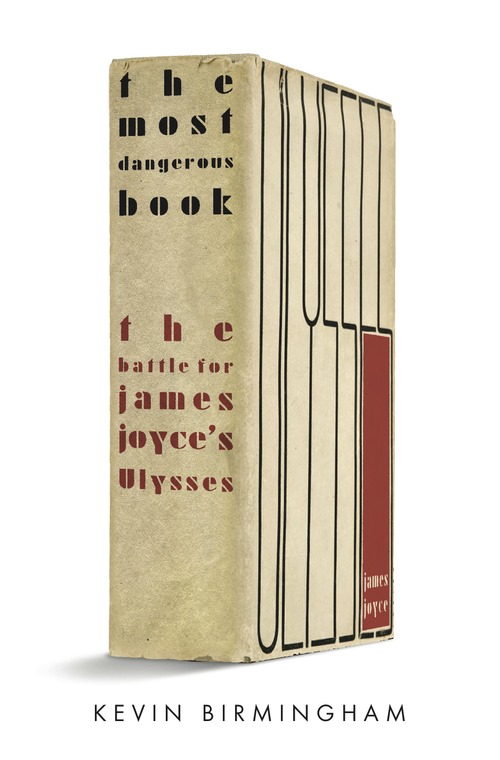
The Most Dangerous Book - Kevin Birmingham

The Most Dangerous Book: The Battle for James Joyce’s Ulysses by Kevin Birmingham thoroughly entertained me with his history of censorship and legal battles to publish what is now considered the best novel in English literature. Even if you have no interest in James Joyce, this book is fascinating history. It does deal with Joyce’s immense struggle to be an artist, and to push the limits of literary expression, but it’s also about why and how our society wanted to rein in artists. It’s about the editors and publishers that risked jail to publish writers like Joyce. In 1920, the year my father was born, Jon Stewart would probably have been sentenced to ten years in jail for each episode of his show, if they could have seen The Daily Show back then.

I listened to The Most Dangerous Book to prepare me to listened to Ulysses. I keep trying to get into Ulysses but I always fail. Ulysses is an almost impossible book to get into, very tough going, but not because Joyce was so intellectual and learned. Joyce wrote about ordinary events and people, but used new writing techniques to show how people actually thought and felt.  Since we often think about sex and bodily functions, or feel thoughts about people we’d never express, our minds are chaotic tangles of incoherent phrases and perceptions, and Ulysses tries to capture this stream of consciousness. In the 1910s and 1920s, readers found his experiments startling, offensive, unnerving and threatening.  Some European and American government officials thought Joyce’s apparent nonsense could be coded messages of espionage. Even his most ardent admirers struggled to decode his prose.

Joyce set the stage for comic observations about humanity that armies of standup comics still mine today. Yet, a hundred years ago, this so horrified government officials they did their damnedest to erase, and keep from the public. Their paranoia over strange ideas was fueled by radicals and anarchists who promoted conflict, disorder and social unrest. There were hundreds of terrorists bombings back then each year. The government associated anything Avant-garde with radicalism.

We have practically no censorship now, and a lot less social unrest and terrorist bombs. Strangely, the lingering forms of censorship we see today often come from terrorist bombers who want to revert our freedoms. The Comstock Law of 1873 was a kind of American Sharia Law, and the people who terrorized the literary world back then was the U.S. Post Office.

The founding fathers made free speech legal, but they didn’t understand what that meant. We’re still exploring the social implications of real free speech.  Kevin Birmingham’s book is a stunning history of the fight for free speech in the early part of the 20th century. He focuses on an array of literary freedom fighters who were directly or indirectly connected to helping James Joyce get his book published. Whether or not you’re interested in literary history hardly matters if you love history itself when considering reading this book.

History is like a jigsaw puzzle with an infinite number of pieces. A great history book is one that helps you put hundreds of pieces together to reveal the big image of the past. A great history book also helps connect its images with pieces of images you’ve assembled from other great history books. The Most Dangerous Book helped me see a lot more of 20th century American and European history.

I still find listening to Ulysses hard going, but I’m making a greater effort because of The Most Dangerous Book. Birmingham explained the tremendous struggle by Joyce to write his book, and why. Birmingham gives a great deal of background facts that interpret each chapter in Ulysses. But most important, he testifies to the valiant effort so many people made that allows us to read Ulysses and books like it. I’m very grateful to those people. I think we all should be.

JWH

Faith in Science

I am reading The Innovators by Walter Isaacson, an overview of the men and women who brought about the age of computers. At other times during the day I’m listening to The Glass Cage by Nicholas Carr, a book about how automation is making humans dumber. Isaacson gives the history of computers starting when they were first imagined as mechanical devices, but really came into being as electronic devices using vacuum tubes, and finally evolving into solid state devices we know today after the invention of the transistor.

Here’s my problem. I can sort of visualize how a mechanical calculator works, at least for adding and subtraction, but beyond that my brain explodes. I especially can’t conceive of how vacuum tubes were used to make a digital computer. I started taking computer programming classes in 1971, and even passed two semesters of assembly language. I used to be pretty good at binary and hexadecimal arithmetic.  But it’s extremely hard for me to imagine how a computer actually works. Essentially, it’s all magic, and I just accept that it’s possible to build a computer according to the laws of science – but my acceptance is really faith in science.

Nicholas Carr believes the more work we give to computers the dumber humans will become. Watch these two videos, and tell me if you understand them. The first is from 1943 and is about the basics of a vacuum tube, obviously a device essential to most of industrial progress at the time, but a forgotten tech today.

This is the technology that scientists used to build the first electronic programmable computers. Can you in any way conceive of how they get from vacuum tube to data processing? How much would I have to know to understand how the first computers were assembled? I keep reading about vacuum tubes, and even though I get a slight glimpse into their nature, I cannot for the life of me imagine how they were used to create a machine to do arithmetic, and show the results – much less understand the commands of a programming language, no matter how primitive that language.

I then thought maybe I’d understand vacuum tubes better if I could understand how they were made.  I found this film.

This film makes me mightily impressed with scientists of the late 19th and early 20th century. If civilization collapsed it would be a very long time before we could ever reinvent the vacuum tube, much less a computer.

What these two short films show me is human knowledge is divvied up so everyone learns extremely tiny pieces of total knowledge, but collectively we can create magical machines like an iPhone 6. A smartphone represents countless forms of expertise I will never understand, or even fathom with any kind of analogous modeling. An iPhone 6 probably has the equivalent of billions of vacuum tubes as transistors shrunk down into a solid state that are only individually visible with an electron microscope. It’s fucking magic. There’s no way around it. I know it’s science, but to my mind any mumbo jumbo I come up with to explain the miracle of a smartphone is no better than the incantations in a Harry Potter novel.

Wouldn’t it be great if we all were Renaissance beings that knew everything the entire human race had learned up to this point? Would we all have more respect for science if our K-12 education had been about recreating how we got to our current level of technology? What kind of curriculum would be required so that each graduating class had to build an ENIAC to earn their high school diplomas? That would only put them 70 years behind the times.

I don’t want to live by faith in science, I want my brain to comprehend science.

I think Carr might be right. I think we’re passing our knowledge off to machines and slacking off ourselves. One day we’ll have intelligent machines that can actually do anything any scientist in history has every done. And all we’ll know how to do is double-tap an app icon to get it started.

JWH

How Many Pre-1950 Artifacts Do You Own?

Our book club recently read A Canticle for Leibowitz, a 1960 collection of three related stories about a future that barely remembers our 1950s civilization.  A Canticle for Leibowitz is set 600 years in the future after our civilization destroys itself in a nuclear war.  The stories are about the Albertian Order of Leibowitz, where a future Catholic monastery works to preserve the relics of a Jewish electrical engineer named Isaac Edward Leibowitz.  They do not know what the relics mean, and even illuminate one of Leibowitz’s engineering blueprints.

A_Canticle_for_Leibowitz

This got me to thinking about how many things I own might be preserved in the future.  And how many things from the past I own.  Making the cutoff date 1950, I quickly realized I have damn few relics from the past.  All I can come up with are photographs, and a few knickknacks Susan and I have inherited from our parents.  If I move the date up to 1960 I can add an old wooden radio cabinet, more photographs, some LPs, a handful of books, and our house, which was built in 1957.  If I jump to 1970, we add many more photographs, a few more LPs, and a fair amount of household items.

None of my older possessions are particular durable.  None will become antiques worth collecting.  The items I find the most meaningful are photographs and twelve hardback Heinlein juveniles I bought in 1968 with my first paycheck when I was 16.  I assume when I die my wife will give the books away to Goodwill and the photographs to my sister or her sons.

Our throw-away society doesn’t lend itself well to being remembered.   However, the sense of wonder generated in A Canticle for Leibowitz is because civilization collapses so thoroughly that most everything is destroyed, and what’s left is cherished.

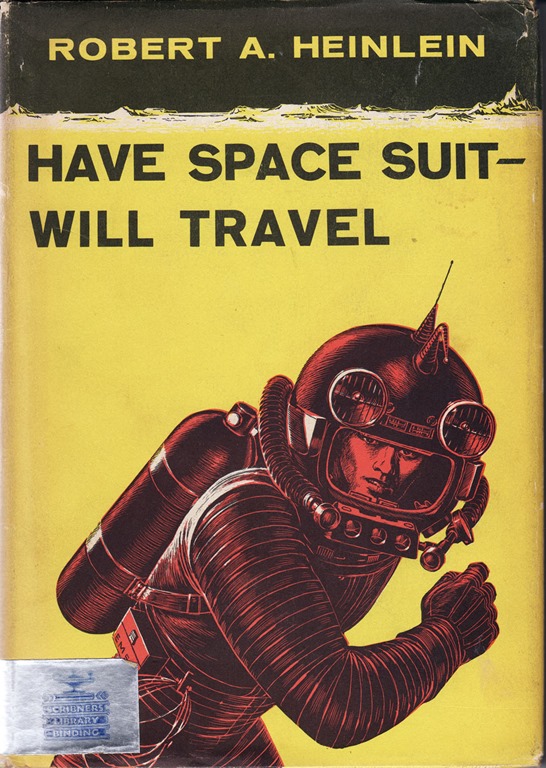
I don’t think I own a single thing that would be worth preserving 600 years, but if I did, what one thing do I own that I would like to represent me and the 20th century to future people?  I would have to pick my hard back copy of Have Space Suit – Will Travel by Robert A. Heinlein.  I used to own a very nice slide rule from the 1950s, and if I still had that, I might have chosen it.  But the Heinlein book really does represent me well.  But what would people a millennia from now think of such a story?  Would their daily language even allow them to read it?

have-space-suit---will-travel

And if I’m honest, I know future people won’t give a  damn about our junk.  They won’t give a damn about what we think or believed.  Some of our crap might make it to museums of the future, and a few eccentrics might collect 20th century doodads, but really, how many people in the year 3013 will even think about us?  Just how much daily life from 1013 do we know about now?  The Al-Hakim Mosque was finished about a 1,000 years ago.

Mosquee_al-akim_le_caire_1

Things that really last are usually buildings, artwork, monuments – works that people create to last.  I’ve often wondered what the world would be like if we all built our houses with the intention they will last a very long time – so every home becomes a museum.  Would that stifle innovation, or stimulate creativity?  Most of the stuff we own ends up in landfill, so psychologically, doesn’t that mean we’re living with garbage and not art?

Imagine a world where the smallest house lot is one acre, and each house owner builds a home intended to last centuries, if not thousands of years.  That everyone lives in the equivalent of an English mini-manor house.  Picture manicured gardens outside, and beautiful art collections on the inside.  How would society change?  Would we still want cars and roads cluttering up the countryside?  Or visible power lines, phone cables, satellite dishes?  Would we design houses to withstand tornadoes and hurricanes?  Could we design roofs that could go 500 years without maintenance?

Homo sapiens have been around for tens of thousands of years.  History, not so long, say five thousand years.  Unless we destroy ourselves, homo sapiens, and their descendants,   AI robots, could be around for millions of years.  How long will we continue to process the resources of the Earth into landfill?  At some point we need to make things that will last, and yet, leave room for new art to evolve and be added.

If I was young I’d buy a plot of land and design a house to last.  I’d furnish it with antique scientific equipment, beautiful electronics from the 20th century, and as much art as I could afford.  I’d want it solar powered.  I’d want enough land to make an interesting landscape. 

It’s a shame I didn’t think of this sooner.

JWH – 10/14/13

The Ghosts That Haunt Me

Most people are haunted by dead relatives – parents, aunts, uncles, grandparents, siblings – but the ghosts that haunt me the most, are people I never knew.  Since I’m an atheist I don’t believe in real visitors from the other side. I don’t expect my Jacob Marley to come calling on Christmas Eve.  On the other hand, there are a number of dead people that won’t leave me alone.

Mark-Twain-by-Alvin-Langdon-Coburn

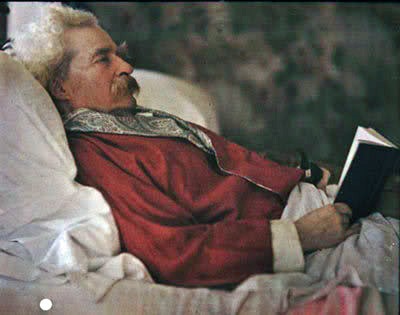
I am mostly haunted by literary figures.  The first one to do this, starting when I was a kid was Samuel Clemens.  For some reason, reading about Mark Twain was always more powerful than reading his fiction.  It started with his autobiography.  I was a kid with my life in front of me, reading about a very successful man writing about his life behind him.  Samuel Clemens led both a charmed and tragic life.  His wife and two of his three daughters died before he did, and Clemens took this very hard.  Clemens always had a sharp tongue for the human residents of Earth, but towards the end, his writing turned bitter to the point of viciousness.  I was born naïve and became a skeptic by twelve, and Clemens writings fueled my conversion to disbeliever.  I have never experienced the tragedies Clemens experienced, so I’ve yet to become bitter, a burden I hope to avoid.

Twain didn’t finish an actual autobiography, but two versions of an autobiography appeared after he died that were heavily edited collections from his voluminous autobiographical writings.   Over the decades the University of California Press released various collections of Twain’s writings, with more and more material that hadn’t been published in his lifetime.  I first got a taste of Twain’s unpublished writing as a teen with Letters from the Earth, coming out in 1962 that I didn’t read until 1968 or 1969.  Over the decades many biographies about Twain have appeared and he would haunt me again and again.

kerouac

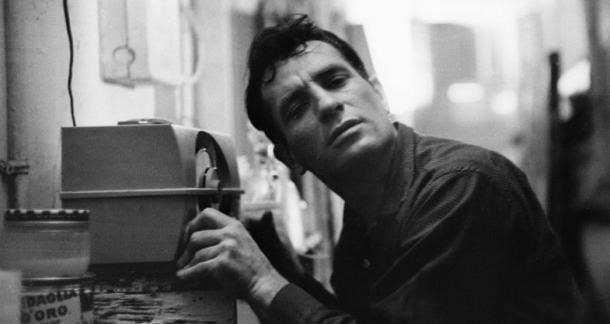
Jack Kerouac was the next literary specter to haunt me, beginning in my twenties.  Jack died in October 1969, the fall I started college, the same year as the first Moon landing and Woodstock.  That was around the time I read The Electric Kool-Aid Acid Test by Tom Wolfe.  I can’t remember if I read that first, which led to reading On the Road, of if reading On the Road led to reading The Electric Kool-Aid Acid Test. Kerouac was a character in Wolfe’s book.

Kerouac was a writer like Proust and Thomas Wolfe (not Tom), who wrote books that were thinly disguised accounts of their own life.  I didn’t know this until I read the Ann Charters Kerouac: A Biography in the early 1970s.  That’s when Kerouac really began haunting me.  I’d read his books, then another new biography, and then reread the novels, and then another biography.  Kerouac became a 10,000 piece puzzle that I’ve never finished.

Even before Philip K. Dick died in 1982 he was a legendary character.  I remember reading about his paranoid theories in The Rolling Stone magazine, and stories about him in science fiction fanzines.  My college roommate even had dinner with Dick and his wife at a convention in the 1970s.  As soon as the biographies came out, I started reading them.  Like Kerouac, no matter how many puzzle pieces I found, the image I had of PKD was always shifting.  Like Twain and Kerouac, Dick was another troubled soul.  Why am I so haunted by people so torn up by their lives?

There is a book of conversations with PKD called What If Our World Is Their Heaven?  That title captures PKD’s kind of spookiness.

Louisa-May-Alcott

I read a biography of Louisa May Alcott before I read her famous book Little Women.  I started off reading about the American Transcendentalists, and found Louisa.  I read two Louisa May Alcott biographies before finally getting to Little WomenLittle Women was my mother’s favorite childhood book.  She tried to get my sister and I to read it when we were kids but I didn’t want to read a girl’s book.  But I was willing to watch Katherine Hepburn and June Allyson play Jo in the movie versions.  Over time Louisa May Alcott started haunting me too.  Another troubled soul.

Other writers haunt me too, Heinlein, Hemingway, Fitzgerald, Wells, Lawrence, Huxley, but so far I’ve only read one biography each for them.  Writers don’t appear truly ghostly until I’ve read several biographies and start reading their letters.  I have read many books on Wyatt Earp, but his appeal is different.  He doesn’t haunt me – maybe because he wasn’t a writer.  Or maybe he wasn’t a troubled soul like Twain, Kerouac, Dick and Alcott.  I’ve always loved biographies, they were among the first type of books I learned to read.  But most subjects of the biographies I read never lingered in my psyche like these four.

Interestingly, the lives of Clemens and Alcott overlapped, as did Kerouac and Dick.  Clemens and Alcott both became successes after the Civil War, becoming famous for writing about their childhoods.  Kerouac and Dick both wrote a lot of books in the 1950s that affected readers in the 1960s counter culture.  All four of them have had their share of film success – with their fictional work, and as characters themselves.  I am not the only person they haunt, not by a long shot.

There is a 1968 Burt Lancaster movie called The Swimmer based on a 1964 short story by John Cheever.  The story begins when a man at a pool party tells his friends that he thinks he can swim all the way home because there’s a pool in every yard across the suburbs to his house.  I think a wonderful account of American history could be written by just writing a series of biographies of all the American writers that span the centuries back to colonial times.  We’re used to history being about politics and war, conquest and invention, economics and industry, but I think there are many ways to look at the evolution of our culture, and the lives of these writers give a much different, and for me, a more real insight into the living through history.

I believe these writers haunt me more than the memories of my ancestors is because my relatives never wrote down their thoughts.  If my dad had written about his life, I think it would be a whole lot like Jack Kerouac’s.  They were both restless men and died miserable drunks.  I’m sure my mother and her mother loved Louisa May Alcott because their lives seemed much like hers.

For some people, the promise of prosperity never lives up to their unfolding lives, and that’s very hard to take.  Ambitious idealists usually have a long way to fall.  I’m currently reading The Unwinding by George Packer.  For all its shiny glory, the American Dream is hard to achieve.  Packer chronicles many Americans who have succeeded or failed, or both, in the last four decades.  What’s amazing about this book is the diversity of the people it presents.  Every American has a different American Dream.  I think we’re all haunted by past Americans.  I think we’re all inspired by our personal ghosts.

JWH – 9/4/13 – Happy Birthday Janis

Rethinking the Great Books of History

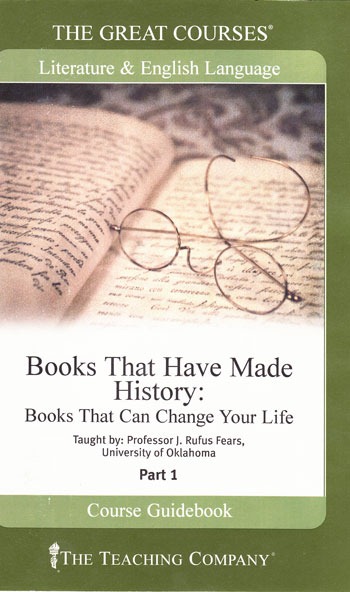
I am listening to “Books That Have Made History:  Books That Can Change Your Life” from The Teaching Company, taught by Professor J. Rufus Fears and I’m wondering if the “classic” books of history are being oversold.

great-courses

I’m a life-long bookworm.  I got my degree in English Literature.  I study books about books, such as those by Harold Bloom, and I even study the Bible as literature although I’m an atheist.  I wish I had the time to master the great books.  And I started listening to these lectures expecting to expand on my knowledge of the great books of history.  However, Dr. Fears is making me think otherwise.

Books That Have Made History is a popular course for The Great Courses, but I think it has a fatal flaw.  And I’m not the only one to criticize this series, just read the customer reviews at the site.

Dr. Fears approaches these 36 lessons with the assumption the greatest books of history have great moral lessons to teach.  He expects great books to explore and answer four questions:

  • Does God or do gods exist?
  • What is fate?
  • What do we mean by good and evil?
  • How should we live?

Dr. Fears teaches these books with a firm belief in the answers.  He teaches each title by fitting them into his own theological beliefs.  In his opening lecture he discusses Dietrich Bonhoeffer and how he was imprisoned by the Nazi’s and hanged on April 9, 1945.  Dr. Fears said Bonhoeffer and the judge that sentenced him to die both read and studied the same classic books of history, and asks:  How did they come to such morally different conclusions?

Dr. Fears assumes the great books of history have answers to the great questions of history.  I think he’s wrong. 

Dr. Fears assumes there is a God, there is good and evil, that we’re expected to live by definite rules, and we have a fate or destiny in our lives.  I think he’s wrong.

Dr. Fears refuses to believe that the universe is accidental, that there is no good or evil, that there are no moral laws embedded in the universe, and the universe expects nothing from us.   I think he’s wrong.

Dr. Fears advocates The Iliad was the Bible for the ancient Greeks like the Christian Bible is for the western world, and that Homer was a singular real person.  I disagree.

Dr. Fears believe Moses was a real historical figure and there’s amble historical and anthropological evidence to support his story.  I disagree and even think many Jewish scholars disagree.

Now my point is not to say I dislike this lecture series because I disagree with the professor.  I’m asking why we should read the great books of history?  If they exist for the reasons Dr. Fears suggests, then I say, let’s forget them.  I’m dead tired of trying to puzzle out truth about reality from ancient thinkers.  I’m willing to read their books to understand the evolution of mankind and its history, but I have no interest in acquiring their beliefs.

Dr. Fears believes studying these books are valuable and relevant to teaching modern people how to think and act.  I think that’s wrong.  I think that’s why our world is confused and full of conflicting belief systems.

Great books make you think about life and reality, but they should give no answers.  Explicit answers are dangerous.  We live in the 21st century and we need to study the moment.  Now it’s actually impossible to study the current “now” in books, since books take years to write.  But for example, if you are studying cosmology, anthropology, or geology, or another other science, you really need to be reading books written in the last five years, and no more than 10 year old.

History and biographies can have a trailing edge of maybe 25 years, but that’s because some topics don’t get written about all that often.

If you’re studying the great books of history, I believe they should be read as primary sources to supplement current historical research.  Your research efforts should go into studying how and why they were written in context of their times, and not use them for acquiring personal beliefs.

This represents a schism in approaching reality.  If you believe that science has been the only consistent human endeavor to answer questions about reality, ancient knowledge will only be superstitious beliefs and endless philosophizing.  If you believe in God, then ancient writings are a goldmine of potentially revealed secrets.  Books That Have Made History falls in the later category.  My thinking falls in the former, so these lectures have little value to me.

However, they do make me ask:  Should or can we write current books that summarize good and ethical behavior for people to study?  If people are wanting to read books about how to live their lives in a “proper” manner, can’t we come up with something a little more current and based on contemporary knowledge?

JWH – 9/12/12