Isn’t Receptivity for Fake News in Our Genes?

by James Wallace Harris, Tuesday, November 29, 2016

When we are very young our parents convince us to believe in Santa Claus, The Tooth Fairy and The Easter Bunny. We grow up believing in Super Heroes, Harry Potter like magic, and far out science fictional ideas. We are taken to churches and taught to believe in Jesus, God, angels, heaven, hell and eternal life. All of these beliefs are easily disproved with a good education. And when we want to keep these fantasies rather than accept reality, we learn denialism. Even our favorite adult art forms – television, movies and novels depend on us suspending rational thinking to enjoy.
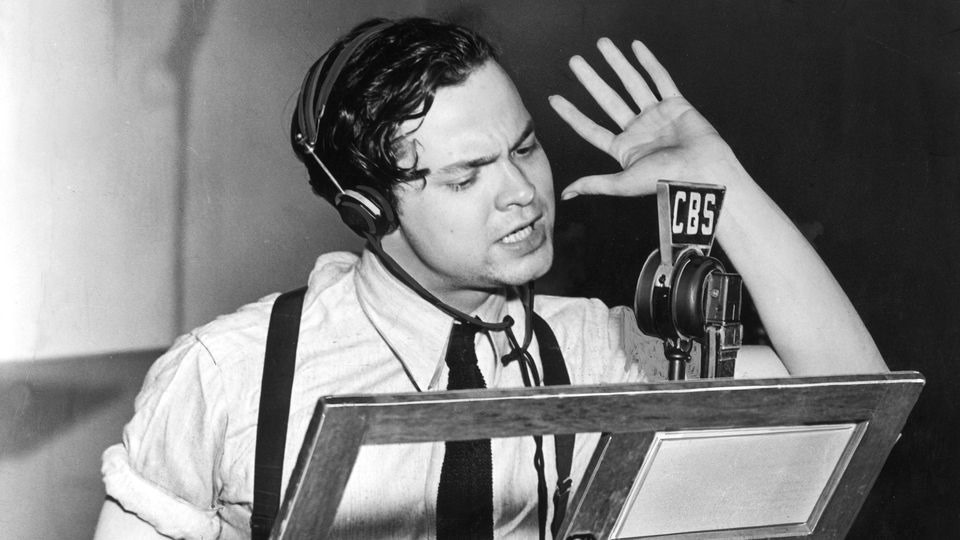
Orson WellesWe are conditioned to believe in fantasies. Most people aren’t atheists because they can’t throw off their childhood brainwashing even when there’s amble evidence. And all the fantastic ideas we embrace are so much more appealing than the cold facts of reality. Is it any wonder we find it easier to rationalize what we want than to be rational thinkers able to discern fake news from validated facts? Homo sapiens aren’t rational creatures, but rationalizing ones.

Strangely, fake news is in the news like its something new. The Onion and Saturday Night Live have been doing fake news for decades (1988, 1975). Tabloids go back much further, but even the earliest of newspapers played fast and loose in their reporting. It’s also well established that first person testimony is unreliable. We all live in a sea of lies, so is it such a surprise we can’t tell shit from Shinola?

The Bible is promoted as the literal word of God by many, yet it only takes reading the book itself to reveal it was written by all too human people, expressing widely divergent opinions and philosophies, using different writing styles and points-of-views, and often showing contradictions and inconsistencies. And scholars of history, who study The Bible in-depth, have found parts of it to be fake history. Many books of The Old Testament appear to have been written to pre-date land claims in building of an ancient nation. And books in the New Testament were forged to shape Christian theology based on personal bias. To compound the many false aspects of The Bible, many thousands of books have been written to rationalize those falsities. Anyone who reads The Bible should at least get a scholarly study Bible, like The New Oxford Annotated Bible, and read what experts have to say along with the currently best translation of the oldest biblical texts we have. It would also help to read books about the history of The Bible before starting any serious Bible study, such as The Bible Unearthed or Who Wrote the Bible? to give a historical context why the The Bible was originally written, and by who. But we don’t do that, do we? We just embrace the good bits, using them to justify our current beliefs and wants, claiming “God” an an authority.

And remember that saying, “History is written by the victors,” that’s just the start of the distortion. Anyone who wants to shape current thought can write a history book. And the news media can say anything about history, as well as artists. Just look at JFK by Oliver Stone. Everyone thinks they know the truth. But reality is Rashomon 24×7. Truth is extremely elusive, unless you understand science, math and statistics, and only then it’s the best truth we can find at the moment.

How to deal with fake news is the talking-head topic of the month. Most discussions are about how to ban fake news, yet I can’t imagine a world where we can trust what we read, hear and see. Will we ban satire? Obviously we won’t ban lying politicians. Should churches have to prove the existence of eternal life before collecting tithes? Shouldn’t fantasy fiction come with the warning “Magic Does Not Exist” printed on the spine?

Fake news isn’t just those weird stories you see on Facebook. Fake news is any information you use to understand reality. I include religion because gospel means the good news. We assume its true, but isn’t it fake news too? Gossip can also be considered fake news, since it’s usually distorted. When it comes to spotting fake news, we’re piss-poor judges, and it’s everywhere.

To abolish fake news would require programming our kids to become hyperaware of lying, to think skeptically, distrust the media, history books, social institutions and other people, and carefully evaluate everything they read, see, or hear. We need to educate them about science, logic, philosophy, ethics, authority, evidence, scholarship and statistics. We’d have a wiser society if folks studied statistics and data mining every Sunday instead of going to church.

But will any of this ever happen? Didn’t Donald Trump win because of anti-intellectualism, denialism, fake news, unethicality, and mob rule social media? Doesn’t his success endorse its efficacy? Isn’t fake news an effective tool in the fight against science and enlightenment politics? Didn’t orthodox Christianity suppress liberal Christianity in the first three centuries of the common era with the same tactics? George Orwell’s classic novel, Nineteen Eighty-Four illustrated perfectly the value controlling the news. Aren’t the institutions of news always the first things revolutionaries take over in revolutions? Haven’t conservatives succeeded amazingly well with Fox News? Fake news is too effective to give up, especially if your objective is to get votes, change laws, or demolish reputations.

I’d like to believe we could change things for the better, but when I read history I’m not sure I see any signs of progress. I’d like to believe the pendulum swings back and forth between conservative and liberal eras, and overall we’re becoming more liberal over time. But that might be like climate change deniers taking tiny segments of temperature histories to claim a cooling trend, while ignoring the larger trend on the graph. Reading books like Collapsed by Jared Diamond suggests we don’t change. Our species has been extremely stable for a couple hundred thousand years. Evolution produces species that adapt to their environment, and we have adapted very well. But we have adapted because of the selfishness of individuals. We have not adapted because of liberal ideals. Fake news benefits the survival of the fittest individuals, not groups.

JWH

Could You Pass 4th Grade Math?

By James Wallace Harris, Tuesday, January 12, 2016

One of my great regrets in life is not trying harder in school when I was young, especially at studying math and science. I did get through Calculus I in college with a B, but I laid out a year and when I returned to take Calculus II, I was lost. I always studied just enough to pass the tests, but never enough to gain a deep understanding. It was complete laziness on my part.

Now that I’m retired, and I sense my mind in decline, I’ve wondered if I could learn in my final third of life what I didn’t in my first third. It’s that age-old question: Can you teach an old dog new tricks? Would it be possible for me to relearn math and then finish Calculus II? I’ve been meaning to get started on this project for two years, but like my younger self, I put it off to play instead.  I don’t know why, but about a week ago I did get started, studying math with a workbook and the Khan Academy.

Khan2

My first impulse was to begin again with Algebra, but I thought I better refresh myself with Arithmetic, and tried some 4th grade math. It’s a good thing I did, because I’ve discovered I’ve forgotten how to do advanced subtraction and division problems. Decades of using a calculator has ruined my basic math skills and I discovered I was completely flummoxed by that whole carry the number thing.

What’s really amazing is how fantastic the Khan Academy is at teaching. At least the new version, with interactive assessments. Ever since personal computers came out in the late 1970s, I thought they should be fantastic teaching tools. And I assumed the best subject computers to tutor would be math. But every time I looked at math teaching programs I was disappointed. The Khan Academy programs have come up with a rather straight forward method that I’m actually finding addictive. They have drills that automatically assess my answers. Each session covers six problems. I work out the problem on paper, and put in the answer on the computer. If it’s right, I get the next problem, if it’s wrong, I’m forced to keep trying. I can ask for hints, or I can watch instructional videos.

Khan Academy

My ego pushes me to get all six problems right in a row. I hate seeing the big X that reminds me I failed. Early on I learned that I’m careless about reading the screen properly, or transferring the problem to the paper, or the answer to the screen. But I quickly began to double check my work. Then I learned that I make casual math mistakes. I used to know my times tables cold, but evidently I’ve got some bugs in my brain. So I do everything twice or thrice. Finally, and this was most enlightening, is I’ve completely forgotten how to do some basic math skills. Which makes me glad I started with arithmetic.

This challenge is demoralizing in a way. I used to believe that with effort I could relearn all my old math and finish Calculus II, but now, I’m not so sure. It’s certainly going to take a lot of time, and hard work. What I’m actually feeling are the limitations of my mind. I’m hoping those limitations are like exercising the body, and that with daily workouts will build my math stamina. I already physically exercise three times a day, and I know my body will never do what it did in my twenties or even forties again. I might be fooling myself that I can mentally turn back the clock, but for some reason I do have hope. I believe my brain is plastic enough to still learn. I’ll learn just how adaptable my 64 year old brain is this year when I get into algebra.

I am reminded of that wonderful novel, Flowers for Algernon, about a guy name Charlie, with an IQ of 68. Charlie volunteered for a medical experiment to boost his intelligence. The procedure worked, and eventually Charlie became a genius, but then the treatment wore off, and tragically Charlie returned to his low IQ existence. Getting old feels like being Charlie after the treatment starts wearing off.

Essay #997

Explaining Reality With More Than One Book

By James Wallace Harris, Tuesday, December 8, 2015

What are the minimum number of books you’d have to read to get a good overview of reality? Would they all be science books, or would we need philosophy, history, mathematics or even religious texts to go beyond what experimental results can’t cover?

There are billions of people on this planet who explain existence with the help of just one book. These sacred works have been around for hundreds, if not thousands of years, well before science and scholarship. It’s quite understandable to want just one manual, but is this world explainable in words? Science experiments offers an alternate explanation to ontological questions, but requires reading a library of books to understand. That might be why billions stick to their single volume guides.

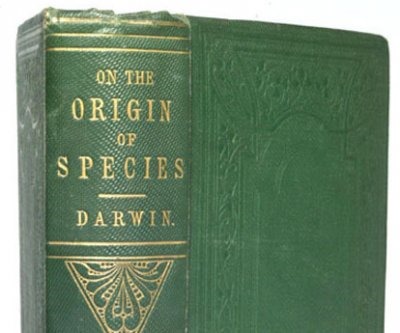
On the Origin of Species

Is there a single science book that can compete with The Bible, Quran, Tanakh, Tao Te Ching, Rig Veda, Diamond Sutra, etc.? Does science even try to give one book believers what they want? A book on cosmology or biology explains aspects of reality but without telling people how to live. People who live by just one book, read for guidance, not explanations. They want the world to be easily explained, fair and just. The trouble is science splendidly explains how reality works in tremendous detail, but offers no guidance how to live. We followers of science are left to find our own purpose, because science clearly shows everything in this reality is a product of impartial statistical events.

Do people choose one book solutions because reality is overwhelming, preferring simple myths instead?

How many science books would a person of faith have to read before they could understand the existential nature of their lives? Because believers are taught from an early age to believe in their single books, their non-scientific views are deeply ingrained in their minds, and hard to reprogram. Apparently, anything we learn as children sticks with us, and is very hard to erase. If children were taught Darwin at an early age, and their one book was On the Origin of Species, would the world be psychologically different?

Few scientists understand the actual science of things beyond their narrow specialty. If everyone had to read the original research of all the discoveries of science, we wouldn’t have much time for anything else. Most supporters of science understand reality through popular science, which is only an approximation of real science. Our knowledge about reality is collective knowledge. People who argue against evolution are really arguing against millions of books and research papers.

I once bought On the Shoulders of Giants by Stephen Hawking, which reprints the original scientific writings of Kepler, Copernicus, Galileo, Newton and Einstein, but I could not read it—at least for long. If I devoted my life to it, I could probably understand this book after a few decades of trying.

What would happen if schools showed documentaries that recreated all the great science, mathematics and engineering experiments of history, so that little kids saw how people discovered details of reality for the first time? Would seeing be better than reading?

I’ve read hundreds of nonfiction books and seen just as many documentaries, but I’d be hard press to point to a selection and claim they are the basis of my beliefs. Of course I have a confusing, muddled view of science and mathematics, and couldn’t actually teach what I know either. However, because there are endless views of The Bible or Quran, I tend to think even having just one book to master doesn’t lend itself to consistent explanations.

Despite all the books I’ve read about Einstein, and all the documentaries I’ve seen that explain his work, I still can’t comprehend relativity. Evolution makes sense to me, but I couldn’t teach it. I can understand why other people might not comprehend evolution.

Maybe we should ignore books altogether. Maybe we should strive to teach kids the basic concepts of science by having them recreate the experiments themselves. I’m getting sort of old, but I wonder if there are any experiments I could learn to do, that would allow me to see how a basic aspect of reality works. For example, I’ve been taught the sun is a big ball of hydrogen. Is there anyway I could prove that for myself?

For 2016, I plan to read On The Origin of Species. I wonder how close I can get to seeing the science behind it, and how much will remain just a story, a myth, a generalization? And after that, I want to find another science book that will take me closer to understanding real science rather than popularization. Einstein discovered relativity with thought experiments. I don’t think there will be many books I can comprehend actual science without mathematics and experimental apparatus, but there might be a few. I’m sure it’s more than one.

I ask my friends who believe in The Bible to distrust what it says, but am I not a creature of faith by my acceptance of science from popular sources? Who knows, maybe one book guides are one too many. Maybe we shouldn’t believe anything unless we can recreate the experimental proof ourselves.

JWH

Classroom Learning v. Online Learning

By James Wallace Harris, Thursday, October 15, 2015

This week I started a continuing education class in beginning drawing. It’s the first classroom learning experience I’ve had in over a decade. Of course, folks my age don’t usually go to school, but I was still taking some graduate courses in my fifties. In recent years I’ve been using online courses from Coursera and Udemy, or I sometimes buy Great Courses on DVD. And whenever I want to learn something quickly, I go to YouTube and find a How-To video. Plus, I’ve been an autodidactic my whole life, and learn on my own with books.

Taking this drawing course is way off my beaten path because I’m trying to learn something I have absolutely no previous experience with in any context. Even my expectations for what the class would be like was completely different from what I experienced. I assumed the teacher would start us with pencil and paper and teach us the rudimentary skills of line drawing. Instead she had us create two 1-10 gray scales with 9B pencil and black Conte crayon. Then she had us “draw” from still-life objects by using shading rather than lines. She took us through a tour of the building where the walls were covered with student artwork and showed us how it’s possible to draw without lines, and explained the lines we see in reality are just edges to various levels of shading.

An_elderly_man_Realistic-Pencil-Drawing

[See the power of the pencil]

It was when we actually got down to work that I realized the difference between classroom learning and online learning. Nine-seven percent of my time I worked alone, but when I did get the teacher to come by to show me something it caused a big leap in my ability. Unfortunately, my teacher didn’t spend that much time with me. She had to lecture and visit the other students. Now this one little insight is the intent of this whole essay. I have found numerous videos online that teach drawing. They are all equal or better to classroom lectures when dealing with information. The same is true for books, although seeing someone demonstrate drawing techniques works much better in videos than from the printed page.

Where the classroom wins is when you get feedback. Sadly, most classroom instruction is built around lectures, and the reality is most video lectures come from top tier instructors. I also watched my fellow students in class and realized if I could work with them, all of whom had more experience drawing than I did, I could learn from them as well. This reminds me of when I went to computer school back in the early 1970s, at the State Technical Institute in Memphis. Classes were three hours. The first hour was lecture. The next two hours were programming. The teacher hung around to give one-on-one help, plus students worked together and helped each other. This method was perfect. This is how Pythagoras and Aristotle taught over two thousand years ago. This is not how most of my university classes were like. It was better decades ago when classes were lectures and discussions, but unfortunately, someone asshole invented PowerPoint, and things got real boring. That’s why my last stint at college was taking fiction writing workshops.

My guess, the best way to learn is with a tutor, with one-on-one instruction. And I’d advise colleges and professors who don’t want to be put out of business by online courses to spend more time interacting with students while they work. Leave the lecturing to the folks who are most eloquent in front of a camera. Instruct while walking between your students, and having them work on something you can guide them personally. Stop by each student often to see how they are progressing. Give the students time to work together. Spend as much time as possible away from the front of the class. Online learning can’t compete to this kind of instruction.

Here are some samples of online lectures. Notice how the video deletes dead time—some of these seven minutes lessons would be a whole class period in the real world. It’s very easy to go back and repeat parts. It’s also easy to find other teachers covering similar topics. What the videos can’t do is give instant feedback and guidance. It really helps to have a human say, “That won’t work, try this.”

My continuing education course would actually be far more effective if it was built around a computer lecture series, and all the time I got to spend in class was interacting with a teacher and my fellow students.

JWH – #973

How Do You Keep Learning After You Finish School?

By James Wallace Harris, Tuesday, July 7, 2015

Problem

  • Going to school forces us to acquire a general education.
  • Most people stop their general education when they stop going to school.
  • What’s the best method to continue a general education throughout life?

Hypothesis

Regular reading of a general interest magazine that covers the widest possible number of subjects written by the best specialists on those subjects will provide the best continuing general education.

Proposed Test

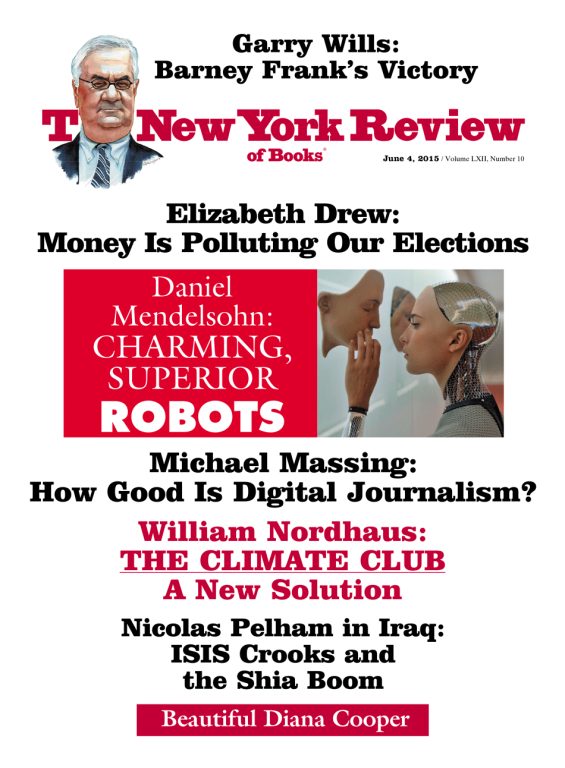
Read The New York Review of Books. (not all articles are free)

Alternate Tests

Tell me your proposed solutions or preferred magazines.

NYRoB

JWH