Rebecca (1940)

by James Wallace Harris, 9/11/23

This is not a review, but my reactions to watching Rebecca, the 1940 Alfred Hitchcock movie with my friend Olivia. I’ve decided I don’t want to review books and movies because that would involve withholding spoilers. I want to talk about how I react to fiction — how fiction works on me.

I don’t think I’ve seen Rebecca before. I’ve started it a few times recently, but in recent years I have had trouble watching movies by myself, so I didn’t watch it all the way through until Olivia wanted to see it too. I’m thankful she came over to join me. Over the past year I’ve encountered several women friends who have told me they’ve read the 1938 novel Rebecca by Daphne du Maurier. They all loved the book, and I bought a copy. I started the book a couple of times but didn’t stick with it. I loved the writing. I adore the open paragraphs. du Maurier description of nature taking over the old estate is exactly how I picture nature taking back cities when civilization falls.

Last night I dreamed I went to Manderley again. It seemed to me I stood by the iron gate leading to the drive, and for a while I could not enter, for the way was barred to me. There was a padlock and a chain upon the gate. I called in my dream to the lodge keeper, and had no answer, and peering closer through the rusted spokes of the gate I saw that the lodge was uninhabited. 

No smoke came from the chimney, and the little lattice windows gaped forlorn. Then, like all dreamers, I was possessed of a sudden with supernatural powers and passed like a spirit through the barrier before me. The drive wound away in front of me, twisting and turning as it had always done, but as I advanced I was aware that a change had come upon it; it was narrow and unkept, not the drive that we had known. At first I was puzzled and did not understand, and it was only when I bent my head to avoid the low swinging branch of a tree that I realized what had happened. Nature had come into her own again and, little by little, in her stealthy, insidious way had encroached upon the drive with long, tenacious fingers. The woods, always a menace even in the past, had triumphed in the end. They crowded, dark and uncontrolled, to the borders of the drive. The beeches with white, naked limbs leaned close to one another, their branches intermingled in a strange embrace, making a vault above my head like the archway of a church. And there were other trees as well, trees that I did not recognize, squat oaks and tortured elms that straggled cheek by jowl with the beeches, and had thrust themselves out of the quiet earth, along with monster shrubs and plants, none of which I remembered. 

The drive was a ribbon now, a thread of its former self, with gravel surface gone, and choked with grass and moss. The trees had thrown out low branches, making an impediment to progress; the gnarled roots looked like skeleton claws. Scattered here and again among this jungle growth I would recognize shrubs that had been landmarks in our time, things of culture and grace, hydrangeas whose blue heads had been famous. No hand had checked their progress, and they had gone native now, rearing to monster height without a bloom, black and ugly as the nameless parasites that grew beside them. 

On and on, now east now west, wound the poor thread that once had been our drive. Sometimes I thought it lost, but it appeared again, beneath a fallen tree perhaps, or struggling on the other side of a muddied ditch created by the winter rains. I had not thought the way so long. Surely the miles had multiplied, even as the trees had done, and this path led but to a labyrinth, some choked wilderness, and not to the house at all. I came upon it suddenly; the approach masked by the unnatural growth of a vast shrub that spread in all directions, and I stood, my heart thumping in my breast, the strange prick of tears behind my eyes. 

There was Manderley, our Manderley, secretive and silent as it had always been, the gray stone shining in the moonlight of my dream, the mullioned windows reflecting the green lawns and the terrace. Time could not wreck the perfect symmetry of those walls, nor the site itself, a jewel in the hollow of a hand. 

The terrace sloped to the lawns, and the lawns stretched to the sea, and turning I could see the sheet of silver placid under the moon, like a lake undisturbed by wind or storm. No waves would come to ruffle this dream water, and no bulk of cloud, wind-driven from the west, obscure the clarity of this pale sky. I turned again to the house, and though it stood inviolate, untouched, as though we ourselves had left but yesterday, I saw that the garden had obeyed the jungle law, even as the woods had done. The rhododendrons stood fifty feet high, twisted and entwined with bracken, and they had entered into alien marriage with a host of nameless shrubs, poor, bastard things that clung about their roots as though conscious of their spurious origin. A lilac had mated with a copper beech, and to bind them yet more closely to one another the malevolent ivy, always an enemy to grace, had thrown her tendrils about the pair and made them prisoners. Ivy held prior place in this lost garden, the long strands crept across the lawns, and soon would encroach upon the house itself. There was another plant too, some half-breed from the woods, whose seed had been scattered long ago beneath the trees and then forgotten, and now, marching in unison with the ivy, thrust its ugly form like a giant rhubarb towards the soft grass where the daffodils had blown. 

Nettles were everywhere, the vanguard of the army. They choked the terrace, they sprawled about the paths, they leaned, vulgar and lanky, against the very windows of the house. They made indifferent sentinels, for in many places their ranks had been broken by the rhubarb plant, and they lay with crumpled heads and listless stems, making a pathway for the rabbits. I left the drive and went onto the terrace, for the nettles were no barrier to me, a dreamer. I walked enchanted, and nothing held me back.

du Maurier, Daphne. Rebecca (pp. 1-3). Little, Brown and Company. Kindle Edition. 

This is why I wanted to see the movie and finish the book. I wanted to see it even more when I discovered there was a 2020 remake with Lily James, and a 1997 Masterpiece Theater version. What makes this story so compelling that it gets filmed many times? It’s immensely popular, and Hitchcock’s film won an Oscar for best picture. I find such enduring tales intriguing to study. Watching Rebecca with Olivia was just my beginning of studying du Maurier’s novel.

I didn’t know that when I watched Rebecca last Thursday, but reading about the film reveals that Rebecca was the movie David O. Selznick produced right after Gone with the Wind. Two movies about strong-will women. Gone with the Wind could have been titled Scarlett. Rebecca is never shown in Rebecca, but I now picture her as Vivian Leigh.

I was somewhat disappointed with Rebecca. It’s slow to get into. My wife Susan bailed on it after the first hour and left Olivia and I to finish it on our own. But more importantly, it’s the kind of story that withholds information to create suspense, and I dislike that plot trick. Overall, I did enjoy the film.

Don’t read any further if you haven’t seen the film or read the book, because I’m going to give away big spoilers.

The film begins by recreating the dream sequence I’ve quoted above from the book, but it’s shortened and somewhat changed. There are clues to what happens in this dream sequence, but the real mystery is why the dreamer can’t return to Manderley.

The story then cuts to Monte Carlo where a young naive woman (Joan Fontaine), a paid companion to a Mrs. Van Hopper, meets the mysterious Maxim de Winter (Laurence Olivier), aged forty-two. At this point in the movie, the scenes are light and somewhat humorous. Joan Fontaine plays the unnamed young woman as drab, skittish, fearful, clumsy, and innocent. We don’t know why the older, rich, sophisticated man takes an interest in her, but he does, and they quickly marry. This opening is a kind of Cinderella story, and I assume why women like the picture so much.

I didn’t buy it. Maxim came across as a tortured soul, both wise and educated, but mentally imbalanced. If age of consent was based on a relative scale of maturity, then the young girl should have been out-of-bounds. But a discerning Sherlock Holmes might have guessed something here. If Maxim was honest with Mrs. de Winter 2 the whole rest of the picture which turns into a gothic torture tale could have been avoided and we could have continued with a light romantic comedy.

Now we arrive at Manderley and slowly learn about Mrs. de Winter 1, who was named Rebecca. This whole middle 80% of the film is about misdirection. Both the audience and Mrs. de Winter 2 slowly learns about Rebecca and gets an entirely false picture of her. This is exactly the kind of plotting that Alfred Hitchcock loves. He tells this part of the story with many tense sequences, building us up, and then backing off a bit. Hitchcock has hooked an enormous fish and reals us in slowly.

A good part of this action involves Mrs. Danvers (Judith Anderson), who is the creepy housekeeper of Manderley. She loved Rebecca. Obviously, du Maurier was a huge fan of Charlotte and Emily Brontë. It’s worth reading the Wikipedia entry on Rebecca, especially the sections on “Derivation and inspiration” and “Plagiarism allegations.” Du Maurier was jealous of her husband’s former lover and claimed it gave her the idea for the novel. Other people thought differently.

Finally, the movie takes a weird twist. We were told Rebecca had drowned and her body recovered. Eventually, her sunken boat is found by divers, and her body is found inside with clues to suggest she was murdered. Jack Favell (George Sanders) shows up and we learned that Rebecca had been fooling around with him. Favell starts accusing Maxim of murdering Rebecca and the plot really thickens. Poor Mrs. de Winter 2 starts going crazy trying to figure out what was going on. It’s then that Maxim confesses what happened.

Up till then Mrs. de Winter 2 thought Rebecca was an angel and perfect wife she could never measure up to. Maxim tells her that Rebecca was a cheating sack of shit who began destroying his life just days into their honeymoon. Mrs. de Winter 2 is immensely relieved because she finally realized Maxim loves her for herself. Of course, there’s the matter of Maxim might be a murderer. But she still loves him. In fact, these revelations empower her to fight for her man.

The film goes through a few more twists and turns to wrap things up with a happy conclusion after the crazy housekeeper burns down Manderley with herself inside. That’s why people can’t go back.

If du Maurier and Hitchcock had not withheld information at the beginning of the story, we wouldn’t have had such a tortured-tension plot. If Maxim, back in Monte Carlo, had told the innocent lady’s companion that he liked her because his dead wife was everything he hated, we would have needed a different plot. That would have been the natural thing to do for most men.

And it’s illogical that Maxim kept Mrs. Danvers on, who worshipped Rebecca and kept half of Manderley as a shrine to her. Most guys would have fired her and gotten rid of everything that reminded them of Rebecca. In fact, the premise that Rebecca could do what she wanted because Maxim wouldn’t want her indiscretions to ruin his reputation is also ridiculous. Maybe it’s better explained in the book, but I find that to be an extremely weak point of the story. Divorce was common enough in England in the 1930s.

Why didn’t Maxim pull Rhett Butler and tell Rebecca he didn’t give a damn about her threats? Both Maxim and his new bride are weak and retreating. Is there another story here? What if Rebecca wasn’t bad? What if Rebecca had to live with a mentally ill husband, the reverse of Mr. Rochester in Jane Eyre?

Rebecca is essentially a thriller with a major plot twist. That’s the trouble with thrillers and mysteries, they often depend on unbelievable plot points. They contrive and contort their stories. I understand why Hitchcock does this because he loves to manipulate his audience. But I’ve got to ask: Why does the audience accept being manipulated? In one interview I saw with Hitchcock he compared what he did to scary amusement rides at carnivals. Riders know they are safe but love to pretend to be scared. This suggests that most moviegoers loved to be manipulated. I’ve gotten tired of it.

I’m anxious to read the book to see if du Maurier makes the same kind of contrivances in her story. Did Hitchcock bend it to his needs, or did du Maurier have better explanations? Her opening describing how plants take over is very realistic. I’m hoping to find more of that realism in her novel.

Plus, I’ve thought of some things after watching the movie. Why does the crazy housekeeper trick Mrs. de Winter 2 into dressing up as Rebecca for the costume party? She probably knew that Maxim hated Rebecca. On my first viewing of the film, I assumed that Maxim loved Rebecca and blew up at Mrs. de Winter 2 for recreating a painful good memory. But as we know now, it’s a painful bad memory. We knew Mrs. Danvers wanted to kill Rebecca’s replacement, so I should have guessed a different motive for her getting Mrs. de Winter 2 to dress as Rebecca.

This is why rereading books and rewatching movies are important. Since I know the information that du Maurier and Hitchcock withheld, will the story still work? Or will it fall apart? Or will it even work better as I see deeper into a multidimension structure?

JWH
Replacing Classic Novels

by James Wallace Harris, 8/12/13

Most bookworms just want to be entertained. They know their tastes are so individualistic that no friend or authority can predict what they will like. However, teachers and literary scholars like to think that certain books should be read, and a tiny fraction of readers are willing to read books because they have a great reputation. We feel reading the classics makes us a better person.

There is no FDA like agency that officially rates books as choice or prime. So, what makes a classic novel? The common assumption is novels that survive the test of time are the real classics. However, you can go on Amazon and order a lot of books from the 19th century that no one considers classics. Some people consider books that are taught in school or college to be the classics. And there is some merit to that, but literary works that get taught are also subject to the whims of pop culture, and English departments.

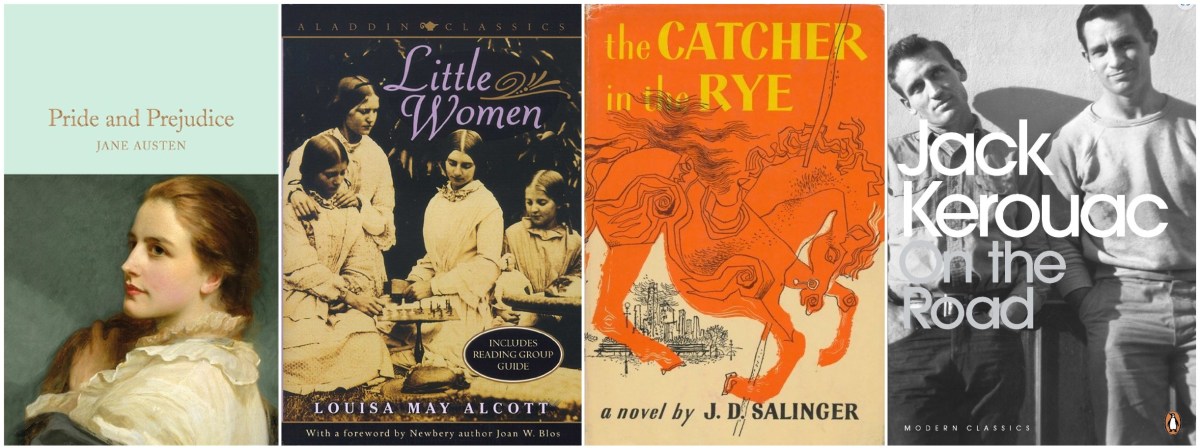
I mention all this, because I read “8 Overrated Literary Classics and 8 Books to Read Instead” by Jeffrey Davies, especially since it throws four of my favorites under the bus: On the Road by Jack Kerouac, Pride and Prejudice by Jane Austen, The Catcher in the Rye by J. D. Salinger, and Little Women by Louisa May Alcott.

Of course, this is clickbait, but I’ve seen this kind of essay before. A couple other examples are “13 Overrated Literary Classics, and What to Read Instead” by J. W. McCormack and “9 Overrated Classics — And What to Read Instead” by Zoraida Córdova.

I understand why young people rebel and want to overthrow the reading lists of the past, especially a past dominated by white male writers. And sure, sometimes these articles are just giving suggestions as to something different to read. But other times, I do feel the writers just hate the classics they are demoting. I often see On the Road and The Catcher in the Rye listed in these literary rebellions. (A hilarious generational attack on The Catcher in the Rye is the novel King Dork by Frank Portman)

What I would like to propose are rules for this game. If you want to oust a literary classic, you need to provide a proper substitute. All too often, these writers offer alternatives that are just their personal favorites, and usually something from recent decades. Classics have specific qualities that any substitute should have too. They include:

  • A snapshot of history – time, place, and subculture
  • Innovation in writing style and techniques
  • A philosophical or psychological insight

In other words, classic novels offer a view of everyday life in the past, even if it’s inaccurate, slanted, or distorted. That’s why I’m against publishers cleaning up aspects of older novels to make them politically correct for modern woke minds. We need to know both the good and bad about how we were. No censoring or whitewashing the past by substituting novels that agree with your moral and ethical sensibilities.

Classic novels supplement history books to build mental models of the past in our heads. Removing any one of them takes pieces of the puzzle away from the collective images we’re building of our cultural heritage and history.

If you’re serious about offering replacements because you feel an existing classic work doesn’t do the job well enough, then suggest a novel that offers a better view of the same time and setting. One that is more insightful.

The trouble is, doing just this is extremely hard. Readers have spent decades and centuries winnowing out the best novels. You might dislike novels for the views they show, but finding good replacements takes a lot of work and reading.

I would suggest, instead of trying to replace specific classic novels, you offer supplements instead that expand or enhance the classics. For example, The Catcher in the Rye (1951) and On the Road (1957) are about alienated youth in America before the youth rebellion of the 1960s. We need more novels about kids growing up in America in the 1940s and 1950s to expand on the views those two famous classics give. I would suggest Horseman, Pass By and The Last Picture Show by Larry McMurtry and The Bell Jar by Sylvia Plath, among others.

The challenge would be to find novels written near the time and setting covered, ones that have been forgotten but are worth resurrecting and remembering. There is something more authentic about novels written by people who lived in the time of the novels as opposed to later novels that are historical fiction.

Few novels are truly contemporary. On the Road was set in the 1940s, but was written in the early 1950s, and published in 1957. It takes a certain number of years to get the perspective and write things down. Breakfast at Tiffany’s was published in 1958, but about 1943. And it’s not the early sixties we see in the film, and neither is the plot or characters. Holly Golightly is a lot closer to Neal Cassidy than most people realize. She is another alienated youth from the 1940s, and another supplement for The Catcher in the Rye.

I understand why young readers dislike older novels. I can understand why they want to promote their favorite stories as classics. But I don’t think it’s an ethical idea to suggest they should replace the older classics, especially with newer novels.

They need to decide which novels from the eras in which they lived paint a worthwhile picture of those times and places, and then promote them as the classics that represent those settings and characters.

If these essay writers need a hook to promote the books they love, please don’t throw the books under the bus that other people love. I’d suggest being straight forward and creating titles like: “The Best Books about Miami in the 1980s.” Or “Novels About People Who Lived Down the Street from Jane Austen.” Or “Characters Who Lived While Jack and Neal Were On the Road.” Or “Novels That Louise May Alcott Read That We Should Read Too.”

JWH

Memories Imagine the Darndest Things

by James Wallace Harris, 7/10/23

This essay is about remembering something that never happened and the theories I’ve developed to explain my memory hallucination.

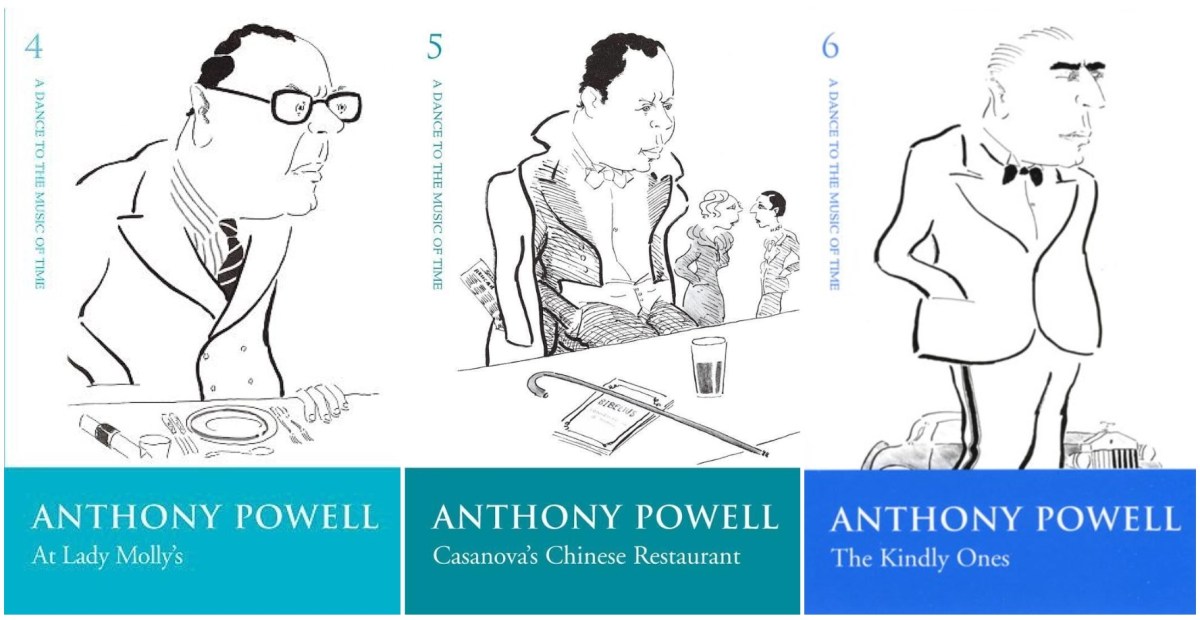
While reading The Kindly Ones by Anthony Powell, the sixth novel in a twelve-novel series called A Dance to the Music of Time, I had the constant feeling I had read it before. Several scenes throughout the novel seemed so familiar that I felt like I had studied them over several readings. I always assumed it was because I had twice watched the four-part miniseries based on the books. I’m sure that accounts for the general sense I’ve read The Kindly Ones before, but not the intense sense of remembering specific scenes. Yesterday I replayed the portion of the miniseries that deals with the most remembered scene and it merely skims over a very long detailed scene in the book.

A Dance to the Music of Time is about Nick Jenkins and his life from the 1920s through the 1960s. It’s not a Roman à clef but Anthony Powell based Nick on his own life. It’s a fictional exploration of memory, so it’s rather ironic that I’m having memory problems reading it.

There were many scenes that felt I had read before, but I just assumed they were in the miniseries. However, one scene was intensely vivid and familiar. It was the long scene where Nick Jenkins met Bob Duport years after Nick had had an affair with Duport’s wife Jean That affair was chronicled in an early novel in the series. So those pages recall events that happened in earlier novels, but it also has much new information that wasn’t in the earlier novels. The most vivid scene involved Nick wanting to avoid the subject of Jean, but Bob slowly getting around to talking about her. Bob starts describing the men he knew Jean had affairs with and what they were like. Bob kept making a case that Jean was attracted to men who were assholes and even admits to being one himself. Nick doesn’t know if Bob is intentionally insulting him or accidentally torturing him.

In recent years I have become distrusting of my memory for many reasons. The first is, memories often feel faulty. But that sense of faultiness is the kind we associate with dementia. I’m now exploring memory delusions.

I’ve read a number of books about the limitations of memory, and I’ve come to assume memories are unreliable. The best book I’ve read on this is Jesus Before the Gospels by Bart D. Ehrman. You wouldn’t think a book about Jesus would be the best place to learn about the limitations of memory, but it’s the best I’ve found.

If the television miniseries wasn’t where I acquired my pre-knowledge of that scene in The Kindly Ones, where did it come from? My first thought was to wonder if I had read the book before? I checked my reading log, a listing of books I’ve read since 1983, and it wasn’t there. Now, there have been times when I forgot to record a book read, but I don’t think that happened in this case. Why would I read the sixth book of a series out of order?

Another possibility is I listened to it in my sleep. Books 4-6 are in a combined edition on my Audible edition, a total of 21 hours. Theoretically, I could have fallen asleep and my unconscious mind heard it. This happens all the time. But I wake up, usually, in minutes, but no more than an hour, and shut off the book. I always scroll back to a scene I’m positive I listened to the day before. I’m almost positive I didn’t let this whole book play while I was sleeping with The Kindly Ones. Because of an overactive bladder, the longest stretch I can sleep at night is two hours.

I do have a wild and crazy theory. What if certain human experiences become part of what Jung called our collective unconscious? I know this is New Age woo-woo, but it’s a thought. It might explain why some people think they are reincarnated, or some instances of Deja vu.

I have two less wild theories, ones I think might be closer to the truth. One involves prediction, and the other involves resonating with tiny universal fragments.

The novels in A Dance to the Music of Time feel like an autobiography. The novel series is not a Roman clef, but they were inspired by Powell’s own life and the people he knew. I’m thinking they create such a detailed sense of Nick Jenkins, especially after six novels, that when I got to the scene with Bob, I felt like I was Nick, and the encounter felt so real that I had experienced it as if I was remembering it.

The second theory is somewhat like the basis of holograms. If you cut one up, it will still show the whole picture, just fuzzier. Even a tiny fragment of a hologram will still show the entire image, but just very fuzzy. This second theory suggests that any scene involving a man meeting the husband of the woman he had an affair with will trigger a resonating memory response. I can’t recall any specific similar scene in fiction or real life that matches this, but that doesn’t mean I haven’t and just don’t remember it.

This hologram fragment theory might explain all Deja vu experiences. Our mind remembers things in generalized tokens, and sometimes we confuse the token from one event with another. If you think about this, you’ll probably recall this happening to you. The other day I asked Susan if I had gotten the mail, and she said, yes, you got a book. I said, no, that was yesterday. I was quite positive. I even convinced Susan that it was true. A few hours later I remembered that yesterday was the 4th of July and there was no mail. I have a “got the mail” token in my brain and it makes me feel like I’ve always gotten the mail. But it’s not really specific to any single event of getting the mail.

A recent episode of 60 Minutes on Google’s AI called Bard offers another theory. Bard was asked to explain inflation, which it did, and offered five books on the subject with descriptions of the books. When CBS fact-checked that list days later they discovered the books didn’t exist. CBS asked Google about this. They were told this was an AI phenomenon called hallucination. Evidently, AIs will just make up shit whenever they feel like it. Maybe what I experienced was a memory hallucination.

Google’s Bard performed another scary feat. It taught itself to read and write in a language it wasn’t trained on, and without being asked. Maybe my brain just tricked me into thinking I had read this book before?

And there’s one last idea. Last night I dreamed of a variation of an episode of a TV show Susan and I watched last evening. The dream didn’t involve characters from the TV show, but people I know. But the dream put me, and people I know in the same exact situation. Have you ever wondered how our brain can generate so much endless dream content? What if the same mental mechanism that generates dreams also creates our memories and beliefs? What if that mechanism works like Bard?

I’ve always liked Roman à clef fiction, or fiction that is highly biographical. I’ve always been obsessed with memory. I’m ready to finally read Proust, who is the authorial authority on fictionalizing memory. Some people compare Anthony Powell to Proust, others hate that comparison. Proust fans don’t think Powell was heavy-duty enough. I think they each had their own approach to remembering their life. Powell may have been an extrovert and Proust an introvert, and the differences in their prose were caused by that and not the quality of writing. But I also think the differences involve the different ways of how memory works.

JWH

How To Calculate the Value of Your Monthly Subscriptions

by James Wallace Harris, 7/4/23

I feel like Susan and I have too many monthly subscriptions for watching television, listening to music and books, and reading the news. Everything is going digital, and everything requires a subscription. That increasing number of monthly subscriptions is bothering me, but is it really too many, or a problem?

I decided to create a way to measure their value. I looked at the monthly cost versus the total hours Susan and I use each service and then calculated the hourly cost of using each subscription. The results were surprising.

FYI, the hours were calculated by how much each of us used the service. For example, We both watch Acorn TV together for one hour a night, so the total usage was 60 hours for the month. For YouTube TV, Hulu, Peacock, and Netflix, the hours look very large, but it’s because I add both mine and Susan’s together and because Susan has the TV on in the background while she sews.

684 hours a month seems like a lot of digital content. But remember, most of Susan’s TV watching is while she’s working on her sewing. She’s being more productive than me. I only watch TV when the TV is on. There are 730 hours in a month, times two, which equals 1,460 hours. That means Susan and I spend over a third of our time using digital content.

$260.37 isn’t a huge monthly expense at all then when you think about how much we get out of it.

Even though that’s not that much for two people, I don’t want to waste money and I want to reduce our monthly bills. I consider anything under $1 an hour to be a good value. We are getting the most bang for the buck with TV. It’s news that’s more expensive.

It’s obvious I need to cancel my subscription to Apple News+. Having access to over 300 magazines seems like a fantastic bargain for $9.99 a month, but I never get around to reading many magazines — even though there are over a dozen I want to read. If I read magazines 30 minutes a day, that would be 15 hours for the month, or 66 cents an hour – in the value range. I need to either read more or cancel.

Apple News+ offers several newspapers. I could drop The New York Times and The Washington Post. I’d probably spend at least 30 minutes a day reading the news, which would bring the value under a dollar an hour. However, I want to support both the Times and Post as institutions. I need to think about this. Apple News+ is a bargain for news reading, but it’s terrible for supporting individual magazines and newspapers.

Calculating how much news I read each day should tell me just how many newspapers and magazines I should buy each month. If I was completely honest with myself, that would be one magazine and one newspaper. I’d probably settled on The Atlantic and The New York Times. But even then, most of their content would go unread. My eyes have always been bigger than my stomach when it comes to periodicals. I’m currently buying WAY MORE newspapers and magazines than anybody could ever read in a month, much less what I actually read.

I’m currently getting The New York Times for $6 a month because I quit to get an introductory rate, but when it goes back to $25 a month I don’t think it’s going to be a reasonable value.

We could probably slash that $260 bill for subscriptions. But seeing these expenses laid out like this is quite revealing. Susan and I hardly ever eat out anymore, and we stopped going to the movies, so this pretty much is our entire entertainment/education budget. It’s not that big, especially when you think it’s just $130 apiece.

JWH

Do You Remember the Childhood of Famous Americans Series of Biographies Written for Children?

by James Wallace Harris, 6/12/23

Over the years, my friend Linda and I have nostalgically recalled a series of books we both read in elementary school. They were biographies aimed at kids, but that’s all we could remember. We both wondered why we never saw them in used bookstores, or libraries, or met other people who fondly recalled them?

These books came up again on Sunday, and I did a Google search and discovered they were books published by Bobbs-Merrill starting in the 1930s. The series was called Childhood of Famous Americans. Linda and I remembered them being blue, but in my search, I found many people remember them as the “orange books.”

Well, this site solved that mystery, claiming there were 220 in the series, and showed photos of how they looked different over the decades. Some of them were orange and others were blue. They also had uniform dust jackets with numbers. Those numbers appealed to me. They made me want to read them all. However, I doubt I read more than 10-12 of them. Linda claims to have read far more, but then she was a much bigger bookworm in elementary school than I was. Linda and I both remember the yellow decoration about the blue book below.

Evidently, this series was intended to provide patriotic reading for young readers. I was already a patriotic little kid when I discovered them. My father was in the Air Force, and we were living on Homestead Air Force Base, and I discovered them in 1962 in the Air Base Elementary. I was in the 5th grade. My teacher was Mr. Granger. He was a WWII vet, who had been in a Japanese prisoner-of-war camp. Mr. Granger had lost a leg in the war and had a wooden one which the class found fascinating. Sometimes Mr. Granger would step on our feet not knowing it, and we all would never let him know. Mr. Granger told the class lots of interesting stories. It would have been interesting to have a biography of Mr. Granger.

I became a bookworm that year. Linda says she became a bookworm in the first grade, but I didn’t discover books until summer school between the third and fourth grades. I was sent there because they thought I couldn’t read. On the first day, the teacher said to pick out a book from a twirling wire rack and I found a kid’s version of Up Periscope. It turns out I could read. They just had never given me anything worth reading before.

In the fourth grade, I slowly started getting into books. I liked nonfiction books about war, planes, dogs, and nature. We moved to Homestead for the 5th grade and I had access to two libraries: the base library and the school library. I loved Homestead Air Force Base Library, and have written about it before. It was while I regularly used these two libraries that I became a bookworm.

The Childhood of Famous Americans was the first book series I got hooked on. They may have caused my lifelong love of biographies, or my biography-loving genes first discovered biographies there.

I remember reading bios of Ben Franklin, John F. Kennedy, Jim Thorpe, George Washington Carver, and I think Betsy Ross that are in the series. I’m pretty sure I read several others but don’t recall specific memories. I also remember reading a biography of Blackjack Pershing then but he doesn’t seem to be in the series, so maybe there were other biography series for kids.

This page at LibraryThing lists 208 books in the series, with links about them, and gives the totals for people owning them in their collection. Few people owned them, but some titles have huge numbers of likes. That suggests there are plenty of people like me and Linda who remember them.

The series ran for a long time, and have been reprinted in paperback, and inspired other series. Some publishers have even tried to restart the series.

I can’t remember any exact details from the books, but reading about them while researching this piece, it seems they were a mixture of fiction and nonfiction. Some writers have called them problematic for both conservatives and liberals. All this book banning is making people overly sensitive about books.

I’ll keep an eye out for Childhood of Famous Americans books at the library bookstore and see if I can find some to read. I wonder if I can document any instances of them that were the seeds of my current philosophy?

Did you read any of the Childhood of Famous Americans books? Leave a memory in the comments.

JWH