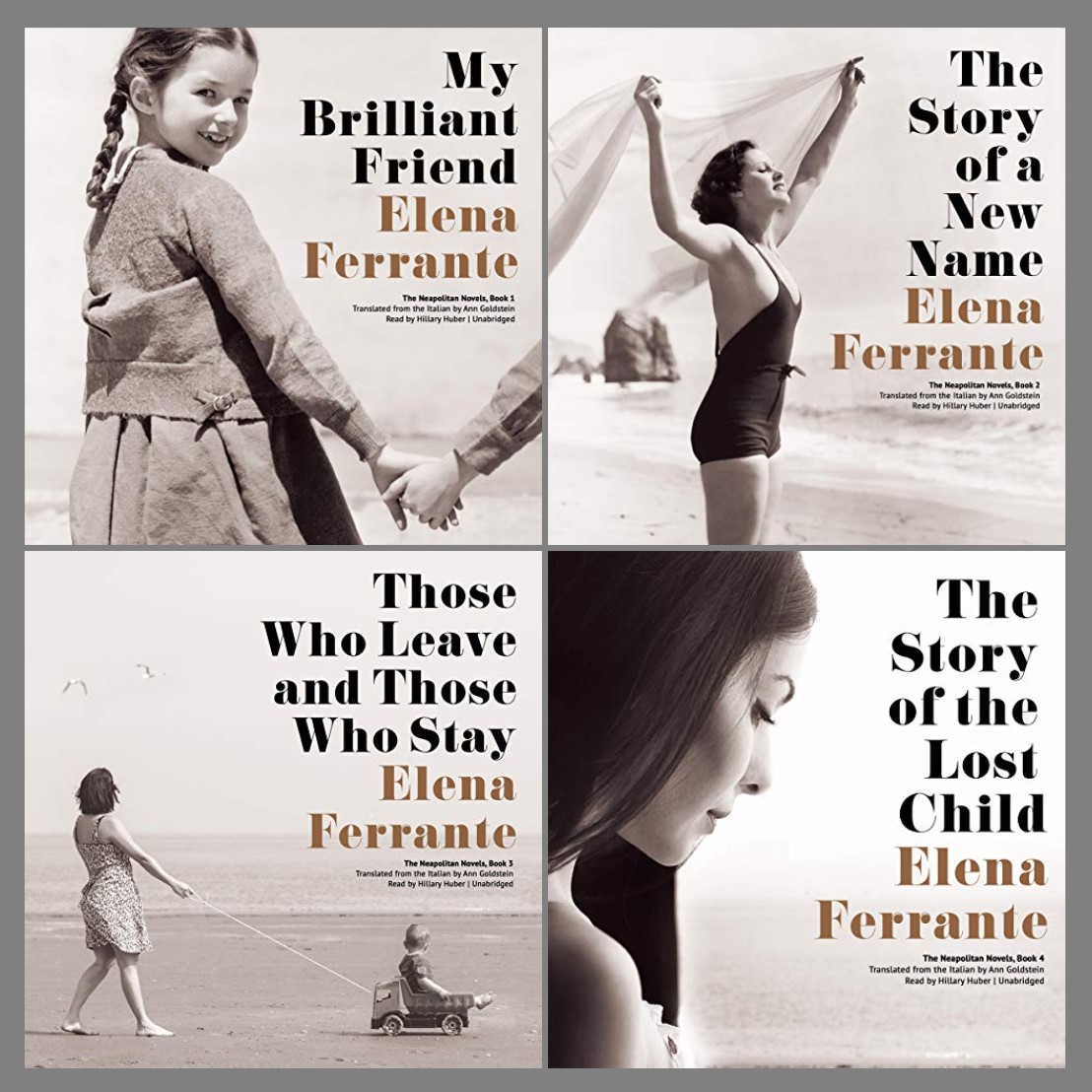
MY BRILLIANT FRIEND by Elena Ferrante

by James Wallace Harris, 10/19/24

Technically, My Brilliant Friend by Elena Ferrante is the first novel in a four-volume sequence that is collectively referred to as the Neapolitan Novels. Now that I’ve read all four books, I dislike that tagline for the whole story. The four books are really one whole novel, and even though Naples, Italy is very important to the story, it doesn’t properly describe the complete novel. Each volume picks up exactly where the last one stops. If they were published in one volume with no subdivisions, you wouldn’t notice any transitions.

For this review, I’m going to refer to the whole as My Brilliant Friend, and when needed, I’ll point to the individual titles as part of the story. The structure below uses the dates for the English translation. The books were originally published in Italian one year earlier.

  1. My Brilliant Friend (2012)
    • Prologue: Eliminating All the Traces
    • Childhood: The Story of Don Achille
    • Adolescence: The Story of the Shoes
  2. The Story of a New Name (2013)
  3. Those Who Leave and Those Who Stay (2014)
    • Middle Time
  4. The Story of the Lost Child (2015)
    • Maturity
    • Old Age: The Story of Bad Blood
    • Epilogue: Restitution

Circular Plot and Recursion

The complete story begins where it ends. And throughout this long story, it constantly refers to itself. It’s so recursive that it feels like two mirrors aimed at each other. It’s also cyclical because it’s about daughters and their mothers, who eventually become mothers of daughters. In so many ways, this story mirrors its parts.

The novel is about two women, Elena Greco and Raffaella Cerullo, who call each other Lenù and Lila. The story feels like an autobiography, and we have to remember that the author’s name is Elena too. Elena Ferrante hides behind a pseudonym, but this novel feels very autobiographical. Lenù and Lila react and respond to each other so intensely that it’s hard to tell who originates what traits. I even imagined that Elena Greco is writing about two versions of her own identity, the one who writes books, and her ordinary self. And it’s interesting that Ferrante hides behind her pseudonym, claiming she wants to remain anonymous while Lila also wants to remain anonymous throughout the story. So many reflections.

Literary Novels

I’ve always thought the greatest of literary novels feel biographical or autobiographical. They don’t need to be about real people, but they do need to feel like they are, and this novel offers two realistic portraits. Another trait of great literary novel is setting. We often think of London when we think of Dickens, or Russia when we think of Tolstoy, or Ireland when we think of Joyce. Ferrante has made her book about Naples and Italy.

If you’ve only read the first volume, My Brilliant Friend, you should tell yourself that you never finished the novel. The Neapolitan Novels boxed set runs 1,965 pages. On audio the four books run 78 hours and 52 minutes. To give perspective, War and Peace by Leo Tolstoy averages about 60 hours in the various audio editions. Different translations of The Bible run 82-102 hours. The seven volumes of Proust’s Remembrance of Things Past runs 154 hours and 14 minutes. In other words, the whole My Brilliant Friend is a literary heavyweight.

Most novels that come out in a series are never artistically heavier than a single volume. That’s why when I finished reading the single volume entitled My Brilliant Friend, I couldn’t understand why the writers polled by The New York Times considered it the top book of the 21st century so far. It was good, but not that good. That’s because it’s only one-fourth of a whole. Now that I’ve read all four volumes, I can easily see why it was voted the top novel of this century.

Will it Become a Classic?

Whenever I read a highly respective modern novel I’ve wondered if it will someday be considered a classic. I’ve never felt sure about any modern novel to predict one before. However, for the whole of My Brilliant Friend I felt like it was at least an equal to Anna Karenina by Leo Tolstoy. That novel only runs 36-40 hours in audio, so it’s about half the size of the full version of My Brillian Friend. The Ferrante novel is far more ambitious, at least in being a biography of two women, so maybe it needs twice the space that Tolstoy used to tell us about Anna Karenina. However, Anna is never developed in such detail like Lenù and Lila.

We follow Lenù and Lila from being little girls to old women, and that makes a huge difference in storytelling ambition. This novel is primarily about friendship, even though it says almost as much about kinship. Men do not come across well in this story. This novel is feminist at a visceral level. I’d also say this book is an anti-chemistry book in the sexual sense. Time and time again, hormones overwhelm Lenù and Lila into making bad life-changing decisions. The great loves of their lives are the same evil Mr. Right. Nino Sarratore is no Mr. Darcy. Ferrante makes Nino one of the detestable bad guys of literary history. I can’t believe that Lenù and Lila didn’t immediately recognize that he was a clone of his father, Donato, the slimy seducer they knew from childhood.

The Prose

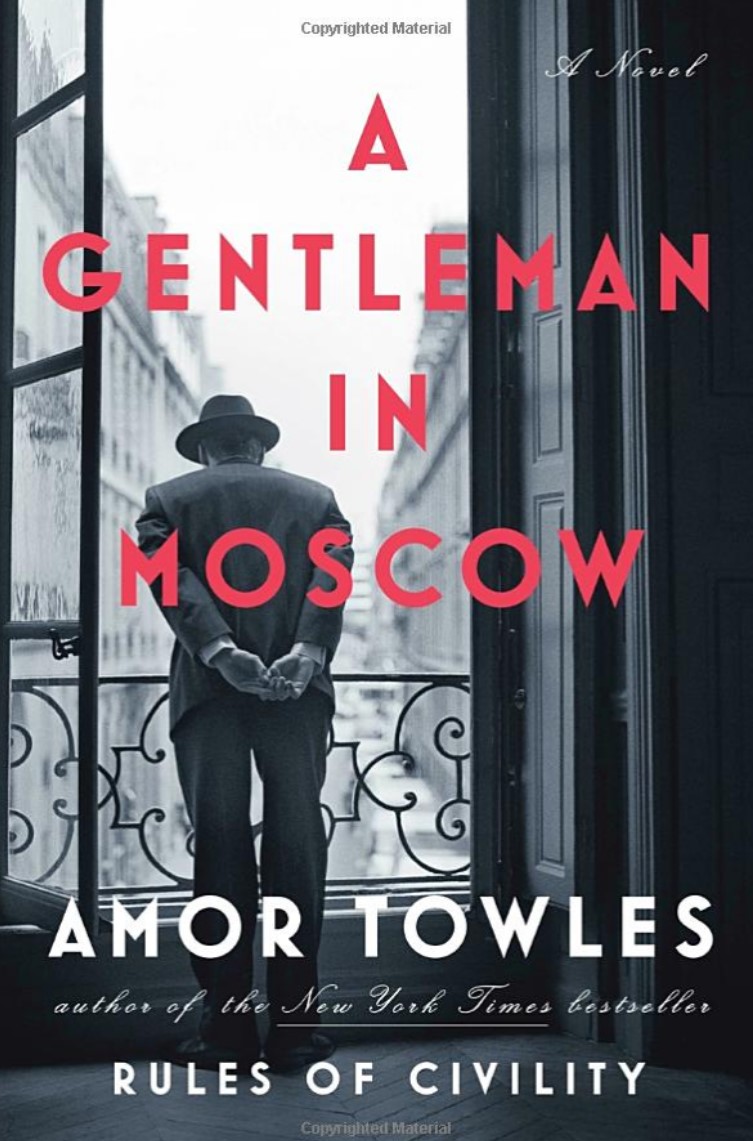
It’s hard to judge the writing of a translated novel. I do know that Ann Goldstein’s translation of Ferrante’s Italian prose is clear and precise, and the writing comes across as vivid and impactful, but the style is plain and unadorned. It lacks the colorful authorial voice of two recent novels where the prose enchanted me, A Gentleman in Moscow by Amor Towles and Lessons in Chemistry by Bonnie Garmus. Nor does it have any the wonderful authorial commentary like old literary writers Dickens or Tolstoy since Ferrante’s story is told in the first person.

A lot of modern bestsellers have the highly refined writing style taught by MFA programs. Readability and clarity are valued over wordy digressions and colorations. This is one reason why I have a hard time predicting if a novel will become a classic a century from now. The classics we’ve crowned from the 19th century all have distinctive writer’s voices. Ferrante’s voice comes across through the characterizations of Lenù and Lila, and it’s confusing to distinguish Elena the author’s voice from Elena the character.

Final Judgment

I liked this story tremendously. It may have ruined me for reading lesser novels, especially for reading science fiction, which seldom achieves any kind of deep character development. The whole story of My Brilliant Friend reminds me of two other multi-novel sequences about characters as they age.

The first is A Dance to the Music of Time, a twelve-volume series by Anthony Powell which he wrote from 1951 to 1975 using his own life and friends for inspiration. I reviewed them here, here, and here.

And the other are books by Elizabeth Strout. Collectively, they follow the growth of two women too, Lucy Barton and Olive Kitteridge. I’ve reviewed them here.

This first reading of the entire My Brilliant Friend story will not be enough to truly appreciate this novel. Even though it’s told in a straightforward manner, it is quite complex in what it has to say. I listened to the books this time. Next time I’ll read them with my eyes. Luckily, I have a one-volume Kindle edition that includes all four books.

Ferrante made me think about my life as a whole. She also makes me think about aging. And she has quite a lot to say about the relationship between men and women. Her novel might be the perfect illustration as to why we don’t have free will. Whether or not it becomes a classic in future centuries, it is worth reading and contemplating now. It gives us lot to meditate on.

JWH
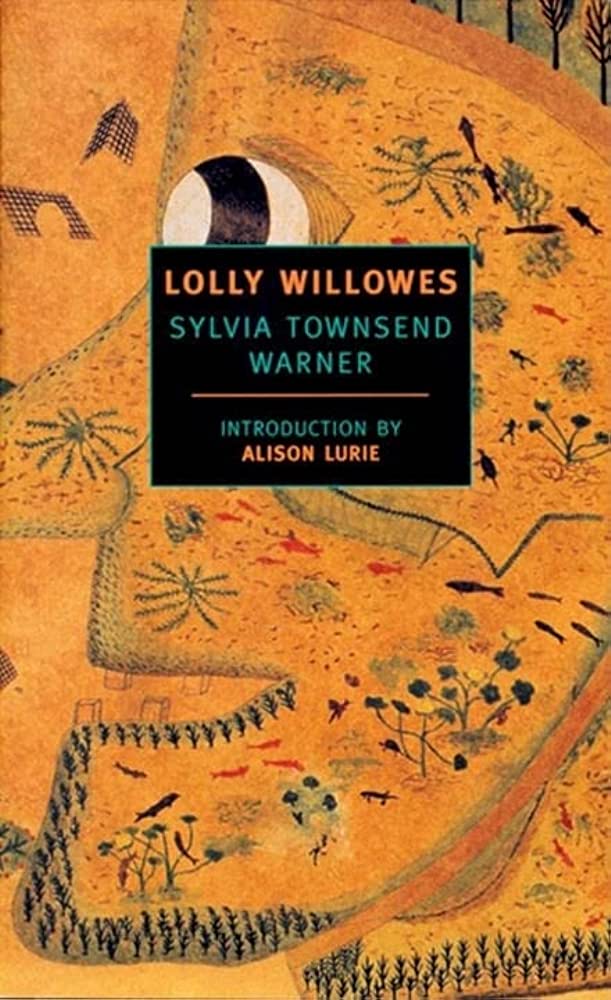
Lolly Willowes by Sylvia Townsend Warner

by James Wallace Harris, 8/20/24

Sometimes you find yourself deep within the rabbit’s hole before you realize you’ve fallen into one.

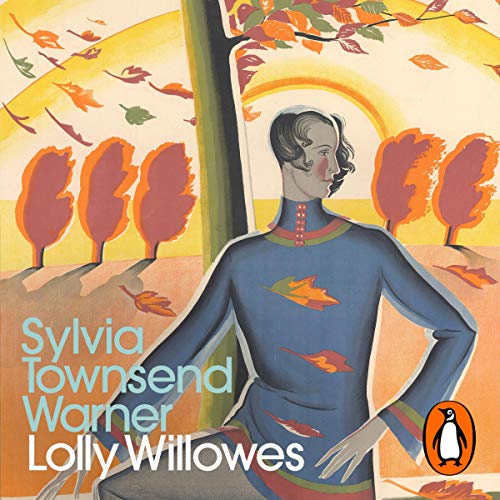
I wish I had read the biographical entry for Sylvia Townsend Warner in Wikipedia before I read Lolly Willowes. It was her first novel, published in 1926. Warner was born in 1893 in Middlesex, England. She was greatly influenced by her father, a successful scholar, who died in 1916. Lolly Willowes is about Laura Willowes’ life after her father died. The story begins when Laura, called Lolly by her family, is twenty-eight, a spinster, who is forced to live with her brother’s family and take care of his children.

Warner was just five years older than Laura when she wrote Laura’s story, and unmarried. In the second part of the novel, Laura is forty-seven and lives a vastly different life. After Warner wrote Lolly Willowes she became involved with a life-long lesbian relationship. Warner authored many novels, many short story and poetry collections, worked in a munitions factory during WWI, became a communist, traveled to Spain twice during the civil war working with the Red Cross, and had a long productive life in several fields, including writing a biography of T. H. White. She died in 1978 at age 84.

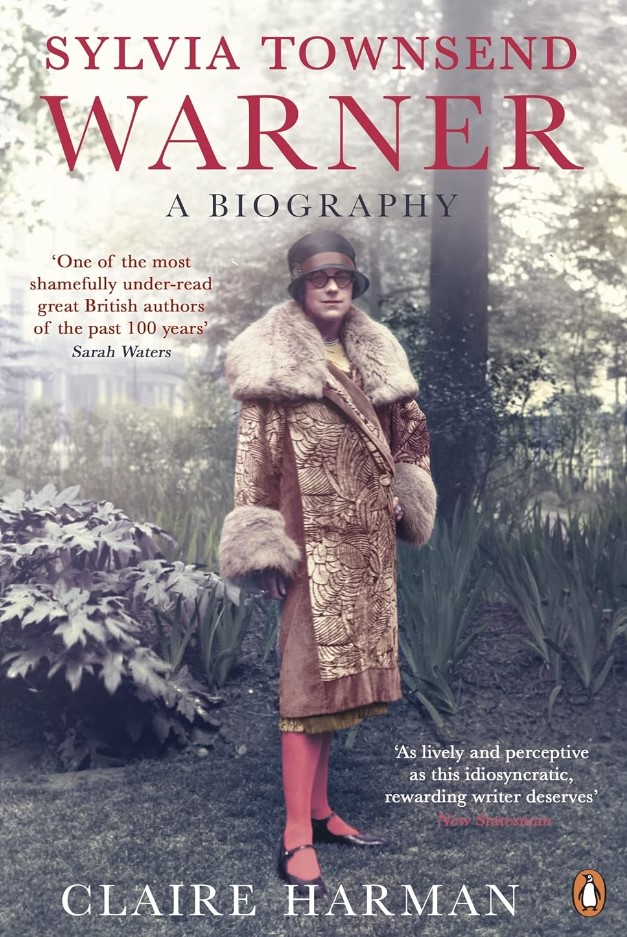
In 1926 Sylvia Townsend Warner imagined it would take Laura twenty years before she could free herself from the roles society defined for her. Warner didn’t wait that long. I finished Lolly Willowes yesterday, and today I read the biographical piece in Wikipedia. It inspired me to order a biography on Warner by Claire Harman.

I bought Lolly Willowes by Sylvia Townsend Warner because the Kindle edition by NYRB (New York Review Books) was on sale for $1.99. NYRB is famous for reprinting forgotten classics. I often buy them when they go on sale, but what really sold me on Lolly Willowes is the blurb claimed it was the very first Book-of-the-Month Club selection. A quick peek at Wikipedia told me the novel was an early feminist classic, an international bestseller when it came out, and it was about witches and Satan. The book’s subtitle, “The Loving Huntsman” refers to the devil.

The NYRB edition is no longer available on Amazon, but since the novel is in the public domain, there are many editions available, including one for forty-nine cents. NYRB’s site still lists four novels by Warner, including Lolly Willowes, which does have a nice introduction by Alison Lurie.

Now, after all that build up, I’m not sure I can recommend this novel. Sometimes, forgotten classics are forgotten for a reason. The first half of this book tells us about Lolly’s upbringing and background. And it’s told rather than shown, meaning it’s a long narrative description. It’s not until Laura’s nieces and nephews grow up and have children of their own, becoming Aunt Lolly to a new generation, that she finally rebels. Laura moves to Great Mop, a small hamlet, to live alone. It’s here where she discovers she wants to become a witch and befriends the Devil.

At the beginning of the story we feel sorry for Lolly because she’s unmarried at twenty-eight. For most of the story we feel sorry for Lolly because for the next two decades she’s trapped as a live in aunt, in a role she doesn’t want. Then at forty-seven she defies everyone to go live on her own. It’s interesting that Warner has Laura gaining her freedom around the time of menopause. I am reminded of the sociological study, Sex and the Seasoned Woman by Gail Sheehy. Sheehy profiled women who felt that after menopause they no longer had to put husband or children first, and were finally free to pursue their own life. This fits with the novel.

Lolly Willowes came out in 1926, three years before Virginia Woolf’s A Room of One’s Own. Late in Lolly Willowes Lolly tells the Devil, “It’s to escape all that–to have a life of one’s own, not an existence doled out to you by others….” Doesn’t that remind you of Woolf’s classic title?

It’s this impassioned speech that Lolly makes to the Devil that finally launches the novel into orbit. It’s a shame that it comes so late in the story. I even wonder if readers would benefit from reading it before starting Lolly Willowes. It might make all the rambling story that comes before it more powerful.

Here is that speech. Don’t read it if you think it will spoil the story. She is addressing the Devil.

“Is it true that you can poke the fire with a stick of dynamite in perfect safety? I used to take my nieces to scientific lectures, and I believe I heard it then. Anyhow, even if it isn’t true of dynamite, it’s true of women. But they know they are dynamite, and long for the concussion that may justify them. Some may get religion, then they’re all right, I expect. But for the others, for so many, what can there be but witchcraft? That strikes them real. Even if other people still find them quite safe and usual, and go on poking with them, they know in their hearts how dangerous, how incalculable, how extraordinary they are. Even if they never do anything with their witchcraft, they know it’s there—ready! Respectable countrywomen keep their grave-clothes in a corner of the chest of drawers, hidden away, and when they want a little comfort they go and look at them, and think that once more, at any rate, they will be worth dressing with care. But the witch keeps her cloak of darkness, her dress embroidered with signs and planets; that’s better worth looking at. And think, Satan, what a compliment you pay her, pursuing her soul, lying in wait for it, following it through all its windings, crafty and patient and secret like a gentleman out killing tigers. Her soul—when no one else would give a look at her body even! And they are all so accustomed, so sure of her! They say: ‘Dear Lolly! What shall we give her for her birthday this year? Perhaps a hot-water bottle. Or what about a nice black lace scarf? Or a new workbox? Her old one is nearly worn out.’ But you say: ‘Come here, my bird! I will give you the dangerous black night to stretch your wings in, and poisonous berries to feed on, and a nest of bones and thorns, perched high up in danger where no one can climb to it.’ That’s why we become witches: to show our scorn of pretending life’s a safe business, to satisfy our passion for adventure. It’s not malice, or wickedness—well, perhaps it is wickedness, for most women love that—but certainly not malice, not wanting to plague cattle and make horrid children spout up pins and—what is it?—‘blight the genial bed.’ Of course, given the power, one may go in for that sort of thing, either in self-defense, or just out of playfulness. But it’s a poor twopenny housewifely kind of witchcraft, black magic is, and white magic is no better. One doesn’t become a witch to run round being harmful, or to run round being helpful either, a district visitor on a broomstick. It’s to escape all that—to have a life of one’s own, not an existence doled out to you by others, charitable refuse of their thoughts, so many ounces of stale bread of life a day, the workhouse dietary is scientifically calculated to support life. As for the witches who can only express themselves by pins and bed-blighting, they have been warped into that shape by the dismal lives they’ve led. Think of Miss Carloe! She’s a typical witch, people would say. Really she’s the typical genteel spinster who’s spent herself being useful to people who didn’t want her. If you’d got her younger she’d never be like that.”

Warner, Sylvia Townsend. Lolly Willowes (New York Review Books (Paperback) Book 5) (pp. 149-150). New York Review Books. Kindle Edition.

Even though I bought the Kindle edition, I listened to the audiobook edition because it was part of my Spotify subscription. Hearing this speech came across far more dramatically than I can read it in my head.

I find it fascinating that Sylvia Townsend Warner could be so accepting of Lolly selling her soul to the devil. I must assume it was her way of saying how awful being confined by the traditional woman’s role was to her. Yet, Warner also portrays the Devil as Lolly’s master. Has she not traded one form of servitude for another? The biographical piece in Wikipedia also said that Warner wrote essays against the church.

Lolly Willowes does have a great deal of details about middle class life in England in the late 19th and early 20th century. I’ve always enjoyed those kinds of details about English life. There were many passages that reminded me of D. H. Lawrence. Unfortunately, I didn’t feel the story was consistently told as a singular work of art. And the novel seldom featured dramatic dialog.

Lolly Willowes is not a modern novel even though it came out in 1926. I felt it was closer in style to George Elliot, but Lolly Willowes lacks the depth of Dorothea Brooke, but then Warner’s novel is only five hours on audio, and Middlemarch runs around thirty-five hours.

If you’re into English novels, especially those written by women, then give Lolly Willowes a try. However, if you want a solidly fun book about an English woman on her own, reading Miss Buncle’s Book by D. E. Stevenson, which came out in 1934. It’s interesting how different women can be just seven years later.

I must admit, that the more I read about Sylvia Townsend Warner, the more likely I am to reread Lolly Willowes in the future. Like many books, multiple readings brings out depths missed with just one reading. I may have missed a lot.

JWH

Reading the Best Books

by James Wallace Harris, 8/16/24

Why read any book when you can read a terrific book? Yes, but which books are great? Recently, The New York Times asked 503 writers, critics, editors, and other experts on literature what were their favorite ten books published since the year 2000. The editors wanted to know what the best books were published so far in the 21st century. They produced this list (NYT-W). It’s a list of one hundred fiction and nonfiction books that tend to be more literary and serious.

But they also asked the paper’s readers to submit their favorite ten books published since the year 2000. That produced this list (NYT-R). That result seems to lean towards the bestsellers that readers love.

The Guardian back in 2019 created their own list of the best books of the 21st century. This gives a British slant.

Each list ranked the books 1 through 100.

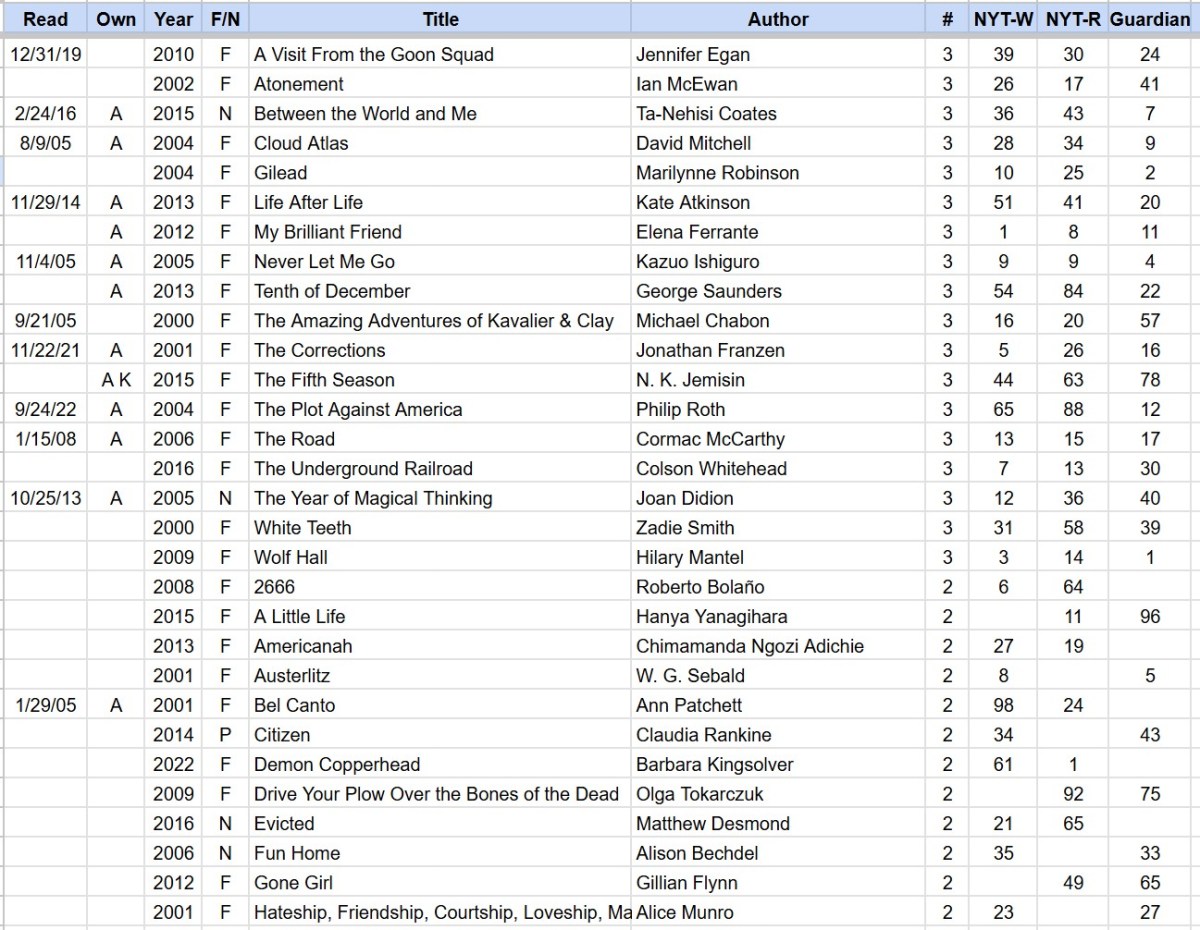
I combined all three lists in a Google spreadsheet and sorted it by the books on the most lists. Eighteen books were on all three lists, and thirty-six titles were on two lists. Those 54 titles are the real standouts. The three lists produced 225 unique titles.

I shared my spreadsheet in case you want to look at it, or even download a copy.

My plan is to start reading all the books on the list, focusing on the ones that were on the most lists first. I’ve marked those I’ve already read.

I want to read and study these books. Eventually, I want to make a list of qualities that go into books that create a universal appeal. Now that I’m getting older, I don’t want to waste time reading mediocre books.

Not only do I want to broaden my taste in reading, but I crave finding books that I’ll remember. I don’t expect to remember much, because I can’t remember much anymore, but I want to read books that I remember something, some little takeaway that I can keep.

JWH

What Makes a Great Book Great?

by James Wallace Harris, 7/13/24

The New York Times has made quite a splash with its interactive feature 100 Best Books of the 21st Century. The list was created by polling 503 writers, critics, and other book lovers to vote for their top ten books of the 21st century. The final one hundred were the most popular books among all the 503 voters. The NY Times site allowed their readers to mark which books they’ve read from the one hundred, and which books they wanted to read. Here’s my tally:

But I must ask the question: What makes a great book great? Were these just the most popular books read by writers and critics? Does that make them great? Dozens of nominators allowed the NY Times to publish their ballot, which lets us readers understand what kind of books everyone liked in general. You can read their ballots here. This also reveals books that didn’t make it to the final one hundred list, and I’ve read many of them too.

The #1 most voted for book is My Brilliant Friend by Elena Ferrante. I’ve tried reading it, and I’ve tried listening to it, and even tried watching the miniseries based on it, and never finished any attempt. I’m not saying it was bad, but it just didn’t hook me.

The #2 most voted for book is The Warmth of Other Suns by Isabel Wilkerson, which I have read and consider one of the best books I’ve ever read. It’s a monumental nonfiction book that took Wilkerson a decade to write. It’s a history of the migration of African Americans from the South to the North between 1915 and 1970.

The Warmth of Other Suns would be the archetype of a great book in my mind. From it, can I define what qualities go into a great book? Well, first, a great book must cover a great subject. I would say, a great work of nonfiction needs to leave me feeling like I’ve learned something profound about reality. By that measure, I can quickly fill up my top ten great books of the 20th century with these titles leaving no room for fiction:

  1. The Warmth of Other Suns by Isabel Wilkerson
  2. The Information by James Geick
  3. Jesus Before the Gospels by Bart D. Ehrman
  4. An Immense World by Ed Yong
  5. The Invention of Nature by Andrea Wulf
  6. Behind the Beautiful Forevers by Katherine Boo
  7. The Order of Time by Carlo Rovelli
  8. Fantasyland by Kurt Andersen
  9. Dark Money by Jane Mayer
  10. The Code Breaker by Walter Isaacson

And this is just from a quick look at my bookshelves. If I studied my reading log of books read published after 1/1/2000 I’d probably find plenty more to compete for the top ten spots.

All ten books above have the qualities I’d consider needed to make a great book, but the reality is that’s because they’re nonfiction. Fiction often deals with historical, scientific, and philosophical topics, but do they deal with them honestly? Does reading a novel about racism or inequality have the same impact and value as reading a nonfiction book about the subject?

Greatness is much harder to evaluate in fiction. I read a lot of science fiction, but I’d never but consider it great literature. None of the novels I’ve read in the NY Times 100 list are great in my mind. I might call them great reads because they were entertaining and page turners, but I’m not sure I’d reread any of them.

I love the novels by Elizabeth Strout but are they great? Olive Kitteridge made the list, and it’s probably favorite of the novels that did, but is it better than Strout’s other novels? I think I like Olive, Again, and Lucy by the Sea even more. Franzen’s The Corrections got on the list, it’s my least favorite of his books. I’m partial to Crossroads. And as much as I liked Richard Powers’ The Overstory, I much prefer Bewilderment.

I’m not sure if greatness in fiction can be recognized so soon. It might take a century, or at least a half-century. I reread older novels. I’ve read On the Road by Jack Kerouac and The Sun Also Rises by Ernest Hemingway three times each. They go in and out of fashion. I’m not even sure if I think they’re great, but I keep reading them and reading about them. Is that the mark of greatness in fiction?

I wish the Times had three different Top 100 lists for the 21st century. Novels, Nonfiction, and Memoirs/Biographies. Memoirs like In the Darkroom by Susan Faludi, The Year of Magical Thinking by Joan Didion, Between the World and Me by Ta-Nehisi Coates, and Educated by Tara Westover are far more powerful to me than any of the novels.

For me, major nonfiction works trump memoirs in the greatness impact. But then memoirs are far more impactful to me than novels. I don’t know why novels get all the fame. However, nonfiction works seldom stay in print. As great as The Warmth of Other Suns might be, will it be read often fifty years from now? And that’s also true for memoirs. Biographies tend to last a bit longer, until someone writes a new definitive biography on the subject.

Most books are forgotten. Of all the novels listed in the final list and from the nomination lists, how many will be read after 2050? I was blown away by Middlesex when it came out, but I just don’t feel like rereading it. I’m looking forward to rereading Olive Kitteridge (and the other Strout books). And I’m looking forward to rereading a few other novels from 2000-2024 someday, probably Lessons in Chemistry, A Gentleman in Moscow, and Bewilderment. Is that a factor that designates them as great? I don’t know.

I also think age is a factor when considering novels great. When we’re young, any novel that’s exciting to read is great. I don’t know if that’s true now that I’m in my social security years. In the last third of life, greatness in books seems to equate with resonating with what I’ve learned throughout my lifetime. Whether with fiction or nonfiction, it must reveal something that makes me think, “Oh wow, that’s so damn insightful.” Entertaining is a big plus, but it doesn’t count for much in judging a book great.

Nonfiction must be great in terms of understanding reality, while fiction must be great in terms of understanding being human. Now that I’m getting old, I think the tide is turning against fiction, which might be why I’m so hard on it now.

JWH

When Tsundoku Meets Döstädning

by James Wallace Harris, 7/9/24

Tsundoku is a Japanese term for buying books and magazines far faster than you can read them. Döstädning is a concept from Sweden that translates into death cleaning, advice for how to get rid of your stuff before making other people do it after you die.

At 72, I figure it’s my time to turn the tide of tsundoku into a wave of döstädning. Last year I took many shopping bags of books to give to the Friends of the Library so I could shelve every book in my house. I had finally reached the equilibrium of perfectly filled bookshelves with no books lying on desks, tables, nightstands, or floors. It felt so good.

Today I gathered all the books lying on desks, tables, nightstands, and floors and had to stack them on top of my bookshelves again. I’m losing the battle with tsundoku again.

I don’t get out much anymore. I take my turn going to the grocery store every other week, and I go to the Friends of the Library Bookstore once a week. I buy books I think I want to read before I die, but I’ve already own enough books to last me until the middle of the twenty-second century.

Instead of coming home with two or three books every week from the Friends of the Library Bookstore I need to take two or three books to donate. That would still give me an outing every week. I guess I could continue to buy books so long as I always donated more books than I purchase.

If I knew some Japanese and Swedish people, I’d ask them to produce a phrase that means “döstädning my tsundoku.”

I need to develop a system for death cleansing my bookshelves. One idea came to me while reading A Gentleman in Moscow by Amor Towles. The story is about a Russian aristocrat, Count Alexander Rostov, who is sentenced to life imprisonment in the Metropol hotel after the Russian revolution. But instead of remaining in his luxury suite, Count Rostov is forced to live in a tiny garret once used by the servants of the aristocracy. He keeps one book with him to read, Michel de Montaigne’s Essays. What a wonderful book to read in that situation.

That reminded me I needed to finish my copy of Montaigne’s complete essays.

And it gave me another idea too. I need to read books that are most suited for an aging guy waiting for the guy with the scythe to show up. Books that make me feel philosophical positive about my life and help me understand the decline of civilization. I feel A Gentleman in Moscow is most suited. I would call it a fairytale for old folks, something Charles Dicken, Robert Louis Stevenson, and Tolstoy might have collaborated on if they were living in our century. It is a delightful yarn about a man growing old imprisoned in a hotel while the twentieth century changed outside his window.

I need to start thinning my book collection of books aimed at young people, unless they are books I read when I was young and want to remember them from an aged vantage point.

I need to read books that make me feel good about getting older. I need to jettison books that don’t deserve to be among the last books I read. Even if I live another couple of decades, I doubt I can squeeze in more than a thousand books, and that leaves me a couple thousand to abandon. If I live only another five years, I might finish 250 reading at my peak pace when I was younger, but more than likely, less than two hundred, since I’m now reading less every year.

Some days I don’t feel like I’ll make it to eighty, and on other days feel, gee, I might make it to ninety. I need to save those books suitable for someone in their 70s or 80s, and thin out the others.

It would be fun to see my library shrink over time, each year further distilled into a smaller collection of greater books, so in my last year I read only classics that fully reveal their depths to readers about to depart this planet.

Now, I think I have a system I can work with. It sounds logical and doable. I’ll have to report back in the future if it works. When I get in there pulling out books one by one, and asking myself if they are worthy of reading in my elder years, I might think every volume I already own is perfectly suited.

JWH