Boneshaker by Cherie Priest

Earlier this year, when the novel nominees for the 2010 Hugo Award were announced, I decided to read all six.  Boneshaker by Cherie Priest is the fifth story I’ve finished, and I thought from the book’s blurbs the one I’d like the least.  I was wrong.  I thought I had a zombie prejudice, but evidently if you mix a colorful steampunk novel with great characters, zombie prejudice can be overcome.

boneshaker-by-cherie-priest

Actually, I would find it hard to imagine any reader not liking this novel is they gave it a serious try.  Sure it’s hard to ignore the fact that you’re reading a novel about zombies – that is embarrassing – but I’ve found that biting the bullet and just accepting the undead as literary fashion and remembering this too shall pass, allows me to concentrate on the quality story that Boneshaker presents.

Here’s the situation, a woman and her teenage boy are the wife and son of a man that everyone hates in a alternate history 19th century Seattle.  Their lives has been destroyed by this hatred, and the boy desperately wants to prove his dad had some virtues, despite what his mother confirms about his father. 

This Seattle, Washington is unlike the one we know.  The civil war has been going on for twenty years, and an evil inventor has caused gases from beneath Seattle to well up and kill thousands of people.  To protect the country a giant wall is built around Seattle to contain the gas.  However, years later some people remain within the city, living in pockets of good air, knowing that if they breathe the gas they will die, or turn into a zombie.

That description does absolutely no justice to how colorful the setting is for Boneshaker.  But I don’t want to tell you too many details.  I listened to the audiobook edition of this novel without knowing much about it other than it had zombies, and people called it steampunk.  I would have been better even knowing less.  I had low expectations and even dreaded reading it. 

As soon as I started listening I didn’t want to stop.  Here’s the reason why it’s up for the Hugo – it’s a damn good story.  It’s just a good old fashion tale with lots of colorful characters and thrilling adventures.  Robert Louis Stevenson would have loved Boneshaker.  Ditto for Edgar Allan Poe, and maybe even Charles Dickens.  Edgar Rice Burroughs would have been jealous of its skillful twin narratives.

And I highly recommend the audiobook edition read by Kate Reading and Wil Wheaton.  Yes, that’s Wesley Crusher reading the boy’s part and he gives an impressive performance.  Of course Kate Reading is a superstar of the audiobook world.  The Boneshaker audio production is top notch and the dramatic reading brings out all the color of the novel.

Be sure and visit The Clockwork Century where Cherie Priest lays out plans for more novels set in the strange version of our 19th century America.

By the way, this effort to read all the Hugo nominee novels has paid off handsomely.  The diversity of story telling is impressive, but more than that, it’s a great snapshot of what science fiction and fantasy has become.  I shall do this again next year.  I’ve got one more novel to go, Palimpsest by Catherynne Valente, but the audio edition won’t be available until August 15th, still plenty of time to listen to before the awards are given over the labor day weekend.  So far, they’ve all deserve the Hugo.

JWH – 7/29/10

Little Brother by Cory Doctorow

Little Brother is often categorized as science fiction, like 1984, the book that inspired it, but I think that’s wrong.  Neither are science fiction.  Both books are political philosophy, and even though both books are set slightly in the future, they are about today’s politics.  Little Brother is an exciting story, well told, vividly detailed, full of technological ideas, excellently plotted, with engaging characterization of a Wi-Fi generation – a real page turner.  I highly recommend reading Little Brother.  But it’s also as serious as a terrorist attack.
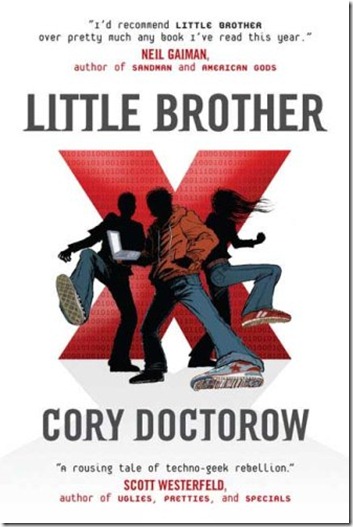
littlebrother

Cory Doctorow campaigns hard for his beliefs, standing on Little Brother like a soapbox.  I’m sorry Little Brother didn’t get more widespread public attention, because it deserves it, but I’m guessing that outside of the ghetto of science fiction and the geek world of Slashdot, it’s was pretty much ignored.  This is unfortunate, because the ideas it brings up for debate need universal attention.

Now, that’s not to say I completely agree with Doctorow.  I have some fundamental differences in philosophy.  Marcus Yallow, the seventeen year old hero of this novel, and his three friends have a nightmare encounter with the Department of Homeland Security (DHS) and from then on the story diverges philosophically with my thinking.  Doctorow believes in fighting fire with fire, and Marcus and his friends use high tech to battle the high tech of the DHS.

If we lived in Iran I would agree with that, but we don’t.  We live in an open society, and if we want to keep it free and open, we need to fight for civil liberties on a battlefield where everyone can watch.  Doctorow invents a special distribution of Linux called Paranoid Linux which allows for an underground youth rebellion to assemble in privacy.  And he compares this new revolution to the radical yippies of the 1960s. 

But there’s a huge difference.  Back then the rallying cry was “The Whole World is Watching.”  The way to fight big brother oppression is to make everything public.  Doctorow has his revolutionaries encrypt everything.  That’s bad.

I want to live in a society where I can write anything I want in this blog.  I don’t want to live in a society where I must encrypt my thoughts and secretly share them with my friends with public and private keys.

More than that I want the government to use all the technology in its power to find the enemies of society, but I also want our government to prosecute terrorists in the full light of day, and not hide them in secret prisons around the world.  None of this bullshit about civil rights being different in war times.

Doctorow is right, innocent people do suffer when fighting terrorism, but turning them into underground freedom fighters isn’t the answer.  The book eventually does come to my way of thinking and investigative reporting saves the day.  But there are many smaller issues that need to be discussed by a wider audience.

For example, should there be video cameras in classrooms, and do our children need 24×7 surveillance.  I grew up in the 1950s and 1960s where I ran wild and unobserved.  I loved that freedom and I’d hate to think the kids today don’t have it.  But we live in a much different world. 

Education is failing many children.  The failure of education is creating a widening class divide. Education is the tax straw that’s breaking many a local and state financial back.  There is a tremendous sense of failure regarding education.  If we applied the “Whole World is Watching” to the K-12 landscape, where anyone could tune into any classroom and see what’s going on for themselves, would that revolutionize the problem?  Would people really claim urban schools get equal quality education as suburban schools? 

Doctorow had a classroom scene which caused a teacher to be fired.  If it had been on video would that have happened?  Would kids act up or tune out if they knew their parents were watching?  I’d vote for more cameras in the school, but also want to find ways to give kids more privacy from adults after school.  We live in the era of watching video cameras, and we’ve yet to explore the impact of that philosophically.

We also live in a world of too many secrets.  I don’t want or need Paranoid Linux.  If parents could observe their darling young ones in their classes would it help education in our nation?  If parents had to spend one day a month going to school with their children, would our educational system get the improvements it needed?  That would mean on average there would always be one parent observer in every classroom every day.

In Little Brother the DHS conduct very secret processing of suspects.  Would not cameras or citizen observers have solved the central problems of this story?

Doctorow tries to make it clear that he thinks the computer techniques the DHS and other police systems use to sift out the bad guys are silly because they produce too many false positives, and that might be true, but we’re fighting a war on individuals, not nations, and we have to use such statistical techniques.  When a few people can kill thousands, we have to find new criminal detection tools. 

Little Brother is a novel about privacy, civil liberty and freedom during an era when people are willing to sacrifice all of those rights for more security.  I’m surprised that rabid conservatives haven’t made a call to ban Little Brother because the Department of Homeland Security is the villain of the story.  But they haven’t because we live in America, not North Korea.

While reading Little Brother, I often felt on the side of the bad guys (the government), but then, in this story the rallying cry of the young is, “Don’t trust anyone over 25” and I’m 58.  It also makes me wonder how I would react if I could meet my younger self who used to believe “don’t trust anyone over thirty.” 

Little Brother does more to capture the feeling of the radical sixties than any book I’ve ever read set in the sixties.  But I’m not sure if Doctorow isn’t idolizing the wrong people.  Abbie Hoffman was an asshole.  The yippies were a joke.

It’s very hard to be anti-government and not sound anti-American, but I think this book pulls it off.  Everyone wants to be free and secure, but some people are willing to give up a lot of freedoms to feel more secure.  What Doctorow illustrates is sometimes that’s an illusion, but what he doesn’t explore is the real value of security.  Freedom and security are entwined like Yin and Yang.

A society of billions is unbelievably complex and there are no easy answers.  Most of us want to live our lives in peace and pursue happiness.  There are a few, and by population standards, an extremely tiny portion, who want to hurt other people, or bring down society.  It would be great if we could put all of these people on an island and let them have the freedom to hurt each other, but that’s not possible.  We have to find these few and neutralize them.  That will require police techniques that might hurt or inconvenience the normal citizen.  I don’t see any way out of that, but Doctorow brings up the topic for debate.

JWH – 7/17/10

Out of the Silent Planet by C. S. Lewis

Out of the Silent Planet by C. S. Lewis should not be considered a science fiction novel, it follows more in the footsteps of The Devine Comedy and Paradise Lost than it does with H. G. Wells and Jules Verne.  I would go so far and say Out of the Silent Planet is an anti-science fiction novel, although it reads much like Stanley G. Weinbaum and other pulp writers of the 1930s, and was inspired by the 1920 fantasy novel, A Voyage to Arcturus.  Strangely enough, it reminds me of the recent film Avatar.

Please do not read any further if you haven’t read the book and want to avoid spoilers.  What I have to say is a reply to the philosophical implications of the novel and that indirectly gives away plot elements.

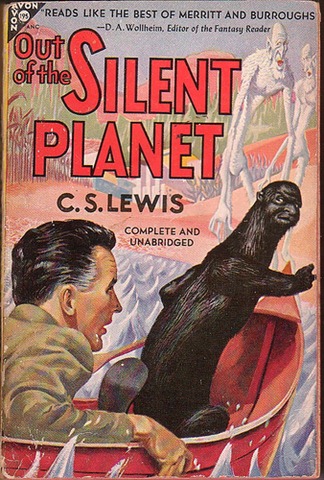
Out-of-the-Silent-Planet

The reason why I claim Out of the Silent Planet is anti-science fiction is because the story wants to convince its readers that outer space is the supernatural heavens of religious myths and is full of spiritual beings, even beings who live in the void between planets.  Essentially Lewis does this for religious reasons, and not scientific, and the story feels like medieval philosophy.  Now, this isn’t to say the story isn’t a ripping good yarn, nor does it imply a lack of old fashion sense of wonder about alien life on Mars, like most SF fans love from science fiction from the 1920s and 1930s.

What C. S. Lewis attempts is to claim outer space for Christianity, which is pretty interesting since most Christians focus heavily on Earth and ignore cosmology.  The ending to Out of the Silent Planet reminds me of the ending in Have Space Suit-Will Travel, where in both, humanity and Earth come under the judgment of higher life forms on other planets.  Strangely, the bad guy in Out of the Silent Planet makes the same case as the good guys in Have Space Suit-Will Travel.

Now this is a very essential difference in philosophy, and why I’m making a case that C. S. Lewis is writing anti-science fiction.  Heinlein and most of science fiction is pro mankind, even to the point of taking Satan’s attitude in Paradise Lost, “Better to reign in hell than serve in Heaven.”  Weston, a pathetic, spiritually blind, scientist in Out of the Silent Planet wants mankind to conquer the heavens and spread humanity to all the planets.  Oyarsa, the archangel like ruler of Mars, or Malacandra, has godlike powers and considers Weston bent, or evil.

I am reminded of Lester del Rey’s “For I am a Jealous People” where God takes the side of aliens and mankind declares war on God.  Science fiction is the ultimate hubris.  Of course all of this assumes there are spiritual beings and dimensions we cannot see with our science.  If you believe in those dimensions and beings, you will take the side of C. S. Lewis, but if you don’t, I expect most science fiction fans prefer to follow Heinlein and believe mankind is the most dangerous creature in the universe.

I think a new philosophy is emerging, that’s post-Lewis and post-Heinlein.  There are no spiritual beings, but then we’re not going to be rulers of the universe either.  I think in a few decades Heinlein will feel as archaic as Lewis in his philosophy, and Heinlein is my favorite writer.  I grew up believing in the manifest destiny of space but the relentless reality of science is convincing me otherwise.

Out of the Silent Planet is a throwback and could easily have been written in 1838 instead of 1938.  It’s the last of its kind, rather than being an early novel of future directed science fiction that dominates the twentieth century.  Out of the Silent Planet wants to incorporate the spiritual world into the physical world – to weld them together.  If you accept science there is no room in reality for angels, and the only hope of the spiritual world existing lies on the other side of the doorway of death.

JWH – 7/9/10

Julian Comstock by Robert Charles Wilson

Julian Comstock: A Story of 22nd Century America by Robert Charles Wilson is the fourth novel I’ve read that’s up for the Hugo Award this year.

  • Boneshaker, Cherie Priest
  • The City & The City, China Miéville
  • Julian Comstock: A Story of 22nd-Century America, Robert Charles Wilson
  • Palimpsest, Catherynne M. Valente
  • Wake, Robert J. Sawyer
  • The Windup Girl, Paolo Bacigalupi

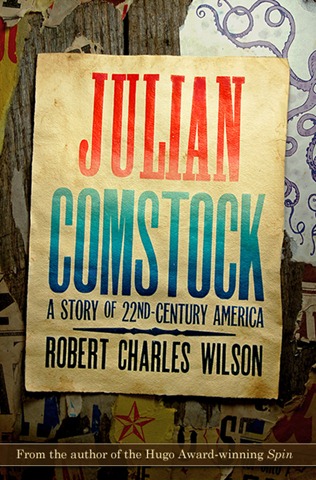
juliancomstock

This is the first time I’ve tried to read all the nominees before the awards were given and it has proven to be a rewarding endeavor.  I’ve got Boneshaker and Palimpsest to read before September 5th.  I listened to all four books, and will listen to Boneshaker next, and Palimpsest last, since it won’t come out on audio until August 15th.  This is a sign about how successful these novels are because they are all getting the audiobook treatment.

Even though I’ve thoroughly enjoyed each of these books, so far I’d bet that The Windup Girl will win because it’s gotten the most attention.  Wake has been the story most like a traditional SF novel, and covered my favorite subject matter, but the other three have been the most literary ambitious.  The Windup Girl makes for an interesting bookend to Julian Comstock since they are both about the 22nd century after the oil runs out.  Strangely, their imagined futures couldn’t be more different.

The Windup Girl portrays science progressing after the collapse of oil, whereas Julian Comstock pictures the world de-evolving into technology that’s downright 19th century, and some people have even called the novel steampunk, but I wouldn’t.  For instance, people of the United States in Robert Charles Wilson’s future live under a flag of sixty stars but ride horses again and sail across the oceans on schooners.  They even have to reinvent the repeating rifle and have reverted back to silent films with a strange twist.

These books don’t try to predict the future but tell complex stories set in strange worlds far different from ours.  Each book does speculate on current trends, but they diverge in fascinating ways.  In Julian Comstock America is ruled by the Executive Branch of the Presidency, the Military and the Dominion of Jesus Christ, a new Orthodox church that apparently grew out of today’s fundamentalism.  Society has restructured itself around severe class distinctions, including indentured servitude, feudal land owners and an aristocracy.

Julian Comstock is a rich story that has the flavor of 19th century dime novels.  The Dominion of Jesus Christ has brought back puritanical beliefs and censorship so the characters think and speak like people from the pioneer days of the old west.  Julian Comstock is the nephew of a murderous President who must hide out in the western states because the Presidency has become an inherited title and his uncle fears any possible challenges to his rule.  Julian is raised with Adam Hazzard, a son of an indentured worker who narrates this modern picaresque tale.  Wilson uses Adam to make some fun swipes at his own profession of writing.

Julian Comstock is a colorful novel that would make a beautiful movie, perfect for Hollywood’s liberal philosophizing, but I’d like to see a more balanced treatment.  Even though I’m a liberal myself, I think the story could have been improved if the Dominion of Jesus Christ hadn’t been so one dimensional.  It would have been far more fascinating and scary to see a more realistic theocracy taking over America, as many fundamentalists dream about.  This is an odd subject for science fiction, but Heinlein explored it back in the early 1940s with some of his first stories collected in Revolt in 2100.

Wilson never gives enough reasons why in his world of Julian Comstock so much technology and science from our era is forgotten, like radio communication, or needs to be reinvented, like machine guns, which leaves me to think the story is less science fiction and more allegory about the dangers of religion in politics.  But this story does make me wonder just how much we could forgot?

JWH – 6/27/10

The City & The City by China Miéville

The City & The City by China Miéville is the third novel I’ve read that’s up for this year’s Hugo Award and my least favorite.  But don’t get me wrong, if I wasn’t comparing it against other stunning novels, The City & The City would stand out on its own as a major novel.  So far, I’ve read three of the six nominees and they’ve all been impressive. 

I really don’t want to say much about the story itself because the novel creates a rather unique fantasy world that readers should slowly assemble in their minds.  Please don’t read reviews or plot summaries of this story beforehand.

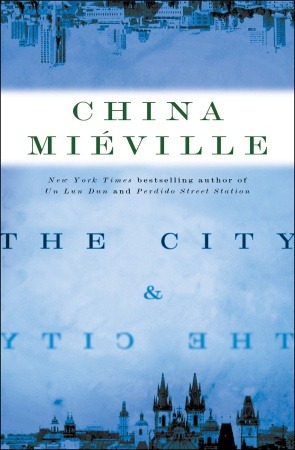
the-city-and-the-city  

The City & The City is a murder mystery, like the 2009 Hugo Winner, The Yiddish Policemen’s Union, by Michael Chabon, which was about another fantasy city, but one from an alternative history.  China Miéville’s cities might be considered from an alternative history, or just an extra invention for our own world we never learned to see.  I don’t know, but it’s extremely clever.

 Michael Moorcock at The Guardian sees the story as science fiction, trying to tie in string theory physics, but I don’t buy that.  Don’t read Moorcock’s review until after you’ve read the book, he gives away practically everything, but do read his review, it has a lot of good stuff to say.  A case could be made that The City & The City isn’t fantasy or science fiction.

The City & The City depends on believing something that’s pretty hard to believe, or imagine, although I think it would make a wonderful movie if it could be pulled off visually.  Miéville ask his reader to believe the mind is far more powerful than most people suspect.  I think the mind is capable of this kind of power.  I don’t know how psychological Miéville intends to be with his story, but I can read a lot into it.

How far can culture condition us?  We know suicide bombers commit horrendous acts because their beliefs have programmed their minds to see reality very different from the rest of us.  But how much do we perceive and not perceive from our training in childhood?

I am reminded of an experiment I read about decades ago.  Kittens were raised in two control environments.  One environment only had vertical lines, and the other only had horizontal.  After some months the cats were removed to live in a normal environment.  The kittens who grew up with only horizontal lines would walk into chair legs and other objects that were made up of vertical structures.   Kittens that were used to vertical lines wouldn’t jump up on shelves or chairs seats.  Whenever I think about this experiment I wonder what I don’t see now because I never learn to see it in childhood.

We follow Inspector Tyador Borlú, of the Extreme Crime Squad, as he searches for a murderer in a city of Besźel.  I had never heard of this city before.  Because I was reading a novel up for a science fiction award, I first thought it might be new pronunciation of one of our existing city’s name in the far future, but I was wrong. 

I’m not a mystery reader, but I have read several of the classics like The Maltese Falcon by Dashiell Hammett and Farewell, My Lovely by Raymond Chandler.  Cities are very important to the mystery genre.  In fact, I don’t care who commits the murder in mysteries, it’s the details of the setting and character that have to enchant me when I read one.  And it’s character and details I like in The City & The City

As an untrained mystery reader I can’t say how successful Miéville is at writing a murder mystery.  The City & The City is very readable and entertaining, but it’s not science fiction, what I am trained to read.  Nor do does it really feel like a fantasy novel.  It’s hard to categorize this tale, but I think it’s main appeal will be with mystery readers.  Oddly, it wasn’t nominated for the Edgar Award this year, so I don’t know if mystery readers are even giving it a chance.

This novel seems targeted to some unseen genre, like the cities in this story.  I think it was best summed up by Denise Hamilton at the LA Times, “If Philip K. Dick and Raymond Chandler’s love child were raised by Franz Kafka, the writing that emerged might resemble China Mieville’s new novel, The City & the City."

The City & The City is such an odd novel, that I’m having fun reading reviews of it after I finished it, to see what other readers made of this very different story.  That’s the strength of fantasy writing, writers can write about anything they can imagine, but all too often writers crank out the same old crap.  I make and rest my case with the current vampire craze.

JWH – 6/12/10