Blade Runner 2049 – The Evil of Heartless Sequels

by James Wallace Harris, Wednesday, October 11, 2017

Normally I don’t write “reviews” of works I dislike. Why waste time on bad art, huh? I prefer to promote creative work I admire. However, in trying to understand why I disliked Blade Runner 2049 I asked myself, “What did I love about the original?” It came to me instantly – the voiceover. In that moment I realized Harrison’s Ford narration in the original film was the heart of the story. That insight also explained why Ridley Scott detested the voiceover. The narration must come from a human, and Scott wanted Deckard to be a replicant.

Blade Runner 2049-2

Before seeing Blade Runner 2049 I watched Blade Runner (final cut) with a friend. I explained the history of all the versions to her and offered to show her whichever one she wanted. She picked the final cut. Normally, I always rewatch the theatrical version, which is how I first saw the film back in 1982. Whenever I see one of the director’s cuts the viewing is always a letdown. They have the same sterile quality Blade Runner 2049 has.

Blade Runner 2049 is directed by Denis Villeneuve, with the story by Hampton Fancher and Michael Green. However, it feels like a Ridley Scott baby. Scott has always argued that Rick Deckard was a replicant and Blade Runner 2049 vindicates that idea to the point that I think of this film as an expression of his ideas.

Back in 2008, I wrote “Is It Time To Remake Blade Runner?” which was really a plea to film Do Androids Dream of Electric Sheep? as the story was written by Philip K. Dick. I believe the book deserves a truer conversion to film than Blade Runner. I can’t document this, but I believe Ridley Scott bragged that he hadn’t even read the novel when making the movie. Don’t get me wrong, I loved the original theatrical version of Blade Runner, but I don’t consider it very PKD.

When the screenwriters changed androids to replicants something else got changed. In the book, androids are soulless creatures who look like humans but completely lack empathy. They are self-aware but are also psychopathic sociopaths. I believe PKD intended them to be symbolic of inhuman humans. Blade Runner is about artificial creatures that were meant to be soulless slaves that have accidentally evolved empathy. We’re supposed to feel for them. And I did with the Harrison Ford voiceover.

Without the voiceover, both films are just action flicks of heartless machines killing heartless machines. Why has Riddley Scott never understood the Romeo and Juliet beauty of having a love story between lovers from two opposing houses? In Blade Runner 2049 we are taken on a meaningless thrill ride where it’s impossible to tell human from replicant – and I really didn’t give a shit either. There are a few touching scenes in Blade Runner 2049, but they are so artificial as to cause existential angst. At times we feel for K, our replicant protagonist, but the scenes are so obviously manipulating us that it’s hard to genuinely care.

In Blade Runner 2049 it becomes obvious the real problem is our lack of understanding of replicants. They are called skin jobs. That implies they are machines covered in skin. But that’s not true. In both movies, they bleed. In Blade Runner 2049 they seem to be artificially produced biological creatures that can’t reproduce on their own, and the goal of the mad scientist Niander Wallace (Jared Leto) is to create a Nexus model that is self-replicating. But what’s the fucking point of that? Humans are self-replicating, and we have plenty of them.

Wallace wants a new process to produce less costly slaves. The government obviously backs him as long as replicants don’t act like real humans. However, we also learn replicants have secretly organized into a slave rebellion. But why secret? What good is a secret mass-movement? Isn’t it obvious that replicants aren’t soulless machines?  Do any moviegoers feel the replicants aren’t equal to people? That makes the whole point of the film a straw man argument. Truly pointless. It’s funny, but Jared Leto’s character is the most inhuman character in the film and he’s supposed to be human. Or will Ridley Scott pull another juvenile joke and claim everyone in this film was a replicant.

Our world is full of robotic slaves now. They don’t have consciousness. They don’t look human. They lack any kind of consciousness. A major theme of science fiction has always been about when robots become conscious. Generally, these science fictional robots are shown as looking human. I guess SF writers assume we can’t empathize with them if they don’t look like us. By the way, the film Her did a fantastic job of overcoming this problem.

We’ve always wanted to build robots that look like us, and that’s a problem. We want them to do our work, but we worry about robots becoming self-aware as us. If they do, we can’t keep them as slaves, and we fear they may become better than us. The TV show Humans is exploring this same topic. The trouble is Blade Runner 2049 adds absolutely nothing to this topic. The film only confuses the issues in its razzle-dazzle. It lacks both a heart and a brain. Almost every character is violent and action-oriented.

Blade Runner 2049

PKD’s original novel, Do Androids Dream of Electric Sheep? isn’t about action. His androids are conscious, self-aware beings that lack empathy. Rachel is alluring and beautiful, but a cold-blooded killer. Dick’s theme wasn’t robot suffrage. PKD believed the androids in his story deserved to be destroyed because without empathy they are evil, and in doing so infers that humans without empathy are evil too. PKD’s story wasn’t about killing androids but identifying inhuman humans.

Do Androids Dream of Electric Sheep? is vastly more complicated than Blade Runner. If I could film it I would give it the look of 1959 films, because I believe PKD formative decades were the 1940s and 1950s. Its future setting would be very retro-future. It would have the Penfield mood organs and Mercerism. And the story would focus on philosophy and psychology rather than fights and shooting. The film must keep Iran, Deckard’s wife. And it needs the fake police station, having Deckard doubt himself, and eventually proving he’s human. And it needs the artificial religion of Mercerism.

Blade Runner leaves so many fascinating concepts out from the original novel. First off, Rick Deckard isn’t a tough-guy like Harrison Ford, but a married man trying to save his marriage. Their livelihood depended on the bounty from killing androids. The novel opens with their marital squabbling, and the use of mood organs. Mood organs are personal devices for controlling psychological states. People in this future use them to subtly control how they interact with other people, cope at home and work, and explore hundreds of emotional states. PKD uses this imaginary device to dissect human nature. The book is stuffed with observations about what it means to be human. Blade Runner uses none of that. PKD was obsessed with psychiatry, psychology and philosophy and his stories constantly explore those subjects. The Blade Runner movies only faintly hint at the issues PKD brought up in endless ways.

Blade Runner 2049 does not define humans or replicants. We can’t tell them apart. In fact, the evil scientist who creates the replicants acts like a heartless AI, and K, the Ryan Gossling character, who we know is a replicant, when left alone is humanly hung up on an AI girlfriend (who may be a future descendant of Alexa).

Blade Runner 2049 fails horribly if you need a human story. For moviegoers who love eye candy, violence, and a rollercoaster plot, you’ll probably be happy enough.

What’s evil is trying to make millions by making a movie that lacks heart, based on a novel that struggles to define our hearts. Seems kind of heartless, don’t you think?

Blade Runner 2049 is chock full of touchstone analogs from the original Blade Runner. That felt manipulative like Ridley Scott wanted to push our emotional buttons as if we were replicants. Did he expect us to emotionally resonate with air hoses being pulled out, yucky eyeballs, pianos, giant billboards animated with Japanese women, microscopic photo scanning machines, bicyclists riding in parallel formation, machines that measure artificial minds, old abandoned apartment buildings, drinking whiskey from squarish glasses, women dressed like 1970s hookers, giant pyramid-shaped buildings, flying cars, sentimental photographs, umbrellas and rain, and so on.

Everything in Blade Runner 2049 seems set-up for additional sequels, but like his Alien franchise, they will probably continue to abuse the original. I’ve gotten so I hate sequels to books and films. There are few exceptions, but for the most part, sequels feel like they are conning me for my money.

JWH


To Be A Machine by Mark O’Connell [Annotated]

by James Wallace Harris, Saturday, September 22, 2017

Are you a transhumanist? I am not. I reject transhumanism for the same reason I reject religion – both unrealistically crave immortality. The faithful feel their soul will leave their body upon death and move into another dimension. Transhumanists believe technology will someday copy their soul to a machine or clone body. Science has never found any evidence for souls. I’m confident our conscious self-awareness can’t be separated from our bodies. In fact, I believe our body is essential in creating our consciousness.

That said, I find transhumanism to be a fascinating philosophical topic. Transhumanism is a very popular theme in 21st-century science fiction, and a goal embraced by many in our high-tech culture. Religion is the old way people hope to escape death. Transhumanism is the new way of fulfilling that old hope. I think both reject the reality of our finite lives. Transhumanism is just another belief system that lets its believers avoid who we really are.

To Be A Machine by Mark O'ConnellTo Be A Machine: Adventures Among Cyborgs, Utopians, Hackers, and the Futurists Solving the Modest Problem of Death by Mark O’Connell is a book about the future of humans I just finished. O’Connell, a journalist from Dublin traveled the world exploring transhumanistic endeavors by men and women whose goals feel more like science fiction than science. O’Connell is a skeptic of transhumanism, and so am I. However, wherever O’Connell went, he found brilliant, often eccentric people working hard on exciting projects. I thought it would be fun to find links to each of those endeavors and people he describes in the book.

I envy journalists who get to see in person the exciting events and people they write about. That’s why I love a good documentary. Seeing is believing, and O’Connell got to meet many far-out prophets of transhumanism. O’Connell’s book is well worth reading because he applies contextual history and philosophy to a growing belief system emerging our of technological culture. The men and women O’Connell interviews are the John the Baptists of Transhumanism.

Anyone who is interested in the future should enjoy this book, but especially science fiction readers and writers. I’m going to go chapter-by-chapter providing links to what O’Connell writes about. I envy him for being about to wander the globe to check out cutting-edge research.

System Crash

This first chapter deals with death and transhumanism. Transhumanists are people who seek everlasting life with the help of technology and not waiting on any promises from theoretical entities.

An Encounter

A Visitation

This was my least favorite chapter, about people who freeze themselves in hopes future medicine might give them life again, or transfer the contents of their brain to a new body or machine. We might eventually invent some kind of suspended animation, but I flat out disbelieve we can copy our conscious minds to another body.

Once Out of Nature

A Short Note on the Singularity

Talkin’ AI Existential Risk Blues

A Short Note on the First Robots

Mere Machines

Science and Invention 1924 May interior art

Biology and Its Discontents

Faith

Please Solve Death

The Wanderlodge of Eternal Life

JWH

Books To Read To Save The World

by James Wallace Harris, Saturday, July 15, 2015

  • We will destroy civilization before the end of the century.
  • Denying science is denying reality.
  • Denying evidence for personal gain is treason to our species
  • Greed is destroying all the species on this planet including our own.
  • Self-interest is leading to species suicide.
  • We have the knowledge and technology to solve our problems.
  • We must change the way we live to save the planet.
  • Human nature is too stupid to survive free market capitalism.
  • We will not save the world just by buying LED light bulbs and driving electric cars.
  • Reading books will not save the Earth, but it will help understand the complexity of the problems we face.
  • Reading these books can be depressing.
  • Not reading these books only makes our problems worse.
  • Read and recommend books that help us understand the reality of your actions.
  • We can only divert the collapse of civilization if we find a new sustainable way to live.
  • Read ten books before deciding if I’m wrong.
  • Read another ten to begin to find hope.

If you know of other good books, recommend them in the comment section.

The Sixth Extinction by Elizabeth Kolbert

This Changes Everything by Naomi Klein

Sapiens: A Brief History of Humankind by Yuval Noah Harari

Homo Deus by Yuval Noah Harari

Countdown: Our Last, Best Hope for a Future on Earth? by Alan Weisman

Learning to Die in the Anthropocene by Roy Scranton

Half the Sky: Turning Oppression into Opportunity for Women Worldwide by Nicholas D. Kristof and Sheryl WuDunn

A Path Appears: Transforming Lives, Creating Opportunity by Nicholas D. Kristof and Sheryl WuDunn

Capital in the Twenty-First Century by Thomas Piketty

The Rise and Fall of American Growth by Robert J. Gordon

Energy and Civilization: A History by Vaclav Smil

How Will Capitalism End? by Wolfgang Streeck

EarthEd: Rethinking Education on a Changing Planet by The Worldwatch Institute

Climate of Hope by Michael Bloomberg and Carl Pope

The Gulf: The Making of an American Sea by Jack E. Davis

The Death and Life of the Great Lakes by Dan Egan

Strangers in Their Own Land by Arlie Russell Hochschild

White Trash: The 400-Year Untol History of Class in America by Nancy Isenberg

The New Jim Crow by Michelle Alexander

Between the World and Me by Ta-Nehisis Coaste

Girls & Sex by Peggy Orenstein

Sex Object by Jessica Valenti

Saving Capitalism: For the Many, Not the Few by Robert B. Reich

Dark Money by Jane Mayer

Getting to Green: Saving Nature – A Bipartisan Solution by Frederic C. Rich

The Great Disruption: Why the Climate Crisis Will Bring On the End of Shopping and the Birth of a New World by Paul Gilding

Merchants of Doubt by Naomi Oreskes & Erik M. Conway

Democracy in Chains: The Deep History of the Radical Right’s Stealth Plan for America by Nancy MacLean

Growing a Revolution: Bringing Our Soil Back to Life by David R. Montgomery

The Carbon Farming Solution by Eric Toensmeier

Are We Smart Enough To Know How Smart Animals Are? by Frans De Waal

Half-Earth: Our Planet’s Fight for Life by Edward O. Wilson

On Tyranny: Twenty Lessons from the Twentieth Century by Timothy Snyder

No Is Not Enough by Naomi Klein

The Ocean of Life: The Fate of Man and the Sea by Callum Roberts

Water: The Epic Struggle for Wealth, Power, and Civilization by Steven Solomon

Climate Change and the Health of Nations by Anthony J. McMichael

Collapse: How Societies Choose to Fail or Succeed by by Jared Diamond

JWH

Have We Accepted Rising Oceans as Inevitable?

by James Wallace Harris, Thursday, March 16, 2017

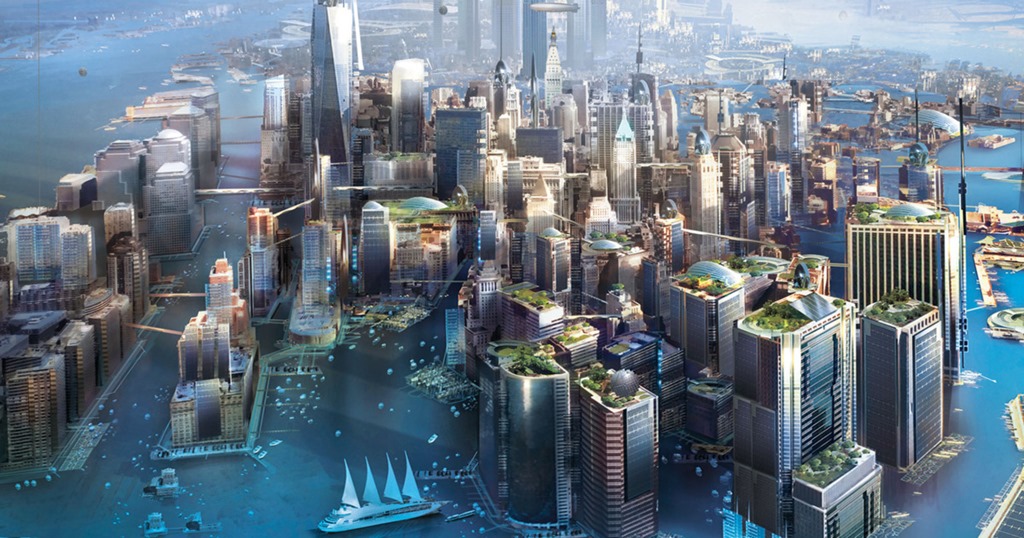
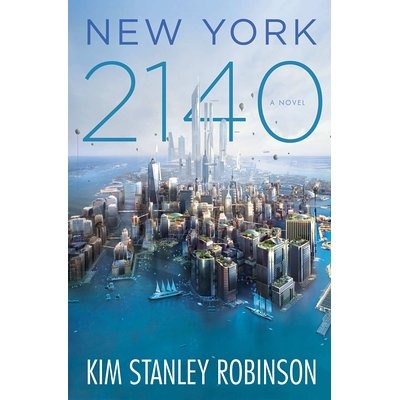
I’m reading Kim Stanley Robinson’s latest science fiction novel, New York 2140. The story depicts a future New York City through the eyes of a wide cast of characters, reminding me somewhat of Stand on Zanzibar by John Brunner. Robinson’s characters are survivors of a massive rise in sea levels. And even though they face horrible problems, their problems don’t seem any worse than those we face. The message is we always have problems, and we always solve them in a muddling way.

New York 2140

I’ve felt until now that climate change fiction warned us to avoid environmental doom. Have we already given up the battle? Are we now accepting rising seas and mass extinctions as inevitable? Donald Trump’s budget came out today, and it’s all too obvious he’s not going to fight climate change. Has everyone else given up too, including science fiction writers, of returning CO2 levels to below 350 ppm?

It is quite clear that conservatives have chosen lower taxes over action to stop global warming. Their greed knows no bounds, just look at their health care proposal. They prefer a tax cut for the rich over any Sermon on the Mount compassion. They pretend to believe climate change is not real, but I can’t believe they’re that stupid. I wonder if they haven’t psychologically accepted rising oceans in exchanged for lowering taxes and deregulation windfalls?

New York 2140 is a very entertaining novel, but I’m wondering if Robinson isn’t taking a Pollyanna view of the future. His New York City of 2140 is vibrant and alive, even after the oceans have turned it into a new world Venice. If I wrote science fiction my 2140 NYC would look a hundred times worse than New Orleans right after Katrina. My novel of a doomed city would be closer to Samuel R. Delany’s Dhalgren. Robinson makes 2140 NYC horrible but exciting, even attractive.

New York 2140 cover

KSM is considered a very realistic science fiction writer, but isn’t he also overly optimistic? Red Mars, Green Mars, Blue Mars, and 2312 reveal a lot of hope for the future. Is Robinson being too hopeful? We have to ask ourselves if civilization can survive runaway climate change? Robinson’s book suggests we’ll adapt and survive like our species always has in the past. But can we really bank on that trend? I’m not so sure.

I don’t think humanity will become extinct if we don’t reverse rising CO2 levels. We are adaptable. I do think we risk devastating billions of lives, and jeopardizing civilization as we know it. Our current successful civilization depends on relentless economic growth. I don’t think that’s sustainable. The real challenge of climate change is mutating our current civilization from free market capitalism to steady-state capitalism. The neo-nationalism we’re experiencing today suggests humans aren’t adaptable to such a change.

In that sense, I’m not sure Kim Stanley Robinson is right in thinking we’ll continue to succeed like we’ve had in the past. I worry we’re approaching a breaking point. That might happen yet in his novel, I haven’t finished it yet.

I’m listening to the audio version of New York 2140, but I admire it so much, I’ve decided to get the book version and read it too. I don’t think one reading will be enough.

JWH

Becoming an Outdoors Person Again

by James Wallace Harris, Wednesday, February 22, 2017

When I was a kid living in New Jersey, Florida, Mississippi, and South Carolina, I loved playing outside. My friends and I could spend whole days in the woods. I even liked camping out. As I got older the comforts of indoors ruined me for the outdoors, especially after I discovered computers in the 1970s. I just got too prissy to shit where my wild friends go. At 65, I do get outside some, going for walks and bike rides, but not as much as I should. A couple years ago I became a member at a botanic gardens near my house. Even though it’s the middle of February, it feels like Spring, and I’ve gone several times this week to take photographs. I thought I might chronicle the changes of seasons this year in my blog, and try to become a bit of an outdoors person again.

My inspiration for this transformation came from listening to One Wild Bird at a Time by Bernd Heinrich. Heinrich is a retired professor from the University of Vermont. He has cabins in Vermont and Maine where he observes birdlife in great detail. We often want to be the kind of people we are not. I’ve always wanted to be a naturist like Heinrich or Rachel Carson, unfortunately that lifestyle doesn’t fit my computer nerd nature. Heinrich has written other books I want to read, One Man’s Owl and Mind of the Raven, and maybe they will inspire me to visit the outside more often. One Wild Bird at a Time was an extremely pleasant book to listen to. Made me even want to take up birding.

Crane-on-the-Hill

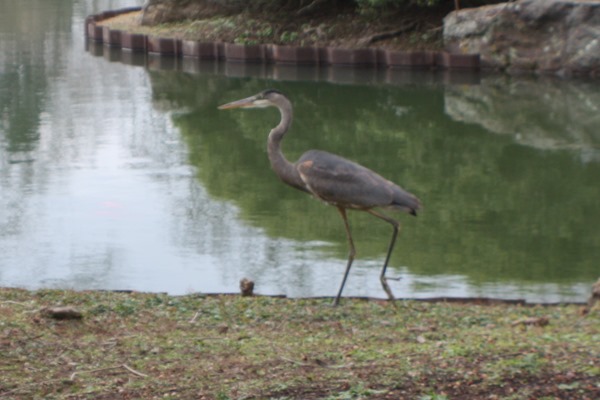
I don’t have a cabin in the woods, but the botanic gardens is less than a mile from my house. I’ll make do with it. Real naturalists spend days outside observing, no matter the weather. I can only handle 30-60 minutes, even on the most beautiful days. Heinrich’s book is full of details, including proper names for all the living things that grow, creep, run, crawl, fly, hop, slither, flutter. I took the above picture. I can’t name any living thing in the picture. I think the bird is some kind of crane. I believe these guys are geese, but I’m clueless as to what kind. They honk.

Geese

Not only do I not know the proper names of the plants and animals, I’m not a very good photographer. So I’m trying to learn several things by visiting this park. First, to just enjoy being outside. Second, and this might never happen, but I’d like to learn the names of beings I see in nature. Third, I want to teach myself how to be a better photographer. Fourth, I want to become better at seeing.

I should keep a journal like Heinrich. For now, I’m just going to occasionally post something here. I went to the gardens on Saturday with my wife Susan. I wanted to test a cheap close-up lens I got for my Canon Rebel Xsi, attaching it to my zoom lens. Here’s one of my first shots:

Alien-face

I have no idea what kind of flower this is. It looks like a face of a science fiction alien.

Most of my shots came out poorly. I left the close-up lens on, but took a bunch of medium distant shots. The field-of-focus was painfully narrow. I returned the next day, Sunday, with just my 18-55mm zoom lens. I was again disappointed with the field-of-focus. I found this wonderful cheat sheet on field of focus. I went back to the park today, Wednesday, with just my 55mm fixed-focus lens, set to aperture override at f8. I discovered that setting the camera to manual aperture control automatically puts it in RAW mode. That has forced me to start learning new ways to process my photos in Photoshop Elements.

Crane

Here’s a tightly cropped photo of the crane from Saturday, when I still had the close-up lens attached to my 18-55 zoom. The crane wouldn’t let me get that close to him, so I have to blow up the picture. He’s not in focused. Now here’s a photo I took today trying hard to get a larger field of focus.

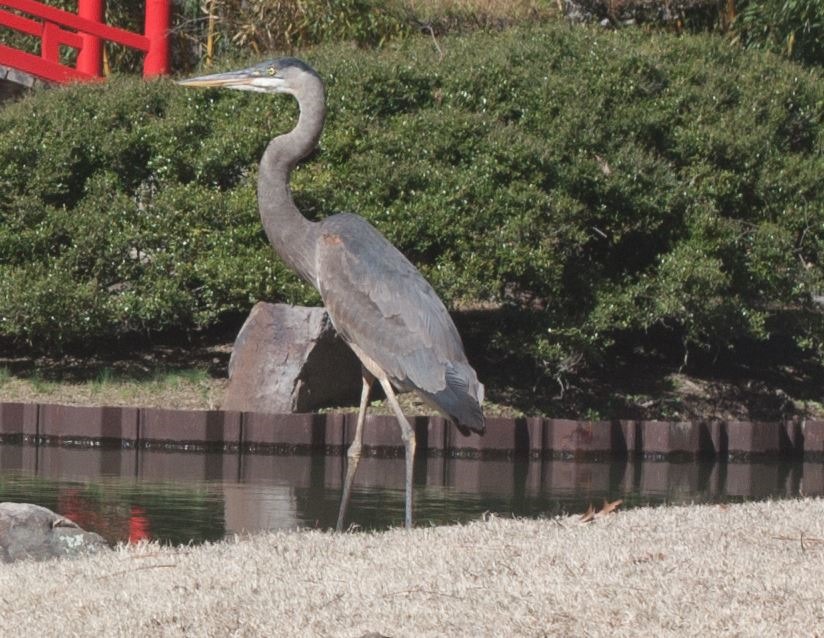
Crane---Wed

I do believe the crane is much better focused, with details sharper both in front and behind him, but it’s still far from perfect. It’s hard to tell because the photo is so cropped and it’s been converted to jpeg. Here’s a screenshot from within the camera raw editor. It’s still been saved as a jpeg, but it appears sharper, showing more detail – although it might just be more magnification. (Does anyone know what kind of bird this is?)

Crane Screenshot from Camera Raw editor

All of this experimentation takes time. But I am learning. I want to get into photography, but I don’t want to get bogged down with equipment. I like detail, sharpness, and large depth-of-field. That means I can’t get too close to my subject. I believe what I need is a very good wide-angle lens with large image sensor that captures a lot of megapixels. I can then just crop out what I need.

I did a search on “minimalist photography” hoping to find advice on equipment, but it turns out there’s an art form with that label. For now I’m going to use my old Canon and see how far I can push it to get what I want. But ultimately, I’d like to buy a camera that meets my minimalist definition. Something that’s easy to carry and use, and helps me record what I see with the maximum of sharpness and detail. It occurs to me that this pursuit will force me into finding a system for managing my photographs. I’ve already learn to quickly delete what I don’t like, but photos pile up quickly. That’s not being minimalistic. I wonder if there’s software that works a diary for photos?

Another software invention I’d like to see, and it might exist already, is a way to organize my photos so they map out the park. Wouldn’t it be cool if photos saved precise GPS info, and you could drop them into a folder, and a program would automatically create a virtual view?

Of course this gives me yet another hobby to pursue. One which will slice up my time into even smaller segments. On the other hand, it does get me out of the house. It’s a seeing hobby. I’m trying to get away from so many hobbies that involve computer screens and book pages. It’s somewhat artistic, which compensates for my overly analytical nature.

Statue-of-girl-in-fountain

Here’s one last picture (and I took 175 these three days). I’m including it to see what a larger version will look like on my blog page. My layout limits me to showing photos at less than 600 pixels width. I’m hoping double clicking will show this photo in a larger view.

JWH