Looking Forwards v. Looking Backwards

by James Wallace Harris, Wednesday, September 20, 2017

Do you read books about the past, or about now, or the future?

Our Nig by Harriet WilsonThis morning I started work on an essay about African-American fiction in the 19th century. It began with a question that had popped into my head: “Who was the first black novelist in our country?” This kind of fun sleuthing on the internet inspires me to write essays. I quickly came across articles about how Henry Louis Gates, Jr. had discovered a long forgotten book in the early 1980s called Our Nig; or, Sketches From the Life of a Free Black (1859) by Harriet Wilson. That made me want to research a number of other things. Have earlier novels been uncovered since? What were the second, third, fourth, fifth novels? What about short stories? Were any bestsellers in their day. Before long I realized I could spend weeks on this project.

Men-Into-SpaceI usually think of several ideas a day for researching and writing. I start work on just a fraction of these ideas, and complete work on damn few. Another idea I got yesterday was to write about Men Into Space, a one-season TV show of 38-episodes (1959-60) that worked to be very realistic about space flight. A lady in my online book club mentioned it and I was surprised I hadn’t known about it before now. It’s not available on DVD except as DVD-R sales through places like eBay (because it’s in the public domain). It is available to watch online at YouTube. However, I did find a book, Men Into Space by John C. Fredriksen that extensively writes about the series. I’d love to write a book like this – if I could focus my mind for a year or two.
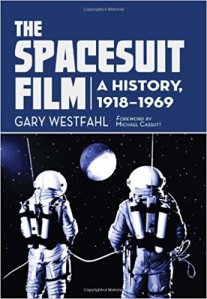
The Spacesuit Film - A History 1918-1969 by Gary WestfahlWhile researching Men Into Space I came across another book The Spacesuit Film: A History 1918-1969 by Gary Westfahl that covered Men Into Space as well as other movies and television shows that prefigured the space age. Hell, this exactly the kind of book I’d love to write too. But can you imagine the time it would take? But wouldn’t it be fun to watch all those old movies and television shows analyzing them for how they imagined the future? However, how many people read such books? I want to, but the $39.95 price for the paperback stops me. Even the $19.99 price for the Kindle edition is making me think long and hard.

This suggests another idea for researching. How many people buy and read these esoteric kinds of history books? How many people love to study tiny segments of forgotten history? I have this nagging desire to write something longer than blog essays. This month was supposed to be the month I began a book-length project. And I did start on an idea, but once again got side-tracked by too many distractions. But I’m back to focusing my mind on the project.

I have to ask myself, who is going to read what I write and why? Why spend a year, or several, writing something few people will want to read? It occurred to me this morning I could divide books into three categories: about the past, about the present, about the future. This is true for both fiction and nonfiction.

To Be A Machine by Mark O'ConnellI’ve always loved science fiction, which is future-oriented. But when I think about writing about science fiction, that’s past-oriented. Because I write for Book Riot, I can also write about contemporary publishing. I even think about writing books like To Be A Machine: Adventures Among Cyborgs, Utopians, Hackers, and the Futurists Solving the Modest Problem of Death by Mark O’Connell, which is essentially about how science fiction is affecting our world today.

I also came across this pledge drive for Farah Mendlesohn yesterday. She is writing a book about Robert A. Heinlein and is looking for backers. She’s gotten 143 supportors so far. This is also exactly the kind of book I’d love to write – but is that the rough number of people who would be interested in reading it?

I’m now worrying that I’m spending too much time thinking about the past. Is that because I’m getting older and it’s natural for aging folks to analyze yesterday? I assume that many people who like my blog do so because they are somewhat like me – they are older and thinking about when they grew up, and we all loved some of the same things.

I believe my less popular essays at Book Riot are due to writing about topics that bore their demographic readership, which tilts young and female. This makes me wonder if I should accept that I like to write about things that appeal to a subset of aging baby boomers, or if I should work to write about topics that have a wider appeal across different age groups.

My guess is writing about contemporary subjects or about the future has more universal appeal. I wonder if writing about today or tomorrow isn’t more psychologically positive for both me and readers. But I’m so fascinated by the past, especially esoteric subjects.

I’m currently reading The Man Who Loved Only Numbers by Paul Hoffman about Paul Erdős, a brilliant mathematician, and The Five Gospels, about the Jesus Seminar, a group of scholars who work to figure out what the historical Jesus actually said. Both of these books are intensely fascinating. Both of these books are about the past and have little relevance to today or tomorrow.

I have to wonder if I’ve given up on tomorrow because I don’t have much hope for the future, either for myself, or the planet, and I’m finding pleasure and meaning by exploring the past.

I’ve always loved science fiction but when I read science fiction today I’m usually very critical of works that are based on unrealistic ideas. I don’t believe in all those far out futures like I used to. As a writing challenge maybe I should work to write about positive futures that could be realistic, ones we can hope to find. Yet, my most popular essay ever is, “50 Reasons Why Humans Are Too Stupid To Survive.” Gloom and doom does sell. Hell, the TV shows my friends and I binge-watch focus on awful people and horrible events.

Writing is about focus. Writing a book is about intense focus over a great time span. I’m wondering if choosing to write about the past isn’t a way of escaping the present or future? I also wonder if writing about the future isn’t a way to give myself hope for tomorrow?

Maybe you can’t relate to this topic because it’s about writing. Think of it this way. Do you love watching old movies and television shows, or new ones? Do you listen to old music or new music? If you’re mentally young, no matter what your age is, you’ll be enjoying whatever is new.

I’m being more and more drawn into the past. 1950s movie westerns, mid-20th-century written science fiction, 1960s romantic movie comedies, 19th-century novels, 1950s jazz, 1940s film noir, 1920s modernistic literature, Victorian scientific romances, etc. Growing up, I always thought about the future…

JWH


I’m Known for Human Stupidity and Dinosaur Dreams

By James Wallace Harris, August 26, 2016

If you search Google for “humans are stupid” my essay “50 Reasons Why the Human Race is Too Stupid to Survive” comes up in the #1 spot. At least it does for me, and for my friend Connell in Miami. I’ve been wondering why that essay gets 50-75 hits a day. I just searched on “why are humans so stupid” and I’m the #1 return again. If I use Bing, I don’t come up at the top of the returns. It’s weird to think that people are wondering why humanity is stupid, and come to my blog for answers. So far I’ve gotten around 15,000 hits. I feel a little guilty about spreading negativity. I guess it’s a positive sign I’m not getting more hits. Some of my readers who leave comments have been pretty down on the world. I suppose I can use the number of hits I get each day as a barometer to measure unhappiness in the world.

Smoking Dinosuars - Gary Larson

If you happen to search on “dinosaur dreams” I’m the #2 return on Google and #21 on Bing. (Why doesn’t Bing like me?) This is very weird too. Evidently, 30-50 people each day have a dream about dinosaurs, search Google to find out why, and come to my blog to read “Do You Dream About Dinosaur Attacks?” So far, over 13,000 people have done that. That’s pretty amazing that so many people dream about dinosaurs. Even more amazing – some of my readers have dreams just like mine, where dinosaurs show up, and everyone knows to be quiet and still, but some dumbass always makes a noise near us to attract their attention. I’m always more mad at the noisemaker in these dreams than scared of the dinosaur.

JWH

Writing For Other Sites and My Health

James Wallace Harris, Thursday, April 28, 2016

I’m publishing less here because I’m publishing more elsewhere. That doesn’t mean I want to give up writing for my blog, but I do need to develop a plan for what’s best to post here. When I write about science fiction its obvious to give those essays to SF Signal, because science fiction is what they’re all about. Plus, they get more readers. And I’ve been accepted at a general book site, so now I can write about all the other books I’m reading for them. I’ll let you know what site that is when they publish my first essay and I have a link. They’ve accepted two essays so far. That leaves non-book subjects for me to write about here at Auxiliary Memory. I just need to find the time. My plan is to publish one blog post here each week. All told, that’s committing myself to writing eight essays a month. The ones I write here might be short, like this one.

I’ve been retired two-and-half years now, and writing essays has turned into my retirement hobby. That’s worked out very well because writing counteracts brain rust. I’ve noticed the longer I go without writing, the more trouble I have remembering words and pronouncing them. I’ve always called blogging piano practice for writing essays, well now I know it’s exercise for the mind too. I highly recommend blogging as a hobby, for the young or old. Writing over a 1,000 blog posts has really paid off.

Essay writing is turning out to be preventative medicine for dementia. Writing is showing me my physical and mental limitations. Because the newer essays require so much research, I’m having to push myself much harder, causing me to hit a wall each day. That’s an effective barometer of my mental and physical health. Each day takes more psychic management, and it’s all too obvious each birthday I pass leaves less creative energy. I doubt I’ll be able to do a fraction of what I’m doing now in my seventies. Getting old sucks, but that’s not news to anyone already old. It might be news to my friends who have yet to retired. Before I retired I thought all I needed was time. Well, at least I’m still learning new things.

I’m learning what it takes to do research, and that’s given me much greater respect for serious writers. It’s one thing to write an opinion piece, it takes several magnitudes more effort to include useful facts. Especially if you order them in some kind of coherent fashion.

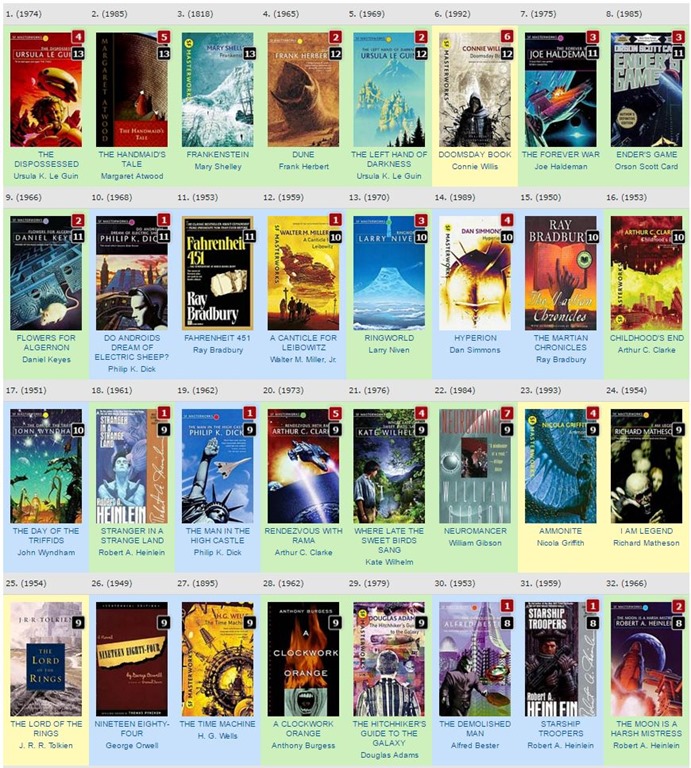
I’ve had  two essays published at SF Signal in April. The first, “The Biographies of Philip K. Dick” is about the many books written about PKD. Duh! Titles are important. The second, “How Well-Read Are You in Science Fiction?” serves two purposes. First, it asks how many classic science fiction books do you have to read to feel like an expert. Second, it describes how to use the Worlds Without End’s database to catalog the science fiction books you’ve read, which then allows you to see how you stack up on more than fifty “Best SF/F/H Books” lists. Read the article if you want to learn how, it’s a lot of fun to use the WWEnd database. Here’s an illustration of how well I did with their “WWEnd Top Listed” list. It’s color coded. Blue and green are books read, with blue being favorites, yellow means the book is on my to-be-read list. Orange means I’m reading that book currently. Yeah, I’m embarrassed to let people know I’ve never read I Am Legend by Richard Matheson or Doomsday Book by Connie Willis – but I own both.

top-listed

I don’t think I mentioned another article I wrote for SF Signal. Damn, I forget them as fast as I write them. But I do like plugging this Great Course. See “How Great Science Fiction Works – A Great Course in SF by Gary K. Wolfe.” If you love the history of science fiction, this is an excellent overview of the genre, and is only one credit at Audible.

JWH

77 Things I Learned From Writing 1,000 Blog Essays

By James Wallace Harris, Wednesday, January 20, 2016

This is my 1,000th blog post and I’ve learned a lot from blogging.

My first post was “Access time in a fifty-five year old brain” published 12/26/2006. Here’s the first paragraph:

The main reason I’ve created this blog is to help me remember.   After that I want to study how information is organized with the ultimate plan of taming the horde of competing topics that have tangled up my synapses.  I’m hoping if I can find a way to organize my thoughts I will be able to remember facts and details more efficiently and faster.  If I can’t, then the search box will do the job my neurons can’t.  My access time for my gray matter runs from instant, to many hours, to total failure.  This started as a noticeable problem in my late forties and has been getting worse ever since.

Well, I’m still struggling to organize my thoughts, but I’m quite confident Auxiliary Memory has been an huge help as an external memory device. Blogging is also a form of mental exercise that keeps my declining mind in shape. After nine years, or 3,314 days, and over a million words, I have forgotten most of what I’ve written, but it’s still there for me to retrieve. I’m often surprised to reread what I write. Blogging has turned out to be an incredibly useful tool, and I wonder why more people don’t blog.

To celebrate these nine hundred and ninety-nine essays, I thought I’d note some of what I’ve learned.

  1. Blogging is like piano practice for writing.
  2. Essay writing is a concrete way to organize thoughts.
  3. Original thoughts are thin and vague, and it takes a lot of work to make them coherent.
  4. Often coherency doesn’t show up until days of writing and rewriting. 
  5. We don’t realize how unclear our thoughts are until we try to put thoughts into sentences.
  6. Thinking improves with editing.
  7. The quality of my writing is directly related to the number of times I reread and edited an essay before I hit the publish button.
  8. There is no relation between getting hits and what I’m interested in writing about.
  9. I can’t predict what people will want to read. The old essay that gets the most current hits is “Do You Dream About Dinosaur Attacks?” If you search Google for “Dreaming about dinosaurs” my piece is 2nd in their listing. Evidently 30-50 people a day research this topic. I never would have predicted that.
  10. If my goal is to get hits, then I should review products. Product reviews are my consistent hit getters, but I quit writing them. 
  11. Science fiction is the subject that has garnered my most readers, and my favorite topic to write about.
  12. Don’t expect your friends and family to read your blogs.
  13. Only a few of my friends have subscribed to my blog and will occasionally mention reading an essay, or post a reply.
  14. I’ve learn to write what I feel like writing and not to worry if it will be read. I’m currently getting 250-350 hits a day, mostly due to Google searches, but also because of a handful of regular readers. I have 1,500 subscribers. But I can’t assume that a hit means a read. Just because a person clicks on a Google search return doesn’t mean I’m providing them with information they want to know. And many of my subscribers are other bloggers hoping I’ll read their blog. (Which I do try to do.)
  15. It’s extremely hard to write a 1,000 words that someone else will want to read.
  16. Few people want to think about a specific topic the same time that I do.
  17. There are very few people that have the same mixture of interests as I do.
  18. Blogging is a way to embed your personality into words.
  19. Blogging is a way to find out how many of your friends, family, and strangers think your interests are interesting.
  20. Blogging is a way to express yourself without boring your friends.
  21. If you want to find out how interesting you are to your friends, blog your thoughts. You might be surprised.
  22. There is a direct relationship between how much time my friends are willing to listen to me talk and whether or not they will read what I’ve written. My most chatty friends, the ones that never let me get a word in, never read my blog. I don’t say this as a hurt ego, but to show that blogging will reveal which of your friends are actually interested in what’s going inside of your head. Don’t blog if you don’t want to know.
  23. Blogging will reveal what your true interests are to yourself, and how fanatical you are about them.
  24. Blogging is a good way to meet people like yourself online.
  25. Blogging is a good way to learn if you have common interests or obscure fascinations.
  26. Blogging is a way to learn when your thinking is faulty.
  27. Blogging is a way to learn when your thinking is political incorrect.
  28. Blogging is a way to learn things about yourself that you don’t see – because readers do.
  29. Blogging is a way to test the limits of your memory.
  30. If you blog about a past event and try to document it with photos, outside reference material, interviews with people at the event, you’ll learn that memories are piss-poor at best.
  31. A well written blog about an event written within 24 hours will provide a better memory than your brain.
  32. If you get an idea for a blog post start writing it as soon as possible because the idea will disappear quickly.
  33. Blogging is mostly memory, opinions and reporting.
  34. Reporting is when you document events outside of yourself.
  35. Being a good reporter is hard.
  36. Opinions are a dime a million, essentially worthless unless you can back them up with evidence.
  37. The more evidence the better. 
  38. My personal memories are only interesting to people if I can frame them in a universal theme. And even then, few people will read them. One of my favorite memory-lane pieces, “Super Men and Mighty Mice” has gotten the least amount of hits. It was about being kids and pretending to fly, and begins like this:

    During the Ozzie and Harriet years, when I was seven and people called me Jimmy, my sister Becky and our best friends Mikey and Patty, would beg old tattered terry cloth towels from our moms and pretend to be George Reeves. We’d tie those old faded pastel rags around our necks, stretch out our arms, hands flat, fingers pointing forward, tilt our heads down and run like Hanna-Barbera cartoon characters, occasionally jumping with all our might, with the hopes of getting airborne like Superman, or at least Mighty Mouse. And when we were burnt out and our little bodies too tired to try any more, we’d go to sleep at night and have flying dreams.

  39. It’s hard to write Jean Shepherd type nostalgia and get hits. Shepherd is famous for A Christmas Story. Nostalgia just doesn’t index well on Google.
  40. Nostalgia does appeal to readers who have similar past experiences. It’s lucky when you find those people, or they find you. 
  41. Blogging teaches elements of journalism. If you want hits, you have to write what other people want to read. That means focusing on current popular topics, and writing short pieces that don’t exceed the common attention span. I decided long ago to write what I’m interested in and at lengths longer than most people want to read. So it goes. 
  42. I’ve learned that I naturally think in 500-1500 word essays.
  43. 500-1500 words is far longer than what most people want to read.
  44. Titles are very important.
  45. Delete all the words that people will skim over.
  46. I’m a verbose writer and don’t delete enough.
  47. Over the years I’ve often written about topics I’ve already written about but have forgotten that did.
  48. I have common themes I repeat but I hope are refined with each new approach. 
  49. Regular blogging helps with my writing and thinking skills.
  50. Regular blogging helps with my verbal skills. This was a real revelation.
  51. Regular blogging keeps my vocabulary active. If I don’t blog for a week or two I start forgetting words, and forget how to pronounce them. That old saying, “Use it or lose it” is true.
  52. Blogging has been a great social outlet since I retired.
  53. I can express myself better in a blog than I can talking.
  54. Blogging helps me listen to other people.
  55. Blogging makes me wish my friends blogged so I could read their thoughts.
  56. Blogging makes me wish my friends blogged so they would make their thoughts more coherent.
  57. Blogging is somewhat like being in a hive mind.
  58. I wished I had started blogging when I learned to read and write.
  59. I wished I had learned to read and write at age 4, when I started being self-aware.
  60. I wished my parents, grandparents, and ancestors had blogged so I could read about their inner lives.
  61. I wish the Library of Congress would archive blogs.
  62. I wish politicians, famous people and people doing interesting jobs would blog. Sound bites on television makes people seem shallow, tweets make them seem snarky, and Facebook makes them seem silly.
  63. Everyone approaches blogging differently. Some people use it like a diary, making short notes about their day. Others post photographs of all the places they visit. Some people repost other people’s blogs that they like. Some people write excessively about tiny topics, or say essentially nothing about big topics. There’s no one way to blog.
  64. Folks want to read about your dreams about as much as they want to see your vacation photos.
  65. Sometimes you have to guess what you remember. In recent years many writers have gotten into trouble for writing nonfiction that turned out to be fiction. Memory is closer to fiction than nonfiction. That’s just how it is.
  66. Wikipedia is my absolute best memory bank.
  67. Google makes a great spelling tool and dictionary.
  68. Sometimes I have to play Six Degrees of Separation to remember a person. IMDb is great tool for that.
  69. I’ve learn to fact-check my memory.
  70. I always try to send friends my blog when I mention them, but most people don’t care.
  71. I generally get photos from Google and use them without credit. I shouldn’t do that. I do try to get generic photos, or things in public domain.
  72. Sometimes people use my posts and photos without credit. Sometimes I think it’s flattery, other times I think fraud.
  73. Blogging is good for my mental health.
  74. Blogging gives me a sense of purpose after I retired.
  75. Blogging is a way to examine my life – remember an unexamined life is not worth living.
  76. Blogging is a way to be philosophical.
  77. Blogging is a way to push myself to do more.

Pug10

JWH

Publishing Outside My Blog

By James Wallace Harris, Tuesday, January 5, 2016

I’ve had two essays published at SF Signal that normally I would have published here. I don’t know if my regular readers, all seven of you, will miss these stories or not, but I thought I might mention them. They were “64 Classic Science Fiction Books I Want To Hear” that was written for my 64th birthday, and “The Literary Novels of Philip K. Dick.” SF Signal is a website devoted to tracking anything on the net that deals with science fiction and fantasy. It won a Hugo award in 2012, 2013 and 2014. So it’s ego boosting to get published there. And I want to thank it’s editor John DeNardo for linking to this blog in the past, encouraging me to submit, and accepting these essays.

I’ve been writing Auxiliary Memory since 2007, and this is my 993rd essay. I consider blogging piano practice for writing. Now that I’ve been retired for two years I’ve decided to push my writing ability by submitting to other sites. I’ve gotten comfortable with blogging, and I need to dial up the intensity knob, aim higher and push against my limitations. I’m starting by submitting to non-paid sites for a while, to get used to writing for editors. After that I’ll work up to submitting to paid sites. Writing is a fulfilling hobby to have in retirement—and it helps strengthen flabby memory muscles.

I will keep blogging, hopefully at a regular pace, but I need to spend more time on substantial pieces that I’ll send elsewhere. I need to learn what kind of essays are best suited for this blog, and what kind are best sent elsewhere. I’m also hoping that getting published on other sites will attract readers for this site. WordPress says I have 1,500 followers, but I know most of them are just folks promoting their websites (which is cool by the way). Writing something that another person will take ten minutes of their time to read is a challenge. I’m sure there are tens of thousands of new works to read on the internet every day, maybe even in the millions. Competition is fierce for eyeballs. Deciding on a writing topic that is reading worthy is a difficult task. It’s work that pushes my brain to think harder, and since I’m at a stage in life where my brain cells want to kick back and watch TV, it can feel like walking two miles to school everyday, both ways uphill, in the snow,

JWH