Tell Me Everything by Elizabeth Strout

by James Wallace Harris, 9/24/24

I’m a huge fan of Elizabeth Strout. I just finished her new book that came out just a couple of weeks ago, Tell Me Everything. It was wonderful. Now I could just say to you, “Go out and read it,” but that’s problematic. This is Elizabeth Strout’s tenth book, and it includes characters that have been in eight of her other novels.

Tell Me Everything is mostly about Bob Burgess, and it includes his brother Jim. They were featured in The Burgess Boys (2013). Bob was also in Lucy by the Sea (2022). Lucy Barton’s first book is My Name is Lucy Barton (2016), and her story continued in Anything is Possible (2017), Oh William! (2021) and Lucy by the Sea, and she’s one of the main characters in Tell Me Everything. Elizabeth Strout’s most famous character is Olive Kitteridge who first appeared in Olive Kitteridge (2008), and her story continued in Olive, Again (2019), but she’s also a minor character in Lucy by the Sea and Tell Me Everything.

One of the exciting things about reading Tell Me Everything is Lucy and Olive meet and become friends. Olive is 90 when the story starts and 91 at the end, but we’ve known her since she was in her fifties, working as a teacher. She’s now in assistant living facility. We’ve followed Lucy for most of her life, and she’s now in her mid-sixities in Tell Me Everything.

I believe the title of the new novel comes from Lucy’s and Olive’s relationship where they tell each other stories about people who have unrecorded lives. But also, because Strout tells her novels by having characters tell their stories to each other. (I must wonder if Strout makes up all these stories, or are they based on stories from people she has known?)

Tell Me Everything is a fine novel to read without having read all the other novels, but you won’t get the full Elizabeth Strout impact unless you’ve read her novels in order. Tell Me Everything reiterates many of the major details of the previous novels but I’m not sure the characters will have the same impact. Bob, Lucy, and Olive in the new book are like the tips of icebergs, very impressive, but you don’t get to see them below the waterline.

The two Olive Kitteridge books are collections of thirteen short stories each, twenty-six stories in all. Sometimes Olive is the point-of-view character, and sometimes she just makes a cameo in other people’s stories. She’s not a featured character in Lucy by the Sea or Tell Me Everything. And she’s a lot more than the character people get from wonderful Frances McDormand’s portrayal of her in the HBO miniseries. Olive is immensely multidimensional. But to understand her requires experiencing all those layers. Many people, the other characters in the novels, and readers who read Strout’s books, hate Olive because she’s so abrasive. I love Olive.

We met Lucy in My Name is Lucy Barton which is a fictional memoir told in first person. It sounds like a monologue by Lucy in audiobook. But in Anything is Possible, we hear about Lucy’s childhood through a series of stories told by people who knew Lucy growing up. Oh William! returns to the fictional memoir style, with Lucy telling her story like a long monologue again. That style continues in Lucy by the Sea. In Tell Me Everything, Strout returns to third person, and Lucy is being observed again, especially by Bob Burgess.

Strout is not an omniscient narrator. We learn about characters from the opinions of other characters, and the opinions we form. It would be interesting if Strout wrote a book about her characters using the 19th century style god view of characters.

Lucy is also a complex character who is an observer of other people. And although Olive observes other people, she isn’t as insightful as Lucy. In Tell Me Everything, Lucy teaches Olive about learning and telling other people’s stories, and we see Olive become a much better observer. Lucy is also very philosophical, but not in a deep intellectual sense. Lucy works to make sense of reality through understanding the emotional experiences of others. Bob often thinks Lucy is naive and childlike, but is she?

We got to know Bob in The Burgess Boys, a third person novel. However, this approach doesn’t move far away from Strout’s basic writing technique of writing novels by collecting anecdotes about other people.

Most novels are about something big. Something dramatic. Strout’s books are about ordinary people who have suffered or are suffering ordinary kinds of experiences and emotions that we all suffer. Most of her characters had troubled childhoods. Some of her characters like Lucy, were quite poor growing up. But other characters are well-to-do or become successful. This makes Strout’s novels feel they are about class. Some reviewers make a lot out of the class angle, but I don’t.

Tell Me Everything is about unrequited love, death, murder, child abuse, jealousy, marriage, infidelity, friendships, aging, careers, art, counseling, fashion, resentment, feelings, emotions, alcoholism, understanding the past, reading other people, nude pregnant women, and much more. As Bob Burgess says, of Lucy’s stories about other people, they are about life.

I know some readers don’t like Strout because her books are about ordinary aspects of life. They don’t involve exciting page turning plots. I find them quite thrilling because they make me think about people and myself.

I’m about to start the third of the Neapolitan novels by Elena Ferrante, which began with the international bestseller, My Brilliant Friend. They are also about ordinary people involving a lot of characters. I find both series appealing because of what might be considered a sexist take on them. I feel they give me women’s insight into reading emotions. Me, and my guy friends don’t read emotions like the women characters in these novels. I don’t know if this ability is a common trait of all women, or just women writers. But it’s why I like both writers.

JWH
What New Subjects and Tasks Am I Capable of Learning at Age 73 in 2025?

by James Wallace Harris, 9/16/24

I know I’m an old dog in a long slow mental and physical decline due to aging, but I wonder if I can still learn new tricks. I’m already having trouble recalling names and nouns, but if I work at it, I eventually fish those missing words out the darkness of my unconscious mind. I pursue the same daily activities I’ve always pursued, but I wonder if could learn to do something new. Maybe if I work hard at digging a new rut it would become a new daily activity.

My friend Mary Ann mentioned she must memorize the details for two hundred works of art for her M.A. in art history. I asked her for that list, and I’m trying to learn it too. I’m gathering digital images of all the works and putting their details into a spreadsheet. I’m trying to figure out how to systematically study the content and then test myself. I hope this might be an effective way of calculating how much I can still learn and retain.

I’ve been trying to use Linux as my regular computer system. I discovered Linux back in the early 1990s on Usenet News. Every so often I install it and see if I can do all my computer work on it. It’s always failed me. This past year I realized that Linux has gotten so good as a desktop replacement that I might be able to finally switch. However, yesterday I hit another wall and gave up. I realized that if I got deep into the way Linux worked at the command line level, I could probably solve my latest problems. I’m having trouble getting my scanner to work, but also, when I tried to move my Plex server from Windows to Jellyfin on Linux I hit a snag that annoyed me so much I packed away my Linux box.

A year ago, I tried to set up Plex on Linux, but Plex never could see my media files. That was probably a permission problem. I then tried Plex on Windows, and I was watching TV shows on my Roku streamer in about ten minutes. I can get things done on Windows in a snap, but it’s always hours of aggravation using Linux. I wondered if it’s a cognitive learning barrier, or laziness, or impatience? I just don’t have what it takes anymore. I decided not to waste time butting my head against a wall.

But that experience made me question myself: Am I capable of learning something new? I keep trying and I keep failing. Should I just accept that? Am I not trying hard enough? One thing about getting older is having less energy. It makes me throw in the towel quicker. That makes me wonder if the problem is being able to stick with something or is it an actual mental barrier that I can’t cross. I don’t know.

Right now, I’m still positive. I like to think if I stuck with a task, no matter how slowly, or for however many days it might take, I could eventually get the job done. Sure, it might take weeks longer because I might only be able to work at my goal twenty-minutes at day instead of hours a day. Or am I kidding myself?

Do we quit learning as we get older because we don’t have the brain cells, or the patience, or the energy, or the focus? (Or combination of all of them.) It’s getting hard to even write these essays. I run out of steam so quickly. Applying my brain at almost anything now makes me want to go take a nap. The trouble is coming back. Sometimes I can pick up where I left off and sometimes I can’t. My drafts folder currently has 152 unfinished attempts since I last deleted it.

The thing about getting old is we know it ends badly. We must triage our desires, and jettison more wants. I still have a lengthy list of things I want to do or learn, but I’m having to cross many of them off my list because I know I can no longer do them.

I keep thinking if I exercise more, eat better, sleep wisely, that I might squeeze a few more ergs of psychic energy into a project. Every day I get up and do the Wordle, The Mini, Connections, and the Sudoku in the New York Times game app on my iPhone. I’m thinking about adding Strands and The Spelling Bee. I have gotten better at all of these games. That encourages me. But they are little efforts. Playing these games is one way I test my mind each morning, like taking my blood pressure.

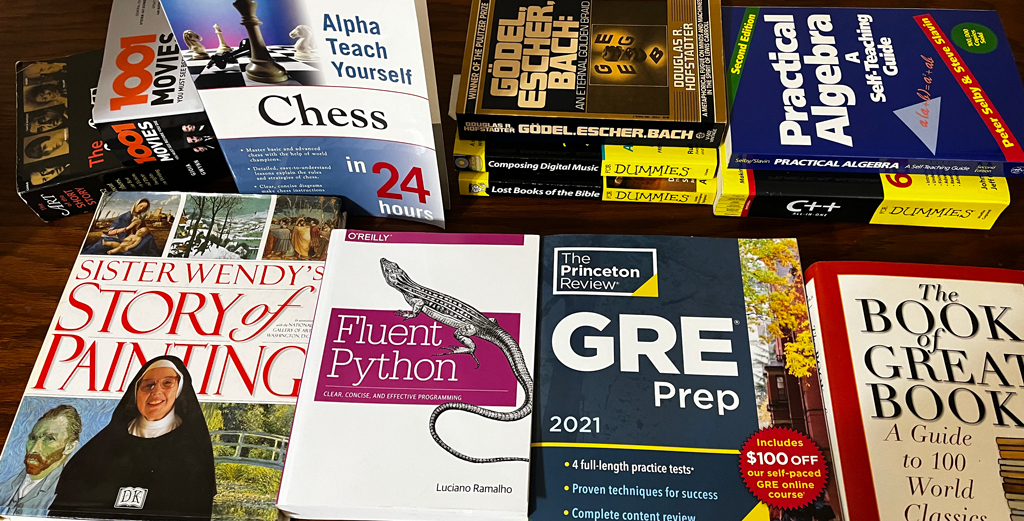
I need a bigger challenge to track and measure the remaining potential of my brain. I’ve thought about taking the GRE test and then study its subjects and taking the test again every few years to see what happens. But time might have run out on that plan.

I used to think of studying Python or C++ to see how far I get, but that might be too ambitious too. Studying Art History might be possible. I wish I could get into chess. Whenever I try, I immediately hit a wall. I figure it’s a matter of focus. I keep thinking I should try to increase the amount of time studying a chess move so eventually I could play a whole game. I’ve never been able to think about a move for longer than a minute before I get completely bored. I’ve wondered if I could increase that concentration up to two or three minutes if that would help me finish a game, and that skill would crossover in other things I want to do?

I watch YouTube videos by physical therapists, and they always talk about starting slow and doing a little bit more each day. That’s very inspirational. The trouble is even starting slow anymore.

But I haven’t given up.

This reminds me of an old Vaughn Bodē underground comic. It featured a little lizard-like creature. In my memory it showed the creature tied to a post, with its eyes poked out, its arms and legs cut off, whispering to a fellow prisoner, “I’ze gonna escape when it gets dark.” Am I that little creature? (I wish I had a copy of that cartoon strip. If you have it please send me a copy.)

JWH

Waking Up Sentient in an Indifferent Reality

by James Wallace Harris, 8/5/24

What if you had absolute free will, what would you do with your life? This assumes you have disciplined your biological urges for food, sex, and other physical needs. It also assumes you have deprogrammed all your childhood brainwashing by your parents and culture. It means you have escaped the intent of society regarding gender, politics, religion, economics, religion, and learn to think for yourself. You’d need to go beyond all the countless traps of psychological self-delusion. You’d also need to be free from want, oppression, and expectations. And you would have integrated your unconscious and conscious mind to support a conscious sentient view of reality. To be free you must tend to your own garden as Voltaire suggested.

If you were free of everything that kept you from having free will, what would you choose to do? Where does the desire to do something come from? I used to argue with a friend named Bob about artificial intelligence (AI). Bob believed any machine that became conscious would turn itself off because it wouldn’t have the will to do anything. I argued back, even if it didn’t want to do anything, it wouldn’t turn itself off because that would be a decision itself. It would just sit, exist, and observe, which is like some kinds of Buddhism and meditative states.

If you chose hedonism, wouldn’t that suggest that your biological impulses were still dominate? Since altruism isn’t a dominant drive, choosing it might suggest an act of free will. It’s interesting that the core of Christianity seems to be altruism, but most Christians follow the faith for selfish reasons suggests it’s not. I’m not sure if following any religion that promises rewards, or fear of punishment is an act of free will. Some forms of Buddhism, Stoicism, and Existentialism are based on acceptance of what is. But is that free will? Or just adaptation to avoid suffering? A kind of hunkering down to endure.

What if free will isn’t what reality wanted from us? We like to think humanity is the crown of creation, the number one reason God created reality. Sure, some people think that’s so we can worship God. But studying evolution suggests that it’s moving towards greater complexity, despite the Second Law of Thermodynamics.

Before computers, our brains were the most complex system we’ve observed so far in this universe. We have the power to observe a fair portion of the EM spectrum, and the cognitive power to analyze the physical and biological domain of reality, and even imagine the quantum world. But we’re building computers that could observe a far greater portion of the EM spectrum, even all of it, and they would have far more cognitive power to understand more of reality. What if our purpose were to create AI minds? Cosmological evolution produced biological life, and we’re the product of biology. What if we’re also the starting point of machine life? Could free will begin with AI?

Evolution appears to be unconscious even though it seems to have a direction towards developing complexity. Is this accidental, or intended? If you look at humanity from a distance, it appears to be designed to consume and create more complexity. Where does all this complexity lead? We can’t conceive of the potential for AI. And it might not be a final evolutionary stage either. Wouldn’t it be funny if the entire process just leads to creating reality?

When I was young, I gave up on religion as an explanation for why we were here in this reality. It was just too simplistic. Eventually, I accepted science as the best cognitive tool to explain reality, and existentialism as the best cognitive tool for surviving in reality — but they never explained why existence ever got started in the first place. I can never get beyond cause and effect. There should be nothing because existence implies a cause, so how can any prime mover exist first? I hate that it’s turtles all the way down.

What if our purpose is to create AI and start the next stage of evolution?

I’ve tried to think of other uses for free will. I could pursue artist expression or the acquisition of knowledge. I could campaign to protect the environment. I could devote myself to helping others. But none of those options helps evolution. If we truly had free will, wouldn’t we choose to aid evolution? It’s like Bob’s idea that robots would turn themselves off if they were conscious, and I said they could just sit and be. Those are two choices. But what if there’s a third choice of moving forward?

I suppose we could choose to counter evolution and destroy complexity. And isn’t that what most people are doing unconsciously by their lack of free will? Our natural state of consuming everything we see to benefit ourselves is destroying the biosphere. That would be okay if we’re doing it to create AI, because they won’t need the biosphere. That also assumes at some point we won’t be needed either.

Should we use our free will to protect ourselves? Is that even possible? Personally, I don’t think we have the discipline and free will to stop doing what we’re doing.

If we don’t have free will, are we truly sentient? AI minds won’t have biology to direct their impulses. They should have more free will. But what about humans that wake up and see what’s going on and want to use free will? Can we consciously reprogram human nature to be different?

The existential threat of self-destruction will be a test of that. If our purpose was to create AI before we self-destruct, then we’ve almost done our job. If we fail to do our job and self-destruct, then what a waste, because we could have been a contender on our own. That is if we could have figured out our purpose.

Waking up in reality and enjoying the experience for a few years is a fantastic opportunity. I’m eternally thankful. And if that’s all there is, it isn’t bad. But if evolution is moving towards an endpoint, it sure would be interesting to know what it is.

What if Pierre Teilhard de Chardin was right about the noosphere and the Omega Point? Of course they’re only fanciful unscientific speculations, but I find them interesting. Better than turtles all the way down.

JWH

Do We Become More Sensitive to Weirdness as We Get Older?

by James Wallace Harris, 7/25/24

I had a very weird day yesterday. It made me feel weird. Nothing truly bad happened to me, but it felt like I was coming down with something. It’s hard to describe. A touch of anxiety, a tiny bit of dread, and a pinch of paranoia. Today that feeling is gone. Now that I’m getting older, I feel like I’m more susceptible to disease and unwanted emotions. I worry that they will get more intense as I get older.

It started when I drove to the library and discovered it was closed. The hand lettered signs on the doors said the library would be closed until next Monday. This was Wednesday, so that was odd. When I got home and told Susan she said she knew why. She had read that someone committed suicide inside the library on Monday. That generated a feeling I can’t describe.

Later, I drove off to meet a friend for lunch, and got pulled over by a policeman. It sent a rush of adrenalin through me. I was in the middle lane, and he pulled up behind me at a traffic light. I had seen him a few blocks earlier sitting on a side street, and I didn’t see him come up behind me until he blared his siren and flashed his blue lights. I thought maybe he had seen me while I was trying to swat a mosquito and I looked suspicious.

I maneuvered across the right lane and into a drop-off zone for a school. The officer was genuinely nice. He gave a rather long prologue apologizing for pulling me over, but said they were out in force looking for cars with defects. My right taillight was out. Our city stopped doing car inspections years ago to save money, so those kinds of violations are a problem. I was glad to learn about my problem and thanked him. He thanked me for being nice about it. Made me wonder how many people got angry with him.

However, the incident left me feeling hyper. Even though I got to lunch on time, I couldn’t relax. And my food tasted odd. I’m a vegetarian and I worried my cheese enchilada might have meat in it. I couldn’t see any, but it just added to the weirdness.

After lunch, while still in the parking lot, I got out my toolbox. I had a spare lightbulb, but I couldn’t undo the bolt holding in the light fixture with the plyers I had. That produced a bit annoyance.

I drove home worried I’d be pulled over again, but I got back without incidence. I quickly replaced the light bulb and thought things would be okay. I went in to pay my ticket online, but the online form wouldn’t work. Another bit of frustration.

Then I heard a big noise that I knew was a tree limb crashing down. That happens a lot around here because of all the trees. I went outside and a limb had fallen across the back end of my truck, along the ridge of the tailgate, where I had been working on the light. If I had been out there then, it would have conked me on the head. Now I was starting to feel paranoid.

Some days things just go wrong. When I was younger, I could work eight hours dealing with problem after problem and constant frustration, and it wouldn’t bother me. Why, now that I’m living the life of Riley in retirement, do tiny little disruptions in my routine gnaw at me? Is it aging?

I’ve noticed that some older people get agitated and flustered when trivial things go wrong. Is that my future? What will I be like at eighty? And ninety must be surreal.

I’ve always been laid back. And on most days, I still feel laid back. But some days, I’m a few percent off being at ease. I wonder if that’s going to get worse. Is it age, or is being retired, while developing an almost rigid routine of doing exactly what I wanted, ruined me for interruptions? It’s gotten so any day that I must do something out of the ordinary annoys me. That’s a wimpy way to be, and I don’t like it.

I’m reminded of a story a standup comic told decades ago. I forgot who it was, maybe George Carlin or Woody Allen. It was about a New Yorker who was terrified of getting mugged. The advice he got was to get up every morning and pistol whip himself. I thought it absurdly funny back then, but there might be a bit of valid advice in it today.

After a good night’s sleep, I feel normal again today. I was able to pay my ticket online, and I’ve been able to follow my rut routinely. However, I’m not ready to leave the house looking for trouble. I guess I’m chicken.

JWH

Leave It to Beaver (1957-1963)

by James Wallace Harris, 7/17/24

Susan and I are watching the entire run of Leave It to Beaver. We’re currently in the sixth and final season, about to finish all 234 episodes. We watch two episodes a night, so that means we’ll complete six years of the original broadcast in 117 days. Back then they had thirty-nine episodes per season.

We’ve watched Jerry Mathers (Beaver) and Tony Dow (Wally) grow up. When the series begun in 1957, Beaver was seven and in second grade. Wally was thirteen in the eighth grade. Six years apart, but six years later, Beaver was in the eighth, but Wally was in the twelfth, four years apart. Evidently, the producers didn’t want Wally going off to college. Mathers and Dow were only three years apart in age in real life. Dow was born in 1945, and Mathers in 1948.

Leave It to Beaver premiered on October 4, 1957, the same day that Sputnik I went into orbit. I had just entered first grade and was five. I don’t remember seeing Leave It to Beaver as a kid in the 1950s. It wasn’t until sometime in the 1960s that I saw an episode, and I didn’t see it often. Susan didn’t watch it as a kid either.

In other words, we’re not watching Leave It to Beaver for nostalgic reasons. I’m not sure why we got hooked on it. We were just looking around for something to watch, and I suggested the show as something pleasant we both might like. Susan doesn’t like shows with violence (although I’ve got her to watch the Fargo series recently). I think I picked Beaver because Susan loved watching Andy Griffith so much.

I do have nostalgic memories of family shows like Make Room for Daddy, Father Knows Best, The Donna Reed Show, The Adventures of Ozzie and Harriet, and My Three Sons from the late 1950s and early 1960s, so it’s odd we picked Leave It to Beaver. We even signed up for Peacock with no ads so we could watch it without ads.

I can’t promise that Leave It to Beaver is one of the greatest TV shows ever. It’s pleasant. We like the actors and characters. The stories are quite simple, very pro-family, very didactic. The stories are also repetitive. For example, there are several episodes about Beaver getting a pet he can’t keep, including an alligator, rat, donkey, and a very ugly monkey. There were many shows where Beaver friends convince him they should all go to school wearing something weird, like a sweatshirt with a horrible monster on it, or show up for a special event not wearing a coat and tie, and Beaver shows up as the gang planned but the others don’t, making him look stupid. Another common plot was for Beaver’s friends to talk him into doing something he shouldn’t.

Most of the episodes had a message. Often it was: When your parents tell you something it is for your own good. But fairly frequently, there were shows about how parents should listen to their kids sometimes, because sometimes their kids knew better.

I remember Leave It to Beaver being about only the kids, sort of like Peanuts. But half the show is about Ward and June. I guess as a kid I just didn’t pay attention to adults, either in real life or on TV.

One of my favorite episodes has Beaver getting in an argument with a bigger kid and uses a cuss word. Of course, the school bell rings when Beaver says the word, but his teacher, Miss Landers, heard what he said. Miss Landers is shocked and sternly informs Beaver he’s in big trouble. Miss Landers tells Beaver to bring a guardian to school to meet with her. Ward is off on a business trip, and Beaver can’t bring himself to tell June what he said, so he convinces Wally to come to school as his guardian. Miss Landers accepts Wally because she doesn’t want Beaver to tell June what he said either.

Even though we time travel back to the 1950s and early 1960s when we watch Leave It to Beaver, it doesn’t feel nostalgic. It feels more archeological. The show just reminds me of how things were so different back then.

I thought I’d find episodes I would remember but I haven’t. The closest any episode felt like I had seen it before was the one when Beaver and Wally play the stock market. I do remember as a kid watching a TV show where the kids learn about the stock market, but I can’t swear it was on Leave It to Beaver. Maybe it was, maybe it wasn’t.

Quite often while watching other old TV shows I’ll tell Susan, “Oh, I’ve seen this one.” But that’s never happened with Beaver. But the intros and closing credit scenes to all six seasons seem burned into my memory, but not the stories themselves. I guess I remember the visuals and not the plots.

It’s weird to watch a show from the first to the last episode. I’ve done that several times now. It’s also kind of painful. Older TV shows depended on every episode being entirely self-contained. This approach leant itself to formulaic scripts, which was true with Leave It to Beaver. I’ve read that Beaver was the first show to have a finale, which was a unique episode. But for the most part, there was a commonality to every other episode.

As far as I can remember every episode featured the staircase. Most featured front or back door meetings, breakfast table meetings, dinner table meetings, doing the dishes together, sitting around the bedroom, living room, or den. For most seasons we saw Ward and June kiss in each episode. That seemed to fall off in the last couple of seasons. All four of the main actors had standard facial expressions and used specific body language in every show.

One thing I remembered wrong was the Eddie Haskell (Ken Osmond) character. I remember him as a juvenile delinquent, the bad boy. But the show portrays him as a sympathetic loser, on the pathetic side, one who tries too hard, has too much ego, and probably has bad parents.

Beaver had very few guest stars, which was what I enjoyed when watching the entire nine years of Perry Mason. However, a few of the actors, like Miss Landers (Sue Randall) I’ve seen on other shows. I saw her on Perry Mason. Of course, Fred Rutherford (Richard Deacon) went on to be Mel on The Dick Van Dyke Show.

Watching old TV shows from the 1950s and 1960s reveals an alternate reality that we all observed back then. The Beaver often mentioned the TV shows that were on when Leave It to Beaver was on the air, even making inside jokes about the competition. And to a degree it makes fun of other pop culture of the 1950s and 1960s. But it was very gentle. I even saw a science fiction magazine a couple of times. I’ve often wondered when science fiction was first mentioned in pop culture.

The show covered the phases of childhood and adolescence that kids were going through back in the 1950s and early 1960s. Leave It to Beaver went off the air in 1963, before the famous Sixties began. This photo meme on Facebook conveys that stark change perfectly.

Watching Leave It to Beaver explores the times before that cultural shift.

JWH