Cross Generational Music Appreciation

By James Wallace Harris, March 14, 2016

In his new book, The Song Machine: Inside the Hit Factory, John Seabrook begins by telling how his young son took over the car radio during their morning ride to school. Seabrook loves music and wanted his son to love his music, but the kid was adamant that he wanted his own music. I remember doing this to my dad back in the late 1950s. I’m sure all of us have been on both sides of that divide of music generations. Seabrook decided to get into his son’s music, and ended up writing a fascinating book.

How much cross generation listening goes on? Don’t most people bond with the music from their teenage and college years and then essentially stop listening to new stuff when the next generation annoys them with their music? In recent years though, I’ve noticed that some kids have embraced a few bands, songs and albums from my generation, the 1960s. I belong to their grandparents’ times. Are these kids rebelling against their parents’ by listening to the music their parents rejected?

My generation (who knew the Who could be so prophetic) has become terribly nostalgic for music history, seemingly to never tire of documentaries like, The Wrecking Crew, Muscle Shoals, 20 Feet From Stardom, Standing in the Shadows of Motown, Big Star: Nothing Can Hurt Me, Searching For Sugar Man, Atlantic Records, and Respect Yourself: The Stax Years. Just last week I watched documentaries on Fats Domino and Carole King. I’d watch more if I could find them. It’s funny, but this music is the one bridge I have with my Fox News watching conservative friends. We hate each other for our politics but commune over music.

But if I tell my peers I have Katy Perry or Nicki Minaj on my playlists they laugh at me. But if I tell them I’ve been listening to Ronnie Spector or Dionne Warwick it sparks a memory fest. And if tell them I’m been playing Peggy Lee or Lena Horne, a few of them will perk up. Among my music loving buddies who do cross generations, they generally travel backwards. I guess the young people I meet with Jimi Hendrix T-shirts are traveling backwards in time too. I don’t know why older folks look down on the music of younger generations. I have a number of friends who stopped listening to new music around 1975, and no matter what I play for them, I can’t seem to get them to move forward in time.

That’s a shame because musical creativity didn’t stop in the 1970s. Seabrook writes specifically about pop music (Katy Perry, Ke$ha, Rihanna, KPOP, American Idol, Denniz Pop, Max Martin, Dr. Luke, Ester Dean) and how they make hits with computers and teams of creative personnel that collaborate with the performing artist. There are no singer-songwriters here. No bands that play all their instruments. Producers are the emperors of the studio, hiring up to a dozen people to write a song. But wouldn’t that be true back in the Motown era if everyone who added anything to a song got credit? The Song Machine was absolutely fascinating to me, even though I’m not from that generation. It annoys me that my friends won’t give new music a chance, and probably refuse to read this book.

the-song-machine-john-seabrook

All this cogitation about cross generation listening has made wonder about many things. How do kids today choose what they listen to from past generations? And why? Are they mesmerized by tunes in movies and end up chasing them down? Have they found LPs at Granny’s or Goodwill, which inspired them to dig up an old record player, curious about the tunes on those strange black discs? This morning I was wondering why young people remember The Beatles, but not The Byrds. Is there any reason for one generation to remember the pop culture from another generation? Has classic rock become the elevator music of today, and Beatles songs became ear worms boring into young brains? Do they teach The Beatles in school? Maybe kids clicked past nostalgia shows on PBS and got hooked. I don’t know what percentage of today’s generation discover old music, but is there any reason to expect them know about my music, or even like it? And why don’t I ever hear them express their love for The Byrds—my favorite band from the 1960s?

Mr Tamborine Man - The ByrdsTurn Turn Turn - The Byrds

At the moment I’m listening to a collection of 1950s songs on Spotify because I caught an episode of American Masters on PBS about Fats Domino. One thing I didn’t know, Fats was as popular as Elvis for a short while during the 1950s, but people now remember the 1950s belonging to Elvis. That makes me think there are some people like me, who remember their decade of music differently. I hardly play The Beatles anymore, but I play music from the 1960s constantly. Bob Dylan, The Byrds, Motown, San Francisco rock and pre-1965 Brill Building pop dominate my memories. If I made list of my favorite songs, I bet there would be a couple hundred songs from the 1960s at the top of my list before I even listed my first Beatles tune.

And I loved The Beatles, but I loved other artists from the 1960s more. Should I encourage young people to discover their music? Should schools teach 1960s music like they teach classical music in music appreciation courses? As I got older I sought out popular music that came out before the 1960s, going back into the 1950s, 1940s, 1930s and even the 1920s. I crossed genres into jazz, country, big band, folk, pop, world, opera and classical. I suppose some of the kids who are discovering The Beatles are doing that today.

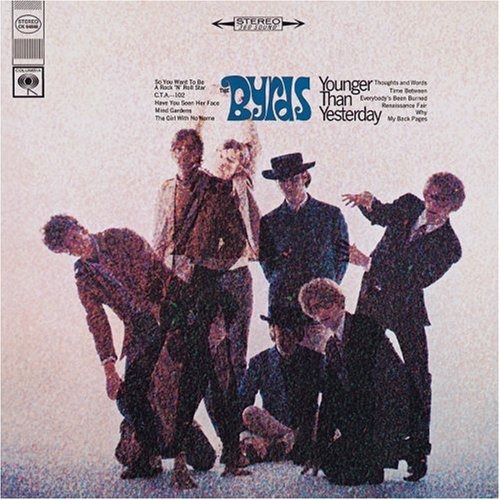
Fifth Dimension - The ByrdsYounger Than Yesterday - The Byrds

When does pop culture become history? When does memory become nostalgia? They used to play Fats Domino songs like I’m listening to as I write on the weekends in 1962, on WQAM and WFUN, and called them “Oldie Goldies” even though they were less than ten years old. Now they’re over sixty. People from my generation go to concerts today performed by acts they grew up with, even though those artists are even a generation older than us. I’m not keen on seeing dinosaur rock. I love remembering those performers when they were young, vibrant and in their times. On Facebook I have friends who post photos from parties where they act like they are still in high school. That’s cool. But should they listen to some new music too? It’s really hard to give up the pop culture that imprinted on us as teens.

I’m not sure there are reasons to require listeners to cross generational divides. When I watch “People Are Awesome” videos on YouTube I realize the current generation have plenty to keep them busy, more than I ever had. Now is always more important than the past—or the future. On the other hand, I’ve switched from Fats to “Jealous” by Ester Dean, playing it over and over. It’s definitely not from the 1950s! I’m too old to live in the times in which this song belongs, but Dean’s voice and melody touches my heart in a way that I wish I could.

Nortorious Byrd Brothers - The Byrds Sweetheart of the Rodeo - The Byrds

Do the young today long to visit my era in the same way I wish I could be young now? The Beatles were tremendously exciting, but were they more exciting than the groups now? Why are the sounds of The Byrds, Buffalo Springfield, and Jefferson Airplane still siren calls that hold me back in time? If I stopped listening to the songs that tie me to the past, could I modernize my brain by only playing new songs on Spotify?

I often think about my future when my body will be fading out of existence and my mind barely floats in reality. I’ve often thought listening to music on headphones while I die would be a great way to go. Will I be listening to seventy year old songs? More and more, the songs on my main Spotify list are newer ones. I play my tunes on random play. Will I leave reality hearing 1965, or 2037? Wouldn’t it be weird if I lived long enough to live The Sixties again?

JWH

Information Overload and Getting Old

By James Wallace Harris, Wednesday, February 24, 2016

I was cleaning out old magazines and stopped to read about Empress Theodora in The New York Review of Books. Evidently much of history about Theodora comes from ancient gossip, and a new book puts things right. The past is like today. Procopius, an ancient writer we use to remember Theodora, would have loved Twitter and shaming. Trying to get an accurate picture of Byzantine court life, politics and actual events is extremely difficult. Real history is information overload, and most of accepted history are Tweets.

information-overload

Here’s the thing, I’m suffering from a monstrous hangover caused by information overload. I want to know everything and can’t. I don’t know why read magazines anymore, especially ones like The New York Review of Books, where their essays are comprehensive, written by extreme experts, that make me think I’m completely uneducated. Reading one issue feels like I’ve learned more history than all I studied in K-12 schools. And it hurts. Often I can only read one essay before my head seems like a fission bomb reaching critical mass.

But if I stop trying to learn, living feels like killing time watching television while waiting to die. I can’t win either way. I’m starting to wonder if internet reading isn’t shorting out my neural pathways. Mostly I headline graze. There’s got to be some kind of happy median between Ph.D. scholar and Tweet view of every topic.

Generally when I feel this way, I return to science fiction, a cozy little artificial reality I discovered in my youth. I used to think the science fiction universe was small enough to comprehend, but in the last week, I’ve discovered inflationary events have expanded it well beyond my limits of observation. Now I understand why people dwell on highly focused specialties. Being a generalist is impossible. That also explains why the human race is too stupid to survive. Our brains are too tiny to comprehend even a vague model of larger reality. Our politicians think in sound bites because that’s the limit of their ability. We disagree with them because our 140 character capacity sees the same reality differently.

Part of my overload agony comes from growing older and sensing my brain slowing down. I hate giving up on keeping up. Yet, I also realize to survive aging I must jettison what I can’t mentally carry. I have to discover a practical diet of information consumption. I need Marie Kondo to declutter my mind. And I need to stop beating myself up because I can’t lift knowledge I once easily pressed.

Dirty Harry revealed exquisite wisdom when he said, “A man must know his limitations.”

Since I’m retired I assume I have all the time in the world, so I should be able to keep up. But it doesn’t work that way. Every new fact requires time to digest. If I don’t think about what I’m learning I forget it immediately. And even when I do contemplate new insights, it appears my brain is erasing something old to squeeze in something new. I not getting ahead anymore. Reading an essay from The New York Review of Books gives the illusion I’m learning something significant, but it’s going to be gone after I go to sleep tonight. I hate that. I truly hate that. I’m living in The Invasion of the Mind Snatchers.

Currently, I can comfortably manage one book, one audiobook and two or three documentaries a week. I just can’t make myself finish magazine articles anymore, or even read longer news reports on the web. I graze web pages. I’m not sure if internet reading is good for me. I’ve learned it’s better to spend my mental energy on fewer topics. I waste too much time chasing too many subjects. Web surfing is a very pleasant diversion, letting me think that I’m keeping up with the world, but I’m fooling myself to believe I’m actually learning anything.

JWH

Remembering Pulp Science Fiction

By James Wallace Harris, Saturday, February 20, 2016

I grew up reading science fiction written by writers who grew up with pulp magazines. That generation assembled anthologies in the late 40s and early 50s of their favorite stories from Amazing, Astounding, Thrilling Wonder, Planet Stories, Unknown and other legendary pulps. Reading those anthologies was like listening to the old Blues records in the 1960s that inspired The Rolling Stones. Those anthologies put me one generation from the pulp era when I started reading science fiction in the early 1960s. As a kid, I’d haunt the gloomy backroom stacks of the downtown Miami Public Library searching out musty old collections by Groff Conklin.

I think we all remember how popular culture impacted us between ages twelve and twenty. Did you remember how your pop culture heroes were slightly older? Maybe you even paid attention to their influences, who was one generation older still. In other words, our favorite books and songs were usually created by the folks from the two previous generations. And depending on your age, you might have noticed that you aren’t keeping up with current pop culture. Some folks can stay hip with the generation after themselves, and a smaller number can keep up with one more generation, but eventually we become clueless about what’s new and cool. Most people have a pop culture window of four or five generations depending on their age. Of course I know some people stuck in a two-generation window.

For example, my generation, the Baby Boomers, loved The Beatles, but John, Paul, George and Ringo were not Baby Boomers. They were from the previous generation, and they were inspired by music produced from even an earlier generation. There’s a trailing off affect in both directions of time.

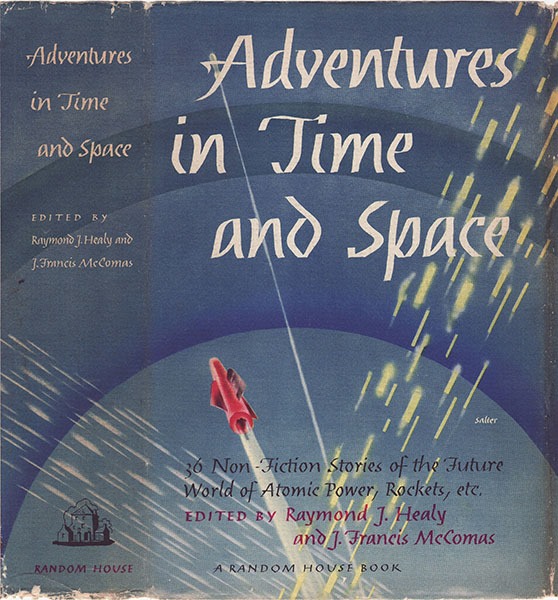
Adventures in Time and SpaceA Treasury of Science Fiction

This chart represents the distribution of SF short stories in several famous anthologies from 1946-1995 that I remember reading.

Year 1920s 1930s 1940s 1950s 1960s 1970s 1980s 1990s
1946 2 13 22          
1948 1 6 23          
1950 3 4 16 7        
1952 2 6 12 22        
1959   1 7 16        
1965   3 12 4 2      
1970   3 10 12 1      
1973     3 29 4      
1974   2 1 7 8 3    
1979 3 8 10 11 14 3    
1980     5 15 11 8    
1981   1 7 16 7 9    
1995     2 5 4 12 15 4

Women of Wonder 1Women of Wonder 2

If you click on the above titles the link will take you to ISFDB.org where you can see the actual story titles in the anthology. As you can see, over time, anthologists started forgetting about the 1920s, then the 1930s. I consider the pulp era over by 1949, and that the digest magazines of the 1950s were a horse of a different color. The digest era is slowly dying out today, being replaced by online magazines. If you’re old enough, this is kind of sad.

When I was growing up in the 1960s it wasn’t hard to run across old pulp magazines. You’d see stacks of them in old bookstores, or I’d meet men who are my age now, who collected runs of their favorite science fiction magazines from the 1920s, 1930s and 1940s. They nostalgically collected Amazing Stories, Astounding Science Fiction and Planet Stories that meant so much to them when they were young. Sometimes I’d meet older guys, and they were always guys, who collected All-Story and Argosy from the beginning of the 20th century. And even older still, and these guys were extremely rare, were collectors of dime novels from the 19th century. It’s been decades since I met a dime novel aficionado, or even an old guy who collects Argosy. I still run across guys who collect Astounding or Unknown, but they are fading away like old WWII vets. Out on the net, if you search for them, you can still find fanatical pulp collectors, but I’m afraid their species is becoming extinct. Folks my age, and that does include some rare women, prefer to collect the digests like F&SF, If, Galaxy and Astounding.

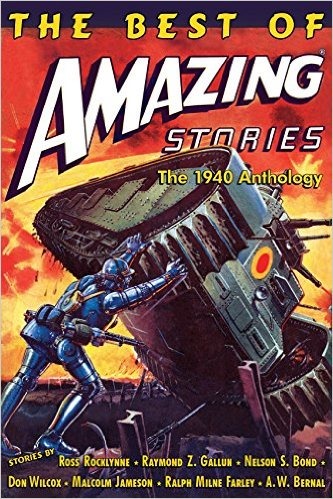
Amazing Stories 1940STARTLING-STORIES-42.09

I don’t know how many fans of pulps still exist, but I see reprints of pulps at Project Gutenberg and Internet Archive, and run into guys who collect scans of old pulps as digital files. I used to buy old pulps occasionally, but eventually gave them all away. Every once in a blue moon I like to buy an anthology that resurrects the old stories. Last night I bought The Best of Amazing Stories: The 1940 Anthology. Amazing Stories still exist, in case you didn’t know. And I noticed that facsimile editions of old pulps have started showing up on Amazon for $12.95 or $14.95. (However, you can sometimes find the original issues for less on Ebay.)

If I collected old digest magazines, I’d be tempted by the Cele Goldsmith and Ted White runs of Amazing and Fantastic from the 1960s or early 1970s, or F&SF and Galaxy from the 1950s. However, it’s a pain to deal with old magazines because they are all decaying. Pulps existed before acid free paper, so they’re quickly disintegrating. I also assumed they’d disappear as the generation of collectors before me died off. So I’m surprised that people still love pulp SF. There’s now four generations between the current new generation and the pulp generations. You’d think they’d be forgotten by now.

But is all this interest in old SF pulps from people my age, or are newer generations searching them out? I recently came across The Time Traveler’s Almanac, edited by Jeff and Ann VanderMeer. The VanderMeers appear to be early Generation X, and their anthology had a few pre-1950 stories in it. One of my favorites is “Vintage Season” by Henry Kuttner and C. L. Moore, but it’s one of the most anthologized stories of all SF stories from the pulp era. I guess a few pulp fiction stories will become classics.

Interest is short stories seems to be declining but it’s hard to tell. Every year Gardner Dozois reports on the decline of subscriptions to the printed digest magazines. I don’t know how many people are reading web magazines. Studying ISFDB shows there were over 400 anthologies in 2014, when The Time Traveler’s Almanac came out.

When I first discovered science fiction, the short story was the heart of the genre. That seemed to be a legacy of the pulps and the digests. For 50 plus years I get all the major best-of-the-year anthologies and it seems that people still love short stories, even though I know damn few people who read them. Most of the genre fans I know love to read novels, especially novels that come in long series. And some of my friends are obsessed by giant books that go on forever, like The Wheel of Time series.

Tonight I read “The Voyage That Lasted 600 Years” by Don Wilcox, which Wikipedia claims is the first story about a generation space ship, coming out a year before Heinlein’s “Universe.” It’s a quaint tale, that’s not very well told, but was probably very exciting back in 1940, and obviously, it presented ideas that inspired later authors of generation ship stories. I should be reading new stories, which are more sophisticated in their storytelling, and have better science, but sometimes it’s fun to read the old tales from the early days of science fiction.

What’s been fun lately is to find even older stories. I recently reread “The Machine Stops” by E. M. Forster, from 1909. It anticipates the Internet Age rather creepily, and might have inspired Asimov’s The Naked Sun. When I was a kid, I thought the science fiction I read represented new ideas. Now that I’m old, jumping back in time, I’m finding those ideas were old when I thought they were new. I’m currently haunted by the notion that ideas we think of as science fiction has always been around, maybe even before recorded history, and a small percentage of the population always had a sense of wonder.

JWH

My Brain Is Not Firing On All Neurons

By James Wallace Harris, Tuesday, January 26, 2016

For years now I’ve be plagued by forgetting words, especially nouns and names. From what I’ve read, that’s just a normal part of getting older. It doesn’t make me worry because my peers are experiencing the same problem.

Recently I started studying math using the Khan Academy. At first, I figured I could begin with algebra, but quickly discovered I needed to relearn basic arithmetic. One of the disconcerting things I’ve experience is thinking I’m doing a problem right, then double-checking, still feeling I’ve got the right answer, submitting the answer to Khan Academy, and seeing, nope, I was wrong. Damn! Each time I discovered I had made a very simply addition or multiplication mistake. If I had been calculating something in the real world, I would have used my answer with confidence. What a delusion.

neuron

More and more, I’ll start a movie on television thinking I haven’t seen that movie, only to discover I have. Sometimes, even fairly recently. And sometimes, I even have to watch 10-20 minutes before I realize my mistake. This is unnerving when I realize I saw the movie just three months ago. That would worry me big time, but I’ve heard other friends my age describe the same experience. Just another kind of senior moment we’re all collecting. And we all feel we can remember movies better from 50 years ago than the ones we saw last week.

I’ve been noticing in the past year or two I don’t have the same sense of balance that I did when I was younger. For example, I’ll be toweling off after a shower, and catch myself starting to fall because I was leaning over too much. Although, I still amaze myself with how often I can catch something I’ve accidently dropped. Some reflexes seem sharp, while others are wimping out.

Evidently neurons in every part of our brains are failing, but we don’t notice until we need them.

I don’t think anything is particularly wrong with me considering I’m 64. But I’m developing a theory. Maybe not a very scientific one, but still it’s my theory. I’m wondering as I lose neurons I’ll lose very tiny abilities. I’m sure I’ve got billions of neurons, but I’m thinking as we get older, and our neurons wink out, we’ll only notice their loss in subtle ways. Like one of those signs made of an array of thousands of lights, but with a few dead bulbs. The sign still conveys it’s message, but you see some dark holes where a light should be. It starts to be a problem when the dead lights change the wording.

I always pay attention to folks older than me, those in their 70s, 80s and 90s. They generally have more problems than I do, yet they still function. Just slower, with more little glitches.

I’ve read that we can grow new neurons even late in life, and make new synaptic pathways. I’d like to believe that. I’d like to believe if I keep studying math that other neurons will learn what the lost neurons knew. This hope fits in nicely with that old saying, “Use it or lose it.” But it also reminds me of those old acts on Ed Sullivan where a guy keeps a bunch of plates spinning on top of sticks. He would have to run from stick to stick to reenergize each plate to keep them all spinning. That would imply that anything we stop doing regularly is going to fall off its stick and break.

I also have to assume since none of us get out of here alive, that we’re all fighting losing battles. So over time, the number of dying neurons will grow faster than their replacements. That might explain why I see old people pursuing a dwindling list of interests as they age. I already feel like I’m chasing after too many hobbies and that I need to cut some loose. It’s like that old movie Lifeboat, where one by one the weak passengers give up. That means more for the survivors, but it’s cruel. I guess that also explains why downsizing is so popular with older people. We throw our weak interests overboard to die to help our major interests to keep living.

That line of thinking makes me wonder if I should sacrifice some hobbies sooner, if it would let me keep other hobbies longer. Here’s some of hobbies I was hoping to pursue in my retirement years:

  • Essay writing
  • Short story writing
  • Novel writing
  • Learn to program Python
  • Learn to program R
  • Study data mining
  • Study deep learning programming
  • Learn how to draw
  • Study art history
  • Relearning Algebra, Geometry, Trigonometry and Calculus
  • Learning Linear Algebra, Discrete Mathematics and Statistics
  • Learn basic electronics to build fun toys.
  • Learn to build and program robots
  • Build and play an analog synthesizer
  • Learn to recreate famous science experiments
  • Build a cheap supercomputer
  • Buy a microscope and study simple microorganisms

The Khan Academy practice is teaching me just how ambitious my math goals are for an old guy. If I live another 20-30 years I might achieve some of them, but it’s going to take considerable work. Would those neurons be put to better use studying writing? Or does studying math boost my overall brain power that will help with writing too?

Should I give up my plans for math and electronics and gamble all my neurons on writing?

Of course, relearning math might be a complete pipe dream anyway. I’m currently studying 5th grade math. I might not have enough new neurons to get through algebra or geometry again. I’m working on an essay this week where I’ve hit the wall. I’m pretty sure I could get further if I gave up most other things I love to do each day.

It could be that neurons are like time, we only have so much, and as we get older,  we need to ration our neurons.

JWH

Could You Pass 4th Grade Math?

By James Wallace Harris, Tuesday, January 12, 2016

One of my great regrets in life is not trying harder in school when I was young, especially at studying math and science. I did get through Calculus I in college with a B, but I laid out a year and when I returned to take Calculus II, I was lost. I always studied just enough to pass the tests, but never enough to gain a deep understanding. It was complete laziness on my part.

Now that I’m retired, and I sense my mind in decline, I’ve wondered if I could learn in my final third of life what I didn’t in my first third. It’s that age-old question: Can you teach an old dog new tricks? Would it be possible for me to relearn math and then finish Calculus II? I’ve been meaning to get started on this project for two years, but like my younger self, I put it off to play instead.  I don’t know why, but about a week ago I did get started, studying math with a workbook and the Khan Academy.

Khan2

My first impulse was to begin again with Algebra, but I thought I better refresh myself with Arithmetic, and tried some 4th grade math. It’s a good thing I did, because I’ve discovered I’ve forgotten how to do advanced subtraction and division problems. Decades of using a calculator has ruined my basic math skills and I discovered I was completely flummoxed by that whole carry the number thing.

What’s really amazing is how fantastic the Khan Academy is at teaching. At least the new version, with interactive assessments. Ever since personal computers came out in the late 1970s, I thought they should be fantastic teaching tools. And I assumed the best subject computers to tutor would be math. But every time I looked at math teaching programs I was disappointed. The Khan Academy programs have come up with a rather straight forward method that I’m actually finding addictive. They have drills that automatically assess my answers. Each session covers six problems. I work out the problem on paper, and put in the answer on the computer. If it’s right, I get the next problem, if it’s wrong, I’m forced to keep trying. I can ask for hints, or I can watch instructional videos.

Khan Academy

My ego pushes me to get all six problems right in a row. I hate seeing the big X that reminds me I failed. Early on I learned that I’m careless about reading the screen properly, or transferring the problem to the paper, or the answer to the screen. But I quickly began to double check my work. Then I learned that I make casual math mistakes. I used to know my times tables cold, but evidently I’ve got some bugs in my brain. So I do everything twice or thrice. Finally, and this was most enlightening, is I’ve completely forgotten how to do some basic math skills. Which makes me glad I started with arithmetic.

This challenge is demoralizing in a way. I used to believe that with effort I could relearn all my old math and finish Calculus II, but now, I’m not so sure. It’s certainly going to take a lot of time, and hard work. What I’m actually feeling are the limitations of my mind. I’m hoping those limitations are like exercising the body, and that with daily workouts will build my math stamina. I already physically exercise three times a day, and I know my body will never do what it did in my twenties or even forties again. I might be fooling myself that I can mentally turn back the clock, but for some reason I do have hope. I believe my brain is plastic enough to still learn. I’ll learn just how adaptable my 64 year old brain is this year when I get into algebra.

I am reminded of that wonderful novel, Flowers for Algernon, about a guy name Charlie, with an IQ of 68. Charlie volunteered for a medical experiment to boost his intelligence. The procedure worked, and eventually Charlie became a genius, but then the treatment wore off, and tragically Charlie returned to his low IQ existence. Getting old feels like being Charlie after the treatment starts wearing off.

Essay #997