Television for the 55-Plus Folks

By James Wallace Harris, Monday, May 2, 2016

Talking with my old buddy Connell last night, I commented that everyone today has very different tastes in music. Out of 432 songs on my favorite Spotify playlist, I might share a unique handful with each of my friends. Back in the 1960s, when we were young boomers, we all watched the same three TV networks, listened to the same AM top-40 radio stations, often bought the same albums, went to the same rock concerts and movies, and pretty much shared the same pop culture. Living in the shiny future of the 21st century, pop culture has exploded. Everyone has gone off to do their own thing—usually tuning out with earphones and a personal screen—and won’t VR be even more isolating? I feel little pop culture kinship anymore.


Antenna_TV_logo.svgme-tv-logo

I wonder if cord cutters, the retired ones, aren’t all sitting in our darkened rooms, by ourselves at night, watching the same TV shows? We’ve reduced our TV universe to a few local broadcast networks again. Going from 200+ channels to a handful might be a socially unifying trend. How many of us are watching Antenna TV, Grit TV, Movies!, Decades, GetTV or MeTV?

I cut the cable cord years ago. I planned to watch Netflix, Hulu and other streaming services instead. What’s weird is I spend more time now watching broadcast TV. What goes around, comes around. I own a Tivo Roamio, which allows me to record over-the-air TV—and zip past the commercials. When I do see the commercials, most are targeted to my demographic, the 55-plus crowd. At any random moment of the day, a quick flip by all the channels will mainly reveal commercials. To get folks to watch those commercials they use old shows and movies as bait. I guess they know what we’re biting.


decadeslogo2Grit

If I didn’t have the Tivo, I couldn’t handle that. I hate commercials. Yet, I’ve got to admit they’ve got my number, because these networks broadcast content that appeals to me, and I assume, to my fellow baby boomer cord cutters. I hardly ever watch the major networks anymore. Their primetime shows aren’t geared to my tastes. Mostly I watch PBS. However, when I’m not watching public television, I love the local channels that show old movies, and to a lesser degree, the old television shows. Especially content created in the 1950s and 1960s, when I grew up. Is broadcast TV curated for us baby boomers? Or do young people like retro-TV? After we get on social security, and our fixed incomes become cable-unfriendly, lots of us go back to over-the-air television reception. Evidently, marketing gurus have discovered old episodes of Peter Gunn, Perry Mason and The Twilight Zone sell adult diapers, self-catheters, Consumer Cellular phone, prostate pills, unbreakable reading glasses, and other doodads for the 55-plus-set better than reruns of Cheers or The Mary Tyler Moore Show . I have 4-5 channels where I can watch the same shows I watched when I lived with my parents. Decades later, in the 1980s we chanted, “I want my M-TV.” Now I sing, “I want my GetTV.” (My city doesn’t have it yet.) There’s a tremendous number of broadcast networks, but no city gets them all. But as each city gets more of them, won’t there be less demand for cable?


     movies tv logogettvlogo

How many over-55 cord cutters are watching these networks? By reducing the the number of networks we watch, do we bring ourselves closer? Will there ever be a time again when people share the same pop culture? Sometimes I think I could cut out all TV but one network – PBS. Are public television lovers my chosen peeps?

I cancelled my subscription of Netflix discs because I just let the discs sit around for weeks. I have Netflix streaming, but I don’t watch it much, mostly for documentaries. I also have Amazon Prime which I use to watch new television shows and movies when I have company. When I’m by myself, which is most of the time, I mainly watch documentaries on PBS or old westerns. I spice things up now and then by trying an ancient TV show, or an old film, in particular, a 1960s comedy, or a 1940s film noir. When I have friends over, we watch new TV shows like Mr. Robot, Humans, Fargo, The Knick, Man in the High Castle, Mad Dogs, etc. I do like modern scripted TV, especially if the show is one story told in 10-13 episodes. But I save those shows for when I have company and we can share. It’s great to have new shows to talk about. Solitary watching is different. I guess my comfort TV is old stuff.

I realize I have multiple personalities. I have my main personality that watches TV by myself, and a different personality for each of my friends. I almost never listen to music with friends anymore. I guess group listening to albums stopped when we quit smoking pot back in the 1970s. I wonder if medical marijuana for old folks is bringing back album parties? I do read books with friends, sometimes, because of book clubs. And I usually go to plays and art shows with friends. When I think about it, I spend a lot of time enjoying various art forms alone. Back in my K-12 years, that wasn’t so. You’d watch TV with your family, and then go to school the next day and discuss the shows with your friends. Our world was smaller, but it was closer. I guess in a couple decades when I move into a retirement home, I’ll be back watching TV together with a new family.

With over sixty years experience watching TV, I’ve gone though many phases of TV culture. I wonder as I get older if I’ll want to rewatch 1970s TV, and then 1980s TV, and if I live long enough 1990s TV. Do people get nostalgic for their twenties, thirties, forties, fifties? In the future, will baby boomers crave Must See TV and want to watch old episodes of Seinfeld, Mad About You, and ER? Right now I can’t even make myself watch old Star Trek series which I once loved. Will, I change in the future and crave them again? Or will nostalgia always keep me trapped in 1956-1965 TV-land?

JWH
Writing For Other Sites and My Health

James Wallace Harris, Thursday, April 28, 2016

I’m publishing less here because I’m publishing more elsewhere. That doesn’t mean I want to give up writing for my blog, but I do need to develop a plan for what’s best to post here. When I write about science fiction its obvious to give those essays to SF Signal, because science fiction is what they’re all about. Plus, they get more readers. And I’ve been accepted at a general book site, so now I can write about all the other books I’m reading for them. I’ll let you know what site that is when they publish my first essay and I have a link. They’ve accepted two essays so far. That leaves non-book subjects for me to write about here at Auxiliary Memory. I just need to find the time. My plan is to publish one blog post here each week. All told, that’s committing myself to writing eight essays a month. The ones I write here might be short, like this one.

I’ve been retired two-and-half years now, and writing essays has turned into my retirement hobby. That’s worked out very well because writing counteracts brain rust. I’ve noticed the longer I go without writing, the more trouble I have remembering words and pronouncing them. I’ve always called blogging piano practice for writing essays, well now I know it’s exercise for the mind too. I highly recommend blogging as a hobby, for the young or old. Writing over a 1,000 blog posts has really paid off.

Essay writing is turning out to be preventative medicine for dementia. Writing is showing me my physical and mental limitations. Because the newer essays require so much research, I’m having to push myself much harder, causing me to hit a wall each day. That’s an effective barometer of my mental and physical health. Each day takes more psychic management, and it’s all too obvious each birthday I pass leaves less creative energy. I doubt I’ll be able to do a fraction of what I’m doing now in my seventies. Getting old sucks, but that’s not news to anyone already old. It might be news to my friends who have yet to retired. Before I retired I thought all I needed was time. Well, at least I’m still learning new things.

I’m learning what it takes to do research, and that’s given me much greater respect for serious writers. It’s one thing to write an opinion piece, it takes several magnitudes more effort to include useful facts. Especially if you order them in some kind of coherent fashion.

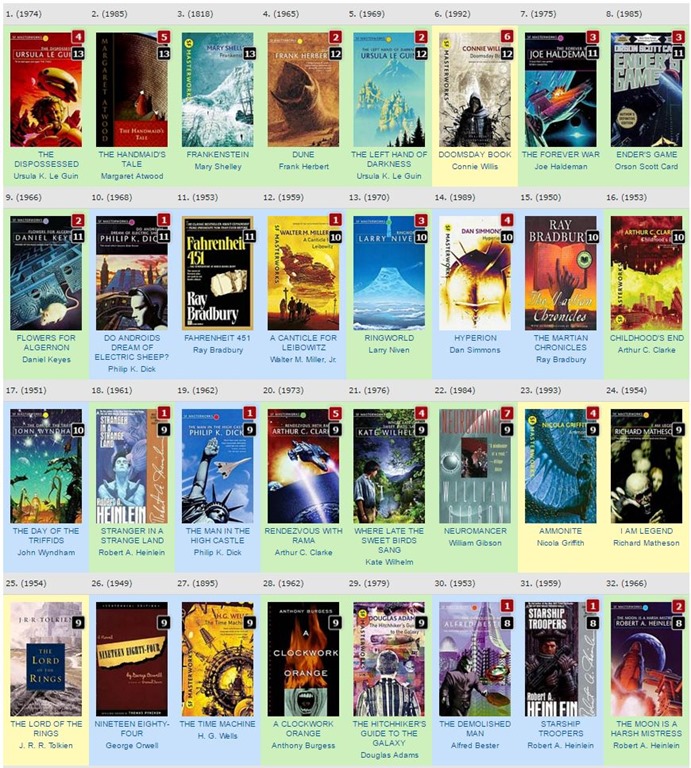
I’ve had  two essays published at SF Signal in April. The first, “The Biographies of Philip K. Dick” is about the many books written about PKD. Duh! Titles are important. The second, “How Well-Read Are You in Science Fiction?” serves two purposes. First, it asks how many classic science fiction books do you have to read to feel like an expert. Second, it describes how to use the Worlds Without End’s database to catalog the science fiction books you’ve read, which then allows you to see how you stack up on more than fifty “Best SF/F/H Books” lists. Read the article if you want to learn how, it’s a lot of fun to use the WWEnd database. Here’s an illustration of how well I did with their “WWEnd Top Listed” list. It’s color coded. Blue and green are books read, with blue being favorites, yellow means the book is on my to-be-read list. Orange means I’m reading that book currently. Yeah, I’m embarrassed to let people know I’ve never read I Am Legend by Richard Matheson or Doomsday Book by Connie Willis – but I own both.

top-listed

I don’t think I mentioned another article I wrote for SF Signal. Damn, I forget them as fast as I write them. But I do like plugging this Great Course. See “How Great Science Fiction Works – A Great Course in SF by Gary K. Wolfe.” If you love the history of science fiction, this is an excellent overview of the genre, and is only one credit at Audible.

JWH

Movie Memories From Growing Up

By James Wallace Harris, Tuesday, April 19, 2016

Yesterday I watched two movies I had first seen in the 3rd and 5th grades. I don’t know what spurred this bout of nostalgia, but I wondered enough to write this essay. I don’t think I’m unique in wanting to see shows again from childhood. I often read customer comments when buying DVDs on Amazon that start with phrases like “I’ve been searching for this movie for decades.” Been there, done that, more times than I can count.

Cooper and Beery - Treasure Island

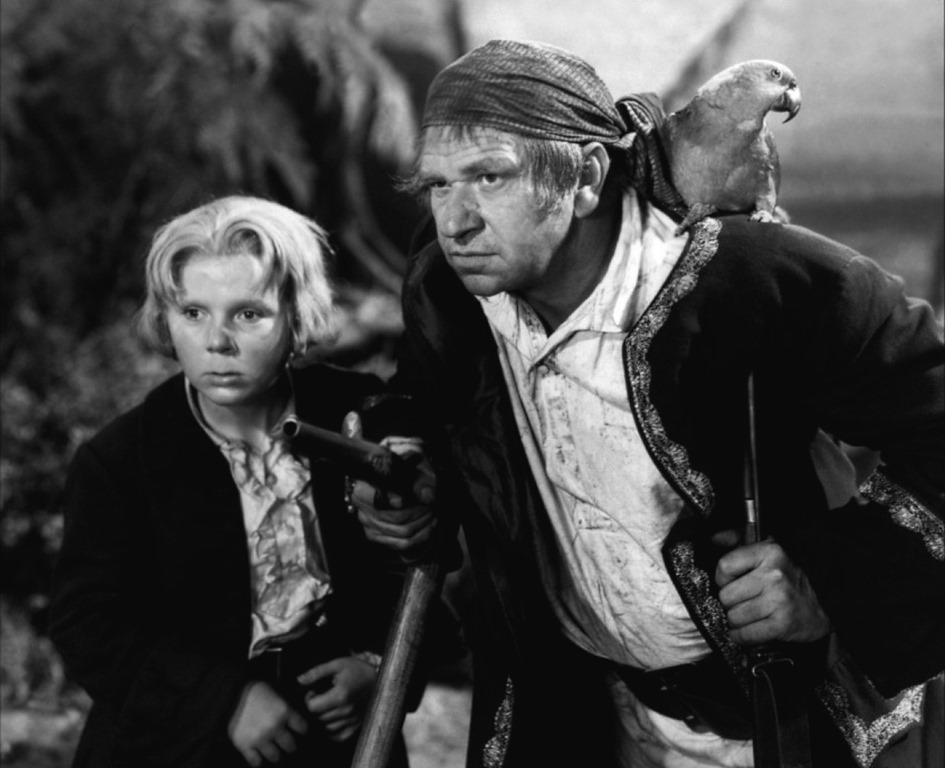
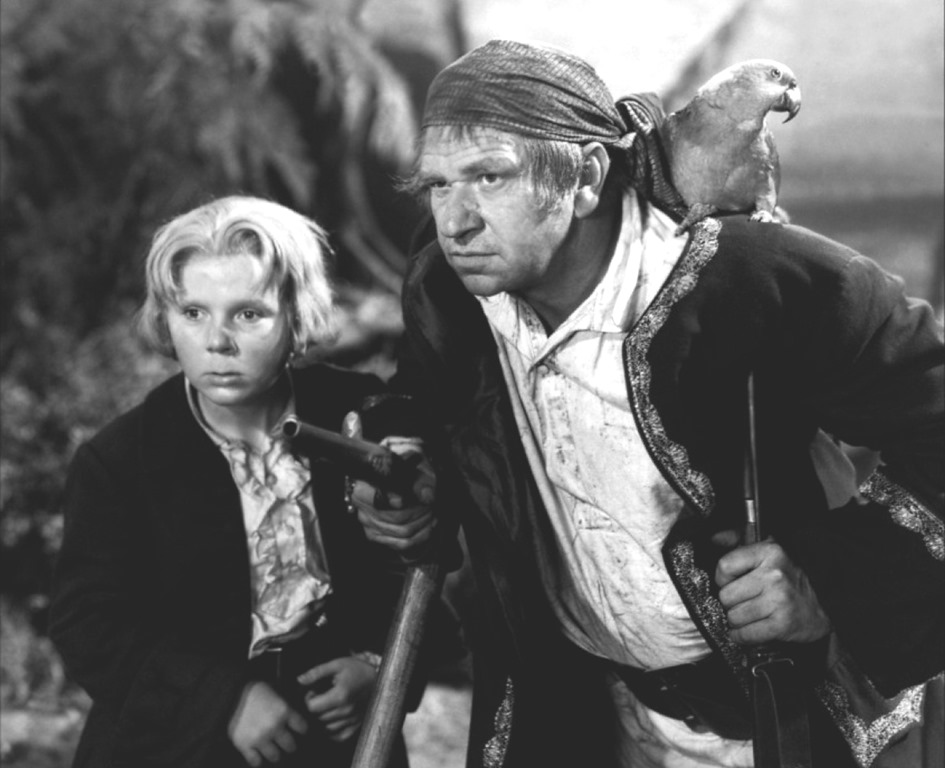
The first film I watched yesterday was Treasure Island from 1934, with Jackie Cooper and Wallace Beery. I was in the third grade, and we were living in New Jersey. I believe I saw the movie first, then my mother got the book and read it to me, or with me. It’s the only memory I have of her reading to me. I also remember going to a costume party that year dressed as Long John Silver. I’ve seen this film countless times over my lifetime, and it always evokes strong wistful emotions. I don’t know if it’s the story, or memories of my own feelings from long ago. It’s funny, there’s been many versions of Treasure Island since 1934, but I’ve never seen any of them. I either feel the Wallace Beery version can’t be beat, or I’m afraid of ruining my nostalgia. For some reason my memories of black and white movies are stronger than movies in color. There were some old films that were in color, but I first saw them in B&W because we didn’t own a color TV until 1965.

The Time of Their Lives

The second movie, the one I first watched back in the 5th grade with my sister Becky, is The Time of Their Lives, an Abbott & Costello film from 1946. Lou and Marjorie Reynolds play revolutionary war ghosts, falsely condemned as traitors, cursed to haunt the Danbury estate where they were killed till the crack of doom. Bud plays a guy in the past and the present, but kind of an asshole in both eras. The neat thing about this Abbott & Costello flick, is the duo are separated. Even as a kid, I could only handle so much of their standard shtick, so The Time of Their Lives was refreshingly different. Becky and I loved the story of very old ghosts interacting with the modern world. Of course, we also love the Charlie the Tuna commercials that came on with the movie. Today, I can enjoy parts of The Time of Their Lives but it’s pretty damn silly. Mostly, it’s nostalgia that keeps me watching. The Time of Their Lives is often referred to as the Abbott & Costello film for people who don’t like Abbott & Costello.

Death Takes a Holiday

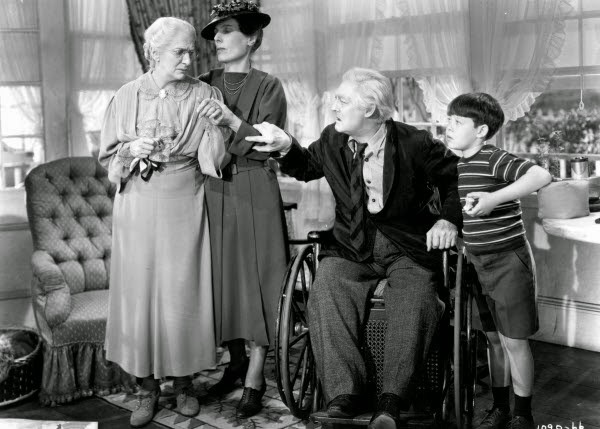
As a kid, I didn’t really like a lot of kid flicks, not even Disney films. But I did love films about pirates, folks stranded on desert islands, ghosts and angels. The first film I remember seeing, High Barbaree, I’ve written about a number of times, included a mystical island and a stranded naval pilot. Did that film start me on my road to loving fantasy, or was I born with a fantasy gene? Or is it just typical for kids to love movies about ghosts and angels? Doesn’t everyone love It’s A Wonderful Life, A Christmas Carol, Here Comes Mr. Jordan, The Bishop’s Wife, For Heaven’s Sake, Angels in the Outfield, Death Takes a Holiday, On Borrowed Time – wait, I seem to be remembering only old black and white angel movies. I do love Wings of Desire, City of Angels and Angel-A, and other modern angel movies, but not like I love the old ones.

What’s hilarious is I’m an atheist, but love angel movies. Go figure. Even as a kid I was skeptic. When I was very young I was extremely gullible that attracted torment. I was a year younger than all the kids my grade. For example, they picked on me for being the last kid to believe in Santa Claus. So I guess I turned towards fantasy in movies and books, my secret way to enjoy ghosts and angels, knowing they weren’t real, but still getting to believe in an approved way.

On Borrowed Time

I have to wonder why the movies I saw before age 13 burned deeper into my consciousness than the movies seen since? I’ve watched thousands of films, and I know intellectually that modern films are far more sophisticated, better made, better acted, and better told, than my old favorites. But it’s the old films that have glued themselves to my neurons. It’s also these films first seen in childhood, that I buy and rewatch. Is that just me, or true of everyone as we get older?

National Velvet

Which reminds me, I also loved old movies about dogs and horses, especially National Velvet and Lassie Come Home, or maybe as a kid I just had a crush on the young Elizabeth Taylor. During that time I used to love reading books by Jack London and Albert Payson Terhune.  And don’t forget Johnny Weissmuller’s Tarzan flicks, and shows about monsters like King Kong and Frankenstein. But by the time I was in the sixth grade, I had developed a passion for 1930s movies, especially for MGM and Warner Brother pictures. I didn’t know anything about the studios back then, I just loved black and white movies from the 1930s. That’s what showed on TV growing up, so I was conditioned by them. Films like Manhattan Melodrama and Grand Hotel seemed otherworldly to me then, and maybe now too.

manhattan-melodrama

Maybe one reason why those old films are so well buried in my brain is I used to stay up late watching them. During the summer vacations my parents would let Becky and I watch the all-night movies. I realize now my mother probably allowed this because we’d sleep until noon, and this would give her some private time before she had to be at work at 2pm. Anyway, maybe I love these films more because I watched them instead of getting my REM sleep. To me, one of the most powerful forms of nostalgia is watching old black and white movies late at night in a darken room. I love the flicker of movie light being the only illumination of reality. Hell, I had VR sixty years ago.

JWH

The Williamson Effect–Losing Interest in Life

By James Wallace Harris, Monday, March 28, 2016

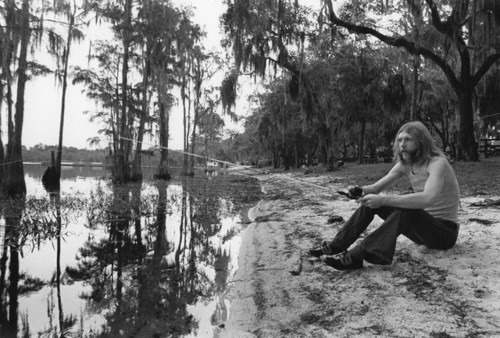
A friend of mine, before he died, called me to talk about life. His name was Williamson, and he was depressed. This was back on the first night of the Gulf War. Williamson said something then, a quarter century ago, that has always stuck with me. He said he was down to loving only two things in life. Benny Goodman and Duane Allman. I had gone to see The Allman Brothers with Williamson when Duane Allman was till alive. That was a long time ago. Williamson and I were buddies for a while in the 1970s, and we went different ways when I got a steady job.

Duane Allman Fishing 

Williamson hated working, always telling friends, “A job a good way to waste a life.” He spent his life avoiding the old nine to five, choosing to pursue endless hobbies and schemes hoping they’d pay off. They never did. I was surprised to hear from Williamson in August of 1990. The decades had changed him, and he was quite bitter. He called me a few times after that, and then disappeared. I heard later he died under mysterious circumstances.

I now worry when a friend tells me they are getting tired of things they used to love. I call it The Williamson Effect. I’m known to be a naturally happy person, even though I love to write about depressing subjects. I don’t know if I’m happy because of genes, or because I’m constantly searching out new things to love. Whenever I hear a friend suffering from The Williamson Effect I encourage them to try new things, especially music. I’m always amazed how a new artist and their music can revitalize my thinking.

I tried to convince Williamson that there was more to music than Benny Goodman and Duane Allman. He only sneered and belittled my then current favorites. Benny Goodman and Duane Allman are still on my main Spotify playlist, but so are Katy Perry and Sarah Jaffe, and I’m still living.

JWH

The Fiction at the Bottom of Our Souls

By James Wallace Harris, Thursday, March 17, 2016

  • Can we trust who we think we are?
  • Can we assume our convictions are correct?
  • Why are we so passionately convinced our version of reality is the right one?
  • Is fiction truer than memory?
  • How does fiction consumed in childhood affect the way we perceive reality?

Of your earliest memories, which do you favor: remembered events or stories? I can dredge up some exceeding vague memories from when I was three, but lately I’ve been reading about scientists studying memory that makes me doubt what I recall. I know what I think of as actual events might not be recordings of reality, but memories of memories of memories. Every time we replay an old memory, science now thinks, we record over the original memory with the impressions of remembering that memory. (Watch “Memory Hackers” on PBS NOVA or The Brain with David Eagleman.)

Treasure Island

There is nothing in my memory bank as vivid as the photo above.

Mixed in with all my memories of reality are memories of fiction. I was born in 1951, but my earliest memories of television come from 1954-55. A few years later, are memories of seeing my first movie on TV, High Barbaree. I’m sure I saw others, but its the one I remember. My late 1950s memories are filled with black-and-white science fiction films and Johnny Weissmuller’s Tarzan flicks.  Around 1959 I encountered Treasury Island, the first book I remember reading.

I have many memories of external reality growing up in the 1950s, but I also have more memories from television. Because I’ve seen those TV shows & old movies repeatedly over the years and decades, and often reread my favorite books, those fictional memories have gain vividness, while my real life memories fade. Is it any wonder that Turner Classic Movies has become so meaningful to the social security set?

I once returned to the house I lived in when I was four. I think of age four as the beginning of my personality.  When I stood on that sidewalk in front of that house, I felt like I was at the Big Bang beginning of my existence. From 1955 till today, I have two kinds of memory. What happened in my life and what happened in stories. In terms of deciding which programmed my soul more, I’m undecided.

Robert Silverberg has a wonderful essay, “Writing Under the Influence” in the March 2016 Asimov’s Science Fiction about how a favorite fantasy story he discovered in childhood influenced two novels he wrote as an adult (Son of Man, Lord of Darkness). The story, The Three Mulla-Mulgars, by Walter de la Mare, from 1919, is one I’ve never heard of before. Folks at GoodReads gush about how delightful this forgotten fairytale is to read. I snagged a free Kindle edition from Amazon and hope to read it soon.

I highly recommend reading Silverberg’s essay. I love people’s reading histories. Unfortunately the link to read the essay online will quit working when the next issue comes out. You can get Asimov’s at your newsstand, or from Amazon as a Kindle ebook.

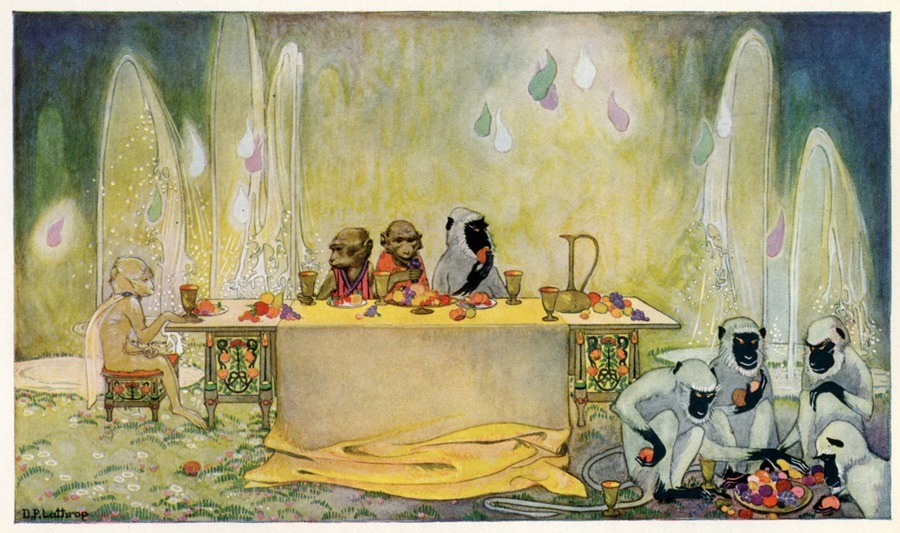
dorothy-lathrop-three-royal-monkeys

Here’s one of the original Dorothy P. Lathrop illustrations from The Three Mulla-Mulgars, from a collection of them at 50 Watts.

Partly why Silverberg’s essay resonates so deeply with me is because he describes how an earlier true-life African explorer narrative, The Strange Adventures of Andrew Battell of Leigh, in Angola and the Adjoining Regions figured in The Three Mulla-Mulgars. I’m fascinated by how stories inspire stories. Or how writers are inspired by authors from earlier generations. The memories of authors are encapsulated into their stories, and we share their memories by reading, and their memories as passed on through us. And if we write stories, using older memories from those we’ve read, those memories are rerecorded for another generation, much like brain memories, and just as distorted.

High BarbareeHigh Barbaree Movie

I’ve often fantasized about writing a story based on my memory of my first encounter with fiction. My earliest memory of seeing a movie is waking up in the middle of the night, and watching the all-night movies with my dad. This was before I went to school, and I didn’t comprehend movies, acting or fiction. All I can remember is a scene of two kids who were friends being separated, when the girl and her family moved away. Even at that young age, that had already happened to me more than once, because my father was in the Air Force. It was a strong fictional emotion bonding with my own remembered emotions.

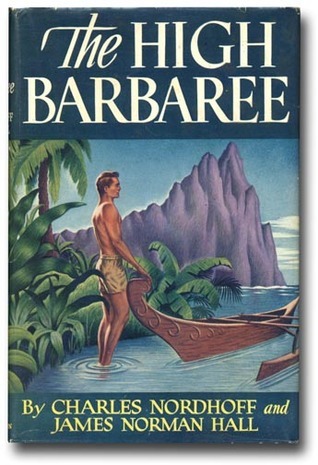
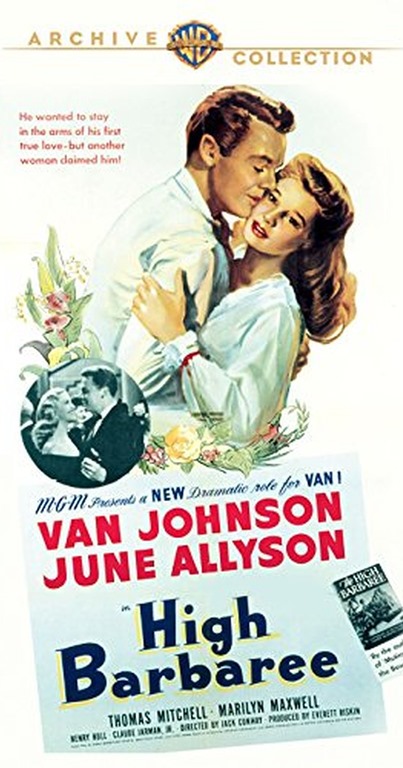
This was when I was too young to remember the title of movies. Years later I saw the movie again, and that’s when I memorized its name, High Barbaree, with Van Johnson and June Allyson. I was in the sixth grade. I used to trust my memories from that age, but I don’t anymore. I caught High Barbaree again in my twenties, after I got married. This time it occurred to me that it might be based on a book. I wasn’t able to find the book until the internet age, and AbeBooks.com. It was then I discovered the book was written the same guys who wrote Mutiny on the Bounty, Charles Nordhoff and James Norman Hall, and they also have a fascinating history. I was also able to track down a biography of those two writers at that time too, In Search of Paradise by Paul L. Briand, Jr.

Between the original novel, and the biography, I learned High Barbaree was about memory, and a fictionalized autobiography of sorts for James Norman Hall. Hall was writing about how our souls are formed by early memory and fiction. He was remembering the writers who influenced him. His memories became my memories, and if I could ever write a novel, their memories would get passed down, along with some of mine. I guess I am a believer in the collective unconscious.

It’s now possible to buy High Barbaree on DVD, but I’m not sure I can recommend it. It’s slight, sometimes silly, and very sentimental. The book is more serious, and fits the memories I have of seeing the story as a child. Or at least, that’s how I remember it now. I know my original impressions, however vaguely they were recorded by my brain, have been lost to rewriting by all the times I’ve recalled that memory. Each time I’ve watched that film again, dwelled on those memories, reread the book, or written about all of this, I’ve recolored those deep original memories with newer philosophical musings.

I used to believe we could discover the truth of history. I used to think memories were real and trustworthy. Now I doubt the reliability of neural recordings, and any collective knowledge we have about actual history. We constantly rewrite our own memories, and we constantly rewrite history. For example, the new book by Bart Ehrman, Jesus Before the Gospels, has more than convinced me that it’s absolutely impossible to know anything about Jesus as a real person in history. Ehrman’s analysis of history and memory applies to recent historical figures as well, where we have solid documentation, like for Abraham Lincoln or Albert Einstein. All these revisiting and new recordings have written over any real history that happened.

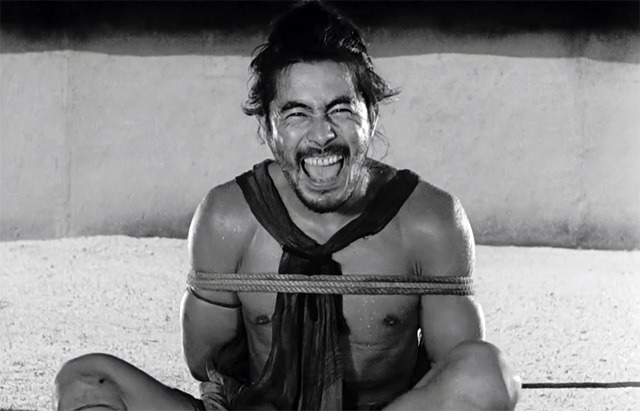
rashomon

The best nonfiction is still fiction. I’ve taken classes and workshops in creative nonfiction, and I know from experience I can’t write the absolute truth.  Memories are just stories we tell ourselves about fleeting impressions of the past poorly etched in our brains. Our minds are not DVRs. And even if they were, how often have you seen a video in the news where people argue over what actually happened? Realty was never our version of events—it’s always the Rashomon effect.  Even if we average out all the eyewitnesses, we can never definitively say what happened.

All during 2016, we hear folks wanting to be president tell stories they swear are true. And we’ll vote for the candidate whose stories match our own stories the best. All of those stories were shaped by the fiction everyone encountered growing up. Remember how Ronald Reagan used to blend movie scenes into his recollections? I used to think he was a doddering old man, but now I wonder if he wasn’t wiser than he appeared. We’re all going to look like silly old fools someday, dwelling on fleeting memories of our past, poorly remembered. But that doesn’t mean the stories we tell ourselves and others don’t have a kind of elegant logic. It won’t be the truth, but if we could only get our stories to work together, it might be true enough.

My reality is colored by stories I encountered in my early years, like High Barbaree. Just like Robert Silverberg’s reality was colored by The Three Mulla-Mulgars, which he discovered when he was young. We might think the fiction at the bottom of our souls are merely stories, but I’m not so sure anymore. Those early tales had a butterfly effect on shaping who we became. We can’t understand reality in black and white certainty. But we do make sense of our external existence by storytelling, and so we need to understand the truth of that.

JWH