If Screens Are Bad for Kids Are They Also Bad for Adults Too?

by James Wallace Harris, Monday, October 29, 2018

While reading the Sunday The New York Times yesterday on my iPhone, 3 of the 8 stories in the Trending Section dealt with the dangers of computer screens and kids. They were:

The first story opens:

SAN FRANCISCO — The people who are closest to a thing are often the most wary of it. Technologists know how phones really work, and many have decided they don’t want their own children anywhere near them.

A wariness that has been slowly brewing is turning into a regionwide consensus: The benefits of screens as a learning tool are overblown, and the risks for addiction and stunting development seem high. The debate in Silicon Valley now is about how much exposure to phones is O.K.

“Doing no screen time is almost easier than doing a little,” said Kristin Stecher, a former social computing researcher married to a Facebook engineer. “If my kids do get it at all, they just want it more.”

The gist of these stories is: If the creators of screens won’t let their kids use them, why should we? If the Luddites are also the Technophiles, shouldn’t we worry? Or is this just elitism, like those intellectuals who sneer at watching television? Or is this a genuine back-to-analog-reality movement?  Ever since science and technology began integrating into society there have been those who want to stop its progress. There have been protests against trains, industrialization, cars, television, computers, automation, robots, and now joining the hive mind via our smartphones.

screens

On one hand, society teaches using and understanding technology is an important part of education, on the other hand, people question if using technology constantly is a good thing? Both children and adults are spending a larger percentage of their time staring at screens – phones, tablets, laptops, computer, and televisions. That means a significant portion of reality is viewed through a flat surface. Are the critics of screens saying we should have more 3D reality-time?

I’m not actually sure where the basis of the criticism lies. If they mean kids are spending too much time playing games or watching videos, then is the danger they fear escapism? If you spend ten hours a day in AutoCAD designing NASA space probes are you spending too much time using a screen? What about an author writing the great American novel? Or a heart surgeon using five screens at once in their surgery? If your kid spends five hours a day on a screen becoming a mathematical genius would you object?

If I wasn’t using a screen to read I’d be using a book to read. Is spending hours a day on pages instead of screens a more valuable experience? What if I gave up writing and spent those hours outside gardening? Would that make my life more rewarding?

Kids love toys. Evidently, screens are preferable to other toys. Does that make them unhealthy toys? My guess is the Silicon Valley types know about getting ahead in life, becoming a success, making money, inventing products. They want their kids to have an advantage over other kids, so they’d prefer their kids not waste time playing with screens but learning what it takes to be the next generation of billionaires.

Then the question becomes: What are the best activities for children if you want them to get ahead in life? Maybe we don’t worry about adults using screens so much because we’re not worried about them succeeding in life. Either they’ve made it or not, so wasting time on screens won’t change our fate. But with kids, they have this huge potential and we don’t want them to blow it.

Or have we reached a stage where we’re worrying about becoming cyborgs? Should kids be reading instead, or playing baseball outside, or Monopoly inside? Maybe seeing so many kids mesmerized by screens is making us think about what it means? But, then shouldn’t we wonder about our own screen use?

I like writing. Would using a typewriter and submitting my essays to magazines be more fulfilling than writing for my blog? Would it be even more rewarding if I wrote longhand on paper? What if I gave up television? Is reading really a better use of my time? If I didn’t read or watch television, I think my next choice would be building and programming computers, developing databases, teaching myself AI and machine learning, and constructing robots. I don’t think I’d be happy if I gave up technology altogether. I could take up gardening and woodworking, two very down-to-Earth activities, but I don’t think I’d find them as rewarding as what I’m doing now.

If I counted all the hours I spend with my HDTV, 4K computer monitor, Kindle Paperwhite, iPad Mini, and iPhone, it would be a lot. Certainly, the majority of my day. Should I really wonder if that’s unhealthy?

JWH


The Rise and Fall of Astounding Science-Fiction

by James Wallace Harris, Friday, October 26, 2018

AstoundingOn October 23, 2018, the magazine Astounding Science-Fiction was remembered in two ways. First, Isaac Asimov’s Foundation series came in at #49 on the PBS Great American Read, and second, Astounding: John W. Campbell, Isaac Asimov, Robert A. Heinlein, L. Ron Hubbard, and the Golden Age of Science Fiction by Alec Nevala-Lee was published.

For a subgroup of the G.I., Silent and Baby Boomer generations, the Golden Age of Science Fiction was from 1939 to 1950, and mostly due to one magazine, Astounding Science-Fiction under the editorship of John W. Campbell, Jr. There was one other book in the PBS Great American Read where Campbell was the first editor to buy – that was Dune by Frank Herbert, which came in at #35. So, Campbell had two books in the top 50, not a bad legacy. Dune appeared in his magazine just after the name changed to Analog Science Fact & Fiction.

Alec Nevala-Lee’s new book, Astounding, isn’t the first history of the magazine, and I doubt it will be the last. As I listened to the audiobook edition I thought about all the ways writers have tried to tell the story of Astounding and the golden age of science fiction. Alva Rogers in Requiem for Astounding did an issue by issue overview. Arthur C. Clarke wrote a memoir about how the magazine shaped his youth in Astounding Days. And Alexei and Cory Panshin focused heavily on Astounding, Campbell, Heinlein, Asimov, and van Vogt in their Hugo winning book, The World Beyond the Hill: Science Fiction and the Quest for Transcendence. All those books focused on the stories. Nevala-Lee focuses on Campbell, Asimov, Heinlein, and Hubbard, giving us the biographical background to the editor and his three most famous writers.

There’s been plenty written about Asimov, Heinlein, and Hubbard, but other than tributes and collections of letters, I’m not sure how much has been written about John W. Campbell, and he is the real focus of Nevala-Lee’s book. However, his story is so intertwined with the magazine and his famous writers that Astounding is a history of the magazine and a biography of four men.

Reading Astounding was both rewarding and depressing. It’s depressing because we endure the painful deaths of all four subjects, but even worse than that, they all fall from grace. I’m not sure if I should reveal what they become. If I did, some would call it spoilers, but others might call them trigger-warnings. Let’s just say this is a tell-all biography where Nevala-Lee gives us the best and worst on each man. All four men were autodidactic know-it-alls. All four men were egomaniacs. Three, maybe four, had severe delusions of grandeur. All four were hard on wives and women, and at least two of them would have thrown out of pop culture if they lived during #MeToo times. One turns out to be white-supremacist and another started a religion and has been defied by his followers, even though Nevala-Lee makes it abundantly clear he was a pathological liar, and his church is often vilified and has a reputation of being a paranoid cult.

Despite all of this, Astounding is a valuable history book on an important era of science fiction. By combining the four biographies, Nevala-Lee shows us the wizards behind the curtain. Yes, in many ways, they were all humbugs, but in many other ways, they were genuine magicians. Campbell and all the writers of Astounding Science-Fiction created art that inspired a generation. Astounding Science-Fiction was essential to the evolution of the art form we know today as science fiction.

There has always been a problem calling 1939-1950 the golden age of science fiction because for many people it wasn’t. I’ve been systematically reading The Great SF Stories volumes 1-25 (1939-1964) edited by Isaac Asimov and Martin H. Greenberg. I’ve finished the first seven volumes, and I’ve got to say, many of the stories are forgettable. Nearly all the stories come from Campbell’s two magazines, Astounding Science-Fiction and Unknown. I’m sure these stories were mind-blowing back in the 1940’s, but there’s been much better science fiction written since using the same ideas and themes. In 1957 Peter Graham said in a fanzine called Void, that “The Golden Age of Science Fiction is twelve.” That deeply perceptive observation has been accepted as truth ever since. I turned 12 in late 1963, and the science fiction I discovered was published in the 1950’s. Some of it was reprints from Astounding in the 1940’s, and others were stories that appeared in F&SF, Galaxy, and IF, the Young Turks that usurped Astounding’s reign in the 1950’s, as well as original science fiction books that began being published that decade. Today, I generally think of the 1950’s as the golden age of science fiction, and I’m sure people younger than I feel the same way about the decade they first read when discovering science fiction.

This alternate view of the golden age of science fiction will probably limit the audience to Astounding by Alec Nevala-Lee, but it’s already the #1 book in Amazon’s Science Fiction and Fantasy section. Today it is quite common for young people, especially women and minorities, to dismiss older science fiction as being too white-male dominated from an unenlightened era. Nevala-Lee’s book will only reinforce those beliefs. However, I think it’s important to read this book. It does capture the ambitiousness of science fiction’s most ambitious proponents.

Science fiction changed dramatically in the 1980’s and 1990’s, and again this century. I routinely read science fiction stories from the 19th, 20th, and 21st centuries. Surprisingly, the ideas and themes remain consistent, but not the storytelling and characters. Science fiction authors have become much more sophisticated writers creating deeper and diverse characters. I see Nevala-Lee’s book as one piece in a very large puzzle. If you look for them, you’ll find plenty of books being written today on the history of science fiction. Most remain obscure and little read. I’m surprised that Astounding is getting all the attention it’s getting. Does it represent a tip of an iceberg of science fiction fans hungering to know more about the evolution of their favorite genre? Or, has all the science fiction fans from my generation suddenly become nostalgic for Astounding again?

I worry if younger science fiction fans read Astounding they may be turned off to 1940’s and 1950’s science fiction. All four men in Nevala-Lee’s book eventually come across as emotionally flawed, delusional, egomaniacal, and if not diagnosable with several DSM disorders, at least very nutty. Until the genre label “science fiction” emerged in the 1950’s, people would call it “that crazy Buck Rogers stuff.” I’m afraid the history in Astounding will only reinforce the crackpot reputation of science fiction.

This isn’t a criticism of the book, Nevala-Lee is just telling it like it was. But I believe readers need more context. I’m not sure people today have any idea what the psychological fallout the first atomic bombs, ICBMs, and Sputnik did to the citizens of the 1940’s and 1950’s. They all were looking desperately for answers to monumental existential threats. The stress was tremendous. Many thought the world was coming to an end. Psychiatry almost became a fad in the 1950’s, including experimental use of LSD under psychiatric supervision.

I’m not depressed that Nevala-Lee reveals how science fiction went nuts, but I wished he would have put its breakdown in the context of how everyone was going nutty back then. We look back with embarrassment to Campbell’s embrace of psychic powers, but a large segment of the country was doing the same thing.

I was born in 1951, so I grew up with the 1950’s. I remember my uncles raving about the psychic powers of Edgar Cayce and Jean Dixon, believing in the past lives of Bridie Murphy, excited by the multiple personalities of Eve, and dedicated followers the UFO nut, George Adamski. Nevala-Lee doesn’t mention how crazy America was in the 1950’s, so it seems Campbell is a standout nutter. He wasn’t. He was the mansplainer to mansplainers. He would pontificate to experts in their fields on their own subjects, telling them where they were ignoramuses.

I’ve also read other biographies of Heinlein as well as several biographies of Philip K. Dick, along with many interviews with SF writers of this era. It’s very hard to capture the crazy times from Hiroshima to Woodstock. And if you compare those times to our times, you’ll see that most people believed a lot of crazy crap by then. Of, sure, we still believe a lot of crazy crapola today, but those true believers in weirdness are far fewer now. And it is a fact that back then almost everyone had horrible prejudices and were unenlightened to equality. I’d like to believe society has evolved, and the percentage of crazy and prejudice people are down from those times. Of course, recent events suggest they were only hiding.

My one criticism of Astounding is by focusing on the biographies of Campbell, Asimov, Heinlein, and Hubbard Nevala-Lee didn’t convey the tremendous excitement and variety of the science fiction stories that Campbell published. And that probably wasn’t his goal. To most fans, Astounding Science-Fiction magazine was by far the best science fiction magazine of the times because of the stories. They didn’t care about the lives of the editors and writers. I hope future historians of this era include the other magazines like Amazing Stories, Thrilling Wonder, Startling Stories, Planet Stories, and Astonishing Science Fiction. I’m not sure Astounding deserves all of the attention and credit.

Alec Nevala-Lee’s book is one of a coalescing history. It is valuable because of its biographical slant. I wished he could have included more biographies of Campbell’s writers in his book, especially A. E. van Vogt, C. L. Moore, Clifford Simak, Hal Clement, Lester del Rey, Theodore Sturgeon, Ross Rocklynne, L. Sprague de Camp, and many more. Here is a list of all the stories that appeared in Astounding from July 1939 to September 1960.

Nevala-Lee’s book reminds me of the Beats. They were a literary subculture from the 1950’s that biographers can’t let go of. The Beat library keeps growing. I think the subculture of science fiction is attracting interest in the same way, and Alec Nevala-Lee is helping it by promoting the cult of the character. Heinlein, Asimov, Hubbard, and Campbell remind me of Kerouac, Cassidy, Ginsberg, and Burroughs. Over time, I believe the science fiction generation of the 1940’s and 1950’s will be remembered in biographies like The Transcendentalists, The Lost Generation, and The Beats.

Finally, I would like to also recommend The World Beyond the Hill by Alexei and Cory Panshin. It is coming to the Kindle next month and is currently just $3.99 for pre-ordering. And if you’d like to actually read copies of old Astoundings, click here.

JWH

Judging Science Fiction by its Extrapolations

by James Wallace Harris, Tuesday, October 23, 2018

Science fiction writers believe they can extrapolate from current events and imagine possible scenarios that will prepare readers for the world of tomorrow. Science fiction writers never claim to have crystal balls that predict an exact future. Instead, they write stories that will never come true but theoretically could. Generally, they are of two types. Let’s make dreams come true (i.e. colonize Mars, build intelligent machines) or let’s avoid a nightmare (i.e. a fascist America, an eco-catastrophe).

But, how good is science fiction at extrapolation? What invention or social movement in the last 100 years has the genre fictionalized using extrapolation and speculation? Here’s an overview of the last 100 years that came quickly to mind. I put links to Wikipedia for those of you who want deeper reminders.

  • 1920’s – The Roaring Twenties, The Jazz Age, Prohibition, The Lost Generation, the stock market bubble and crash, Charles Lindbergh’s flight, women getting to vote, the rise of the KKK across America, gangsters
  • 1930’s – The Depression, talking movies, Big Bands, The New Deal, the Dust Bowl
  • 1940’s – World War II, the A-bomb, V-2 rockets, the United Nations
  • 1950’s – The Korean War, The Cold War, the H-bomb, television, Sputnik, NASA, interstate highways, Beatniks, Rock and Roll
  • 1960’s – The Viet Nam War, The Space Race, the Counter Culture, Civil Rights, Feminism, Gay Rights, Ecology, Apollo 11, Surveyor, Mariner, and Pioneer spacecraft, hippies, LSD, back to nature communes, muscle cars
  • 1970’s – The Oil Crisis, Watergate, Apple II, Atari video games, Viking Landers, Voyager spacecraft, environmentalism, organic farming, singer-songwriters
  • 1980’s – The Space Shuttle, MTV, IBM PC, The Macintosh
  • 1990’s – The Hubble Telescope, The Internet, World Wide Web, Amazon.com, Dolly the sheep, German reunification, the collapse of the USSR
  • 2000’s – 9/11, Hurricane Katrina, An Inconvenient Truth, iPhone, Barrack Obama, New Horizon spacecraft, high definition TV, Columbine
  • 2010’s – VR, Boston Dynamics robots, Donald Trump, Sandy Hook, active shooters

Were there any SF tales written before these decades that imagined their significant events? Science fiction’s big winner has always been space travel. Would we have gone to the Moon if science fiction hadn’t imagined it many times for hundreds of years? Did Robert Goddard build rockets because of the fiction he read? A few science fiction writers wrote about the atomic bomb before 1945, but they got their ideas from scientists who were already talking about them.

Of course, this is getting away from my topic. There is a difference between claiming science fiction speculates about the future based on current trends and saying science fiction pushed us into doing something. Science fiction lasts longer than people’s inspiration and brainstorming sessions. The more I read about the history of science fiction, the more I discover that science fiction writers were always inspired by inventors and scientists, rather than the other way around.

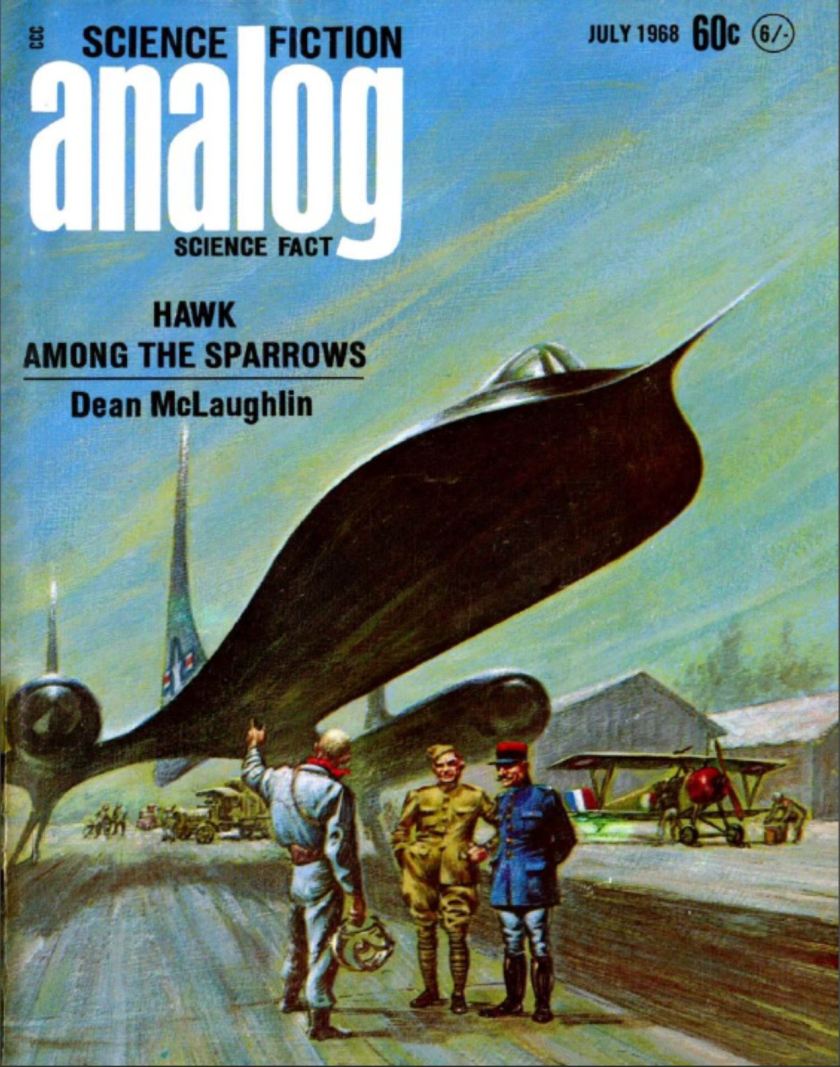
Analog Science Fiction July 1968

What I’m talking about is different. There’s a famous cover to the July 1968 issue of Analog Science Fiction for the story “Hawk Among the Sparrows” by Dean McLaughlin. It shows an SR-71 Blackbird-like jet sitting on a WWI runway with a biplane in the background. That cover represents fun hindsight for a time travel story. But what if a 1918 issue of The All-Story Weekly featured that cover painting? Extrapolating that biplanes would eventually evolve into something spectacular like the SR-71 is what I’m talking about. How often has science fiction done that?

unbelievable_time_required_to_cover_immense_distances_of_space__1918 by Harry Grant Dart

Here’s Harry Grant Dart’s 1918 artistic imagination of future aircraft/spacecraft. Not quite Lockheed SR-71s, are they? I’m not sure just how capable we are of extrapolation.

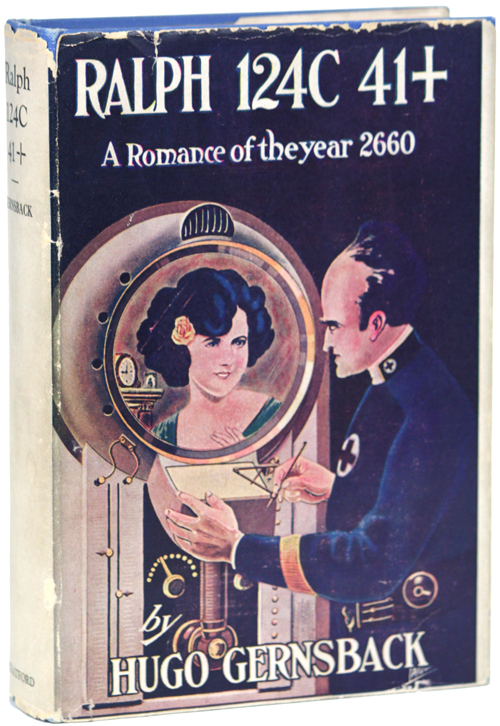
In 1911 Hugo Gernsback wrote Ralph 124C 41+ that contained many inventions he expected to be invented in the future. Just follow the Wikipedia link to read a rather long list of them. It’s 1925 hardback cover apparently shows a doctor interviewing a patient over a videophone. Science fiction has a pretty good track record of imagining possible future gadgets, but generally, their authors were inspired by current technology. Hugo Gernsback was probably the biggest proponent of technological extrapolation, but by the 1930’s science fiction had become 99% adventure fiction.

Ralph 124C 41+ by Hugo Gernsback 1925

Science fiction seems less capable of extrapolating Black Swan technology, especially the social repercussions of those gadgets. The genre just wasn’t ready for computers, especially personal computers, the internet, the web, smartphones, and most of the technology of the last several decades. Science fiction quickly embraced all this technology, but only afterward. Evidently, change is happening faster than science fiction writers can imagine it.

Books like Brave New World, Nineteen Eighty-Four, The Handmaid’s Tale, and Stand on Zanzibar seem prophetic now because they appear to foresee our current social and political nightmares, but are they extrapolations? Weren’t they reactionary to the times in which they were written, and just happen to come into vogue again?

The 1909 short story, “The Machine Stops” by E. M. Forster is one of the most prophetic SF stories I’ve ever read. But it didn’t seem so in 1970 when I first read it. It was only recently, well into the Internet Age when I read it again, that I thought Forster was such a genius for writing it. The main character, Vashti, an old woman, is essentially a blogger using a machine to communicate with other agoraphobic citizens. Everyone lives alone in their rooms, communicating through the machine. Forster knows nothing about computers and networks, only imagines a very clever machine. Her son, Kuno wants to escape the machine. Forster says he was inspired by H. G. Wells’ “The Time Machine,” and it’s Eloi and Morlocks. But I can also imagine Forster thinking writing for magazines and book publishers was like being tied to a machine, and fantasizing about doing something in nature was appealing.

I am working on a science fiction short story. I’d like to think I’m imagining something people will do in the future that they don’t do now. But am I deluding myself? (I’m not going to explain my idea until the story is published.) I’d like to think I’m imagining something new, but I’ve got to analyze if I’m extrapolating or just describing what we do now in a new way.

The more I read old science fiction, the more I see science fiction in a different light. Science fiction has never been just one thing. Extrapolation has only been one aspect of the genre. Even as a kid, I didn’t believe people could predict the future. But I did think science fiction could be a cognitive tool for making good guesses. I’m now wondering if the best science fiction is deeply insightful about the present, and extrapolation about the future is a bunch of malarky.

I’m starting to wonder if I want to write a great science fiction story I should work as hard as possible to see into my own hopes and fears, set the story in the future, and then assume my dreams and nightmares might resonate with future readers.

JWH


Inequality and Overpopulation

by James Wallace Harris, Saturday, October 20, 2018

In the 21st-century countless problems threaten our survival. Long before climate change can drown us, inequality and overpopulation will dissolve our civilization. People tend to obsess on a single issue when all our problems are interrelated. Republicans have laser-focused on reducing their taxes while denying all other threats due to their expense. Our economy is a million times more complex than a nuclear power plant, yet Republicans feel they can control it with just one knob.

Nuclear power plant control room

We won’t solve problems we refuse to see. The past tells us we need a convinced percentage of the population before we act. History also shows progress is slow, and sometimes humans never change. We live in politically terrorizing times. The frog in boiling water analogy Al Gore used for climate change works for all the problems we need to solve today. In the middle of the last century, John Calhoun’s experiments with rat and mice overpopulation probably say more about our times than we want to believe. Watch the video if you don’t believe me or this longer one, Down the Rabbit Hole.

Today, most people ignore the issue of overpopulation even though most of our social problems are directly connected to 6 billion too many humans. Deniers claim food production has always grown faster than population, so we don’t have to worry about overpopulation. However, starvation was never the sole threat of too many people.

If you regularly watch TV news, the same stories cycle over the same periods of days, weeks, months, and years. And with each new iteration, these same problems intensify. I have been pessimistic about the future for decades. I don’t know if my pessimism is the natural one of old age or there’s real evidence for worry.

Honduran migrant caravan October 2018

The new Honduran migrant caravan is much larger than the last one and Donald Trump is panicking. Trump thinks he can control the border. The past tells us that won’t work. Whenever people suffer they move to where people don’t. Just look at Venezuelans pouring into Columbia in the photo below. Don’t the two groups look similar? Haven’t we seen them before? Won’t we see groups grow ever larger and more frequent for the rest of our lives? How are they different from those fleeing hurricanes Florence and Michael? Imagine yourself in such a group. It’s almost certain you’ll either be a refugee in your lifetime, or you’ll be building walls to keep them out. What will it take to avoid both fates?

Venezuelans migrating to Columbia.

This isn’t overpopulation, but inequality. Overpopulation and inequality are related. When populations conflict over war, there is inequality of peace. When there are extremes of rich and poor, there is economic inequality. Where society deems a physical trait of the body superior to another there’s racial inequality. When society treats men differently than women, there is gender inequality. When there are more people than jobs, there is work inequality. When one species takes all the natural resources, there is inequality of lifeforms.

If you watch the Mouse Utopia Experiment film, it’s easy to forget you’re seeing mice and see us instead. As the population grows on Lifeboat Earth, the passengers will fight over the remaining rations. We can’t solve overpopulation right now. We can solve the inequality to reduce the conflicts until we reduce our numbers. If we don’t, nature will do it for us.

Republicans believe the needs of the few outweigh the needs of the many. They are not the ethical Vulcans from Star Trek. The only way our species can survive all the problems we’ll face in this century is by providing equality to all. That will require turning all the knobs in the control room in subtle ways until we find the correct settings. A difficult but not impossible task. And it’s not just for our country. If anywhere in the world one group is singled out and not given equal rations and opportunity, this lifeboat will sink. We have grown so large, that even a 1% minority is 70 million people, a powerful force.

We fail because we lack empathy for people unlike ourselves. I recommend two essays to prove my point. I could list thousands, but please read these two to see if they don’t change your mind. They are “The Case for Reparations” by Ta-Nehisi Coates and “The Longest War” by Rebecca Solnit.

No matter what kind of walls you build to keep out whatever kind of refugee your fear, that wall will never be big enough. The only way not to need walls is to create equality uniformly everywhere. As long as you believe you can wall yourself in you’re doomed.

World-War-Z-photo-zombies-1

JWH

Aren’t Republicans the True Disciples of Darwin?

by James Wallace Harris, Friday, October 12, 2018

I’m beginning to see my liberal hopes for social justice are naïve and conservatives are survivalists acting on animal instinct and not theology.

In “Notes from the Fifth Year” from We Were Eight Years in Power by Ta-Nehisi Coates, he describes why he does not believe in cosmic justice or God. As a kid, Coates got beat up and learned he could only rely on himself for help. He saw that in society too. Our hunger for justice is the desire to be protected, but Darwinian laws of red tooth and claw overrule theology and legal systems. As a liberal, I want society to be just and protective, but I’m realizing that counters my own atheistic and scientific beliefs. What I find ironic is Republicans who claim to be Christian, a belief in cosmic justice, want laws and government that affirm Darwin. That I, an atheist, an avowed disciple of Darwin, really want a Christian society. It’s it hilarious when Christians act evolutionary and atheists yearn for grace?

I thought “Notes from the Fifth Year” both brilliant and depressing. It reminds me of a film I saw on the internet of a big green snake coming out of a woodpecker’s hole while the woodpecker frantically fights to pull the snake out to save its nest. I knew people were on the ground filming and watching this struggle. I wanted the woodpecker to win. It kept pecking the snake, and the snake would grab it by the wing, and the bird would struggle free, fly away, but then immediately return to attack the snake again. Its only hope was itself. I wanted the bird to win. I wanted the people on the ground to find a way to pull the snake down. But like Coates, I realized there is no help for the woodpecker except its own efforts to survive.

More and more I see Republicans as survivalists fighting with all their might to save their way of life. They don’t want to pay taxes to help other people because they want that money to protect themselves. They don’t want laws to help other people, only laws that to protect themselves. They’re against minorities, immigrants, and poor people because they threatened their survival. They offer no alternative to Obamacare because they believe in the survival of the fittest. They don’t really disbelieve climate change but deny the expense of global warming because it threatens their pocketbooks. They’d rather have dollars in their paychecks than a clean environment or a just and equal society.

The Republicans are the snake in the tree, not the valiant woodpecker because they are strong and can take what they want. Coates is right, we live in an atheist reality where the powerful prevail. And the strong won’t help the weak. It’s against their nature.

I find it hard to believe Republicans claim to be Christians. They don’t believe in the fishes and the loaves. They don’t believe in turning the other cheek. They don’t believe loving thy neighbor. They don’t believe the meek shall inherit the Earth. But they’re positive camels can go through the eyes of needles.

I now assume Republicans are Darwinians on Earth but Christians after death. They believe in easy Christianity, where merely saying “I believe in Jesus” is a ticket to heaven. But what happens if Dietrich Bonhoeffer’s The Cost of Discipleship is right, and true Christianity is far more expensive?

I’m an atheist that wants humans to create a society that overcomes the laws of Darwin. Even though I’m not a Christian, I felt Jesus wanted to create a heaven on Earth where everyone is treated equally and just. Am I naïve and the Republicans realistic? Conservatives believe the City of God lies beyond death, whereas liberals want humanism to construct it on Earth.

We can now see that Republicans have given up any pretense of ethics. With them, the end justifies the means, and their means are Darwinian, not Christian. Back in the early days of the Environmental movement, the idea of Lifeboat Earth emerged. It’s a great analogy. There’re always people in lifeboats who feel they deserve the rations than the others, and that the weak should be put off the boat. That’s very Darwinian. Aren’t Republicans acting like the ruthless in a lifeboat?

JWH