Yesterday morning while riding my stationary bike I watched a video about The Beatles. Eric Callero of Vinyl Rewind covered his least favorite Beatle song from each album. I think it’s fascinating that young people are into The Beatles and their albums that came out over fifty years ago. Can you imagine Baby Boomers excited about bands from the 1910s or 1920s when we were young.
I started listening to The Beatles in 1964 and bought all their records as they came out in the 1960s. My nostalgia finds it confusing because The Beatles albums on sale today were not the same ones we bought back in the 1960s. I bought all The Beatles standard albums again in the late 1980s when they came out on CD, and then bought them again this century when they came out on remastered CD.
The Beatles were tremendously exciting back in the 1960s but they weren’t my favorite band back then. That was The Byrds. I did play each Beatle album quite a bit as they were released, but I forgot about them in a few weeks. Then over the decades whenever Susan and I watched a documentary about the Fab Four I’d get the albums out again. When the remastered CDs came out several years ago I bought them but only listened to each album one or two times.
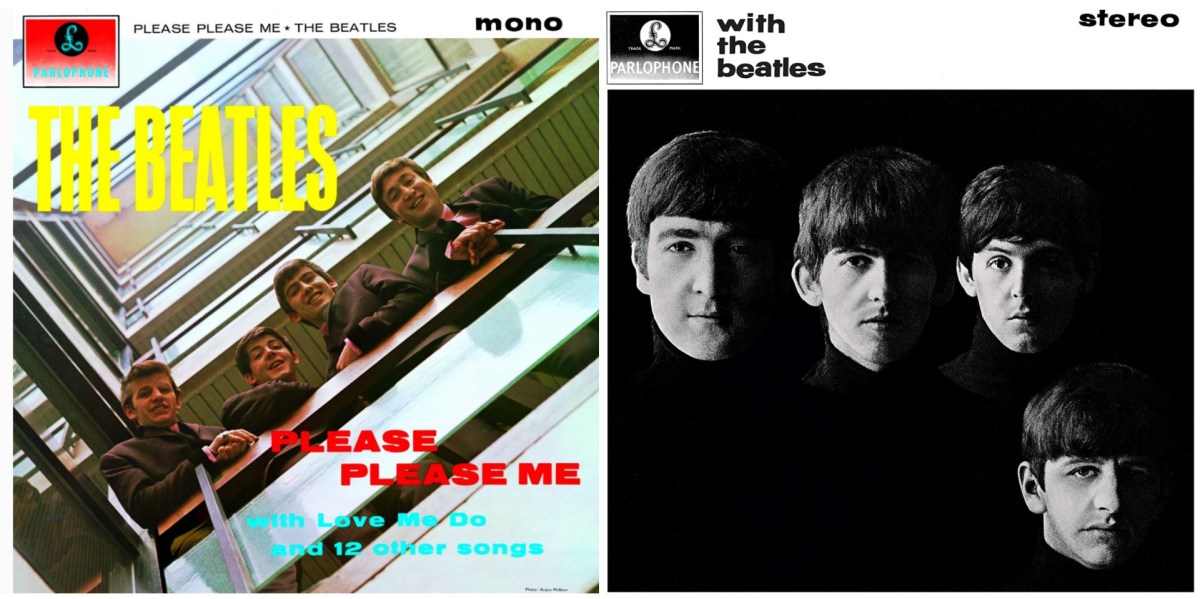
Yesterday, inspired by the Vinyl Rewind video I listened to Please Please Me and With the Beatles. Unlike Eric Callero I couldn’t pick my least favorite song from each album. I was surprised by how good all the songs sounded. I also notice something. I couldn’t distinguish between John and Paul’s voices. Sometimes I thought I could but I was never sure. I did spot the two songs sung by Ringo, but I didn’t even notice that George was the main singer of five of the songs.
This made me realize that I’ve never paid close attention to The Beatles’ songs. Susan and I love watching documentaries about The Beatles, and we’ve read a few biographies on them. Susan can sing their songs, but we’re not Beatlemaniacs.
While watching the Vinyl Rewind video I envied Eric Callero for being able to cite so many details from each song. I’ve always listened to music as a kind of drug. Music stimulates my brain, setting off emotions. I take in each song as a gestalt. To be honest, I hardly even pay attention to the lyrics.
I got out a book we had on The Beatles, tell me why by Tim Riley, that lists the main singer for each song and started trying to train my ear to discern whether John, Paul, George, or Ringo was singing. This website also gives that information.
I’m going to keep playing these albums after lunch and see just how much I can get out of each song. I remember noticing in the past I didn’t know who was singing. And I also remember noticing in the past that the songs are recorded weirdly, with what appears to be the bass, drums, and George’s guitars on the left, and the singing and John’s guitar, and sometimes other instruments, on the right. I also knew that some songs were covers, but never really paid that much attention to which were originals and which were covers.
The desire to notice more in songs comes from several motivations. For being such a major music addict I feel bad about not knowing more about the music I love. But I also feel bad that I don’t pay more attention to the details of life. I’m curious if I can become more discerning. I’m also curious if I can change myself so late in life.
At seventy, I feel my mind is slowly decaying. I know my body is, so it’s natural to assume my brain is too. I eat better and exercise to squeeze more out of my body. I wonder if paying attention to details will it help sharpen my dull mind?
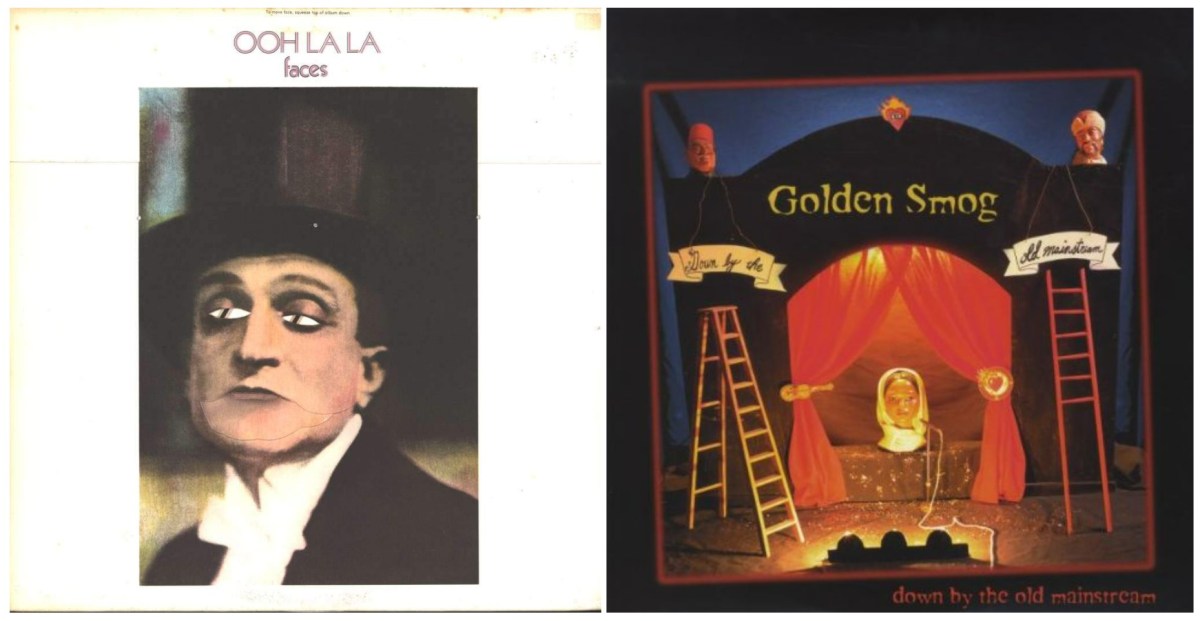
For many many years, the song “Glad and Sorry” from the album Down by the Old Mainstream by Golden Smog has randomly played from my main playlist. I bought the CD because I was a fan of The Jayhawks and some of their members were playing on it. The song originally appeared on Ooh La La by the Faces in 1973 (originally, the Small Faces). I’m pretty sure I had that album back in the 1970s but didn’t remember it or “Glad and Sorry” when I first listened to Down by the Old Mainstream back in the 1990s.
I like to play whole albums after lunch and Spotify offered up Ooh La La. When I heard “Glad and Sorry” I recalled that album by Golden Smog. That’s when I started my research and discovered the song was written by Ronnie Lane of the Faces. Then I found a lovely remembrance of the song which I’ll quote below.
Here’s how the Faces did “Glad and Sorry” in 1973
Here it is again by Golden Smog.
The song is loved enough that it inspired 14 playlists on Spotify, and there are many cover versions. I love how some songs inspire countless performers to sing and record them. Here’s a nice jam session.
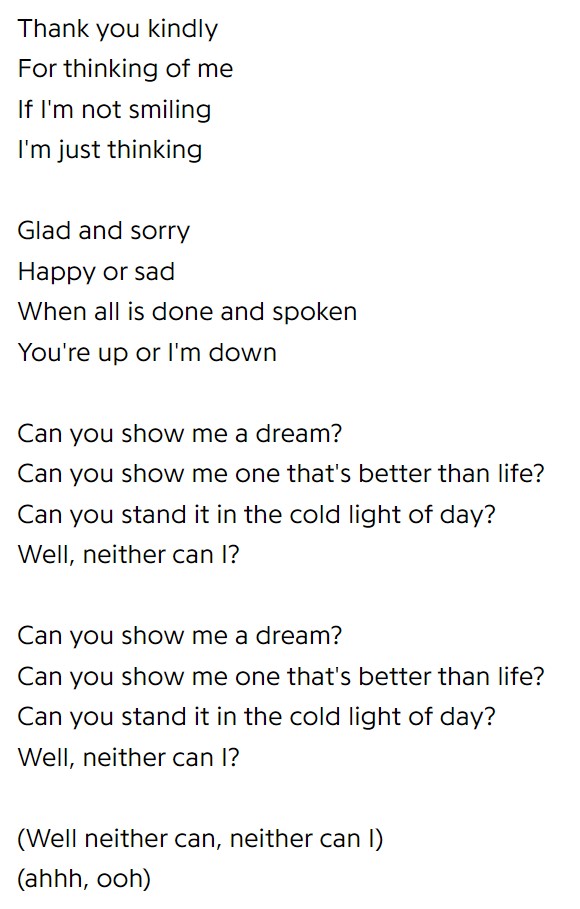
The lyrics are very simple:
That beautiful interpretation of the song is at the site One Week // One Band but without the name of who wrote the essay. Here’s the quote I mentioned, but it’s worth reading the entire piece. This is the way I wish I could write about music (I took this quote starting about halfway down the page, after the history of the song):
“Thank you kindly/For thinking of me/If I’m not smiling/I’m just thinking.”

All my life I’ve been the Quiet One, the one who (mostly) doesn’t say what he’s thinking, the one who doesn’t interact with others because he’s too withdrawn, or too self-serious, or too afraid that he’s bothering people. Always thinking, never sure he’s thought of anything worthwhile to say. “Smile,” they used to tell me, back when I had people in my life who would regularly engage in what they called encouraging me. “It’s not that bad.” Well, no—but smiling for the sake of smiling feels like dishonesty to me. Anyway, I’m thinking.

“Glad and sorry/Happy or sad/When all is done and spoken/You’re up or I’m down.”

It’s never “I’m up,” it’s never “you’re down.” There’s always a fundamental disconnect, we never meet in the middle, and I’m always lower. Not class or any bullshit like that, just circumstance. I can never meet your needs—emotional, physical, social, financial. The person who is You changes every so often, as people pass in and out of my life, but the relationship, once begun, is always the same. It’s bittersweet every time; the emotions are always tangled up. Glad, happy, sorry, sad—and then, at some point, I’ve done everything and said everything I’m going to do or say.
I wish I could relate to lyrics and poems like that.
I’m writing this because this song moves me, but I don’t know how to describe how it moves me. I’m writing this because I love how some songs stick with us for years. I’m writing this because I love how some very simple songs resonate deeply with people. I’m writing this to remember this afternoon, and to remember “Glad and Sorry.” Sadly, I won’t remember it every day, but on those days the songs pop up in my playlist, and I’ll add the original to my main playlist.
This YouTube video from CNBC says the Oscars and Emmys have lost more than 80% of their peak viewership. CNBC claims this is due to a generation shift, and because of cord-cutting. It reminds me of another news story I read about The Gilded Age on HBO Max. That report said the good news was the show was a hit, the bad news was only people over 65 watched it. Of course, that was devastating news to people who sell things.
Are the Oscars really a generation thing? Just how relevant are those awards to anyone nowadays? Why do we watch movies? Is it important that they be awarded prizes? Is it even important that the movies we love, win awards? Do we crave validation for our favorites? I used to use the awards as a checklist of what to try, but I stopped that years ago. However, I do love March, when TCM has 31 Days of Oscar.
I don’t know if it’s a generation thing either. I quit watching the Oscars decades ago. Even though I’m a big movie fan, it’s been years since I could remember the names of any of the new movie stars or directors, and the award ceremony always seemed to really be about and for them.
Before the pandemic, I went to the movies once a week. I haven’t seen a movie at a theater in over two years. When the 2022 Oscar nominations were announced I thought I’d stream all the films that were up for the best picture to catch up. I don’t really care who wins and don’t plan to watch the ceremony. This year ten movies are up for best picture:
This made me wonder just how many movies came out in 2021? Checking Rotten Tomatoes, they list 235 with over 70% positive reviews — there must have been many hundreds made. There are just 30 in their Golden Tomato Awards. Only 4 of the Oscar-nominated best pictures were in that 30. Indie Wire lists their 50 favorites, which have some overlap with both the Oscar nominees and Rotten Tomatoes but rank them differently. Paste Magazine remembers 2021 with another list of 50 films, and with a different slant of opinion. The web could provide me with many more lists, and if you look at enough of these lists, some movies do seem to pop up on many of these top movie lists. In recent years, that’s how I measure movie success — if a film got on multiple best-of-the-year lists.
I’m realizing by following the Oscar best picture nominee list I’m doing myself a big disservice. If I consider the other award categories that involve a feature film, there are 21 other films to consider, for a total of 31 (assuming my ability to count is accurate). I was surprised by how often the 10 best picture nominees were also nominated in the other categories. The movie business is big on promoting their films for the Oscars, often spending millions according to the CNBC report above. They said Netflix spent $60 million to promote Roma. So the Oscar awards feel incestuous, picking the same films over and over again in each category.
I also expected the ten films nominated for best pictures would all be stunning and obvious choices, but I loved only a few of them, and two of them I found tedious and boring. I thought it interesting that three of the ten were remakes. I thought all three remakes were technically superior to the originals, but I prefer the originals for Nightmare Alley and West Side Story. I’m not sure if I care about any version of Dune.
I saw the 1947 black and white version of Nightmare Alley just weeks before seeing the beautiful color 2021 version. I liked everything about the 2021 production, yet I thought the 1947 version was creepier. I wondered if time-period had anything to do with it? Nightmare Alley (1947) seemed to be about something real, something contemporary, whereas Nightmare Alley (2021) felt like a pulp noir fantasy. This was also true for West Side Story. The original felt relevant to when I saw it back in the 1960s. The 2021 version seemed like a perfect recreation of the past but without any current significance. Nowadays gangs kill each other with assault rifles, so a musical about angry teens with switchblades seems out of date.
Dune was gorgeous, but it felt like I was looking at the Illustrated Classics comic version of the story. I read Dune back in the 1960s, and again about ten years ago, and the story felt heavy and rich. The movie versions feel cliche. But science fiction movies about galactic empires have become so common that they now seem silly parodies of each other. While watching Dune my eyes were delighted by the visuals. Yet, intellectually I was wondering if the reason why science fiction movies don’t win awards is because they feel aimed at childish minds? There’s nothing wrong with children’s stories and YA fiction, but the awards appear aimed at stories for grownups.
I’m afraid Drive My Car mostly bored me. I love foreign films, so that isn’t the issue. The problem is Drive My Car felt like MFA literary writing. It’s the kind of story that academics love to analyze and admire. That kind of fiction works on me sometimes, such as The Wonder Boys, Who’s Afraid of Virginia Woolf, or the way Birdman played with Raymond Carver. I just didn’t pick up on Uncle Vanya as a subtext like I did with “What Do We Talk About When We Talk About Love” in Birdman.
But what I like and don’t like isn’t really the point. What I’m asking is: Do the Oscars help us find the best films to watch from the previous year? In recent years I haven’t paid attention to the Oscars but this year I’m using the ten nominees to catch up on what I missed during the pandemic. While I didn’t go to the theater in 2021, I did stream a couple dozen films from that year. CODA and King Richard were my top favorites. I admired The Power of the Dog and Belfast but didn’t love them. I really enjoyed Being the Ricardos. Why wasn’t it up for the best picture Oscar? Who decides these things?
This makes me wonder about how we determine what makes a great movie. I’m sure it’s different for everyone, so there’s no objective way to measure movies. Looking at what I liked, King Richard and CODA makes me wonder if feel-good movies might be my yardstick. Both were riveting stories that left me feeling like I learned something, and they made me feel good about people. (Many movies push my misanthrope tendencies.)
Dune and Nightmare Alley were just fun stories. I would add The Dig and The Last Duel to that kind of story. Don’t Look Up was a very relevant satire, but very uneven to watch. I thought Some Kind of Heaven, another fun satire, was a far better film.
I won’t be around in 50 years, but in 2072 how many movies from 2021 will be shown on TCM in March? If you look back to the 1972 Oscars, I’m still watching many of the films it picked. Professional and critical recognition might matter after all. Then, on the other hand, how many movies do you love that are unrecognized, obscure, and forgotten?
We mostly find the movies we love by accident. It would be interesting if there were a system that would identify films we’d resonate with for sure. Giving films an Oscar doesn’t predict anything for sure, but it might help some in finding movies to watch. Watching the nine nominees for best picture was an interesting education.
I’m planning to watch Licorice Pizza tonight to finish out the ten.
I’ve been retired for eight-and-a-half years and I feel it’s been one long slow physical and mental decline. Of course, that feeling of decline could just be natural aging. I can understand why my body is wearing out, I mean, what machine runs for 70 years without breaking down? But comprehending my mental decline is a little harder to visualize. I know the brain is also a physical mechanism but it doesn’t feel like one.
What if that decline isn’t entirely due to aging?
I know is I’m having a harder time focusing. This morning, I asked myself, what if that lack of focus isn’t due to aging? It occurred to me that maybe having all my time free is destroying my focus, and making me mentally lazy.
Let me use a rather icky analogy. I have an overactive bladder. Tests show my bladder has shrunk. One theory put forth by my doctor is I developed the habit of going to the bathroom as soon as I felt the need. That conditioned my bladder, and it shrank.
What if being able to do anything I wanted. when I wanted, has shrunk my attention span? My days are spent flitting from one fun diversion to another, but never sticking with any task for very long. After eight years, I now have the time-on-target of a butterfly.
For example, I have a very hard time sticking with TV shows and movies. I switched to watching YouTube videos a couple years ago because they were shorter. However, they’re starting to feel too long. I watch a few minutes of one, then click to another. Similarly, I’ve switched from novel-reading to short story reading.
My days are filled with a routine of chasing one interest after another. I do the same kind of flitting on my phone, spending many total hours during the day compulsively checking Facebook, email, Flipboard, Apple News+, Spotify, Audible, Scribd, Feedly, Wordle, Quordle, Octordle, Twitter, NY Times, NY Times Crossword, Google, Wikipedia, etc. That might be another culprit to consider.
Every night I try to watch TV after dinner. I used to watch the news faithfully, now I skip through the 30-minute recording in a few minutes. I used to watch Jeopardy faithfully, now I skip days, and if the topics aren’t appealing, I hit the old back button to return to the menu to find something else. I record countless movies on TCM I want to watch, but each evening I go through my recordings trying four, five, six movies, often just watching them for a few minutes each.
Every so often I find a movie or TV show I’ll stick to. I used to love binge-watching shows but seldom do that anymore. I end up clicking on YouTube and watching short videos. Especially ones that last under 5-10 minutes. When I tire of TV I switch to reading or listening to music or doing puzzles or blogging. I can always find something I enjoy doing, it’s just that I don’t stick with anything long.
I would say I was bored or depressed, but I don’t feel bored. I actually enjoy this constant grazing of different activities. I now check YouTube three times a day for new videos. I’ll read for a little bit, then listen to music for a while, then write on a blog, enter data for CSFquery, play with the cats, take a nap, eat a snack, visit a friend, go to the bookstore. There’s always something else to do.
When I worked I had to focus on my job from 8:30 – 5:00 each day. I wonder if that discipline gave me the ability to focus in general? During my work years, I could watch a 3-hour movie without getting the least bit restless. Or write for several hours until I was worn out and starving.
Has aging ruined my attention span or lack of discipline?
I’ve thought of a way to test this hypothesis? Start sticking to one project again and build up discipline. Then see if that beefed-up ability to focus crosses over and improves my attention span in other areas. It’s sort of like my bladder. I’m retraining it by waiting longer before I go pee.
I have no desire to go back to work but maybe I can find one task I can work at until I can stick with it for three or fours hours straight. I’m going to work at this, but I just remembered something. Before I retired my ability to focus at work was waning. Maybe it is old age. Some people train with weights. I need to train with focusing. Then I’ll know.
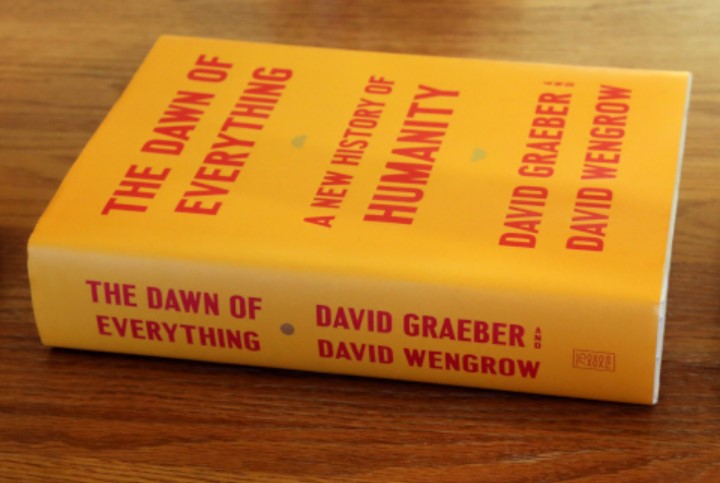
I’m still reading The Dawn of Everything: A New History of Humanity by David Graeber and David Wengrow. I’m a member of an online book club that will be discussing the book all during the month of March, so I’ll be discussing it here piece by piece, whenever a particular topic intrigues me.
Here’s the setup for the book. Humans have been around in their present form for about 200,000 years, but recorded history only covers around the last three thousand years — what were we doing for those other 197,000 years? Anthropology and archeology help answer that question to a degree. The Dawn of Everything works to say to what degree is possible. However, most of what anyone can say about those 197,000 years is speculation, and that can cause controversy.
For most people, prehistory is a mixture of the Garden of Eden imagery and fantasies about cave people. Anthropologists study the evidence provided by archaeologists then speculate about that evidence by comparing it to what we learned from ethnographic research on various indigenous societies from the last few hundred years. Unfortunately, what most Americans know about the pre-20th century indigenous people of North America comes from watching westerns. In other words, unless you read a lot of books on anthropology it’s doubtful you think about prehistory at all, and what you do think you know is pop culture deceptions.
David Graeber and David Wengrow, an anthropologist and an archeologist, have caused some political shit storms by angering some of their readers with their discussion of freedom and inequality while analyzing what we know about prehistory. These brouhahas are caused partly because Graeber was an anarchist and was a leader in the Occupy Wall Street movement, and, partly because they challenge the established Western views that speculate on humans in prehistory, and tie ideas about various forms of inequality and freedom to their speculation. They seem to imply humanity made a wrong turn, but I’m not so sure we did, but don’t care to argue it. Graeber and Wengrow do review a lot of speculation that claimed we made a wrong turn when we switched from hunting and gathering to farming, but I’m not sure they believe that idea either, but merely review it too.
First off, there is no introduction, so the first chapter works as an introduction, but I don’t think it’s a good one. So far, I’ve felt every chapter has been self-contained, so it’s hard to assess the book as a whole. They title their first chapter, “Farewell to Humanity’s Childhood: Or why this is not a book about the origins of inequality.” I don’t think some readers took that to heart and feel The Dawn of Everything is harping about inequality. I wonder if conservatives dislike the book for the same reason they don’t like Critical Race Theory, that it smells of liberal thinking, and it asks them to relearn a history they’ve already embraced and memorized.
Here’s the thing about speculating about prehistory — speculation is only speculation. We’ve found some human bones, lots of animal bones, we have some pots and graves, some old cave paintings, remnants of housing, stone monuments, figurines, lots of rock tools, but not much of anything else. Most speculation about prehistory rests on ethnographic studies of primitive cultures that have survived into historical times. What Graeber and Wengrow challenge are generalized ideas we’ve developed about those cultures over the last couple of centuries.
Most of The Dawn of Everything is about the limits of speculation. What we really want to know is what were the people like? What did they think? How did they relate to each other? What kind of societies did they form? How much did they know about nature and reality? It’s one thing to look at old bones and relics and guess what people did, it’s entirely another thing to extrapolate what they thought and believed.
Here’s what I want to ask: Can ideal concepts exist before they are defined? Take inequality? That’s a concept that’s been emerging for a few centuries and a concept that modern society is working on. Even something like freedom is a concept been around for a long time, but has it always existed? What about science? Graeber and Wengrow have a whole chapter dealing with the origin of scientific thinking. Our ancestors might have observed nature and put two and two together but was that really science? I believe a concept like fairness might be very ancient, but I don’t know about inequality. I believe inequality is an emerging concept. There might have been societies in history and prehistory that had more equality but I don’t think they thought about it as a concept.
I think it’s completely insane to suggest humanity took a wrong turn because we don’t like aspects of our present society. The old saying, “the only constant is change” applies here. The variety of ways humans can organize their societies is infinite, and that comes across in this book. I think Graeber and Wengrow are right to say we can’t generalize about the past like Rousseau or Hobbes.
The best we can do is study all the ethnographic studies, examine all the archeological evidence and review all the speculation, and then create our own inner map of what prehistory was like with the jigsaw pieces we have. We also must be willing to constantly update that map as we gather new puzzle pieces.
We must resist philosophers and psychologists who try to characterize humans now or in the past in broad general terms. I believe what Graeber and Wengrow are telling us is not to lump together various stages of human development or societies into convenient pigeonholes. For example, there was no one shift from hunting and gathering to agriculture. Nor was there one type of nomads or hunting and gatherers. For example, North America had hundreds of different types of Native American cultures, so there is no way to generalize about what they thought about gender or money, or politics.
The trouble is there are places in the first chapter of this book (and I’m only on chapter six) that seem to imply that Graeber and Wengrow are advocating that we should be working towards all the various forms of equality. We can judge modern societies on inequality and even ethnographic studies of primitive societies we have studied, but I believe speculation on inequality in prehistory societies will be based only on our biases, and I think Graeber and Wengrow make that clear even though they keep trying.
Personally, I wonder if Graeber and Wengrow haven’t spoiled the rest of their book with chapter one. Most of the reviews I’ve seen focus on that first chapter. That might be due to the reviewers only reading that chapter, or it might be because it’s the one that pushes buttons. The other chapters I’ve read deal more with what we know, and I’m finding them quite fascinating. It makes me want to read more ethnographic studies — although, as Graeber and Wengrow show, those studies are often colored by their observer’s speculations. If anything, this book shows us time and again how we distort the evidence.
For me, the key to enjoying learning about prehistory is to avoid speculation and focus just on the evidence. The trouble is a certain amount of speculation is good. Nowadays generalizations are considered evil. But we make useful generalizations all the time — it’s called pattern recognition. We just can’t go overboard. Every archeological dig is like a crime scene. You only find so much evidence. Science never knows anything for sure, but works with statistics, looking for a preponderance of convincing evidence.
Most people don’t spend time studying history, much less prehistory. And it’s hard to make a case to get people to care about history and prehistory. For most people, it’s about as useful as studying geometry, cosmology, or particle physics. But consider this. All of us are deluded. We constantly fool ourselves in countless ways that make us see reality distorted by our cultural upbringing. Studying other societies that adapted to our shared external reality in different ways can break us out of the brainwashing of that upbringing. If the book is doing its job it should be stirring things up.
It’s not about whether or not we made a wrong turn, but knowing about all the possible turns we took and could have taken. I think this is scary for some people. If you want to believe the Bible is literally true, then learning about all the societies that existed at the same time as the Bible was being written could be disturbing. If you’re a scholar of Western culture that backed a particular view of history and prehistory, considering what Graeber and Wengrow are saying could also be disturbing. But aren’t all paradigm shifts uncomfortable?
Humans think we’re the crown of creation. And people raised in western culture believe we’re the pinnacle of human intellectual development. Maybe Graeber and Wengrow believe we took a wrong turn because our global society is sailing into an iceberg and they want us to change course. Personally, I don’t think our species has any control over its evolution. It’s not a matter of choice, but playing out all the anti-entropic possibilities. I believe studying history and prehistory shows us some of the many things we’ve already tried.
Knowing where we’ve been might help us know how we can adapt to climate change. Here’s one example. Graeber and Wengrow consider that prehistory societies made the choice between being hunting and gatherers and settling down and that they often chose to stay on the move because it offered more advantages. This video, it shows one modern reason why nomadic people choose to settle down and pursue year-round agriculture. It allows them to build wealth and stability in their lives. This is a very inspiring video.





 Auxiliary Memory