The Golden Age of Science Fiction is 56, Again

It is so easy to get distracted while writing.  My goal the other night was to focus on what it means to search for sense of wonder books in late middle age, but I got sidetrack from this intent by reminiscing about Clifford Simak’s City.  We science fiction fans often agree that around age 12 is when discovering science fiction is the most exciting.  But should that be so?  And is it true for everyone?  Indeed, it is easy to become jaded as one gets older, as well as becoming better educated, more cynical, sophisticated, and, dare I say it, more discerning.

Does that mean we are destined to outgrow science fiction?  I have to admit that I find it very hard to discover new SF&F to enjoy.  Furthermore, I’ll admit that when I reread some of my favorite books from my golden age of discovery they often fail to bring me back to the good ole days.  The thrill is gone.  And when I do reread books that I still love I’m worried that I’m just wallowing in nostalgia, and not appreciating the story for its own merits.

Is the power of science fiction at its greatest potency when viewed by twelve year olds because they are wild-eyed, full of enthusiasm, and anxious to discover everything exciting about the world, or because children are easily manipulated by the slight-of-hand of fantastic stories?  At 12 our critical x-ray vision isn’t very strong, so we tend to welcome everything with believability.  I know it’s just entertainment, but when I was a kid I wanted to believe in science fiction.  It was my religion.

To play devil’s advocate to my own supposition, I should admit on cross examination that I read with great excitement the Harry Potter novels and the Philip Pullman’s His Dark Materials trilogy.  There is a clue here.  Those are young adult (YA) novels.  Furthermore, my all-time favorite novels to reread are Robert A. Heinlein’s twelve YA novels.

The mature of the literary world have often sneered that science fiction is crude pulp fiction for adolescents.  I don’t know how mature I am at 56, but I still find excitement in the concept of science fiction, and want it to be an art form for all ages.  Now this could be avoiding adultification on my part, and I may not be alone, because look how successful Harry Potter books have been with my fellow boomers.  Many of the blogs I read about science fiction are written by old guys like myself fondly looking back to their favorite books.

There is a boom in YA fiction, being read by kids and adults.  I know plenty of middle age people who have found a renewed excitement for reading through YA novels.  So, is it the age of the reader, or just the YA subject matter that stir up our minds?  YA writers know how to target their audience with stories that resonate with the teen years.  Science fiction and fantasy, whether marketed as YA or adult fiction strongly appeals to youthful readers.

This finally brings me to the question I want to ask:  If literature can be targeted to the formative years, can it also be targeted to the waning years?  When I first started reading Old Man’s War by John Scalzi I thought, “Hot damn, science fiction for old guys.”  If you’ve read the novel you’ll also probably guess my disappointment in the change of direction it eventually takes.

As a boomer seeing my golden years glow on the horizon, I want those years to be a new golden age of science fiction.  I wonder if there’s a market for sunset science fiction?  Who knows, maybe I have a bad attitude towards aging, but I can’t help but thinking I’ll have 15-30 years of wrinkly freedom.  It won’t be like being young, but it doesn’t have to be all about dying either.

I think the excitement of reading YA fiction is the quality it brings to thinking about the future and exploring what we can be “when we grow up.”  One reason many people turn away from fiction is because growing up turns out to be a dud in relation to our YA fantasies.  Adultification sets in and dreams dissipate with compromising.  One of the tragic beliefs of youth is we’ll have lots of time to pursue our dreams after high school, but college, jobs and marriages kills that dream fast.

If I retire and have 15-30 years of free time, I’m going to have that free time I wanted in my youth.  I might not be fit to do anything, but I shouldn’t give up.  What we need is RA fiction, Retired Adult fiction that inspires us to do something with those years of freedom.  Fishing, golfing and shuffleboard are philosophical lacking, so I want sense of wonder ideas for my elder years.

Hell, maybe J. K. will write a series about a Hogwarts Retirement Home.  Or Victor Appleton II can be resurrected to write about the adventures of a geezer Tom Swift.  However, this time around I want maximum sense of wonder with less fantasy.  I can believe fantasies about a robotic Jeeves becoming a geriatric companion easier than I can believe being downloaded into a cloned body.  I’d love to read more stories about the possibilities of mental rejuvenation.  I’m not against physical overhauls, but so far medicine only seems to produce scary people with rigid faces.

What we need is the idealism of the 1960s for octogenarians.  Let’s see some creative utopian assisted living homes.  And does anyone write erotica for the wrinkled?

Science fiction original sold me the Brooklyn Bridge on Tau Ceti.  It’s easy to fool kids that rocket travel is just around the corner.  This time around I want science fiction writers to really wring their imaginations and bring about another golden age of SF.

Jim

Best Science Fiction Short Stories 2007

It’s that time of year again, when all the annual best of anthologies start showing up.  This year I’ve come across four so far, one of which I’m reading (Hartwell & Cramer), two of which are winging their way from Amazon (Dozois & Strahan), and a fourth is waiting to be shipped (Horton).  There are probably more of these out there, so let me know.  Here are the titles I know about so far:

What’s truly strange is how little overlap there is, with only 12 stories out of 87 getting in more than one book.  This made me feel good about wanting to buy all four volumes, but on the other hand, I wished there were more obvious stand-out stories.  We know that the Ted Chiang and Karen Joy Fowler stories won Nebula awards this year, and  these stories are nominated for the 2008 Hugo Awards:

  • “Memorare” by Gene Wolfe (novella) (HC)
  • “The Cambist and Lord Iron: A Fairytale of Economics” by Daniel Abraham (novelette) (JS)
  • “The Merchant and the Alchemist’s Gate” by Ted Chiang (novelette) (GD, JS) (Nebula winner)
  • “Dark Integers” by Greg Egan (novelette) (RH)
  • “Glory” by Greg Egan (novelette) (GD, JS)
  • “Finisterra” by David Moles (novelette) (GD)
  • “Lost Contact” by Stephen Baxter (short story) (GD, JS)
  • “Tideline” by Elizabeth Bear (short story) (GD)
  • Who’s Afraid of Wolf 359″ by Ken MacLeod (short story) (HC)

Greg Egan and Nancy Kress got in all four best-of-books with multiple stories, and 12 other writers got into more than one volume with one or more stories.

Abraham, Daniel The Cambist and Lord Iron: A Fairy Tale of Economics JS
Asher, Neal Alien Archeology GD
Baker, Kage Plotters and Shooters HC
Baker, Kage Hellfire in Twilight GD
Ballantyne, Tony Aristotle OS HC
Ballantyne, Tony Third Person HC
Barnes, John An Ocean is a Snowflake, Four Billion Miles Away GD, RH
Baxter, Stephen Last Contact GD, JS
Baxter, Stephen No More Stories HC
Beagle, Peter S. The Last and Only, or Mr. Moskowitz Becomes French JS
Bear, Elizabeth Orm the Beautiful JS
Bear, Elizabeth Tideline GD
Benford, Gregory Reasons Not to Publish HC
Benford, Gregory Dark Heaven GD
Bisson, Terry Pirates of the Somali Coast HC
Black, Holly The Coat of Stars JS
Brooke, Keith The Accord GD
Cadigan, Pat Nothing Personal GD
Chiang, Ted The Merchant and the Alchemist’s Gate GD, JS
Daniel, Tony The Valley of the Garden JS
Di Filippo, Paul Wikiworld RH
Egan, Greg Glory GD, JS
Egan, Greg Induction HC
Egan, Greg Dark Integers RH
Egan, Greg Steve Fever GD
Finlay, Charles Coleman An Eye for an Eye RH
Ford, Jeffrey The Dreaming Wind JS
Fowler, Karen Joy Always HC, RH
Gaiman, Neil The Witch’s Headstone JS
Goonan, Kathleen Ann The Bridge HC
Goss, Theodore Singing of Mount Abora JS
Gregory, Daryl Dead Horse Point JS
Hand, Elizabeth Winter’s Wife JS
Hemry, John As You Know, Bob HC
Hitchcock, Robin They Came From the Future HC
Holm, Palle Juul A Blue and Cloudless Sky HC
Irvine, Alex Wizard’s Six JS
Jablokov, Alexander Brain Raid RH
Jones, Gwyneth The Tomb Wife HC
Jones, Gwyneth Saving Tiamaat GD
Kessel, John The Last American HC
Kosmatka, Ted The Prophet of Flores GD, JS
Kowal, Mary Robinette For Solo Cello RH
Kress, Nancy By Fools Like Me JS
Kress, Nancy End Game HC
Kress, Nancy Art of War RH
Kress, Nancy Laws of Survival GD
Laidlaw, Marc An Evening’s Honest Peril HC
Landis, Geoffrey Vectoring RH
Link, Kelly The Constable of Albal JS
MacLeod, Ken Jesus Christ, Reanimator JS, RH
MacLeod, Ken Who’s Afraid of Wolf 359? HC
MacLeod, Ken Lighting Out GD
McCormack, Una Sea Change GD
McDonald, Ian Sanjeev and Robotwallah GD, HC
McDonald, Ian Verthandi’s Ring GD
McIntosh, Will Perfect Violet RH
Moles, David Finisterra GD
Palwick, Susan Sorrel’s Heart JS
Phillips, Holly Three Days of Rain RH
Pratt, Tim Artifice and Intelligence HC, RH
Purdom, Tom The Mists of Time GD
Reed, Robert Night Calls RH
Reed, Robert Roxie GD
Reynolds, Alastair The Sledge-Maker’s Daughter GD
Rickert, M. Holiday JS
Roberson, Chris The Sky is Large and the Earth is Small GD, JS
Rosenbaum, Benjamin & Ackert David Stray GD
Rusch, Kristine Kathryn Craters GD
Sedia, Ekaterina Virus Changes Skin RH
Shunn, William Objective Impermeability in a Closed System HC
Silverberg, Robert Against the Current GD
Singh, Vandana Of Love and Other Monsters GD
Sinisalo, Johanna Baby Doll HC
Skillingstead, Jack Everyone Bleeds Through RH
Stableford, Brian The Immortals of Atlantis GD
Stanchfield, Justin Beyond the Wall GD
Sterling, Bruce Kiosk GD, JS
Sterling, Bruce The Lustration HC
Sterling, Bruce A Plain Tale From Our Hills RH
Stross, Charles Trunk and Disorderly JS
Swanwick, Michael Urdumheim JS
Swanwick, Michael The Skysailor’s Tale GD, RH
Van Pelt, James How Music Begins HC
Van Pelt, James Of Late I Dreamt of Venus GD
Watts, Peter Repeating the Past HC
Wolfe, Gene Memorare HC

The Golden Age of Science Fiction is 56

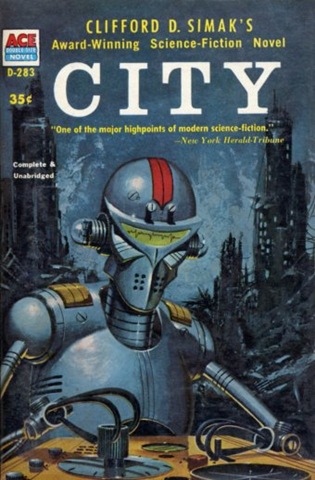
If the golden age of science fiction is 12, what am I to read at 56?  I still yearn for the same sense of wonder thrills as I did as a kid, but they are much harder to find.  What if I reread the books I loved at 12 now at 56?  Are they the same books even though I’m not the same me?  No, of course not.  I reread one or two books a year, so I know.  I’m listening to City by Clifford Simak, a story I loved as a kid.  I barely remember the flavor of the story, and damn few details.  It’s almost like reading the book for the first time.

City

However, the sense of wonder I get from City in 1965 when I first read it, is much different from 2008, while listening to it now.  There are so many factors at play:

  • The world of 1952 when City was published
  • The knowledge of science fiction by Simak in 1952
  • The knowledge of the science by Simak in 1952
  • The state of the world in 1965
  • The state of science fiction in 1965
  • How many science fiction books I had read by 1965
  • The state of science in 1965
  • Who I was in 1965
  • The state of the world in 2008
  • The state of science fiction in 2008
  • How many science fiction books I had read by 2008
  • The state of science in 2008
  • Who I am in 2008

There are other factors, but these are enough to discuss for now.  In fact, it’s too broad for a blog essay, so I shall narrow it down.  One of City‘s sense of wonder aspects is robots, so let’s focus on how my perception of stories about robots changes over time.

In 1965 my knowledge of robots mainly came from SF movies like The Day the Earth Stood Still, Target Earth and The Jetsons, and the robot stories by Isaac Asimov.  It’s a rather limited view.  I don’t even know if there were any real robots in the world at that time, and if there were they were no more than toys.  And I certainly hadn’t read any histories of literature discussing the antecedents of robots like Frankenstein and The Golem.

When Clifford Simak was writing his robot stories in the 1940s, his only inspiration was probably other science fiction writers and their stories.  Robots were all speculation.  He had the play R.U.R. which coined the term robots, and Metropolis, the classic silent film from Germany, and he had Isaac Asimov, Eando Binder and Lester del Rey, and before the City stories were fixed up for hardback publication, he had the magnificent Jack Williamson story, “With Folded Hands.”  When City came out it won the third International Fantasy Award in 1953.  Other winners were Earth Abides (1951), More than Human (1954) and The Lord of the Rings (1957).  It was a well respected book.

In 2008, City is quaint and it would be very kind to just say the speculation is full of holes, but the story telling is still magical.  I look forward to every moment I can spend with it.  I like Jenkins like I like Godfrey and Charles, two butlers William Powell played in 1930s films.  If I could interview my 1965 self, even though he was a kid in junior high, he probably knew the speculation of the story was silly then.  The quality of the story telling held me then as it does today.  Simak if far from a great writer, and his prose is barely a step up from pulp fiction, but damn, he does have a lot of far out ideas in such a small book.

One of the reasons why The Golden Age of Science Fiction is 12 is because at that age you don’t know much about the world and everything you discover has impact.  Just the concept of building artificial beings is mind blowing.  Of course it’s not much different than wishing I could fly like Superman in terms of reality.  One of the things that has tarnished old science fiction stories is real science.  Robots have a reality in 2008 – yet their reality is far from science fiction then and now, but strangely I think science fiction robots have a better chance of finding their place in the real world than interstellar space travel, aliens or time travel – the other major motifs of early SF.

Science fiction robots have evolved in the years since 1965.  You have the philosophical replicants of Blade Runner, the charm of Commander Data on Star Trek:TNG, the cyborg tenacity of The Terminator, the cuteness of Wall-E, the comic duo of R2-D2 and C-3PO, the threat of the Cylons, the wise robotic aliens of A.I. When I read City today I see Jenkins in relation to all the robots I’ve met since.  He is a simple faithful servant, intelligent, but hardly more than a mechanical Mr. Jeeves.  Of course, if I owned a robot, I’d want a Jenkins.  Owning a Commander Data or even a Rachael from Blade Runner would be a kind of slavery.  Jenkins’ mechanical servitude is acceptable, but that’s a whole other world of speculation.

In 1965 just the concept of an intelligent machine was cool.  The possibilities were endless.  Soon after Jenkins I encountered Mike, the intelligent computer in The Moon is a Harsh Mistress, and then HAL in 2001, and the concept of artificial intelligence grew in my mind.  There is a chance I even majored in computers in 1971 because of those stories.  They were a far cry from the IBM 1620 I was programming with punch cards at the time.  Working with real computers taught me the limitations of science fictional computers.

When I read City today, I analyze Simak’s speculation about the future from his vantage of 1952 and earlier.  He pictured atomic power, private planes, helicopters and hydroponic farming causing such a societal paradigm change that cities were dissolved and people chose to live far from one another independently.  While this was going on, Simak imagined the development of robots and the uplifting of dogs.  His speculation of de-urbanization, or re-ruralization seems silly today, but it is elegant speculation.  Simak’s whole imagined future where humans disappear and are forgotten, leaving the Earth to intelligent dogs and robots is quite beautiful.  That holds up.

What my 56-year-old self needs is a 2008 novel about robots that is as ground breaking as City was in 1952.  This wished for novel needs to have the story quality of City so it remains in print until 2060 and later.  And I need to live to be a 109 so I can reread it and evaluate my sense of wonder one last time before I pass into oblivion.

Jim

Twilight by Stephenie Meyer

Twilight by Stephenie Meyer is the new YA novel that all my adult lady bookworm friends are reading.  At my office four women have already read it and two have even finished the two sequels, New Moon and Eclipse, and are anxiously awaiting for August 2nd to bring them Breaking Dawn.  I am more than halfway done with Twilight, but I’m starting to wonder if I shouldn’t be reading it.  This book has a disturbing philosophical motif that isn’t suited for males.  To put it bluntly guys, so far this story comes across as a manifesto against sex and pro all those qualities women wished us men had but most of us don’t.  Is this the beginning of a radical movement?

I feel like a spy reading a classified document meant for her eyes only.  Can women really read our thoughts from looking at our eyes?  Are women’s secret desire to have their true love stay all night in bed with them without trying a damn thing?  Is attention, talk and protection all what women really want from men?  If Twilight is a big time fantasy for girls, then boys, all those porn fantasies you spend every waking moment on, are on such a vastly different wavelength from the object of your desires that I think maybe you ought read Twilight, just to learn what the enemy is thinking while you are picturing them without their clothes.  They are picturing you in clothes.  Nice clothes.  Outfits you don’t take off.

Strangely enough Twilight is about vampires and werewolves, which you’d think would be full of great action and thrilling violence, but no.  These vampires all belong to my sister’s Please and Thank You Club.  Like I said, I haven’t finished with the first book, but so far killing and stakes through the heart are absent.  This is a far cry from Van Helsing, and it’s definitely not Buffy and Spike bringing down a house.

If J. K. Rowling had used a female as her lead character instead of Harry, would the Hermione Granger series have had as many readers, and would the working of the magic unfolded as it did for a male point of view?  Is Stephenie Meyer different, a writer revealing feminine secrets unlike most female writers who play along with male fantasies, or does her explosive success represent a large segment that’s pro chastity?

I have to admit that Meyer’s take on vampirism is quite cool, if intellectual, but I’ve got to wonder if it’s just one giant metaphor for male desire, where Meyer ties lust and sex to violence and death.  Edward Cullen becomes the ultimate beautiful male that must control his instinct to kill, which for the average guy is the instinct to get laid.  Now I could be completely off base here, and Meyer will eventually come around to the traditional values of sex and violence that all us guys enjoy and love, but I’m worried how far she will delay gratification.

This is a fun way to review a book.  I can’t spoil the ending because I don’t know it.  I can tell you the book is gripping, full of tension between Bella and Edward, and that women love this story.  I’m not used to reading teen girl fantasies, so it may not be as much fun as seeing into the girl’s locker room, but it might be like having a secret microphone planted there.

Jim

Blogging, WordPress and the Future

I’ve been blogging for awhile.  I started with LiveJournal, and then moved to WordPress on my hosted site, and finally to WordPress.com.  I like the convenience of WordPress.com maintaining everything, and I’m developing a wish-list of desired features I hope they will roll out in the near future.

First, let’s think about blogging in general.  The basic idea is to write a post and get comments.  Older posts are pushed down and stored away, and the general method used to find these older stories is either by categories, search box or calendar grouping.  It’s pretty effective for what it does, but I wonder if other methods might be developed to organize the overall site and expand the theoretically limits of what it means to blog.  WordPress is constantly adding new widgets, so their structure is built around adding features, so this post is going to suggest some features I want and imagine where I’d like blogging to evolve in the future.

Paid For Feature Modules

I don’t know if I can expect all my desired features for free, but what if each module was a paid add-on or part of a plus service?  I have no idea how WordPress makes its money.  It’s a great free service that doesn’t appear to use ads and what few add-on features they do sell don’t look like big revenue generators.

Some of the features I’m wishing for could be part of a $49.95/year plus package.  I’ve invested a lot of time in WordPress, so I don’t mind paying.  I don’t want them to go bust – I want WordPress to be around for generations to come.  I assume WordPress wants to maintain their current marketing plan of offering a free service, but I can picture my blogging needs expanding, and I imagine so do others.

Right now there are too many Web 2.0 services.  I can share my thoughts on WordPress, my photos on Picasa, computer work on Zoho.com, friendships on Facebook.com, genealogy on Ancestry.com, my book lists on LibraryThing.com, and so on. 

What I’d like is one place to present the digital me.  MySpace and Facebook want that place to be their services, but I’m not happy with those sites.  They are too restricting.  What I want is one place to combine all the features, and for now I’m thinking my blogging home at WordPress.com is the place to start.  I have no idea if the people who produce WordPress want to be such an enterprise, but I’m guessing my desires are just part of an evolutionary process on the web and somebody will offer them.

The Digital Me 

Let’s think of a blog as an analog for a person’s life.  Right now blogs model people with the diary format.  Before computers, memoirs and autobiographies were two ways to convey a person’s life.  However, those formats depend on linear progress and some random discovery.  When you meet someone at a party you don’t get to know them in a start at the beginning, end at the end, fashion.  Generally you start talking about a subject, and this is covered by blogging with categories.  But if you’ve ever been to a blog site of someone you like to read and they have a long list of categories it’s not very inviting.  And if their current three posts are all boring then you’ll get the wrong idea, even if they wrote a brilliant post just before that.

Science fiction has for years imagined artificial beings or speculated on machines recording people’s minds and converting them into computer beings in artificial worlds.  I’m thinking a blog could be something like that – a download of your personality.  But you need a face to represent the whole of your being.

Table of Contents

Magazines use their covers and table of contents to promote their top stories, hoping an eye catching headline will get you to buy a whole magazine and read the rest of the issue.  However, magazines are not good structures to model a person’s complete life, but the TOC could be a good format to use for an introduction, or your face.  Home pages on blogs take you to the latest post.  I’m wondering if WordPress could create a Table of Contents page to use as the default home page, something that would combine the features of the About page and table of contents, to welcome blog visitors and help bloggers introduce themselves, giving guests a bigger picture of what you are like.  Also, let this page have more layout options, use a 2-3 column HTML table to organize the structure, and allow the maximum customization. 

Since the word categories is already used, have an organizing unit called “Projects” to be a super-group above categories.  I like the word “projects” because I like to think of organizing my life into projects.  Marketing people might come up with a better word.  Maybe tie it in with major personality traits.   Here’s an example of what I mean.  For the Table of Contents page have several user-created Topics or Projects called Family, Friends, Work, Hobbies, Travel, and Reviews.  Under Reviews I might have category listings for Audio Books, Books, Movies, Television Shows, Music, etc.  Under Family I might have categories for Parents, Wife, Kids, Genealogy, etc.  Then allow each Topic/Project to have an icon or small photo in the layout, so visitors at a glance can see how the blog writer organizes his or her life.

TimeLine

Another fun format to add would be the TimeLine – something to help people remember when and were things happened.  Since people have imprecise memories, you’d have to have a Date field that could handle  years, months, seasons, and days.  I don’t think hours and seconds would be needed.  (Fall 1949, 12/7/82, January 1971, 1963.)  Users could enter birthdays for family, and then school years and schools.  That way people could quickly know how old they were in a during a particular school year, or what years they worked as a bag boy.  Bloggers could enter dates for when they met people, got jobs, saw concerts, had children, went on vacations, etc.  Additional fun features would be hyperlinks to web sites that show the TV schedules, top news, best selling books, big movies, etc. for each year to help prompt memories.

Lists

I like keeping a list of the books I’ve read, my favorites, the ones I own, favorite songs, my CD library, favorite movies, DVDs, movies seen, etc.  Lots of people are list makers, and so having a list making module would be awful cool.  Like the TimeLine module above, this would force WordPress to get into the database business, which moves them more into the Zoho.com type service.  WordPress could offer both custom database applications and do-it-yourself kits.

Genealogy

Blogs are about people.  I use my blog to help remember things.  One of the things I’ve always meant to get into is genealogy – but not in a big way.  What would be amusing for blogging is to enter enough information so it links to other genealogy sites and to other bloggers, so when you meet people you can glance at their ancestry and maybe check if you’re related.  If this linkage grew eventually we’d be able to say to our blogs, “show a family blogging tree.”

Who Is Your Blog For?

When you’re typing away at your blog posts do you do it for friends, strangers, or yourself?  I call my blog Auxiliary Memory because I’m getting more forgetful all the time.  I really would like to use my blog as a supplemental brain.  If WordPress had the security, I’d even like to save private information on my blog.  Not bank account numbers, but just data only I would want to see when I’m trying to remember something, maybe something personal like address books, Christmas card lists, work and home To-Do lists, etc.  I’d also like to keep my last will and testament and parting thoughts, so when I die, especially unexpected, I can leave some last messages.

Now do you see what I mean when I think of a blog as a digital analog of myself?  Right now blogs are a collection basket for thoughts, but it could collect other personal items, like photographs.

Photos and Time and Place

There are plenty of online photo galleries for people to share their pictures, but I’d like one integrated into WordPress.  Why separate thoughts from images.  I’d like to tie photographs to the TimeLine and to the Genealogy.  Currently we enter posts by today’s date and time, but I’d like to be offered a field that would let me enter posts for past dates and time, that way I could organize my photographs chronologically, and work to remember the past.

It’s quite obvious what would happen if you could link photos to genealogies.  I’d also like to link photos to streets and cities, and I would like to connect to other people to share photos linked by time and place.  I moved around a lot when I was a kid.  Imagine putting all my photos from Maine Avenue when I lived at Homestead Air Force Base from 1962-63 into the system and someday getting a message from long lost friends who went to Air Base Elementary with me?

Photo Rotation and Linking

Right now we get one photo for our header to represent our personality.  It would be great to draw from a pool, so on some pages visitors would see images from a random rotation from the pool of personal or stock photos and for other pages, specific photos to go with the content of the post.

This would be a nightmare to roll out for WordPress.  It’s much easier to manage the system when there’s a limited number of templates for users to build their sites.  For this to be practical, WordPress needs to designate certain sized photographs – so all header photos would be the same size for a particular template, as they do now, but offer you the system to switch photos on the fly.  When you create a new post you’d have the opportunity to link to a photo pool folder or link to an individual photo.  This wouldn’t require a major programming change, and WordPress would sell a lot more space.  Of course, it would be nice to link to Flash videos and animations too.

I’m Sure You Get My Point By Now

By now you should see the trend.  I supposed with XML and web services many of these features could originate on companies outside of WordPress, or allow these features to work across all blogging sites.  I love the idea of OpenID and that needs to be expanded.  Selecting a blogging service like WordPress, Blogger, LiveJournal is like selecting a nationality, but we shouldn’t have language barriers to keep us from communicating across borders.

It may even be possible that various blogging services could work together so you’d have memberships on more than one service and combine the results.  I see people trying to do this now but the results are disjointed, like they have multiple personalities, or they want to have separate public identities.  I hate when I leave a reply on a Blogger site and it wants to send people to my Google identity rather than my WordPress identity.  My FaceBook page should just have a widget that displays my WordPress blog instead of trying to duplicate a blogging feature.

Has anyone thought about the ramifications for blogging for decades?  Or generations?  Permanent storage needs to be addressed for historical purposes.  I always like to ask people, “What would the world be like if Jesus had a blog and we could read it today.”  Whose blog would you want to read from history?  File and data formats are going to have to become standard if they are going to be readable in a thousand years.  And if you spend a lifetime crafting your blog so it represents who you are, do you want it to die just because your body can’t go on?

These are just some idle thoughts on my part.  Start thinking about what blogs could really become.  Just wait a few years for when WordPress rolls out its AI widget that allows you to program a talking personality to go with your blog.  All it’s personality will be based on your past blog entries.  Eventually, we’ll be able to talk to our AI and it will automatically create our posts just from interviewing us.

Jim