The Other Side of the Future

If you live long enough you can get to the other side of the future.  In the 1960s I consumed massive amounts of science fiction and quite a bit of it was set in years that have already past.  I have lived through a lot of futures.  1984 was just another year in life, and so was 1999, 2000, and 2001.  One of my favorite novels growing up was The Door Into Summer by Robert A. Heinlein, which was written in 1956, that I read in 1965, about a man in 1970 taking the cold sleep and waking up in 2001, and who eventually time travels back to 1970.  Even in 1965 the year 1970 was so full of futuristic possibilities.

Of course its 2010 now, and that novel is way in the past, from so many perspectives.
suenos-diurnos

I’m in an online science fiction book club called Classic Science Fiction where a bunch of members are like me, who came of age reading science in the 1950s and 1960s.  We’re reading the great science fiction stories of our youth from the other side of the future, and it’s a whole different vista than we saw from that distant shore of the past.  Now it’s not like we don’t have a lot of future still to outlive, especially when you think we might live another 40-50 years, the amount of time we’re looking back over.  But we have lived long enough to live past many speculative fictional years.

Let’s just say that the future is everything I never imagined.  I’m sitting here typing on a computer that’s linked to the world wide web while listening to Katy Perry sing “Teenage Dream” over digital streaming, from a library of over 10 million songs that I have access online.  Didn’t see that one coming back in 1965 when I was mowing lawns to buy the latest Byrds’ album to play while reading Robert A. Heinlein’s Have Space Suit-Will Travel.

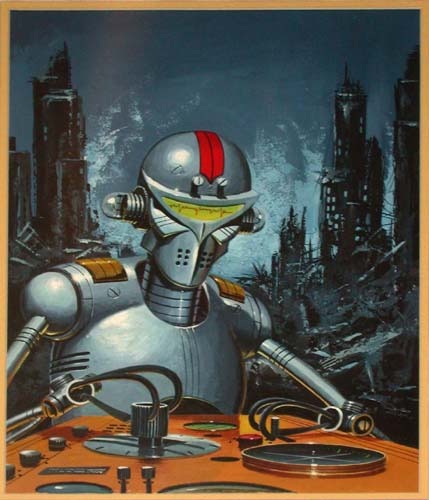
The thing is, back in 1965 I thought I knew the future because I was reading so many science fictional roadmaps.  I was youthfully confident that by 2001 we’d have a colony on the Moon, and we’d have hundreds of men and women roving all over Mars, and there would be manned spaceships heading out to Titan and Ganymede.  Quite a few of us old fart guys and gals at Classic Science Fiction are crying in our beer over that lost future.  How could Heinlein/Clarke/Asimov have been so wrong?  Of course we’re haven’t reached Clifford Simak’s future of City either, but I still wonder about that one.
ValigurskyCitySimak

In 1964 Arno Penzias and Robert Wilson discovered the cosmic background radiation while I was discovering 1940s and 1950s astronomy in musty old books in the Miami Public Library.  I never imagined anything like the Hubble Space Telescope, or all the magnificent robotic explorers that have flown across the solar system in our lifetime.  And who imagined a future with only eight planets?  Isn’t that a step backwards?  On the other hand, just rent The Universe from Netflix and watch several seasons.  What we’ve learned about cosmology is mind blowing, far beyond the wildest imaginations of legions of science fiction writers.

Back in the sixties our parents told us to clean our dinner plates because it was horrible to let food go to waste when people were starving in China, but now China is about to eat our lunches racing to new far out futures.  Did any SF writer see that change coming?  Did anyone foresee America retiring from manned exploration of space?  Or that maybe the Chinese might do what we once dreamed.

One of the strangest things for me living on the other side of the future are the deaths of Heinlein/Clarke/Asimov.  In the book club we’re mostly partial to books from the 1950s and 1960s and we feel science fiction itself has changed.  In that old back to the future world, science fiction was about conquering reality, but now it’s either about escaping from reality, or dark stories about how reality is going to conquer us.  Science has discovered a universe far vaster and more slower to travel than we ever imagined.

Nostalgia seems to be the order of the day for us old folks at Classic Science Fiction.  We read and reread the good old days of science fiction.  Political and scientific realities make us dream of simpler days of rocket ships and ray guns.  Do we return to the classics of science fiction like opium addicted dreamers giving up on reality?  Do we cherish the dreams of youth more than reality on the other side of the future?

JWH – 11/15/10

The Metaphors of Magic


The concept of magic has been around since the dawn of mankind.  Modern people associate the belief in magic with superstition, so the belief in real magic is waning.  However, the belief in fantasy magic is growing.  People love stories where magic is real.  Fictional magic can take many forms because the rules and intent of magic within a story has literary purpose.

A Great and Terrible Beauty coverI am listening to A Great and Terrible Beauty by Libba Bray, and beautifully read by Josephine Bailey.  It is the first book of a trilogy about four girls in Victorian England that get seduced by the power of magic.  One metaphor for magic used in this book is addiction.   The girls have hangovers after using magic.  They are drawn to magic because of their unhappy lives and magic makes them feel good.  They are warned about the dangers of magic, but they become addicted, knowing that magic killed the two girls that are their spiritual guides.  In A Great and Terrible Beauty magic is seen as a kind of high, or escape of from the real world.

The metaphor for magic in the Harry Potter books is different.  J. K. Rowling treats magic as if it was a science, to be studied in school, with textbooks,  journals, and learned societies.   Magic has rules and limitations, and mastery of it takes work, skill and talent.  This is probably the most popular metaphor for magic.  Readers love everyday stories of practical magic.

Older books, especial from medieval times and earlier, see magic as a metaphor for good and evil, directly related to God and Satan, or gods and goddesses.  There is white magic and black magic, and human users get their magical power through association.  As humans self importance grew, and the power of the gods declined, the nature of magic was moved into hidden aspects of reality.  It was the secret knowledge of adepts.  Stories like The Lord of the Rings comes out of this heritage.

Nowadays magic doesn’t have to have a philosophical justification.  Every writer who creates a new series of books about vampires decides the rules for how they live in their literary creation.   Magic is a tool that shapes fictional form, which can go from sexual magic (True Blood) to comedy magic (Buffy the Vampire Slayer) to satire magic (Saturday Night Live) to alternate history science fiction magic (“The Merchant and the Alchemist’s Gate” by Ted Chiang).

The sad thing is sometimes people really do want to believe in magic.  They want their fictional fun to be reality.  All religions believe in magic of some sorts.  Miracles are the metaphor for religious magic.  But people also want to believe in concepts like luck, Karma and voodoo too.  Thus magic is a metaphor for altering reality.  That’s where it gets really dangerous.  New Age believers are convinced in the power of mind over matter.  That’s an especially dangerous belief.

That’s why you must ask yourself:  Do I believe in real magic or just fictional magic?  Fictional magic is just a plot device to create fun stories, and sometimes its also used as a moral metaphor, like in A Great and Terrible Beauty.  But if you think anything other than the laws of science rule reality then you have something to worry about.  And I don’t mean worrying about being delusional, which you probably are.  No I mean, you have to worry about knowing the rules of your magic. 

For example, if you believe in angels, you have to also believe in devils.  If you believe magic can help you then you also have to believe it can hurt you.  If you can hex someone, they can hex you.  If you believe in ghosts, then you are never alone.  It gets creepier and creepier.  That’s why I love the magic metaphor in Ted Chiang’s gorgeous story “The Merchant and the Alchemist’s Gate,” where he uses a fantasy time machine to teach the lessons of the Koran.  All magic has laws, even if magic might be real.  All magic has philosophy, even if its untrue.  The best magic is fiction that teaches us lessons about living in the world of reality.

So, whenever you encounter magic ask yourself:  What does this magic imply.

JWH – 11/14/10  

Richocracy

Who rules America?  We all like to think we do, since we believe we live in a democracy.  But what if that’s not true?  If you watch the new documentary film Inside Job by Charles H. Ferguson you might think the rich rule us, and they’re doing a bad good job because of the 2007-2010 financial crisis.  Greed triumphs over wisdom.  Richocracy is a form of oligarchy, where the extreme tiny minority of the very rich have the power of ruling.  The insight of Inside Job is these people reign whether the Republicans or Democrats are in control.

We do not see the real ruling rich in Inside Job, but their representatives, Henry Paulson, Ben Bernanke, Timothy Geithner, Alan Greenspan, the CEOs of the leading financial institutions, and their philosophical spin-doctors, the economists that teach in academia and consult in Washington.  Many of these men stay in power regardless of which political party is in the Whitehouse or Congress.  They rule by economic theory that justifies getting more wealth for the richocracy.

It’s all very obvious when you think about it.  Money is power, the people with the most money have the most power.  With very large amounts of money and power its possible to change both the laws of the land, and the rules of business.  Furthermore the richocracy hire the top Ivy League economists to justify their wild money making schemes.

To me, the most damning evidence revealed in Inside Job is how the richocracy made the credit rating agencies  a total sham.  Wall Street created investment systems that insiders knew were worthless but got them rated AAA so gullible banks, investors, retirement systems, local, state and foreign governments, would buy.  These investors of little people’s money used these corrupt credit ratings in their decision making, and thus trillions were stolen.

Would we have had this financial crisis if we had honest credit ratings?  I don’t think so.  Most people who invest money have very little knowledge of how their money is put to work.  They have to trust the institutions that hold their savings.  Those institutions use the credit rating systems like Moody’s and Standard & Poor’s to understand risk.  An AAA rating is suppose to be as secure as U.S. government bonds.  How do you feel about your retirement money being invested in schemes rated AAA (prime) but should have been rated CCC (extremely speculative).

But that’s the point of this film, greed corrupts everything.  People ignore risk when they think they can make a quick buck.  The solution to that is regulation.  Capitalism without rules is chaos.  The richocracy fights all regulation with every fiber of their souls.  That’s how they use the Republican party.  Regulation slows down wild speculation, but it’s the bubbles of wild speculation that create wild piles of wealth.  But in recent decades most new forms of speculation have been no more rational then Ponzi schemes.  The richocracy love the Ponzi scheme because it’s a quick way to take away a lot of money from the suckers and give it to the very few, the richocracy.

As Inside Job points out, in the old days investment firms invested their own money and they were very careful how it was used.  Over recent decades investment firms started investing ever larger growing pools of money that didn’t directly belong to the money managers, so it became ever more easy to bet on riskier schemes.  Governmental financial regulations are designed to keep investing money within the bounds of reality.  Which means no Ponzi schemes.  And all systems for quick riches ultimately come down to a Ponzi game.

Now the real question to ask:  What can us little people do about this?  The people with all the money have all the power, but the legal system is suppose to be based on democracy.  Democracy is corrupted by lobbying.  The more money you have, the more lobbyists you can buy.  For the little people to gain power they either have to find ways to get their own lobbyists, or force a political change to the lobbying system.  But the inherent nature of the richocracy really precludes the second option from happening.

The ultra rich is often called the top 1% of America, but that would be over  3,107,044 people.  My guess is the richocracy is actually much smaller than that, maybe only the top .1%, or a little over 300,000 people.  Those other almost three million people are hardcore richocracy wannabes.  So we can think of it as us (99%) versus them (1%).  You’d think the little guys would have the power, but they don’t, because all the wealth is with the 1 per-centers.

But that’s an illusion too.  Us little guys have a lot of wealth too, but we let the richocracy manage it for us.  Of course, we’re just as greedy as they are.  We want 10% returns on our retirement investments and take risky chances with our 401k money.   It would be possible to lobby with our money but we don’t control how its invested.

We don’t make the laws of the land, the laws of business, nor the theories behind government and finance.  We think we have power with our votes, but I’m not so sure about that anymore.  As Inside Job shows, people voted for Obama because they wanted change in the financial systems but he failed to deliver.  Obama hired the same richocracy representatives that were used by the Republicans, and regulation was once again avoided.

Essentially us little people have no power and all we can do is sit by and hope the richocracy doesn’t drive the country into absolute ruin.  We can hope the richocracy can learn from their own madness but Inside Job also points out that all the people that caused the recent crisis walked away rich.  The richocracy is evidently waiting for the economy to settle down so they can start up the next bubble.  They know how to get fabulously wealthy from financial bubbles.  The trouble is if you look back at the history of these bubbles, they are getting larger each time, and the country and us little people are suffering more with each new cycle.  How many more can we survive?

JWH – 11/14/10

Are Smartphones Nanocomputers?

Young people will probably not know this, but back in the 1970s personal computers were called microcomputers.  The dinosaur of computers, mainframes, were huge, some as big as houses, and cost millions.  Then in the 1960s newer, smaller computers started coming out that were dubbed minicomputers.  These were still too expensive to be personal, but they were cheap enough that they spread like gossip.  So when even smaller computers came out in the 1970s they were dubbed microcomputers.  These eventually became cheap enough for almost everyone to own one.

Now most people think of their smartphone as a phone, but it’s really a computer, just a very small one, so why not consider the smartphone the next paradigm of computing and call them nanocomputers?  I doubt if smartphones have any actual nanotechnology in them, but they might, but nano is obviously the next label in the series, so why not call them that?  Of course, what will picocomputers be like?  Nanocomputers are a planned concept, and smartphones might eventually use real nanotechnology, so it might be a self-fulfilling prophecy.

In the current vernacular, a “PC” is a Windows based computer.  PC used to stand for personal computer, and in the old days all microcomputers were PCs, even ones from Apple.  Somewhere along the way it became the PC versus Mac.  The smartphone is even more personal than the original PC because people actually carry them on their person.  We could call the smartphone a pocket computer, but that would be another PC acronym.

We could also call the smartphone the hand computer, following the labels of desktop and laptop computers.  The term handheld was in use for awhile, but it doesn’t quite work.

So why do I object to the phrase “smartphone” when it’s already so popular?  Because it’s rather limiting to think of the device as a phone.  Steve Jobs and Apple have done a wonderful job with the iPhone by creating a new category of pocket computer with hundreds of thousands of applications.  The phone part is just one of those applications, so why should it get top billing?

Already iOS phones and tablets have garnered over 1% of net user market share, competing with both Windows and Mac operating systems.

iPhones and Androids are quickly evolving into what I dreamed of having, an auxiliary brain.  Cellphones are about as close as we’ll ever get to telepathy.  Their GPS features give us homing pigeon like directional sense.  Adding the still and video camera broaden their versatility to create new concrete forms of memory.  The device is obviously more than a phone.

In the 1980s it was all the rage for schools to offer computer literacy courses to help the public understand the impact of the microcomputer on society.   Nanocomputers are bought and used without any training and no one talks about computer literacy anymore.  But do we understand the true impact of the nanocomputer?

Take this one example.  Public opinion pollsters are worried that telephone polls are now skewed because only certain types of people still have a landline phone, which is the only kind they can poll.  Now I don’t ever want pollsters to be able to call cell phone numbers, but what if nanocomputer users could elect to have a polling app, so whenever they felt like it, they could respond to variously kinds of polls.

What if nanocomputers became uniquely customized to its owner that they could be used to verify the identity of the user?  Nanocomputers could then be used as voting booths, and that would lead to their use for referendums.   By this thinking we should see these devices as extensions of our body.  We can already network the ear with a Bluetooth headset.  What if we connected nanocomputers to sensors inside our body?  As we integrate nanocomputers to our body, when do they become part of us?

And more importantly, how do we become part of them?  I now spend more time in front of a computer than I do sleeping.  Computers dominate my life, and so too for most people.  When do we start thinking of them as a prosthesis?  Aren’t they becoming enhancements for our brains, aren’t they becoming prosthetic minds?  We should think of nanocomputers as body enhancements that are leading us towards group minds.

The idea of wearable computers has been around for decades.   Most people thought such a concept was dorky, but now most people carry around one or more computers with them all the time.  Even a normal dumb cell phone is a computer, and so are MP3 players, game units, tablets, calculators, GPSes, digital cameras, ebooks, etc.  How long before it becomes obvious that the most convenient way to carry a nanocomputer is by wearing it?  Many people wear their Bluetooth headsets all the time now.  When will glasses and hearing aids be networked with the nanocomputer?

We need to get away from thinking of nanocomputers as phones but cybernetic enhancements to our bodies and minds.  So when did the Borg assimilate us?  When you think about it, Bluetooth headsets look like the first sprouting of Borgware.

the-borg

JWH – 10/28/10

Waiting for “Superman” – The Indictment of the AFT and NEA

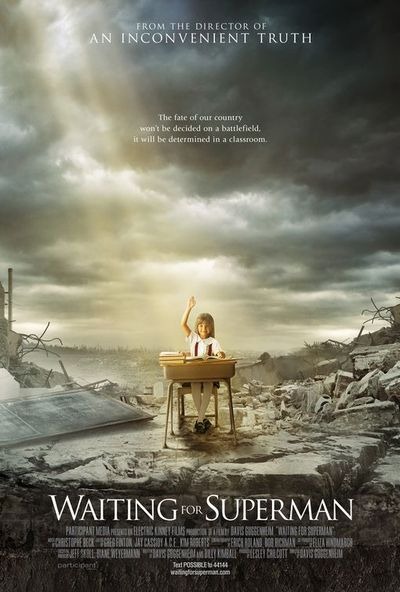
Waiting for “Superman” is an inspiring, if clunky, documentary about the problems of education in America.  The director, Davis Guggenheim, made two other popular documentaries, An Inconvenient Truth and It Might Get Loud.  I doubt Waiting for “Superman” will ignite the political firestorm that An Inconvenient Truth did, it doesn’t feature Al Gore, but it essentially convicts the AFT and NEA teacher unions for causing the failure of the American education system.  To be perfectly fair, all viewers of this film should read the AFT and NEA responses to this documentary.

waiting-for-superman

I called Waiting for “Superman” clunky because it starts off slow.  My movie buddy left after five minutes to go find something else to watch at the theater, but I think she regrets it after I told her how much better the film got and the fact that she picked a dud of a Woody Allen film to sneak into.  The show is also clunky with old clips from the 1950s Superman television show, amateur undercover video, dull press conferences and most unfortunately, uneven interviews with five students and their parents that was the core of the narrative.  The featured real people were not always persuasive and some of the kids seemed bored by being subjects of a documentary.

To me, Waiting for “Superman” gets an A+ when it was presenting animated graphs.  The actual facts and figures about the failure of American schools are the real stars of this show – but I don’t know if they are accurate.  If you go see this documentary, don’t get sidetracked by the specific student stories Guggenheim tries to tell.  The five students and their families did generate a certain level of emotion with me, but sadly, they didn’t seem like particularly good sample cases.  Too much of the movie focuses on these kids trying to win school lotteries, time that could have been spent on sexier facts.

Now, don’t get me wrong, I believe everyone in America should see this film.  I work at a College of Education, but not as an academic, so I’ve spent over twenty years hanging around with educational professionals and heard a lot.  And the ones I’ve talked to consider Waiting for “Superman” misleading if not fraudulent.    I’ve read many books, articles and seen quite a few other documentaries on the same topic.  It’s a complex issue that no 102 minute documentary can cover fairly.   The important thing is to get involved with the problem.  Education in America is like Global Warming, a giant iceberg in our Titanic’s path – if we don’t change course we’re going to crash and sink.  I’m sorry, that’s really a bad metaphor.  In both cases we’ve already crashed into the iceberg, the real issue is how many people are going to make it to the lifeboats.

Hundreds of high schools in America have over fifty-percent failure rates, which Guggenheim and others call failure factories.  This is the heart of the story, and Waiting for “Superman” does a B+ job of explaining.  This topic deserves it’s own weekly PBS show, like NOVA.  We spend so much of our TV time on partisan political histrionics while ignoring the real issues.  The Democrats, Republicans and Tea Party candidates have zero content value when it comes to dealing with the real problems in America.  Waiting for “Superman” at least focuses on something real and meaty.  The subject deserves at least 52 hours – one hour a week of required watching for everyone in this country.  We waste countless hours each week on political bickering that leads nowhere.  Waiting for “Superman” gets an A+ for defining an important issue.

Not to spoil the movie, but Waiting for “Superman” makes the following hypothesis that needs to be tested:  If we change the system it is possible to teach kids from the worse economic environments to beat the average test scores now from the best economic environments.  This is the core of this film.  It says America is cruelly and inhumanly condemning millions of its citizens to educational starvation and stunted intellectual growth.  Waiting for “Superman” tries to express this graphically and emotional as a film, but I feel it only succeeds with a C- effort.

This is a heated subject, and Americans want to blame the students for not studying, the parents for not parenting, teachers for not teaching, and principals and superintendents for not leading.  They feel that taxes are being wasted on education in America, and many want to even abolish the U. S. Department of Education.  I give Waiting for “Superman” a B+ on explaining how such thinking is leading to national Hari-kari.

Waiting for “Superman” does have a prescription for educational success.  It suggests by showing the strengths of experimental schools that a longer school day, including Saturday classes, with a full-time school year, combined with  good school teachers that  we could have dramatic change.  To get good school teachers the film implies we need to do away with teacher tenure and allow school systems to fire poorly performing teachers.  Thus the burden of changes  comes from attacking the teacher unions, requiring them to give up job security and require working longer hours, and to work all year round.  That’s a lot to ask.

The film left out asking students and parents to do more.  I guess the filmmakers assume parents and students already want more for themselves and are willing to work harder, but I don’t think that’s true.  That’s where Waiting for “Superman” gets a big fat F.  It doesn’t show how kids and parents are failing the system.  Sadly, too many Americans are just plain ignorant when it comes to understanding the value of an education.  But we can only be a great nation if the average intelligence of our citizens is greater than the average intelligence of all the other national citizens we compete with on the world stage.

That’s why education is an issue that’s equal to global warming.  We could survive the worst scenarios of each, but who really wants to live in a Mad Max future.

JWH – 10/24/10