Balancing the Budget–Part 1

Everyone is talking about how to solve the federal budget crisis.  Of course, people have been talking about this subject my whole life.  It’s a heated topic with no easy answers.  And it’s a more of a crisis in bad economic times than in boom times, so there is a certain amount of the sky is falling psychology behind the topic.  However, the debt of the United States is growing so large that maybe the sky really is about to fall.  Who really knows?  It does seem prudent to slow the debt we’re incurring.  It would be impossible to balance the budget in one year without massive spending cuts even if we set aside the current national debt as a separate issue.  It could take a whole generation to really get close to balancing the budget.

There is an excellent graph at the New York Times showing Obama’s 2011 Budget Proposal.  It illustrates the sizes of the various expenditures in relationship to each other.  However, you can read the details at the Office of Management and Budget.  For the average citizen looking at the budget is just mind boggling, and for most people they just think, “Hell, let the experts worry about it.”  The trouble is our government is in political gridlock with two opposing ideologies claiming they know what’s right.  To solve the problem will require thinking and acting out of the box.

There are a number of think tanks that focus on the federal budget which have web sites you can study.  I recommend studying these sites rather than listening to politicians or watching the news on television.  They all have a political bias so I recommend reading more than one.

Personally, I have four recommendations that I think would help working on the problem.

  1. First, don’t consider the budget as a whole, but break it down into parts and lets research and discuss the parts.  Don’t think of it as one giant problem, but many smaller problems.
  2. Remove Social Security from the annual Federal Budget.  Consider it a separate insurance system paid for by FICA.  Don’t allow the Federal budget to use FICA income and make it pay back what it’s borrowed.  Consider Social Security a separate issue.
  3. Let’s really examine the whole issue of defense spending.  It’s been an untouchable sacred cow for too long.  And it hasn’t been the defense budget since the cold war ended – it’s become a world police force and nation building organization.  The whole system needs a rethink.
  4. Let’s have a moratorium on tax cuts.  Until the national debt gets under control lets work on spending cuts and don’t allow any more tax cuts until the budget is under control and we can afford them.  If our country is about to go down the drain because of national debt then we really should be talking about tax hikes.  It’s insane to talk about paying off debt and reducing income at the same time.

That still leaves a million issues to argue over, but I don’t want to write about them for now, that’s why I called this post part 1.  My friend Bill in his blog “That’s interesting …” has been running a lot of posts about the battle of the budget.  It’s such an emotional hot issue with way too many Chicken Littles running around.  Are the press and politicians creating a panic that need not exist?  Would a thriving economy just automatically solve these budget problems?  Are politicians assuming it’s the end of the world as we know and have started a fight over a shrinking pie?  I don’t know.  Politics has become so contentious and ungentlemanly that I want to quit watching all news programs.

JWH – 2/19/11

The Implications of Watson

Watson, the supercomputer contestant on Jeopardy this week represents a stunning achievement in computer programming.  People not familiar with computers, programming and natural language processing will have no clue to how impressive Watson’s performance is, but it has far reaching implications.  Jeopardy is the perfect challenge for demonstrating the machine’s ability to process English.  The game requires the understanding allusions, puns, puzzles. alliterations – almost every kind of word play.  This might look like a smart gimmick to get IBM publicity, but it’s so much more.

Computers can process information if its formatted and carefully structured – but most of the world’s knowledge is outside the range of a SQL query.  Watson is a machine designed to take in information like we do, through natural language.  When it succeeds it will be a more magnificent achievement than landing men on the moon.

While I was watching the intro to the second day show and listening to the designers of Watson I felt rather humbled by my puny knowledge of computers.  I felt like a dog looking up at my master.   Most people like to think they are smart and intelligent, but when they meet people with brains that far exceed their own minds it’s troublesome.  A great novel about this is Empire Star by Samuel R. Delany.  It’s about a young poet who thinks he’s having original experiences until he meets an older poet who has already done everything the younger man has.

How will we feel when the world is full of Watsons and they are the intellectual giants and we’re the lab rats?  IBM built Watson to data mine natural language repositories – think libraries, the Internet, or NSA spying.  The descendants of Watson will be able to write papers that leave human PhD candidates in the dust.  One of the Watson designers said they built Watson to handle information overload.  Of course he assumed Watson would be a tool like a hammer and humans would be in control – but will it always be that way?

Watson cannot see or hear, but there are other AI researchers working on those problems.  We’re very close to having machines like those in The Moon is a Harsh Mistress or When H.A.R.L.I.E. Was One or Galatea 2.2.  Right now Watson is way too big to put into a robot body so he will live immobile like HAL and WOPR, but that will change too.

Real life has seldom caught up with the wild imaginations of science fiction.  I had hoped manned exploration of the solar system would have happened in my lifetime but that is not meant to be.  I’m starting to wonder if robots and intelligent machines will.  What will that mean?  I don’t think there is any going back, we just have to surf the changes.

NOVA has an excellent overview of Watson that you can watch online.

JWH – 2/15/11

Among Others by Jo Walton

My friend Carl first convinced me to read Among Others by Jo Walton with his blog review.  He loves Among Others so much that he’s immediately rereading it, this time aloud to his wife.  To further explain why the book is so important to him, he compares the story to the friends he’s made in the Classic Science Fiction Book Club in his post “A Karass.”  With that kind of personal impact how could I not immediately go buy a copy and read it – which is exactly what I did.

Jo Walton has written a creative fictionalized memoir about two troubled years in the life of Morweena Phelps, that may or may not be autobiographical with her own life.  Mori, as she wants to be known to her friends, loves libraries and reading, especially science fiction and fantasy, and uses books to stabilize her connection with reality, which strangely enough includes fairies and  magic.  Mori  is psychologically damaged by family tragedies and through making friends with other science fiction fans begins a healing process.  I can completely identify with Mori from my own teen years as a bookworm.  I had alcoholic parents that should have made me remember growing up as a miserable time, but I don’t.  I loved childhood because I used science fiction to create my own happiness and stability.

among-others-hc-final

I say it’s a fictionalized memoir because Among Others is written as a diary starting Wednesday 5th September 1979 and runs through Wednesday 20th February 1980, with a tantalizing glimpse from 1975 as an intro.  It feels like a real memoir except that in Mori’s world magic is real, or is it?  Morwenna Phelps, Walton’s alter ego, has the ability to use magic to influence people and talk to fairies.  Phelps, like Walton comes from Wales, but is forced to attend a boarding school in England.  The fictional story is about a young girl running away from her mother after her twin is killed and living with her estranged father.  Mori is a bookworm of the first order, and is pleasantly surprised to find that her father is a science fiction fan with a large library.  As an emotional outsider, Mori has trouble getting close to people until she meets a small group of science fiction fans that meet at a library near her posh boarding school.

Now, this is how I grew up, being an outcast until I met other SF fans, and how many science fiction fans also grew up.  Aren’t we all outcasts until we meet our others?  To make Among Others even more endearing to the science fiction and fantasy fan, Mori liberally references the books she and her friends are reading, and all too often I have read these books.  And I felt particularly close to her when refers to Empire Star by Samuel R. Delany several times as one of her favorites.  It’s a particular favorite of mine too.  Walton has a blog at Tor.com where she’s written over 500 posts, most of them reviewing SF/F books, including Empire Star.

I recommend reading Among Others if you are a science fiction fan, or are a hardcore bookworm, or if you grew up as an outsider.  And after you read Among Others, I recommend that you should follow Walton’s Live Journal blog where she talks about her writing, reactions to this book, and even gives sales information.  So far she’s sold 864 copies.   Walton also maintains a FAQ about Among Others, where visitors can post questions and comments.  This all makes for a wonderful meta-fiction quality to the story.  It’s sort of like the literary fun of finding the James Joyce in Stephen Dedalus.

Like Carl, I’m already ready to reread Among Others, but I’m hoping for an audio book edition.  Science fiction is often accused of being very unliterary, and Among Others is a literary look at science fiction and fantasy readers.  And for me the very best way to appreciate writing is by listening to it read by a great narrator.  I don’t know if Walton is successful enough yet to have her books to come out on audio, but the buzz this book is getting should help.  Audible, are you listening?

JWH – 2/13/11

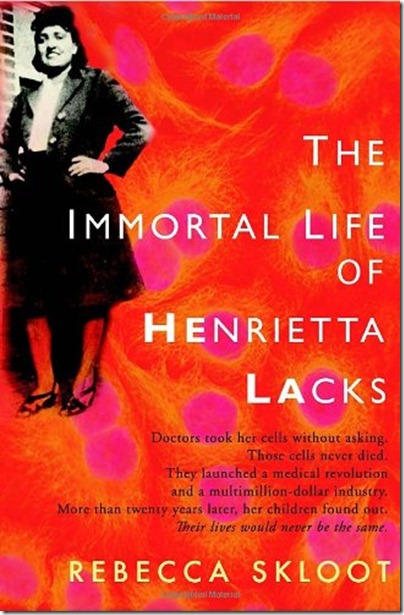
The Immortal Life of Henrietta Lacks by Rebecca Skloot

Rebecca Skloot has written a masterpiece with The Immortal Life of Henrietta Lacks, a nonfiction book that’s about, well, that’s another story, because it’s not a biography, but it is about Henrietta Lacks, it’s not a memoir, although Rebecca’s story is integral to the narrative, and it’s not a science book, even though The Immortal Life of Henrietta Lacks is about the impact of cell culture on our lives.  More than anything I think this book is about storytelling, and to understand why I say that means explaining the emerging genre of creative nonfiction.
the-immortal-life-of-henrietta-lacks-by-rebecca-skloot

Rebecca Skloot has a MFA in Creative Nonfiction Writing from the University of Pittsburgh, and has taught Creative Nonfiction at the University of Memphis.  Creative nonfiction uses techniques borrowed from fiction to tell a true, nonfictional story.  Creative nonfiction walks a delicate ethical line because in presenting the facts more engagingly and creatively writers sometimes step over the line into fiction.  To combat this, writers often put themselves into the story to explain how they acquires their facts, and thus they become part of the story themselves.  The first book I remember using these techniques was The Electric Kool-Aid Acid Test by Tom Wolfe that I read back in the 1960s.  Wolfe called it new journalism back then.

Now I’m going to be upfront here and state that my goal in writing this essay is to get you to read The Immortal Life of Henrietta Lacks.  And to be perfectly honest, I do have several obstacles to overcome before I convince you to go out and buy this book.  The Immortal Life of Henrietta Lacks is about so many different things, working at so many different levels that it’s hard to describe.  I could just tell you to go Google “Best Books of 2010” and you’ll find Skloot’s book on many people’s list of best books of 2010, and let you read their praises.  But I don’t think that’s good enough.  I think I need to offer some specific hooks.

Immortality

Most people want to be immortal, and like Woody Allen, most people would prefer the kind of immortality where we just didn’t die.  Religious folk have the promise of heaven, but us skeptical people must live with a kind of shadowy immortality, of just being remembered.  On the surface, The Immortal Life of Henrietta Lacks is about her cancer cells, called HeLa, that were cultured in 1951 and are still living today.  HeLa cells are the first line of immortal cells, and that’s one thrilling scientific aspect of this book.

However, the book deals with other kinds of immortality too, in different layers of this story, which is why I love this story so much.

  • In the process of writing this book Skloot shows what’s left of a person after they die.  For Henrietta Lacks, that wasn’t much, a hank of hair in an old Bible, a couple photos, an unmark grave, a handful family stories and, medical records.  Have you ever wondered how much of our lives are left in moldy files and computers digits?
  • The traditional down to Earth road to immortality is by having children, and Henrietta had five, and Skloot spends years getting to know them, which gives this book heart.
  • Some people seek immortality through creative work, but sadly Henrietta didn’t.  She never knew of her great accomplishments, which accidently turn out to be astounding.
  • A few people are remembered because people write about them, and Rebecca Skloot has written a book that should last a long time.  Most nonfiction books have short lifespans, but I think The Immortal Life of Henrietta Lacks should have the same kind of longevity as Rachel Carson’s Silent Spring.
  • Finally, Henrietta herself didn’t live forever, but one strain of her cancer cells did.  They went on to revolutionize science and medical research, and this is the science part of Rebecca’s book that should amaze readers.  I read a lot of science books and I didn’t know about HeLa cells.

Medical Misconduct

At another level The Immortal Life of Henrietta Lacks is a series of indictments against medical research, with some of the charges being historically horrifying, especially the stories about medical experiments done on institutionalize African Americans.  Henrietta Lacks died in 1951, the same year I was born, so in my lifetime the changes in patient rights have been dramatic.  Yet I wonder, are there research procedures used today that in another fifty years will horrify our descendants?

I don’t want to go into the specifics of what Skloot reports because it would spoil the reading of her story.  Let’s just say what happens to this one family is shocking.  HBO and Oprah Winfrey are working on a film version of this story and I’m curious how they are going to dramatize it.  I wonder if they follow the creative nonfiction structure Skloot has created, or if the film people will go linear and try to reenact the 1951 for the Lacks and follow her daughter Elsie, and her life at Crownville Hospital Center.

How the mentally ill are treated in America is a story our society has always kept hidden, and even in The Immortal Life of Henrietta Lacks, Skloot only touches the peripheral.   Today this nightmare is still hidden away.  We cleaned out the insane asylums, only to let the mentally ill fend for themselves on the street, and now they fill our jails.  At least I hope we’re no longer using the mentally ill for medical research.

Privacy and Informed Consent

In 1951 there was no informed consent laws, or HIPAA.  Henrietta’s doctor just took a sample of cancer without asking and gave them to George Gey at Johns Hopkins University, and Gey cultured them and gave them away to other researchers.  Skloot chronicles their scientific legacy in this book, and it was only by accident that we know the cells came from Henrietta Lacks, which provides half the human side of her story.  The other half is how her family reacted to learning decades later that their mother’s cells were still alive and that millions were being made selling them for research.  If Gey had preserved the patient’s privacy, Skloot’s book would have been far different.  It’s strictly a whim of fate that this scientific story is tied to the tragic human story of the Lacks.

Whose Story is Being Told?

In classes for fiction writing, when critiquing stories, we often ask, “Whose story is it?”  The Immortal Life of Henrietta Lacks is about five people, Henrietta, Elsie, Deborah, Zakariyya, and Rebecca.  Skloot spent over a decade researching and writing this story and she is also one of the main characters.  She tries to stay out of the way, but her bravery and determination shows through.  This is a great book for people who want to  learn how to write non-fiction books.  It takes tremendous dedication.

Why Is This Book So Good?

There’s lots of great books to be read, so why should you pick this one?  I’m in two book clubs that selected this book for their monthly discussion, and for the most part everyone has been tremendously moved by this story.  Partly this is due to the story and Skloot’s storytelling skills, but another part is due to reading about something very novel, and that makes it exciting.  There are many lessons to be learned from this story too, but the most important is about education.  Without an education we can’t assess our situation in society and culture.  Now this is obvious when we read about the Lacks, but it’s also true of the reader.  This book now makes all those consent forms I sign at the doctors and the hospital meaningful.  It also makes those privacy laws that I thought were stupid not stupid.

I think this book is great because it’s different in content, storytelling technique and what it reveals.

JWH
Do Colds Get Stronger As We Get Older?

I have a mystery.  My annual colds are getting more debilitating each year.  I missed 5 work days with this cold, and I was sick on both connecting weekends too.  I still have nasty lingering symptoms.  This year was so bad that I’m freaked out about next year already.  Usually when I get a cold I’ll miss a couple days of work and get some reading done.  I didn’t even feel like reading this year. 

Why?  Here are some possibilities:

  • I’m getting older – is a cold harder to handle at 59 than 49 or 39?  How will they feel at 69, 79, 89?
  • I’ve been taking flu shots for the last three years, could this be a side-effect?
  • I’ve been living in a new (old) house and it has a new heating system – could that affect my system?
  • I’m exercising less because of a back problem – could reduce stamina hurt my ability to handle a cold?
  • Maybe I just hit a run of stronger cold strains and things will change?
  • Or is it only a matter of self-deception and the current infection is always the worse?

Looking back over my life I don’t remember colds being this unpleasant, but the one I’m getting over now has been a doozy.  And to be honest, after studying colds and flus, some of my memories of having the flu might actually have been a cold, so that I did have some bad colds when I was younger.

Wikipedia has a wonderful essay on the common cold.  It says the average adult gets 2-4 colds a year, and the average kid gets 6-12 cold infections annually.  It also says the average length of a cold is 7-10 days with some symptoms lasting up to 3 weeks.  Now that describe my “bad” colds.  And hell, I don’t ever remember having that many colds, either as an adult or a kid.  (If you do the math from Wikipedia, something sounds fishy though.  Some people must be sick all year round.)

I do think I’m on a four winter streak of ever worse colds, and I wonder why.

Under normal conditions having a cold wasn’t all that bad, I took off from work and read.  I’ve even thought  that a cold produces a nice high that’s perfect for rereading favorite novels and wallowing in nostalgia.  This year I couldn’t read.  I watched damn little TV.  I just tried to sleep as much as possible to escape the misery of the moment.  It’s been 12 days now, with the last three back at work.  I’m better, but I have a lingering hacking cough that scares my co-workers and keeps me up at night.  I’m still coughing up green pus, blowing out green snot (which is sometimes bloody), and if I leave my eyes shut for any length of time they will gum up with green goo. 

People keep telling me to go to the doctor and get antibiotics.  Several people have said green is a sign of infection and I need antibiotics to fight it off.  I found this article that contradicts that.  And besides, I’m afraid of going to a doctor.  I picture her waiting room filled with sick people with even more germs to infect me.  And I’m also chicken about taking antibiotics.  I ended up in the emergency room in my twenties and I was told it was probably a reaction to penicillin. 

I’m a total wimp when it comes to getting sick.  If I can barely handle a cold now, how will the flu feel?  If my body can’t handle a common ailment how will it do if I have a heart attack, or pneumonia or cancer, or any of those other diseases old people get?  I need to build up some stamina if I’m going to even make it to my social security years.  It makes me wonder if God is getting me back for my skeptical life, or at least my body is getting me back for living a slothful, overweight life.  How can I redeem myself?

My friend Mike is four years younger than me, but when he had some health problems, he took control, lost weight, and is now running half marathons.  I need to make Mike my role model, but there’s one problem.  Mike has always been very disciplined and I’m not.  I’ve been trying to lose weight for twenty-five years and never have succeeded.  And that’s despite the fact that I’ve given up eating most of my favorite junk foods.

Be that as it may, I still need to work a little miracle of self-transformation on myself.  I just don’t know how.  I also feel that if I don’t find some method of aerobic exercise that my back can tolerate that my vitality and stamina is in a slow decline.  I bet next year’s cold will be even worse than this year’s cold.

JWH – 1/26/11