Are Galactic Empires the New Middle Earth?

I used to think science fiction was all about the future, but I’m not so sure anymore.  Speculating about the future is what got me addicted to science fiction, but that was back in the 1960s when the future was all shiny.  I think the future has tarnished over the years and science fiction has reinvented itself many times over with new fictional destinations.  Rereading old science fiction has shown me that science fiction wasn’t all about the future in the past either.  Science fiction is a never never land for adults.  Settings for science fiction don’t always have to be the future, they can be any time, place or dimension, just as long as it’s not here and now.  And like Dorothy’s visit to Oz, it’s all about learning our heart’s desire.

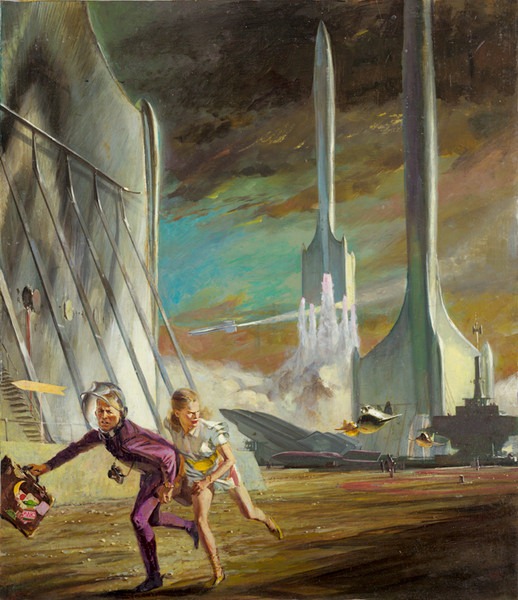
I recently read The Currents of Space by Isaac Asimov, a rather enjoyable standalone novel that didn’t involve robots or psychohistory, but was set in a galactic empire like his Foundation stories.  More than anything it reminded me of the Star Wars universe and I wondered if George Lucas had been a big Asimov fan growing up.  There are lots of galactic empires in science fiction,  and readers seem to love the kind that has the political structure of medieval or renaissance Europe overlaid on a vast structure of many-world interstellar space.  Are we seeking the future, or the past?

We’re reading two galactic empire novels in the Classic Science Fiction book club this month, The Mote in God’s Eye by Niven/Pournelle and Risen Empire by Scott Westerfeld, and both of them have an aristocracy.  So does Dune, and oh yeah, Star Wars.  What is it with monarchies and emperors ruling the galaxy in the future?  Is good old fashioned democracy just too boring?  Why do readers want social orders and class structures of the past in their stories of the future?

Readers love big sprawling fantasy novels, with heroic men, beautiful women, fantastic creatures, magical powers, swords and horseback riding.  J. R. R. Tolkien defined that archetype with his books about Middle Earth.  No one believed his fairyland existed.  When I was growing up the difference between science fiction and fantasy was science fiction was supposed to be speculation about potentially real futures – that SF authors were extrapolating about days to come.  But I think that’s no longer true, I think stories of galactic empires are the new fantasy archetype for modern times – that galactic empires have become the new Middle Earth.
the-currents-of-space-asimov

Is science fiction really about the future?  When it comes to galactic empires I don’t think so.

Asimov eventually attempted to tie his science fiction series into one epic view of the future, and even suggested a reading order you can find here.   The Currents of Space is a fun read, but it made me think about how science fiction is evolving.  As a kid discovering science fiction back in the 1960s I’d sometimes discover books that seemed quaint and very out of date, but still fun to read, like the Edgar Rice Burroughs Martian series, and the epic space opera of E. E. “Doc” Smith.  The ideas in them were obviously superseded by science of the day, yet they were fun stories, just unbelievable.  That sort of puts the kibosh on calling those stories science fiction in my mind.  Does time and the march of knowledge turn all science fiction into fantasy?

Even the Heinlein I was reading in the 1960s, that was written in the 1950s, like Red Planet and Stranger in a Strange Land, that featured an ancient Martian civilization, had been converted to fantasy by the Mariner spacecraft photos.  This revelation was sad because I had wished for a Martian civilization, or at least some kind of life on Mars.  I was reading science fiction believing it was foretelling the future of mankind, and all too often it was wrong.

At 13 I assumed interplanetary travel would unfold in my lifetime and I would die knowing that interstellar travel would arrive in the 22nd century.  That doesn’t look like it’s going to happen now.  Yet modern science fiction is full of galactic civilizations.  Has science fiction become Oz books for adults?  Is science fiction just another kind of magical fairy land to visit with our minds?

I have grave doubts that galactic empires will ever be possible – but they are a powerful meme.  What’s so appealing about galactic empires?  The deep, spiritual response to Star Trek and Star Wars suggests almost a Jungian desire for elements of the galactic empire.  Could it be that it’s not about the potential realism of future manned exploration of the galaxy, but tuning into desires for certain kinds of experiences?

  • Speed of travel.  Most galactic empire stories involve trips between stars taking days and weeks, which would be comparable to ocean travel back in the old days.  If we ever travel between the stars it’s going to take years or even centuries.  However, in most galactic empire stories people travel between the stars at the speed of old sailing ships.  I think weeks on a boat (starship) is romantic to people.
  • Effort.  Most stories involve spaceships requiring no more maintenance than our cars or speedboats.  We seldom see stories with even the hint of maintenance like we see for commercial aircraft, and never for something like we see for navy vessels.  In Star Trek, the Enterprise was far easier to maintain than a Gulfstream jet.  I can’t think of any interstellar transportation system in science fiction that even approaches the support structure of the space shuttles, or even the Russian rockets.  But the technology of these interplanetary ships seem no more complicated than old sailing ships.  What we really want are ships about the complexity of pirate ships.
  • Cost.  NASA can only be funded by the federal government, but in galactic empire novels, space travel seems no more costly than commercial ships in Victorian England.  The Millennium Falcon looked no more costly than an ancient ketch from the Bahamas.
  • Weapons.  Galactic empire novels tend to have very high tech weapons, but whenever the story can, it will bring back the sword.  Light sabers are high tech swords.  Often on primitive worlds in galactic empires, people travel by horse, or something akin to one.  You get the feeling that deep down many readers would love a world where dueling is both honorable and accepted.
  • Mysticism and Magic.  You’d think that science would be the only system for understanding reality in the future, and religion and magic would be long forgotten.  But again, how often have you read a galactic empire series were metaphysical powers come into play?    Readers love humans that have powers and talents.  These may come from tech enhancements, or ESP, or some mystical mumbo-jumbo like The Force.
  • Diversity.  You got to say this for galactic empire stories, we seem to want tremendous diversity in the human body.   Just read some of Samuel R. Delany’s early books like Empire Star, Nova or The Einstein Intersection, which are set in galactic empires, and think about the body types in Tolkien.
  • Gender Roles.  The 1974 Mote in God’s Eye is downright paternalistic about women, whereas thirty years later, in Risen Empire, women are liberated to be combat soldiers.  However, I think in the future where mankind has spread across the galaxy, readers still prefer strong men and beautiful women, and maybe even damsels in distress.
  • Fantastic creatures.  Are aliens really any different from the fantastic creatures we find in fantasy fiction?

Why are our science fictional futures so much like our real histories?  Asimov said he patterned the Foundation series on Roman history.  I felt The Mote in God’s Eye was patterned on the British Empire.  I often feel military science fiction is inspired by American grunts of WWII.  I thought Dune riffed on Arab and Australian aborigine  cultures.  And many people have compared space opera with westerns.

The practical scientific prospect of human galactic empires is next to nil.  Or about the same as Middle Earth being real.  So aren’t many epic science stories really just another kind of fantasy epic?  What does that say about reader psychology?  If galactic empires are a kind of mental comfort food, a romantic setting for our deepest desires, what does that say about what we really wish life was like?  Do we all have genetic programming to go on quests?  Would we like to bring back the class system with aristocrats and peasants?  Just look at fantasy based computer games where players get to design their characters and how they are typed and categorized – not very egalitarian.  Isn’t there a lot of overlap between fantasy games and sci-fi games?  How different is a fantasy warrior from a futuristic mech warrior?  And don’t people prefer a princess over an ordinary girl both in fantasy and the future?  And how do we analyze something like The Game of Thrones by George R. R. Martin?

Despite the success of science fiction in popular culture we’s stopped believing in the shiny future we wanted in the 1950s.  Our new fantasy/SF worlds have become Baroque hodgepodges of past and future.  Readers for the most part don’t enjoy dystopian visions of the future, nor do they like gleaming promises that are closer to utopias.   They seem to love down and dirty complexities where good and evil still battle it out – doesn’t Tolkien show a lineage with John Milton?  Doesn’t Star Wars reveal DNA from Sir Walter Scott, Alexander Dumas and Rudyard Kipling?

Personally, I used to believe in galactic empires like Christians and Muslims believe in heaven, but now I’m completely skeptical of them ever existing.  However, they make for a delicious fictional destination.  As and I get older I’ve come to appreciate the comforts of cherished fantasies.

JWH – 6/9/11 – Table of Contents
Philip K. Dick–The Penultimate Truth

At the online book club Classic Science Fiction, we had a series of posts discussing whether or not a book should stand alone or if it helped readers to know about the writer and why they wrote their fiction to fully appreciate the story.  Most of the members wanted books to be completely self-contained and did not want to know about the author.  If fact, many readers worried if tales about the writer were slanderous or gossip it might unfairly color their appreciation of the story.  They were responding to my comments about Radio Free Albemuth and how I judge Philip K. Dick to be crazy.  My response was that certain writers like PKD, Proust, Fitzgerald, Kerouac, Wolfe and other autobiographical novelists almost demand knowledge of the writers to fully appreciate their work.

Let me say upfront that if you are reading just for entertainment, books have to be standalone and self-contained.  No knowledge of the author or literary history should be required.  And I do read for entertainment, but for me it’s the foundation to the house, and the real architectural design to be admired is what fiction says about reality.  I’m just not interested in one dimensional fiction.  The novelists I love the most are natural philosophers and reporters.  Now that doesn’t mean I want pontification in fiction – no, fiction is about catharsis, not messages.  To me the best philosophical stories are those where the author is invisible behind the scenes, and their characters, setting and conflicts presents the reader with a deeply emotional experience, whether tragic or comic.

I used to think that only Dick’s last novels were about his personal experiences, but after watching Philip K. Dick-The Penultimate Truth  I now think different, and realize he was always autobiographical to some degree.  Philip K. Dick is very close to Jack Kerouac in that their novels are spiritual journeys that try to make sense of their troubled souls.  Although this documentary about PKD is framed with a cheesy X-Files setup of two FBI like agents brainstorming from boxes of evidence about who Philip K. Dick was, it’s actually a perfect metaphor for Dick’s life.  FBI agents were watching PKD, and he was obsessed with being watched.  You can view this documentary online at YouTube, or get it from Netflix, or follow the link to Amazon above and buy it.  I highly recommend this film.

Here’s the first of nine parts on YouTube:

The documentary gathers three of Dick’s five wives (Kleo Mini, Anne Dick, Tessa Dick), many of his girlfriends, and several of his closest friends (Ray Nelson, Tim Powers and K. W. Jeter) to talk about him while the agents pin photos on a wall as if they were trying to solve a crime.  Some people like to think that PKD actually experienced mystical events and they are unexplained revelations of truth, but I don’t.

All through the documentary they show clips from a speech Dick gave in Metz, France in 1977, that to me is conclusive evidence that Dick was crazy.  He essentially confesses his madness in front of the audience.  His girlfriend that was with him at the conference, Joan Simpson, said the speech was quite horrible and she wished she could have been anywhere else.  She said the French audience was kind to him, but she felt they had been greatly disappointed too, because they expected his wild stories to be creative rather personal visions that Dick confessed to believe.

Now I’m not saying we should write off PKD as a man lost in madness.  As K. W. Jeter says about The Transmigration of Timothy Archer, that Phil provides a critical self-portrait and realizes before he dies that he had been crazy, and as Jeter would like to think, he didn’t die insane, and had finally accepted this reality.

This is an excellent documentary that expertly summarizes the life and work of Philip K. Dick in 89 minutes.  Philip K. Dick was a major explorer of reality and he ventured to some very dangerous places, but ultimately he comes back to report that we shouldn’t go where he’s been.  PKD is a teacher about what it means to explore madly divine concepts.  He is a professor of paranoia and Gnosticism.  We like to think that penultimate realities don’t exist, but Philip K. Dick traveled into them and wrote mission reports back to us.

Here’s the thing.  If you are sane and have a firm grasp of reality, those penultimate gnostic worlds don’t exist, but if you have a weak understanding of this reality they do exist, and they are very real.  It’s not that Dick’s mad ideas explain the ultimate reality because they don’t, but they do explain penultimate realities that we really don’t want to visit.  What’s sad, tragic and troublesome is the people who ask if what PKD experienced was real in our ultimate reality – those people are too close to a penultimate reality, and to them Dick’s visions explains a reality they see but we don’t.  Anyone familiar with mentally ill people will recognize many of the belief systems Dick explored.

Reading Philip K. Dick’s books are a study in madness, and not philosophy, religion or even science fiction.  They are meta-fiction, autobiographical, epistemological,  and a form of exegesis.  PKD even kept a journal he called The Exegesis.  I believe that at times Dick fully believed his visions, but at other times he questioned his sanity.  Many people read his books as science fiction and find them entertaining.  Dick was good a writing fiction.  At the entertainment level many of his books are self-contained stories that work without knowing anything about his life, but the more you know about PKD, the more you see something different about his work, and you see that he was an explorer of penultimate realities.

And when I say “penultimate reality” I’m not riffing on PKD’s titles.  I’m talking about people with gnostic mindsets.  To them, they seek the ultimate truth, or hidden knowledge.  They think they are living in a penultimate reality and are being told lies, and this reality is a sham, and the real reality is a secret being kept from them.  Such thinking has always been a part of various religious sects in world history.  PKD is a modern Gnostic.  Conservative religions don’t like to discuss this, but madmen are often the driving force of the early stages of their religions.  People with mystical instincts are attracted to seers like Philip K. Dick as a form of validation, and Dick knew this.  He was seduced by his own visions too.

Christianity rejected Gnosticism in the early centuries of the common era, but the modern faithful also believe this reality is a penultimate reality.  And this is why we should read Philip K. Dick, he’s a modern day example of a prophet, mystic, seer, writer of revelations, like those in the Bible and other holy books.  If you believe in science, this is the ultimate reality, and mystic people are crazy, now and then.  If you believe this is a penultimate reality, then Dick was a visionary, and from my perspective, you are a tortured soul like he was.  Because any believer in hidden knowledge finds this reality confusing and upsetting.

This is why I say books by Philip K. Dick aren’t just for entertainment and escapism.  You need to know as much about PKD as possible to decipher them.  Sure you can read them as far out science fiction and just consider them weird ass stories to be amusing.  But my fear is some PKD fans live in a penultimate reality, and see Dick as a mystic and that’s really scary.

For me, the real reason to read Philip K. Dick is to study the madness of metaphysical worlds and to avoid them.

JWH – 6/4/11

What Does it Cost to Read a Book? How Ebooks will Change Book Buying Habits.

With hardback and paperback sales sliding down the charts while ebook sales rising, it appears the new paperback book is the ebook.  Unlike the past, where readers had to wait months or years for the paperback edition to come out, the ebook and hardback are now published simultaneously.  This is great news for readers until you realize what has happened is the price of a paperback has been increased.  You get to read it sooner, but it costs more – but the whole point of mass market paperbacks was to read books for less.

It used to be a book would come out in hardback, say for $25.99, and then months later, a $14.99 trade edition would come out, and finally after sales for the trade edition tanked, the $7.99 mass market edition would appear.  The cost of reading a book depended on how soon you wanted to read it after first publication.  Now we’re seeing $9.99-$12.99 or more for the ebook, but we get to buy it right away.  On one hand this seems like a very fair price, because it’s such a savings off the hardback cost, but on the other hand, you get nothing but electrons for your money. 

When you buy a hardback you have something physical that will last, that’s collectable, or nice to look at on a shelf, and makes a great gift, or is wonderful to lend to your friends, or even sell.  Even if you didn’t read the book, you had something when you bought a book.

Most people only read a book once, and if you’re buying ebooks, all you’re really getting is to read it.  An ebook will last, but if you only read a book once, it’s more like renting the book.

By the way, from now on when I mention pricing, I’m going to use Amazon’s for sale pricing and not list.

You’d think pricing would be based on what you get for your money.  The ebook would be the cheapest, then mass market paperback, then trade paperback and then hardback, because of the production costs and materials that go into creating the book.  And sometimes this happens.  For example The Mote in God’s Eye by Larry Niven and Jerry Pournelle is $6.35 ebook, and $7.99 mass market paperback.  But Isaac Newton by James Gleick is $11.99 ebook and $10.20 trade paperback – WTF?  Does that mean a mass market paperback only costs $1.64 to produce and the ebook costs $1.79 more than a trade paperback to create?  I don’t think so.

James Gleick’s newest book, The Information is $17.21 for the hardback and $12.99 for the ebook.   What Amazon is asking the reader, are you willing to pay $4.22 more to have a hardback copy, or would you just prefer to read it on your Kindle for $12.99. 

The list price of The Information is $29.95, which is probably what you’d pay at a brick and mortar store.  So the publisher probably thinks $12.99 is a great bargain for the reader, with $16.96 savings.  The author is probably thinking, at what price and royalty rate do I earn the most money.  The pricing of a book is a really hard math problem, isn’t it?

Me, I’m thinking something different.  I’m thinking:  What does it cost to read a book?   Once we enter into the world of ebooks, I’m essentially paying to read the book.  I don’t own anything.  I can’t sell my copy when I’m done with it.  I can’t lend it to a friend (even though they are working on that, but it’s not like owning a real book which I could lend over and over again).  I can’t put it on the shelf for others to admire my large library of great books.  I read the book, and more than likely, I’ll move it to archive on the Kindle, or even delete it so I have less cluttered interface to deal with.

You’d also think ebooks would be priced by the word, to take into account the cost of writing and editing the book, so that a 100,000 word book would cost twice as much as a 50,000 word book.  That doesn’t happen either.  Basically publishers are charging whatever they can get, and each has their own system for pricing.  With ebooks I think they are guessing what the demand will be, and if they think it’s high, they will raise the price accordingly – so a new ebook off the press might be priced $12.99.  But if they think they can sell more copies at the $9.99 price they sell it for that.  When demand goes way down, they will think about lowering the price.  That’s all understandable.

But ebooks is changing the habits of bookworms.  I’ve always bought lots of hardbacks, and never read many of them because I sit them on my shelf thinking one day I’ll find time to read them when I retire.  I’m just not going to do that with ebooks.  I’m going to buy just before I start reading.  I’m not even sure I could save an ebook for twenty years before I got around to reading it, but there’s just no pleasure in owning a bunch of books I can’t see.

And since I don’t feel “buying” an ebook is like “owning” a book, when I see the price at Amazon for the Kindle edition, I’m going to check the library first to see if there is a copy I can “borrow” because reading a book on the Kindle feels a whole lot like borrowing a library book – I’ll only see it as I read it.

Recently Amazon announced that they were selling more ebooks than hardback and paperback books combined.  I’m not sure the world is really ready for the implications of this.  Essentially bookstores, both news and used, are the side effect of bookworms, and not book collectors.  Real, hardcore book collectors are rare compared to the ordinary everyday bookworm that consumes books.  If we bookworms can get our reading electronically, what happens to the bookstore?  And once bookworms realize they are only paying to read a book, and get past the illusion of owning books, how they judge what a fair price is for a book will change.  I’m not sure if publishers are ready for this.

Finally, the move to ebooks is changing me in other ways.  When I shop for books now I realize I was fooling myself.  I’m not going to read all those books I bought.  I don’t really need my shelves of books because I’ve learned I’m a consumer of words, and not a collector of books.  Several times lately I went to buy a book and stopped myself, because I knew if I didn’t read the book right away there is little chance I’d read it at all.  I can’t plan for future reading because I read by what I’m hungry for at the moment.  This is also why I don’t buy ebooks when I see one I want to read.  That impulse is different from the impulse for picking a book to read right now.  With a Kindle, you can finish a book and download another and start reading immediately, and since finding books electronically is so easy, why not wait until it’s time to read the next book.

The future price of a book won’t be based on what the publisher thinks the book is worth, but on the price readers are willing to pay to read it next.

JWH – 5/24/11

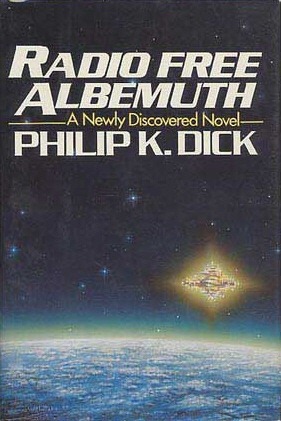
Radio Free Albemuth by Philip K. Dick

I’ve always asked two questions when reading science fiction books.  First, why did the author write it?  Second, why do I want to read it?  The easy answers are usually the author wanted to tell an entertaining story and make some money, and I want to be blown away by an exciting new science fictional idea.  Now that might be true for Neuromancer and Dune, but not for books like Stranger in a Stranger Land or, in this case Radio Free Albemuth.  When science fiction writers write about about religion I can’t help but wonder if they believe their own fiction, or want us to.

Radio_free_albemuth

I actually prefer science fiction with an agenda.  Fun fictional adventures are great for being entertaining, but I love science fiction novels with vision.  During the 1950s I think Heinlein had an agenda for his juvenile books – he wanted to jump start manned space exploration.  Heinlein’s books after 1960 have another intent which I never cared for.  I think Philip K. Dick spent his entire career exploring the same ideas – he wanted to understand what is man and why are we here.

Throughout Radio Free Albemuth, Philip K. Dick defends himself against his reputation as a drug writer, which he blames Harlan Ellison for starting in Dangerous Visions.  But he doesn’t defend himself from his reputation for paranoia and imagining endless crazed explanations for the reality around him.  PKD couldn’t let epistemology and ontology alone – it was two bones he would gnaw at his whole life.  So when I read something like Radio Free Albemuth I must ask:  Did PKD believe in the Gnostic ideas discussed in the book?  If Gnosticism had been the theme of only one book I would have said no, because it does lend itself well to a weird entertaining science fiction plot.  But Dick spent too many books exploring the idea.

If you haven’t read anything biographical about Philip K. Dick and read Radio Free Albemuth it would be easy to dismiss it as a wild idea for a science fiction novel, but Dick had experienced many visions in February and March of 1974 which he could never stop trying to explain, so he wrote several novels about them, and a journal called The Exegesis.  Now people with mental problems will fixate on such ideas, and explore them endlessly trying to make some kind of sense of the confusion they live in.  I can’t help but feel that PKD was mentally ill, but he had the outlet of writing to explore his obsessions, so do we just ignore his ideas as wild science fictional stories, or explore them along with Phil?  Or do we consider his books meta fiction and consider them a study in madness?

John C. Lilly, noted scientist who studied dolphins, went off the deep in when he began using sensory deprivation tanks and hallucinogenic drugs, and wrote a book, Programming and Metaprogramming in the Human Biocomputer, which led to experiences like those found in a Philip K. Dick novel.  If you push the mind, either through physical defect of the brain, stress, deprivation or with drugs, you get to some very far out places.  To me it’s easy enough to write those places off as hallucinations, but I think we should psychoanalyze these communiqués from the deepest part of our minds.  Philip K. Dick was exploring the same territory as saints, mystics, yogis and madmen.

Gnosticism tells us this universe is crazy, but there’s a hidden reality that does make sense.  In Christian Gnosticism Christ was the teacher of this hidden knowledge.  I think PKD really wanted to believe in the hidden knowledge.  I think this world tormented him, and he was desperate to find a rational truth.  This is no different from many religious teachings.  People have a hard time accepting this reality – in fact most are ready to reject it.

Radio Free Albemuth is about two men living in an alternative America ruled by a police state.  They are Nicholas Brady and Philip K. Dick.  Radio Free Albemuth was written before VALIS, but published after Dick’s death.  In VALIS, Phil is the narrator, but the other character is Horselover Fat, which is a weird translation of his own name.  Both books were inspired by the same real world experiences.  Both books deal with hidden knowledge, and Dick’s particular view of Gnosticism.  To me, Radio Free Albemuth has a more traditional story structure, and it’s the book that was made into a movie, which seems to confirm it had the better story structure.  But most people consider VALIS the masterpiece version, and it’s the version collected in the Library of America edition.

I can’t explore the ultimate details of the story without giving away the plot, but let’s just say it’s very hard to tell the science fiction from Christianity in this novel.  Imagine if God talked to you with technology, would you think it’s God or an alien?  Philip K. Dick felt his mystical experiences were real, and wanted to believe they were clues to hidden knowledge, or did he?  In the end, we have to ask, does Phil believe his own far out ideas?  But isn’t that like asking if Christians really believe in Heaven and salvation?  I’d like to think Phil was always just examining these ideas, like the blind figure of justice holding the scales, weighing the issues, but what I like and what really happened is probably unknowable.

Up to now I’ve been exploring how and why PKD wrote Radio Free Albemuth, but I haven’t asked we we should read it.  Should we just be amused by the wild craziness?  I worry that crazy people will find satisfying proof in this book for their own mad ideas, but we can do nothing about that.  How is Radio Free Albemuth any different than Harold Camping predicting the arrival of the rapture on May 21, 2011?  If you call the book just entertainment, it’s not the same thing at all.  But if we accept the idea that Philip K. Dick considered it a legitimate philosophical exploration, we have to wonder if Phil was a crazy prophet too.

I’m afraid that any exploration on metaphysics has to be analyzed as a kind of madness.  And I think most people will just chuckle and say ideas like those PKD explores is just crazy stuff.  Something to be laughed at.  Sadly though, a large percentage of our population will say no, metaphysics is real.  But I say, hey, we need to study people who believe in hidden knowledge and see how such beliefs affect our world and history.  Maybe PKD was saying, I’m mad, and here’s how my madness works, you better study me, but I tend to doubt that.  I tend to think poor Phil worried some of his hallucinations were real.  I say that because I know too many people people who believe their hallucinations are real too.

I’m not sure PKD is a sci-fi writer, but a psy-fi writer.

JWH – 6/22/11