
Spotify versus Rdio, MOG, Napster and Rhapsody

[This review of Spotify is essentially part 2 of my review of MOG v. Napster v. Rdio v. Rhapsody.]

Spotify is finally here and I got my invite to use the free portion of the service, which is ad supported for streaming millions of songs through a computer.  Spotify also offers two other pricing options.  For $4.99 you can get unlimited computer streaming without commercials, and for $9.99 get unlimited computer streaming and on-the-go music for your smartphone or iPod.

Spotify requires downloading and installing a client to use, unlike all the other services that can work through the web.  Think of the client as a customized browser just for music.

My first impression is Spotify is BLAZINGLY fast!  Second, the sound quality is excellent with 320kbps streams.  Third, without me noticing it, Spotify indexed all the songs on my computer and added them to their search engine.  One of the first things I did was search for music I know that’s not on the other services, and was deceptively blown away when Spotify started playing Willis Alan Ramsey’s legendary out-of-print CD.  It wasn’t until after I searched on Nanci Griffith’s “Daddy Said” and it started playing that I realized I was playing my own songs.  I was disappointed that Spotify’s library wasn’t truly unlimited, but this is a very cool feature.  With one search engine I can play Spotify’s library of 15 million songs and my library of 18,000+ songs.

Spotify works with a client that must be installed on your computer – and for disciples of Steve Jobs, yes, there is a Mac client.  If you have an iPhone or Android smartphone, and you’re willing to pay the $9.99/month Premium fee you can sync your Spotify playlists to play offline.  If you’re online (Wi-Fi or 3G/4G) you can stream the entire site.  Users of the Free and $4.99 Unlimited plan can use the Spotify client to load your personally owned songs to your mobile phone or iPod.  What this means is Spotify wants to replace Windows Media Player or iTunes to manage your music – but it doesn’t require any conversion – Spotify just indexed my songs immediately after installing.

The client for Spotify is streamlined and basic, with a dark background – it reminds me of sleek basic version of iTunes.  Spotify is rather plain looking compared to Rdio my current favorite streaming music service, and Rhapsody, my longtime favorite.  Those sites love to show lots of album covers, but Spotify doesn’t do that.  It has two areas of the client where random visual ads pop up, but they hardly bother me, and I hate ads.  One reason why they don’t bother me is who looks at the client when they are playing music?  But on the other hand there are audio ads!!!  Now that might take some getting used to.

Having an ad support site means millions of people can try subscription music and discover why spending $4.99-$9.99 a month for subscription music is one of the most fantastic bargains on Earth right now.  I can even get my wife and other friends that refuse to pay for music hooked on Spotify.

I’m playing Colbie Caillat’s new album All of You while I write this review and so far I’ve had three commercial interruptions between songs.  The ads so far seem to be music related spots, and the audio ads have been either for Spotify Premium or other album artists – nothing as offensive as AM radio ads – so far.

Spotify does have social features but not wonderfully integrated like Rdio.  They seem to depend on Facebook or Twitter, although you can get the URL of any album, song or playlist and send it to your friends who have Spotify and they can then play what you want them to hear.  I didn’t test the Facebook feature because I hate sharing on Facebook.  I’m afraid Spotify would annoy my friends like Farmville fanatics with their sharing.

Spotify is slick in its simplicity.  Here’s what it’s Chart’s list page looks like, that show the Top 100 Songs and Albums.  [Try clicking on the images to see larger views.]

Spotify

Notice the ad on the right.  Now here’s what the album page looks like:

Spotify-Album

And here’s how Spotify shows my Bob Dylan albums.
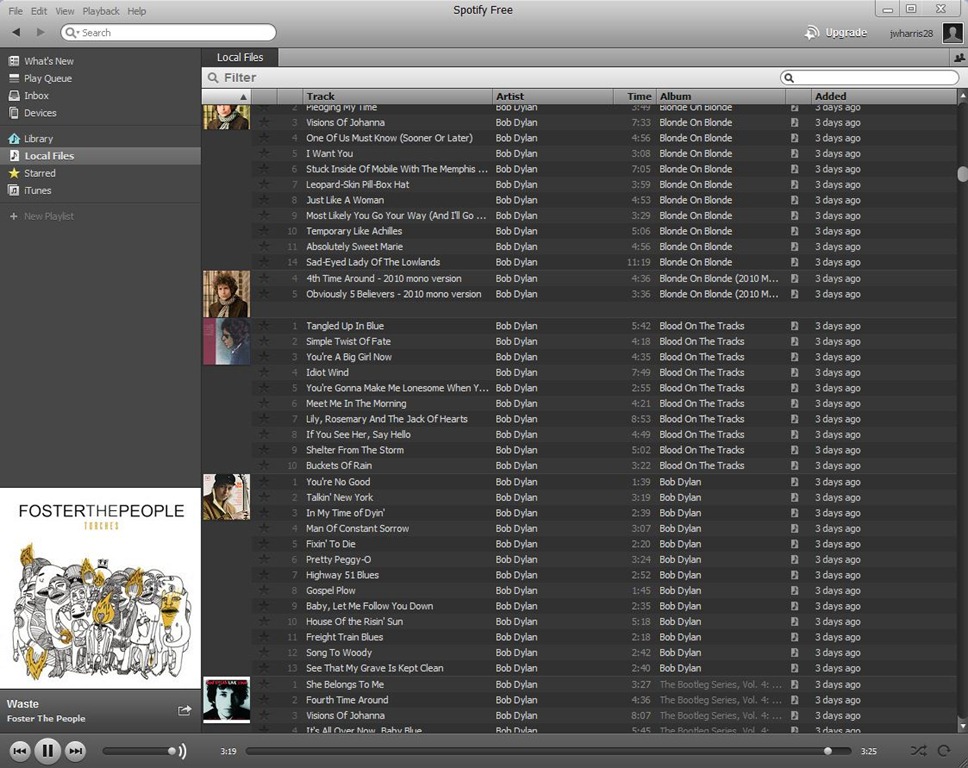
Spotify-LocalSong

Go to http://spotify.com and request free invite.  Try out the service.  If you’ve never used a subscription music service Spotify is a great introduction.  But do yourself a favor if you like it, spend $4.99 and try out http://rdio.com for a month.  Read my review of the four other top music subscription services.  They each have unique features that make them all worthy considerations.  At the very minimum, if you love music get the free version of Spotify.  If I wasn’t so attached to Rdio right now I would buy the Unlimited version of Spotify, and I might still, it’s a very slick and FAST music player.

The reason why I’m sticking to Rdio is I have two friends at work that use it too, and the social features are addictive.  For so long music has become a solitary pursuit with people plugging in and tuning out.  Now, music is becoming social again.  I have great nostalgia for when I was growing up and me and my friends would get together and play albums.  No one seems to do that anymore.  Well, with subscription music services you can, just not together in the same room.

A third co-worker is definitely going to join Rdio, and a fourth is considering it.  That kind of momentum is sealing my allegiance to Rdio.  But subscription music is just catching on and Spotify might be the service to join, especially if you have a lot of music buddies on Facebook.

To sum up the comparisons I’d say MOG is a top consideration if you want the most efficient way to make playlists and you want to play music through your Roku.  Napster is your choice if you love playing songs from Billboard charts that go back to the 1950s.  Rhapsody might have the widest selection of songs, and it seems to have the most supplemental information and it has a great blog.  Spotify is great for two reasons.  First, there’s a free version, so everyone can use it.  Second, it’s perfect for people who have large personal collections of MP3s because Spotify integrates its collection with yours seamlessly.  Finally, I believe Rdio is best for people who like to share music with real world friends and discover new music by social networking with online friends.

I imagine all of these services will evolve quickly and develop new features and copy the best features of their competitors.  I believe streaming music is the future of music distribution and the end of owning music – except for true collectors who like to fill their houses with 78s, 45s, LPs and CDs.

JWH – 7/21/11

Should Amazon Charge Sales Tax?

Borders bookstores are closing and laying off 10,700 employees.  Bookstar closed months ago.  Record stores are almost gone.  How many other retailers are going out of business not because of the recession, but because of Internet sales?  And I have to admit I love Amazon and buy most of my books there, and when I bought CDs, I bought them mainly from Amazon.  I also buy my underwear, running shoes, pet supplies and other stuff from them too.

How can people not want to shop Amazon with it’s deep discounts and no sales tax, and if you buy $25, no shipping.  It’s a lean mean selling machine.  But is Amazon and other Internet retailers good for the economy?  My state, Tennessee, like so many others is really hurting for revenue.  If everyone bought locally the state would have more sales tax and maybe more people with jobs to pay even more taxes.

Taxes are considered satanic now, but I can’t help but wonder how much Tennessee would gain if they could collect taxes from Internet retailers.  Amazon has taken a rather arrogant approach to this – fighting states every way they can not to  charge sales taxes.  I don’t know why, I’d still buy from them if they charged sales tax, they offer deep discounts that are hard to resist.

The other thing I have to ask myself, is why am I buying more online when I should be buying less?  When I visited Borders last week I was shocked by changes I saw there, a store I’ve been shopping at for years.  It’s a national company like Amazon, so why should I feel any different about it going out of business rather than Amazon?  I think one reason we don’t pay sale tax with Amazon is because they are going to set up two distribution centers in Chattanooga, employing 1200 regular and 2000 seasonal people.  But does that offset the sale tax revenue and does it make up for all the jobs lost to Amazon’s competitors?  Isn’t this the same story as Walmart, but without the big superstores?

It’s way too hard to understand the subtle economics behind this issue, but I would love to see a well researched documentary on the subject.  I did find this video but it’s heavily bias.  I need to see an in-depth NOVA episode devoted to this issue.

Evidently, sometimes jobs are worth more than sale tax revenue, or so this article from The Tennessean suggests.  It hurts my head trying to understand this problem.  Should I feel good about shopping with Amazon, or should I not?  So Tennessee has made a deal and gets jobs instead of sales taxes, but what about all the other states that don’t get distribution centers?

I admit I have no answer for the question I asked at the top of the page.  Maybe it’s just too complex to answer.  Maybe I should just accept what my state law makers have decided, assuming they know best.  I don’t know.

Yet, I have one last thing to wonder about.  What if everyone bought everything they could online?  Besides book and record stores, what other kinds of merchandise can online retailers take away from local businessmen?  Mail order businesses have been around since the 19th century – do they show the limits of what people will buy sight unseen?  Could it be that book and record stores are disappearing because physical books and records are disappearing?

If that’s true, what’s going to happen to Amazon?  Well, they selling Kindles, MP3 songs and downloadable movies and TV shows.  If physical book and CD sales are down, then why do they need so many distribution centers?  Well, Amazon is selling other stuff.  I’ve also bought things like a HDMI cable, a Blu-ray player, computer parts, and TV antennas from Amazon, as well as running shoes and underwear.

Maybe the Amazon sales model is just progress and there’s no going back.  I still feel bad about Borders and Bookstar though.

JWH – 7/18/11

A New Kind of Reading: iEssays

What’s the best economic model for finding the absolute best essays to read?

I decided to go paperless with my periodical reading back in February, 2008, and my last magazine subscription (Popular Photography) has finally run out.  At one time I subscribed to over 20 magazines. I love magazines, and I spent six years working in a periodicals department at a university library back in the 1980s. 

At first this effort was to do my part in fighting global warming, but over the last few years I’ve realized that magazines aren’t the most efficient way to read about the world.  Out of a year’s worth of The New Yorker, I might only read 1/20th of the printed pages, and it was probably less.  I now subscribe to The New Yorker on my Kindle, but I don’t even look at every issue, so I’m wasting my money.  I do wish I read each issue cover to cover because it’s a great magazine, but in reality I spend far more time reading on the Internet.  There’s something compelling about jumping from one web site to the next grazing on information.

Long before the Internet was a gleam in its designers’ eyes, magazines and newspapers were the world wide web of information.  Most print magazines and newspapers have a web presence today, and they all compete for eyes and dollars, while still trying not to compete against their own print editions, but I can’t imagine that lasting for many more years.  With ebooks, smartphones and tablets all offering periodicals and news reading apps, how can paper periodicals compete?

I wish I could take a news pill every morning and just know what’s happening around the world, but that’s not possible – yet.  But here’s the modern reality of reading – petabytes of data are being created daily, but we all still live in a 24 hour world, and at most I might spend 7 of my 168 weekly hours keeping up the world by reading short non-fiction essays, and when I’m busy or lazy it’s a lot less.

The Challenge of Keeping Current

We live in exciting times, and this is a happening world, but it is surprising how ill informed we are about what’s going on.  For most of my life I’ve watched the half-hour evening news and then supplemented it with some magazine reading, and figured I was doing pretty good keeping up with current events.  But I realize now that I’m not.  Too much of the evening news on television is worthless.  Are daily stories about natural disasters, politics, and economics really that valuable to keeping up with external reality beyond our tiny lives?

In any 24 hour period, what really are the most worthwhile stories to know about?  Let’s say we spend 60 minutes a day, whether surfing the net, scanning RSS feeds, watching television, reading a newspaper or magazine – what’s the most productive way to spend those 60 minutes in terms of learning about what’s going on in reality?

Generally, we all have a passive attitude towards acquiring news.  We take in whatever’s in front of us, whether it’s the NBC Nightly News or Slashdot.org.  But what if we read with conscious intent?  What if we systematically reviewed data sources ourselves, instead of letting editors at newspapers, magazines and TV shows decide what we need to know?

The Old Way

Before radio and television, people read newspapers.  Your daily paper might present 25 stories and you picked the ones you wanted to read.  With mass broadcasting on radio and TV, news was bundled into shows of 30 or 60 minutes and you just sat through all the stories, even if you really weren’t interested in all of them.  If you wanted to know more you subscribed to magazines and hoped they presented in-depth coverage for stuff you missed from your newspaper, radio and TV.  Before the plague of attention deficit syndrome hit the world, magazines often presented long essays, thousands of words on a topic, offering far more data than you’d get in a one hour documentary.

The Current Way

The Internet publishes thousands, if not millions, of stories every day.  There are many ways of finding stories to read.  You can go to a editor driven sites like Google News, MSN, Slashdot, Engadget, or any of countless other outlets and scan for interesting items to read.  Or you can go to social sites like StumbleUpon or Digg and hope serendipity will bring you a great news surprise.  Or, you can add all your favorite sites to a RSS feed reader and try to manage the internet fire hose of data that way.

With the advent of the tablet computer we now hold a magic magazine that can overcome the limitations of the printing press. 

The Better Way?

Money makes a great editor, in more ways than one.  I guarantee if you go buy copies of The New Yorker, The Atlantic, The New York Times, Scientific American, or any of the many top printed periodicals and read the longest articles you’ll get the best bang for you reading time.  These publications pay writers top dollars and there is a kind of survival of the fittest in information quality going on.  However, we still have the problem of subscribing to paper copies, or tediously searching the net for the web editions.  And whether we pay for paper copies or subscribe to digital editions, we’ll buy a lot of content we won’t read.

What we need is the iTunes of essays, iEssays or a Readers Digital Digest.  Articles under 1,000 words should be 49 cents, 1,000-4,999 should be $1, and stories greater than 5,000 words that aren’t considered books, should be $1-3.  If you buy one $5.99-6.99 magazine a week, you’re spending a $1 a day for essays, and I doubt many people would read more than one long essay a day, so these prices are about equal to average magazine reading.  Leave the under 500 word content to free web sites supported by ads.

Picture The New York Times Most Popular section but getting content from hundreds or thousands of magazines, newspapers and web sites.  This is how I read the NY Times, start at this page and only reading the best/most popular articles.

At our iEssays site, we could follow best seller lists set up by topics to quickly find the Hit Essay of the Day from a variety of subject categories.  They can also keep lists for Hits of the Week, Month or Year.  Imagine sitting down with your iPad once a day with the intent of spending 30-60 minutes reading a very high quality article and you’re willing to spend a buck.  This would definitely weed out the crap and silly stories you mind at most social news sites. 

And it’s important that the site not charge a subscription for the whole site.  What we want to do is generate hit essays like iTunes creates hit singles.  It would be important to still read newspaper sites or watch TV news to get a general impression of the news, but if you wanted to really learn something new every day about the world, I think the iEssays would be the best way to go.

Also, to help the survival of the fittest process, I think as part of your purchase you get to send an article to up to five friends, or link it on your blog.  So articles could be promoted up the Hit List by purchase votes, recommendation votes, or link hit votes.  The New York Times allows free reading to its articles if they come in via links.  I think that’s an innovative way to promote stories and still collect payments.

And finally, I think the iEssays should be an app that stores your purchased articles forever in the cloud, so they become part of your digital memory.

Conclusion

I’m not expecting this system to supplant subscription systems.  Most people prefer passive news gathering.  Most people are happy to subscribe to a newspaper or magazine and just skim and read, tossing the issue out when they are done.  But I think there’s enough people like me who are annoyed at buying far more content than we read, and wanting to get the most for our money.  It’s like cable TV plans, spend $60 a month and get 200 channels.  Some people don’t mind channel surfing, but I don’t.  Not only would I like a la cart cable, I think I’d like to buy television by the show.

Unless magazines and newspapers go the way of subscription music, I’d prefer paying by the article rather than the issue.  I pay $4.99 a month to Rdio and get to listen to essentially everything.  I use its social tools and charts to narrow my listening.  But I think by the essay pricing would help me find the best article reading the fastest.

Right now The New York Times charges $20 a month for unlimited tablet access.  That seems way too expensive when compared to what I get from the music business.  If The New York Times also presented content from many major newspapers and magazines, then I might consider a $20 monthly bill, like how I spend for TV and movies through Netflix.  But the NY Times is trying to price their digital newspaper like the old paper copies, and this is different world.  Netflix and Rhapsody are changing content pricing models in people’s minds and I don’t think they will go away.

I think the Rhapsody pricing model is superior to the iTunes pricing model, which is superior to the old CD pricing model.  iTunes sells hits, and I want to buy hit essays.  I don’t want to buy whole papers and read just a handful of its stories.  I want either the Netflix/Rhapsody model which is gigantic piles of content for one low monthly price, and I’d use built in tools to find what I want, or I want the iTunes model, where I buy just the hits. 

When it comes to reading quality essays (or short stories and poems for that matter), I predict the price per song model is superior for quickly finding the best reads.  And ultimately I think more writers and publishers would benefit from this model too.  If I spent $20 a month for The New York Times I doubt I buy any only periodical.  Which is why I can’t make myself spend $20 for one online newspaper.  If they added 20 top magazines to their deal, I would gladly pay $20 a month, but I’d rather pay $1 an article for an even larger pool of hit providers.

The monthly library model like Netflix and Rhapsody is great for music, movies and TV shows if you like to try out lots of different songs or programs.  But reading is different, at least for me.  I have a limited amount of time I spend reading, and I only want the very best stories to read.  It’s like people who prefer iTunes to Rhapsody.  They just want to get a few hits to play and aren’t concerned with trying out one or two dozen new albums a week.  That’s why I think some enterprising Readers Digest wannabes should apply the iTunes model to creating iEssays.  Or if the Best American Series editors came out with a monthly digital issue rather than a series of books once a year.

JWH – 7/17/11

Is The Kindle a Swindle?

I love my Kindle.  I’ve reached the large print reading years and the Kindle is a wonderful aid to my eyes, but the prices of ebook editions have risen so much that I feel cheated by buying the Kindle edition.  The price of the Kindle edition is often very close to the hardback or trade paperback edition.  There is no reward for buying the ebook and saving the publisher the cost of printing, binding, boxing, shipping and distributing the the physical book.

For example, our book club is reading Destiny Disrupted by Tamin Ansary.  It’s $10.85 for the trade paper or $9.76 for the Kindle.  I’m looking at the new hardcover of The Genesis of Science by James Hannam – it’s $19.77 for the hardback (from Amazon of course) and $14.38.  Another book I was thinking about buying is The Clockwork Universe by Edward Dolnick.  It’s $16.08 hardcover and $14.99 Kindle.  Or On the Grid by Scott Huler – buying the ebook version saves me 88 cents ($10.87 trade, $9.99 Kindle).  Next month’s book club selection, Empire of the Summer Moon S. C. Gwynne, it’s 39 cents cheaper to buy the trade edition instead of the Kindle Edition ($9.60 trade, $9.99 Kindle).

Of course, there is an illusion here.  I’m giving the Amazon price.  If I gave the publisher’s list price, things would appear better.  For example, The Information by James Gleick is $29.95 for the hardback list, $17.21 Amazon priced, but $14.99 for the Kindle.  But I’ve gotten used to Amazon’s prices, so the real buying decision is $17.21 v. $14.99.

Here’s how I feel about books versus ebooks.  When I buy the hardback I feel like I’m adding to my library.  It’s something I can save, or lend, or sell.  When I buy an ebook, it’s something I consume, like renting a DVD.  Now if my ebooks were added to a virtual library, and they were multimedia interactive, and I could enjoy collecting them,  virtually flipping through my collection from time to time, then it might be different.  In fact, books with maps, graphics, and photos just don’t work well on the Kindle.  Now that might change if I had a 10” tablet, but for now, the normal Kindle is all about text.

The psychology of all this is I seldom buy new books from brick and mortar bookstores anymore because of Amazon.  The discounts on hardbacks are just too great.  On the other hand, I hardly ever buy new books for my Kindle because the ebook prices seem too high.  So for now, the heavily discounted hardback wins out.

If all the books I mentioned above were $7.99 each for the Kindle, I would have gobbled them up without a thought.  $9.99 is as high as I’ll go, and since I’ve bought several ebooks at that price and ended up not reading them, I’ve become very careful about buying ebooks.  Buying a hardback and leaving it on the shelf for years doesn’t bother me, but buying an ebook and not reading it right away feels like I just threw my money away.

I know ebooks are all the rage right now, but will ebook sales always be shooting upwards?  I’m swinging away from ebooks, and I’m wondering if other people are feeling that way too?  Ebook prices have been growing and I’m sorry, that just feels like a swindle to me, because I don’t feel like I’m owning anything after giving Amazon my money.  The Kindle just feels like I’m renting books.

[By the way, I don’t feel the Kindle device is an actual swindle.  And when I say Kindle I mean all ebook readers, like the Nook and Sony readers.  I just think, and I’ve heard this from many other ebook owners, that since we don’t actual get a printed book when we buy an ebook, the price should be significantly cheaper.  I thought when I first bought my Kindle I’d be buying a lot of ebooks at lower prices and that just hasn’t turned out to be so.  Now, I’m wondering if I’m not the only one feeling different about ebook readers?]

JWH – 7/14/11

The Barbarians at the Liberal Gates

Republicans have dug in their heels and swear they’ll die before they allow any new taxes.  What does this mean?  I think they have two main motives:  greed and the destruction of liberal ideals.  This is no big news, but what does it mean really?  Republicans have fixated on lowering taxes for decades and I think this is mainly due to ordinary old greed, but they have come up with so many justifications to achieve this goal, that they have developed an anti-liberal philosophy to promote tax cuts.

They think big government is taking their money, and so they’ve developed a philosophy against big government.  But what does having a big government mean?  Or more precisely, what does having a small government mean?

Civilization has always meant bigger and bigger government.  All throughout history whenever a civilization would develop barbarians would come along and attack it because it was an easy source of booty.  Protecting civilization began the ever spiraling costs to support big government and big military.  There are two kinds of people in this world, those who want to build civilizations and those who want to tear it down.  Civilizations take a lot of money to create and run, and history shows there are essentially two sources of wealth to run a civilization, taxes or conquering other civilizations, which is essentially a non-citizen tax if you will.  Europe flowered during the Renaissance by taxing the natives of the Americas, Africa, Middle East and Asia, as well as the heavy burden of taxes they imposed on their own citizens.

Like it or not, great civilizations cost a lot of money.  During the course of the last five hundred years we also saw the growth of liberal ideas.  It’s no longer socially acceptable to attack a primitive society and steal their wealth to build your own society.  Either through colonists, armies or corporations.  And the history of corporations are really the history of private business plundering the resources of other nations through price speculation.

However, things have changed.  The nations of the Earth are no longer in flux and national stabilization has set in, and corporations are no longer tied to specific countries, but work worldwide.  This means vast booms of generating wealth through exploiting other people is tapering off.  Nations are having to compete as equals, and the wealth of governments depend more and more on internal taxes based on economic productivity of their citizens.

In other words, if the United States wants to be the leading civilization of the world, the cost of that civilization is on the backs of its taxpayers.   Our military might will wane as the world stabilizes.  So will our influence.  So what will make us the great nation we believe we are?  As all nations become more capitalistic, we’ll no longer be the richest.  For the longest time, we were great because we championed freedom and democracy, and liberal ideals – but they are spreading worldwide too.

So what kind of nation will we be if the Republicans get their way and cut social programs and other spending, and reduce the size of the federal government?  I can’t help but believe we’ll be more like India or Egypt than Germany, Japan, England, South Korea or France.  We’ll have a democracy with lots of poor people.  We’ll have lots of beggars, criminals and lower class people, a small middle class, and a few very wealthy people that stand out in stark contrast.

We won’t have the arts, science, and infrastructure of a #1 nation, and instead start developing the look of a decaying empire.

The greed of the wealthy to avoid taxes will lead to a downward spiral of employed people, or people who look and act employed because of social programs.  Social Security and Medicare allow millions of Americans to contribute to economic activity as if they were employed.  We already have more young well trained people wanting work than we have jobs, so to throw millions of older, well experienced people to compete with them will ruin the job market and raise unemployment to new high levels.  Employment levels have always been an illusion in our country.  Unemployment is high now because we can’t maintain the fevered economic activity of unnatural economic booms. 

We can only get to 5% unemployment when the economy is booming and support big social programs.  If we cut out social programs and followed a balanced-budget economy we’d probably have 25% unemployed, if we were lucky.  Some economists are saying we already have a real unemployment rate of 15% or higher now. 

If we pursued a totally efficient economy we’d probably put half the workers out of work.  Just think what a flat tax rate would do to bookkeepers, accounts, tax advisers, and other bean counters.  Just imagine our society if no one used a credit card, or if everyone spent money like economic advisers advise.  A large part of our economy is based on inefficiency, buying things we don’t need, social programs, crime, crazy unsafe business schemes and stupid unproductive speculation.

Liberal ideals have progressed until they believe that all people, regardless of gender, race, creed or sexual orientation deserve equality and a minimal standard of living and medical care.   Pursuing those ideals has created an ever growing segment of our economic activity.  Reversing those ideals will destroy our economy.

Just watch the news to see how all over the country governmental services are being cut back.  This is the dismantlization of our civilization.  The barbarians are at the gates looking to sack our civilization.  And all of this just to save a few bucks on their taxes.

Barbarians have always wanted wealth for themselves.  Civilized people have always wanted to share the wealth.

JWH – 7/9/11