
The Gnostic Gospels by Elaine Pagels

The Gnostic Gospels by Elaine Pagels is both fascinating and tedious.  Who Jesus was has been argued by billions for thousands of years, so why should anyone assume we can solve an unsolvable puzzle?  Before the Catholic Church became the monolithic institution that defined Christianity for centuries, there were a few centuries after Christ’s death where many different Christian beliefs flourished, and among those were the Gnostics.  Gnosticism wasn’t limited to Christian thinking, but Christian Gnosticism in various forms were large enough movement that early orthodox leaders wrote books teaching against Gnostic thinking.  Gnostics were heretics early orthodox Christians hated even more than the Romans.  The orthodox did everything it could to wipe out the heretics and burn all their books.  In 1945 we found 52 texts at Nag Hammadi, Egypt.

gnostic-gospels

The Gnostic Gospels by Elaine Pagels is a short overview of alternate Christian beliefs before the Council of Nicaea in 325 AD.  Now here’s the rub.  You have many Christian philosophies before 325 AD, then hundreds of years of the Catholic Church, and many Christian philosophies after the Protestant Reformation in 1517.  The Catholic Church spent centuries hammering out who Christ was and what his teachings meant, but there are always other people believing he taught something different.  Gnostics had very radical ideas about Christ that sound just as good or better.  Who is the real Jesus?

How Christianity evolved is a fascinating historical mystery.  I’ve been watching Lost Christianities: Christian Scriptures and the Battles over Authentication, A Great Course lecture by Bart D. Ehrman.  I got The Gnostic Gospels as a supplement.  The Gnostics are intriguing because they claim to have secret knowledge of Jesus based on his mystical teachings, like Eastern religions.  Some Gnostics thought the virgin birth and bodily resurrection were silly stories the orthodox Christians believed in and claim to know the real truth.  They said Jesus taught that the Kingdom of Heaven was within and had already arrived and with the right practices and secret knowledge it would be revealed here on Earth.  It wasn’t faith, but direct experience.

While studying these early Christians I got a strange idea.  History is full of religious charlatans and con men.  What if Jesus had been a con man gathering his flock with a promise of secret knowledge.  Then he gets killed, and after that all his followers taught something different about his “secret knowledge” creating endless religions never knowing they had been conned.  Most people like to assume that one view of Christ is the right one.  But what if they are all wrong?

The more I study the history of Christianity the more its obvious that every Christian see a different Jesus and it’s impossible to know the real Jesus.  Reading The Gnostic Gospels only made me feel more conclusively that Jesus and his teachings are unknowable – and all we can know is an endless series of imaginary Christs created by people who have their on unique beliefs.

JWH 1/4/12
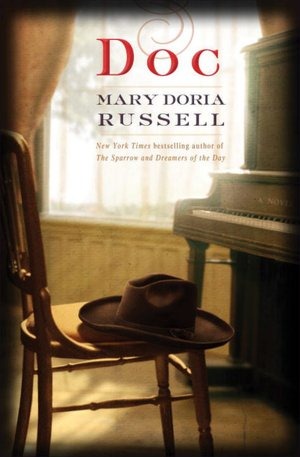
Doc by Mary Doria Russell

Doc is John Henry Holliday, legendary figure from the old west and most famously remembered for standing with Wyatt, Morgan and Virgil Earp at the gunfight at the O.K. Corral in 1881 as Doc Holliday.  All too often fictional accounts of famous people of history tend to be heavy on the fiction and light on the history, but this ain’t so with Doc, the new novel by Mary Doria Russell.

doc

To see how serious Russell treats the history start reading her blog at Starting the Next Novel.  Blogs are annoying for reading older posts, but if you start here and read forward with the link at the bottom of the article, you’ll be able to track her comments about writing Doc and the next novel dealing with Wyatt.  Russell even took a five day horseback ride that recreates Wyatt Earp’s Vendetta Ride.  But keep reading her blog and you’ll be charmed by Russell and understand how she put so much biographical research into her fictional character.

Even covering this material in a nonfiction books like The Last Gunfight by Jeff Guinn it’s very tricky painting a portrait of a real person.  History leaves a limited set of facts that’s never enough to be definitive.  Like I said in Nonfiction, Fiction, History, Myth and States of Consciousness it’s extremely hard to discern nonfiction from fiction, and history from myth but Mary Doria Russell makes a climbing Mt. Everest effort to portray John Henry Holliday as fully and accurate as possible in the context of a novel.

I enjoyed this story immensely.  I’ve read many books and seen many movies about Doc Holliday and the Earps and Russell’s picture of them in 1878 Dodge City is nothing less than brilliant – not in the Einstein way of thinking, but in the way the Harry Potter kids use the term.  I have no idea how true this story is, but it feels right.  At worst I’d say she worked too hard to make Doc likable, and even elegant and tragic.  She elevates Morgan over Wyatt, but history has favored Wyatt because he survived.  I do believe Russell is right in suggesting that Doc was mainly Morgan’s friend, and after Morgan was killed and his murdered avenged, Doc didn’t have much reason to stick with Wyatt.

Now if you’re not caught up in the mania for Tombstone and the Gunfight at the O.K. Corral you might not give a fig about this book.  It is a well written western that stands on its own even if you aren’t caught up in the history, but I think you’ll at least need to love western movies to enjoy this book.  And I love westerns.  And this was one of my favorite books of 2011.

JWH – 1/2/12 

Why Do People Want To Be President?

Why do people want to be President?  I used to think they wanted the job because they had a visionary solution to fix the problems we all face – but that’s naïve.  We’re polarized instead of unified.  Each Republican claims they are the unique true conservative as if their rivals were deviating from a script that defines the ideal American. 

The Republican candidates make no effort to appeal to all Americans but to the extreme conservatives.  I’d like to know how many people are very liberal, liberal, middle of the road, conservative and very conservative, but finding that breakdown is hard.  Help will be appreciated.

The U.S. POPClock stands at 312,789,991 Americans.  Anyone wanting to be President must represent all those people.  The reason why politics is so polarized is only a fraction of that number get a candidate that matches their political beliefs.

Finding statistics on party affiliation is hard.  I did find out in 2010 there were 137,263,000 registered voters or about 59.8% of those eligible.  Here is a report from the U.S. Census on the 2008 voter demographics.  It covers age, sex, race, education, income and other statistics, but not political parties, but is a good snapshot of American voters.  Infoplease has a chart of voter turnout for the years 1960-2010 that suggest about half the people registered to vote end up voting for Presidents.  In 2008 132,618,580 people voted, or 56.8 percent of the voting age population, which is very close to the population of registered voters above.

So in 2008 there was about 300,000,000 Americans, with 231,229,580 eligible to vote, with only 132,618,580 voting, and so the winner actually represented less than a fourth of the country.  And if that winner is extreme conservative or liberal, it means a large hunk of American citizens are unhappy.

The Occupy Wall Street movement points out that 1% of the population holds most of the wealth.  The rich can’t politically get what they want on their own.  Republicans claim we need a smaller government, but isn’t that to acquire the federal wealth?  California went to a smaller government and now people hate it.  If you shrink the government who gets that wealth?  Everybody or the 1%?

Is there any candidate that tries to appeal to all the people?  Or do they each campaign to get just enough votes to win knowing that votes from the largest subgroup wins the game?  Are conservatives really the largest subgroup in America?  The 1% can’t elect who they want on their own so they’ve allied themselves with radical conservatives.  Do they actually represent America?

There is something terrible wrong about a leader that appeals to such a small segment of the population, especially when it appears to be for greed.  Evidently people want to be President not to help the country, but the most vocal subgroup.  Is that really democracy?

JWH 1/2/12

2012 New Year’s Resolutions: Becoming the Person I Want To Be

I turned 60 last year and my batting average for keeping new year’s resolutions is pretty close to .000 – but that doesn’t mean I won’t keep trying to become the person I think I should be.  This year I have more incentive than ever to change.  The question is whether or not I can find the discipline to live differently.  Few people ever choose to do the hard things in life.  Well that’s me, I always take the path of least resistance. 

As I’ve gotten older and my body has reacted strongly to different bad habits, I’ve learned that it’s better to listen to my body than suffer the consequences.  Pain and poor health has been my real incentive to change.

I have spinal stenosis and the amount of time I can stand or walk is dwindling.  I’m down to 15-30 minutes before my legs start going numb.  I weigh 237 pounds and need to loose 62 pounds to get to a normal BMI.  Losing weight won’t cure the spinal stenosis but it might reduce the strain of standing and walking.  Will this powerful negative incentive help me lose weight when I’ve always failed before? 

I do have some will power.  I became a vegetarian back in the 1960s.  I gave up caffeine because it helped with headaches, rosacea and just feeling better.  I’ve given up chocolate and fatty foods because it upsets my stomach.  I mostly drink water because of my bladder and kidneys protesting other drinks.  And I’ve given up eggs and junk food to help lower my cholesterol.    You’d think with all the foods I’ve given up for other health reasons I’d be losing weight, but I haven’t.  It’s uncanny – my body gets more efficient at processing food.

I also think about how I should be more charitable and giving.  I have a few problems but other people have a lot more problems and I feel guilty that I’m so lucky.  On all the nightly news programs they have been running stories about innovative charities.  I find that very inspiring.  I wondering if I can find a creative way to be more helpful.

Along with my need to lose body weight I wished I could lose clutter pounds.  This would be clutter that fills my house and office, and thought clutter crowding my brain, and activity clutter that wastes my time.  What I’d really love is the ability to focus on bigger projects and get them done rather than dissipating my life chasing after so many little things.

Finally, I want to be less verbose and more focused in my blogging.

Happy New Year

JWH 1/1/12

2011 Year in Reading

2011 was an above normal reading year for me where I read 58 books, more than I did in 2008 (45), 2009 (40), and 2010 (53).  I’m in three book clubs.  One for science fiction where I read two books a month:  one classic and one modern.  But I don’t always read both.  I’m also in an online club for reading non-fiction, and a local supper club that also reads nonfiction.  If I kept up with the clubs I’m committed to 48 books a year.  I try.  It’s fun reading books that I can discuss with other people.

My reading goal every year is to read at least 10-12 books published during the year and I read 11 this year.  I like reading new books because it’s exciting to discover something great as it comes out and then help spread the word about them.

I’m able to read so many books because I listen to audio books.

Outstanding Non-Fiction Books Read This Year

  • The Information (2011) – James Gleick
  • The Warmth of Other Suns (2010) – Isabel Wilkerson
  • The Immortal Life of Henrietta Lacks (2010) – Rebecca Skloot
  • The Blank Slate (2002) – Steven Pinker
  • Empire of the Summer Moon (2010) – S. C. Gwynne
  • Cheap (2009) – Ellen Ruppel Shell
  • The Greater Journey (2011) – David McCullough
  • The Last Gunfight (2011) – Jeff Guinn

Outstanding Fiction Books Read This Year

  • The Way We Live Now (1875) – Anthony Trollope
  • Doc (2011) – Mary Doria Russell
  • Among Others (2011) – Jo Walton
  • Middlemarch (1874) – George Elliot
  • The Absolutely True Diary of a Part-Time Indian (2007) – Sherman Alexie
  • True Grit (1968) – Charles Portis
  • Wonder (2011) – Robert J. Sawyer

This is more titles than I normally list as my favorites of the year, but I was really impressed with all of these books, and they really are outstanding.  I’ve never read Trollope before, but I just loved The Way We Live Now.  I’m already anxious to read it again.  Mary Doria Russell did a fabulous job of historical research to flesh out Doc Holliday and the Earps in her new novel Doc.  It’s interesting to contrast this with the The Last Gunfight which was nonfiction, and also excellently researched.  Russell’s next book will be set in Tombstone, so I’m anxious to see what she does with that legend.  At the science fiction book club we were all blown away by Among Others by Jo Walton, since it’s love letter to science fiction fans.

All the nonfiction titles I list above are heavy duty books in their own way.  The Information is just huge in scope and like the old Connections TV show with James Burke covering territory over centuries.   The Warmth of Other Suns and The Immortal Life of Henrietta Lacks are both tremendously enlightening books about African-American history, but they also say volumes about 20th century American history.  Empire of the Summer Moon, The Greater Journey and The Last Gunfight all expanded my knowledge of 19th century history.  I thought Cheap was just going to be a fun throw-away book that we read for my local book club, but it’s turned out to be very useful in understanding our current economic problems.  The Blank Slate is an intense look at human nature that I wish I could memorize.

Books Read in 2011

  1. True Grit (1968) – Charles Portis
  2. The Man Who Folded Himself (1973) – David Gerrold
  3. The Immortal Life of Henrietta Lacks (2010) – Rebecca Skloot
  4. Among Others (2011) – Jo Walton
  5. I, Robot (1950) – Isaac Asimov (2nd time)
  6. Time for the Stars (1956) – Robert A. Heinlein (5th time)
  7. Flashforward (1999) – Robert J. Sawyer
  8. The Blank Slate (2002) – Steven Pinker
  9. Cheap (2009) – Ellen Ruppel Shell
  10. The Currents of Space (1952) – Isaac Asimov
  11. Brain Wave (1954) – Poul Anderson
  12. Middlemarch (1874) – George Elliot
  13. The Absolutely True Diary of a Part-Time Indian (2007) – Sherman Alexie
  14. The Good Book (2009) – David Plotz
  15. Do Gentlemen Really Prefer Blondes? (2008) – Jena Pincott
  16. A Million Miles in a Thousand Years (2009) – Donald Miller
  17. The Moral Landscape (2010) – Sam Harris
  18. Forged (2011) – Bart D. Ehrman
  19. The Man Who Loved Books Too Much (2009) – Allison Hoover Bartlett
  20. Wonder (2011) – Robert J. Sawyer
  21. The Way We Live Now (1875) – Anthony Trollope
  22. Rite of Passage (1968) – Alexei Panshin (3rd time)
  23. The History of the World in Six Glasses (2005) – Tom Standage
  24. The Warmth of Other Suns (2010) – Isabel Wilkerson
  25. Mildred Pierce (1941) – James M. Cain
  26. Radio Free Albemuth (1985) – Philip K. Dick
  27. The Life and Times of the Thunderbolt Kid (2006) – Bill Bryson (2nd time)
  28. When HARLIE Was One (1972) – David Gerrold (2nd time)
  29. The Mote in God’s Eye (1974) – Niven/Pournelle
  30. A Tale of Two Cities (1859) – Charles Dickens
  31. The Ten-Cent Plague (2008) – David Hajdu
  32. A World Out of Time (1976) – Larry Niven
  33. Second Variety and Other Stories (2010) – Philip K. Dick
  34. Calculating God (2000) – Robert J. Sawyer
  35. Destiny Disrupted (2009) – Tamim Ansary
  36. Feed (2010) – Mira Grant
  37. Letter to a Christian Nation (2006) – Sam Harris
  38. 1959 (2009) – Fred Kaplan
  39. The Life of Pi (2001) – Yann Martin (2nd time)
  40. Empire of the Summer Moon (2010) – S. C. Gwynne
  41. Alas, Babylon (1959) – Pat Frank
  42. The Clockwork Universe (2011) – Edward Dolnick
  43. Earthlight (1955) – Arthur C. Clarke
  44. A Canticle for Liebowitz (1959) – Walter M. Miller, Jr (2nd time)
  45. The Information (2011) – James Gleick
  46. The Zookeeper’s Wife (2007) – Diane Ackerman
  47. Soulless (2009) – Gail Carriger
  48. Stand on Zanzibar (1968) – John Brunner (2nd time)
  49. Aegean Dream (2011) – Dario Ciriello
  50. SuperFreakonomics (2009) – Steven Levitt and Stephen Dubner
  51. In Other Worlds (2011) – Margaret Atwood
  52. Galactic Patrol (1950) – E. E. Smith
  53. In the Garden of Beast (2011) – Erik Lawson
  54. Bossypants (2011) – Tina Fey
  55. Empire Star (1966) – Samuel R. Delany
  56. The Greater Journey (2011) – David McCullough
  57. The Last Gunfight (2011) – Jeff Guinn
  58. Doc (2011) – Mary Doria Russell

Reading Goals for 2012

Every year I want to read more new books and hopefully explore new reading territory, but after chronicling my reading habits for four years I definitely see trends.  I hate to say it, but I need to ditch some science fiction books to read more science books.  And I’d like to read more novels written by people from other parts of the world.  Eva at A Striped Armchair inspires me with her wide-ranging reading habits.

Happy New Year to All – let’s hope all the unemployed find jobs in 2012.

JWH – 12/31/11