I’ve Been Living Under a Rock–So Who are the Kardashians?

I’ve been living under a rock, or so it would seem, because until today when I looked up Kardashians on Wikipedia I really didn’t know who they were.  For weeks I’ve been hearing the word Kardashians and wondered if they were a band. 

Friday at work, I overheard three students arguing about the K named people.   When two left, I asked the remaining young woman, and she smiled and kindly explained they were people who were paid to be famous.  “Umm…  They do that now?” I wasn’t so clueless that I hadn’t notice tabloids exclaiming gossipy stories about K named women at the checkout.  Something about an expensive wedding and a marriage gone bad in 72 days.

Today I looked up the name Kardashian on Wikipedia and found out about their television show.  Even when I had cable I never watched E!.  I really don’t need to know any more about the Kardashians than I do now, and would not recognize one if I saw one.

This amuses me and I chuckle at my own cluelessness.  To the young, knowledge of the famous is a sanity check.  Not knowing the glitterati often gets me a sneer or sarcasm, that tells me I’m out of touch with reality and implying I’m over that famous hill.  I turned 60 last year, and I can’t name the young people who are currently famous as movie stars, TV stars, sport stars, and I would stay rock stars, but is rock is even famous anymore?  I’m just now memorizing Kate Winslet’s name and I saw Titanic twice at the theaters – for the shipwreck.

My pop culture education grades took a nose dive when I gave up cable TV and quit reading TV Guide and Entertainment Weekly.  I do read The Rolling Stone on my iPad, so I know a few new groups, but I had to buy two Arcade Fire albums before I could remember their damn name, and I still can’t remember any of their dang song titles.  Starting in my late 40s, and all through my 50s, I’ve been losing the ability to remember nouns – so maybe that’s why I lost interest in pop culture.  Following the famous requires noun memorization.

I know who Kay Francis and Robert Montgomery were, and I doubt millions of young people do – so there!  Who is clueless now?

Luckily, forgetting doesn’t hurt.  Oh, it’s annoying when I struggle to recall a name I used to know, but it doesn’t hurt.  And it’s not even embarrassing at work when young people make fun of me for not knowing the people they worship.  I remember being 13 and baffled by parents, aunts, uncles and teachers that reveal their low IQ by not knowing The Byrds and Robert Heinlein.

The 21st century is so passé, the 19th century is where it’s at.  My new idols are Anthony Trollope, Louise May Alcott, John Singer Sargent, Edith Wharton, Charles Darwin, … so back under my rock.

JWH – 1/16/12

Science Fiction’s New Future

Back in the 1950s and 1960s classic science fiction promised a future of space travel, with Star Trek epitomizing our hopes. That future has been revised constantly for us Baby Boomers so what does contemporary science fiction promise the youth of today? Will it be The Windup Girl, The Hunger Games or Ready Player One? Is the Final Frontier off the table? The fact that the United States continues to ignore global warming does not bode well for science fictional speculation. Since we refused to solve our problems we must live with the results.

In Ready Player One people are happy to live in a virtual reality that lets them escape the bleak actual reality.  The United States at mid-21st century is still in today’s recession.  In The Hunger Games, the 22nd century U.S. has collapsed and a new government has formed that’s nothing like what we have today.  In The Windup Girl corporations are even more powerful and the negative effects of technology even more pervasive.  If you combined the speculation in The Windup Girl with Ready Player One they have probably foreseen a future closer to what will happen than what Heinlein/Clarke/Asimov imagined.

There’s little reason to picture the super-science futures of modern space opera happening at all, and at least not any time soon.  By soon, I mean before the year 3000.  And what about what Robert J. Sawyer imagined for us in his WWW Trilogy?  How close is IBM’s Watson to Webmind?

I grew up believing the future would be what Heinlein/Clarke/Asimov showed us.  How do teens see the future today?  A generation ago kids imprinted on Star Wars, but is their faith still firm in that galactic empire fantasy?  Not if they are paying attention to reality.  Ignoring global warming offers plenty of addictive delusions, but really, what science fiction do today’s teens read to see their future in 50 years?  That would be a great topic for a SF Signal Mind Meld.  Is it dark or bright?

Fifty years ago I was ten and all excited about the Mercury program, waiting for Gemini and Apollo.  My early teen years were filled with science fiction books and The Jetsons, Lost in Space and Star Trek on TV.  The future was so bright we had to wear mirrored shades.  As a high school kid I was absolutely positive I’d be watching men and women walking on Mars by 1980 – instead I got MTV and an Atari 400.

Do today’s kids see the future through rose colored glasses?  Do they realize the 1% has already stolen their future by refusing to allow America to work on the problem of global warming, guaranteeing a life like The Windup Girl?  The effects of global warming won’t end our world, but it will but the kibosh on Star Trek and Star Wars space age dreams.

JWH – 1/15/12

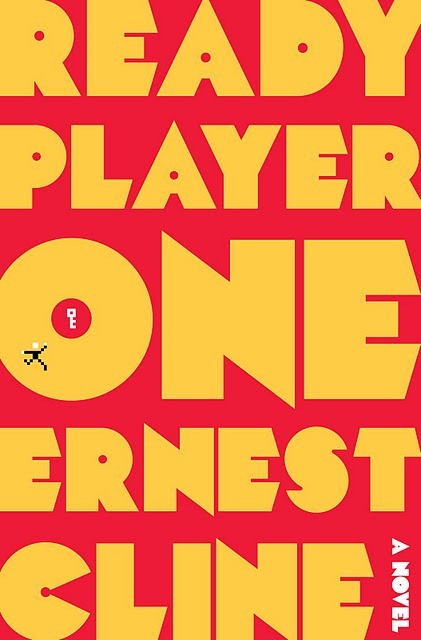
Ready Player One by Ernest Cline

If you were a teen in the 1980s, loving Sesame Street, the Muppets, Atari 2600 games, John Hughes movies, D&D, MTV music, Zork, and nerdy Commodore 64s, then I have a book for you:  Ready Player One by Ernest Cline.  I lived through the 80s too old to play D&D but I dug the music, films and computers.  Cline made me terribly envious I hadn’t grown up in his decade.

Ready_Player_One

I wish I could understand why this book was so much fun to read!  I’d use the formula to write bestsellers.  This story reminds me of a hip new version of Citizen Kane that doesn’t take itself so seriously.  Set in mid 21st century, aging billionaire James Halliday dies leaving a rather unique Last Will and Testament.  Halliday made his fortune developing a virtual reality universe called OASIS that most people use to attend school, work and play in because the real reality is rather bleak.  Halliday’s avatar tells the world he’s worth over $200 billion and that the first person to find his Easter Egg in the OASIS will win his fortune and company.

Now this gets the attention of the world’s foremost video gamers, as well as corporations hot to own the OASIS.  Our story begins with Wade Watts, a poor kid living in the trailer park from hell, whose only access to OASIS comes from his public school gear, but in his own 21st century Horatio Alger, Jr. way climbs out of poverty to compete with legendary gamers.

The contest designed by Halliday is hard, so hard that no one gets anywhere for five years.  It becomes obvious that the clues are hidden in Halliday’s childhood, just like Charles Foster Kane’s secrets, and only the most obsessed fans of 1980s trivia have any chance of solving the puzzles.  Ready Player One is perfect for people who grew up in the 1980s, but the story is so well told bookworms from any decade will love it.

I wonder how many people born forty years after the the 1980s will ever find our times so fascinating?  It would be like me devoting my whole life to the 1910s – but wait, I am madly in love with Downton Abbey.  And just look at the success of Steampunk!

This might be the clue to Cline’s success – creating great characters set in an fantastically detailed milieu, because if we had an OASIS system to visit, I think we all would find virtual worlds based on the past quite seductive.  Nostalgia is a powerful emotion.  At work the favorite topic of guys my age is music from the 1960s and 1970s.  I’m in a classic science fiction book club where we read and reread books from the 1940s-1970s.  Start paying attention to movies (Hugo, Sherlock Holmes, TinTin, War Horse) as more are set in the past.  Maybe it’s the bad economic times and we just need escapism.  Ready Player One sure made me forget about now.

Other Reviews and Sites – probably to read after reading the book

JWH – 1/12/12

Google+ versus Facebook

Having two competing social networks is a problem.  Logically, you’d like everyone to be at one location for convenience.  Until recently, it looked liked Facebook was going to be the universal social network.  I’m not much of a Facebook user, but I can’t quit it either.  Too many friends, old acquaintances and relatives are on Facebook, so it’s easy to keep an eye on everybody.  Facebook is actually much better than snail-mail letters, postcards and Christmas cards at keeping track of people.  In fact I often wish all my relatives would use Facebook.  Facebook actually makes me feel closer to people.  Then came Google+.

google-plus-logo

Google+ has a few nifty new features, some a touch better than Facebook, but to make Google+ practical I’d need all my Facebook friends to move over to Google+ and that would be rude to ask.  Many people I know on Facebook are computer phobic, and it took them a long time to learn Facebook.  Getting them to switch would be cruel.

What to do?  What if Google+ is a superior tool?  What if we all move over to Google+ and Apple or Microsoft came out with an even better product?  Do hundreds of millions of people then move again to another new system?  Given time wouldn’t Facebook add the features we all want anyway?

Mike Elgan is fanatically campaigning for Google+  and currently 374,958 people have him in one of their circles.  Google+ definitely has more geek cred than Facebook, which makes me think I should use Facebook for people I know in real life and use Google+ as a geeky hangout for people I met over the Ethernet.

There are many things to consider.  Is social networking a fad?  Many pundits and friends have already abandon Facebook.  On the other hand, I can only imagine Facebook becoming better and more valuable over time.  Does that mean we should all stick with Facebook because of its initial momentum?  Are we already stuck with Facebook forever?

Mike Elgan claims Google+ can replace our email systems too and that Google+ can become a central hub for all kinds of communications Facebook doesn’t do and the average user doesn’t understand yet.  At least I don’t.

Which is more secure?  Which is more natural at organizing levels of relationships?  Which offers the most features I’d actually use?  Which is easier to use?  Which can be customized more?  And most important, which has fewer ads?  I hate ads.  I don’t have the answers, but I’m trying to find out.

And one last interesting tidbit.  Facebook isn’t indexed on search engines, whereas Google+ is indexed on Google, Bing and others.  Facebook is a closed system, and that’s appealing, I think.  Then again, should you ever put anything private and personal on any computer system?

JWH – 1/10/12

If I Had a Super PAC

There’s an old Bruce Cockburn song called “If I Had a Rocket Launcher” that if I was musically inclined I’d adapt to modern times and write new words and sing, “If I Had A Super PAC.”  To understand a little bit of what a Super PAC is read “Newt’s Shop of Horrors.”  Basically, if you’re wealthy you can make political war for or against political candidates so long as you don’t align yourself with any candidate.  In essence it allows individuals and corporations, folks with lots of dough, to weigh in political and do the dirty fighting for the candidate of their choice.

In the old days a six-shooter was considered an equalizer.  It didn’t matter if you were big and strong or little and weak, the implication was guns made everyone equal.  The Bruce Cockburn song ups the ante to imply you need a rocket launcher to be equal in our modern world.  Well, now it seems to be equal in politics you need a Super PAC.

The inherent problem of Super PACs is only the rich can afford them and thus the rich have more political influence.  What Timothy Egan’s article says about Republicans fighting each other with Super PACs is it ironically illustrates why they are unfair.  Mr. Gingrich helped promote the creation of a Super PAC and now he’s suffering from the results of an escalating war.

I’m poor and liberal, but I got to thinking, what if I had a Super PAC, what would I do?  Not that I’d really use one – I mean, I don’t own an assault rifle (hey, I’m liberal) but it’s fun to think about what one would do with a Super PAC.  If a big gun makes you feel like you have a big you know what, what must welding a Super PAC make you feel?

Our polarized political society is creating all kinds of escalating political weapons.  Take the hacker group Anonymous – they attack corporations they deem unethical with hacker tools.  Arab Spring showed us how little people can overthrow powerful tyrants by using Twitter, Facebook and other social media.  Conservatives and NRA members probably never picture liberals armed to the teeth, so I don’t imagine Republicans pictured Democrats with Super PACs, but after the conventions I expect both parties to bring out whole legions of Super PACs on both sides.  What we have to ask are Super PACs weapons of mass destruction that should be outlawed?

Expect shock and awe attacks on President Obama of all kinds.  But also imagine what liberals can do with Super PACs.  Republicans are going to claim The Comedy Channel started the escalation.  Then countered with Fox News.  Researcher should graph the growth negative ads in politics and the evolution of rhetoric to unbelievable levels.

I find it painful.  If I had a Super PAC I’d attack the legality of Super PACs, but instead I’ll just turn off my TV.

JWH – 1/7/12

For more fun on Super PACs, read my friend’s Bill blog, That’s Interesting…