New versus Old

The Hunger Games has sold millions as a book, and then sold millions of movie tickets.  Like the Twilight and the Harry Potter stories, The Hunger Games created mobs and mania opening weekend.  What I’d like to know is why do only new books create a mania?  At least at the movies.  The John Carter of Mars books were hugely popular in their day, and they had nearly a century to build up fans.

Why didn’t all the John Carter of Mars fans come out for premier weekend of John Carter?  I read the Edgar Rice Burroughs John Carter books when I was a teen and found them thrilling.  I suppose there are few young people discovering them today, and without the kids you can’t have pop culture mania.  Or can you?  The best counter example is Lord of the Rings and Stieg Larsson Millennium series.  Not quite the same hoopla, but pretty big – adults don’t show their excitement in the same way as kids, but I knew an awful lot of bookworms my age gush about the Stieg Larsson books.

What do you do if you don’t have new books to make into blockbuster movies?  Can old ones do the job?  Larsson is an example of the new making a big entry splash, but Lord of the Rings does prove an old book can still generate some pop culture excitement.  The size of the mania seems related to the size and age of the audience.

Would there have been a mania for The Beatles without teens?  Disney spent a PowerBall fortune making John Carter and it flopped.  Didn’t they know movie manias require the endorsement of the young to make the kind of money they want?  Did Disney think they could create an instant mania?  Avatar did it?  Why?  Sometimes the mania hits without books preceding the movie.

I assume movie makers use books for a ready made audience.  So have they mined all the old best sellers of history?  Look at this list of All-Time Best Sellers at Wikipedia.  Six books have sold more than 100 million.    The all time top sellers at 200 million copies are A Tale of Two Cities and The Little Prince, although other people estimate Don Quixote has sold more than 500 million copies.  I doubt we’ll have open weekend mania if these books were made into films.

The real sellers are series books, with Harry Potter toping the list at 450 million.  Edgar Rice Burroughs did make a show with his Tarzan series at 50 million copies, but John Carter wasn’t listed.  Looking at the list shows some promising titles that haven’t been filmed, but overall the list looks well picked over by Hollywood.

Last year, Ayn Rand’s cult classic, Atlas Shrugged came to the movies at the old theater that I go to see art and foreign movies, where the parking is usually empty.  The lot was full for Atlas Shrugged, even though the film got horrible reviews.  Old books can sell new movie tickets, but it’s a hard sale, and the local news didn’t film adults waiting in line wearing costumes for Atlas Shrugged.  If they had worn Ayn Rand outfits, maybe the film crews would have been there.  Maybe movie makes need adults to act more like kids if want to make a killing in that first weekend.

Science fiction fans have been waiting half a century to see Stranger in a Strange Land or Foundation at the movies, and if they got big Disney sized productions would they do any better than John Carter without the backing of teenager movie goers?

Masterpiece Theater fans watch production after production of old classics, but how many fans does it have?  Downton Abbey created a bit of a mania for the baby boomer set but it was no Beatlmania.

Real fan mania requires both new and old fans.  That’s why some YA novels are read both the young and the formerly young.

Poor movie producers hoping to become billionaires just need to wait for the next new thing, whatever it might be.  That’s probably why they keep remaking movies, because waiting for new authors to write runaway bestsellers is kind of tedious.  Old pop culture doesn’t recycle very well.  The current boom in comic book productions seems to pay off, but how long can they keep that going?  At some point superheroes will jump the shark.

Hollywood must really be desperate if they have to make Abraham Lincoln: Vampire Hunter.  This is an attempt to combine the old with the new, even though vampires stories are really old, they’ve been through several recycling’s, but they are currently new again.  For awhile.  Just look at this trailer.  Is it new or old?  Will it sell or bomb?  Is it a new trend to repackage old history with new fantasies?

How many new stories are invented each decade that are so well loved they will sell millions of tickets the first weekend? And are there any old stories that can still do the same thing?

JWH – 4/3/12

The Soul Torture of Dieting

I need to lose weight for health reasons.  I have arthritis in my back that makes it hard to stand or walk for long.  I’ve bought Z-coil shoes that have shock absorbing springs in the heels that help tremendously.  They make me look silly wearing them, but those bouncy shoes proves that my weight is related to my degenerative back disease.  Even with the incentive of pain, for the life of me I can’t make myself lose weight!

Dieting is torture.  Craving fun food is hormonal tyranny.  Drug addicts argue over which drug is the most addictive, well I say the junk that’s the most addictive is junk food.  I can force myself to go months without eating my favorite desserts, but then bam, something snaps, and my will power breaks.  Dieting is the absolute test of mind over matter, and carbs beats the crap out of my gray matter every time.

Just because my mind lives inside this body doesn’t mean its cozy relationship affords any influence.  Actually, I think it proves that the mind doesn’t just occupy the our skulls, but the whole hormonal system.  Insulin affects my thinking just as much as any mind altering drug.

ben & jerrys chocolate therapy

A carton of Ben & Jerry’s can bring me such happiness, energy and creative stimulation that it’s torture to resist.  But I have resisted!  I haven’t had any B&J’s for months, but the desire for it never goes away.  But it doesn’t have to be anything as fabulous as ice cream for my hormones to torture me, sometimes I just crave an ordinary peanut butter and jelly sandwich.  Just losing eight or ten pounds seems to trigger something that makes me lose all mental control and resolve.

I used to come home from work and stoke up on M&Ms, Coca-Cola, pies, cake, cookies and candy.  All those calories would jazzercise my neural activities so I felt like doing after being burned out from work.  When I diet I want to come home and veg out.  In the last ten years I’ve discovered that a nap after work will rejuvenate me like my surgery loves, but it doesn’t do away with the craving.

cake-and-ice-cream-1

Why isn’t eating simple and logical?  Shouldn’t it be a Mr. Spock like decision.  These foods will make me healthy, those foods are poison.  Okay, I’ll take the poison.  What sane person thinks that way?

Now scientists are telling us sugar is toxic.  That’s probably perfect true, but I’ve been developing a tolerance to sugar my whole life, and I can take on some high levels of that poison.

There is something incredibly unfair that desserts are evil.  We seldom get what we dream, but a carton of Ben & Jerry’s is something dreamy that’s easy to obtain.  Of course, now that my teeth are going, well just one, but another is feeling poorly, I feel I should have listened to those warnings against sugar all those years ago.  It’s like that old joke of Woody Allen, where his mother tells him that masturbation will make him go blind and he asks if he can do it until he needs glasses. 

I’m afraid I’ll be needing choppers and still wanting to eat sweets.  Or they’ll be cutting off my feet while I eat M&Ms.  Why is it so hard to say no?  On the news tonight they reported that there’s an epidemic of skin cancer among young women because they love tanning bed tans.  Will that news stop them?  What a silly question to ask.

Why aren’t we smarter?   Or to ask it another way, why do our urges trump our brains, because we do know the answers, and we even believe what we’re told, but we still do the things bad for us like lemmings heading for the edge of the abyss.  I suppose it’s the same thing with global warming – we can’t give up fossil fuels any easier than sugar or cigarettes.  We’re like one cell animals heading directly to the stimulus we love the most.  Becoming big brain beings didn’t overcome those basic instincts.  What good is a neo-cortex when it can’t control the mammalian and reptilian parts of our brains? 

Have they ever considered lobotomies for the lower brain functions?  Or would being healthy and logical like Mr. Spock feel like being a zombie?

JWH – 4/2/12

I Try to Buy One TV Channel from AT&T U-verse

I gave up cable TV awhile back and I haven’t really missed it except for one station, Turner Classic Movies.  I love movies from the 1930s and TCM has more movies from the 1930s than any place else except the 1930s.  I grew up watching old black and white movies late at night.  In the summertime my parents let me and my sister stay up late and watch the all night movies – it kept us quiet during the day time.  One of the most intense nostalgic feelings I have is for watching old black and white movies in a dark room with the TV creating an eerie flickering light.  Now that’s escapism.

I’ve been really missing TCM.  I can’t duplicate their movie lineup with Netflix, nor can I buy the films I want from Amazon.  TCM’s vault of old flicks is truly amazing.

Today, my wife and I went to the AT&T store to talk turkey.  Their website is appallingly bad, and the only way to get good help is to visit the store and talk with a sales person.

We walk in the door and a lovely young woman is standing right there.

“Can I help you?”

I hold up one finger, “I’d like to get one cable channel please.”

“Are you an AT&T customer.”

“Yes, we have U-verse for internet and phone.”

“What channel would you like to have?”

“Turner Classic Movies in HD.”

“Let’s go look that up.”

We follow her to the counter and she begins going through her computer and foldout of TV plans.  A sales person, an older lady, at the next terminal who is selling a smartphone to a customer takes an interest and offers to help.   She tells the young lady that TCM is part of the family plan.

“That will be $59 a month,” says the younger woman.

“What is the real price after the promotion?” I ask.

“It will be $80 a month,” she replied.

I didn’t hear the exact figure, all I heard was the eighty part.  “But I just want one channel.”

“But the family package comes with 200 channels.”

“I can’t get just one?”

“No, sorry.”  She was very nice.

“Oh well, that’s more than I want to pay.  I just want one channel.”

I wasn’t mad or anything.  I had hoped they would offer me their cheapest package and tack on $10 a month for TCM, but that’s not the way it works.

I check Comcast.com when I got home.  They would be almost as much money and they don’t seem to have TCM HD.  I was willing to go $40 a month for TCM HD, but not $80.

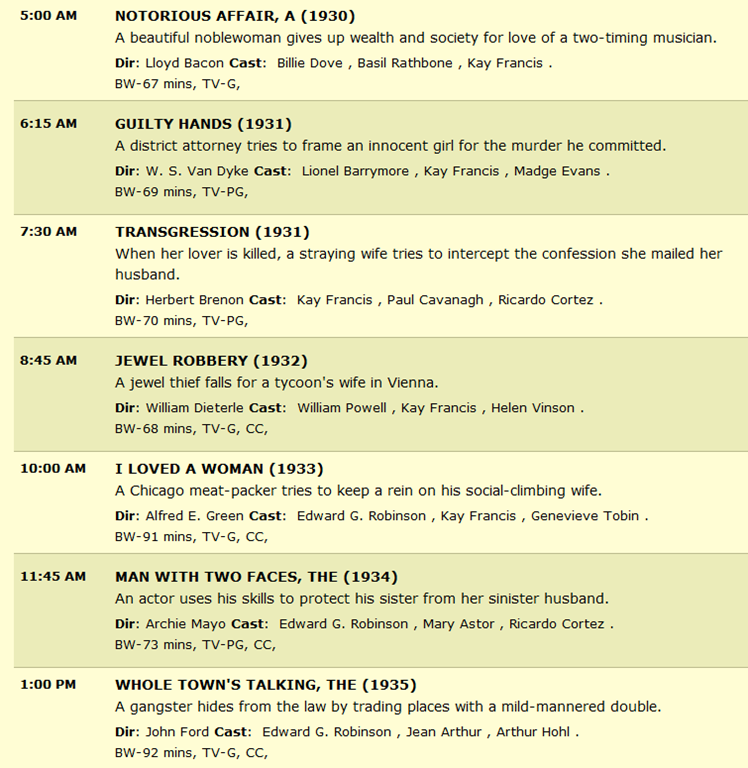
I wish TCM would offer a pay channel on my Roku, or an internet deal like Hulu Plus.  Or even offer DVDs for $15 each at their web site, but their DVDs are more expensive than that and they don’t sell the movies I want to see.  For example, here’s a great lineup of films I’d love to see that will show April 6th.  You might need to click on the image to see a larger readable version.

tcm

I’m thinking of asking my friend Janis who has cable if I can come over to her house at 5am that day.  I’d take a vacation day.  I wish I had a time machine.  Wouldn’t it be great to go back to those years and just watch those movies in the theaters?

How weird is this?  I wonder how many people are like me and love old flicks like these?

I’d go back to cable TV if they offered a base package of no channels and a set-top box with DVR for $15 a month, with an on-screen menu listing available channels and monthly prices and I could pick exactly which channels I wanted.  And no bullshit about charging extra for HD – the world is HD now, it shouldn’t be extra!  I’d really want more than 1 channel.  I’d like CBS, NBC, ABC, PBS, TCM and maybe a couple others.  Maybe not either.  I hate seeing channels I don’t want to watch.  I doubt a la carte cable TV will ever happen, but it’s what many people want.

I’ve got more TV than I can watch now with Netflix.  TV I really, really want to watch.  It’s just sometimes I’d like something Netflix doesn’t offer, especially movies before 1940.  I can buy some, but strangely the oldest movies are often way more expensive than the latest movies.  Careful shopping on the web can find me a few bargains, like double feature DVDs of pre-code Hollywood films for $15.  But all to often, like the Warner Archive DVDs, they want $25 for a single movie.  That’s nuts.  If Amazon sold digital copies of the old movies from TCM for $4.99 each, I’d buy them like crazy.

JWH – 3/31/12

How Famous is Robert A. Heinlein Outside the Science Fiction Genre?

At the peak of his career, Robert A. Heinlein was the most famous and influential science fiction writer within the genre, but how famous was he ever outside of the community of written science fiction?  There are legions of science fiction fans and writers who tell stories about how Heinlein influenced their reading and writing lives.  Yet, how influential is Robert A. Heinlein as a 20th century writer?  How famous is Robert A. Heinlein in the at large pop culture world outside of the tiny ghetto of science fiction?  As a life-long fan of Robert A. Heinlein, I’d like to know just how important my literary father figure is to everyone else.

Recently the Science Discovery channel ran a series The Prophets of Science Fiction, and episode 7 featured Robert A. Heinlein.  Before I saw this episode I thought “Wow, Heinlein is finally going to get the recognition he deserves!”  After I watched the show I felt, “WTF!”  If that’s the best that can be said about Robert A. Heinlein then the poor guy really is dead and buried, both physically and literarily.  The show was so murky in its focus that it neither described Heinlein’s life nor his work.  Sure, Heinlein is a hard guy to pin down, but he deserved better than that.

What else does the public know about Heinlein?  Last year, volume one of a serious biography came out, Robert A. Heinlein: In Dialogue with His Century by William H. Patterson, Jr., which I reviewed here.   It got a mere 32 customer reviews at Amazon, and it’s current sales rank is #360,570.  I’d really love to know how many copies were sold in total, but I don’t know if it would be polite to ask the author that question.  However, the CATO Institute presented William H. Patterson, Jr. in a hour talk about the book that’s on YouTube.  So far it’s gotten 2,353 viewers.  There are several videos on YouTube about Heinlein, and there seems to be little interest in them.  The Patterson talk is very worthy of watching, at least to us Heinlein fans, but why is no one else interested in Heinlein?

This begs the question:  How important is written science fiction to the world?  Sure, we know movie goers love science fiction and it makes billions for Hollywood, but let’s focus on written science fiction.  As a literary form, how worthy is science fiction?  The Science Discovery show, The Prophets of Science Fiction, gives the world the absolutely wrong idea about science fiction.  Prophecy is a bogus concept, whether in religion, history, science or science fiction.  The future is unknowable, period.  Science fiction writers aren’t prophets, and to call them that is insulting.  Sometimes they can be accidently prophetic, but that’s all.

I’ve always believed that science fiction was a serious tool to speculate about the future, but it’s been corrupted and hijacked by the entertainment business for creating thrill rides.  I think Heinlein took his job speculating about the future very seriously, but I’m afraid the world at large never saw that.  David Boaz, who introduces Patterson in the above video tells us a quote from Heinlein in his introduction.  He says that Heinlein left a 3×5 card in a safety deposit box to be read after his death.  The handwritten note said if people name three of his books as their favorites, Stranger in a Strange Land, Starship Troopers and The Moon is a Harsh Mistress, then they have grokked him.  He said all three books are on one subject, freedom and responsibility.

Is that the legacy Heinlein wants?  That he had something important to say about freedom and responsibility?  And what does he say about those subjects?  I’ve read all three of those books at least four times each, and yet I could not summarize them in that way.  I’m not sure I’ve ever read an essay about Heinlein that saw those books in that way either.  And those aren’t even my favorite Heinlein books.

Starship Troopers (1959), Stranger in a Strange Land (1961) and A Moon is a Harsh Mistress (1965) have become Heinlein’s most famous books.  It really helps that Starship Troopers was made into a movie because a film adaptation is one of the few validations that the world at large uses to remember a writer.  In The Greatest Science Fiction Novels of the 20th Century, my most popular blog essay (50k hits), I show how very few science fiction genre novels are remembered by the public at large, and that Stranger in a Strange Land is Heinlein’s most famous book with people outside of the science fiction genre.

I also wrote “What Was Heinlein’s Most Loved Story” based on stats from the Internet.  Troopers, Stranger and Mistress are the top three.  Another form of validation is how many books are on audio, and Heinlein does very well here.  I wrote “Heinlein on Audio” and have tried to maintain the list.  Heinlein is getting very close to having all his books in print as audio books.  Of course, this only proves he’s still a popular writer with his old fans.

Another clue to Heinlein’s popularity is the book, The Top Ten, edited by J. Peder Zane.  Zane asked 125 writers to list their top ten favorite books.  Heinlein gets one vote, or 4 points, for Stranger in a Strange Land by David Foster WallaceDune by Frank Herbert also got one vote, but only earned 2 points by Zane’s system.  The Top Ten shows that the literary world doesn’t think much of science fiction.

Even within my own system of ranking science fiction, “The Classics of Science Fiction,” Heinlein doesn’t score high – but I’ve always thought that was because he had too many popular books competing with each other.  My list includes the above three famous titles plus Double Star and The Past Through TomorrowThe Sci-Fi Lists Top 100 Sci-Fi Books also validates Heinlein is still popular with science fiction fans, and Troopers, Stranger and Mistress are the favorites.

But the more modern site, SFFMeta shows Heinlein falling from memory.  Their All-Time High Scores shows Heinlein is pretty much forgotten, but that’s how their system works.

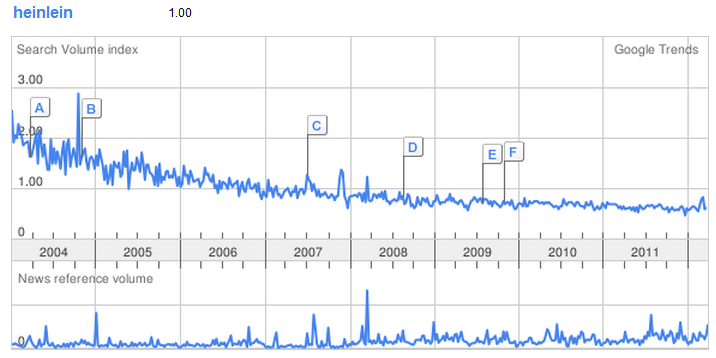
A Google search on “Robert A. Heinlein” only returns 759,000 hits.  I’ve only got my memory to go on, but I think Heinlein used to get in the millions.  Here’s the Google Trends graph for Heinlein.
heinlein-google-trends

I think I need to accept that my literary hero is declining in popularity, that his most famous books were his favorites and the ones Heinlein wanted to be remembered for, but not the ones I wanted remembered.  Here are my favorites and the ones I actually think say way more about science fiction than Heinlein’s own favorites:

  • Have Space Suit-Will Travel
  • Tunnel in the Sky
  • Time for the Stars
  • The Rolling Stones
  • Farmer in the Sky
  • Starman Jones
  • The Star Beast
  • The Door Into Summer
  • Citizen of the Galaxy

Essentially, those are his young adult books.

Now here’s the thing.  Is Heinlein being remembered for his ideas, or his stories?  The three books Heinlein states he wants to be remembered for and why, suggests he wanted to be remembered for what he had to say.  Wrong answer Bob.  Ideas are a dime a dozen, and they do poorly with the test of time.  Novelists are remembered for their stories and characters.  Sadly, Heinlein never wrote an Anna Karenina, the most popular novel in The Top Ten list, or even something as memorable as The Sun Also Rises, nor anything like Nineteen Eighty-Four, Brave New World, Fahrenheit 451, Slaughterhouse Five, Dune, or Earth Abides, books using science fiction techniques that the literary world does remember.  Stranger in a Strange Land and Starship Troopers are his best competitors and I’m not sure if they have real lasting power.

The above Heinlein novels I list as my personal favorites are books I love because I bonded with them in adolescence, but I know they can’t compete with the standard classics.

Heinlein deserves more of a literary reputation than was seen in his episode of The Prophets of Science Fiction.  I’d like to think he’ll at least attain the status of Edgar Rice Burroughs, H. Rider Haggard or Robert Louis Stevenson have today, but in the world at large one hundred years from now.  However, he will be defined by the genre of science fiction, and I think that’s where the show The Prophets of Science Fiction failed miserable – they couldn’t define the scope, value and purpose of literary science fiction.  Science fiction has always been a vague term and its getting vaguer.

I had always hoped Heinlein would be remembered as the American Jules Verne and H. G. Wells of the 20th century.  In 100-150 years from now, Heinlein might be remembered like the book, Frank Reade: Adventures in the Age of Invention, because I’d like to think Heinlein’s juveniles helped inspire a generation that wanted to make space travel the final frontier.

I associate Heinlein with 1950s science fiction, but I think that generation is fading now.  I’m afraid the public now thinks of science fiction not in association with space travel, but movies and toys, like “Twenty Things Every Sci-Fi Nerd Should Own Physically and Emotionally,” – as  geeky fantasies of obsessed fans.

William H. Patterson claims Heinlein’s legacy will be:

And even among this select group of writers-cum-culture-figures, Heinlein is unique.  He galvanized not one, but four social movements of his century:  science fiction, and its stepchild, the policy think tank, the counterculture, the libertarian movement, and the commercial space movement.

I totally disagree that science fiction influenced the development of the think tank. Historians of science fiction will give Heinlein a lot of credit for influencing 20th century science fiction, but claiming anything else science fiction maybe have inspired is very hard. Heinlein hated the counter culture and I don’t think he’d want credit for any accidental influence on hippies. I’m pretty sure inventors in the commercial space movement loved Heinlein’s books and might even say their careers were inspired by him, but I don’t know how much credit Heinlein can take for their success. Heinlein was a writer and his legacy must be literary.

If science fiction has a serious purpose other than escapist entertainment, it has yet to be acknowledged. I believe science fiction can be a cognitive tool like philosophy for examining reality that is separate from both science and literature. Science is the premier tool for exploring reality but it has limitations. Science fiction, using what-if and extrapolation can anticipate what science has yet to discover. Unfortunately, science fiction has been corrupted by the fantasy of desired miracles, just like religion. Too many people want more from reality than exists in reality.

Science fiction really needs to be carefully defined to be considered a cognitive tool or true art form.  Right now it’s just a catch all term.  How can we say someone is a great science fiction writer when we can’t define science fiction?  Heinlein said he wanted to be remembered for writing about freedom and responsibility, and that’s not even science fictional.  The makers of The Prophets of Science Fiction want people to believe science fiction is about prophecy, but that’s bullshit.  We really need to define science fiction so we can judge if writers hit the target.

The Hunger Games trilogy is immensely popular book right now and I believe it is science fiction.  Suzanne Collins is not trying to predict the future, or even warn us against a possible future.  “Suzanne Collins” returns 56,400,000 results from a Google search.  Orson Scot Card, probably the most popular writer within the genre, returns 3,800,000, and remember, Heinlein only got 759,000 hits.  I guess that makes Suzanne Collins the new Dean of Science Fiction.  What is she saying about freedom and responsibility?  What is she saying about science fiction?

When the baby boomer science fiction fans die off, I’m afraid interest in reading Robert A. Heinlein will disappear.  The only thing that could revive his literary reputation for the younger generations is if Hollywood makes several movies based on his novels.

By the way, Lady Gaga gets 602,000,000 results from Google.  In comparison “science fiction” only gets 233,000,000 hits.  If I could filter out interest in movies and television shows that number would be tiny.  Why is the literary world of science fiction so ignored?

JWH – 3/31/12

What Republicans Don’t Know About Obamacare

Conservatives are running like a pack of wolves to pull down and kill Obamacare, while they dream of killing Medicare afterwards.  What they don’t recognize is killing Obamacare will promote socialized medicine, not kill it.  Obamacare was designed with Republicans in mind.  It’s the free market solution to universal healthcare.  When Republicans get their way and Obamacare is destroyed, the only solution left will be socialized medicine, and Medicare will become the model.

Most of the world has moved to universal healthcare, Americans are just slow to see that.  It’s an idea that it’s time has already come, we don’t see it because we cling to outdated notions about capitalism.  Wake up and smell the roses, capitalism is constantly evolving and it’s incorporated aspects of socialism to be more efficient.  Sooner or later as universal healthcare becomes a success in all but the poorest countries, Americans will realize they have been left behind.

Obama and the Democrats designed the healthcare system we call Obamacare based on private insurance to appease the conservatives.  Obamacare is the experiment to prove free market capitalism can do the job when it comes to universal healthcare.  Killing Obamacare means killing the belief that there is a non-socialized solution.  That’s okay by me, I never liked that idea, I always thought Medicare was a better model.

What’s going to happen is conservatives are going to kill off Obamacare and we’ll be forced to expand the scope of Medicare to cover the poor and uninsured.  Most people with jobs will stay with private insurance – for a couple decades.  Over time more and more private businesses will stop providing health insurance as more and more of the population will shift into a Medicare type system.

Sooner and later Americans will wake up and realize the rest of the world has a better solution.  Obamacare was the Republican solution, they just don’t remember it.

JWH – 3/29/12