Forgotten Science Fiction: The Year of the Quiet Sun by Wilson Tucker

One thing I like to do is dig up long forgotten Hugo and Nebula award novel nominees that didn’t win, and read them to see if they should have.  Most Hugo and Nebula award winners in the novel category are remembered, often in print, or at least frequently reprinted.  In 1971, the winner for both awards was Ringworld by Larry Niven.  Everybody remembers that one, but what about the others?

Here are the other nominees:

I’ve linked each of these books to the ISFDB publication record so you can see how often they’ve been reprinted.  Three of the books, And Chaos Died, Fourth Mansions and The Steel Crocodile seemed to have been forgotten by the 1980s.  The Year of the Quiet Sun was last printed in America as an anthology of three time travel novels in 1997.  It was also nominated for the Locus Poll Award, coming in 2nd place, and actually won a retrospective John W. Campbell award in 1976 for a “… a truly outstanding original novel that was not adequately recognized in the year of its publication.”

I remember when The Year of the Quiet Sun came out, but I didn’t read it.  I got on the trail of it again last year when it was nominated for our science fiction book club, but it didn’t get enough votes to be read by the group.  I read some reviews and ordered a copy.  I finally got around to reading it a couple weeks ago.

the-year-of-the-quiet-sun

The Review

The Year of the Quiet Sun is one of the most realistic time travel stories I’ve ever read, and our chrononauts don’t travel in a time machine, but a TDV (time displacement vehicle).  I really liked that.  A secret American governmental agency builds a TDV back in the 1970s, but travel in it is limited to the location of the building where it’s housed and to a timeline that always includes a functioning nuclear power plant attached to the building.  Time travel takes a lot of power, but maybe not as much as the 1.21 gigawatts produced by the flux capacitor in the Back to the Future movies.

Another appealing aspect of this time travel novel is how timid the time travelers are with their itineraries.

The Year of the Quiet Sun is about Brian Chaney, an arrogant futurist and famous Biblical scholar, one of three men conscripted to be time travelers.  The other two are military men, Air Force Major William Moresby and Navy Lieutenant Commander Arthur Saltus.  The military men don’t think Chaney has the right stuff, and Chaney seems to have made a bad initial impression with them.  Eventually, they work out a truce.  All three fall for their beautiful young handler, Kathryn van Hise, competing for attention while they train.

The Year of the Quiet Sun has a simple beauty in its constrained ambitions.  Wilson, writing near future science fiction, uses the story to make social and political projections that didn’t pan out, but I’m not sure that ruins the story.  Science fiction that creeps past its projection date often is dated, so it’s the story that counts in the long run.

The Year of the Quiet Sun was one of the first books that were part of the legendary Ace Science Fiction Specials started in 1968 by editor Terry Carr.  Many of them were paperback originals.  And Chaos Died, Fourth Mansions and The Steel Crocodile were also Ace Science Fiction Specials.

The Analysis with Spoilers

Read no further if you plan to go out and read The Year of the Quiet Sun, because I’m going to tell everything that happens and ask why.

There’s two real tests for a science fiction book, the impact it makes when it comes out, and the impact it makes once it becomes an old science fiction book.  Science fiction goes stale easily and spoils.  For a futuristic literature, science fiction is usually about the present, and seldom becomes timeless.  And it’s usually very hard for a time travel novel to become timeless.  My favorite example of a timeless time travel novel is Replay by Ken Grimwood.

The Year of the Quiet Sun is far from timeless.  It’s a quick read at 252 paperback pages.   It’s too quiet for lovers of loud adventure fiction, and it’s too active for literary quiet.  Wilson Tucker works up a very nice time travel machine, and some reasonable characters that are somewhat interesting, especially Chaney, but where Wilson blows it, is when our time travelers travel to – a library down the street a couple years in the future. Logical, but not exciting.  But I liked that kind of realism.

The first assignment is for the President to see if he’ll be reelected.  Cautiously they move further into the future where they find a second civil war, this time its blacks against whites.  The Year of the Quiet Sun was written just after Martin Luther King, Jr. was assassinated, during a decade of many battles for civil rights.  Wilson Tucker essentially imagines us failing, which shows little faith in the future.  If he had been right, this would have been a prophetic novel, as it is, it’s a big dud at prophecy.  Tucker just couldn’t imagine the positive changes we’ve made.

Tucker redeems himself by his trick ending.  It turns out Brian Chaney is black, which we learn slowly.  In the future of this book, but actually our past, the U.S. collapses under a new civil war, and a black time traveler showing up in territory held by whites is not welcomed.  But Chaney doesn’t know why until the very end of the story when he meets an old Kathryn van Hise.  This is an amazing coincidence that nicely ties up the novel, and it feels good for a storybook ending, but now, over forty years later, doesn’t feel right with all our hindsight.

This is why its very dangerous for a science fiction writer to explore the near future.  But this plot also doesn’t work because there is no integration with the book’s present and the future it discovers.  Wilson Tucker holds Chaney’s ethnic background for a surprise ending, but I think he would have had a much more successful novel if the reader was told immediately Chaney was black, so the theme of the story would have been constant.  Some reviewers claim its there for us to guess if we picked up the hints, but I didn’t.  The Year of the Quiet Sun was published in 1970, but set in 1978 at the beginning, with Tucker making several predictions about the future that was just eight years away.  He predicts things will be worse socially and economically, and that we elect a weak president, and about the most modern thing he predicts is some women going topless.  No MTV, PCs or Internet.

I believe if the time displacement device had been invented to solve the current problems of America before they happened, focusing on race relations by intentionally having a black time travel agent on the team, the story would have been more meaningful.  Brian Chaney constantly pines for Kathryn but always holds back while the two military men make their play.  We understand why at the end, because he’s black.  But wouldn’t knowing that fact make the story more interesting from the beginning?  Would it allow him to deal with race issues throughout the book?

Instead of using the time machine to ward off the collapse of the United States, the time travelers get stuck in the future they cannot change.  Now this is very realistic, and I admire it, and I think it makes the story much more likable.  I don’t think every science fiction story needs to save the world, but the failure here is so damn passive that it seems pitiful.  Now I both admire this restraint and feel disappointed by it too.

The Year of the Quiet Sun is about little people doing something very big in a little way, and failing in a little way.  In a way it reminds me of Timescape by Gregory Benford, another very realistic time travel story that’s not full of action.

I admire The Year of the Quiet Sun because it’s so realistic, but I’m conditioned by science fiction to want more, even knowing most action oriented time travel stories come off contrived and silly.  I guess I don’t believe people with a time machine would be so timid.  Most time travel novels are about going into the past to make a different present.  Here we have a story about traveling into the future that should have taught our characters to change the present.  Of course, what could they do?  Come back and have a press conference that’s shown on the CBS Evening News:  “Scientists report the United States will collapse in 20 years after visit to the future.”

Has anyone written a time travel story where present travelers go into the future, find out the bad stuff, return home, fix the problems and then go back to the future to check their work, and to find out what next needs to be fixed?

I think The Year of the Quiet Sun is still a fun quick read, especially for SF fans who like to read old SF, but it fails as a timeless novel.   Read Earth Abides by George R. Stewart to see what I mean by a timeless classic.  The Year of the Quiet Sun had the potential to be that good.  And maybe that’s why it was up for all those awards – readers admired it’s potential.

JWH – 5/29/12
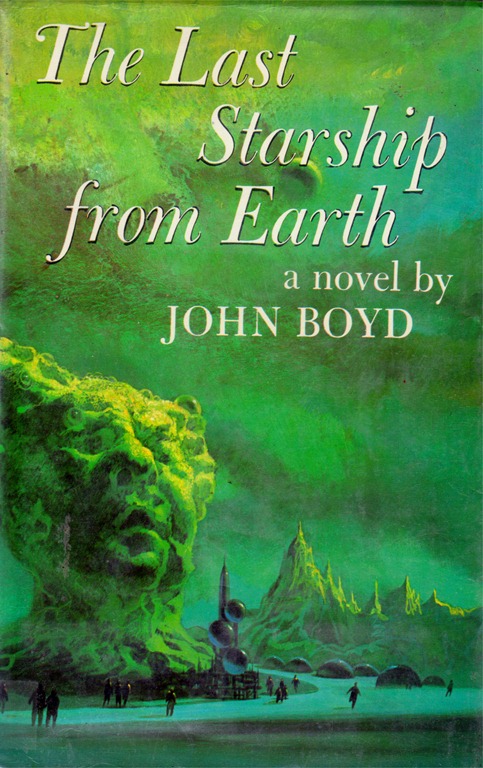
Forgotten Science Fiction: The Last Starship From Earth by John Boyd

Every year thousands of SF and fantasy books get published, but few are reviewed, not many more become popular, and damn few get remembered.  Ten years out, most books are out-of-print and forgotten.  How many books can you remember from 2002?  And if we’re talking fifty years down the timeline, well it’s almost a miracle for a book that old to still be read, much less remembered and loved.

I discovered science fiction in the 1960s, in my teens, and like most people reading their first hundred SF titles, they all seemed so damn far out!  Now decades later, I doubt my memories of those first impressions.  So, when I have a little extra reading time, I order a book from ABE Books based on those dying memories and reread it.  I’ve now reread many of my teenage classics and a majority of them don’t hold up.

Most memories are fleeting, and my memory of The Last Starship From Earth was next to nothing.  All I remembered was a favorable impact.  Just a lingering sense of it being a standout read for 1968 or 1969.  To test that memory I recently bought and reread The Last Starship From Earth.  Sad to say, it was a discard from the Columbus Public Library, a common practice for books that don’t get checked out.  Not a good sign.  The last English reprint of this novel was in 1978.  It’s last edition was in French, in 1995.

The-Last-Starship-From-Earth-by-John-Boyd

The Review

The Last Starship From Earth is a dystopian novel set in 1968 and 1969, but not the 1968 and 1969 that I remember, or lived through.  In the world of this story, Jesus did not die on the cross, but was killed leading an assault on Rome.  He was the Messiah that people expected.  The government of John Boyd’s world is a global government run by Christians along “scientific” lines, where psychologists and sociologists in conjunction with the Church and an AI Pope rule the world.  People marry and mate because of their genes, sort of like the film Gattaca, and the hero of our story is Haldane IV, M-5, 138270, 3/10/46, a math student of great promise, being the fourth in line of great mathematicians.  Unfortunately Haldane gets the hots for Helix, a mere poet.  By law and social custom Haldane is expected to have nothing to do with her, but as you’d expect he falls in love with her.

Haldane concocts a ruse to justify more meetings with Helix by studying Fairweather I, a 19th century mathematician who also wrote poetry.  Much of the first half of the book deals with pseudo-academic studies from this alternate history.  Boyd is creative in his steady flow of ideas and concepts, but there’s little emotion in the story.  It’s somewhat Heinlein-esque, in it’s attitude and world building, but lacks the charm of Heinlein’s best prose.

Now, this quick summary is enticing, and I would like to report that The Last Starship From Earth is a forgotten classic, unfortunately, that’s probably not true.  I enjoyed the book, but only as a quick read.

Surfing the web I’ve found few other reviews of this novel, and although I’ve found people who claim it’s their favorite book, I also found people that thought it ho-hum.  Now, I’ve got to admit it has a humdinger of an ending, almost as startling as the film The Sixth Sense, but I’m not sure this last minute thrill pays for the reading the whole book.

I found the love affair of Haldane and Helix no more believable than Romeo and Juliet and far less exciting.  John Boyd does write well, but the plot is mostly intellectual, about the dystopian society, and its complications.  The book is only 182 pages, and the whole tale feels rushed.  Boyd staked out a solid gold claim but never mined it.

Analysis with Spoilers

The trouble with many SF novels, especially those written back in the 1950s and 1960s, was they were written very fast, and they were about ideas and not characters.  John Boyd has actually written a very ambitious novel by creating an alternative history of Jesus, but he never fleshes it out, and most of the story is a setup for the surprised ending.  The scope of the book is epic, the line by line writing reasonably entertaining, but the overall feel of the book is thin.

Haldane and Helix are discovered, and the middle part of the book is a trial that allows Boyd to work out the politics and legal system of this alternative reality, however, like the rest of this book, it’s rushed.  It’s padding.  That’s its downfall.  He has a big ending but it’s way bigger than the story.  To pad the story even more Haldane is sentence to exile on Pluto, which is called Hell.  There he meets Fairweather I and is reunited with Helix, who happens to be Fairweather’s granddaughter.  Fairweather needed a mathematician for his time machine, and Helix was sent to Earth to engineer the exile of a mathematician to pilot an experimental time machine.  In a very short time Fairweather makes Haldane immortal, tells him his new name is Judas Iscariot, and his mission is to go back in time to kill Christ.

Now if Boyd had spent a couple hundred pages recreating the Biblical world and shown how Haldane tracks down Jesus, we would have had a much better story.  But all of this was summed up in a short epilogue.  We are told Haldane captures Jesus and puts him in the time machine and sends him back, and the rest of the epilogue is about how he has relived the two thousand years to return to his own time and meet a girl that’s an awful lot like Helix, living in a future that’s much more like ours.  But did Haldane let Jesus die on the cross, or does he just disappear him from history?  Unless Haldane at least engineers a dying on the cross scene for history, we should not expect this timeline to be ours.

How do you plot a riveting novel with great characters based on the idea that Jesus didn’t die on the cross and the world became very different?  How do you tell the story twice?  Boyd really grabs a tiger by the tail and yells, “Look at me!”  And I think, “Cool!  Far out man!  But what are you going to do with him?”  He’s got to do more than just swing it around.  I’ll give Boyd a solid C for his world building, but they are only tantalizing sketches.

I really like this ending, but is it good enough to make The Last Starship From Earth a classic SF novel worth reading today?  I’ve linked several references to this book on the net and even though I can find fans of the book, I can find more people who think it sucks.  You’d think  Boyd Bradfield Upchurch, John Boyd’s real name, if he’s still alive, would arrange for his books to be reprinted as ebooks.  That certainly would make it easier for more readers to decide if The Last Starship From Earth is worth reading.

I’m afraid Boyd falls far short of classic standing.  The Last Starship from Earth is a good novel for science fiction historians to read, but it needed to be four or five times longer, more the size of Dune, to get the job done that Boyd outlined.  However, I’m not sure how he could have pulled off this big ambitious idea.

And is Boyd saying our history is the better timeline?  Why is his first timeline all that evil?  Is the freedom to fuck whoever you want the perfect ideal worth rewriting all of history?  Isn’t the more interesting story about a world where the promise of salvation and eternal life never happened?  Isn’t Boyd’s surprise ending really a cheat?

Time travel machines often ruins more stories than they’ve ever help.

Boyd has a three part story.  Life on Earth in an alternate timeline, life on Pluto, life on Earth in another timeline.  The story really isn’t about genetic breeding of humans like we see in Gattaca, or in Heinlein’s Beyond This Horizon or Huxley’s Brave New World.  It’s about an oppressive government.  But does it deserve to be wiped out by time travel?

Here’s the thing, our 1968 was a horrible time for America, but should we send a man back in time to wipe it out?  Boyd wasn’t writing a protest novel like Nineteen Eighty-Four.  Nor did he write a novel that truly explored a timeline with a different Christ, which would have been ambitious enough.

Would The Last Starship From Earth been a better novel is it hadn’t used the time machine gimmick?  Not as it stands, but it potentially could have been.  I believe it’s a grave mistake for any alternate history novel is have a do-over.  Time travel is really a very dangerous concept to use in fiction.  Time travel is very hard to pull off.  The beauty of an alternative history novel is the alternative history.  Don’t add time travel.  This would take away Boyd’s surprise ending, but it would have meant he would have been forced to write a better novel.

I felt cheated when Helix shows up so easily on Pluto, in what at first appears to be a happy romantic ending, but then we’re thrown for another loop.  Haldane loses her again, only to find her again 2,000 years later.  Oh come on man, this horny-at-first-sight love isn’t believable.  Weren’t there no math babes for Haldane?  This really is a case of what you can’t have makes the heart grow fonder.  And neither Haldane nor Helix are all that interesting – if you want a great love story you have to have great lovers.

The powerful driving motive in Gattaca is that Vincent wants to go into space.  He wants to prove that he’s as good any genetically selected human.  The driving force of The Last Starship from Earth is Haldane wants to screw Helix.  Boyd doesn’t make it believable why his world outlaws sex, nor does he make it believable that Haldane and Helix are in big time love.  Hell, even the prosecutors of the story wink at him, and say why didn’t you use a condom and just screw her, implying this world does overlooks recreational sex, just not casual genetic mixing.  But then Boyd never explains why his world requires genetic  fidelity to specialties like mathematics and poetry.   In Gattaca we have the justification that their world doesn’t want naturals to pass on bad traits, but in Boyd’s world there is no reason to breed pure bred mathematicians.  Also, how many math geniuses does one world need?

John Boyd wrote just enough alternate history world-building to set up his surprise ending.  In essence The Last Starship From Earth is a O’Henry type story, and we now use those type stories as examples as how not to write a story.  However, The Last Starship From Earth suggests two possible storylines I’d love to read.  First, I’d love to read an alternate history where Christ was the Messiah that everyone was expecting.  Second, I’d love to read a time travel story about people having to learn what it takes to live in ancient Israel and track down Jesus.  Both would require a tremendous knowledge of real history.

JWH –5/28/12

Turning Your Desktop Into a SF Cover Art Gallery

This is how my desktop of the moment looks (click on all images for 1920×1080 versions):

powers-screen

This is a painting by Richard M. Powers for a 1974 paperback book, The Mountains of the Sun by Christian Leourier from Berkley Medallion Books.  Powers’ art visually defined science fiction for many fans in the 1950s and 1960s because of his book covers for Ballantine Books.

Now I don’t know if this is legal by copyright standards, but I like to find images from science fiction book and magazine covers, and format them for my computer desktop background.  I’m going to provide some basic instructions on how to do this, but they’re specific for Windows 7.  Max OS X and Linux users can also have desktop backgrounds, but you’ll need to know your system to customize these instructions.

All computers, tablets and smartphones come with a method of changing the desktop background. Most devices have built-in programs for cycling these images. And you can install programs with various levels of sophistication that take folders of photos and cycle your desktop images and use the photos for a screensaver.

Finding the Photos

When I discover a book cover I like I go to Google and click Images and search on the book title.  Usually somebody has already scanned it for the web.  Google will show you an array of images.  Here’s what a Google Images search looks like for “Richard Powers Art.” 

google-image-search

Look for the highest resolution with the sharpest scan.  I right-click on potential images and select “Open link in a new window” and then click on “Full-Size Image.”   That gives me the image in a browser page by itself.  You want the largest possible version you can get, because unless the image is the same size as your desktop it will be blown up to fit your screen and small images can become very blurry.  When you find one you like, right click and select, “Save image as” and save it into a folder for collecting your desktop SF art.

[FYI, IE will shrink an image to fit within the browser window.  If it does, you’ll see a little magnifier with a + in it.  Click the image and you’ll see the full size version.  It will be bigger than the browser window sometimes.  Sometimes much bigger.  Right click and save that version to get the absolute best results.]

Repeat this procedure until you have a little collection of art.

Formatting for the Desktop

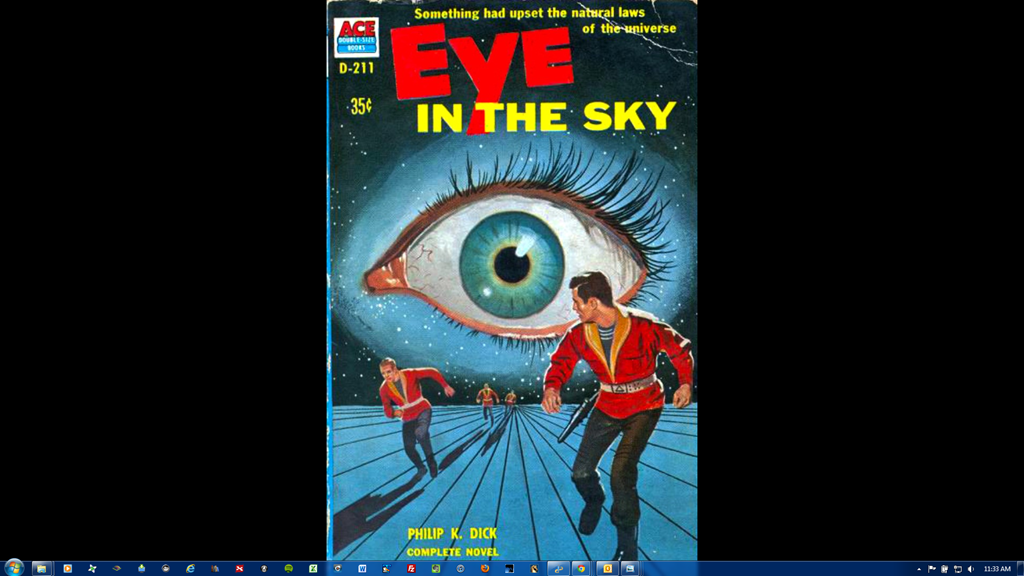
Most pictures you collect won’t have the same aspect ratio as your screen.  If you want to preserve the original image do nothing.  This is especially true if you are collecting book and magazine covers.  However, your screen will end up looking like this:

eye-in-the-sky-cover-formatted

But sometimes it’s fun to crop part of the art to fit the screen to really show off the art.  Like this:

eye-in-the-sky-cropped

If you click on this image to look at the full size image you’ll see that my blow-up looks a bit fuzzy.  However, it’s within my acceptance range, but I’d prefer a sharper image.  If I see a better scan someday I’ll grab it.

[FYI, I was inspired to grab this cover by Joachim Boaz’s Adventures in Science Fiction Cover Art: Eye(s) in the Sky.]

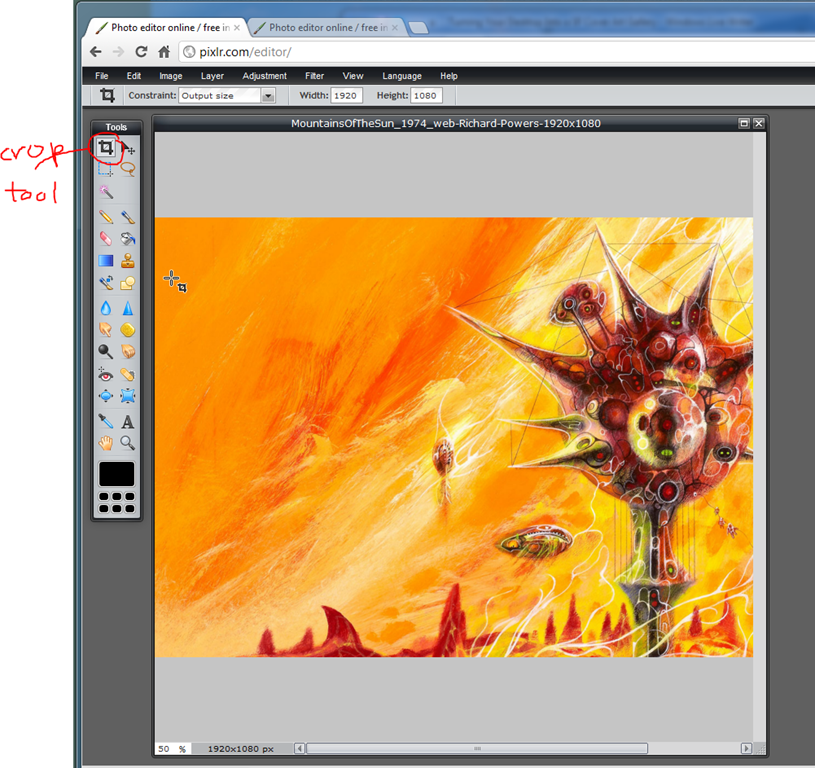
Cropping for the exact desktop size is a bit tricky.  It helps to have Photoshop or some other program that let’s you crop by pixel height and width.  Luckily, there’s a free online Photoshop clone you can use at http://pixlr.com.  Go to that link and click on –> Open photo editor <-.   Then click on “Open image from computer.”  Browse to your art folder and select an image to edit.

Then click on the crop tool, under Constraint at the top, a small pull-down menu, select “Output size” and in the Width and Height text boxes put in the dimensions of your monitor.  Mine are 1920×1080.  Then click on the upper-left corner of the area you want to crop and drag down the mouse to the bottom right.  Let go.  You’ll see a frame outline that you can reposition.  Double click on the crop to finalize.  Anything you crop will be in the exact dimensions of your monitor.  Then in the Pixlr File menu, select Save and put the picture back on your computer.  I usually renamed crops so they have the dimensions as part of the name.   For example, eye-in-the-sky-1920×1080.png.

pixlr 

You can also use pixlr to punch up the color, brightness, contrast, and other image variables, and even fix bad spots.  

Basic Manual Setup

Now that you have some images ready, we can turn them into backgrounds.  If you aren’t running a background changer, meaning the image on your desktop never changes, we’ll install one of your new images manually.  Go to your SF Cover Art folder and find an image you want to use.  Right click on the image filename and select “Set as desktop background.”  Your image should now be the desktop background.  Minimize all windows and admire.  [There is a button at the far right of the Windows 7 Taskbar that will close all windows on the desktop so you can see your art unhindered. Clicking it again brings back your windows as they were.]

Automatic Desktop Changer

If you right click on your desktop background and select “Personalize” you’ll see something like this:

Personalize

At the bottom is a link to “Desktop Background” – select it.  You’ll then see:

choose-desktop-background

I normally use another program for switching backgrounds, but Windows 7, and most other OS systems, have a simple desktop changer built in.  You can select the built-in program for Windows 7 up at the top of this screen, it’s called “Windows Desktop Backgrounds.”  Then hit browse and find the folder with your art.  Set the “Picture Position” to Fill, and “Change picture every” to 30 seconds.  You can change this to a real time interval later, for now this will quickly show your images to you for testing.

For years I used a program called Webshots, and it’s wonderful, but it wants to show pictures in its file format.  You can add your pictures to its format, but that’s extra work.  Recently I’ve discovered John’s  Background Switcher.  Gizmo’s Freeware has a whole list of Wallpaper Changers.  I like John’s Background Switcher because it can handle many sources for pictures, including online galleries, and even images from my Webshots folder.

Other Galleries

I have other galleries other than SF Cover Art, like astronomy photos and copies of famous paintings.  If you search around for Desktop Art or Background Art, you’ll find a myriad of images to collect.  Here’s an astronomy desktop.

horse-head-nebula

I’m also fascinated by historical photographs, like this street scene.

street-scene

Having photos, or copies of artwork blown up and randomly shown is very stimulating.  Photos induce interesting contemplative states of mind for me.  I’m very inspired by visuals.  At my work office, visitors often sit across from me and stop talking because they get mesmerized by images on my computer screens.  I have a dual monitor setup at work.

I’ve always loved book, magazine and album cover art.  I’ve collected art books for decades.  I hated when LP covers shrank to the size of CD covers.  Paperbacks are naturally small to begin with.  So putting this kind of artwork on a 23” 1080p screen really showcases the art.  If you have a HTPC, you can also use the same techniques for putting art on your large high definition television screen.

My art books seldom get looked at, but stuff on my desktop gallery gets looked at every day.  It’s a visual reminder of how big the universe is when I’m sitting in front of a 23” monitor all day long.

One reason I switched from Webshots to John’s Background Switcher is that program makes it easy to add new photos to my desktop galleries.  Whenever I find something good on the net I just do a right click, save image as, and put it on of my desktop background folders.  I also have a folder in Dropbox so I can save images from any computer I use.

Back in the early 1970s my roommate Greg and I would use macro lenses and photograph covers of The Magazine of Fantasy and Science Fiction, Astounding & Analog, Galaxy & If, as well as book covers and show them at our SF Book Club meetings.  People loved seeing the SF/F art blown up big.  Putting covers on your desktop is much easier and you get to see them everyday.

JWH 5/26/12

Questions about The Avengers from a Science Fiction Fan

Are all superheroes as durable and immortal as Wile E. Coyote?  My wife and I went to see The Avengers the other day.  Normally we don’t go to movies about comic book characters, but The Avengers was getting such great reviews we thought we’d give it a try.  I went through a brief comic book reading phase in 1963, and I’ve seen the first Christopher Reeves Superman and the first Michael Keaton Batman, and that’s about it for my comic book experience.  As a child I loved the George Reeves Adventures of Superman TV show and the Mighty Mouse cartoons.  One of my  first blogs was about memories of all us neighborhood kids wanting to fly, “Super Men and Mighty Mice.”

I am a lifelong science fiction fan and computer geek, so I’ve been around a lot of people who love comics.  By all accounts, I should love comics too, but for some reason I don’t.  I’ve read books and watched documentaries about the history of comics and their fans, so I’m not completely ignorant of the genre.  But watching The Avengers was probably what it would be like for me to attend the opera, I was way out of my element.   It made me want to ask a lot of questions.

the-avengers

This isn’t a review of The Avengers.  I’m quite confident it’s a great movie for its intended audience.  I’m not the intended audience, and it left me wondering about many things, and I obviously don’t have the right mindset.  Maybe if I knew how the game was played I could have enjoyed the movie more.

Why people love comic books and superhero movies totally baffles me.  Now I don’t want to be a Grinch about comics, or be a old man fuddy-duddy pooh-pooh other people’s fun, but I do have some questions about comic books and superheroes.

My first question is:  Are you expected to check your mind in at the theater door when going to see a superhero movie?  Is the fun of such a show returning to the state of mind you had before starting 1st grade?  Is part of the thrill forgetting all logic and science?  Is the fun of watching The Avengers pretending to be five years old again?

Many people call superhero movies science fiction, but I really hate that because it suggests that science fiction can be completely ignorant about science.  I’d go so far as to say that superhero movies are anti-science by ignoring the laws of physics and coming up with really insane concepts and suggesting they are science based.  For instance, in The Avengers the whole story is built around a power source called a tesseract.  A tesseract is a geometrical concept, a 4D cube.  The film also has a flying aircraft carrier, space aliens, Norse gods, mutated humans and flying metal suits with no apparent fuel supply.  Plus characters can pound on each other like Warner Brother cartoon characters and behave like the Three Stooges and no one ever gets hurts, much less bruised and bleeding.

I have to ask:  Do superhero movies exist in a reality similar to the reality where Bugs Bunny and Moe, Larry and Curly exist?  That’s okay if that’s how to play the game, but to me fictional realities with no rules ruins the fun of make-believe.

And, why are superheroes like Greek and Roman gods?  They have all kinds of powers, they fly, they are petty and egotistical, and they fight with each other.  Also, we’re asked to believe that the fate of humanity depends on these beings saving us time and again.  Doesn’t that seem like some kind of transference from religion?  Are fans of superheroes worshippers?

Don’t get me wrong.  I’m not saying people shouldn’t watch superhero movies.  These movies are loved by millions, and the movie industry makes huge profits, a big US export, so they are great for the economy.  All I’m asking is if other people don’t question the fictional reality of the comic book superhero world.  I love science fiction, and even some fantasy, but the world of superheroes seems way out there, way beyond any possible believability.  Or is that their appeal?  Are comic books a genre about an alternate reality with no scientific laws and magic works?

I mean, we’re talking the age of myths.  It’s like reverting our minds back to a Paleolithic mindset.  Talk about your old time religion, this kind of magical thinking would put us back in the time of Genesis and Exodus, when the world was full of powerful beings, magic and great catastrophes.    Why are superhero movies so appealing?  Do people actual crave a time when the laws of physics were totally unknown and seeing is believing?  Of course this state of mind was how the whole world existed before science.  Maybe comics should be called pre-science fiction.

Watching The Avengers, it bothered me that normal humans were like ants scurrying around waiting for the superheroes to save them.  You could call superhero movies salvation films, because their plots often reflect evil wanting to destroy mankind and superheroes saving us.  Of course, we could just let Joseph Campbell explain the whole hero with a thousand faces again.

I grew up on the science fiction of Robert A. Heinlein, and he liked to believe that humans were the most dangerous critters in the universe.  He thought normal people could take on all challengers in the galaxy, and only ordinary human heroes were needed.  I thought Heinlein was overly aggressive in wanting to kick alien ass, but I do like his idea that we should live and die by our own abilities.  I don’t want to babysat by gods, mutants and aliens.

Watching The Avengers made me wonder if superhero movies are like porn movies, but instead of making you want sex, they make you lust for power.  That each of the Avengers represents powerful abilities movie goers would love to have themselves.  But if you really think about the Avengers, do you really envy them?  Who would want to be The Hulk?  Or Thor?  I bet most people envy the billionaire playboy, but does being a super-asshole have to come with the power suit?  Captain America seems like a nice guy, but that outfit!  Really?  How important are those awful clothes?  Can Superman fly just in jeans and a t-shirt?  I wouldn’t mind being able to fly like that if I didn’t have to wear a leotard and cape.  And Batman looks like a pimped out S&M freak.

What kind of inner fantasies do superheroes appeal to?  Has anybody asked their therapist?

Movie fans flocked to The Avengers and loved it.  I’m just curious as to why.  Asking me to believe in flying aircraft carriers is insulting to me.  I guess my imagination has limits.  I can accept angels and monotheistic robots in Battlestar Galactica, but I can’t accept flying aircraft carriers.  Why.  Did it do anything up in the air that it couldn’t do floating on the ocean?  Where was it going, and where did it come from?  As far as we knew it was just flying around in a holding pattern.  How was a flying aircraft carrier important to the plot?

Also, why are all the superheroes equal in durability.   Shouldn’t their be some kind of hierarchy of power?  Shouldn’t their be a chain of command?  They should be like rock, paper, scissors. Thor can hammer Loki, Loki can outwit The Hulk, The Hulk can forge Iron Man, Iron Man will bend Captain America, Captain America can romance Black Widow, and Black Widow can seduce Thor.  Why do they squabble and punch each other like Moe, Larry and Curly?  In the movie our heroes spent more time fighting each other than the enemy.  My wife barely liked the movie, and thought it was okay as a comedy.

I was bored.  I’m 60, so I’ve seen a lot of movies with explosions and cities blowing up.  I didn’t see anything new in special effects, or any new action sequences that I didn’t see in 1996 watching Independence Day.  In terms of creating an alternative reality, The Matrix (1999) had just as much comic book action as The Avengers, and it was believable within its own context.  Of course, that leads me to ask:  Am I suppose to assume all superhero movies exist in the same alternate reality and it’s an assumption I should come to the theater believing, or do each of them create a new reality to explore?

I’m used to science fiction where every story invents a new reality for the reader to judge.  So I’m asking:  Are superhero stories all set in a shared comic book reality.  Or is it two realities, Marvel and DC?  Dune isn’t the world of Foundation, and Foundation is not the world of Blade Runner, or Starship Troopers.  To me it seems like superhero reality is one shared by all comic book writers and it would believable that Superman could fly along side Ironman.

Like I said, I really don’t mean to pick on superhero movies.  I love westerns and old movies from the 1930s, and most of my friends don’t.  So I can understand my taste for comic book movies is just not suited for the genre.  My not liking comic book movies is no different from me not getting into opera or basketball.  It’s not a criticism.  I just wondered into the wrong movie theater and went WTF?

JWH – 3/20/12

How Would Life on Earth Be Different if Everyone Was an Atheist?

Belief in God and an afterlife affects how people see reality.  What if one day we all woke up without any superstitious beliefs in the metaphysical?  What if science caught on and everyone began thinking in the same way about how reality works – would that change the social fabric of Earth?  Does religion help or hurt when it comes to doing good?

Think about what John Lennon suggested in his song “Imagine”

Imagine there’s no heaven
It’s easy if you try
No hell below us
Above us only sky
Imagine all the people living for today

Imagine there’s no countries
It isn’t hard to do
Nothing to kill or die for
And no religion too
Imagine all the people living life in peace

You, you may say
I’m a dreamer, but I’m not the only one
I hope some day you’ll join us
And the world will be as one

Imagine no possessions
I wonder if you can
No need for greed or hunger
A brotherhood of man
Imagine all the people sharing all the world

If religion and metaphysical ideas disappeared would we come together as one?  I doubt it, but I think we could start working on the real problems we face.  I can’t help but believe that if people didn’t think a better life awaits them after death they would take this world more seriously.

I think religious divides us, but I think something else divides us more:  politics.  But politics are just the outward manifestation of our inner beliefs which are tangled up in religious beliefs.  The litmus test for that division is how we treat the poor.

Some people hate giving to the poor.  They feel the poor should work.  They feel the poor are undeserving of charity.  Welfare makes their heads explode with anger.  Paying taxes for public schools galls them no end.  Foreign aid and food stamps just annoy the hell out them.  Their resentment knows no bounds when it comes to paying taxes.

Other people want to divvy up the wealth and make life on Earth decent for all.

What’s strange the first group tend to be Christians and the second tend to be secular or spiritual rather than religious.  To the first group, socialism is a dirty word, even though their God was known for dividing the fishes and loaves so everyone could eat.

So, I’m not sure if religion disappeared life on Earth would be any different.

We are going through transformative times.  Communism failed.  But capitalism cannot provide enough jobs for all.  There will always be a certain percentage of the population that are idle.  We have incorporated many socialistic solutions into our economy, and many people hate that.  If we revert to a complete free market, where it’s dog eat dog capitalism, we will have a world where the rich lived in armed enclaves and the rest struggle to survive in a cruel uncontrolled Darwinian conflict.  The early Christians saw Jesus’ teachings as a solution to this problem, but modern Christians have moved away from those socialistic beliefs.

I tend to wonder if modern Christians haven’t jettison all the Christian philosophy and just hung onto the belief of heaven.  They want to be rich on Earth, and rich in Heaven.  If these people turned atheists one night I doubt anything about the world would change.

Religion is a distraction like watching TV.  Believing in vampires or angels, it doesn’t matter, it’s all fiction.  To get the world that John Lennon imagined doesn’t come from giving up religion.  What we need is for everyone to stop thinking about themselves and resenting others. 

The real solution is to think global but act locally.  We have to solve the problem of creating a healthy Earth, and how to create an economy that provides the basics of a decent life for all seven billion people that live on Earth.  Our problem is the 10% want everything for themselves and expect the 90% to go fuck themselves.  As far as I can see religion is irrelevant to this problem.

Like I said, we’re going through a transformative age that people in the future will name and analyze.  Will the Earth survive?  The rich want to ignore that issue.  They want to get as much as they can for  themselves.  They do not care what happens to the Earth.  They do not care what happens to future generations.  They do not care about the rest of the people living on the Earth now.

Humans are a cancer consuming this world.  Unless we get our greed under control we will consume everything, including ourselves.

To answer my title question:  Unless becoming atheist means becoming liberal and socialist, the disappearance of religion would mean nothing to life on Earth.  The real issues to how we live on Earth lies elsewhere.  I don’t think greed is a belief.  It’s genetic, conditioned and animalistic.  Religion neither helps nor hurts in solving greed.

I think people who want to help the world do so because they just want to help the world.  But those people aren’t enough.  Unless the greedy are brought under control, and we’re all greedy, we can’t save ourselves.  Christians want to be saved, but the plight of the Earth is another kind of salvation.  Unless we’re all saved, then we’re all lost.   Whether a God is watching us or not, it does not matter, because we can only save ourselves.

JWH – 5/16/12