The Evolution and Education of Artificial Minds

After space travel, one of the most loved themes of science fiction is robots.  Many people, going back centuries, have imagined creating artificial people.  Writers of robot stories have seldom explored the technical details behind what it means to create a thinking being, they just assumed it will be done – in the future.  Since the 1950s artificial intelligence has been a real academic pursuit, and even though scientists have produced machines that can play chess and Jeopardy, many people doubt the possibility of ever building a machine that knows it’s playing chess or Jeopardy.

I disagree, although I have no proof or authority to say so.  Let’s just say if I was to bet money on which will come first, a self-aware thinking machine or a successful manned mission to Mars, I put my money on arrival of thinking machines.  I’m hoping for the both sometimes before I die, and I’m 61.

There is a certain amount of basic logic involved in predicting intelligent machines.  If the human mind evolved through random events in nature, and intelligence emerged as a byproduct of ever growing biological complexity, then it’s easy to suggest that machine intelligence can evolve out the development of ever growing computer complexity.

However, there’s talk on the net about the limits of high performance computing (HPC), and the barriers of scaling it larger – see “Power-mad HPC fans told: No exascale for you – for at least 8 years” by Dan Olds at The Register.  The current world’s largest computer needs 8 megawatts to crank out 18 petaflops, but to scale it up to an exaflop machine, would require 144 megawatts of power, or a $450 million dollar annual power bill.  And if current supercomputers aren’t as smart as a human, and cost millions to run, is it very likely we’ll ever have AI machine or android robots that can think like a man?  It makes it damn hard to believe in the Singularity.  But I do.  I believe intelligent machines are one science fictional dream within our grasp.

Titan1

[click on photos for larger images]

Titan is the current speed demon of supercomputers, and is 4352 square feet in size.  Even if all it’s power could be squeezed into a box the size of our heads, it wouldn’t be considered intelligent, not in the way we define human intelligence.  No human could calculate what Titan does, but it’s still considered dumb by human standards of awareness.  However, I think it’s wrong to think the road to artificial awareness lies down the supercomputer path.  Supercomputers can’t even do what a cockroach does cognitively.  They weren’t meant to either.

It’s obvious that our brains aren’t digital computers.  Our brains process patterns and are composed of many subsystems, whose sum are greater than the whole.  Self-aware consciousness seems to be a byproduct of evolutionary development.  The universe has always been an interaction between its countless parts.  At first it was just subatomic particles.  Over time the elements were created.  Then molecules, which led to chemistry.  Along the way biology developed.  As living forms progressed through the unfolding of evolutionary permutations, various forms of sensory organs developed to explore the surrounding reality.  Slowly the awareness of self emerged.

There are folks who believe artificial minds can’t be created because minds are souls, and souls come from outside of physical reality.  I don’t believe this.  One proof I can give is we can alter minds by altering their physical bodies.

To create artificial beings with self-awareness we’ll need to create robots with senses and pattern recognition systems.  My guess is this will take far less computing power than people currently imagine.  I think the human brain is based on simple tricks we’ve yet to discover.  It’s three pounds of gray goo, not magic.

Human brains don’t process information anywhere near as fast as computers.  We shouldn’t need exascale supercomputers to recreate human brains in silicon.  We need a machine that can see, hear, touch, smell, taste, and can learn a language.  Smell, touch and taste might not be essential.  One thing I seldom see discussed is learning.  It takes years for a human to develop into a thinking being.  Years of processing patterns into words and memories.  If we didn’t have language and memory would we even be self-aware?  If it takes us five years to learn to think like a five-year-old, how long will it take a machine?

And if scientists spend years raising up an artificial mind that thinks and is conscious, can we turn it off?  Will that be murder?  And if we turn it off and then back on, will it be the same conscious being as before?  How much of our self-awareness is memory?  Can we be a personality if we only have awareness of the moment?  Won’t self-awareness need a kind of memory that’s different from hard drive type memory?

I believe intelligent, self-aware machines could emerge in our lifetimes, if we all live long enough.  I doubt we’ll see them by 2025, but maybe by 2050.  Science fiction has long imagined first contact with an intelligent species from outer space, but what if we make first contact with beings we created here on Earth? How will that impact society?

There have been thousands of science fiction stories about artificial minds, but I’m not sure many of them are realistic.  The ones I like best are:  When HARLIE Was One by David Gerrold, Galatea 2.2 by Richard Powers and the Wake, Watch Wonder Trilogy by Robert J. Sawyer.
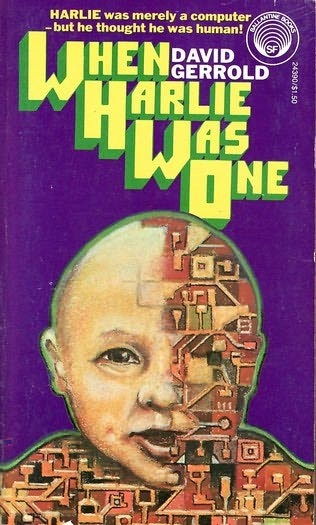
when-harlie-was-one

galatea-2.2

wake

These books imagine the waking of artificial minds, and their growth and development.  Back in the 1940s Isaac Asimov suggested the positronic brain.  He assumed we’d program the mechanical brain.  I believe we’ll develop a cybernetic brain that can learn, and through interacting with reality, will develop a mind and eventual become self-aware.  What we need is a cybercortex to match our neocortex.  We won’t need an equivalent for the amygdala, because without biology our machine won’t need those kinds of emotions (fear, lust, anger, etc.).  I do imagine our machine will develop intellectual emotions (curiosity, ambition, serenity, etc.).  An interesting philosophical question:  Can there be love without sex?  Maybe there are a hundred types of loves, some of which artificial minds might explore.  And I assume the new cyber brains might feel things we never will.

In the 19th century there were people who imagined heavier than air flight long before it happened.  Now I’m not talking a prophecy.  Most people before October 4, 1957 would not have believed  that man would land on the Moon by 1969.  I supposed we can pat science fiction on the back for preparing people for the future and inspiring inventors, but I don’t know if that’s fair.  Rockets and robots would have been invented without science fiction, but science fiction lets the masses play with emerging concepts, preparing them for social change.

My guess is a cybercortex will be invented accidently sometime soon leading to intelligent robots that will impact society like the iPhone.  These machines with the ability to learn generalized behavior might not be self-aware at first, but they will be smart enough to do real work – work humans like to do now.  And we’ll let them.  For some reason, we never say no to progress.

I’m not really concerned cybernetic doctors and lawyers.  I’m curious what beings with minds that are 2x, 5x, 10x or 100x times smarter than us will do with their great intelligence.  I do not fear AI minds wiping us out.  I’m more worried that they might say, “Want me to fix that global warming problem you have?” Or, “Do you want me to tell the equations for the grand unified theory?”

How will we feel if we’re not the smartest dog around?

JWH – 5/19/13
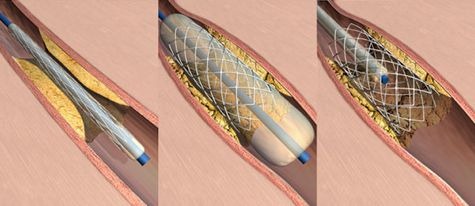
The Heart (Disease) of the Matter

On May 9th, I had a stent put in my coronary artery.  For months I’ve been having out-of-breath episodes, but I thought it was just because I was getting older, and not getting enough exercise.  In the last few weeks it got worse so I went to see my doctor and she sent me for a bunch of tests that ended up with a heart cath and getting a stent.  It’s been an extremely educational month with lots of philosophical implications.

coronary-stent

Our hearts are just pumps, and our veins and arteries just hoses, but when they stop functioning, it feels very metaphysical.  To actually feel them failing is quite revealing about existence and non-existence.  I’m sure the faithful would feel heart disease as a spiritual turning point, a time to communicate with God, and contemplate life after death.  Since I’m an atheist, I contemplated non-existence and thought about physics, chemistry and biology.  The heart and circulatory system is a machine that follows the laws of physics, much like the water pump in your car.  I had a rather fundamental plumbing problem:  a blocked hose.

The first diagnostic test I had was a calcium CT scan.  I got a score of 451, which my doctor didn’t like at all.  My second test was a Thallium treadmill test, which I passed, but the photographs suggested problems.  She sent me to a cardiologist.  It took a couple of weeks to get to see a cardiologist, and that was stressful in itself.  I went to a cardiology center with 32 cardiologists and the earliest appointment I could get was two weeks.  Lots of people with heart problems out there!  Time and again I was told if I needed immediate attention to go to an emergency room.  Fixing hearts is a factory-like affair.  Don’t expect a lot of personal attention.

My advice to the young:  Eat healthy now!  Don’t break your own heart. 

My clogged arteries were my fault.   Yes, the doctors can often fix your heart problems, but if you’ve ever had to deal with an old machine with breaking parts, you know one fix is just temporary before another part will go.  A stent only squishes the plaque up against the artery wall, making more room for blood flow, it’s not a form of healing.  And you don’t get plaque in just one place, it’s all over.  I just had a blockage in two high traffic area, with one bad enough for a stent.

The stent is only part of the solution.  I now have to take a bunch of drugs.  I’ve always been horrified at the sight of elderly people worrying over their prescription medicines.  I’ve always thought being over the hill as living with lots of orange plastic bottles, and now I’m part of that demographic.  Here’s where chemistry and biology comes into this story.  Modern day medicine men are scientists.  Our bodies are biological machines they study.  Millions of chemical reactions go on within our body all the time.  Doctors work by statistical studies, and the numbers tell them that my odds of living longer are improved if I consume certain chemicals.  I can’t argue with them.  I take the drugs.

These are cold equations, indifferent to how we feel philosophical about our health situation.  I hate taking drugs!  I fear drug side effects.  I hate being depended on drugs, even though I’m am quite thankful that science created them.  I’m very lucky to have good health insurance and live in a country where these kinds of problems can routinely be fixed – if they are found in time.  A fellow computer guy died at work from a heart attack recently.

My father died at 49 on his third heart attack.  He also survived a stroke.  He chained smoked Camels, drank a lot of Seagram 7, and his standard chow was steak and potatoes.  I’ve always wondered why he didn’t try to change his lifestyle, and now I know why.  I’ve been overweight for decades.  I didn’t listen to all the warnings.  In the last few years I’ve tried to eat healthier but it’s hard.  Is comes down to this:  Do I do what I like?  Or, do I do what’s good for me?  Even when I was having trouble breathing I’d often be thinking about how I wanted junk food.  I’m pretty sure my father thought “I’d rather die than change.”  Me, I picked change – but at the last minute.  Not very wise.

Since New Year’s I’ve been reading books by Dr. Dean Ornish and Dr. Joel Fuhrman about using diet to reverse heart disease, and watching documentaries on Netflix about reversing chronic disease through proper eating.  Ornish’s book Program for Reversing Heart Disease came out in 1990, and Fuhrman’s Eat to Live came out in 2003.  I even read parts of Eat to Live ten years ago.  But the nightly news programs have been warning about the evils obesity for decades.  Until your heart actually sucker-punches you a good one, it’s hard to take such warnings seriously.  I should have.

My friend Mike asked me if I thought about God in the hospital.  I did, but not in the way he intended.  Feeling the closeness of mortality showed me why people pray.  The gut instinct is to think “Get me out of this!”  You want magic to work.  It doesn’t.  Thinking that an all-powerful being could rescue you is an obvious wish.  I wish there was such a personal savior, but I didn’t find one.  I knew there was a blockage in the artery going to the heart.  I hoped diet would clear it, but my doctor said he doubted it, and I knew I had spent decades building the blockage, so I knew he was probably right.  I knew my only hope was his skill and the scientific knowledge he possessed.  Medicine is collective knowledge that works.  It’s not magic, and it doesn’t always work, but it’s the only real game in town.

We’d like to believe we’re the master of our own fate, or that a magical being cares for us.  But neither positive thinking or spiritual belief affects reality.  My chance of using the power of self-control had long passed.  If I wanted control of my fate, I should have lost weight thirty years ago.  The reality is death comes to us all.  We can extend our lifetimes and improve our health if we work at it, but we have to put in the effort.

I do believe we have the power to affect our health, just watch this video.

I cannot do anything about not starting sooner.  I couldn’t avoid that first stent at the last moment.  I’ve already lost 15 pounds.  Maybe I can avoid the next stent.  I don’t know if a plant based diet can reverse heart disease, but it’s the hypothesis that I’m using  for now.

My final lesson was about dying.  When you think time might be up you learn what you really want:  more time!

Getting close to the end only reinforces the awareness that time comes to an end.

The funny thing was I learned I didn’t want to do big bucket list things, but to have more time for all the little things I do now, and to keep seeing everyone I know now.

JWH –5/12/13

Paradigm Shifts in Medicine–Can Lifestyle Change Cure?

Modern medicine is scientific, evidence based, and very conservative.  Doctors like to treat patients with medicine and procedures that offer the best known odds for success.  No doctor wants to try out something new only to discover it kills their patients.

Patients on the other hand are fearful folk.  They usually know little of their newly diagnosed conditions and they are afraid of suffering or dying.  They are quick to take any cure they are offered.  If they have faith in their doctor and she says  take these pills and have this surgery, they will comply.  However, many people are afraid of pills and surgery.  They hate to suffer, but they are afraid of the cures offered them.  If they hear about alternative medical treatments that are less scary they will chase after them.

I’ve recently discovered I have clogged arteries, but won’t know how bad until next Thursday when I get a heart catheterization.  This is the kind of personal experience where I get to explore very concrete details of reality.  I have choices to make.  If I decide wrong I could die.  If I decide right I get restored health.

The conservative medical solution is to put in a stint and have me take Plavix for a year.

The alternative is a proposed paradigm shift that claims if I eat a radically different diet, I can reverse the buildup in my arteries.  My doctor says there’s not enough research to support this conclusion.  Books by Dr. Ornish and Dr. Fuhrman claim otherwise.  My doctor replies that those doctor’s claims are meant to sell books, and are unproven.

Here’s my problem.  I can’t handle drugs.  My doctors usually pooh-pooh my fear of drugs.  But here’s what topical steroids did to me.

steroid-reaction

And that photo was after I healed considerably.  It took a year for my face to clear up.

I’ve taken other medicines that filled my mouth and throat with sores.  I often take medicine that tears up my stomach.  I’ve taken medicine that gave me sores under my eyelids.  I’ve taken medicines that gave me pains in my intestines.  I’ve taken medicines that distorted my sense of time.  Taking penicillin once sent me to the emergency room.  And statins really did a number on my body.  I have a hard time taking a 81mg “baby aspirin.”  I even had to give up caffeine.

So the idea of getting a stint and then having to take a powerful drug for a year is pretty scary.  If it was just a stint, I’d say great.  When I had a heart arrhythmia they eventually fixed it by zapping something inside my heart.  That was after years of torturing myself with various heart drugs.  They had offered me the ablation when they offered me the drugs, but I believed I could control my heart arrhythmia with beta blockers, diet and exercise.  I did for years, but ultimately I couldn’t.  Letting them zap my heart was great.

Once again, I’m back toying with the idea of curing myself by diet and exercise.  However, this time, there’s more evidence, supported by real doctors, to suggest that the lifestyle change is a possible cure.

I’ve already shifted towards the new diet, but it’s hard.  Even though I’ve been a vegetarian since 1969, I’m a very poor eater who is addicted to junk food.  Food I found comfortable for my stomach was slowly attacking my heart.  Now switching to healthy food sometimes tears up my stomach like some medicines.  Yet, I do feel better, and I believe if I learn to eat the healthy, and especially if I learn to cook it and make it an easy routine, I could switch my lifestyle.

I do have a proven record of changing.  I did go vegetarian at 16.  And in recent years I’ve control my back and leg pain with physical therapy exercises.  I gave up pain pills and anti-inflammatory meds.

One reason I think conservative doctors are against lifestyle cures is they know few people can change their way of living.  My dad died at 49 after three heart attacks and a stroke.  He never gave up his Camels, Seagram 7, or steaks.  Nor did he try to exercise.  I was in my teens at the time, and I wondered why he wouldn’t change.  Now I know how hard it is to change.  Sometimes I think I’ve lived 12 years longer than my dad because I became a vegetarian.  It also helps that I didn’t follow in his footsteps of smoking and drinking.  What choices can I make to live another 12 years, and maybe 12 more after that?

One reason I believe lifestyle change might work is because bad lifestyle habits clogged my arteries in the first place.  The other bit of logic is if I got a stint and continued to eat and live like I did, wouldn’t I just clog up other arteries?  Isn’t clogged arteries a sign that I’m doing something wrong and should stop?

Such logic can be deceptive.  I’m reading Thinking Fast and Slow by Daniel Kahneman who details all the ways our own brain tricks us.  He chronicles a long list of deceptive psychological mechanisms our brains use to convince us that wrong things are right.  So, how do I know if my cardiologist is right, or Dr. Ornish and Dr. Fuhrman?  Decades ago some researchers suggested that stomach ulcers might be caused by the helicobacter pylori bacteria.  Most doctors said that was insane.  But over time there’s been a paradigm shift.

Are we at the beginning of a paradigm shift with chronic diseases and diet?  We know that the western diet has led to the increase in various chronic diseases, so logically it would seem if we gave up that diet, we might reverse course?

It doesn’t matter what I think.  I know my brain tricks me.  What’s important is what science learns.  My doctor is right to be skeptical of any idea that’s not well backed by lots of scientific studies with huge numbers of participants.  Ornish and Fehrman claim the science is there.  I need to find it.

JWH – 5/3/12

The Defining Science Fiction Books of the 1990s

1950s 1960s 1970s 1980s 1990s
We've added a new feature that allows you to create your own lists from our database of recognized novels and short stories. You can set your own date ranges. Change the citation numbers to focus on more popular titles.

The 1990s was the last decade of the century and the millennium, and although science fiction has been around for centuries, it feels like the genre blossomed in the second half of the 20th century.  By the last decade it feels fantasy flavored SF had overtaken hard science fiction in popular appeal, but many of the most successful science fiction books of the 1990s were about space travel.  Vernor Vinge, Iain M. Banks, Dan Simmons, and Peter F. Hamilton began paving the way for the New Space Opera of the 2000s.  Ben Bova, Greg Bear and Kim Stanley Robinson used NASA’s recent knowledge of the solar system to build new visions of interplanetary colonization.  And more than ever, science fiction is concerned with the post-human future.

SF writers of 1990s represents the centennial descendants of H. G. Wells, and his genre originating novels The Time Machine (1895) and War of the Worlds (1898).  Where Wells explored the impact of Darwinism, 1990s science fiction writers were inspired by NASA interplanetary probes, the Hubble Space Telescope, and the many breakthroughs in contemporary cosmology.  It’s quite amazing, but in the 1990s, both the scientific universe and science fictional universes are tremendously bigger than the objective reality of the 1950s and its science fictional universes.  Heinlein, Asimov and Clarke loom large in our history, but modern science fiction writers stand on their shoulders and see much further than they ever imagined.

Yet, I would claim by the 1990s that it was obvious that science fiction had forked in its evolution.  On one hand, we still have a branch of science fiction inspired by science, but on the other hand, it’s all too obvious that the larger branch of science fiction is inspired by older science fiction.  New sub-genres like Military SF, seemed descended from 1959’s Starship Troopers by Heinlein, and isn’t the sub-genre of galactic empire romances descended from Asimov’s Foundation stories?  NASA will never be able to send a probe to either of these universes.  Whereas, Kim Stanley Robinson and Michael Flynn are practically begging NASA to use their books as blueprints for its future budgets.

A handful of writers dominated the decade with their series books.  Lois McMaster Bujold, Connie Willis, Kim Stanley Robinson and Vernor Vinge, all won multiple Hugo and Nebula awards as well as getting many nominations, and winning other genre awards.

Kim Stanley Robinson set the standard for hard science fiction with his decade spanning Mars trilogy.  He won two Hugos and one Nebula by writing about a realistic colonization of the Red planet.

mars-trilogy

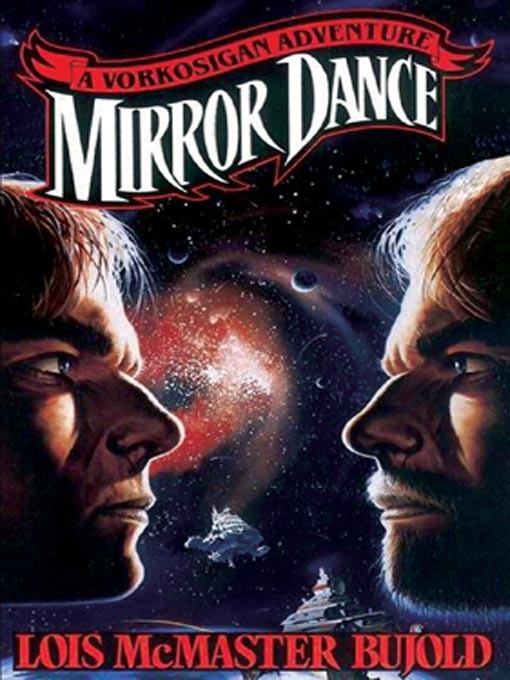
Lois McMaster Bujold had so many award winning books in the 1990s that picking the best is impossible.  The Vor Game, Barrayar, Mirror Dance, Cetaganda, Memory, Komarr and A Civil Campaign are probably getting even more readers today than in the 1990s.  The Vorkosigan Saga just keeps on growing.  And fans debate whether new readers should follow publication order or internal chronological order.

mirror-dance

Connie Willis won five Hugos and three Nebulas in the 1990s, with The Doomsday Book winning both.  Willis has carved out a much loved series based on time travel and history, blending two genres together, and like Bujold, Willis keeps expanding her series today.

the-doomsday-book

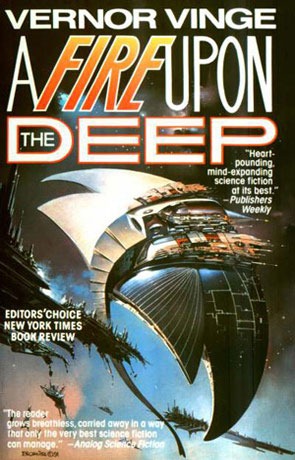
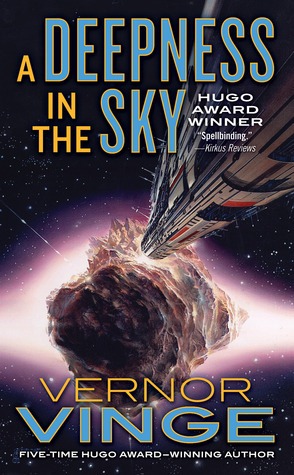
Vernor Vinge picked up two Hugos and two Nebula nominations for A Fire Upon the Deep and A Deepness in the Sky, proving that fans still love a good space opera.

a-fire-upon-the-deep

Some people have asked me how I make up these lists of memorable science fiction books.  The first one, about the 1950s, was more from personal memory, but eventually I discovered various resources I used for the later decades.  I start with Internet Speculative Fiction Database.  I use its advanced search and look up novels, language and type.   I only worry about books in English.  I go down their listings looking for books I remember reading or reading about.  I can right click on any title to bring up it’s bibliographic record which includes how often it was reprinted and whether or not it won any awards.  Most valuable is whether the book made the Locus Poll that year.  That’s the first indicator how popular a book was with the fans during the year it came out.

I also study various best of lists to discern long term popularity.  I look for books that get picked time and again.  This is how I create the short list called the Best Remembered books.  The longer Defining Books list are those books which got particular notice during the year they came out.  Most of these have been frequently reprinted and are often on some of the best SF of all time lists.  I avoided fantasy novels unless they won or were nominated for the Hugo, Nebula, or other SF award.

Best of Book Lists

The Best Remembered Science Fiction Books of the 1990s

The Defining Science Fiction Books of the 1990s

1990

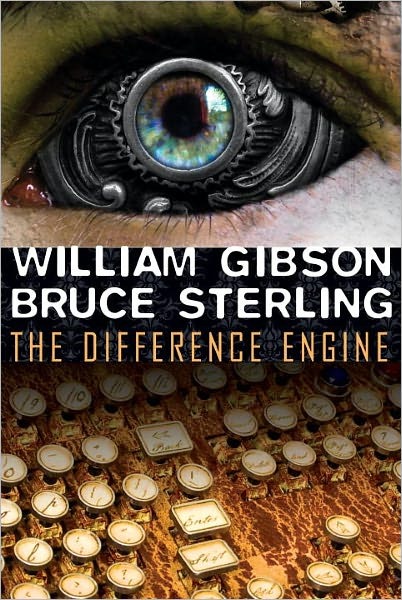
the-difference-engine
1991

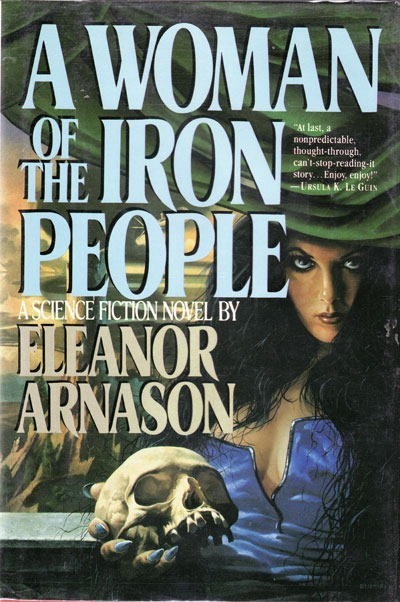
a-woman-of-the-iron-people
1992

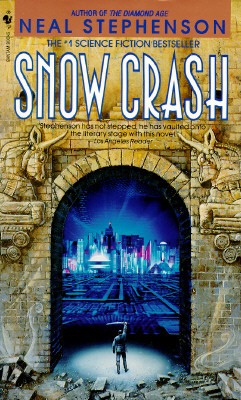
snow-crash
1993

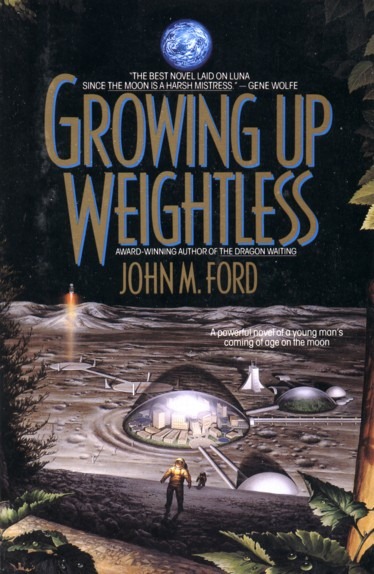
john-m-ford-growing-up-weightless
1994

permutation-city
1995

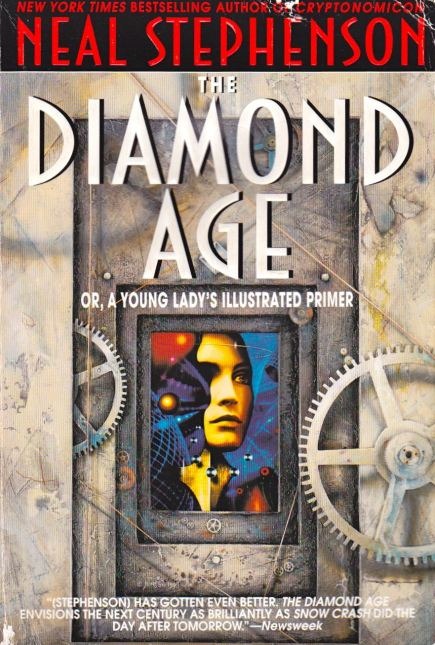
the-diamond-age
1996

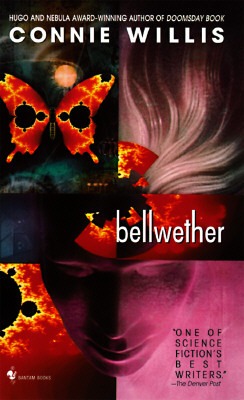
bellwether
1997
Fools War Zettel
1998

1999

a-deepness-in-the-sky
1950s 1960s 1970s 1980s 1990s

Table of Contents

The Second Renaissance in Astronomy

If you are young, are you prepared for the next fifty years?

If you are old, have you digested the last fifty years?

The future will be everything you never imagined.  And it gets here far faster than you planned.

When I was a boy the solar system had 9 planets, 31 moons, and an asteroid belt.  This was before the discovery of the cosmic background radiation and Fred Hoyle was still making a good case for the steady state theory against the big bang theory.

Fifty years later the solar system has 8 planets, 5 dwarf planets,  178 moons, an asteroid belt, a Kuiper Belt, and an Oort Cloud.  The Big Bang won.

… and we’ve discovered thousands of exoplanets!

The world’s largest telescope from 1949 to 1992 was the 200 inch (5 meters) Hale Telescope on Mount Palomar.  In the 1960s we were told it would be extremely difficult to engineer a larger land based scope, so we’d need a telescope in space to surpass the physical limitations of ground based observatories.  Of course, the world of astronomy was knocked on its ass by the success of the Hubble Space Telescope in the 1990s.  Most astronomy photos I admired in the 1960s were black and white, which left the impression that the universe was little more than fifty shades of gray.  The Hubble Space Telescope revealed an immense Technicolor reality beyond our skies, liked Dorothy opening the door to Oz.

The futurists of the past were wrong.  For the past twenty years there’s been a building boom in giant Earth based telescopes.  Astronomers are now using 10 meter telescopes like the W. M. Keck Observatory, and the Gran Telescopio Cararias.

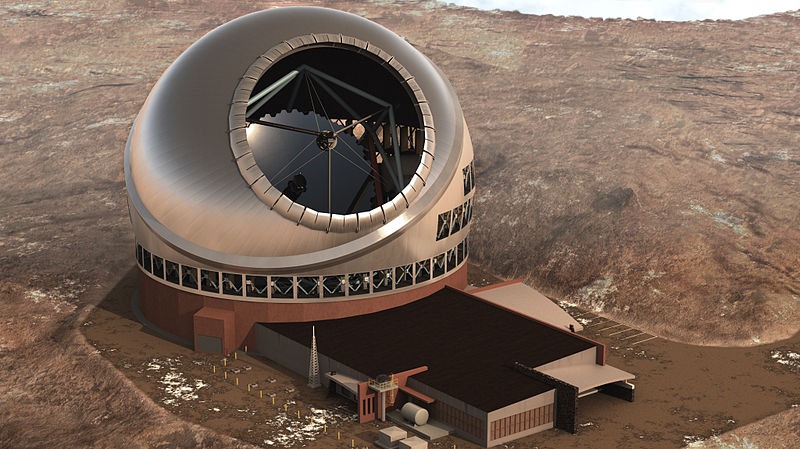
Last week  the Thirty Meter Telescope got permission to build at the summit of Mauna Kea, with an estimated completion in 2018.

thirty-meter-telescope

The European Extremely Large Telescope (E-ELT) has also gotten permission to build a 39 meter telescope in Chile with an estimated completion date of 2022.

E-ELT

Both images are artist’s conceptions.

The list of the largest telescopes now shows 18 telescopes larger than the Hale Telescope that was so mind blowing to me as a kid.  Plus technologies like astronomical interferometry and adaptive optics let astronomers get more bang for the buck per aperture meter than ever imagined by pre-digital age telescope designers.  Essentially, modern engineers have gone way beyond the laws of 1960s physics.

For most Earthlings, astronomy is a science best left to super-geeks, but that will change, just like society changed after Copernicus and Galileo made their orthodox shattering observations.  As the telescopes get larger, the closer they get to detecting life and even intelligent life on far off extrasolar planets.  With more powerful telescopes we’ll be able to image planets directly, and do spectrographic analysis of their atmospheres.  Scientists will be able to detect biomarkers that will prove whether we’re alone in the universe.

Now that’s big!  How will such news change us?  Will it cause a new renaissance?

Probably such discoveries won’t change human life at the rat-race eye view.  We do live in a world where most people still think pre-Enlightenment thoughts.

Ever since Copernicus there have been people writing about life on other worlds.  Even the classical Greeks theorized about other worlds inhabited by intelligent beings.  For over a hundred years now, since H. G. Wells, popular media has entertained us with stories of alien invaders.  So what will happen to the people of Earth when astronomers point to stars and tell us they have planets orbiting them with chemicals in their atmospheres that can’t be made naturally?

Astronomy describes the scope of reality beyond Earth, it’s size and how it works.  Copernicus shook up the world by telling us the Earth moves.  What will it mean when astronomers prove we’re not alone?

Engineers are designing 100 meter telescopes.  What if we built a 100 meter telescope in space, say on the Moon.  That could happen in fifty years.  There is no way to imagine what discoveries it could make.

If you are young, in fifty years you will be writing an essay like this one.  The details will be much different.

References

JWH – 4/20/13

p.s.  Back in 1964 my younger self sided with Fred Hoyle. I thought the steady state theory more elegant philosophically. Hey, I was only 13. But if the multiverse pans out, old Fred and I will be vindicated.  So, what comes around, goes around.