Models of Making Money by Making Music

Songwriters and performers dream of writing a hit song that will be heard by millions and make them rich enough to quit their day jobs.  As a life-long music lover I want my song making heroes to make as much money as possible, so it disturbs me when I read stories like “Get Ready for the Streaming-Music Die Off” that report artists are making so little from my favorite method of buying music that it might die off.  I’m upset that the artists aren’t getting paid properly, and I’m upset that I’m losing my favorite all-time method of buying music.

Music is very important to me, it’s brought my life much joy, solace, inspiration, happiness, stimulation, and pleasure.  It’s well worth the money I pay for it, and it’s angers me that so many people don’t.  Anyone who doesn’t pay for their music has no respect for music, or its creators.  Nor do they have any respect for capitalism and our economic well being.  With the music business we want to do two things:  reward the creators of music, and reward the business of promoting, publishing and distributing of music.  Sadly, it appears that the publishers of music have always been greedy and routinely ripped off their artists.  With the new digital technologies of music distributions it appears artists are getting an even shorter end of the stick than ever before.

Most people think little about music, and even less about how it’s bought and sold.  But if you love music, and you know who you are, it’s very important to know how your favorite artists are paid – their songs are the soundtrack of your life.  But we want more than that.  We want to promote economic strength in our country, and we want a vital music industry.  Americans are making less and less to sell to the world, so unless you want everyone working at a fast food counter, it’s important to promote industry too.

What Business Models Benefit the Artists?

There are two basic ways to sell music:

  • Artists sell digital and physical records directly to their fans
  • Artists sign with a publisher that sell their work in a variety of ways

In a perfect world fans and artists would cut out the middle man, but there’s a problem.  Getting a million people to listen to your song is hard.  Getting ten million people to hear it is far more than ten times harder.  If you want to get rich selling music you have to work with a publisher, and that involves working with loads of other people that take a cut out of the preverbal pie.

Every Tuesday new albums come out.  On Rdio I page through so many I can’t count them.  There are millions of would-be recording stars out there, all wanting millions of other people to listen and buy their music.  Most, if not practically all of them, will never make any money, not the kind of money that would let them live off their creative efforts.  In all the articles I read about the artists complaining of unfair treatment by the music publishers, I don’t see any figures on how many fans does an artist have to find to make a living.  That would be very interesting to know.  If a song writer wants to make a million dollars on his song, how many people have to buy the song directly, or listen on the radio, or hear it from one of the ever growing ways of hearing new tunes.

We know if an artist sells a song on their web site for a $1, it will take 1 million fans buying the song.  But how many would it take if the song was sold on iTunes or Amazon?  How many plays would it take to make a million dollars from fans listening on Spotify or Rdio?  Or Pandora or iTunes Radio?  Or just a plain old radio?  Each method of distribution has it’s costs, and investors that want their share of the action.

Artists are complaining bitterly about streaming music services not paying enough, but as the article linked above shows, it’s the music publishers who make the deals with the streaming services, and it might not be the streaming services to blame for low royalties.

I now get my music almost exclusively through Rdio, which I play $9.99 a month.  I’m contributing $120 a year to the music industry and their artists.  It troubles me when I hear that artists get little from this business model.  Would I benefit artists and the industry more by buying $120 worth of CDs?  Or $120 worth of MP3s from Amazon or iTunes?

To complicate the mathematical understanding of this problem, many of the songs I play on Rdio are ones I already own on CD.  I use Rdio as a convenience.  My favorite playlist is just over 200 songs.  I play it 90% of the time, and listen to new albums 10% of the time to find new songs to add to my playlists.  Probably 100 of those 200 songs I own already, so for about $120 I could buy the others, and go the MP3 buying model of business.  If I did that, I’d probably spend about $50 a year on new songs.

It’s doubtful I’d ever go back to buying physical CDs.  That means paying $120 a year to Rdio puts me at my maximum spending, and the artists on my playlist are getting paid a tiny fraction of a cent every time I play one of their songs.  Thus the solution by my standards would be to pay the artists at a higher rate, and the publishers less.

What Business Models Benefit the Fans?

For most music fans, the casual back ground music listeners, radio, whether AM, FM or various internet service, getting music for free is all they want.  They pay for their music by listening to ads.

Let’s ignore the barbarians that steal music.

Next up are fans who love songs enough to buy them.  They might buy a handful of songs a year, just the ones that are catchy enough to keep.  They will spend a $1.29 here and there.  Over their lifetime they will collect and own a playlist of their favorites.

Then we have fans willing to buy whole albums from their favorite artists, either digital or physical.  They are willing to commit $10-15, or more.  These kinds of music lovers often buy one or more albums a month.  However, this model of business is disappearing.  Fewer and fewer fans collect albums.

For the hard core music fan that loves the widest variety of music, nothing beats streaming music at $10 a month.  (Or $5/month if you only listen from your computer.)

How to Grow the Industry?

Streaming music is based on the idea that fans will pay a monthly fee to hear whatever they want whenever they want.  $10 a month gets convenience.  This is the model I prefer.  I was hoping this model would be the one to succeed.  I show off Rdio every chance I get, but I have convinced damn few people to buy it.  The streaming music model is like owning a giant record store for $10 a month.  It’s an unbelievable deal, but it’s not popular.  Spotify is hoping to get 40 million subscribers, but only has six million now.  It would take a 100  million subscribers to make subscription music a 12 billion dollar a year industry, and that’s not likely, but it would make music into a cable TV like industry.

If digital music had never existed, and the only way to own music was via physical media, the music industry would be huge, but I doubt we’ll return to that business model.

Let me tell you a story.  My friend Leigh Ann brought over a stack of old LPs she had.  She thinks she got them from an estate sale.  They were old Broadway show soundtracks from the 1950s and 1960s.  They looked rare, valuable and in good condition.  Most of them were on Rdio.  My $10 a month gets me whole areas of music I’ve never even tried.  Mostly I use my $10 a month service to play the same 200 songs over and over again.  I haven’t even begun to explore 1/10th of 1/10th of the music on Rdio.  $10 a month for unlimited streaming music is the best money I’ve spent in my life.

Leigh Ann and I started playing her albums but it became obvious that it was much easier just to call them up on Rdio.  I could buy her albums, but the artists that created them wouldn’t get paid.  Someone, probably not the original artists, do get paid, even if it’s a tiny amount, if I play them on Rdio.

Artists should get better rates from subscription music, but subscription music should be the model to market music.  It has one fair concept – artists are paid every time a song is played.  That’s better than what they get from stolen MP3s or people buying used LPs and CDs.  And streaming music keeps millions of albums in print that would be forgotten.

JWH – 12/6/13
Nutritional Rating Systems

I’ve always eaten what I liked, usually junk food, but for decades I’ve longed to eat healthier and lose weight.  Now I have to eat healthy because of my heart.   Eating healthy has always been a vague concept:  avoid junk food, eat natural foods.  What exactly are healthy foods? What are junk foods?  Is there a scientific, quantitative way of judging foods?

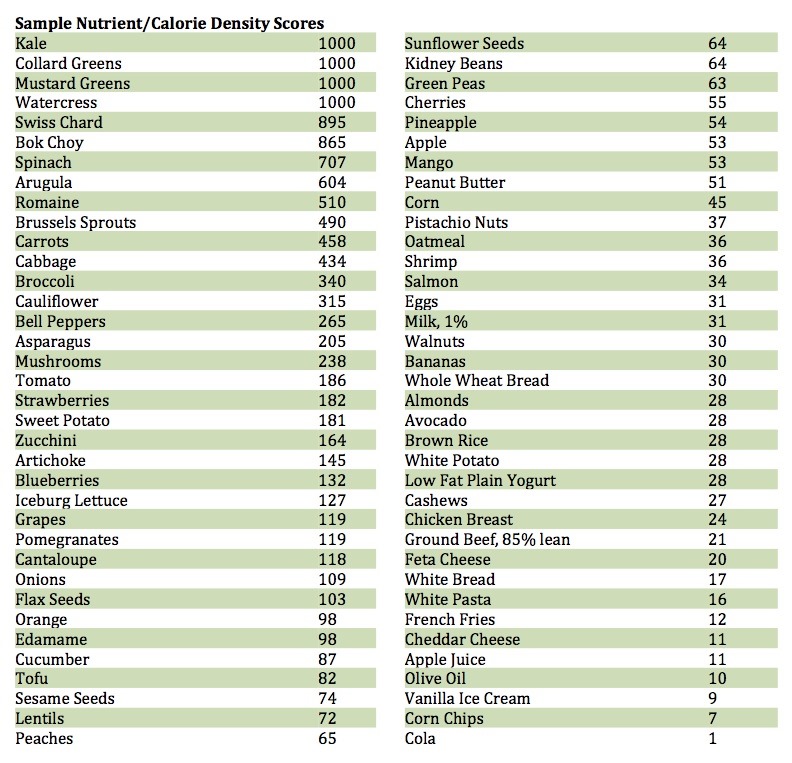
I started studying Dr. Joel Fuhrman, a health guru I discovered on a PBS fund drive.  I made the pledge and got a bunch of books and videos by Fuhrman.  From Fuhrman’s book Eat to Live I read about his nutrition index which I’ve since discovered evolved into the Aggregate Nutrient Density Index (ANDI).  Just look at this chart to get an idea how it works.  It’s rather revealing in a simple obvious way.

ANDI-scores

[Click for larger image]

Is kale really a 1,000 times better than a glass of Coke?  That’s not hard to believe, I would have thought it infinitely greater.  But what about something healthier sounding?  Is kale 50 times better than feta cheese?  Or 20 times more nutritious than peanut butter?  Only if you’re just counting micronutrients.  But Dr. Fuhrman believes phytochemicals are the real key to health.  His books and lectures are quite persuasive in convincing me that eating very nutritional foods can actual reverse my clogged arteries and reduce my cholesterol.

The trouble is, when I tried his starter diet it made me feel awful, and I hated eating the prescribed food.  Fuhrman claims there’s a barrier to get through, and once on the other side I’d feel great.  I’m going to try again, but this time I’m going to work my way into slowly.  Fuhrman doesn’t want his converts to be pussies, but to bite the bullet and jump into eating healthy cold turkey.  I’m having a problem with that.  So I’m going to improve my diet by improving my numbers.

My point however, in writing this essay is to explore nutritional rating systems.  The idea of food coming with a score is appealing, especially when the rating is based on quality rather than quantity, which is essentially what calories count.  When I look at the above list and see that carrots are almost ten times more valuable than an apple it makes me wonder why an apple a day keeps the doctor away.  The ANDI system is far from perfect though, which measures micronutrient density per calorie.  Almonds get a rating of 28, yet I’m seeing all kinds of reports about how almonds are good for you.  And why is a white potato equal to brown rice?  See, they both have equal levels of micronutrients, but the ANDI system makes no claim about macronutrients, or energy producing values of carbohydrates, proteins and fats.  Low value ANDI foods can and do include valuable chemicals that our body needs but is not reflected in their numeric scale.

There’s another rating system that is more complex, that also rates processed foods, called the NuVal, that scores foods from 1-100.  In this system broccoli scores a 100, avocadoes get an 89, but Pepperidge Farm Goldfish are 20.  Iceberg lettuce gets a 82 and pineapple gets a 99.  That doesn’t seem to jive with the ANDI system, but that’s because it’s counting other qualities including fiber.  NuVal is used in over 1700 supermarkets to help shoppers compare all kinds of foods.

Fuhrman’s ANDI system is designed to recognize the healthful benefits of phytochemicals in whole foods.  It’s more of a specialized system.  NuVal is a comparison system to be used by all food manufactures for marketing purposes.   Both have their value.  For my purpose, I value the ANDI system more.  I want to create my own menu of healthy foods to cook, and want to get away from eating prepackaged processed foods.

I can also look at the bigger picture of any food by looking at sites like NutritionData – see this page for kale, which give extensive data, including the amino acids in the protein breakdown.

kale

I doubt I’ll ever need this level of detail information.  Dr. Fuhrman claims if you eat a variety of high value fruits and vegetables from the ANDI system you’ll get everything you need.  But I’m a vegetarian and need to worry about protein.  I do think the ANDI system is a great scale to eat by, but not the only one.

JWH – 12/5/13

Designing My Own Restaurant Style Menu for Healthy Eating

The other day I wrote, “Simplifying an Overloaded Life” which has inspired me to work on a single goal developing a healthy diet.  This morning, in the predawn darkness of being neither awake or asleep, a good idea came to me.  I imagined creating a menu, like the kind we use in restaurants, that would have all the healthy foods and dishes I could eat for breakfast, lunch, dinner and snacks, listed in an attractive way, that will remind me of what I might want to eat, or should eat.  If it’s not on the menu, then I don’t eat it.

health-cook-books

[click on photo for larger image]

I even imagined using Microsoft Publisher to lay out this menu with attractive lettering and appetizing photos, printing it on card stock, and even having it laminated.  I pictured myself pulling out this menu whenever I got hungry so it would remind me just what I could eat, knowing that if I ordered from this Healthy Living Home Menu, I’d be eating just what I need to feel better and lose weight.

Of course, in the light of day, this appears to be quite an ambitious project.  What if my menu offers twelve different dishes for breakfast, lunch and supper?  That’s learning how to cook 36 meals.  Damn, that sounds like a lot.  28 has always been my favorite number, so let’s go with eight items for breakfast, and ten for lunch and supper.  Even that sounds too ambitious. 

Of course I know myself.  I cook one thing and eat on it three days, and freeze any leftovers.  I tend to eat the same breakfast every day.  Right now I live off of about six different meals I know how to prepare, but what I need to do is eat more variety of vegetables and fruits, so I need to expand that repertoire of items on my menu.

I’ve decided that December is the month I’ll totally focus on learning to eat healthy as my one and only goal.  Here’s what I plan to do:

  1. Gather all my diet/health/cook books into one place for study (see photo).
  2. Read and compare these books for their best recommendations.
  3. Write down the best advice and tips I read in Evernote.
  4. Learn how to shop for the best foods I should eat – how to tell when fruits and vegetables are in season, at their best to buy, etc.
  5. Learn how to store food for optimal quality – fruits, veggies, spices, condiments,  dairy, eggs, nuts, etc.
  6. Learn how to chop and cook food properly.
  7. Select 20-30 recipes to master and start learning to cook them – save them in Evernote.
  8. Create and print my menu of approved foods.
  9. When at home, only eat from that menu. 
  10. Research menus at local restaurants for their most healthy meals and make a list of approved away from home menu items.
  11. Make a list of all foods and ingredients I want eat and know about, and why they are good for me, and if they have any curative powers.

One problem I’ve always had when I’m at the store, especially a healthy one like Whole Foods or Fresh Market, is seeing all the fruits and vegetables and not knowing how to select and prepare most of them.  Recently I’ve been adventurous and started buying avocados after some training with my friend Janis.  I’m still never sure how to pick out a good one, but I’ve learn how to cut them open, even though I make a mess, but all I do is put a few slices on my salad and then I have half an avocado that I don’t know what do with.  I really need to get to know fruits and vegetables.

I also need to learn how to use spices.  I can cook by a recipe, but crudely.  What I like to do is think of a selection of tasty veggies and make a stir fry or soup, but I’m never sure how to season my concoctions.  So in studying my cookbook, I need to select a range of recipes that will educate myself about spices.

I assume my menu will be a good place to save all the recipes I want to master, so it might end up like a small book.

My ultimate goal is to simplify my life.  I want to get past thinking about what I should eat.  I want to get past thinking about how to live healthy.  I want to learn what’s in my diet/health/cook books and then give them away.  I want to stop worrying about what I should eat.  I want to stop worrying about eating an unhealthy diet.

I want to start the new year without having to make any resolutions about dieting.

JWH – 12/4/13

Please Recommend SF Books for a Course on Technology and Culture

A friend of mine has a friend that wants to create a course on the impact of technology on culture as seen through science fiction.  Since she knows I’m a Sci-Fi nut, she asked me for author and book recommendations.  This sounded like a fun challenge until I started thinking about concrete examples.  I wondered if most classic science fiction books and authors from the past still count?  When does science fiction go stale?

windup-girl

Does Neuromancer still work to show off the effect of a wired world?  Or would Little Brother by Cory Doctorow be more relevant now?  What’s a good book about robots?  Everyone immediately thinks of Asimov, but his stories are so quaint now that we have real robots.  Would Robert Sawyer’s Wake, Watch, Wonder Trilogy be a better story about intelligent machines and what they would mean to society?

What would be a good book for genetics and longevity?  I could recommend the movie Gattaca, but what book?  What about Holy Fire by Bruce Sterling?

For the impact of technology to deal with global warming and running out of oil, I’d highly recommend The Windup Girl by Paolo Bacigalupi.

There’s zillions of space travel books but do any of them explore the impact of space travel on world culture?  Quite often science fiction is about a technology without being about its impact on society.  Think of all the stories about SETI.  Contact by Carl Sagan is the most famous, but does it really say much about what it would mean to the people of Earth if we started getting messages from the stars? 

How would our lives on Earth be different if humans colonized Mars?

If you think about it, our current society is far more tech driven than any science fiction book I’ve ever read.  What novel captures us now?  I thought about Ready Player One by Ernest Cline.

And should we list books where technology destroys civilization like The Road by Cormac McCarthy?  Or what about books that want to rebuild technology after our culture collapses like Earth Abides by George R. Stewart, The Long Tomorrow by Leigh Brackett and A Canticle for Leibowitz by Walter M. Miller, Jr.?

Are there any technological utopias portrayed in recent science fiction books?  2312 by Kim Stanley Robinson is very hopeful I’d say.

I’m sure I’m missing the obvious, but I also believe there are many great books written in the last twenty years that are excellent but I haven’t read them.  Tell me about them.

JWH – 12/3/13

Simplifying an Overloaded Life

I found a web site today that inspires me, Zen Habits by Leo Babauta.  Babauta claims to have found a key to successful living by making one small change at a time, and over time these small changes have led to major changes in his life.  Since he is succeeding at things I have longed to attain, his web site made me sit up and take notice.

zenstones

I have been trying to make dozens of changes in my life for years, and although I succeed in small ways, it’s always with one step forward and two steps back inefficiency.  Babauta’s breakthrough insight is to pick one goal, focus on it exclusively, and stick to it until it becomes a habit before attempting any other changes.  He even created The Sea Change Program that focused on 12 monthly goals, many of which matched mine.  Unfortunately, his study group seems to have been designed for 2013, so I’m 12 months late.  His goals were:  stop procrastinating, eat healthier, meditate, exercise, write daily, simplify your day, get organized, declutter, be grateful, reduce/eliminate debt, read more and let go – are almost a perfect fit to my goals, if I had the sense to organize my thoughts, which is why they resonate so strongly.

Procrastination

My life has been one long act of procrastination.  I have so many things that I try to do, that I want to do, that I feel required to do, that I do very little at all. Also my sense of decisiveness makes Hamlet look like General Douglas MacArthur.  Babauta’s idea of picking one goal and sticking to it exclusively until it’s attain scares me on many levels.  First, I have to pick the one and only goal, two I have to ignore all the others, and three I have to act.  That requires both decisiveness and commitment, two traits that aren’t in my genetic makeup.

Health

Interestingly, Babauta’s second goal is to eat healthier.  Because my arteries got clogged enough to require getting a heart stent this year, plus discovering that I’m gluten intolerant, and finally having my GP and cardiologist both freak out over my cholesterol just weeks apart causes outside forces to make a decisive decision for me – eat healthier.  So my goal for December 2013 is to studying my diet and health books and solve once and for all what my eating habits should be.  I have books by five different doctors each claiming their diet will restore my health – unfortunately they don’t completely agree.  Strangely enough, they do agree on enough to make certain eating decisions obvious – eat more vegetables and fruits, and stop eating junk food, that I can commit to the basics right away.

My goal for December will be to study all my health and diet books, decide what is good to eat, to stop eating what is bad, to develop a repertoire of meals to regularly cook, research menus at local restaurants that will support my healthy diet, study how to buy and store fresh healthy produce, learn techniques to cook all the meals I need to eat, and then stick to my diet so I can give away all my health and diet books and stop thinking about food.

Discovering that I’m gluten intolerant has been interesting.  I’ve had stomach problems for years which I’ve attributed to many causes, but now that I’ve gone several weeks without Pepcid and Tums,  and my stomach is quiet, the chest pains have faded away, the pains in my knee have disappeared, and my hip pain has been reduced so much that on some days I don’t even notice it, I’ve come to believe that what I eat does affect my health.  Now I just need to learn what to eat or not eat to reduce the clogging in my arteries.  My cardiologist doesn’t seem to believe that diet can reverse plague in arteries, but I have books by other doctors who claim it can.  I need to follow what they say to test their theory.

Meditate

Mediating has always been a mystery to me, but I keep coming across people who claim it works.  It shall be a future goal.  I wonder why Babauta ranks it third though.  Obviously he considers it very important.

Exercise

I already routinely do physical therapy exercises for my spinal stenosis related back problems.  My next goal is to commit to additional daily exercises that are more aerobic, strength and stamina building.  I don’t see why I can’t combine this with my December health goal, but I’ll follow Babauta’s advice and make it a separate goal for January.

Write Daily

I already write daily, but it’s blogging.  My ultimate goal once I get my health related goals accomplished is to write fiction daily.

Simplify

Now this goal is one I ache to achieve.  Years ago when I got my debt under control it was by focusing on paying off one debt at a time until I had only one credit card which I charged everything and paid off each month.  This mirrors Babauta’s ideas about goals.  I haven’t worried about paying bills since.  My daily life is so full of distractions that I feel like I have a thousand bill collectors after me.  The major cause of this is I want to do too many things.  I need to simplify my goals and ambitions.  I’d like to get up in the morning and only think about writing my novel.

Organize

Three of Babauta’s goals simplify, organize and declutter seem to be closely related.  Maybe as I work on them their individual distinctiveness will emerge.

Declutter

I’m constantly trying to declutter.  I’ve been doing this my whole life.  But fighting the battle of endless crap accumulation is an endless war.  I would think decluttering would come before simplify and organize.  I could write a million words about mental and physical clutter.  I don’t know how I’m ever going to accomplish this goal.  For example, I have over 1,000 books, audiobooks and ebooks that I own hoping to read.  I have a book shopping habit where I buy more books to read in one year than I could read in ten.  And I figure there’s easily 10,000 books I would love to read.  I think I already own more unread books than I have time to read for the rest of my life.  Reading is my life – so how could I possibly declutter all the books in my life?  How do I organize my reading when I want to master all the major literature of history.  When you add music, movies and television shows, you can imagine how cluttered my mind is when it comes my pop culture addiction.

Gratefulness

I’ve always been grateful my whole life.  One of my core hopes is that I have a moment before I die where I can contemplate how grateful I am for this chance to exist before I cease to exist.  This is one goal I have down.  All the time I spend with my friends and family, all books I read, the songs I hear, the shows I watch on television, all remind me how grateful I am to be here. 

Eliminate Debt

I’ve already conquered this goal too except for my mortgage.  Now that I’ve retired I’ve got to learn to spend less, and on that too.

Read More

Another goal I don’t have to worry about.  I should probably study how to read less, but I won’t.  My life is reading.  With audio books, ebooks, tablet computers, the world wide web, I’ve become more and more efficient at reading.

Letting Go

Now this one is complex.  I’m not sure what Babauta plans to say, but I went through a Buddhist phase in my early twenties and it has stuck to me my whole life.  Mentally, I’ve let go of so much over the decades that even though my mind is starting to fail, I like my headspace so much now that I never wish to be younger.  Oh sure, I’d love a younger, healthier body, but I would never trade if it meant I had to go back to a younger mental self.  I’m like a Hindu who has done a lot of work to get off the wheel of life and death, and I wouldn’t want to undo all that effort.  That’s how I define letting go.  But I’m an atheist, so I don’t believe we get multiple lifetimes to work on letting go.  We have to do it all in this lifetime.

But what are we letting go of?  Now that’s the interesting part.  If you’re Buddhist or Hindu, then it’s desire.  If you are Zen Buddhist its illusions.  But if you’re a westerner with heavy Christian heritage, it’s sin.  If you’re an atheist, it’s all three and more.  It’s a complete deprogramming of the past, and the twelve goals Babauta has selected is great start.

JWH – 12/2/13