The Resurrection of Lady Dorthy Mills

by James Wallace Harris

[I’m reprinting some of my Book Riot essays to archive here on my blog.]

lady_dorothy_portrait-651x1024Her name was Dorothy Rachel Melissa Walpole Mills. Born in London, 1889, died in Brighton, 1959. Lady Dorothy Mills published nine novels, five travel books, and one memoir, achieving moderate fame in the 1920s and early 1930s as a British aristocratic woman who traveled alone to Africa, the Middle East, and South America. Her books are decades out-of-print, and she is almost completely forgotten. Lady Dorothy Mills should be resurrected, but copyright law has buried her.

Watching Downton Abbey illustrates Lady Dorothy’s upbringing. She was Lady Mary’s age. Her father was Robert Horace Walpole, the 5thand final Earl of Orford. Like the fictional Robert Crawley, the 7th Earl of Grantham, Lord Walpole married a rich American woman, Louise Melissa Corbin, and only had surviving daughters. He even had to leave his estate to a male relative. Lady Dorothy married Capt. Arthur Mills in 1916, against the family’s wishes, and was cut off from their wealth. Lord Walpole was not as forgiving of a wayward daughter as Lord Grantham.

For those who want more details about her aristocratic life, read “Lady Dorothy… writer, traveler – and free spirit” by Jane Dismore. This is the most comprehensive overview of Mill’s life I’ve found in twenty-four years.

Choosing love over inheritance meant learning to live without servants and being poor. Arthur and Dorothy took up writing to survive. At first Lady Dorothy wrote novels about her society set encountering the seamier side of London. Then she wrote The Road to Timbuktu, a nonfiction book promoting herself as a brave Lady going to places that no white woman had gone before. That got her fame. Of course, western women have been marching across Africa for years. Read Great Women Travel Writers: From 1750 to the Present by Alba Amoia and Bettina Knapp.

As a couple, Dorothy and Arthur were popular with newspaper writers, but Mills’s novels never received much respect from reviewers as her travel books. She was dismissed as a writer for shop girls. Men told her she was reckless for going places women shouldn’t. But Lady Dorothy inspired young women in the 1920s, who also dreamed of adventure, romance, and faraway places. Mills gain notoriety just after women got the vote in England and America, and Lady Dorothy did things that few men did, and many men dreamed of doing.

Her novels were exciting too, writing about safaris, jungle Shangri-las, hunting, opium dens, love affairs with Asians and Africans, living among indigenous people while claiming she had the freedom to go anywhere she damned pleased. A few of her novels used science fiction and fantasy concepts. Lady Dorothy was brave in action and thought.

After 1932. Mills went silent, eventually retiring to a quiet seaside village in England, dying alone in 1959. The mystery of why she stopped writing has always haunted me. Her books disappeared from bookstores decades ago. Few copies of her work are on sale at rare book dealers. Copyright law keeps them from being rescued by the public domain. Three of her earliest novels may be in the public domain, but it is very difficult to tell.
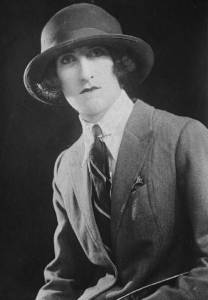
Lady-Dorothy-Mills-from-Library-of-CongressToday, Lady Dorothy is barely remembered, mostly in esoteric history books. She receives just a few sentences or paragraphs in each. History writers use her fiction and nonfiction to document social changes between the wars. Mills lived on the edge, during a decade on the edge. Lady Dorothy sported men’s attire long before Garbo and Dietrich wore it in 1930s movies, not because of style, but because she was competing with the other creatures who wore coats and ties.

In 1926, Lady Dorothy published Phoenix, a science fiction novel about an elderly woman medically rejuvenated to look twenty. Seventy years later, Bruce Sterling had the same idea for his novel, Holy FireIs Phoenix missing from the SF Mistressworks list because it’s a bad book, or because few readers after 1930 got a chance to read it? When does copyright hurt an author?

Since 1992, I’ve been collecting Lady Dorothy’s books, writing about her, and maintaining a website. Every year or two I used to get an email from rare souls who have stumbled across her name. In the last few years, it’s been damn quiet. If her work had been on Project Gutenberg would things be different? Would she have more readers?

There’s a scene at the end of Truffaut’s beautiful film, Fahrenheit 451, where the book people walk through woods memorizing the volume they intend to become. That’s how I think about Lady Dorothy Mills. My dedication is to remember her. I’ve been able to collect twelve of her fifteen books. One, Arms of the Sun, has been for sale for years, but I can’t afford it. That hurts. I’ve even wondered if my writing about Lady Dorothy Mills has driven up their price.

I keep hoping her heirs would put out a collected ebook edition of her work, with distinctive covers using old photographs. At a minimum, I wish the copyright laws were different so fans could scan her books for the public domain.

I’ve long wondered why Lady Dorothy Mills never had her books reprinted. Did inheriting her wealth require giving up writing? Was she an embarrassment to her aristocratic family? Did dismissals in the press turn her against public life? Could she have written just for money? It seems telling when her father died, and she inherited, Lady Dorothy stopped writing? She did continue to travel, but not write.

After traveling far more roads than Jack Kerouac, and exploring more jungles, deserts, and mountains than most male adventure novelists, maybe Lady Dorothy tired of fame. She had passed forty. Why did she choose to disappear, forget writing, and let her books be forgotten? I can’t stop asking that.

Her family had treated her badly. So did her husband. And some book reviewers. Although, I’ve been told by a modern scholar comparing her travel book on Liberia to university-sponsored expeditions during the same years, that she did very well. Lady Dorothy traveled to distant lands, it seems to me, to get away from her 1920s society. Her books show hard-won knowledge and revelation. I can’t understand why she didn’t push to keep them in print. Many of her books received multiple printings and editions before 1932.

In A Different Drummer (1930) she describes the state of mind she found when she was far away from civilization:

“However healthy a love one may have of civilization and all its fleshpots, the best thrill of the year is when one leaves them all behind, and sets off for the unknown with a lot of lumpy luggage that contains hardly any clothes at all. It is good to feel that one has left one’s little niche in the everyday world, where each one of us is assessed and tabulated to a nicety; to slough off one’s everyday accepted self, and to lose oneself in the anonymity of a strange country and people, among whom one has to make good solely by the leverage of one’s personality and will to win. The thrill increases till the last vestige of civilization is gone and one is at grips with the unknown, when it comes down to earth, and settles into a hard absorbing fight with primitive conditions; with the problems of health and climate and transport, with the daily struggle for food, water and transport, and the groping after understanding of the strange and sometimes antagonistic people one is among. All the complexities of life disappear, and one is reduced to the state, mental and physical, of a healthy animal. As long as one’s ” tummy ” is reasonably full, and there is a prospect of somewhere safe and dry to sleep, one is perfectly, almost stupidly happy. The creature comforts of life no longer matter. For the first few days one misses one’s bath most terribly, but in a short time, I am ashamed to say, one doesn’t mind if one never had a bath again! Cleanliness may be next to godliness, but in the wilds it comes a long way after food and sleep, or even a good camel.”

Mills laughs about the crazy stories newspapers wanted her to write. One paper offered her a big check to explain why she traveled without her husband. Was fame too much bullshit?

There are other people like me who work to rescue forgotten writers. I met Harry Williams online because he maintains a website for George Mills, Lady Dorothy Mills’s brother-in-law. It’s a fascinating hobby that I recommend, but don’t expect to discover another Pride and PrejudicePhoenix appeals to me like Herland by Charlotte Perkins Gilman. It uses science fiction to make a feminist statement. Could Lady Dorothy Mills ever be resurrected like Gilman? I don’t know.

Libraries used to be heaven for books. Yet, today many books I buy used in hardback are library discards. Phoenix shows up in just four libraries at WorldCat, three in England and one in America. It took me ten years to track down my copy. I haven’t seen another for sale since 2002.

Society needs to consider changing the copyright laws. I can understand why copyright holders want to keep extending the time they can make money, but copyright laws make no sense for books that haven’t sold a single copy for decades. The law should be amended to say that any book that hasn’t been for sale for 25 years is now in the public domain, and all periodicals older than 10 years are in the public domain if they are reproduced whole.

Such changes in the law would allow fans of forgotten books to scan them and put them in Project Gutenberg. Second, periodicals in the public domain will help researchers explore the past. It would also help when authors donate their papers to put them in the public domain. Modern libraries aren’t the research centers they used to be. The Internet is now the World Library.

Lady Dorothy Mills had modest fame over eight decades ago. If her books were in the public domain, few would read them. But for those who do, and for those of us who want to encourage other people to read them, changing the copyright laws could open up the past to human and AI researchers. Copyright law protects books when they are being sold, but hurts when readers no longer buy.
How Important is Screen Size to Television Watching?

by James Wallace Harris, Mondy, June 11, 2018

Some people love watching movies on their smartphone even though those film premiered on IMAX screens using Dolby Atmos speakers. Evidently, the essential quality of a film is in the storytelling. Television viewers used to watch widescreen Technicolor movies on nineteen inch black and white sets and still enjoyed them immensely.

So why should I worry about upgrading my TV to a larger screen and better sound?

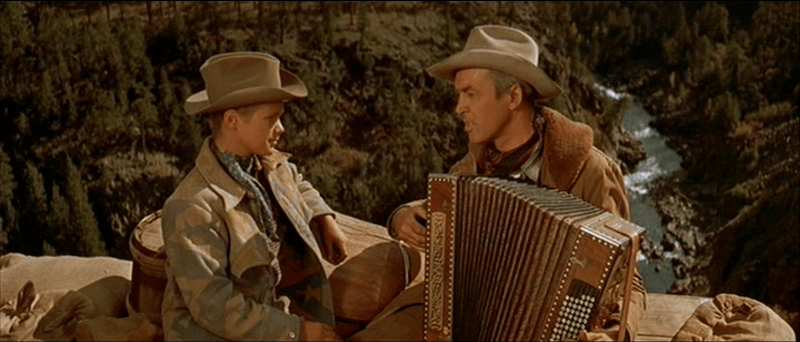
Last night I watched a 1957 western, Night Passage, on a 56″ DLP television via a local over-the-air station called Grit TV. I had recorded it with my TiVo and it cut off the last few seconds. Luckily, I had a DVD copy to watch the ending. When I played the disc I was startled to discover this old western was in 2.35:1 widescreen and the color levels were completely different. When watching the over-the-air version, it didn’t feel like the aspect ratio of 4:3 of old TV pan and scan, because the frame was more rectangular. It had been cropped to be slightly widescreen in appearance.

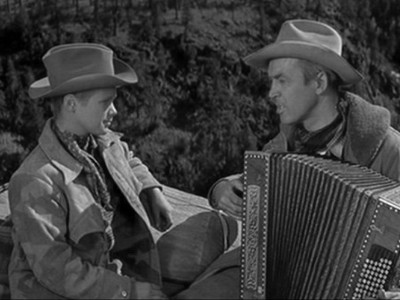
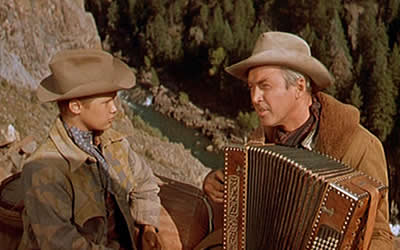
Below is my way of faking what I’m talking about. I wish I could provide real screenshots, but this is close. I just cropped a widescreen scene with Brandon De Wilde and Jimmy Stewart to 400 x 300 pixels and converted it to black and white to imagine what 1950s TV might have been like (it would have been fuzzier). The second is a photo I found that feels more like the Grit TV version. I assume the third photo is the right aspect ratio.

Night-Passage-fake-4to3

Night Passage cropped

Night Passage widescreen

The thing is, I enjoyed the heck out of seeing this movie again. I especially enjoyed the beautiful scenery. The first time I watched this film was on a black and white television set — and I love it then too. I always remember it as a black and white movie even though it’s in color because of first seeing it on a black and white TV set. But when I looked at the DVD version, I felt like I had missed a significant portion of the film. The DVD widescreen view showed far more scenery, was much sharper and probably the color palette more accurate.

What artistic qualities do we miss from movies and television when we only focus on the storytelling? We could just read books instead if all we wanted was a story.

Would I have enjoyed the film more if I had watched the DVD from the beginning? I have dozens of my favorite westerns on DVD and Blu-ray, but quite often I watch them off of Grit TV. It’s just convenient.

I’ve been contemplating giving up the physical technology of CDs, DVDs, SACDs, and Blu-ray discs. 99% of the time I stream music or television. It would simplify my life if I got rid of all my discs.

I love the idea of minimalism, but what am I sacrificing by rejecting the higher resolution discs of my favorite movies, TV shows, and albums? For the most part, streaming music via Spotify isn’t that different from listening to CDs unless I’m concentrating. Streaming movies with Netflix and Amazon are almost as good as Blu-ray if I’m not concentrating.

Watching the DVD on my 56″ TV is probably as close as I can currently get to having seen Night Passage in the theater in 1957. That would be even truer if I had a larger television set. I assume the more I can recreate the cinematographer’s original vision, the more I can experience the original story to its fullest. But what are those extra dimensions beyond storytelling?

Visual and aural realism.

I was looking at TVs at Best Buy today, thinking I’d upgrade to a 65″ television. But my eyes loved the 75″ screens more, and I was blown away by an 83″ model. The bigger the screen, the more I felt like I was seeing reality. That’s also the difference between books and movies. Before movies, writers spent more words describing what readers would see. Such descriptions added realistic details. The better the author was at describing the world in details, the more readers felt like they were reading something based on truth.

Movies give verisimilitude to storytelling. The widescreen version of Night Passage made me feel Jimmy Stewart was actually in all those natural settings and not on a soundstage. When movies were black and white and had an unrealistic square aspect ratio, they were mostly filmed on sets and backlots. Those old films had a tinsel town feel. When we got Technicolor and widescreen, moviemakers went on locations around the world to give us more realism.

Would I experience art as more true-to-life if I built a home theater with a projector TV with a screen in the 100-120″ range? Probably. Is it needed? No. If I was watching a 4K nature documentary I’d certainly feel like I was there more than when watching a smaller set. It’s like when I play CDs and SACDs, I only hear the extra sound texture if I’m concentrating diligently.

It was when I watch a turtle swimming underwater on the largest sets a Best Buy that I noticed the details of the sand and plants it swam over. I then felt like I was there scuba diving. If I watched The Sweet Smell of Success, another 1957 film, I’d feel what it was like sitting in a glamorous smoky bar in New York City with Burt Lancaster and Tony Curtis.

If we watched Downton Abbey at an IMAX theater, the realism of the sets and costumes would be stunning compared to TV watching. Of course, when I tell my wife I want to get a giant screen television she thinks I’m crazy. Why spend so much more money when we already love our twelve-year-old 56″ television? Well, Susan isn’t a good judge of TV technology. She watches television while playing games on her laptop or using Facebook on her iPhone. She needs much less from a story to enjoy it.

The older I get the more I withdraw into my home. Our television set is the way we view the world and visual arts. Is it worth upgrading to 4K? If Night Passage was available on Blu-ray or 4K discs, should I buy them for that extra realism?

Should I give up over-the-air TV? MeTV shows old Perry Mason episodes cropped for modern widescreen TVs without any distortion. Perry never looked better. I tried to find a streaming version of Night Passage to compare, but it’s not available that way. Handmaid’s Tale is stunning to look at on a 56″ TV at 1080p, but what would it look like on a 75″ 4K set, or even projected to 120 inches?

Is wanting a humongous screen just crazy? I could give up all my high-resolution discs, and only live with convenient streaming on a modest 65″ television, but what would I be missing? I suppose someday streaming music and movies will have the same quality as discs and wall-size televisions will be affordable by all and we won’t have to worry about making such decisions.

JWH


When I Can’t Edit My Brain Farts

by James Wallace Harris, Tuesday, June 5, 2018

I’ve never been good at grammar or spelling, especially in early drafts. So when I say I’m experiencing new glitches in my writing, I don’t mean the common mistakes I’ve made all my life. I’d be quite embarrassed if folks read the first drafts of this blog. I rewrite many times before I click Publish, constantly repairing and tweaking words and structure. And even then, I still spot mistakes and wince.

However, in the last few months, I’ve been noticing holes in my sentences where I’ve left out words or tangled them up. They’re a new kind of textual brain farts. For several years I’ve struggled with verbal brain farts, failing to remember names and nouns when talking to my friends. I don’t believe what I’m experiencing is early signs of dementia, but thought glitches caused by slow neuron access times. All my friends my age have similar hiccups with their comm skills. I assume these new mistakes are just more of the same, all part of a slow decline in brain cell efficiency due to normal aging.

Pug

The great thing about writing over talking is I have plenty of time to shape what I say. Writing is like make-up, I can make myself look much better than I really am. What troubles me is when I send an email, or post a comment on a website, and then see a blooper I can’t reshoot. That hurts. Especially when they aren’t grammar/spelling mistakes, but garbled sentences that sound like Yogi Berra imitating Donald Duck.

For me, it’s much more embarrassing when people see snaggled-tooth thoughts than to make a “their, they’re, there” mistake. Blogging is exercising to think clearly. Revising my paragraphs sculpts my thoughts. So reading something I wrote that’s wonky makes me feel I’m losing it. Of course, other people might skip right past my potholes without making judgments. But I’m horrified when I’m reading along and bounce jarringly over a big one.

It doesn’t take a Nostradamus to see aging will bring additional quirks in my quarks, and at some point, I’ll stop making sense. But here’s the Catch-22. If I stop writing my mind will only get worse sooner. Writing is the cure for poor thinking or thinking poorly, even when the brain is turning to mush. I can’t give up.

I’m going to be in real trouble when I stop seeing mistakes. I hate when I can’t edit my brain farts now, but the real horror movie begins when I stop discovering those mistakes.

JWH

Why Do We Dream of Interstellar Travel When It’s Probably an Impossible Dream?

by James Wallace Harris, Monday, June 4, 2018

I’ve always loved science fiction. Dreams of science fiction have felt like our species greatest ambitions. I’m not the only one that feels that way, because space travel enchanted many in the twentieth century. Humans have been imagining how to voyage across space for as long as they’ve known there were destinations to set sail across the sky. Landing on the Moon in 1969 made us believe we could go anywhere in the galaxy. But next year, the 50th anniversary of the Moon landing will only remind us we haven’t.

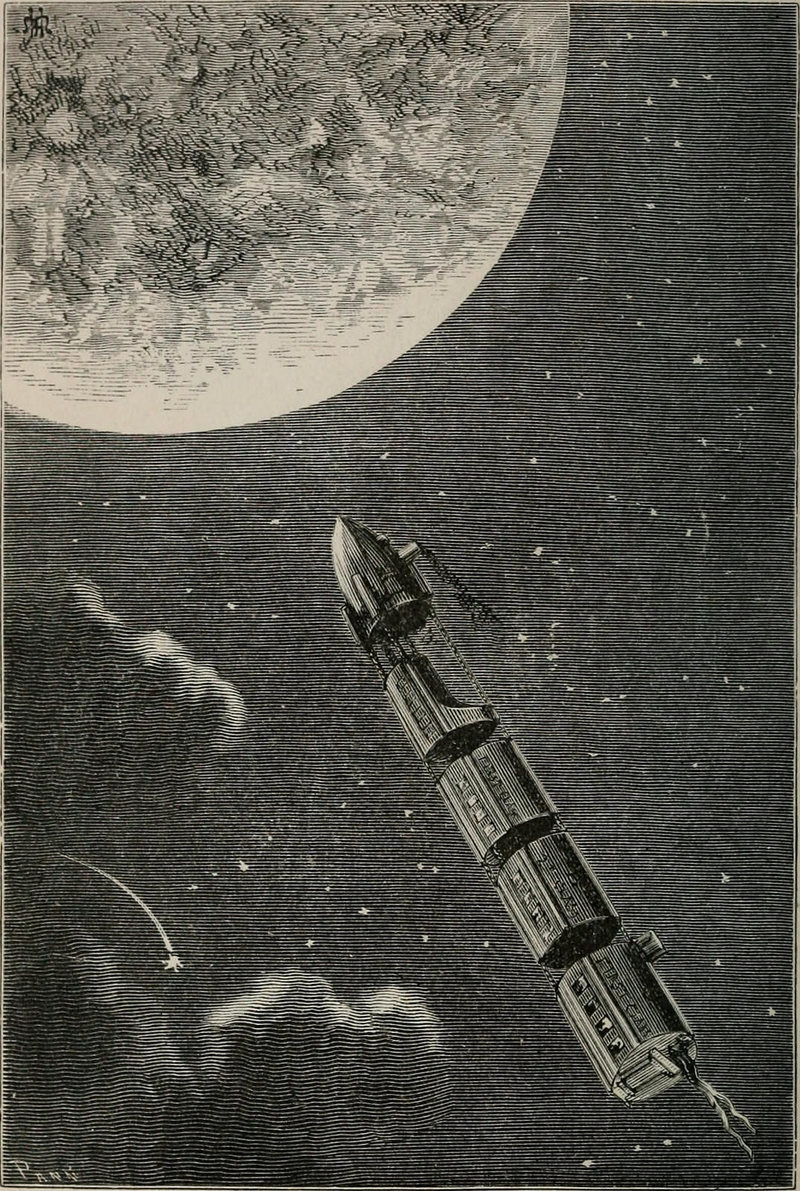
From the Earth to the Moon

When I bring up this subject to science fiction fans, most express a firm faith technology will find a way. I have doubts. Reading science books, rather than science fiction, gives a whole different perspective. My faith fades, and I assume humanity will never go far from Earth. At best, we might put outposts on the Moon and Mars, like those in Antarctica. It will probably never be healthy living off Earth. The more we study living in space, the more we learn that Earth is where our biological bodies are designed to dwell. Shouldn’t science fiction be exploring all these things our species could do in the next million years while stuck on Earth?

Because I’m an atheist I’ve always wondered why people waste their lives in anticipation of heaven. Now I wonder if science fiction’s hope of space travel is equally unrealistic. Strangely, we have far more books and movies about living on other worlds than fantasies about life after death. Is that a shift in faith to something we thought could be actually possible? And what if we find out that dream is just as unreal?

Or am I completely wrong? I’ve always had trouble enjoying fantasy stories because what’s the point of imagining things that can’t happen? Do most science fiction readers see their genre no different from fantasy? I read science fiction because I believe it could come true. Years ago I stopped enjoying stories about faster-than-light travel. Now I’m doubting any story about interstellar travel. I wonder if doubt is happening to science fiction writers too. Just read Aurora by Kim Stanley Robinson.

I’ve always considered Star Wars fantasy but believed Star Trek attempted to be practical science fiction. Yet, when I study the details, Star Trek is no more realistic than Marvel comics. Are all these genres stories for the child that never died in us? When do we grow up and read stories for adults? Isn’t a large portion of TV/movie content aimed at a kind of permanent arrested development in our souls?

When I was a kid I was savvy enough to distrust religion, so why did I buy into science fiction? We have a hunger for the fantastic. We want reality to be more than it is. Is it healthy to justify fantasy as only pretending? We want to aim high in imagining future possibilities, but when is ambition delusion? Why do we reject the mundane for the fantastic?

The Skylark of Space

What if our fantasies are a kind of reality? What if our fantasies are a new dimension we’re creating? A spin-off of this reality. What if all art is creation? Our conscious minds are the accidental byproduct of this universe. We have woken up becoming conscious of reality and said, “I wish it was different.” Maybe all art is fantasy, our blueprints to how we would have designed creation. What if our real desire is to put our conscious minds into our art, our self-created reality?

That philosophy would explain the drive to create VR software or the science fictional hope of downloading our brains into virtual worlds. There are folks who already believe this universe is such a construct.

I don’t know if this is good. Are we not destroying this planet by pursuing our fantasies? Should we not accept the physical reality in which we evolved? We are proud to be an evolved species with high intelligence, but what if we’re really a species with evolved fantasies? Is that creative or delusional?

Can we live in both reality and fantasy while respecting the rules of each?

JWH


Becoming an Expert in a Micro-Expertise

by James Wallace Harris, Thursday, May 31, 2018

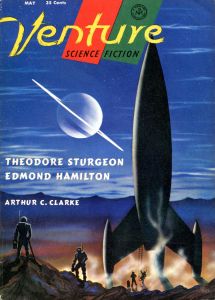
Venture Science Fiction 1958 MayIt’s impossible to know everything about everything. It’s even impossible to know even a little bit about everything. There’s no way to become a generalist, even a half-ass one. That’s why people specialize. But even then, it’s hard to decide just how small an intellectual territory to conquer. Lately, I’ve been absorbing everything I can about science fiction magazines from Amazing Stories (1926) to Worlds of Tomorrow (1963). I’m making my cutoff date 1976, to have a 50-year range, but even that might be too much. I’m considering even sub-specializing on 1951-1969 (birth through high school).

What a weird little patch of knowledge to hoe. I can’t claim it’s meaningful, but out of the whole universe of things to study, it’s what appeals to me at age 66. It’s my way of coping with sensory overload. Yet, even such a microscopic portion of history is too large to master. Now that I am in my social security years, interest in current affairs is dwindling. The present really belongs to the young. I have a handful of small territories I struggle to claim, like movie westerns, 1950s jazz, nineteenth-century art, etc. There’s a special kind of fun in becoming a micro-expert know-it-all.

Marvel Science Fiction 1951 November Hi-ResWhat drives me to conquer various tiny territories of history is the challenge of putting a massive amount of data into a small consumable package. I’ll use my interest in SF magazines for an example. The Wikipedia entry, “History of US science fiction and fantasy magazines to 1950” is an excellent hypertext overview of half my territory I want to explore. And it’s “List of magazines” table is another comprehensive way of looking at it, especially if you follow the links to individual magazine histories. If only this entry was to 1976 or had a part 2, this one article would define the specific science fictional expertise I wish to master. I’d love to write a book that covered this tiny history or package it in a webpage or app.
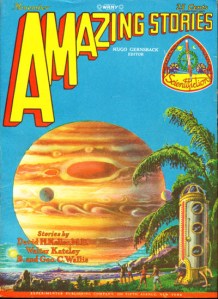
One reason I’d love to focus on little topics is that my mind is letting my general knowledge drain away. I’m theorizing my brain can only hold less, so I jettison the stuff I don’t care about to make room for what I do. But choosing such tiny topics to study isolates me from most people. However, it clearly defines a subculture I wish to identify. I believe everyone needs a few specialties to dwell on. Something we can bore folks with at parties if they’re careless enough to ask, “What are you doing in retirement?”

I connect with most of my friends through everyday living and shared experiences, like television shows, movies, eating out, but it’s nice to have something to intellectually gnaw on that’s uniquely mine. Of course, the history of the science fiction magazine in the mid-20th century is not relevant to real problems we face today, but neither am I. I just love having a small patch of history to putter around. Some people garden in their backyard, I tend a tiny patch of history in my thoughts and blog.

amazing_stories_192811I’ve thought about choosing something contemporary and relevant, like artificial intelligence with Python and R, but I’m not sure my old brain is up chasing a current subject that’s growing too fast even for young geniuses. Focusing limits my scope of study in a comfortable way. Yet, when I outline what I want to know, it’s still a giant pile of data to digest. The pleasant challenge is to organize that data in a way that I might teach it to someone else.
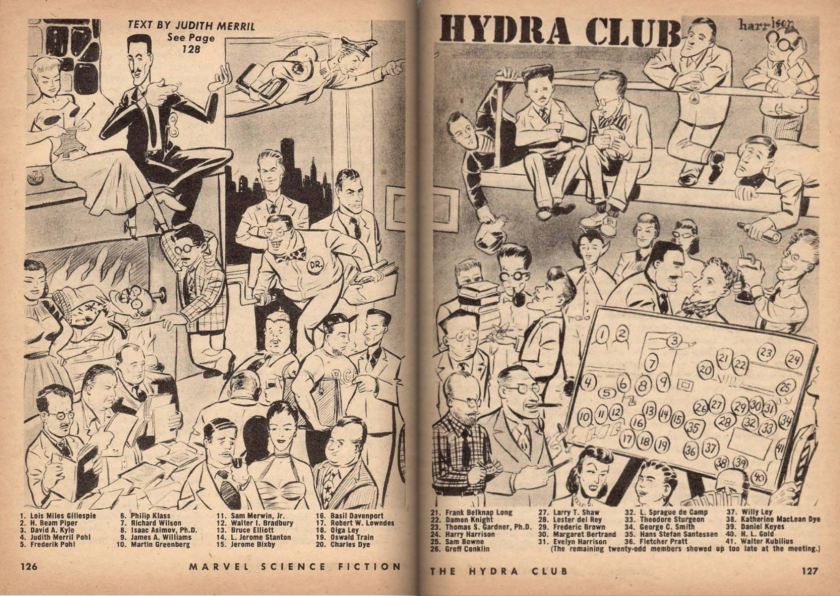
Technology allows me to study science fiction magazines in a way that I couldn’t before the internet. Back in the 1960s when I first became interested in old SF magazines I would have had to spend a fortune to buy and house them. Now I can download digital scans for free and shelve them on an internal solid-state drive the size of a pack of gum. The internet conveniently allows me to locate the histories of the genre, the anthologies that collected the magazines stories into books, the biographies of the writers and editors, digital copies of the primary documents that go with these histories, communicate with other folks studying the same history, and use all the online resources that classify and organize the data that people are building. It’s a great time to become a micro-expert.

The Scope of My Ambition

For a few decades, the center of the universe for written science fiction was the science fiction magazines. Before Star Trek (1966) and Star Wars (1977), science fiction fandom was practically unknown to most people. Science fiction fandom began in their letter columns of the science fiction magazines. Almost all the major SF writers first published in the magazines. The earliest histories and biographies ran as features in the magazines. Most of the classic novels of science fiction were first serialized in the magazines. The earliest gossip and controversies first appeared in the letter columns, which spawned the creation of fanzines. Fanzines were amateur magazines devoted to the genre that devoted most of their content to what was happening in the professional magazines (which fans called prozines).

The history I study covers the magazines and stories, the editors, writers, and artists that worked for the magazines, and the major fans and historians who remember those magazines.

The Magazines

In some ways I’d love to own the actual old magazines – but not really. Pulp paper is now brittle, brown, and fragile. And I’d have to fill all the rooms of my house with bookshelves. And there were too many science fiction magazines for me to care about them all. Here are the science fiction magazines before 1976 that intrigue me enough to collect and study. If you follow the links to Wikipedia you can read very nice concise histories.

Histories

Mike Ashley has published two series of histories just on the science fiction magazine. The older series is mostly an anthology of stories with supplemental essays about the magazines. They include:

  • The History of the Science Fiction Magazine, Part One: 1926–1935 (1974)
  • The History of the Science Fiction Magazine, Part Two: 1936–1945 (1975)
  • The History of the Science Fiction Magazine, Part Three: 1946–1955 (1976)
  • The History of the Science Fiction Magazine, Part Four: 1956–1965 (1978)

The second series are all history, without the stories. These books are expensive, and now that the first three are out of print, they are even more costly to track down. I can’t understand why they aren’t in print as ebooks. I find it annoying that most histories of science fiction are out of print, especially in the age of ebooks and print-on-demand.

  • The Time Machines. The Story of the Science-Fiction Pulp Magazines from the Beginning to 1950 (2000)
  • The Story of the Science Fiction Magazines from 1950 to 1970 (2005)
  • Gateways to Forever. The Story of the Science-Fiction Magazines from 1970 to 1980 (2007)
  • Science Fiction Rebels: The Story of the Science-Fiction Magazines from 1981 to 1990 (2016)

Over the years there have been a few histories and memoirs about specific magazines.

  • A Requiem for Astounding (1964) by Alva Rogers
  • Galaxy Magazine: The Dark and the Light Years (1986) by David Roshelm
  • Astounding Days (1989) by Arthur C. Clarke
  • The Gernsback Days (2004) by Mike Ashley and Robert A. W. Lowndes
  • Astounding (forthcoming 2018) by Alec Nevala-Lee

There are several good essays on the internet about the histories of science fiction magazines.

Then there countless popular and academic histories of science fiction that include histories of the magazines. These are too many to list. What I find fascinating are books that analyze the evolution of science fiction, such as The World Beyond the Hill by Alexei and Cory Panshin. Science fiction has always been a reflection of contemporary popular culture, revealing both the hopes and fears about the future, with unique perspectives from each country in which it was written. China is now generating a new wave of science fiction today, in the same way, the United States did in the 1960s.

Most of the best stories from the old science fiction magazines have been reprinted in books, as novels, as author short-story collections, or as anthologies. What I enjoy about reading the actual old magazines are the editorials, columns, book reviews, essays, letters to the editor, and reports on fandom and fanzines. This gives a history of a subculture. For example, here’s a wonderful illustration of a science fiction club membership by caricature. Hydra Club

I belong to groups on Facebook, Twitter, Yahoo, Groups.io, with members all over the world that love to remember these magazines, its subcultures, and the stories. I think it’s because we all grew up in the 1950s and 1960s and imprinted on science fiction back then. It’s the closest thing I have to a tribe.

JWH