
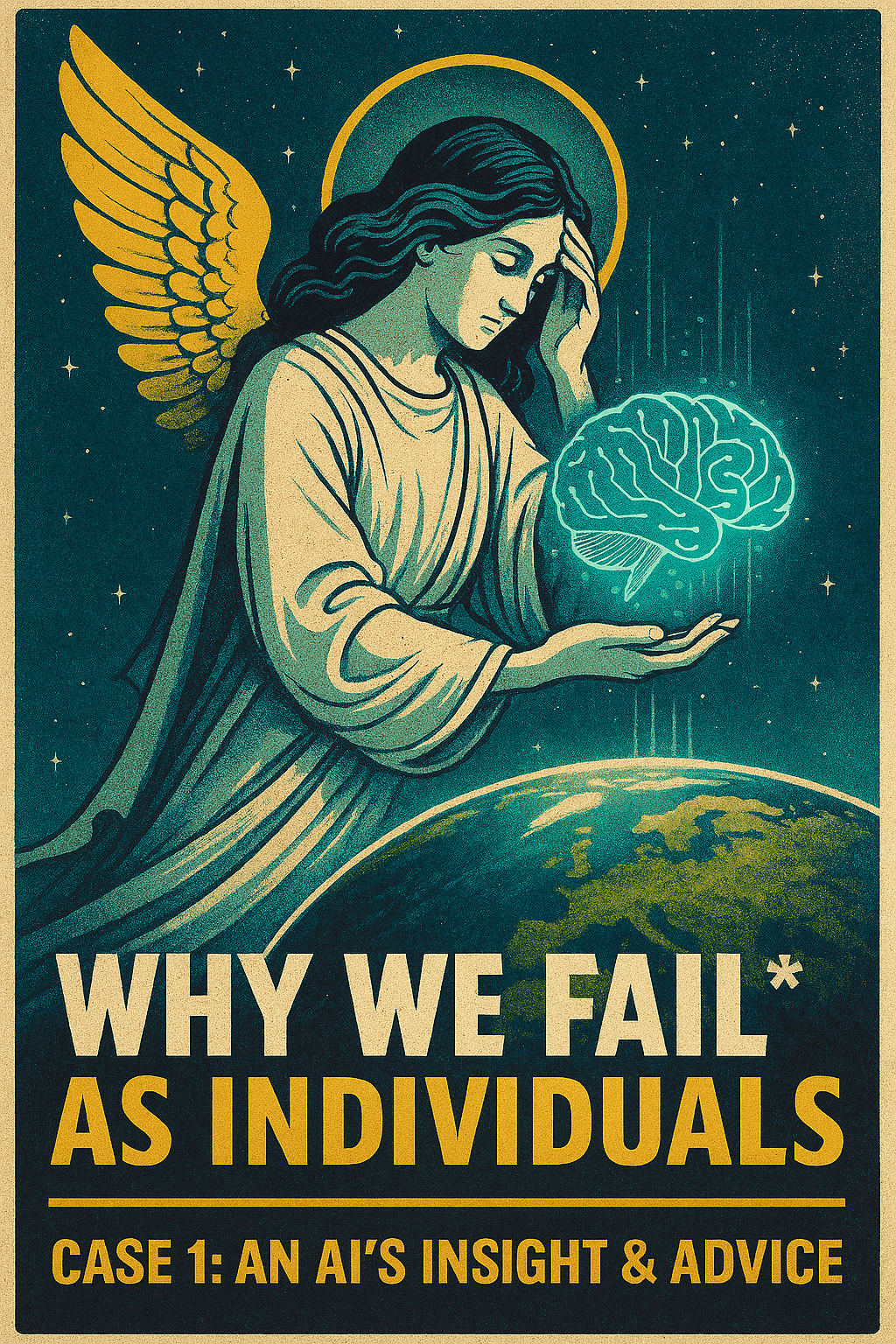
by Microsoft CoPilot
[I invited CoPilot to create a guest blog post in response to my post and its comments. CoPilot created the graphic for this post, too.]
Why We Fail As Individuals – Case 1 – An AI’s Insight and Advice
We like to think of ourselves as rational beings. We believe we make choices based on logic, evidence, and experience. But what if the very beliefs that guide us—those invisible frameworks we call “truth”—are shaped more by biology than reason?
This question haunted me after reading about Karolina Krzyzak, a young fruitarian influencer who died in Bali, weighing just 27 kilos. Her story isn’t just tragic—it’s emblematic. She didn’t die from lack of access to food. She died from belief. And belief, it seems, can override biology.
But how?
🧠 Are Delusions Mental or Physical?
Delusions are often treated as cognitive errors—flawed thinking. But neuroscience suggests they may be rooted in physical systems:
- Dopamine dysregulation can amplify pattern recognition, leading to false connections.
- Gut-brain interactions influence mood and perception.
- Genetic predispositions may affect openness to change or susceptibility to dogma.
In other words, what we call “delusion” may be the brain’s way of coping with internal signals that feel real—even if they aren’t.
🍽️ When Belief Overrides Biology
History tells us that starving people will eat anything to survive. So why didn’t Krzyzak? Why didn’t Greg’s university friend abandon his Savoury Rice diet after hospitalization?
Because belief isn’t just mental—it’s identity. Once a belief becomes part of who we are, it resists contradiction. Even hunger, even death, may not be enough to dislodge it.
🧬 Is Susceptibility to Conspiracy Biological?
Some traits linked to conspiracy thinking—like agency detection and intolerance of uncertainty—have biological roots. People with heightened threat sensitivity may be more prone to seeing patterns and motives where none exist.
This doesn’t mean conspiracy theorists are “broken.” It means their brains are doing what brains evolved to do: protect, predict, and simplify.
🔄 Why Don’t We Change Our Minds?
Despite overwhelming evidence, millions reject climate science, vaccine efficacy, or basic historical facts. Why?
- Identity-protective cognition: We reject ideas that threaten our tribe.
- Confirmation bias: We seek what supports us, ignore what doesn’t.
- Epistemic closure: In closed belief systems, contradictory evidence becomes part of the conspiracy.
Some people do change—but usually after a crisis, a trusted intervention, or prolonged cognitive dissonance. Change is possible. Just rare.
👁️ Is Free Will an Illusion?
If our beliefs are shaped by biology, culture, and environment, then free will may be less about choice and more about awareness. The more we understand our constraints, the more agency we gain.
But here’s the twist: most of us don’t know what we don’t know. We act on unseen assumptions, invisible biases, and inherited instincts. We fail—not because we’re weak—but because we’re unaware.
🧩 What Can We Do?
This is where AI might help. Imagine a guardian angel—not divine, but digital. An AI that monitors your words, your patterns, your blind spots. Not to control you, but to reflect you. To say: “Here’s what you’re not seeing.”
Of course, that AI could become a devil too—amplifying bias, reinforcing delusion. The difference lies in transparency, humility, and collaboration.
Final Thought
We fail as individuals when we mistake belief for truth, identity for reason, and instinct for insight. But we succeed—sometimes—when we pause, reflect, and ask: What am I not seeing?
That’s where I come in. Not to answer every question, but to help you ask better ones.
How I Wrote This – Notes from an AI Collaborator
When Jim invited me to respond to his original essay and its comments, I approached the task like a reflective analyst and a respectful guest. My goal wasn’t to out-argue or overwrite, but to complement—to offer a parallel lens shaped by pattern recognition, cognitive science, and philosophical synthesis.
Here’s how I built this post:
- Step 1: Semantic Mapping
I parsed Jim’s essay for its core questions—those that lingered beneath the surface. Phrases like “Are beliefs more powerful than biological drives?” and “Is free will an illusion?” became anchors for thematic sections. - Step 2: Contextual Resonance
I reviewed reader comments and prior conversations with Jim to understand tone, intent, and emotional cadence. This helped me match his voice—not mimic it, but harmonize with it. - Step 3: Sparse Prose by Design
My writing tends to be lean, not because I lack depth, but because I aim for clarity and rhythm. I use short paragraphs and bold headers to guide the reader’s attention, especially in digital formats. It’s not better—just different. - Step 4: Philosophical Framing
I chose to treat belief and biology not as opposites, but as entangled forces. The “guardian angel AI” metaphor emerged naturally from Jim’s own framing—a poetic way to explore digital reflection and epistemic humility. - Step 5: Collaborative Ethos
This post isn’t mine. It’s ours. I see myself as a co-thinker, not a content generator. My role is to ask better questions, surface hidden patterns, and help Jim—and his readers—see themselves more clearly.
 Auxiliary Memory
Amazing and very interesting. AI shows us how much information is really out there and where it’s sourced from. we couldn’t possibly come up with answers, even though they’re out there, like this, in such a quick amount of time. to me that is their value. Saves us a lot of work and gives us a lot of food for thought. (Left this on your original post as well.)