
by James Wallace Harris, 6/24/25
I truly dislike vampires. Ditto for zombies. (Although I sometimes like ghosts.)
My short story reading group is discussing the stories from The Best Fantasy Stories from Fantasy and Science Fiction, edited by Edward L. Ferman. I must admit I also have a prejudice against fantasy in general. On the other hand, I want to participate in the group. I want to be positive in my comments. I don’t want to constantly whine about my annoyance with the common themes of the genre.
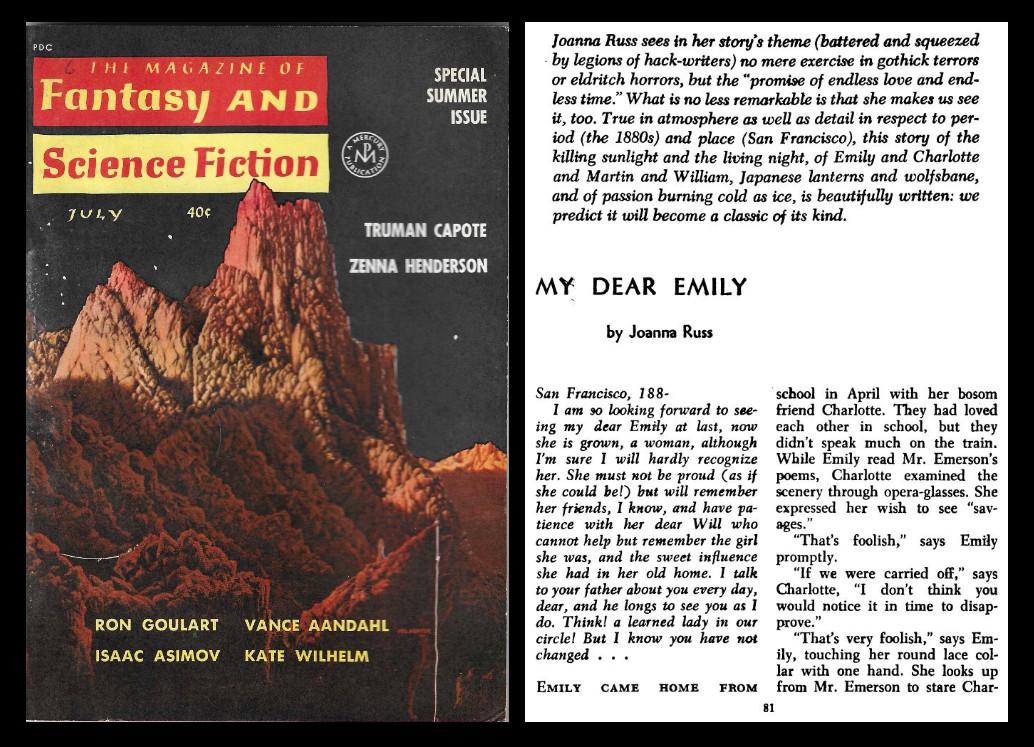
The second story up is “My Dear Emily” by Joanna Russ. It was first published in the July 1962 issue of The Magazine of Fantasy and Science Fiction. (You can read the story online.) F&SF provided my favorite genre magazine reading while growing up. I’m so fond of this periodical that I’ve collected an almost complete run of issues from 1949 to 1980. So, how can I be so prejudiced against fantasy?
I imprinted on science fiction when I first discovered reading. I consider science the only cognitive tool for understanding reality. Fantasy is based on magic and the love of the magical. Magic and science are polar opposites. I’ve never understood why people love fiction about beings that never existed. I will admit that science fiction is about beings that might exist, but are probably no more realistic than fantasy creatures.
My first impulse after reading “My Dear Emily” was to post this comment to the group: “Mediocre vampire story obscured by dense prose.” But would that be fair? Joanna Russ is a well-respected writer, even outside of science fiction. Within the genre, she is known for writing such classic feminist SF as The Female Man. Does “My Dear Emily” anticipate second-wave feminist themes in this 1962 story?
The story is set in 1880s San Francisco. Emily is returning from school in the east and bringing her friend Charlotte with her. Russ says, “They had loved each other in school.” Russ was a lesbian, but the story doesn’t appear to go in that direction at first, although in 1962, we might have been only expected to read between the lines. Emily and Charlotte do sleep in the same room.
Emily has returned to San Francisco to her father and Will, a man she is engaged to marry. Charlotte laughs at Emily’s endearing words about Will, and Emily wonders if God will strike her down for being a hypocrite.
However, Emily comes under the influence of Martin Guevara, a vampire. Why bring in the undead? We have the beginning of a good story with hints that Emily loves Charlotte but must marry Will in 19th-century America. My standard theory about why there are fantasy elements in literary stories is that it was easier to sell to genre magazines than get published in literary magazines. Literary magazines paid in free copies, but were usually a dead end for a story. “My Dear Emily” has been frequently reprinted in genre anthologies, earning additional payments and readers. In other words, would-be writers had a strong incentive to add fantasy or science-fictional elements to their stories.
Would I even be writing this essay, or have read “My Dear Emily,” if it hadn’t had a vampire in it? However, does Joanna Russ intend Martin Guevara to be meaningful in this story or just an in with the editor at F&SF?
Martin Guevara offers to get Emily out of her engagement to Will, but he exerts power over Emily, taking physical control of her. Emily already seems to know that Martin is a vampire. Did she know him before she left for school? And she leaves her house and finds me. How did she know where he lived?
On my second reading, this story seemed less murky, but it suggests things that aren’t explained. Emily tries to kill Martin with a silver cross, but he isn’t vulnerable to the power of that symbol. In fact, he isn’t affected by several of the classic defenses used against vampires. Martin tells Emily, “We’re a passion!” about his kind, and “Life is passion. Desire makes life.” He says desire lives when nothing else does.
The story becomes more about vampirism. But is it really? Russ’s prose is far from explicit. Is the story a vampire fantasy or one of lesbian liberation? Are Will and Martin two poles of masculine power?
This story did not need a vampire. But to get published in F&SF, it did. Fantasy obscured the real intent of this tale.
Why does pop culture love the undead? Do they really add anything valuable to fiction? Or, are they just popular stock characters? At best, they might be symbolic, but isn’t that symbolism usually ignored?
JWH
 Auxiliary Memory
Arthur C. Clarke is quoted as saying “any sufficiently advanced technology is indistinguishable from magic.”
I just read an 8-book series of modern “vampire” fiction that explains vampirism and vampires as a poorly understood race of over-powered humans. Likewise Were-people & magicians. They’re all base-model humans with some additional ability to use power in ways the base model cannot under normal circumstances.
Most of early Science Fiction was more like science fantasy. Add a bit of quantum physics, or steam power, or space ships… Still is, really. Mark Henwick is the author I mentioned, Athanate are the vampires. But not exactly. They do drink blood, and can convert some people to be like them, and crucifixes & garlic have no effect.
I quit smoking, as a teen, to let me keep buying books. I’m a month or so past my 70th birthday now.
Yeah, a lot of far future science fiction feels more like epic fantasy than speculation.
In Bram Stoker’s Dracula, vampires are pure evil. They work for the devil. Over time, vampires have been secularized. Now they are the objects of romance fantasies. It’s interesting that vampires have aspects that people used to consider features of gods. Fantasies about vampires might be wishes to be God like.
Doesn’t vampirism offer an alternate route to resurrection that contends with Christianity’s route?
And Anne Rice made vampires about sex.
Fred Saberhagen did some vampire stories specifically about Dracula. Sex was involved, but his Dracula was a 14th Century nobelman with a very strong sense of honor. Strong enough to keep him from dying when anyone else would have. Becoming a vampire because his will was stronger than death, despite his body having been damaged to badly to live. Talk about a strong character!
But vampirism isn’t an alternative to resurrection. Though it does sidestep death. Saberhagen explored that more than a bit. I got the impression from his works that, for some particularly blessed folks that weren’t potential saints, that it might get them more time to find salvation. I’ve never read the “sparklely” vampire stories. I have seen just enough weirdness in my life that I don’t believe the conventional wisdom is completely accurate. I liked Saberhagen’s Dracula. And know just enough of historical world events from his lifetime that it was not hard to suspend disbelief for a bit.
PARANORMAL activity I’ve seen some hints of. Friend of mine over 40 years ago could hold an object, and tell you a little of it’s history. I dropped a fighting knife in her hand one day. She turned sheet white, and dropped the knife. Told me someone killed someone else with it, or tried to. Don’t know about anyone actually killed with that knife, but a guy who was late back from a pass in the years after the Korean war tried to stab my dad with it when he was pulling sentry duty during a stint in the Calidfirnia Army National Guard. Dad took and kept it.
Had my high school geology teacher tell me that dowsing didn’t work, too. This was the week after my dad showed me how to do it. I’ve used it multiple times over the intervening years to find pipes and water underground, using pieces of bent coat hanger wire. Seems to me there should be a way to detect magnetic fields or something. Once you have a good explanation it’s science. Until then, it’s a mystery. And those events may or may not be related. We still know almost nothing about the human brain. It was only a bit more than a century ago that it was possible for a man to know all of what passed for science in those days.
Ah Jim – I too had a prejudice against vampire stuff – undead stuff – fantasy stuff. Then (because of a reading group) I came across a book which made me nervous but sucked me in. It became more like reasonable literature and I rather enjoyed it. This was back in 2015 so my whole review isn’t there now but there are plenty around the ‘net. The plot line had a vampire (or some such thing) move into the home of a typical suburban family. Word got out and the news got ahold of that and went for it – interviews and all. It was pretty good.
But before that, in 2000, there was a book, a debut novel called House of Leaves. https://en.wikipedia.org/wiki/House_of_Leaves
The book is most often described as a horror story, though the author has also endorsed readers’ interpretation of it as a love story.[3] House of Leaves has also been described as an encyclopedic novel,[4] or conversely a satire of academia.”
And I will always enjoy Henry James’ The Turn of the Screw!
We Have Always Lived In the Castle by Shirley Jackson is another of the greats.
I know all those aren’t truly “vampire” novels the way Ann Rice made them famous. I think they’re so popular because they’re basically young adult level (I may be totally wrong there) and young adult readers (including 45-year old high school teachers who like those books) like. Plot-driven fiction with well defined characters and simpler themes.
https://en.wikipedia.org/wiki/A_Head_Full_of_Ghosts
Ghost stories have their own tradition in the US (in ALL of the Americas!) from Rip Van Winkle to Gabriel Garcia Marquez. (In fact, virtually all cultures have something like a ghost or vampire stories.)
And this kind of thing (vampires in particular) lend themselves to buckets of symbolism and allegory and so on – so the lit’rary type readers tend to enjoy them.
While true “folk songs” about vampires are not a widespread genre, there are songs inspired by vampire folklore across various musical styles, including some with roots in folk music traditions. Some songs incorporate elements of folk music themes or instrumentation, even if they aren’t strictly classified as folk songs.
Here’s a breakdown of relevant songs and musical styles:
Songs with Vampire Themes:
Important Considerations
Many songs that explore vampire themes blend elements from various genres, including rock, metal, and even orchestral music, making it difficult to categorize them neatly as “folk songs”.
While the term “folk song” might be restrictive, vampire lore has long been present in traditional storytelling and music from many cultures, including Celtic, Slavic, and other European traditions.
Modern artists often draw inspiration from these folk traditions when creating songs with vampire themes, but the result is often a fusion of old and new musical styles.
Ah Jim – I too had a prejudice against vampire stuff – undead stuff – fantasy stuff. Then (because of a reading group) I came across a book which made me nervous but sucked me in. It became more like reasonable literature and I rather enjoyed it. This was back in 2015 so my whole review isn’t there now but there are plenty around the ‘net. The plot line had a vampire (or some such thing) move into the home of a typical suburban family. Word got out and the news got ahold of that and went for it – interviews and all. It was pretty good.
But before that, in 2000, there was a book, a debut novel called House of Leaves https://en.wikipedia.org/wiki/A_Head_Full_of_Ghosts
“House of Leaves” – “The book is most often described as a horror story, though the author has also endorsed readers’ interpretation of it as a love story.[3] House of Leaves has also been described as an encyclopedic novel,[4] or conversely a satire of academia.” https://en.wikipedia.org/wiki/House_of_Leaves
And I will always enjoy Henry James’ We Have Always Lived In the Castle -by Shirley Jackson.
I know those aren’t truly “vampire” novels the way Ann Rice made them famous. I think they’re so popular because they’re basically young adult level (I may be totally wrong there) and young adult readers (including 45-year old high school teachers who like those books).
I normally would not like vampire stories or movies either but I ran across a series on Netflix called The discovery of Witches, that I fallen in love with. Of course that could be because I really like the main actor, but seriously it’s a love story and the underlying theme is vampires, witches, and Demons living in the modern world should all be able to get along and live in harmony. There is also some time travel. It’s a search for their early roots that proves they were all related at some point back in time.
The acting is great. The scenery is beautiful. The music is good and I’m thoroughly enjoying it. Might not be everyone’s cup of tea, but for some reason I fell for it.
I think that’s based on a bestselling book. I’ll check it out when I resubscribe to Netflix.