
by James Wallace Harris, 2/15/25
At 73 I’m starting to feel I’m running out of time. I keep having this nagging thought I should have done something, or should be doing something before time runs out. But what? I am immensely grateful for existing but was I supposed to do something while I am or was here? Would knowing who I was explain what I was? Would knowing when and where I was explain how and why I got here? And would knowing all those answers reveal my existential duties?
I just finished reading Orbital by Samatha Harvey which recently won the 2024 Booker Prize. Orbital is the kind of novel that inspires the questions above.
The story is set a few years hence on the International Space Station just as we’re sending astronauts to the Moon again. The book doesn’t have a plot but is a beautiful description of working in space. Harvey’s novel concludes by conveying a tremendous sense of wonder inspired by Carl Sagan’s Cosmic Calendar (large version). The Cosmic Calendar compares the timeline of the universe to one year. Everything since the Scientific Revolution would have happened in the last second of the Cosmic Calendar.
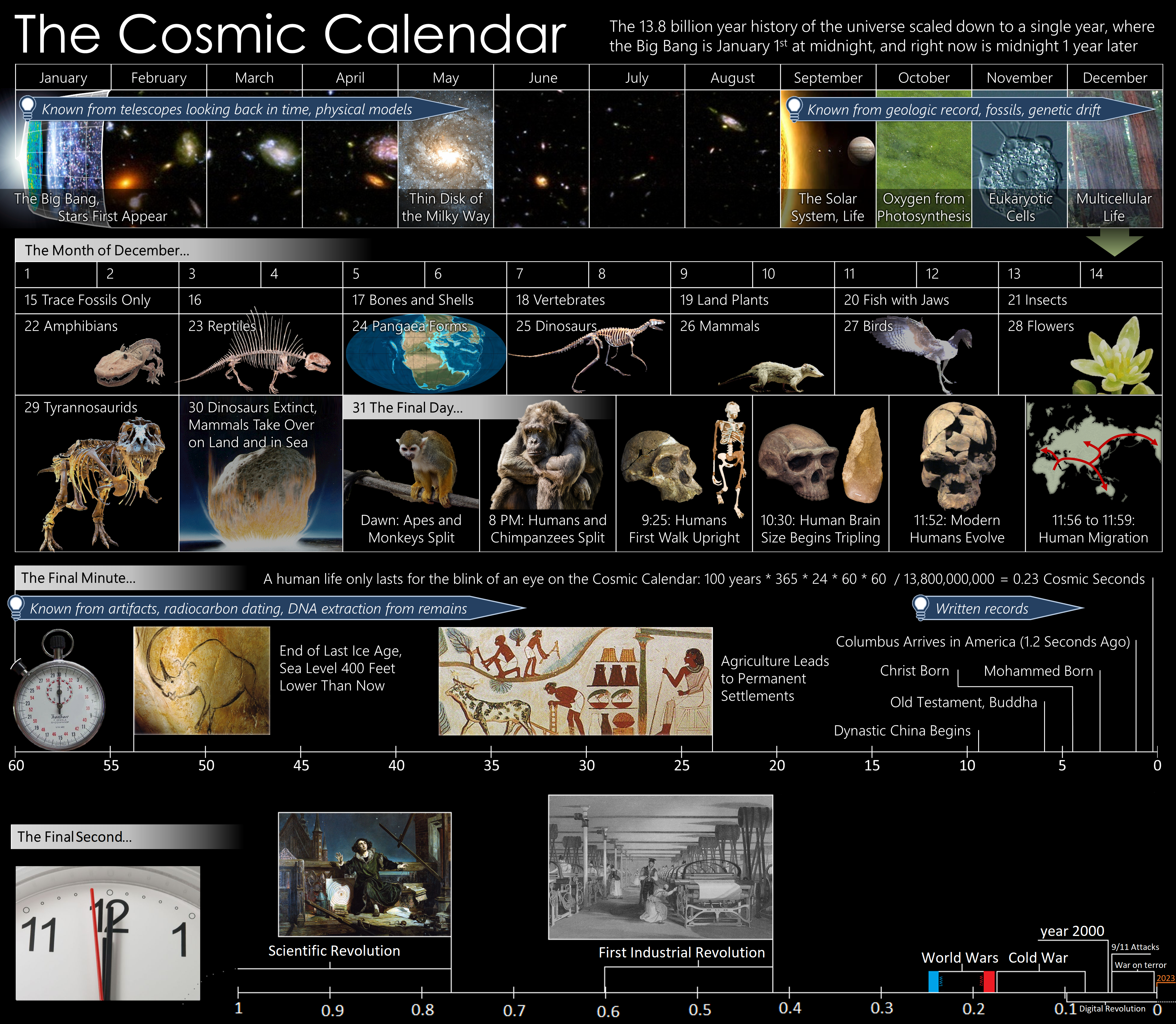
The Cosmic Calendar is a beautiful metaphor to contemplate ontology. How did we get here? There are two main theories. God implies a top-down creation. Evolution suggests a bottom-up development. Each has its paradox. Who created God? Or, how did something come from nothing? Studying cosmology makes it hard to believe in God. How could a single being create all that vastness? What if the universe is God? That’s pantheism. It makes God equal to Evolution but leaves us still with the problem of how things started.
The Cosmic Calendar answers for When.
But do we really need to know how things got started? Shouldn’t we just ask: What is our place in the universe? Scientists are now theorizing that we might exist in a multiverse. In other words, no matter how large we look into the cosmos, there’s always more. On the other hand, no matter how small we look into the subatomic, there’s always something smaller. This is beautifully illustrated by the famous Charles and Ray Eames video of The Powers of Ten from 1977.
The Powers of Ten answers for Where. More importantly, it reveals there are many domains. We might observe the cosmos or even the domain of the atom or quantum, but do they matter to who we are and what we should be doing? Shouldn’t our domain be a hundred meters?
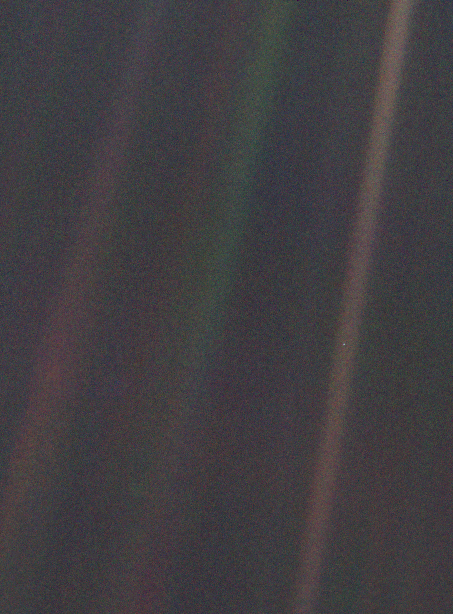
Carl Sagan wrote a book The Pale Blue Dot based on a photograph of Earth taken by Voyager 1 while it passed Saturn. If you look closely, you will see a blue dot. That’s Earth. It’s hard to think we’re significant to the universe. Then think about the Milky Way as seen from the edge of the universe. It wouldn’t be visible at all. It’s beyond conceivable to imagine how small we are compared to all of existence. How can we be significant? How can we have a purpose?
It’s important to think of ourselves relative to the domain in which we live. Many people are depressed by watching the news but isn’t the domain of the Earth too big for one person? Isn’t it ego and delusion to think our purpose could be to organize a nation, city, or even something as small as a neighborhood? I have trouble keeping my house and yard in order.
Lately, I’ve been working in the yard. After fifteen years of neglect, the backyard is overrun with tangled wild growth. Every day I spend a little time trying to conquer my tiny plot of wilderness. At 73, that effort pushes the limits of my physical abilities. I use most of the energy I have left keeping the house somewhat neat. It’s not really clean. I also must spend precious vitality on personal finances, shopping, and general living and maintenance.
Yet, I keep thinking I should be doing something more. I’m not sure what. Maybe it’s having a purpose or making my mark in a small way. This would answer the question of who. And maybe why.
I’ve been using Ancestry.com and learning about genealogy. What did my parents expect of me? What did my grandparents expect of their grandchildren? I have thirty-two ancestors if I go back five generations. Did they expect anything? At most, they expected me to keep the gene line going. Well, that’s where I’ve failed.
I recently read Parable of the Sower by Octavia E. Butler. The story is about the United States suffering an economic apocalypse. The main character felt the need to have a purpose in life, even when everything bad was happening. She decided God was change and our purpose was to affect God/change. That’s a kind of pantheism. What if existence is just trying to become everything that could possibly exist?
Under Butler’s theory, my purpose is to shape myself. To constantly change. Well, I’ve certainly been doing that my whole life.
Right now I’m working on changing myself, my relationships, my house, and my yard. Mother nature was changing the way it wanted the yard. It might seem pointless, but wrestling control from Mother Nature and changing the yard into what I want does give me existential purpose. It’s essentially meaningless in the long run. But maybe our purposes should be limited to a time and place. To a domain. Think small.
I can change myself somewhat. I can change my house and yard. Somewhat. But I can’t change other people. Or anything larger in life.
Maybe that explains how and why.
JWH
 Auxiliary Memory
.png)
to paraphrase r. crumb (by way of mr. natural): whatever’s happened keeps right on happening,no matter what! and if you think that’s simple, i certainly am.
Powers of ten! Fascinating video…I’ve always wondered about all those things. The big one being why is there anything at all? My only thought on that is that nothingness is an impossible state and because of that, there’s an unbelievable amount of stuff and probably always will be in some form or another..
I’ve always thought there should have been nothing. But because it wasn’t, then nothing is impossible.
Jim, I am about two decades behind you, but as far back as my memory goes, I’ve had “this nagging thought I should have done something, or should be doing something before time runs out.” It crops up frequently for me when I read about someone like John Quincy Adams, who, by the time he was my age had served in the Massachusetts Senate, as a U.S. Senator for the state of Massachusetts, as Minister to the Netherlands, Minster to Prussia, Minister to Russia, Minister to the United Kingdom, and while at about age was halfway through his term as Secretary of State — all of this, of course, preceding his term as President of the United States and the seventeen years he spent as a member of the House of Representatives after that. It makes me feel downright lazy.
I know. Some people can do so much and I’ve done so little. I guess I never learned to focus and apply myself.
at second glance, the cosmic calendar puts me in mind of the chronological charts that olaf stapledon employed as an epilog (epitaph?) to a novel titled LAST AND FIRST MEN. anyone else out there familiar with it.
I’ve read LAST AND FIRST MEN but I’ve forgotten the epilog. I’ll have to reread it. I should reread the whole book. Have you read STAR MAKER by Stapledon?
Zen teaching says that the frustration we feel when we desire to change things: that is suffering. All experience is evidence of consciousness: and we cannot change consciousness. It just is.
and in the words of the late and lamented patrick sky: and some have had a dream of making man more civilised/ but that is just a simple waste of time/ for man just comes and goes.
That’s a good quote.